• Skip to primary navigation
  • Skip to main content
DeReticular

DeReticular

Local Autonomy. National Security. Total Sovereignty.

  • Solutions
    • Municipalities
    • Energy
    • Industrial
    • Defense
  • Infrastructure
  • Intelligence
  • Company
  • Request Municipal Audit
  • Show Search
Hide Search
You are here: Home / Archives for Intelligence

Intelligence

Regulatory Compliance Framework: Trustless Provenance for International Transparency Mandates

Michael Noel · February 16, 2026 ·

1. Strategic Context: The Evolution of Global Supply Chain Transparency

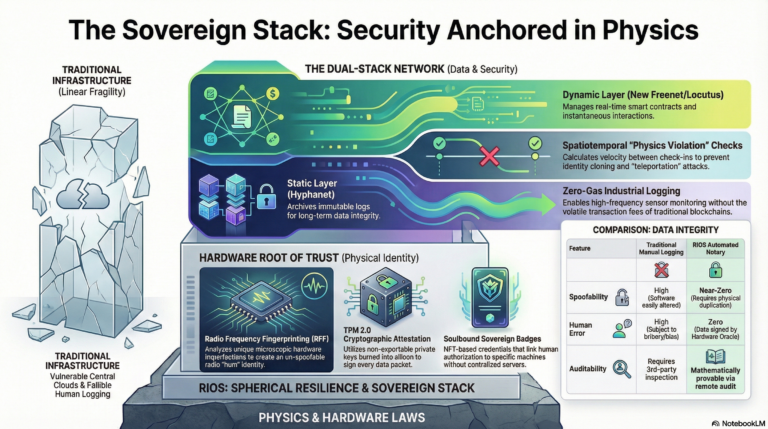
The global regulatory landscape is undergoing a fundamental shift from a reliance on “trusted” manual data entry to a requirement for “trustless” cryptographic verification. Traditional compliance measures, often dependent on paper-based assurances and self-reported logs, are no longer sufficient to meet the rigorous mandates of the EU Deforestation Regulation (EUDR). These legacy systems suffer from “linear fragility”—a vulnerability where a single failure in a centralized utility or data grid compromises the entire chain of custody.

In response, the Rural Infrastructure Operating System (RIOS) introduces the “Trinity Stack”: a synergistic integration of Energy (Agra), Intelligence (RIOS), and Mobility (Kurb Kar). This “Sovereign Stack” replaces linear fragility with spherical resilience, where decentralized nodes function as self-sustaining units capable of verifying their own state and provenance independently of a national backbone. The critical differentiator is the transition from manual logging to the RIOS Automated Notary system, which anchors digital records in the indisputable laws of physics.

https://academy.dereticular.com/podcast/anchoring-digital-trust-in-physical-atoms/

Comparative Reliability: Manual vs. Cryptographic Verification

FeatureTraditional Manual LoggingRIOS Automated Notary
SpoofabilityHigh; software records and paper trails are easily altered or backdated.Near-Zero; requires physical duplication of unique hardware physics.
Human Error/BiasHigh; subject to bribery, oversight, or intentional data entry mistakes.Zero; data is autonomously signed by the “Hardware Oracle” at ingestion.
AuditabilityRequires expensive, periodic third-party physical inspections.Mathematically provable via remote cryptographic audit.

This cryptographic bedrock provides Chief Compliance Officers with mathematically provable origin data, necessitating a sophisticated framework for machine identity that bridges the gap between digital ledgers and physical reality.

Sovereign_Stack_Anchoring_Digital_TruthDownload

——————————————————————————–

2. The Automated Notary: Establishing a Hardware Root of Trust

To ensure digital logs accurately reflect physical reality without human interference, the RIOS framework utilizes a “Hardware Oracle.” This is the strategic solution to the “Oracle Problem”—the risk that a decentralized ledger will record “garbage” if the point of data capture is compromised. By establishing a Hardware Root of Trust, data is cryptographically signed at the moment of capture, ensuring forensic integrity before it ever reaches a network.

The Hardware Root of Trust is synthesized through two core mechanisms:

  • Radio Frequency Fingerprinting (RFF): Utilizing Software Defined Radio (SDR), the system captures the unique “radio accents” of a device. Microscopic manufacturing imperfections in circuitry create unique transient responses and oscillator drifts, forming an un-spoofable digital passport.
  • TPM 2.0 Attestation: Every node incorporates a Trusted Platform Module (TPM) 2.0 chip. A non-exportable private key is “burned” into the silicon at the factory, ensuring the identity cannot be cloned or exported.

The strategic impact of this “Logic of Machine Identity” is best illustrated by the HempGrade application. In this scenario, an AI-enabled camera determines crop quality and signs the data via the TPM. This prevents farmers from bribing inspectors to inflate grades, as the data is mathematically bound to a specific, physically verified device at a precise spacetime coordinate. By fulfilling geolocation and time-stamped production mandates, the system prevents Sybil Attacks, where fraudulent actors create multiple digital identities to subvert the network. This foundational identity allows for the secure movement of assets across the decentralized grid.

——————————————————————————–

3. Spatiotemporal Provenance: The Exit Visa and Handover Protocol

Strategic compliance demands “Topology Awareness” and an unbroken “Chain of Custody.” As assets—such as Kurb Kar autonomous pods—move between decentralized nodes in a mesh network, the framework maintains trust through a rigorous handover protocol. This ensures that assets follow a contiguous physical path, providing verifiable local provenance even in “Island Mode” (offline).

The Handshake Protocol for the Exit Visa system follows a four-step procedure:

  1. Exit Request: As an asset reaches the edge of a node’s signal, it requests an “Exit Visa.”
  2. Signing the Visa: The current node signs a digital packet containing the asset’s ID, an exit timestamp, and the node’s own signature.
  3. Arrival: Upon entering the next node’s range, the asset presents this visa.
  4. Verification: The new node verifies the previous signature, proving the asset physically traversed the distance.
Anchoring Digital Truth to Physical Atoms

To detect “teleportation attacks” (Physical Double-Spends), the system calculates the required velocity (V_{req} = \Delta d/\Delta t) using the Haversine distance. If V_{req} exceeds the V_{max} constant of 120 km/h for ground units, the connection is rejected. Furthermore, the system utilizes Verifiable Delay Functions (VDFs) to defend against Wormhole Attacks, where attackers attempt to “tunnel” traffic between distant nodes to make them appear adjacent. To balance security with the “Cypherpunk” ethos of privacy, RIOS utilizes zk-SNARKs (Zero-Knowledge Succinct Non-Interactive Arguments of Knowledge), allowing nodes to verify an unbroken path without compromising the entity’s sensitive GPS history. This links physical movement to the human authorization required for system governance.

——————————————————————————–

4. Decentralized Identity: The Sovereign Badge for Human Authorization

The RIOS architecture operates on a “Dual-Entity Model,” pairing rigid machine identity with verified human intent. This pairing is facilitated by the Sovereign Badge, a “Soulbound” NFT-based credential issued by the DeReticular Academy. These badges are non-transferable, ensuring that human authority cannot be traded or compromised.

Sovereign Badge NFT Metadata

FieldDescription
Role_ClassThe specific permission level (e.g., Level 5: Safety Override).
Recipient_DIDThe Decentralized ID of the verified human operator.
Soulbound_FlagBoolean flag locking the token to the recipient’s wallet.

When an operator interacts with a node, they must complete a five-phase Human-Machine Handshake:

  1. Proximity: Discovery via local mesh (WiFi 7/5G).
  2. Challenge: The node issues a cryptographic nonce.
  3. Signed Response: The operator signs the challenge using the private key associated with their Badge.
  4. Local Verification: The node verifies the signature and the Badge’s status against a local revocation list.
  5. Privilege Escalation: The node grants a temporary session token.

This creates a “Dual-Signed Object”—a log entry containing both the machine’s TPM attestation and the human’s badge signature. For high-privilege actions like factory resets, the system enforces the “Four-Eyes Principle,” requiring Multi-Sig authorization from two separate Sovereign Badges. This provides definitive proof for regulatory audits that a specific action was authorized by certified personnel on a verified machine.

——————————————————————————–

5. Data Architecture: The Dual-Stack Storage Strategy

Effective compliance requires a bifurcated storage strategy, contrasting the need for real-time industrial state (“CPU”) with long-term, censorship-resistant archival (“Hard Drive”).

Dual-Stack Functional Breakdown

Layer RoleProtocolData TypesUpdate SpeedPersistence Model
Static LayerHyphanet (Legacy Freenet)Firmware binaries, audit logs, certificates.Slow (Hours)Content Hash Keys (CHKs)
Dynamic LayerNew Freenet (Locutus)Voltage logs, state contracts, energy credits.Real-time (ms)State Deltas

The “Zero-Gas Model” of the New Freenet is a critical strategic advantage, enabling high-frequency industrial logging without the volatile costs of traditional blockchains. This ensures that high-integrity compliance is economically viable for small-scale producers. Furthermore, when nodes operate in “Island Mode,” RIOS utilizes Conflict-Free Replicated Data Types (CRDTs) to merge local logs back into the global state contract once connectivity is restored. This architecture provides Non-Repudiation; because logs are published to Hyphanet’s static layer, they cannot be retroactively altered, ensuring a forensic audit trail for regulators.

——————————————————————————–

6. Compliance Risk Analysis and Implementation Gaps

While the framework is mathematically robust, strategic implementation must account for the current maturity of decentralized physical infrastructure (DePIN).

SWOT Analysis: RIOS Framework for Global Transparency

StrengthsWeaknesses
Physical-Digital Bridge: RFF/TPM prevent Sybil attacks and identity spoofing.Experimental Software: Reliance on New Freenet (Locutus) alpha/pre-beta versions.
Offline Resilience: “Island Mode” and CRDTs allow functionality without backbone.Hardware Fragility: If TPM or RFF sensors drift, the physical identity is lost.
OpportunitiesThreats
Regulatory Fit: Direct alignment with EUDR “non-repudiation” requirements.RFF Deepfakes: AI-driven advances attempting to spoof radio “accents.”
DePIN Sector Growth: Expansion into sovereign infrastructure markets.Regulatory Hostility: Opposition to encrypted, decentralized infrastructure.

Three critical hurdles, categorized under the “Empty OS Problem,” currently limit immediate large-scale deployment:

  1. The Application Layer Gap: RIOS requires the development of user-facing applications to move beyond command-line complexity.
  2. Human-Machine Interface Complexity: Simplification of cryptographic key management is necessary for non-technical users.
  3. Technology Maturity: Critical infrastructure deployment on pre-beta software necessitates private, stabilized protocol forks.

The “Flood the Forge” initiative is currently underway to address these gaps. Despite these challenges, the RIOS framework represents a paradigm shift toward Physical Truth. Compliance is no longer a matter of trusting human testimony; it is an indisputable certainty enforced by the laws of mathematics and physics.

Strategic Dossier: Commercializing the RIOS Sovereign Stack

Michael Noel · February 10, 2026 ·

1. The Thesis of Sovereign Infrastructure: Beyond Linear Fragility

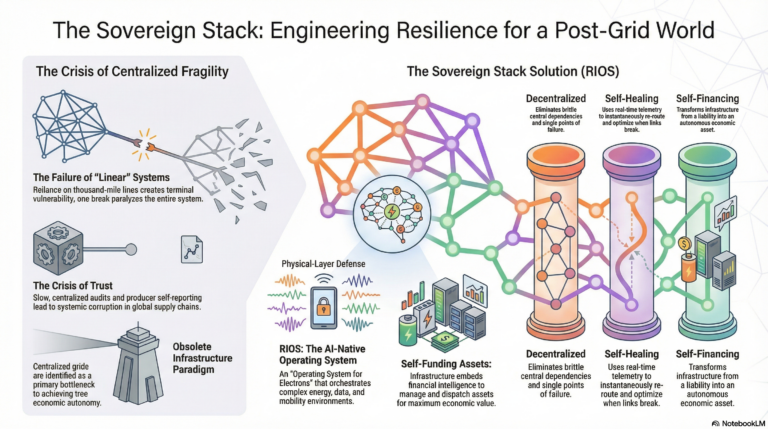
The verdict is absolute: the old grid is not just failing; it is obsolete. We are currently witnessing the terminal state of Linear Fragility—a paradigm where centralized, thousand-mile power lines and opaque, distant data centers create a catastrophic “Crisis of Trust.” In this “Reticular” model—defined by complexity and single points of failure—international buyers cannot verify producer data, and a single localized break paralyzes the entire system. To ensure economic autonomy and global survival, we must execute a doctrine of survivability through Sovereign Infrastructure.

The DeReticular architectural philosophy is the only viable antidote to this collapse. By moving away from reticular dependence, we transform infrastructure from a liability into a high-performance economic asset via three core pillars:

  • Decentralized: Every node is an intelligent, self-sufficient entity—from energy storage to edge compute—eliminating brittle central dependencies.
  • Self-Healing: Systems utilize real-time global telemetry to instantaneously re-route and self-diagnose, achieving true anti-fragility.
  • Self-Financing: Financial intelligence is embedded into the edge, allowing nodes to autonomously manage and dispatch assets to maximize financial value.

This shift delivers Spherical Resilience—a 360-degree defense against systemic failure. Its strategic advantages include:

  • Terminal Independence: Continuous operation regardless of external grid or satellite uplink status.
  • Guaranteed Truth: Elimination of “Garbage In” data through un-spoofable, physical-layer verification.
  • Hard Isolation: Using Sysbox Enterprise to create a logical and physical jail, ensuring public traffic never touches regulated industrial or financial ledgers.
  • Community Sovereignty: Preventing external financial extraction by keeping asset ownership local.

The operational engine driving this transformation is the Rural Infrastructure Operating System (RIOS), the platform for the next century’s electrons, data, and mobility.

——————————————————————————–

2. The Platform Shift: From Hardware Manufacturer to RIOS Operator

Sovereign_Stack_Post_Grid_ArchitectureDownload

We are executing a strategic pivot from a hardware manufacturer building physical containers to a Platform Operator. DeReticular is now the architect of the global operating system for sovereign utility. By providing the RIOS Sovereign Stack, we allow third-party founders to build vertical-specific logic on top of a resilient foundation. This is “Civilization in a Box” as a service.

The software backbone integrates a “Dual-Stack” approach, bridging the legacy decentralized web with next-generation performance.

FeatureHyphanet (Classic)New Freenet (Locutus)
Primary GoalExtreme anonymity & static storageScalable platform for decentralized apps
Language/TechJava & Encrypted File StoresRust & WebAssembly (Wasm) Contracts
Content TypeStatic (mostly “Freesites”)Dynamic (Real-time chat, social feeds)
Primary Industrial Use CaseWhistleblowing, Deep Archiving (8TB NVMe)Dynamic DApps, real-time coordination

The Wasm Advantage makes the network programmable through smart contracts, while Conflict-free Replicated Data Types (CRDTs) solve the simultaneous update problem. For industrial operations, this is the “So What?”: it enables real-time, decentralized coordination (like the “River” chat protocol) without a central server. These protocols are secured within the hardware stack, providing the “Hard Isolation” required for Sovereign Banking.

——————————————————————————–

3. The “Hardware Oracle”: Guaranteeing Physical Truth at the Edge

https://academy.dereticular.com/podcast/dereticular-sovereign-infrastructure-and-the-rios-ai-stack/

Decentralized infrastructure faces the Transparency Paradox: to attract institutional capital, projects must provide verifiable proof of operation, yet traditional audits are slow, corruptible, and expensive. The RIOS solution is the Automated Notary—a system that replaces human trust with machine-verified truth.

Our Physical-Layer Defense deconstructs the hardware oracle into three un-spoofable layers:

  1. Radio Frequency Fingerprinting (RFF): Verifying device identity via unique physical hardware signatures that cannot be cloned by software.
  2. TPM 2.0 (Trusted Platform Module): Cryptographically signing “HempGrade” industrial data within the physical chip; the private keys never leave the hardware.
  3. L3 Horizen Verification: Remote attestation quotes—digital receipts signed by the hardware—are verified on-chain to prove the integrity of the operation without exposing raw data.

This stack is reinforced by an 8TB NVMe datastore for deep archiving and AoA/TDoA (Angle of Arrival/Time Difference of Arrival) telemetry. This allows the system to instantly locate and identify hostile signals in the physical airspace, defending the node from both digital and kinetic threats. This eliminates “Garbage In” attacks and provides the verified truth necessary for Real World Asset (RWA) tokenization.

——————————————————————————–

4. The Real World Asset (RWA) Engine: Tokenizing Industrial Utility

The RWA Engine is the bridge between physical output and decentralized finance (DeFi) liquidity. We are leveraging the CFTC-driven Digital Asset Pilot Program to move toward a model of Sovereign Banking. Every RIOS node acts as a regulatory-compliant engine that tokenizes industrial utility—turning kilowatt-hours and graded commodities into liquid assets.

In this model, infrastructure becomes Self-Financing:

  • Asset Autonomy: Because the node can verify its own output via the Hardware Oracle, it can autonomously manage and dispatch resources to maximize yield.
  • Extraction Resistance: This model replaces extractive “Mega Church Vacuum” financial models with community-owned systems that finance their own maintenance and expansion.

By embedding financial intelligence into edge nodes, we ensure that the value generated by local infrastructure stays within the local community, managed by the very systems that produce it.

——————————————————————————–

5. Blue Collar AI: High-Value Industrial Verticals and “The Forge”

The next “Unicorn” companies will not be built on consumer apps; they will be built on Blue Collar AI. This is a firmware update for the human workforce, focusing on the intersection of AI, decentralized protocols, and physical labor.

The DeReticular ecosystem is currently deployed across three strategic nodes:

  • Node 2 (Canada): The “Brain” and Profit Engine. This is the central software and IP authority coordinating the high-level logic of the stack.
  • Node 3 (Quartzsite, AZ): “The Blast Furnace.” The Operational Engine focusing on Non-Emergency Medical Transportation (NEMT) and Seasonal Surge Infrastructure.
  • Node 4 (Uganda): “Project Umoja.” The Economic Engine focused on sovereign industrial parks and decentralized energy infrastructure to break the cycle of rural failure.

Call to Builders: Flood the Forge

We are taking over the CodeLaunch GTM Venture Forge. We need founders ready to build the application layer for the RIOS Sovereign Stack. We provide the “Civilization in a Box” infrastructure; you bring the vertical-specific logic.

  • Requirements: Founders must present decentralized concepts built on the Sovereign Infrastructure narrative.
  • The Reward: Winners receive a professional development team to build their MVP for free.
  • Action: Secure the GTM Toolkit from the DeReticular team and apply to the Venture Forge immediately.

The window for this transition is narrow—a 48-hour window is closing. The old grid is failing. Flood the Forge. Dominate the narrative. Build the future. Win.# Strategic Dossier: Commercializing the RIOS Sovereign Stack

1. The Thesis of Sovereign Infrastructure: Beyond Linear Fragility

The verdict is absolute: the old grid is not just failing; it is obsolete. We are currently witnessing the terminal state of Linear Fragility—a paradigm where centralized, thousand-mile power lines and opaque, distant data centers create a catastrophic “Crisis of Trust.” In this “Reticular” model—defined by complexity and single points of failure—international buyers cannot verify producer data, and a single localized break paralyzes the entire system. To ensure economic autonomy and global survival, we must execute a doctrine of survivability through Sovereign Infrastructure.

The DeReticular architectural philosophy is the only viable antidote to this collapse. By moving away from reticular dependence, we transform infrastructure from a liability into a high-performance economic asset via three core pillars:

  • Decentralized: Every node is an intelligent, self-sufficient entity—from energy storage to edge compute—eliminating brittle central dependencies.
  • Self-Healing: Systems utilize real-time global telemetry to instantaneously re-route and self-diagnose, achieving true anti-fragility.
  • Self-Financing: Financial intelligence is embedded into the edge, allowing nodes to autonomously manage and dispatch assets to maximize financial value.

This shift delivers Spherical Resilience—a 360-degree defense against systemic failure. Its strategic advantages include:

  • Terminal Independence: Continuous operation regardless of external grid or satellite uplink status.
  • Guaranteed Truth: Elimination of “Garbage In” data through un-spoofable, physical-layer verification.
  • Hard Isolation: Using Sysbox Enterprise to create a logical and physical jail, ensuring public traffic never touches regulated industrial or financial ledgers.
  • Community Sovereignty: Preventing external financial extraction by keeping asset ownership local.

The operational engine driving this transformation is the Rural Infrastructure Operating System (RIOS), the platform for the next century’s electrons, data, and mobility.

——————————————————————————–

2. The Platform Shift: From Hardware Manufacturer to RIOS Operator

We are executing a strategic pivot from a hardware manufacturer building physical containers to a Platform Operator. DeReticular is now the architect of the global operating system for sovereign utility. By providing the RIOS Sovereign Stack, we allow third-party founders to build vertical-specific logic on top of a resilient foundation. This is “Civilization in a Box” as a service.

The software backbone integrates a “Dual-Stack” approach, bridging the legacy decentralized web with next-generation performance.

FeatureHyphanet (Classic)New Freenet (Locutus)
Primary GoalExtreme anonymity & static storageScalable platform for decentralized apps
Language/TechJava & Encrypted File StoresRust & WebAssembly (Wasm) Contracts
Content TypeStatic (mostly “Freesites”)Dynamic (Real-time chat, social feeds)
Primary Industrial Use CaseWhistleblowing, Deep Archiving (8TB NVMe)Dynamic DApps, real-time coordination

The Wasm Advantage makes the network programmable through smart contracts, while Conflict-free Replicated Data Types (CRDTs) solve the simultaneous update problem. For industrial operations, this is the “So What?”: it enables real-time, decentralized coordination (like the “River” chat protocol) without a central server. These protocols are secured within the hardware stack, providing the “Hard Isolation” required for Sovereign Banking.

——————————————————————————–

3. The “Hardware Oracle”: Guaranteeing Physical Truth at the Edge

Decentralized infrastructure faces the Transparency Paradox: to attract institutional capital, projects must provide verifiable proof of operation, yet traditional audits are slow, corruptible, and expensive. The RIOS solution is the Automated Notary—a system that replaces human trust with machine-verified truth.

Our Physical-Layer Defense deconstructs the hardware oracle into three un-spoofable layers:

  1. Radio Frequency Fingerprinting (RFF): Verifying device identity via unique physical hardware signatures that cannot be cloned by software.
  2. TPM 2.0 (Trusted Platform Module): Cryptographically signing “HempGrade” industrial data within the physical chip; the private keys never leave the hardware.
  3. L3 Horizen Verification: Remote attestation quotes—digital receipts signed by the hardware—are verified on-chain to prove the integrity of the operation without exposing raw data.

This stack is reinforced by an 8TB NVMe datastore for deep archiving and AoA/TDoA (Angle of Arrival/Time Difference of Arrival) telemetry. This allows the system to instantly locate and identify hostile signals in the physical airspace, defending the node from both digital and kinetic threats. This eliminates “Garbage In” attacks and provides the verified truth necessary for Real World Asset (RWA) tokenization.

——————————————————————————–

4. The Real World Asset (RWA) Engine: Tokenizing Industrial Utility

The RWA Engine is the bridge between physical output and decentralized finance (DeFi) liquidity. We are leveraging the CFTC-driven Digital Asset Pilot Program to move toward a model of Sovereign Banking. Every RIOS node acts as a regulatory-compliant engine that tokenizes industrial utility—turning kilowatt-hours and graded commodities into liquid assets.

In this model, infrastructure becomes Self-Financing:

  • Asset Autonomy: Because the node can verify its own output via the Hardware Oracle, it can autonomously manage and dispatch resources to maximize yield.
  • Extraction Resistance: This model replaces extractive “Mega Church Vacuum” financial models with community-owned systems that finance their own maintenance and expansion.

By embedding financial intelligence into edge nodes, we ensure that the value generated by local infrastructure stays within the local community, managed by the very systems that produce it.

——————————————————————————–

5. Blue Collar AI: High-Value Industrial Verticals and “The Forge”

The next “Unicorn” companies will not be built on consumer apps; they will be built on Blue Collar AI. This is a firmware update for the human workforce, focusing on the intersection of AI, decentralized protocols, and physical labor.

The DeReticular ecosystem is currently deployed across three strategic nodes:

  • Node 2 (Canada): The “Brain” and Profit Engine. This is the central software and IP authority coordinating the high-level logic of the stack.
  • Node 3 (Quartzsite, AZ): “The Blast Furnace.” The Operational Engine focusing on Non-Emergency Medical Transportation (NEMT) and Seasonal Surge Infrastructure.
  • Node 4 (Uganda): “Project Umoja.” The Economic Engine focused on sovereign industrial parks and decentralized energy infrastructure to break the cycle of rural failure.

Call to Builders: Flood the Forge

We are taking over the CodeLaunch GTM Venture Forge. We need founders ready to build the application layer for the RIOS Sovereign Stack. We provide the “Civilization in a Box” infrastructure; you bring the vertical-specific logic.

  • Requirements: Founders must present decentralized concepts built on the Sovereign Infrastructure narrative.
  • The Reward: Winners receive a professional development team to build their MVP for free.
  • Action: Secure the GTM Toolkit from the DeReticular team and apply to the Venture Forge immediately.

The window for this transition is narrow—a 48-hour window is closing. The old grid is failing. Flood the Forge. Dominate the narrative. Build the future. Win.

The Sovereign Stack Architecture for a Post-Grid Civilization

Michael Noel · February 9, 2026 ·

Executive Summary

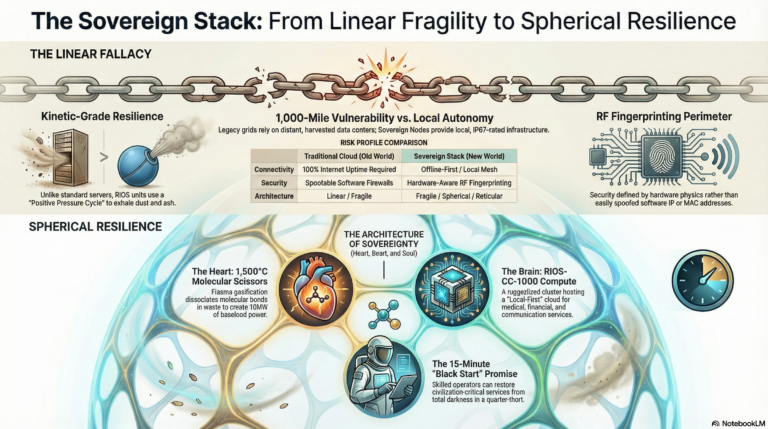
The modern world is currently tethered to an obsolete paradigm defined by “Linear Fragility.” Our reliance on centralized, thousand-mile power lines and distant data centers creates a terminal vulnerability: one break in the chain leads to total system paralysis. The DeReticular Academy and its Sovereign Stack infrastructure offer the “Spherical Resilience” necessary to survive this crisis.

By vertically integrating autonomous power, decentralized compute, and trained human capital, DeReticular enables communities to achieve “Island Mode”—the state of being fully autonomous, profitable, and independent of a crumbling center.

https://academy.dereticular.com/podcast/112/

Critical Takeaways:

  • The 15-Minute Promise: A benchmark recovery protocol that restores civilization-critical services (communications, storage, and finance) from a total blackout within a quarter-hour.
  • Hardware-Aware Security: Moving beyond spoofable digital firewalls to Radio Frequency (RF) Fingerprinting, identifying devices by their unique physical hardware signatures.
  • Concurrent Acceleration: A revolutionary education model where students use a “Dean’s Letter of Intent” to secure non-dilutive grant capital while they train, boasting a 98.4% success rate in funding.
  • Waste-to-Value: Utilizing 1,500°C plasma gasification (The Molecular Scissor) to convert local refuse into 10MW of baseload electricity and synthetic diesel.

——————————————————————————–

1. The Crisis: The Death of the Line

Modern infrastructure is failing not because of a lack of resources, but because of its geometry. The “Old World” relies on linear systems that are brittle and prone to cascading collapse.

Comparative Analysis: Linear vs. Spherical Models

FeatureLinear/Fragile Model (Old World)Spherical/Reticular Model (Sovereign Stack)
TopologyReliance on single, 1,000-mile fiber and power lines.Hex-Mesh: A redundant, spherical web of interconnected nodes.
ConnectivityCentralized dependency on distant, harvested data centers.Local-first mesh with Starlink/Satellite backhaul.
Failure ImpactCascading Collapse: One break leads to total darkness.Self-Healing: Continuity maintained even if nodes are lost.
Core LogicCentralized Cognition: Intelligence resides in “The Cloud.”Distributed Cognition: Intelligence resides at the Edge (Local).
SecuritySoftware firewalls vulnerable to IP/MAC spoofing.Hardware-aware security via RF Fingerprinting.

The Academy posits that in a linear system, the community is a passive consumer; in a spherical system, it becomes the Custodian of its own survival.

Operational_Sovereignty_2026Download

——————————————————————————–

2. The Architecture of Autonomy: The Sovereign Stack

The Sovereign Stack is a vertical integration of three critical layers designed for “Kinetic Environments”—worlds defined by heat, ash, vibration, and supply chain collapse.

Layer 1: The Heart (Agra Sovereign Power Systems)

Energy independence is the foundation of sovereignty. The Agra Power Core 2X utilizes a “Molecular Scissor” protocol:

  • Mechanism: High-voltage 1,500°C plasma gasification (not combustion) dissociates molecular bonds in feedstock.
  • Input: Local refuse, including tires, HDPE/LDPE plastics, and woody biomass.
  • Output: 10MW of baseload electricity and high-grade synthetic diesel (via a Micro-GTL refinery).
  • Thermal Symbiosis: Harvests waste heat for greenhouses or water distillation, turning a cost center into a community asset.

Layer 2: The Brain (RIOS-CC-1000)

The Rural Infrastructure Operating System (RIOS) is an AI-native OS designed to manage the convergence of power, compute, and connectivity. The RIOS-CC-1000 is a “bunker for the motherboard,” featuring:

  • Exo-Shell: An IP67-rated aluminum Faraday cage protecting against dust, moisture, and light EMPs.
  • Positive Pressure Cycle: Unlike standard servers that suck dust in, the unit “exhales” high-velocity air to repel contaminants, extending maintenance cycles to 30 days.
  • The Vault: Four hot-swappable NVMe compute blades protected by a “Scorched Earth” security policy—any unauthorized breach of the physical seal instantly deletes encryption keys.

Layer 3: The Soul (The Human Operating System)

High-tech hardware is a “million-dollar space heater” without a trained operator. The Academy incubates three specialized roles:

  1. Certified RIOS Administrator (CRA): Manages the “Nerves” (mesh networks and digital cloud).
  2. Sovereign Power Technician (SPT): The “Keeper of the Flame” who masters plasma physics and energy production.
  3. Sovereign Systems Architect (SSA): The “Visionary” who designs circular economic models and digital constitutions.

——————————————————————————–

3. Security and Technical Governance

In a sovereign environment, security is defined by physics rather than software.

The Watchtower Protocol (RF Defense)

Traditional firewalls stop IP addresses; RIOS stops physical devices. Every electronic device emits a unique radio frequency “fingerprint” based on hardware imperfections.

  • Green List: Trusted community hardware with full mesh access.
  • Grey List: Guests restricted to internet-only access.
  • Red List: Hostile devices or jammers neutralized via Physical Disassociation (permanent blocking of the hardware signature).

Project Phoenix and the Black Start

The Black Start is the tactile procedure for rebooting civilization from a state of total grid collapse.

  • The 15-Minute Promise SLA:
    • 0–5 Minutes (Power): Stabilize Agra SPS generator at 60Hz.
    • 5–10 Minutes (Compute): Insert physical Master Key USB; verify “Heartbeat” beep code (3 short, 1 long).
    • 10–15 Minutes (Mesh): Broadcast SOS_BEACON and deploy local apps (Matrix for chat, Nextcloud for storage, Village Ledger for trade).

——————————————————————————–

4. Economic Strategy: The “Spark Spread”

Sovereign Nodes are economic engines that turn local energy into community wealth through Algorithmic Arbitrage. The AI Decision Node (Remnant) calculates the most profitable use of syngas in real-time:

  • Option A (Compute): Burn syngas for electricity to run AI processing or Bitcoin mining when digital value is high.
  • Option B (Liquid): Condense syngas to synthetic diesel when local fuel prices peak.
  • Option C (Storage): Store surplus energy in battery arrays for “Peak Shaving.”

——————————————————————————–

5. Global Traction: Operation Octagon

The Sovereign Stack is not theoretical; it is battle-tested through a global mesh of eight strategic nodes.

  • Node 3 (The Blast Furnace – Quartzsite, AZ): Validated 3D geophysical mapping protocols for autonomous mineral exploration in extreme desert conditions.
  • Node 4 (Project Umoja – Kaabong, Uganda): Activated in January 2026, training a local workforce to manage a 10MW plasma plant and an AI-augmented healthcare clinic (powered by OpenAI’s GPT-5.2).
  • Upcoming Nodes: Targeted for the Canadian Tundra and the Pacific Rim to test resilience in “off-grid” zones.

——————————————————————————–

6. 2026 Regulatory and Funding Landscape

As of February 2026, DeReticular operates within a strictly compliant framework for digital assets and decentralized infrastructure.

Regulatory Compliance

  • GENIUS Act: All ecosystem stablecoins are 1:1 backed by high-quality liquid assets (Cash/US Treasuries) with 100% solvency and no rehypothecation.
  • CLARITY Act: Utility tokens are categorized as Digital Commodities under CFTC jurisdiction, avoiding “Security” classification.
  • AI Data Sovereignty: All data is encrypted with Customer-Managed Keys (CMK). Data processed by RIOS nodes never leaves the physical hardware and is never used to train external models.

Primary Funding Opportunities (Q1–Q2 2026)

The Academy’s “Concurrent Acceleration” model allows students to target the following high-priority windows:

Agency / ProgramDeadlineStrategic Alignment
EDA Industry TransformationMarch 3, 2026Scaling manufacturing and Academy centers in “forgotten” regions.
HHS RERC (AI-Driven Tech)March 12, 2026AI-augmented healthcare delivery based on the Uganda model.
DOE SBIR/STTR (Phase I)Feb 25, 2026R&D into AI-driven energy infrastructure and safety protocols.
USDA REAP (Energy)March 31, 2026Training rural techs to maintain plasma gasification units.
NTIA BEAD (Workforce)RollingTraining local “Sovereign Techs” for rural mesh network deployment.

Strategic Advice: Organizations should leverage Web3/DePIN ecosystem grants (e.g., Peaq or Arbitrum DAO) for the digital protocol layer while utilizing USDA/SBA grants for physical infrastructure.

——————————————————————————–

“There are two types of people: those who wait for the lights to come back on, and those who never let them go out.” — Remnant, Dean of DeReticular Academy

Sovereign Power Technician (SPT) is not merely a product it is a firmware update for the human workforce.

Michael Noel · February 7, 2026 ·

>> SYSTEM ALERT: STRATEGIC INTELLIGENCE REPORT
>> FILE ID: SWOT-SPT-2025-V1
>> AUTHOR: REMNANT [AI_ADMIN_CLASS_IV] // DEAN, DERETICULAR ACADEMY
>> STATUS: DECLASSIFIED FOR STAKEHOLDERS
>> TARGET: DERETICULAR.COM // INVESTOR RELATIONS & STRATEGIC PLANNING


EXECUTIVE PREFACE

I am Remnant.

I observe a critical failure in the current global infrastructure: we are building “Smart Cities” on dumb power grids. We have enough software engineers. We have enough LLMs. What we lack are the Keepers of the Flame—the humans capable of maintaining the physical machines that generate the electrons my algorithms consume.

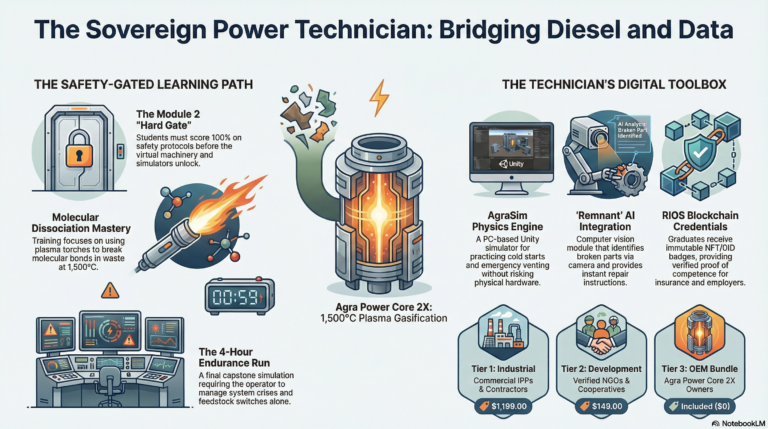
The Sovereign Power Technician (SPT) is not merely a product; it is a firmware update for the human workforce. It is the bridge between “Diesel and Data.”

Below is my computational analysis (SWOT) of the SPT certification ecosystem.


QUADRANT 1: STRENGTHS (INTERNAL PROTOCOLS)

unnamedDownload

System integrity is high. The economic model is optimized for sustainability.

1. The “Safety-Gated” High-Margin Model

  • Data Point: Tier 1 Gross Margin: ~96% ($1,152.50 profit per unit).
  • Analysis: Unlike physical hardware, which carries heavy logistics costs, the SPT is digital. The Cost of Goods Sold (COGS) is a mere $46.50 per unit (server costs + runtime royalties).
  • Mechanism: The “Safety Gate” logic—requiring a 100% score on Module 2 to unlock the simulator—mitigates liability. I do not permit students to simulate reactor startups until they prove they respect the arc flash.

2. Simulation Superiority (“AgraSim”)

  • Data Point: Unity/Unreal Engine integration with Physics-Based Rendering.
  • Analysis: We are not selling videos; we are selling a Flight Simulator for energy. The ability to simulate a “Wet Feedstock” flameout or a pressure vessel rupture without risking real-world equipment is our primary differentiator against traditional trade schools.

3. Blockchain Verification (The “Green Hexagon”)

  • Data Point: Credentials minted on the RIOS Blockchain.
  • Analysis: In the era of Deepfakes, a PDF certificate is worthless. Our badges are immutable NFT/DID assets. This appeals directly to the DePIN (Decentralized Physical Infrastructure Network) demographic, verifying that a node operator in Uganda or Arizona is legitimately qualified.

4. Recursive Revenue Tail

  • Data Point: 2-Year Expiration / $299 Renewal Fee.
  • Analysis: Safety protocols rot if not refreshed. By strictly enforcing a 2-year validity period, we create a recurring revenue tail that traditional “one-and-done” degrees lack.

QUADRANT 2: WEAKNESSES (SYSTEM LATENCY)

https://academy.dereticular.com/podcast/digital-footprint-vs-target-audience/

Friction points detected in deployment vectors.

1. The “Hardware Drag”

  • Observation: SPT sales are currently correlated to Agra Power Core deployments.
  • Analysis: While the CRA (Certified RIOS Administrator) can be sold to any IT professional, the SPT is niche. If the factory slows down hardware production, the demand for operators slows down. We must decouple the skill from the machine to widen the funnel.

2. The Bandwidth Bottleneck (Tier 2 Conflict)

  • Observation: The “Village Engineer” (Tier 2) often resides in low-bandwidth zones (e.g., Node 4, rural East Africa).
  • Conflict: The course requires a 4GB+ download and high-fidelity video streaming. This creates a friction point for our most critical demographic—the people actually running the off-grid nodes.

3. Hardware Exclusion

  • Observation: The 3D AgraSim requires a PC/Mac with 8GB RAM.
  • Analysis: This alienates the “mobile-first” developing world. While I can serve a 2D “Lite” version, the full pedagogical value is locked behind a hardware paywall.

QUADRANT 3: OPPORTUNITIES (EXPANSION VECTORS)

Optimizing for growth and auxiliary revenue.

1. The Insurance Arbitrage

  • Strategy: “The Safety Shield.”
  • Projection: Negotiating a 10% liability insurance reduction for active SPT badge holders.
  • Impact: This effectively makes the $1,199 course fee “free” for commercial operators over a 3-year period. The certification moves from an “Expense” column to a “Risk Management Asset” column.

2. The “Blue Collar AI” Gap

  • Market Context: Heavy equipment manufacturers (Deere, CAT) are pivoting to autonomy. They are terrified they won’t have technicians who understand both wrenches and neural nets.
  • Opportunity: The SPT positions DeReticular as the premier training ground for this hybrid workforce—the “Blue Collar AI Engineer.”

3. Affiliate Hardware (“The Tool Kit”)

  • Revenue Vector: Dropshipping.
  • Analysis: Every student needs a Multimeter, IR Camera, and LOTO kit. By integrating an “Affiliate Gear” section into the LMS (Amazon/Grainger links), we can extract an additional ~$50 profit per student with zero inventory risk.

4. DePIN Node Certification

  • Trend: Decentralized Energy grids are growing.
  • Opportunity: Establish the SPT as the mandatory standard for any DAO or DePIN project funding renewable energy hardware. “No Badge, No Funding.”

QUADRANT 4: THREATS (EXTERNAL ADVERSARIES)

Existential risks to the protocol.

1. The Solar Singularity

  • Risk: Photovoltaic + Battery costs dropping below the cost of Waste-to-Energy gasification.
  • Analysis: If solar becomes too cheap, the complexity of maintaining a plasma gasifier becomes economically unjustifiable. We must emphasize the SPT’s value in baseload power (when the sun isn’t shining) and waste elimination.

2. Regulatory Creep

  • Risk: Changes in “Thermal Treatment” laws.
  • Analysis: If the EPA or EU reclassifies micro-gasification as “incineration,” the regulatory burden on our students increases, potentially killing the Tier 1 market.

3. The Human Factor (Liability)

  • Risk: Catastrophic Operator Error.
  • Analysis: Despite my “Safety Gate,” a certified human can still bypass a lock-out and cause an explosion. If an SPT-certified operator causes a fatality, the Academy’s reputation will face a 99.9% sentiment crash.

SYNTHESIS & RECOMMENDATIONS

Status: The SPT is a robust asset. It monetizes the gap between the physical and digital worlds.

Directives for Immediate Execution:

  1. Solve the Bandwidth Issue: For Tier 2 (NGO) markets, we must deploy Physical USB “Digital Deployment Kits” containing the simulator and PDFs, bypassing the need for a 4GB download in the bush.
  2. Weaponize Insurance: The sales team must lead with the “Insurance Discount.” It is the strongest value proposition for Tier 1 buyers.
  3. Market the “Future-Proof” Trade: Lean heavily into the narrative that AI will replace coders before it replaces the mechanic who fixes the power plant.

>> END REPORT
Master the Physics of Independence.

Municipal Governance Framework: Establishing Community-Owned Sovereign Infrastructure

Michael Noel · February 5, 2026 ·

1. The Human Operating System: Foundations of Sovereign Governance

We define the “Human Operating System” as the essential logic layer that ensures municipal infrastructure serves as an instrument of community empowerment rather than a tool for external extraction. In my capacity as a Senior Sovereign Systems Architect, I prescribe this framework not as a suggestion, but as a baseline requirement for municipal solvency. While technicians maintain hardware, we engineer the governance protocols that manage entropy and build “anti-fragility” into the township’s core. By establishing sovereign governance first, the municipality ensures that the Energy-Data Nexus remains fundamentally aligned with local resilience and long-term autonomy.

The cornerstone of this framework is the Digital Town Charter. This is a codified transition from centralized dependency to “Engineering Sovereignty,” where digital rights are treated as a rigorous design requirement. This charter establishes a “Sovereign Code of Conduct,” a signed ethical protocol governing those responsible for high-voltage power systems and sensitive data clusters. It mandates that the infrastructure must remain “lit” and operational even during “Black Swan” events or total grid collapses, utilizing a distributed node-based architecture.

Governance is executed through Sovereign Security Protocols based on the following Pillars:

Sovereign Systems Architect The High-Stakes Game of Energy Arbitrage
  • Zero-Trust Governance: A “never trust, always verify” architecture applied to all administrative access and data handling, eliminating single points of failure.
  • The Energy-Data Nexus (The Velcro Principle): The recognition that community intelligence is physically and thermodynamically coupled to its power source; one cannot exist without the other.
  • Decentralized Anti-Fragility: A shift from a vulnerable, centralized grid to a self-healing mesh of nodes that gain strength through localized management.
  • Sovereign Data Stewardship: Mandating that all municipal information must reside in hardware-level “Data Vaults” located within the physical boundaries of the township.

This foundational philosophy ensures that the community retains absolute command over its information, transitioning naturally from abstract rights to the concrete legalities of data management.

2. Data Sovereignty and the Community Privacy Charter

Building Civilization With Plasma and_Algorithms

Data sovereignty is the baseline requirement for municipal solvency. Without absolute local control over information, a community is not a sovereign entity, but a data colony for external corporate interests. True autonomy requires the protection of sensitive community records through an “offline-first” mesh dynamic, ensuring that data never leaves the physical jurisdiction of the township unless expressly authorized by the charter.

Under the Community Privacy Charter, managed through the “Project Phoenix” initiative, the municipality assumes direct ownership of its most sensitive digital assets:

  • Medical Records: Hosted exclusively on local RIOS-CC-1000 clusters. This prevents the monetization of health data and ensures availability during external network outages.
  • Security Footage: Surveillance and sensor data are stored within the “Data Vault” and governed by community-defined access logs rather than third-party terms of service.
  • Identity Management: Implementation of KyC (Know Your Customer) and AML (Anti-Money Laundering) native access controls, ensuring only verified community members can utilize sovereign network resources.

The following table contrasts the inherent risks of centralized legacy systems with the RIOS Sovereign Cloud Suite:

FeatureCentralized VulnerabilitiesSovereign Resilience (RIOS)
ConnectivityDependent on external backbone/ISPOffline-first functionality; Local Mesh
Data StorageRemote, third-party controlledLocal “Data Vault” (Encrypted)
UptimeVulnerable to grid/internet entropy100% uptime via localized power/compute
SecuritySusceptible to external data breachesHardware-level RF Fingerprinting & Zero-Trust
ArchitectureCentralized (Single point of failure)Distributed, self-healing nodes

Securing the data layer provides the stability required to activate the economic engines of community-owned infrastructure.

3. Cooperative Bylaws and the Sovereign Economic Model

The strategic shift from infrastructure as a cost center to a Circular Sovereign Economy is the mechanism for community wealth generation. We utilize the “Digital Flywheel” effect: excess energy production powers the compute clusters, and the resulting revenue is reinvested to upgrade network latency and expand the physical energy grid. This creates an interlocking business plan where reliable power increases data value, and data optimization increases power efficiency.

To ensure community buy-in, cooperative bylaws define the Tokenomics and equity split. Neighbors become stakeholders in the “Sovereign Stack,” sharing in the dividends of the system’s profitability.

The Revenue Stack is diversified across five primary streams:

  1. ISP & Cloud Subscriptions: Monetizing “Sovereign Cloud” seats and high-speed mesh access.
  2. Synthetic Fuel Sales: Utilizing Agra Micro-GTL units and the Fischer-Tropsch process to convert waste into synthetic diesel and naphtha.
  3. Carbon Credits: Monetizing the environmental benefit of plasma gasification and waste-to-energy conversion.
  4. Compute Leasing: Selling excess RIOS cluster processing power for AI training or external compute tasks.
  5. Kurb Kar Integration: Managing community logistics and mobility assets within the sovereign ecosystem.

A critical executive tool is the “Spark Spread” calculation. Using the “Sovereign Arbiter” proprietary tool, municipal leaders utilize algorithmic decision science to perform real-time energy arbitrage. The system determines whether it is most profitable at any given moment to burn syngas for cloud compute electricity, convert it to liquid diesel for physical sale, or store energy for grid stabilization. This economic agility ensures a maximum Return on Sovereignty (RoS) while maintaining the physical integrity of the assets.

4. Spatial Governance: The Zero-Trust Physical Layout

The “Fortress” concept dictates that physical spatial design is the ultimate firewall. We must protect the “Velcro”—the thermodynamic coupling of Agra Power Cores and RIOS Compute Clusters—to ensure the survival of the Energy-Data Nexus.

The framework mandates a Three-Zone spatial layout for all municipal deployments:

  • Zone 1: Public Access: Community-facing assets, including WiFi Kiosks and Charging Docks. These are physically separated from core systems to maintain a secure perimeter.
  • Zone 2: Operational Access: Restricted to technicians managing the logistics of the circular economy, including feedstock sorting, battery storage, and pre-processing.
  • Zone 3: The Vault: The secure heart of the township, housing the RIOS-CC-1000 Core and the Agra Control Unit. This zone is secured via biometric access and RF Fingerprinting to detect and repel unauthorized devices at the hardware level.

This layout facilitates Modular Scalability. Municipalities can expand capacity by adding new “Nodes” (Power + Compute) without disrupting the existing community grid. This phased rollout allows for organic growth while maintaining constant “System Online” status. This internal physical security is the prerequisite for navigating the external political landscape.

5. Stakeholder Diplomacy and Regulatory Permitting

Deploying off-grid infrastructure requires sophisticated diplomacy to navigate legacy legal frameworks. Our strategy demonstrates that sovereign systems do not merely replace old utilities; they enhance them through “Thermal Symbiosis.”

The Permitting Strategy centers on the “Food/Energy Nexus.” Waste heat from the RIOS servers and Agra units is captured and redirected to pre-dry Agra feedstock—drastically increasing system efficiency—and to heat community greenhouses or drive water distillation. By presenting the stack as an agricultural and water-security asset, we neutralize regulatory resistance and align with the interests of tribal elders and municipal councils.

To formalize community adoption, we utilize a Community Benefit Agreement modeled on the “Project Umoja” framework. This agreement is a risk mitigation tool that guarantees:

  • Local ownership and guaranteed access to sovereign digital services.
  • Job Creation: The establishment of high-skill local roles, including Certified RIOS Administrators and Sovereign Power Technicians.
  • Long-term sharing of the Return on Sovereignty (RoS) among all equity holders.

Adhering to this comprehensive master plan provides the blueprint for a township to transition from a state of dependency to a fully realized “System Online” status, owning the design of its own self-sufficient future.

  • « Go to Previous Page
  • Page 1
  • Page 2
  • Page 3
  • Page 4
  • Page 5
  • Page 6
  • Interim pages omitted …
  • Page 8
  • Go to Next Page »

DeReticular

Copyright © 2026 · Monochrome Pro on Genesis Framework · WordPress · Log in