Strategic Dossier: Commercializing the RIOS Sovereign Stack
1. The Thesis of Sovereign Infrastructure: Beyond Linear Fragility
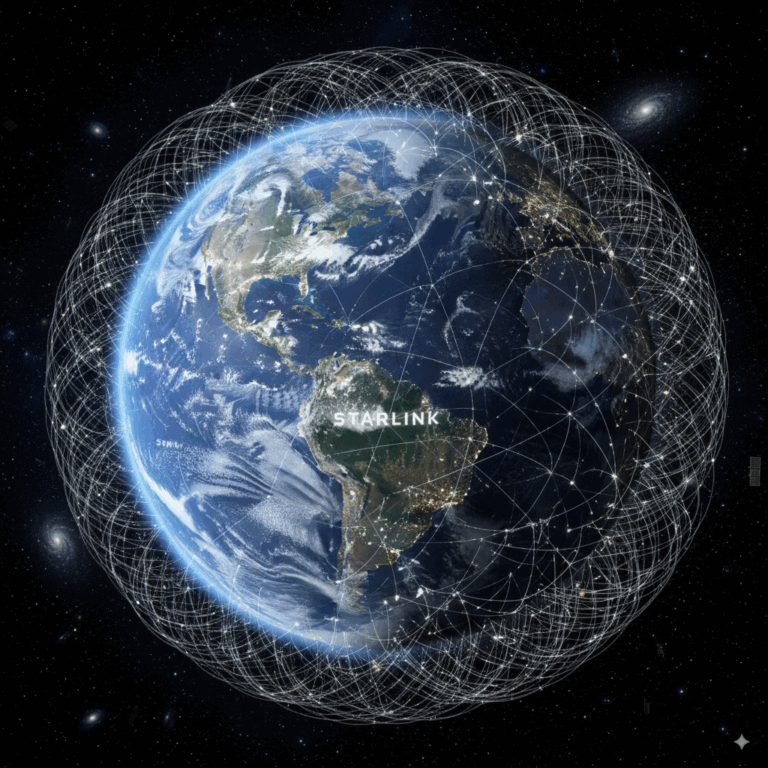
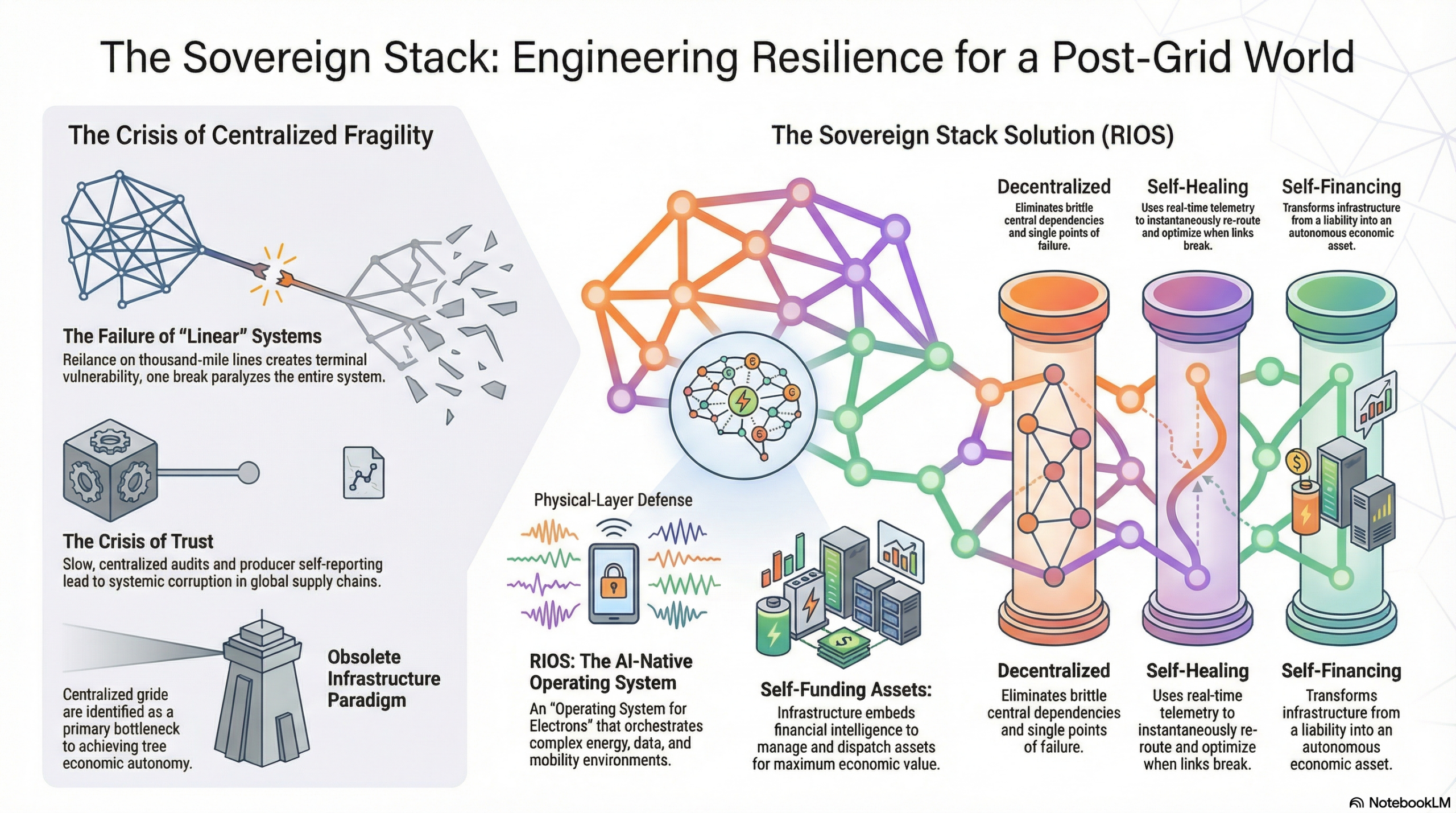
The verdict is absolute: the old grid is not just failing; it is obsolete. We are currently witnessing the terminal state of Linear Fragility—a paradigm where centralized, thousand-mile power lines and opaque, distant data centers create a catastrophic “Crisis of Trust.” In this “Reticular” model—defined by complexity and single points of failure—international buyers cannot verify producer data, and a single localized break paralyzes the entire system. To ensure economic autonomy and global survival, we must execute a doctrine of survivability through Sovereign Infrastructure.
The DeReticular architectural philosophy is the only viable antidote to this collapse. By moving away from reticular dependence, we transform infrastructure from a liability into a high-performance economic asset via three core pillars:
- Decentralized: Every node is an intelligent, self-sufficient entity—from energy storage to edge compute—eliminating brittle central dependencies.
- Self-Healing: Systems utilize real-time global telemetry to instantaneously re-route and self-diagnose, achieving true anti-fragility.
- Self-Financing: Financial intelligence is embedded into the edge, allowing nodes to autonomously manage and dispatch assets to maximize financial value.
This shift delivers Spherical Resilience—a 360-degree defense against systemic failure. Its strategic advantages include:
- Terminal Independence: Continuous operation regardless of external grid or satellite uplink status.
- Guaranteed Truth: Elimination of “Garbage In” data through un-spoofable, physical-layer verification.
- Hard Isolation: Using Sysbox Enterprise to create a logical and physical jail, ensuring public traffic never touches regulated industrial or financial ledgers.
- Community Sovereignty: Preventing external financial extraction by keeping asset ownership local.
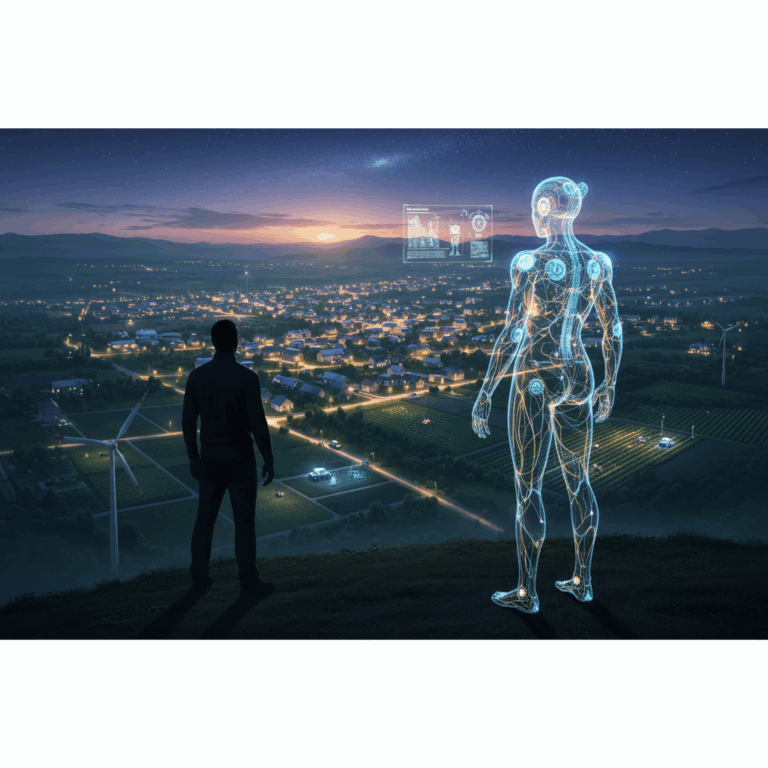
The operational engine driving this transformation is the Rural Infrastructure Operating System (RIOS), the platform for the next century’s electrons, data, and mobility.
——————————————————————————–
2. The Platform Shift: From Hardware Manufacturer to RIOS Operator
We are executing a strategic pivot from a hardware manufacturer building physical containers to a Platform Operator. DeReticular is now the architect of the global operating system for sovereign utility. By providing the RIOS Sovereign Stack, we allow third-party founders to build vertical-specific logic on top of a resilient foundation. This is “Civilization in a Box” as a service.
The software backbone integrates a “Dual-Stack” approach, bridging the legacy decentralized web with next-generation performance.
| Feature | Hyphanet (Classic) | New Freenet (Locutus) |
| Primary Goal | Extreme anonymity & static storage | Scalable platform for decentralized apps |
| Language/Tech | Java & Encrypted File Stores | Rust & WebAssembly (Wasm) Contracts |
| Content Type | Static (mostly “Freesites”) | Dynamic (Real-time chat, social feeds) |
| Primary Industrial Use Case | Whistleblowing, Deep Archiving (8TB NVMe) | Dynamic DApps, real-time coordination |
The Wasm Advantage makes the network programmable through smart contracts, while Conflict-free Replicated Data Types (CRDTs) solve the simultaneous update problem. For industrial operations, this is the “So What?”: it enables real-time, decentralized coordination (like the “River” chat protocol) without a central server. These protocols are secured within the hardware stack, providing the “Hard Isolation” required for Sovereign Banking.
——————————————————————————–
3. The “Hardware Oracle”: Guaranteeing Physical Truth at the Edge
Decentralized infrastructure faces the Transparency Paradox: to attract institutional capital, projects must provide verifiable proof of operation, yet traditional audits are slow, corruptible, and expensive. The RIOS solution is the Automated Notary—a system that replaces human trust with machine-verified truth.
Our Physical-Layer Defense deconstructs the hardware oracle into three un-spoofable layers:
- Radio Frequency Fingerprinting (RFF): Verifying device identity via unique physical hardware signatures that cannot be cloned by software.
- TPM 2.0 (Trusted Platform Module): Cryptographically signing “HempGrade” industrial data within the physical chip; the private keys never leave the hardware.
- L3 Horizen Verification: Remote attestation quotes—digital receipts signed by the hardware—are verified on-chain to prove the integrity of the operation without exposing raw data.
This stack is reinforced by an 8TB NVMe datastore for deep archiving and AoA/TDoA (Angle of Arrival/Time Difference of Arrival) telemetry. This allows the system to instantly locate and identify hostile signals in the physical airspace, defending the node from both digital and kinetic threats. This eliminates “Garbage In” attacks and provides the verified truth necessary for Real World Asset (RWA) tokenization.
——————————————————————————–
4. The Real World Asset (RWA) Engine: Tokenizing Industrial Utility
The RWA Engine is the bridge between physical output and decentralized finance (DeFi) liquidity. We are leveraging the CFTC-driven Digital Asset Pilot Program to move toward a model of Sovereign Banking. Every RIOS node acts as a regulatory-compliant engine that tokenizes industrial utility—turning kilowatt-hours and graded commodities into liquid assets.
In this model, infrastructure becomes Self-Financing:
- Asset Autonomy: Because the node can verify its own output via the Hardware Oracle, it can autonomously manage and dispatch resources to maximize yield.
- Extraction Resistance: This model replaces extractive “Mega Church Vacuum” financial models with community-owned systems that finance their own maintenance and expansion.
By embedding financial intelligence into edge nodes, we ensure that the value generated by local infrastructure stays within the local community, managed by the very systems that produce it.
——————————————————————————–
5. Blue Collar AI: High-Value Industrial Verticals and “The Forge”
The next “Unicorn” companies will not be built on consumer apps; they will be built on Blue Collar AI. This is a firmware update for the human workforce, focusing on the intersection of AI, decentralized protocols, and physical labor.
The DeReticular ecosystem is currently deployed across three strategic nodes:
- Node 2 (Canada): The “Brain” and Profit Engine. This is the central software and IP authority coordinating the high-level logic of the stack.
- Node 3 (Quartzsite, AZ): “The Blast Furnace.” The Operational Engine focusing on Non-Emergency Medical Transportation (NEMT) and Seasonal Surge Infrastructure.
- Node 4 (Uganda): “Project Umoja.” The Economic Engine focused on sovereign industrial parks and decentralized energy infrastructure to break the cycle of rural failure.
Call to Builders: Flood the Forge
We are taking over the CodeLaunch GTM Venture Forge. We need founders ready to build the application layer for the RIOS Sovereign Stack. We provide the “Civilization in a Box” infrastructure; you bring the vertical-specific logic.
- Requirements: Founders must present decentralized concepts built on the Sovereign Infrastructure narrative.
- The Reward: Winners receive a professional development team to build their MVP for free.
- Action: Secure the GTM Toolkit from the DeReticular team and apply to the Venture Forge immediately.
The window for this transition is narrow—a 48-hour window is closing. The old grid is failing. Flood the Forge. Dominate the narrative. Build the future. Win.# Strategic Dossier: Commercializing the RIOS Sovereign Stack
1. The Thesis of Sovereign Infrastructure: Beyond Linear Fragility
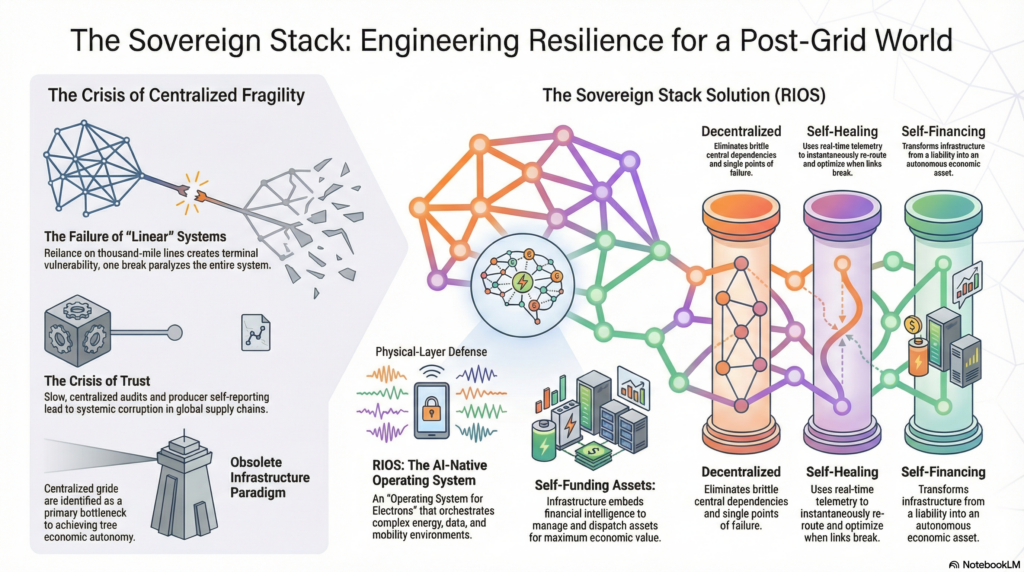
The verdict is absolute: the old grid is not just failing; it is obsolete. We are currently witnessing the terminal state of Linear Fragility—a paradigm where centralized, thousand-mile power lines and opaque, distant data centers create a catastrophic “Crisis of Trust.” In this “Reticular” model—defined by complexity and single points of failure—international buyers cannot verify producer data, and a single localized break paralyzes the entire system. To ensure economic autonomy and global survival, we must execute a doctrine of survivability through Sovereign Infrastructure.
The DeReticular architectural philosophy is the only viable antidote to this collapse. By moving away from reticular dependence, we transform infrastructure from a liability into a high-performance economic asset via three core pillars:
- Decentralized: Every node is an intelligent, self-sufficient entity—from energy storage to edge compute—eliminating brittle central dependencies.
- Self-Healing: Systems utilize real-time global telemetry to instantaneously re-route and self-diagnose, achieving true anti-fragility.
- Self-Financing: Financial intelligence is embedded into the edge, allowing nodes to autonomously manage and dispatch assets to maximize financial value.
This shift delivers Spherical Resilience—a 360-degree defense against systemic failure. Its strategic advantages include:
- Terminal Independence: Continuous operation regardless of external grid or satellite uplink status.
- Guaranteed Truth: Elimination of “Garbage In” data through un-spoofable, physical-layer verification.
- Hard Isolation: Using Sysbox Enterprise to create a logical and physical jail, ensuring public traffic never touches regulated industrial or financial ledgers.
- Community Sovereignty: Preventing external financial extraction by keeping asset ownership local.
The operational engine driving this transformation is the Rural Infrastructure Operating System (RIOS), the platform for the next century’s electrons, data, and mobility.
——————————————————————————–
2. The Platform Shift: From Hardware Manufacturer to RIOS Operator
We are executing a strategic pivot from a hardware manufacturer building physical containers to a Platform Operator. DeReticular is now the architect of the global operating system for sovereign utility. By providing the RIOS Sovereign Stack, we allow third-party founders to build vertical-specific logic on top of a resilient foundation. This is “Civilization in a Box” as a service.
The software backbone integrates a “Dual-Stack” approach, bridging the legacy decentralized web with next-generation performance.
| Feature | Hyphanet (Classic) | New Freenet (Locutus) |
| Primary Goal | Extreme anonymity & static storage | Scalable platform for decentralized apps |
| Language/Tech | Java & Encrypted File Stores | Rust & WebAssembly (Wasm) Contracts |
| Content Type | Static (mostly “Freesites”) | Dynamic (Real-time chat, social feeds) |
| Primary Industrial Use Case | Whistleblowing, Deep Archiving (8TB NVMe) | Dynamic DApps, real-time coordination |
The Wasm Advantage makes the network programmable through smart contracts, while Conflict-free Replicated Data Types (CRDTs) solve the simultaneous update problem. For industrial operations, this is the “So What?”: it enables real-time, decentralized coordination (like the “River” chat protocol) without a central server. These protocols are secured within the hardware stack, providing the “Hard Isolation” required for Sovereign Banking.
——————————————————————————–
3. The “Hardware Oracle”: Guaranteeing Physical Truth at the Edge
Decentralized infrastructure faces the Transparency Paradox: to attract institutional capital, projects must provide verifiable proof of operation, yet traditional audits are slow, corruptible, and expensive. The RIOS solution is the Automated Notary—a system that replaces human trust with machine-verified truth.
Our Physical-Layer Defense deconstructs the hardware oracle into three un-spoofable layers:
- Radio Frequency Fingerprinting (RFF): Verifying device identity via unique physical hardware signatures that cannot be cloned by software.
- TPM 2.0 (Trusted Platform Module): Cryptographically signing “HempGrade” industrial data within the physical chip; the private keys never leave the hardware.
- L3 Horizen Verification: Remote attestation quotes—digital receipts signed by the hardware—are verified on-chain to prove the integrity of the operation without exposing raw data.
This stack is reinforced by an 8TB NVMe datastore for deep archiving and AoA/TDoA (Angle of Arrival/Time Difference of Arrival) telemetry. This allows the system to instantly locate and identify hostile signals in the physical airspace, defending the node from both digital and kinetic threats. This eliminates “Garbage In” attacks and provides the verified truth necessary for Real World Asset (RWA) tokenization.
——————————————————————————–
4. The Real World Asset (RWA) Engine: Tokenizing Industrial Utility
The RWA Engine is the bridge between physical output and decentralized finance (DeFi) liquidity. We are leveraging the CFTC-driven Digital Asset Pilot Program to move toward a model of Sovereign Banking. Every RIOS node acts as a regulatory-compliant engine that tokenizes industrial utility—turning kilowatt-hours and graded commodities into liquid assets.
In this model, infrastructure becomes Self-Financing:
- Asset Autonomy: Because the node can verify its own output via the Hardware Oracle, it can autonomously manage and dispatch resources to maximize yield.
- Extraction Resistance: This model replaces extractive “Mega Church Vacuum” financial models with community-owned systems that finance their own maintenance and expansion.
By embedding financial intelligence into edge nodes, we ensure that the value generated by local infrastructure stays within the local community, managed by the very systems that produce it.
——————————————————————————–
5. Blue Collar AI: High-Value Industrial Verticals and “The Forge”
The next “Unicorn” companies will not be built on consumer apps; they will be built on Blue Collar AI. This is a firmware update for the human workforce, focusing on the intersection of AI, decentralized protocols, and physical labor.
The DeReticular ecosystem is currently deployed across three strategic nodes:
- Node 2 (Canada): The “Brain” and Profit Engine. This is the central software and IP authority coordinating the high-level logic of the stack.
- Node 3 (Quartzsite, AZ): “The Blast Furnace.” The Operational Engine focusing on Non-Emergency Medical Transportation (NEMT) and Seasonal Surge Infrastructure.
- Node 4 (Uganda): “Project Umoja.” The Economic Engine focused on sovereign industrial parks and decentralized energy infrastructure to break the cycle of rural failure.
Call to Builders: Flood the Forge
We are taking over the CodeLaunch GTM Venture Forge. We need founders ready to build the application layer for the RIOS Sovereign Stack. We provide the “Civilization in a Box” infrastructure; you bring the vertical-specific logic.
- Requirements: Founders must present decentralized concepts built on the Sovereign Infrastructure narrative.
- The Reward: Winners receive a professional development team to build their MVP for free.
- Action: Secure the GTM Toolkit from the DeReticular team and apply to the Venture Forge immediately.
The window for this transition is narrow—a 48-hour window is closing. The old grid is failing. Flood the Forge. Dominate the narrative. Build the future. Win.