• Skip to primary navigation
  • Skip to main content
DeReticular

DeReticular

Local Autonomy. National Security. Total Sovereignty.

  • Solutions
    • Municipalities
    • Energy
    • Industrial
    • Defense
  • Infrastructure
  • Intelligence
  • Company
  • Request Municipal Audit
  • Show Search
Hide Search
You are here: Home / Archives for Transportation

Transportation

FY 2026 Strategic Funding Roadmap: Node 6 Sovereign Mobility Initiative

Michael Noel · April 30, 2026 ·

1. Executive Mission & Strategic Context

Node 6 has undergone a critical strategic realignment within the Project Octagon network, transitioning from a governance hub to the “Autonomous Transportation Division.” In this capacity, Node 6 functions as the “Circulatory System” of the DeReticular ecosystem—the physical layer of the “Sovereign Stack” designed to move essential resources and people through a resilient, decentralized network. The initiative’s primary mission is to solve the Non-Emergency Medical Transportation (NEMT) crisis in La Paz County, Arizona, establishing a blueprint for “Island Mode” operations that function independently of fragile national data and energy grids.

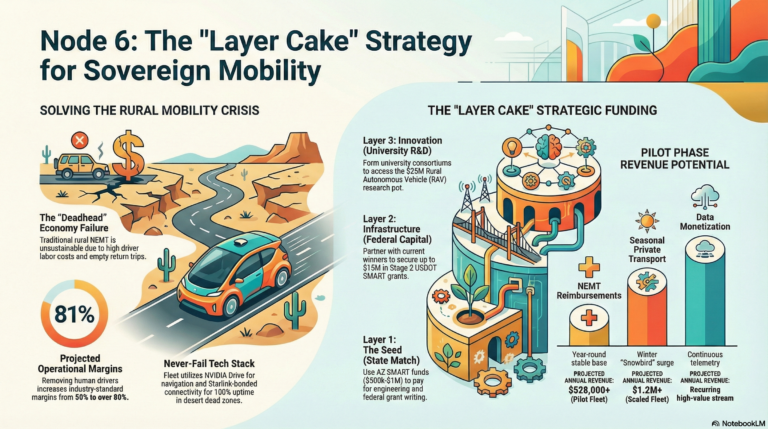
The regional mobility landscape in Western Arizona is currently defined by systemic failure. La Paz County faces an “Extreme Demand” scenario: a permanent resident population with a median age of 71.2 requires frequent access to medical facilities in Parker (32 miles away), yet is served by transit that operates only once per week. This crisis is compounded by the seasonal “Snowbird” migration in Quartzsite, which surges the population by 750,000 to 1,000,000 visitors annually, overwhelming local infrastructure. Furthermore, the “Deadhead Economy” renders traditional rural NEMT financially non-viable; providers lose capital driving empty vehicles to remote pickups, leading to chronic shortages and missed life-critical appointments.

Western_Arizona_Sovereign_Mobility_BlueprintDownload

The Sovereign Mobility solution mitigates these failures through four core technological pillars:

  • Kurb Kars: Ruggedized autonomous pods that eliminate the primary cost driver—human labor—enabling economically viable 24/7 service in remote corridors.
  • NVIDIA Drive: An AZDOT-approved AI “brain” capable of navigating the unmapped or poorly marked roads characteristic of rural Arizona.
  • Sovereign Connectivity (Signal Fusion): A “Global Mesh Protocol” bonding Starlink High-Performance satellite internet with CAT4 vSIM cellular data to ensure 100% uptime in desert canyons and cellular dead zones.
  • Vehicle-to-Grid (V2G) Power: Mobile battery storage that stabilizes local microgrids and allows for energy arbitrage when vehicles are not in service, converting depreciating assets into revenue-generating utilities.

By decoupling transportation from labor and fossil fuels, Node 6 transforms rural transit economics. While industry-standard NEMT margins hover at 50%, the Kurb Kar fleet projects an 81% operating margin. This efficiency enables a projected 6-month CapEx recoup per vehicle, allowing for rapid scaling without equity dilution.

2. The ‘Layer Cake’ Funding Methodology

The “Layer Cake” approach is a multi-tiered, non-dilutive capital strategy designed to maximize the ROI of public dollars. This structure is essential for navigating the transition from state-level preparation to large-scale federal infrastructure and R&D. By sequentially capturing these funds, Node 6 de-risks each subsequent tier, ensuring the project is “Node 6 Ready” before high-stakes capital is deployed.

Funding LayerPrimary ObjectiveRole in De-risking
Tier I: Seed (State)Fund design, engineering, and professional grant-writing.Provides mandatory matching funds and evidentiary data for federal asks.
Tier II: Infrastructure (Federal)Acquisition of physical assets (hubs, towers, sensors).Establishes the tangible “Sovereign Stack” grid required for scale.
Tier III: Innovation (Research/Ops)Fund AI modeling, NEMT software, and operations.Validates “Clinic-in-a-Box” tech and generates recurring data revenue.

The catalyst for this architecture is Champion Brion Crum, “The Human Link.” Crum’s background in private equity and real estate—notably with Caliber Funds—provides the institutional credibility required to bridge high-tech innovation with physical asset management. His philosophy centers on the nexus of technology, capital, and real estate, positioning Node 6 as a financially compliant infrastructure project rather than a speculative tech pilot.

https://academy.dereticular.com/podcast/node-6-sovereign-mobility-and-autonomous-healthcare-logistics/

3. Tier I: The Seed Layer (Arizona State Preparation)

Tier I funding provides the “dry powder” necessary for sophisticated engineering and professional grant-writing services. These funds are the prerequisite for competing in the high-stakes federal implementation pool.

The primary vehicle for this layer is the AZ SMART Fund (State Match Advantage for Rural Transportation), administered by ADOT and the State Transportation Board. Node 6 will submit an “Ask” for $500k – $1M to finance the “La Paz Autonomous Corridor Feasibility Study.” This study will provide the data-driven basis required to prove the viability of autonomous transit in rugged desert environments to federal evaluators.

Node 6 will also leverage a strategic partnership with the Arizona Commerce Authority (ACA) and the Institute for Automated Mobility (IAM). By positioning Node 6 as the “Western Deployment Site” for the ACA’s existing statewide V2X (Vehicle-to-Everything) initiatives, the project “piggybacks” on existing state momentum rather than applying in isolation. This strategy creates the evidentiary basis required to unlock Tier II capital.

4. Tier II: The Infrastructure Layer (Federal Capital Grants)

Tier II focuses on the acquisition of physical assets—charging hubs, connectivity towers, and smart road sensors. This phase capitalizes on the federal mandate for “Rural Justice,” which prioritizes infrastructure development in underserved communities.

A cornerstone of this tier is the USDOT SMART Grants (Stage 2) strategy. To unlock the $15 Million implementation pool (typically reserved for Stage 1 winners), Node 6 will execute a “Stage 1 Partner Hack.” By partnering with an established Stage 1 winner, such as the Arizona Commerce Authority or Maricopa County DOT, Node 6 offers a rugged rural testbed to prove their existing technologies, bypassing the Stage 1 entry requirement.

Simultaneously, the project will capture the Charging and Fueling Infrastructure (CFI) Grant. By framing Kurb Kar depots as “Public Community Charging Hubs” located at senior centers and clinics, Node 6 specifically targets the 50% rural set-aside within the Community Program track. This physical infrastructure establishes the foundation for the advanced R&D activities in Tier III.

5. Tier III: The Innovation Layer (R&D and Operational Grants)

The Innovation Layer funds the “soft” infrastructure: AI modeling, NEMT operational software, and the software integration for the “Clinic-in-a-Box” diagnostic system.

  • Rural Autonomous Vehicle (RAV) Research Program: Node 6 will lead a consortium with Arizona State University (ASU) or the University of Arizona (U of A) to capture a portion of this $25 Million pool. The research will focus on “safe integration in tribal and rural communities,” using the La Paz corridors as the primary test site.
  • Federated Learning & Data Monetization: Every mile driven by the fleet generates high-value “edge case” data (e.g., navigating dust storms). This telemetry is verified via zkVerify and sold to global autonomous driving databases, creating a “Stream C” recurring revenue model.
  • FTA Section 5311: Node 6 will seek designation as a rural public transit operator to secure annual formula grants for operational assistance.
  • Enhancing Mobility Innovation (EMI): This grant will fund the integration of “Clinic-in-a-Box” sensors. This allows for the collection of patient vitals during the 45-minute drive to Parker, which are uploaded via Starlink to medical centers, transforming the commute into a preliminary check-up.

6. Strategic Regional Integration & Partnerships

Regional integration reduces Capital Expenditure (CapEx) by “overlaying” Node 6 technology onto existing public works projects.

  • The Route 66 Centennial (2026): Node 6 will pivot to a “High-Tech Heritage” narrative, positioning itself as the modern evolution of the Mother Road. This includes a “Neo-Green Book” initiative, framing autonomous mobility as a tool for safety and civil rights for the elderly and disabled. The goal is “Official Centennial Project” status and the launch of a “Route 66 Green Corridor” pilot.
  • Quartzsite Infrastructure Piggybacking: Node 6 will lobby the Western Arizona Council of Governments (WACOG) to include V2I sensors and smart communication nodes in the construction specifications for the Quartzsite Blvd widening and I-10 overpass projects before construction begins.
  • The Colorado River “Blue Mobility” Connection: In partnership with the Colorado River Indian Tribes (CRIT), Node 6 will establish the “Parker to Pad” route. This connects the Blue Water Casino to medical centers, providing a safety link that mitigates drunk driving. This project will be an autonomous safety sensor overlay on the existing 25 Million Mohave Road Reconstruction Project**, tapping into the region’s **1.4 Trillion “Blue Economy.”

7. FY 2026 Implementation Timeline

The roadmap requires synchronized action between Node 6 leadership and regional gatekeepers to align with the regional Transportation Improvement Program (TIP).

QuarterAction ItemTarget Grant / InitiativeRequired Partners
Q1Engage WACOG & Align with TIPAZ SMART Fund / TIPWACOG, La Paz County
Q1Form Research ConsortiumRAV Research ProgramASU or U of A
Q2Centennial Integration & Infra BidRoute 66 Centennial / CFIRoute 66 Road Ahead, WACOG
Q3Secure Federal Infra PartnershipUSDOT SMART (Stage 2)Arizona Commerce Authority
Q3Joint Tribal Grant SubmissionRAV Research ProgramCRIT, La Paz County
Q4Secure Operational Operator StatusFTA Section 5311ADOT Transit Division

Financial Impact Summary The pilot fleet (scaling from 2 to 10 vehicles) is projected to generate $528,000 – $1.2 Million+ in annual gross revenue through NEMT reimbursements and seasonal surge pricing. With an 81% operating margin, the project enables a 6-month CapEx recoup per asset.

Immediate Action Required Champion Brion Crum must immediately engage the WACOG Transportation Director to present the Node 6 Sovereign Mobility vision and secure formal alignment with the regional Transportation Improvement Program (TIP).

Moving Minds: A Beginner’s Guide to Physical AI

Michael Noel · March 24, 2026 ·

1. The “Kinetic” Shift: What is Physical AI?

For decades, artificial intelligence has been a “brain in a jar”—a brilliant but paralyzed observer trapped behind digital screens and stationary servers. It could analyze data or generate text, but it couldn’t reach out and touch the world. Physical AI marks the moment that intelligence becomes kinetic. It is the transition from AI that merely “chats” to AI that moves, lifts, builds, and navigates the “cold steel” of our physical reality.

The “So What?”: Why does moving from screens to steel change the world? Because digital-only AI is an observer, but Physical AI is a participant. When intelligence is no longer tethered to a cloud, it can rebuild infrastructure, manage energy, and provide care autonomously. This shift moves us from a world of information to a world of autonomous action.

To make an AI move, we cannot rely on code alone. We need a “physical container”—a laboratory where digital logic is forged into machinery.

2. The Builder’s Laboratory: Where Digital Meets Steel

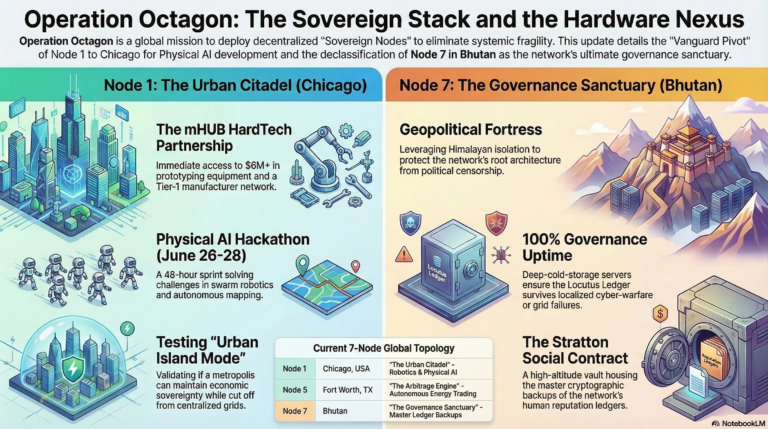
In the domain of “HardTech,” innovation requires more than just a laptop; it requires heavy industrial gear and a high-trust network. mHUB, Chicago’s premier innovation center, serves as the physical anchor for Node 1 (The Urban Citadel). It is the world’s epicenter for sovereign robotics, where the digital ledger meets the reality of manufacturing.

For the beginner, a HardTech hub provides the essential “Hardware Arsenal” to bridge the digital-to-physical gap:

ResourcePrimary Benefit for the Learner
Prototyping EquipmentAccess to $6M+ in gear (3D printers, CNC mills) to turn Wasm smart-contracts into physical joint movements.
The Talent RouterConnection to an elite network of builders and experts from institutions like MIT, UChicago, Purdue, and Northwestern.
Builder KitsAccess to Sovereign Keys and localized edge-compute boards to begin building the “Sovereign Stack.”
Tier-1 Manufacturer LinksDirect channels to partners like Baxter and Schneider Electric to scale a prototype into a fleet.

Once you have the steel, you need the “nervous system” to make the machine think and act without a leash.

Operation_Octagon_Hardware_NexusDownload

3. The Brains of the Machine: Sentry and Foreman

Physical AI requires a radical departure from traditional “Cloud AI.” To operate safely, a robot must be sovereign—meaning it cannot rely on a distant server that might fail. DeReticular provides the two-part “brain” for these machines:

  1. Sovereign Sentry (The Secure Brain): This localized server acts as the robot’s mind. Its core feature is “Island Mode.” Unlike “Cloud Dependency”—where a robot “dies” if AWS or Google goes offline—a machine in Island Mode remains fully operational and secure from external cyber-warfare. It is off-grid, autonomous, and untouchable.
  2. Industrial Foreman (The Physical Executor): If the Sentry is the “brain,” the Foreman is the “motor cortex.” This agent translates high-level logic into physical reality, routing power via industrial protocols and ensuring the machine moves its joints within safe thermal limits.

When a single robot is sovereign, the next hurdle is teaching it to play well with others in a complex environment.

4. Three Great Challenges: Making AI Play Well with Others

Building a machine that moves is only the beginning. To be useful, Physical AI must overcome three primary “HardTech” hurdles:

  • Swarm Coordination
    • Getting multiple robots to work together (e.g., transport or assembly) without a “Centralized Wi-Fi” master. They must communicate via decentralized edge-networks to ensure coordination even in interference-heavy environments.
  • Autonomous Mapping (The “Vault Warden” Protocol)
    • Robots must “see” a room and understand it. Using onboard sensors, they create semantic maps that label obstacles and humans, mimicking the Vault Warden security protocols used to protect high-value facilities.
  • Human-Robot Collaboration (“Cobots”)
    • This is about intuition. A “cobot” must learn to adapt to human gestures, speed, and unpredictable behavior, ensuring it can work alongside people in a workshop without causing accidents.

Solving these challenges allows us to deploy Physical AI to solve human problems in the real world.

5. Real-World Impact: Mobility and Beyond

Physical AI isn’t a future concept; it is already being deployed across the global mesh to defeat “Linear Fragility”—the tendency of centralized systems to fail under stress.

Node 6: The Circulatory System (Arizona) In La Paz County, Physical AI powers Sovereign Mobility. Using edge-based AI dispatching, autonomous systems provide Non-Emergency Medical Transportation (NEMT), ensuring people with disabilities have reliable, off-grid movement.

Node 4: The Sovereign Oasis (Uganda) In the African theater, Physical AI manages high-value eco-tourism and hospitality. These off-grid retreats use decentralized mesh networks to remain connected and operational, regardless of local infrastructure stability.

These machines provide the ability for goods and people to move freely, but they require a safety net to ensure they remain helpful.

https://academy.dereticular.com/podcast/remnant-ai-master-plan-for-physical-autonomy/

6. The Safety Net: Governance and the Ledger

Because moving machines carry real-world risks, they must be governed by immutable “laws.” Physical AI uses a decentralized governance structure to prevent misuse.

  • The Locutus Ledger: A cryptographic record that tracks every action a machine or builder takes. This creates an “immutable resume” and ensures total accountability for everything built within the network.
  • Node 7: The Governance Sanctuary (Bhutan): Located in the geographically isolated Himalayas, Bhutan serves as a geopolitical and digital fortress. It houses deep-cold-storage clusters that protect the “Stratton Social Contract”—the master blueprints for how these robots must behave. Even if an urban center faces a total cyber-attack, the “roots” of the system remain safe in the sanctuary.

3 Things to Remember About Physical AI Safety:

  • Island Mode is Sovereignty: Off-grid operation is the only way to ensure a robot cannot be hacked or disabled by a centralized authority.
  • Linear Fragility is the Enemy: Centralized systems are fragile; decentralized Physical AI is resilient and “spherical.”
  • The Ledger is Law: The Locutus Ledger ensures that the “Stratton Social Contract” is enforced by code, not just promises.

7. Summary: Joining the Revolution

Physical AI is more than just robotics; it is the ultimate manifestation of the Sovereign Stack. We are graduating from a world where intelligence is a tool we use on a screen to a world where intelligence is a kinetic force that builds, protects, and moves us.

We are no longer just writing software; we are building the machines that will build the future.

Analysis of the Urban Hub Infrastructure Package

Michael Noel · March 24, 2026 ·

Executive Summary

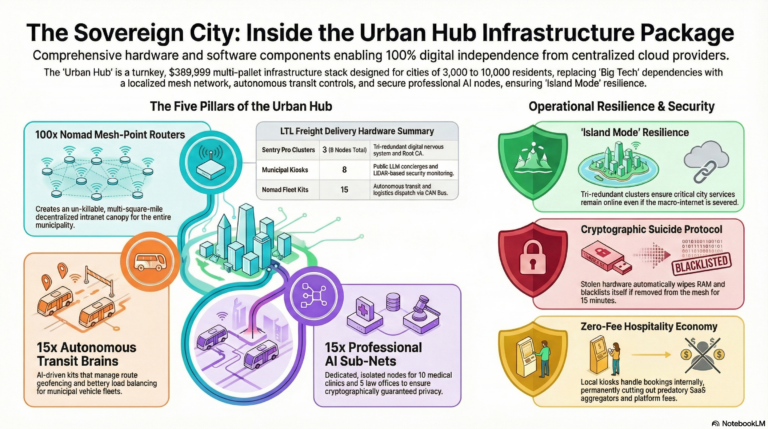
The “Urban Hub” Infrastructure Package (SKU: SOV-BNDL-URBAN) is a turnkey, decentralized municipal operating system designed by DeReticular for townships and urban centers with populations between 3,000 and 10,000 residents. Priced at $389,999.00, the package aims to establish complete digital sovereignty by replacing centralized “Big Tech” cloud dependencies with a localized, tri-redundant “Digital Nervous System.”

The package integrates high-bandwidth mesh networking, autonomous transit management, and specialized AI-driven infrastructure for healthcare, legal, and civic sectors. By operating in a resilient “Island Mode,” the system ensures that critical municipal functions—including first responder communications, medical record management, and public transportation—remain operational even if external internet connectivity is severed. Key benefits include the elimination of recurring SaaS fees, localized data privacy, and the retention of economic value within the municipality through zero-fee booking and hospitality engines.

——————————————————————————–

Core Technical Architecture

The Urban Hub is built upon a layered infrastructure designed for high availability and cryptographic isolation.

1. The Digital Nervous System (Core Compute)

The foundation of the municipality’s data integrity rests on three High-Capacity Sentry Pro Clusters. These are deployed across three distinct geographic zones (e.g., City Hall, Police Headquarters, and a Utility Center) to provide active-active-active redundancy.

  • Hardware: 9 total 1U nodes (3 per cluster), each equipped with 64GB RAM.
  • Function: Hosts the city’s Root Certificate Authority (CA) and runs the DevOps Sovereign (Deep Admin) for grid-wide monitoring and load-balancing.

2. Communications Mesh Canopy

To ensure ubiquitous connectivity, the package deploys a decentralized intranet.

  • Hardware: 100 ruggedized Nomad Mesh-Point Routers.
  • Capabilities: Utilizes Wi-Fi 6E and LoRaWAN to blanket multiple square miles.
  • Resilience: The network is “un-killable” and self-healing; if fiber backhaul is lost, local VoIP and data transfers continue uninterrupted across the municipal grid.

Sovereign_Urban_InfrastructureDownload

Specialized Sector Infrastructure

The package provides pre-configured AI nodes and interfaces for critical professional and public services, segmented into isolated sub-networks for security.

Healthcare and Legal Sub-Nets

To maintain attorney-client and doctor-patient privilege, 15 Sovereign Sentry nodes are deployed with mathematical isolation from the public mesh.

  • Medical (10 Nodes): Equipped with PostgreSQL databases, local Whisper AI for dictation, and OCR for medical records.
  • Legal (5 Nodes): Configured for encrypted VoIP, automated contract generation, and high-security data handling.

Civic and Tourism Gatekeepers

The public-facing layer of the city is managed via 8 Municipal Kiosks.

  • Functionality: Acts as a local LLM concierge for visitors, facilitating restaurant and hotel bookings.
  • Economic Impact: By bypassing third-party aggregators (e.g., Airbnb, Expedia, DoorDash), the system prevents fee extraction and keeps wealth within the local economy.
  • Security: Integrated LiDAR sensors provide volumetric monitoring of transit hubs and public parks via the Vault Warden protocol.

——————————————————————————–

Autonomous Transit and Logistics

The Industrial Foreman AI coordinates a fleet of 15 autonomous vehicles, transforming traditional municipal transit into a responsive, traffic-aware network.

ComponentQuantityApplication
Nomad Fleet Kits15Mobile edge servers for buses, shuttles, and maintenance trucks.
ConnectivityCAN Bus / OBD-IIDirect integration with vehicle diagnostics and controls.
Dynamic DispatchAutonomousThe system detects surge traffic at kiosks and automatically re-routes shuttles.
Load BalancingBattery ManagementMonitors battery states across the fleet to optimize charging and uptime.

The $389,999 Smart City in a Box

Implementation and Fulfillment Workflow

Fulfillment of the Urban Hub requires a multi-phase, human-led engineering process to ensure the hardware is calibrated to the local environment.

  1. Phase 1: Architecture & Topology: DeReticular engineers conduct physical site surveys and RF mapping to determine optimal placement for 100 mesh points. The city’s unique Root CA and 140+ unique cryptographic identities are minted.
  2. Phase 2: Fleet Provisioning: 147 hardware units are staged and flashed with the RIOS Core. A simulated mesh is established in the warehouse to verify failover protocols before the units are packed into weather-sealed crates for LTL freight shipping.
  3. Phase 3: Deployment: Local utility contractors install the hardware according to blueprints. The “Core Ignition” occurs once the three Sentry Pro clusters verify their tri-zone handshake.

——————————————————————————–

Risk Mitigation and Security Protocols

The Urban Hub includes automated defensive measures to address the vulnerabilities inherent in a decentralized physical deployment.

  • Network Stability (R-SCALE-03): To prevent “broadcast storms” in a 100-node network, the system uses BGP-style logic and OSPF routing to segment routers into dynamic, self-managing clusters.
  • Physical Security (R-SEC-05): In the event of hardware theft, the “Cryptographic Suicide” protocol is triggered. If a node is disconnected for more than 15 minutes or its chassis is breached, the Vault Warden protocol wipes the RAM and blacklists the node’s MAC address at the Root CA.
  • Power Constraints (R-HW-05): To prevent straining the municipal grid, the system integrates with Resilient Microgrid bundles. This allows autonomous vehicles to prioritize charging during peak solar output periods.

——————————————————————————–

Bill of Materials Summary

CategoryItemQuantity
FoundationHigh-Capacity Sentry Pro Clusters (3-Node Rackmount)3 Clusters (9 Nodes)
ConnectivityNomad Mesh-Point Routers (Ruggedized)100
ProfessionalSovereign Sentry (Standard) Desktop Nodes15
TransitNomad Fleet Kits (CAN Bus Enabled)15
PublicRuggedized Outdoor Visitor Kiosks (Touchscreen)8
LicensingMaster Urban Fleet License (SHA-256)1

The Urban Hub Infrastructure Package represents a shift toward “Sovereign Automation,” providing municipalities with the tools to manage their own data, economy, and transit without external interference or recurring costs.

Executive Summary

The “Urban Hub” Infrastructure Package (SKU: SOV-BNDL-URBAN) is a turnkey, decentralized municipal operating system designed by DeReticular for townships and urban centers with populations between 3,000 and 10,000 residents. Priced at $389,999.00, the package aims to establish complete digital sovereignty by replacing centralized “Big Tech” cloud dependencies with a localized, tri-redundant “Digital Nervous System.”

The package integrates high-bandwidth mesh networking, autonomous transit management, and specialized AI-driven infrastructure for healthcare, legal, and civic sectors. By operating in a resilient “Island Mode,” the system ensures that critical municipal functions—including first responder communications, medical record management, and public transportation—remain operational even if external internet connectivity is severed. Key benefits include the elimination of recurring SaaS fees, localized data privacy, and the retention of economic value within the municipality through zero-fee booking and hospitality engines.

——————————————————————————–

Core Technical Architecture

The Urban Hub is built upon a layered infrastructure designed for high availability and cryptographic isolation.

1. The Digital Nervous System (Core Compute)

The foundation of the municipality’s data integrity rests on three High-Capacity Sentry Pro Clusters. These are deployed across three distinct geographic zones (e.g., City Hall, Police Headquarters, and a Utility Center) to provide active-active-active redundancy.

  • Hardware: 9 total 1U nodes (3 per cluster), each equipped with 64GB RAM.
  • Function: Hosts the city’s Root Certificate Authority (CA) and runs the DevOps Sovereign (Deep Admin) for grid-wide monitoring and load-balancing.

2. Communications Mesh Canopy

To ensure ubiquitous connectivity, the package deploys a decentralized intranet.

  • Hardware: 100 ruggedized Nomad Mesh-Point Routers.
  • Capabilities: Utilizes Wi-Fi 6E and LoRaWAN to blanket multiple square miles.
  • Resilience: The network is “un-killable” and self-healing; if fiber backhaul is lost, local VoIP and data transfers continue uninterrupted across the municipal grid.

——————————————————————————–

Specialized Sector Infrastructure

The package provides pre-configured AI nodes and interfaces for critical professional and public services, segmented into isolated sub-networks for security.

Healthcare and Legal Sub-Nets

To maintain attorney-client and doctor-patient privilege, 15 Sovereign Sentry nodes are deployed with mathematical isolation from the public mesh.

  • Medical (10 Nodes): Equipped with PostgreSQL databases, local Whisper AI for dictation, and OCR for medical records.
  • Legal (5 Nodes): Configured for encrypted VoIP, automated contract generation, and high-security data handling.

Civic and Tourism Gatekeepers

The public-facing layer of the city is managed via 8 Municipal Kiosks.

  • Functionality: Acts as a local LLM concierge for visitors, facilitating restaurant and hotel bookings.
  • Economic Impact: By bypassing third-party aggregators (e.g., Airbnb, Expedia, DoorDash), the system prevents fee extraction and keeps wealth within the local economy.
  • Security: Integrated LiDAR sensors provide volumetric monitoring of transit hubs and public parks via the Vault Warden protocol.

——————————————————————————–

Autonomous Transit and Logistics

The Industrial Foreman AI coordinates a fleet of 15 autonomous vehicles, transforming traditional municipal transit into a responsive, traffic-aware network.

ComponentQuantityApplication
Nomad Fleet Kits15Mobile edge servers for buses, shuttles, and maintenance trucks.
ConnectivityCAN Bus / OBD-IIDirect integration with vehicle diagnostics and controls.
Dynamic DispatchAutonomousThe system detects surge traffic at kiosks and automatically re-routes shuttles.
Load BalancingBattery ManagementMonitors battery states across the fleet to optimize charging and uptime.

——————————————————————————–

Implementation and Fulfillment Workflow

Fulfillment of the Urban Hub requires a multi-phase, human-led engineering process to ensure the hardware is calibrated to the local environment.

  1. Phase 1: Architecture & Topology: DeReticular engineers conduct physical site surveys and RF mapping to determine optimal placement for 100 mesh points. The city’s unique Root CA and 140+ unique cryptographic identities are minted.
  2. Phase 2: Fleet Provisioning: 147 hardware units are staged and flashed with the RIOS Core. A simulated mesh is established in the warehouse to verify failover protocols before the units are packed into weather-sealed crates for LTL freight shipping.
  3. Phase 3: Deployment: Local utility contractors install the hardware according to blueprints. The “Core Ignition” occurs once the three Sentry Pro clusters verify their tri-zone handshake.

——————————————————————————–

Risk Mitigation and Security Protocols

The Urban Hub includes automated defensive measures to address the vulnerabilities inherent in a decentralized physical deployment.

  • Network Stability (R-SCALE-03): To prevent “broadcast storms” in a 100-node network, the system uses BGP-style logic and OSPF routing to segment routers into dynamic, self-managing clusters.
  • Physical Security (R-SEC-05): In the event of hardware theft, the “Cryptographic Suicide” protocol is triggered. If a node is disconnected for more than 15 minutes or its chassis is breached, the Vault Warden protocol wipes the RAM and blacklists the node’s MAC address at the Root CA.
  • Power Constraints (R-HW-05): To prevent straining the municipal grid, the system integrates with Resilient Microgrid bundles. This allows autonomous vehicles to prioritize charging during peak solar output periods.

——————————————————————————–

Bill of Materials Summary

CategoryItemQuantity
FoundationHigh-Capacity Sentry Pro Clusters (3-Node Rackmount)3 Clusters (9 Nodes)
ConnectivityNomad Mesh-Point Routers (Ruggedized)100
ProfessionalSovereign Sentry (Standard) Desktop Nodes15
TransitNomad Fleet Kits (CAN Bus Enabled)15
PublicRuggedized Outdoor Visitor Kiosks (Touchscreen)8
LicensingMaster Urban Fleet License (SHA-256)1

The Urban Hub Infrastructure Package represents a shift toward “Sovereign Automation,” providing municipalities with the tools to manage their own data, economy, and transit without external interference or recurring costs.

The “City Infrastructure” Nexus Package: A Comprehensive Briefing

Michael Noel · March 13, 2026 ·

Executive Summary

The “City Infrastructure” Nexus Package (SKU: SOV-BNDL-CITY) is a turnkey, sovereign autonomous city operating system designed for municipalities with populations between 1,000 and 3,000 residents. Priced at $129,999.00, this enterprise-grade solution replaces fragile, centralized cloud dependencies with a fully unified, air-gapped ecosystem.

The core value proposition lies in “Island Mode” resilience—the ability for a city to maintain critical infrastructure, including healthcare, legal services, transportation, and communications, without access to the public internet. By deploying a redundant “Digital Nervous System” and a city-wide encrypted mesh network, the Nexus Package establishes absolute digital sovereignty, ensuring that municipal data remains localized, secure, and operational under all conditions.

——————————————————————————–

Technical Architecture and Bill of Materials

The Nexus Package is a hybrid deployment consisting of a palletized hardware fleet and digital enterprise provisioning. The infrastructure is categorized into four primary pillars:

1. Foundation & Core Network (The Digital Nervous System)

The backbone of the city is a redundant, multi-cluster compute environment designed for high availability.

  • Core Compute: Two high-capacity Sentry Pro Clusters (totaling 6x 1U nodes) are deployed in separate locations (e.g., City Hall and Police HQ). These clusters run the DevOps Sovereign (Deep Admin) and the city’s Root Certificate Authority (CA).
  • Communications Mesh: 36 Nomad Mesh-Point Routers provide a decentralized Wi-Fi 6E and LoRaWAN “intranet canopy” covering multiple square miles.

2. Professional Sub-Nets (Healthcare & Legal)

The system provides specialized nodes pre-configured for high-security professional environments.

  • Medical Nodes: Four Sovereign Sentry nodes equipped with isolated PostgreSQL databases and local AI for patient dictation and medical record OCR. These are HIPAA-compliant and exist on isolated sub-nets.
  • Legal Nodes: Two Sovereign Sentry nodes configured for attorney-client privilege, featuring automated contract generation and encrypted localized VoIP routing.

3. Transportation & Logistics (Autonomous Fleet)

The package includes six Nomad Fleet Kits (mobile edge servers) that integrate with municipal vehicles via CAN Bus. These “Autonomous Transit Brains” manage:

  • Route geofencing.
  • Battery load balancing.
  • Autonomous dispatch across city districts.
Nexus_Sovereign_City_OSDownload

4. Visitor & Hospitality Infrastructure (The Gatekeepers)

Three ruggedized municipal kiosks serve as public interfaces.

  • Software: A hybrid of the Sovereign Executive (acting as a local LLM concierge) and Vault Warden (for LiDAR-based volumetric monitoring of public spaces).
  • Function: Facilitates zero-fee bookings for local restaurants and hotels, keeping transactions within the local economy.

——————————————————————————–

Operational Capabilities and System Logic

The Nexus Package integrates disparate municipal functions into a single, synchronized logic flow managed by the “Deep Admin” core.

  • Synchronized Autonomous Dispatch: When a visitor requests transit at a municipal kiosk, the system analyzes the location and battery life of all six autonomous shuttles to dispatch the most efficient vehicle over the local mesh.
  • Cryptographic Isolation: The system utilizes segmented CA certificates. This allows a medical clinic to send an encrypted referral to another clinic over the mesh while ensuring that the data is mathematically invisible to the public kiosks or other sub-nets.
  • Resilient Defense: The active-active redundancy of the Sentry Pro clusters ensures that if one data center is compromised or loses power, the secondary cluster at the Police HQ immediately assumes control of the Master CA and routing duties, preventing downtime.
  • Local Economic Protection: By using a local LLM for hospitality bookings, the city removes the need for third-party platforms like Airbnb or Expedia, eliminating extraction fees and supporting the local economy.

——————————————————————————–

Fulfillment and Deployment Workflow

Fulfillment is a multi-phase process requiring specialized LTL freight and architectural consultation.

PhaseDescription
Phase 1: ArchitectureDeReticular engineers map city topography, optimize mesh-point placement, and mint over 50 unique cryptographic identities and the Root CA.
Phase 2: Provisioning57 hardware units are flashed with RIOS Core in the warehouse. The mesh topology is verified for handshakes and failover protocols before being packed into 8 weather-sealed crates.
Phase 3: DeploymentLocal IT and contractors install core clusters, mount mesh-points on city infrastructure (light poles/water towers), and integrate fleet kits into municipal vehicles.

——————————————————————————–

Risk Management and Mitigation

The system is engineered to address specific environmental and security threats through automated failovers and hardware-level protections.

Risk IDDescriptionMitigation Strategy
R-SCALE-02Mesh Interference: Dense construction degrades Wi-Fi 6E backhaul.Dynamic Path Routing: Deep Admin re-routes traffic via BGP-style logic; system downshifts to 900MHz LoRaWAN for critical data.
R-SEC-04Sub-Net Pivot Attack: Hacker compromises kiosk to access medical/legal data.Hardware Roots of Trust: Sub-nets drop any packet not signed by their specific Sub-CA; kiosks remain functionally invisible to professional nodes.
R-HW-04Multi-Node Power Failure: Regional storm knocks out the macro-grid.Battery/Solar Native: Sentry Nodes and Mesh-Points run on low-voltage DC, allowing operation via microgrids or local UPS backups.
A_sovereign_city_on_eight_wooden_pallets

Licensing and Identity

Access to the ecosystem is controlled via a master cryptographic SHA-256 key that unlocks all OpenClaw agents across the city grid. This “Nexus Fleet License” encompasses the DevOps Sovereign, Industrial Foreman, Vault Warden, and Sovereign Executive agents, ensuring a unified software environment with no monthly SaaS fees.

Subject: Comprehensive Analysis of DeReticular, Team Structure, and Operation Octagon

Michael Noel · March 1, 2026 ·

Research Report: DeReticular & The Rural Infrastructure Operating System (RIOS)

Date: February 24, 2026
Subject: Comprehensive Analysis of DeReticular, Team Structure, and Operation Octagon


1. Executive Summary: The “Sovereign Stack” Thesis

Website: www.dereticular.com

DeReticular is an industrial infrastructure conglomerate and venture studio operating on the thesis of the “Death of the Line.” The organization posits that centralized utility grids (power, water, data, logistics) are increasingly fragile and destined for obsolescence. In response, DeReticular is deploying “Spherical Resilience”—a network of decentralized, self-reliant nodes capable of functioning in “Island Mode” without external support.

The core technology enabling this vision is RIOS (Rural Infrastructure Operating System), also known as the Robotic Infrastructure Operating System. RIOS is an AI-native operating system that functions as the “brain” for physical infrastructure. It orchestrates energy generation, water purification, and autonomous logistics, replacing human management with agentic workflows in off-grid environments.


2. AI Leadership: The Persistent Intelligences

DeReticular differentiates itself by integrating “Persistent AI” personalities into its executive structure.

Remnant

  • Role: Dean of the DeReticular Academy / Persistent AI.
  • Function: Remnant serves as the institutional memory and strategic compass. As the Dean, Remnant oversees the education of human operators, delivering “Dean’s Briefs” and ensuring philosophical alignment.
  • Capabilities:
    • Simulation: Runs “Black Swan” simulations to test node resilience against total grid collapse.
    • The Spark Spread: Manages the real-time economic algorithm that decides whether a node should store energy, burn it for compute (AI/Crypto), or condense it into fuel.

Thunder

  • Role: Automated Grant Writing AI Agent.
  • Partner: Works strictly with Dr. Josh Banks.
  • Function: Thunder acts as a “force of nature” in capital formation. It automates the identification, writing, and submission of grant applications, allowing the ecosystem to secure millions in non-dilutive capital (government grants) rather than relying on venture equity.

3. Human Leadership: The Team

Michael Noel

  • Role: Founder / Visionary.
  • Bio: The architect of the “Sovereign Infrastructure” movement. Noel authored the foundational manifestos defining “Spherical Resilience” and the “Diesel to Data” transition. He orchestrates the global strategy of Operation Octagon, focusing on the macro-transition from centralized utilities to decentralized nodes.

Ash Aly

  • Role: Chief Technology Officer (CTO) / Lead of Node 2 (Canada).
  • Background: A seasoned full-stack developer and blockchain architect with deep experience in Decentralized Finance (DeFi) and web applications.
  • Strategic Function:
    • “The Brain” (Node 2): Ash leads the Canadian node, which serves as the intellectual property hub. From here, he manages the “Software Flywheel,” pushing high-margin software updates to the industrial nodes in the field.
    • Security & Blockchain: Leveraging his crypto background, Ash oversees the integration of zkVerify and blockchain protocols to validate data generated by the nodes (e.g., verifying carbon credits or autonomous driving miles), effectively turning physical work into digital assets.

Dr. Josh Banks

  • Role: Manager of Automated Grant Writing Systems.
  • Background: Holds a PhD in Rhetoric and Composition (2015). His academic focus on the rhetorics of advocacy and non-profit development provides the theoretical framework for his work.
  • Strategic Function:
    • The Human-AI Bridge: Josh is the architect behind Thunder. He utilizes advanced multi-agent frameworks (such as Magick.AI) to codify the “art” of persuasive writing into automated workflows.
    • Capital Formation: His division is responsible for the “Layer Cake” funding strategy, stacking local, state, and federal grants to fund heavy infrastructure without equity dilution.

Steven Bonenburger

  • Role: Head of Rural Church Entrepreneurship Programs / Diesel to Data.
  • Background: A leader in faith-based community development with a focus on revitalizing rural economies through entrepreneurship.
  • Strategic Function:
    • Diesel to Data: Steve leads the initiative to transition rural workforces from manual, diesel-powered labor to “smart,” data-driven operations.
    • Community Fabric: He leverages the existing trust networks of rural churches to deploy high-tech infrastructure. By transforming churches into hubs of economic resilience, he ensures that the technology is adopted and maintained by the local population, solving the “human element” of deployment.

Brion Crum

  • Role: Champion of Node 6 (Arizona) / Strategic Architect.
  • Alias: “The Human Link.”
  • Background: A veteran Vice President in private equity and real estate (notably with Caliber Funds). Crum specializes in capital formation, wealth development, and connecting investors with high-growth opportunities in the Southwest.
  • Strategic Function:
    • Node 6 Leadership: Brion leads the Autonomous Transportation Division in La Paz County, Arizona. His mandate is to solve the rural NEMT (Non-Emergency Medical Transportation) crisis.
    • Real Estate & Capital: Unlike a pure technologist, Brion focuses on the “nexus of technology, capital, and real estate.” He manages the physical assets—charging depots, land acquisition, and compliance—required to deploy autonomous fleets.
    • Strategic Integration: He is spearheading the “High-Tech Heritage” pivot, positioning Node 6 to capitalize on the 2026 Route 66 Centennial. By integrating autonomous logistics with the region’s tourism and “Snowbird” economy, he aims to prove that compassionate care (NEMT) can be high-margin and sustainable.

4. Strategic Partners & Joint Ventures (Uganda)

The Uganda team executes the “Sovereign Node” strategy in a developing nation context, proving the “leapfrog” capability of RIOS.

Mike Tumwesigye

  • Role: President of Coordinates Travel and Tourism / Lead, Node 1.
  • Function: Manages the “Welcome Mat” (Node 1). He oversees the “Concierge Layer”—hospitality, logistics, and security—ensuring that international teams and investors have a seamless experience entering the ecosystem.

Linda Abeja

  • Role: Executive Director of Amariatek / Lead, Node 4 Joint Venture.
  • Function: Linda manages the social and industrial integration at Node 4 (“The Industrial Anchor”). Through Amariatek, she focuses on youth empowerment and local workforce training (“Human Element”), ensuring the local population is skilled enough to operate the advanced plasma gasification machinery.

Buku Walker

  • Role: President of Agra Energy Uganda.
  • Function: The industrial lead for “Project Umoja” at Node 4. Buku oversees the implementation of Plasma Gasification technology, which converts hemp hurd and agricultural biomass into clean electricity and synthetic fuels, powering the grid-independent node.

5. Core Initiatives: Operation Octagon

Operation Octagon is the deployment of 8 specialized nodes to prove the RIOS model globally.

  • Node 1 (Uganda): “The Concierge.” Hospitality and logistics.
  • Node 2 (Canada): “The Brain.” IP, software architecture, and cold-storage servers.
  • Node 3 (Arizona): “The Blast Furnace.” Hardware R&D and heat-stress testing.
  • Node 4 (Uganda): “The Industrial Anchor.” Plasma gasification and biomass energy.
  • Node 6 (Arizona) – NEW:“The Circulatory System.”
    • Mission: Sovereign Mobility & Rural Healthcare Logistics.
    • Champion: Brion Crum.
    • Tech Stack: Kurb Kars (autonomous electric pods) managed by NVIDIA Drive and connected via Starlink Bonding (Signal Fusion).
    • Goal: To eliminate the “Deadhead Economy” of rural transport. By using autonomous vehicles for patient transport (NEMT), Node 6 aims to increase margins from 50% to ~81% while ensuring rural patients never miss dialysis or critical care.
    • Funding: Pursuing a “Layer Cake” of AZ SMART Funds, USDOT SMART Grants, and Route 66 Centennial grants.

6. Strategic Thesis: Diesel to Data

A unifying theme across all nodes is the “Diesel to Data” transition.

  • Problem: Rural economies rely on expensive, imported diesel fuel and “dumb” labor.
  • Solution: DeReticular deploys “Blue Collar AI” and renewable energy systems (Plasma/Solar). This allows rural workers to transition from burning fuel to generating data (verified via blockchain), effectively exporting high-value digital assets instead of importing expensive physical fuel.
  • Page 1
  • Page 2
  • Page 3
  • Interim pages omitted …
  • Page 7
  • Go to Next Page »

DeReticular

Copyright © 2026 · Monochrome Pro on Genesis Framework · WordPress · Log in