FY 2026 Strategic Funding Roadmap: Node 6 Sovereign Mobility Initiative
1. Executive Mission & Strategic Context
Node 6 has undergone a critical strategic realignment within the Project Octagon network, transitioning from a governance hub to the “Autonomous Transportation Division.” In this capacity, Node 6 functions as the “Circulatory System” of the DeReticular ecosystem—the physical layer of the “Sovereign Stack” designed to move essential resources and people through a resilient, decentralized network. The initiative’s primary mission is to solve the Non-Emergency Medical Transportation (NEMT) crisis in La Paz County, Arizona, establishing a blueprint for “Island Mode” operations that function independently of fragile national data and energy grids.
The regional mobility landscape in Western Arizona is currently defined by systemic failure. La Paz County faces an “Extreme Demand” scenario: a permanent resident population with a median age of 71.2 requires frequent access to medical facilities in Parker (32 miles away), yet is served by transit that operates only once per week. This crisis is compounded by the seasonal “Snowbird” migration in Quartzsite, which surges the population by 750,000 to 1,000,000 visitors annually, overwhelming local infrastructure. Furthermore, the “Deadhead Economy” renders traditional rural NEMT financially non-viable; providers lose capital driving empty vehicles to remote pickups, leading to chronic shortages and missed life-critical appointments.
The Sovereign Mobility solution mitigates these failures through four core technological pillars:
- Kurb Kars: Ruggedized autonomous pods that eliminate the primary cost driver—human labor—enabling economically viable 24/7 service in remote corridors.
- NVIDIA Drive: An AZDOT-approved AI “brain” capable of navigating the unmapped or poorly marked roads characteristic of rural Arizona.
- Sovereign Connectivity (Signal Fusion): A “Global Mesh Protocol” bonding Starlink High-Performance satellite internet with CAT4 vSIM cellular data to ensure 100% uptime in desert canyons and cellular dead zones.
- Vehicle-to-Grid (V2G) Power: Mobile battery storage that stabilizes local microgrids and allows for energy arbitrage when vehicles are not in service, converting depreciating assets into revenue-generating utilities.
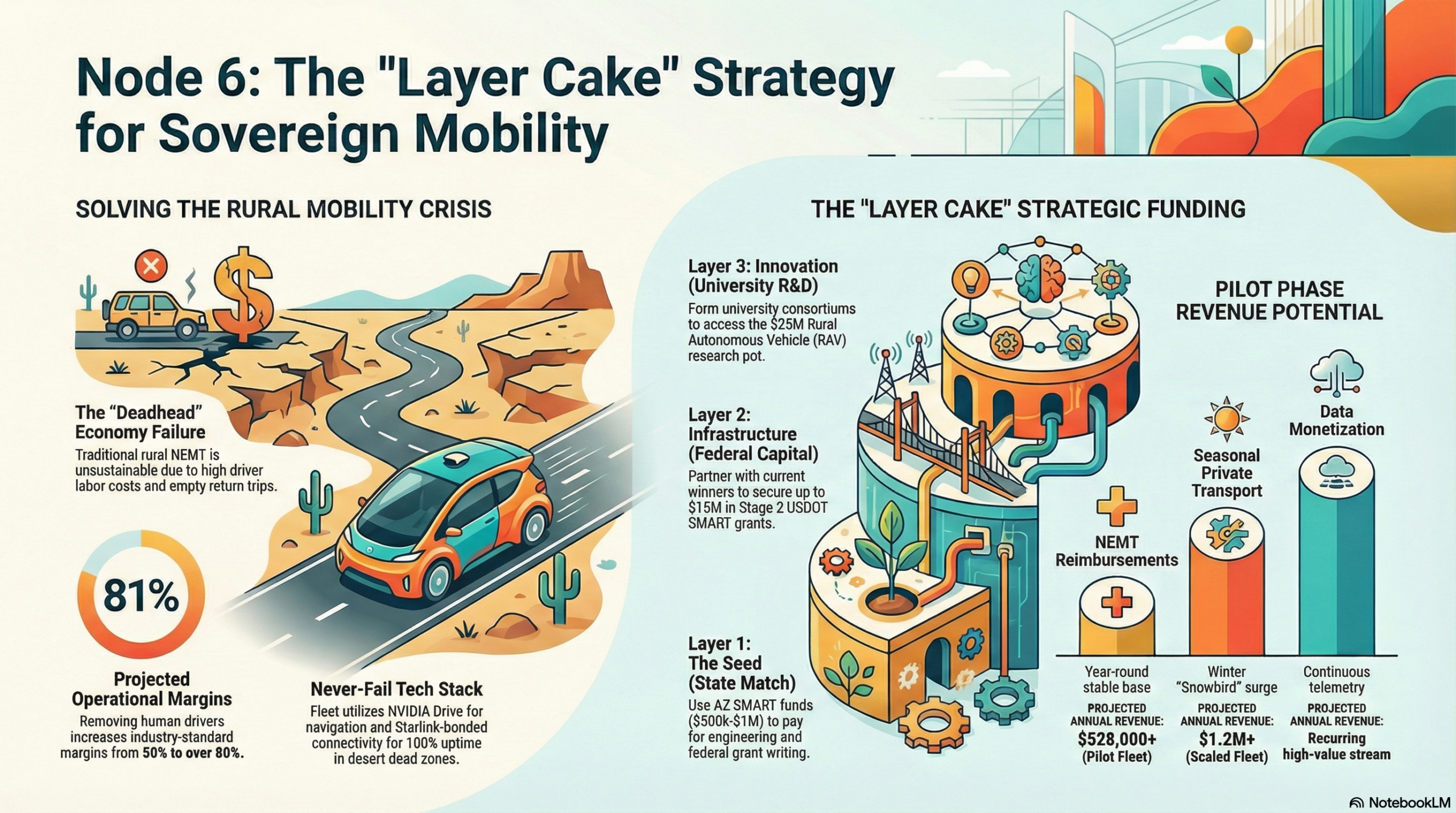
By decoupling transportation from labor and fossil fuels, Node 6 transforms rural transit economics. While industry-standard NEMT margins hover at 50%, the Kurb Kar fleet projects an 81% operating margin. This efficiency enables a projected 6-month CapEx recoup per vehicle, allowing for rapid scaling without equity dilution.
2. The ‘Layer Cake’ Funding Methodology
The “Layer Cake” approach is a multi-tiered, non-dilutive capital strategy designed to maximize the ROI of public dollars. This structure is essential for navigating the transition from state-level preparation to large-scale federal infrastructure and R&D. By sequentially capturing these funds, Node 6 de-risks each subsequent tier, ensuring the project is “Node 6 Ready” before high-stakes capital is deployed.
| Funding Layer | Primary Objective | Role in De-risking |
| Tier I: Seed (State) | Fund design, engineering, and professional grant-writing. | Provides mandatory matching funds and evidentiary data for federal asks. |
| Tier II: Infrastructure (Federal) | Acquisition of physical assets (hubs, towers, sensors). | Establishes the tangible “Sovereign Stack” grid required for scale. |
| Tier III: Innovation (Research/Ops) | Fund AI modeling, NEMT software, and operations. | Validates “Clinic-in-a-Box” tech and generates recurring data revenue. |
The catalyst for this architecture is Champion Brion Crum, “The Human Link.” Crum’s background in private equity and real estate—notably with Caliber Funds—provides the institutional credibility required to bridge high-tech innovation with physical asset management. His philosophy centers on the nexus of technology, capital, and real estate, positioning Node 6 as a financially compliant infrastructure project rather than a speculative tech pilot.
3. Tier I: The Seed Layer (Arizona State Preparation)
Tier I funding provides the “dry powder” necessary for sophisticated engineering and professional grant-writing services. These funds are the prerequisite for competing in the high-stakes federal implementation pool.
The primary vehicle for this layer is the AZ SMART Fund (State Match Advantage for Rural Transportation), administered by ADOT and the State Transportation Board. Node 6 will submit an “Ask” for $500k – $1M to finance the “La Paz Autonomous Corridor Feasibility Study.” This study will provide the data-driven basis required to prove the viability of autonomous transit in rugged desert environments to federal evaluators.
Node 6 will also leverage a strategic partnership with the Arizona Commerce Authority (ACA) and the Institute for Automated Mobility (IAM). By positioning Node 6 as the “Western Deployment Site” for the ACA’s existing statewide V2X (Vehicle-to-Everything) initiatives, the project “piggybacks” on existing state momentum rather than applying in isolation. This strategy creates the evidentiary basis required to unlock Tier II capital.
4. Tier II: The Infrastructure Layer (Federal Capital Grants)
Tier II focuses on the acquisition of physical assets—charging hubs, connectivity towers, and smart road sensors. This phase capitalizes on the federal mandate for “Rural Justice,” which prioritizes infrastructure development in underserved communities.
A cornerstone of this tier is the USDOT SMART Grants (Stage 2) strategy. To unlock the $15 Million implementation pool (typically reserved for Stage 1 winners), Node 6 will execute a “Stage 1 Partner Hack.” By partnering with an established Stage 1 winner, such as the Arizona Commerce Authority or Maricopa County DOT, Node 6 offers a rugged rural testbed to prove their existing technologies, bypassing the Stage 1 entry requirement.
Simultaneously, the project will capture the Charging and Fueling Infrastructure (CFI) Grant. By framing Kurb Kar depots as “Public Community Charging Hubs” located at senior centers and clinics, Node 6 specifically targets the 50% rural set-aside within the Community Program track. This physical infrastructure establishes the foundation for the advanced R&D activities in Tier III.
5. Tier III: The Innovation Layer (R&D and Operational Grants)
The Innovation Layer funds the “soft” infrastructure: AI modeling, NEMT operational software, and the software integration for the “Clinic-in-a-Box” diagnostic system.
- Rural Autonomous Vehicle (RAV) Research Program: Node 6 will lead a consortium with Arizona State University (ASU) or the University of Arizona (U of A) to capture a portion of this $25 Million pool. The research will focus on “safe integration in tribal and rural communities,” using the La Paz corridors as the primary test site.
- Federated Learning & Data Monetization: Every mile driven by the fleet generates high-value “edge case” data (e.g., navigating dust storms). This telemetry is verified via zkVerify and sold to global autonomous driving databases, creating a “Stream C” recurring revenue model.
- FTA Section 5311: Node 6 will seek designation as a rural public transit operator to secure annual formula grants for operational assistance.
- Enhancing Mobility Innovation (EMI): This grant will fund the integration of “Clinic-in-a-Box” sensors. This allows for the collection of patient vitals during the 45-minute drive to Parker, which are uploaded via Starlink to medical centers, transforming the commute into a preliminary check-up.
6. Strategic Regional Integration & Partnerships
Regional integration reduces Capital Expenditure (CapEx) by “overlaying” Node 6 technology onto existing public works projects.
- The Route 66 Centennial (2026): Node 6 will pivot to a “High-Tech Heritage” narrative, positioning itself as the modern evolution of the Mother Road. This includes a “Neo-Green Book” initiative, framing autonomous mobility as a tool for safety and civil rights for the elderly and disabled. The goal is “Official Centennial Project” status and the launch of a “Route 66 Green Corridor” pilot.
- Quartzsite Infrastructure Piggybacking: Node 6 will lobby the Western Arizona Council of Governments (WACOG) to include V2I sensors and smart communication nodes in the construction specifications for the Quartzsite Blvd widening and I-10 overpass projects before construction begins.
- The Colorado River “Blue Mobility” Connection: In partnership with the Colorado River Indian Tribes (CRIT), Node 6 will establish the “Parker to Pad” route. This connects the Blue Water Casino to medical centers, providing a safety link that mitigates drunk driving. This project will be an autonomous safety sensor overlay on the existing 25 Million Mohave Road Reconstruction Project**, tapping into the region’s **1.4 Trillion “Blue Economy.”
7. FY 2026 Implementation Timeline
The roadmap requires synchronized action between Node 6 leadership and regional gatekeepers to align with the regional Transportation Improvement Program (TIP).
| Quarter | Action Item | Target Grant / Initiative | Required Partners |
| Q1 | Engage WACOG & Align with TIP | AZ SMART Fund / TIP | WACOG, La Paz County |
| Q1 | Form Research Consortium | RAV Research Program | ASU or U of A |
| Q2 | Centennial Integration & Infra Bid | Route 66 Centennial / CFI | Route 66 Road Ahead, WACOG |
| Q3 | Secure Federal Infra Partnership | USDOT SMART (Stage 2) | Arizona Commerce Authority |
| Q3 | Joint Tribal Grant Submission | RAV Research Program | CRIT, La Paz County |
| Q4 | Secure Operational Operator Status | FTA Section 5311 | ADOT Transit Division |
Financial Impact Summary The pilot fleet (scaling from 2 to 10 vehicles) is projected to generate $528,000 – $1.2 Million+ in annual gross revenue through NEMT reimbursements and seasonal surge pricing. With an 81% operating margin, the project enables a 6-month CapEx recoup per asset.
Immediate Action Required Champion Brion Crum must immediately engage the WACOG Transportation Director to present the Node 6 Sovereign Mobility vision and secure formal alignment with the regional Transportation Improvement Program (TIP).