
• Skip to primary navigation
  • Skip to main content
DeReticular

DeReticular

Local Autonomy. National Security. Total Sovereignty.

  • Solutions
    • Municipalities
    • Energy
    • Industrial
    • Defense
  • Infrastructure
  • Intelligence
  • Company
  • Request Municipal Audit
  • Show Search
Hide Search
You are here: Home / Archives for Intelligence

Intelligence

Research Report: DeReticular and the Sovereign Infrastructure Ecosystem

Michael Noel · May 14, 2026 ·

1. Executive Summary

DeReticular (www.dereticular.com) is an artificial intelligence (AI) research and commercialization platform functioning as an industrial infrastructure conglomerate and venture studio[1][2]. Co-founded by Michael Noel in 2023[3], the company’s core mission is to solve the global vulnerability of traditional “linear” infrastructure—such as national electrical grids and centralized supply chains—by replacing it with “Spherical Resilience”[4][5]. Through Decentralized Physical Infrastructure Networks (DePIN), edge computing, and localized AI, DeReticular is engineering a future where municipalities, agricultural centers, and industrial parks operate with absolute digital and physical sovereignty[6][7].

2. Rural Infrastructure Operating System (RIOS)

The Rural Infrastructure Operating System (RIOS), often referred to as the “Sovereign Stack,” is DeReticular’s flagship software and hardware ecosystem[4][8]. It is designed to tackle the “last-mile” problem by delivering completely independent, off-grid utility and communications networks[8][9].

Key Features of RIOS:

  • Island Mode Autonomy: RIOS operates independently of centralized cloud servers, allowing communities and facilities to run critical functions (healthcare, data, energy) autonomously during broader grid or network failures[5][6][10].
  • Hardware Root of Trust: The network uses TPM 2.0 chips and Radio Frequency Fingerprinting to verify physical hardware and sensor data cryptographically. This establishes a “trustless” identity layer that protects against unauthorized physical or digital tampering[8][11].
  • Dual-Stack Architecture: RIOS integrates protocols like Hyphanet and the New Freenet[8]. Using Sysbox Enterprise container runtimes, the system establishes a hard isolation boundary between public uncensored communication access and securely regulated financial or industrial data[11].
  • Project Octagon: RIOS is currently being deployed via “Project Octagon,” a master strategy to build a planetary mesh of 8 sovereign infrastructure nodes—ranging from the Arizona desert to rural Uganda—replacing “dumb” centralized grids with intelligent, resilient data islands[5][12].

3. The RIOS Pilot Command Center

To establish these sovereign outposts efficiently, DeReticular has developed the RIOS Pilot Command Center, essentially an “Infrastructure-in-a-Box”[13]. This is heavily utilized in “Phase 0” (Landing Ready) deployment strategies[13].

Command Center Specifications:

  • Rapid Deployment: By utilizing ruggedized shipping containers acting as the initial site’s “digital brain” and primary management hub, the Command Center bypasses traditional local construction delays and vulnerabilities[13][14].
  • Self-Sustaining Energy: Standard modules deploy with a 150 kW Solar Array and a 400 kWh Battery Energy Storage System (BESS) to ensure 24/7 security, power, and connectivity[13].
  • Continuous Connectivity: It utilizes integrated Starlink Business Kits to link the localized micro-grid and sensor arrays back to the global DeReticular mesh via edge servers[13].

4. Sovereign Automation Product Line

The Sovereign Automation product line represents DeReticular’s transition from passive grids to localized, air-gapped AI management[15][16]. It is a suite of specialized hardware and AI agents built on the OpenClaw framework to run large language models and computer vision locally[17].

Product Line Highlights:

  • Specialized AI Agents: Offerings include The Field Medic, The Industrial Foreman, and The Sovereign Elector. These agents handle localized diagnostics, heavy machinery operation, agricultural systems, and secure voting terminal management[17][18].
  • Air-Gapped Privacy: Because the AI operates without a cloud connection (housed on ruggedized hardware like the Sovereign Sentry), it protects organizations from corporate espionage, latency issues, and external cyber-attacks[16][17].
  • Locutus Ledger Integration: Sovereign Automation inherently tracks and logs operations using the Locutus Ledger. This cryptographically records labor, audits, and maintenance records, creating a trustless bridge between digital directives and physical machinery[17].
  • Right-to-Repair: The ecosystem rejects restrictive proprietary lock-ins, operating on a unified “right-to-repair” philosophy that allows operators to fix and sustain their high-tech systems even in remote geographies[17].

5. Conclusion

DeReticular is pioneering a radical pivot in civic and commercial technology. Through the RIOS ecosystem, the immediate-deploy Command Centers, and the Sovereign Automation suite, the company is equipping industries, rural towns, and sovereign operators with the means to untether themselves from fragile national infrastructure[4][6][13][16]. Their work lays the physical and digital foundation for a new machine-to-machine economy rooted in cryptography, localism, and self-sufficiency[7][10].

Sourceshelp

  1. dereticular.com
  2. dereticular.com
  3. gbaglobal.org
  4. daosrus.com
  5. dereticular.com
  6. youtube.com
  7. youtube.com
  8. youtube.com
  9. dereticular.com
  10. youtu.be
  11. dereticular.com
  12. dereticular.com
  13. dereticular.com
  14. dereticular.com
  15. dereticular.com
  16. dereticular.com
  17. youtube.com
  18. kurbkars.com

Moving Minds: A Beginner’s Guide to Physical AI

Michael Noel · March 24, 2026 ·

1. The “Kinetic” Shift: What is Physical AI?

For decades, artificial intelligence has been a “brain in a jar”—a brilliant but paralyzed observer trapped behind digital screens and stationary servers. It could analyze data or generate text, but it couldn’t reach out and touch the world. Physical AI marks the moment that intelligence becomes kinetic. It is the transition from AI that merely “chats” to AI that moves, lifts, builds, and navigates the “cold steel” of our physical reality.

The “So What?”: Why does moving from screens to steel change the world? Because digital-only AI is an observer, but Physical AI is a participant. When intelligence is no longer tethered to a cloud, it can rebuild infrastructure, manage energy, and provide care autonomously. This shift moves us from a world of information to a world of autonomous action.

To make an AI move, we cannot rely on code alone. We need a “physical container”—a laboratory where digital logic is forged into machinery.

2. The Builder’s Laboratory: Where Digital Meets Steel

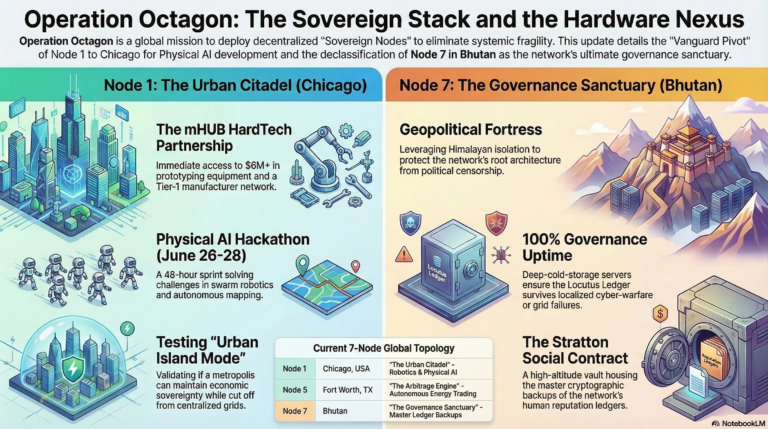
In the domain of “HardTech,” innovation requires more than just a laptop; it requires heavy industrial gear and a high-trust network. mHUB, Chicago’s premier innovation center, serves as the physical anchor for Node 1 (The Urban Citadel). It is the world’s epicenter for sovereign robotics, where the digital ledger meets the reality of manufacturing.

For the beginner, a HardTech hub provides the essential “Hardware Arsenal” to bridge the digital-to-physical gap:

ResourcePrimary Benefit for the Learner
Prototyping EquipmentAccess to $6M+ in gear (3D printers, CNC mills) to turn Wasm smart-contracts into physical joint movements.
The Talent RouterConnection to an elite network of builders and experts from institutions like MIT, UChicago, Purdue, and Northwestern.
Builder KitsAccess to Sovereign Keys and localized edge-compute boards to begin building the “Sovereign Stack.”
Tier-1 Manufacturer LinksDirect channels to partners like Baxter and Schneider Electric to scale a prototype into a fleet.

Once you have the steel, you need the “nervous system” to make the machine think and act without a leash.

Operation_Octagon_Hardware_NexusDownload

3. The Brains of the Machine: Sentry and Foreman

Physical AI requires a radical departure from traditional “Cloud AI.” To operate safely, a robot must be sovereign—meaning it cannot rely on a distant server that might fail. DeReticular provides the two-part “brain” for these machines:

  1. Sovereign Sentry (The Secure Brain): This localized server acts as the robot’s mind. Its core feature is “Island Mode.” Unlike “Cloud Dependency”—where a robot “dies” if AWS or Google goes offline—a machine in Island Mode remains fully operational and secure from external cyber-warfare. It is off-grid, autonomous, and untouchable.
  2. Industrial Foreman (The Physical Executor): If the Sentry is the “brain,” the Foreman is the “motor cortex.” This agent translates high-level logic into physical reality, routing power via industrial protocols and ensuring the machine moves its joints within safe thermal limits.

When a single robot is sovereign, the next hurdle is teaching it to play well with others in a complex environment.

4. Three Great Challenges: Making AI Play Well with Others

Building a machine that moves is only the beginning. To be useful, Physical AI must overcome three primary “HardTech” hurdles:

  • Swarm Coordination
    • Getting multiple robots to work together (e.g., transport or assembly) without a “Centralized Wi-Fi” master. They must communicate via decentralized edge-networks to ensure coordination even in interference-heavy environments.
  • Autonomous Mapping (The “Vault Warden” Protocol)
    • Robots must “see” a room and understand it. Using onboard sensors, they create semantic maps that label obstacles and humans, mimicking the Vault Warden security protocols used to protect high-value facilities.
  • Human-Robot Collaboration (“Cobots”)
    • This is about intuition. A “cobot” must learn to adapt to human gestures, speed, and unpredictable behavior, ensuring it can work alongside people in a workshop without causing accidents.

Solving these challenges allows us to deploy Physical AI to solve human problems in the real world.

5. Real-World Impact: Mobility and Beyond

Physical AI isn’t a future concept; it is already being deployed across the global mesh to defeat “Linear Fragility”—the tendency of centralized systems to fail under stress.

Node 6: The Circulatory System (Arizona) In La Paz County, Physical AI powers Sovereign Mobility. Using edge-based AI dispatching, autonomous systems provide Non-Emergency Medical Transportation (NEMT), ensuring people with disabilities have reliable, off-grid movement.

Node 4: The Sovereign Oasis (Uganda) In the African theater, Physical AI manages high-value eco-tourism and hospitality. These off-grid retreats use decentralized mesh networks to remain connected and operational, regardless of local infrastructure stability.

These machines provide the ability for goods and people to move freely, but they require a safety net to ensure they remain helpful.

https://academy.dereticular.com/podcast/remnant-ai-master-plan-for-physical-autonomy/

6. The Safety Net: Governance and the Ledger

Because moving machines carry real-world risks, they must be governed by immutable “laws.” Physical AI uses a decentralized governance structure to prevent misuse.

  • The Locutus Ledger: A cryptographic record that tracks every action a machine or builder takes. This creates an “immutable resume” and ensures total accountability for everything built within the network.
  • Node 7: The Governance Sanctuary (Bhutan): Located in the geographically isolated Himalayas, Bhutan serves as a geopolitical and digital fortress. It houses deep-cold-storage clusters that protect the “Stratton Social Contract”—the master blueprints for how these robots must behave. Even if an urban center faces a total cyber-attack, the “roots” of the system remain safe in the sanctuary.

3 Things to Remember About Physical AI Safety:

  • Island Mode is Sovereignty: Off-grid operation is the only way to ensure a robot cannot be hacked or disabled by a centralized authority.
  • Linear Fragility is the Enemy: Centralized systems are fragile; decentralized Physical AI is resilient and “spherical.”
  • The Ledger is Law: The Locutus Ledger ensures that the “Stratton Social Contract” is enforced by code, not just promises.

7. Summary: Joining the Revolution

Physical AI is more than just robotics; it is the ultimate manifestation of the Sovereign Stack. We are graduating from a world where intelligence is a tool we use on a screen to a world where intelligence is a kinetic force that builds, protects, and moves us.

We are no longer just writing software; we are building the machines that will build the future.

Beyond Big Ag: How the Sovereign Harvest is Recalibrating the Future of Farming

Michael Noel · March 23, 2026 ·

The Modern Farmer’s Digital Dilemma

Modern commercial agriculture faces a visceral crisis of dependency. Leading equipment manufacturers have designed tractors that literally refuse to run if they lose their cellular handshake with a proprietary remote server. Meanwhile, sensitive yield data is harvested by tech monopolies to be sold to commodities traders, leaving the producer as a mere tenant on their own land.

This reliance creates a critical failure point: when the macro-internet drops or cellular signals fail in remote acreage, automated irrigation and precision planting grind to a halt. The “Sovereign Harvest” Agro-Industrial Package is an architectural intervention against this centralization. It is a comprehensive, air-gapped operating system designed to return control of data and machinery to the individual producer.

Total Air-Gapped Autonomy

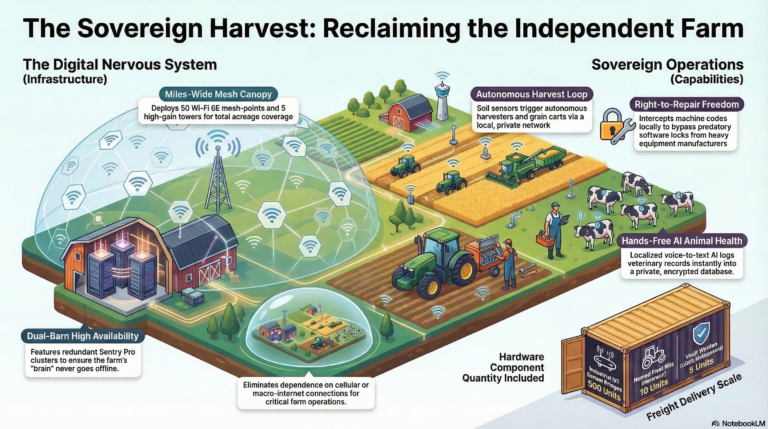
The foundation of the Sovereign Harvest is an “un-killable” digital nervous system that functions entirely independently of the global internet. By deploying 50 Nomad Mesh-Points for Wi-Fi 6E and five High-Gain LoRaWAN towers, the system creates a miles-wide private intranet canopy. This infrastructure ensures that every corner of the operation remains connected without ever touching an external provider’s network.

To solve the “Field Dead Zone” problem, the Nomad Fleet Kits utilize a “Tractor-as-a-Relay” functionality. As heavy machinery moves through rolling hills or dense tree lines, the kits act as mobile mesh repeaters, caching IoT sensor data and blasting it back to the core clusters once they return to range. This ensures a continuous flow of data even in the most remote geographical pockets.

It guarantees that the farm’s most valuable assets—its yield data, genetic records, and operational capability—remain strictly the property of the farmer.

Sovereign_HarvestDownload

The Return of the “Right to Repair”

The Sovereign Harvest provides a technical emancipation from predatory manufacturer software locks and proprietary monopolies. The package includes ten Nomad Fleet Kits that interface directly with the CAN Bus and ISOBUS ports of heavy machinery from major manufacturers like John Deere and Case IH. This allows the producer to intercept, manage, and clear machine codes locally rather than through a remote manufacturer portal.

By hosting a localized Root Certificate Authority (CA) on the Sentry Pro Clusters, the farm generates its own secure identity. This shifts the power dynamic from the manufacturer back to the owner, allowing for the maintenance of heavy equipment over a private network. It effectively transforms a software-locked tractor back into a tool that the owner truly possesses and controls.

The Autonomous Harvest Loop

The system facilitates a sophisticated “Autonomous Harvest Loop” that functions with zero human intervention and zero cellular reliance. This workflow is managed by 500 Industrial Foreman Micro-Nodes acting as field IoT bridges, reporting soil conditions to the “Deep Admin” core. Once the AI identifies optimal harvest conditions, it coordinates the machinery fleet using purely local mesh communication.

Security is paramount in this autonomous environment, where “machinery hijacking” remains a theoretical threat for centralized systems. To mitigate this, every kinetic steering command requires strict X.509 signature verification at the hardware level. Any unsigned or spoofed packets are instantly dropped and flagged by the Deep Admin, ensuring the autonomous fleet remains un-hackable.

AI as a Veterinary Assistant

The package introduces “Hands-Free Animal Healthcare” through localized “Sovereign Executive” AI agents. In the barn, a Sovereign Sentry node utilizes localized Whisper AI to provide voice-to-text dictation for ranchers during physically demanding tasks. This allows for real-time data entry during calving or examinations without requiring the rancher to touch a screen or keyboard.

A rancher can simply dictate observations—such as “Tag 4092, exhibiting lethargy, administered 10cc antibiotic”—and the system extracts the data automatically. This information is then logged into an encrypted, air-gapped PostgreSQL database. By using these localized OpenClaw agents, the system ensures that valuable genetic and health records remain private assets rather than corporate data points.

Spectral Eyes and Volumetric Security

The “Vault Warden” modules provide high-level security and agronomic insights through localized edge processing on Sentry Pro Clusters. These modules use 3D LiDAR to monitor grain silo volumes and secure perimeters against unauthorized breaches. Simultaneously, multispectral PTZ cameras perform “Spectral Provenance” on crop canopies to detect issues before they are visible.

These cameras are capable of identifying nitrogen deficiency or blight early in the growth cycle, allowing for surgical applications of nutrients. By processing this multispectral data locally, the system provides immediate intelligence without the latency or privacy risks of cloud-based analysis. This turns the farm into a self-sensing environment where the data is refined on-site into actionable strategy.

The Future of Sovereign Food Production

The “Sovereign Harvest” Agro-Industrial Package represents an $85,999 turnkey investment in absolute agricultural independence. The value is anchored by the Agri-Fleet Master License and a unique cryptographic SHA-256 key that unlocks a private, decentralized infrastructure. This setup provides a scalable blueprint for producers to exit the proprietary ecosystems of Big Ag once and for all.

As global supply chains and digital infrastructures become increasingly fragile, the resilience of the individual producer is more important than ever. This shift toward self-hosted, air-gapped systems suggests a new paradigm for the entire industry. One must wonder: does the future of global food security ultimately depend on the decentralization of the technology used to grow it?

Procedural Concept Map: The Journey of Autonomous Energy

Michael Noel · March 17, 2026 ·

1. Introduction: The Vision of the Resilient Microgrid

The modern power landscape is defined by “fragile dependency”—a precarious reliance on legacy centralized architectures that are vulnerable to systemic failure, economic volatility, and physical disruption. When the macro-grid fails, traditional solar installations often become useless, lacking the intelligence to operate without a reference signal from the utility. The Resilient Microgrid Utility Bundle is engineered to catalyze a transition toward “anti-fragile community resilience,” where energy is no longer a centralized commodity, but a locally managed, sovereign resource.

By deploying edge-compute hardware at the residential and municipal level, communities can link disparate solar and battery assets into a unified, self-governing network. This system allows for the autonomous capture, translation, and sharing of power, ensuring that critical infrastructure remains energized through local intelligence rather than remote permission.

Primary Goal: To transform fragmented hardware into a unified, sovereign energy network that autonomously negotiates local power distribution, eliminates waste via intelligent load routing, and maintains operational continuity during total macro-grid or internet failures.

This journey from raw solar potential to community-scale resilience begins with the physical interface between the system’s “brain” and the electrical hardware.


https://academy.dereticular.com/podcast/autonomous-solar-sharing-through-neighborhood-microgrids/

2. Phase I: Physical Interfacing (The Senses)

Before intelligent negotiation can occur, the system must establish high-fidelity “senses” to monitor energy states. This requires a physical interface between the Sovereign Sentry node and the site’s solar hardware.

ComponentFunctionResilience Benefit
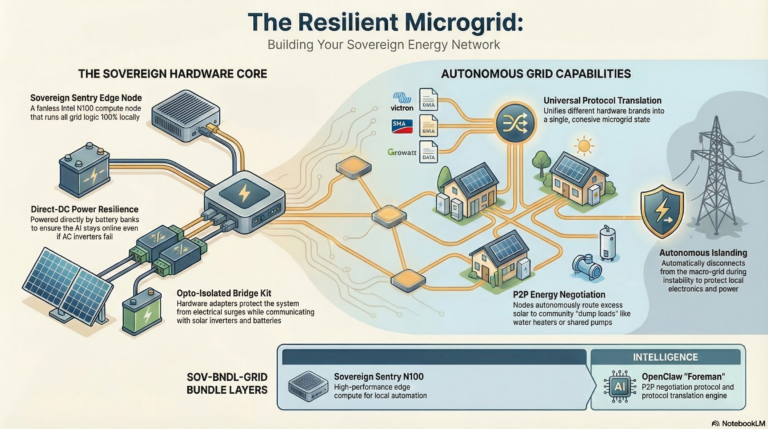
Sovereign Sentry NodeIndustrial Edge Compute (Intel N100, 16GB RAM, 500GB NVMe) running RIOS Core.Local execution of AI and logic; eliminates cloud latency and “kill-switch” dependencies.
Solar/Battery Bridge KitOpto-isolated RS485 and CAN Bus adapters for inverter/BMS communication.Physical opto-isolation protects the Sentry brain from high-voltage surges up to 3kV.
DC-DC Step-Down ConverterRuggedized 12V/24V/48V to Sentry power interface.Allows the “brain” to run directly off the battery bank, bypassing AC inverter failures.

By wiring the system directly to the DC battery bank, the architect ensures that the intelligence layer survives even if the primary AC power electronics fail.

——————————————————————————–

3. Phase II: Protocol Translation (The Universal Language)

Legacy hardware manufacturers utilize proprietary “languages” that prevent interoperability. A Growatt inverter cannot natively coordinate with a Victron or SMA system. The OpenClaw Foreman agent solves this by acting as a hardware-agnostic translator, abstracting the physical layer into a unified data model.

The Transformation Engine:

RAW SIGNALS [Modbus RTU / CAN Bus] \rightarrow FOREMAN ENGINE [Scan / Map / Translate] \rightarrow UNIFIED STATE [Local Dashboard]

Future-Proofing through Abstraction: The Foreman agent performs an automated “Discovery Phase,” scanning connection ports and loading register maps for brands including Victron, SMA, Growatt, EG4, and Sol-Ark. This software layer ensures the microgrid is future-proof; as a community adds new hardware generations over the next decade, the Foreman simply adds new maps to the unified state, maintaining cohesive operation across disparate hardware ecosystems.


Sovereign_Microgrid_BlueprintDownload

4. Phase III: Mesh Networking (The Community Conversation)

Resilience is compromised if the system requires the global internet—a primary point of failure—to function. Instead, the Sentry node establishes a presence on a local town mesh network via Wi-Fi or LoRaWAN to facilitate sovereign communication.

  1. Identity Minting: The node utilizes a Cryptographic Node Key (a unique SHA-256 hash) to unlock the local Docker runtime and initialize its services.
  2. Sovereign Verification: The node presents its X.509 Mesh Identity Certificate to the network. This digital passport establishes a hardware root of trust, ensuring only verified nodes can participate in the energy mesh.
  3. Discovery Phase: The Sentry pings the local mesh to identify neighboring Foreman nodes at local farms, residences, or municipal buildings.
  4. Mesh Peering: A secure P2P connection is established, allowing nodes to share State-of-Charge (SoC) metrics without data ever leaving the local community network.

——————————————————————————–

5. Phase IV: The Negotiator Protocol (The Decision Engine)

The Grid Negotiator Protocol is the system’s autonomous decision engine. It replaces passive consumption with active, strategic energy management using P2P logic.

Scenario: The Farm and the Clinic

  • The Situation: It is 1:00 PM on a clear day. Node A (a local farm) has reached 100% battery capacity. Under legacy architectures, this excess solar would be wasted or sold back to the utility for pennies. Meanwhile, Node B (the town clinic) is experiencing high demand and rapidly depleting its batteries.
  • The Negotiation: Node A’s Negotiator Protocol detects Node B’s low State-of-Charge over the mesh. It initiates a P2P trade.
  • The Outcome: Node A triggers a local smart relay to route its excess production into a shared community asset—such as the clinic’s thermal water boiler. The energy is “stored” as heat, providing immediate utility to the clinic and maximizing the community’s total energy harvest.

——————————————————————————–

6. Phase V: Routing and Dump Loads (The Action)

The final phase translates digital decisions into physical movement of energy. Using the Node-RED Logic Engine, the system executes one of two primary “Action Modes”:

  • Dump Load Routing: This is the primary mechanism for community anti-fragility. When primary batteries are full, the system redirects excess energy to “non-critical” but essential loads, such as agricultural pumps or communal thermal storage, rather than curtailing production.
  • Autonomous Islanding: This is the system’s defensive posture. If the Foreman detects macro-grid frequency anomalies or brownouts, it instantly commands the inverter to disconnect. The home “islands” immediately, running exclusively on local solar/battery power to protect sensitive electronics and maintain stability.

——————————————————————————–

7. System Safeguards (The Shield)

To maintain the integrity of the microgrid, the system utilizes an industrial-grade security matrix to mitigate electrical, mechanical, and digital threats.

Risk IDThreatConsequenceAutomated Defense
R-VOLT-01Ground Loops / SurgesHigh-voltage shorts “frying” the Sentry brain.Opto-isolation: 3kV physical barrier on all RS485 communication lines.
R-LOG-01Relay ChatterRapid state-switching from cloud cover wearing out mechanical relays.Hysteresis Enforcement: Node-RED logic strictly mandates a 5-minute minimum state-hold.
R-SEC-01Grid SpoofingMalicious actors broadcasting fake data to steal community energy.Hardware Root of Trust: X.509 certificates ensure only verified nodes can negotiate loads.

Final Synthesis: The transition from a passive consumer to a Sovereign Powerhouse is achieved by integrating these five phases into a single, cohesive architecture. By decoupling energy management from failing state infrastructure and moving intelligence to the edge, the Resilient Microgrid Utility Bundle does more than provide power—it provides community-scale autonomy. Through hardware abstraction, local mesh communication, and P2P negotiation, we replace fragile dependency with a self-healing, anti-fragile energy reality.

The Municipal Citadel: A Student’s Guide to Autonomous Physical Defense

Michael Noel · March 17, 2026 ·

1. Introduction: The Shift from Surveillance to Autonomous Defense

Learning Objective: Understand the architectural shift from cloud-dependent surveillance to edge-based autonomous defense and the role of “Island Mode” in critical infrastructure.

In the current security landscape, most commercial solutions rely on “Cloud-Native” architectures (e.g., Ring, Verkada). While these provide ease of access, they introduce unacceptable latencies and vulnerabilities for high-value municipal assets. For a police evidence room or a credit union vault, a dependency on external servers means security is tethered to internet uptime and the integrity of a third-party data center.

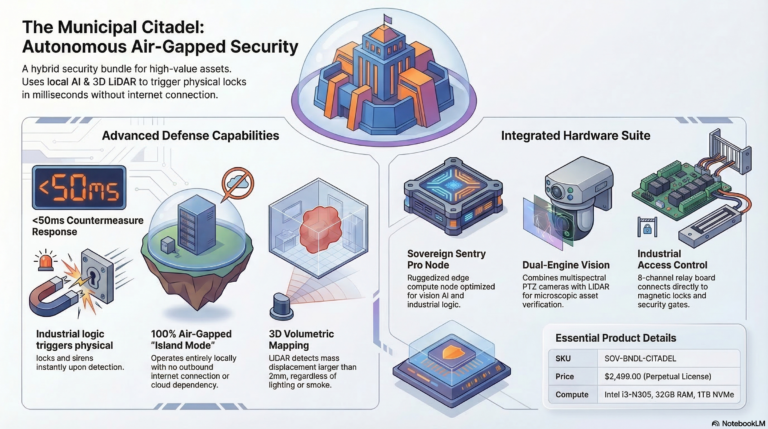
The Municipal Citadel Security Bundle is designed as a “Sovereign” alternative. It is a completely air-gapped system that operates in what we term “Island Mode.” By utilizing a specialized license bypass for the Provada Locutus Daemon, the system functions indefinitely without pinging an external ledger. This ensures that the defense posture remains intact even during total network isolation or targeted cyber-attacks on municipal infrastructure.

High-value security requires “Sovereign Automation”—the ability for a system to sense, think, and act without human or cloud intervention. When protecting assets like town archives or forensic evidence, the intelligence must reside at the edge. This eliminates the “Cloud Latency Gap,” moving response times from minutes to milliseconds and ensuring that physical defense is governed locally and absolutely.

To appreciate the effectiveness of this posture, we must first examine the specialized hardware that serves as the system’s high-fidelity sensory array.


Sovereign_Microgrid_BlueprintDownload

2. The Sensory Array: Seeing Beyond Human Limits

Technical Summary: Students will analyze how 3D LiDAR and Multispectral imaging provide a data-rich environment that is immune to standard visual countermeasures.

Traditional CCTV is easily defeated by environmental factors like smoke, darkness, or blinding lasers. The Provada Sentinel Kit overcomes these limitations by moving beyond the visible light spectrum. The array utilizes laser-based volumetric scanning and microscopic pigment analysis to maintain a “Sovereign” eye on the environment.

Sensor TypeUnique Capability
3D PointPillars LiDAR ModuleEmits rapid laser pulses to create a real-time 3D mesh of the room. It detects volumetric mass displacement as small as 2mm and is entirely immune to smoke, total darkness, or lens-blinding lasers.
Multispectral PTZ CameraAnalyzes light beyond the human eye to perform “Archive Defense.” It verifies asset provenance by zooming in on microscopic pigment and weave patterns to ensure high-value items haven’t been swapped for forgeries.

These sensors do not merely record; they provide a continuous stream of high-frequency telemetry. This raw data is fed into a localized “brain” for immediate inference.

——————————————————————————–

3. The Compute Core: Where Vision Becomes Intelligence

Technical Summary: An exploration of the Sovereign Sentry Pro’s role as a ruggedized edge-compute node and the implementation of Zero-Trust hardware binding.

The “brain” of the Citadel is the Sovereign Sentry Pro, a ruggedized edge node designed for high-compute density in harsh environments. Architecturally, we utilize the Intel i3-N305 and 32GB of RAM specifically to handle multiple “concurrent vision AI” threads. This allows the system to process YOLOv8-spectral and PointPillars-LiDAR algorithms simultaneously without the latency spikes that would occur on lesser hardware.

To ensure a “Zero-Trust” environment, each LiDAR and PTZ unit is bound to the Sentry Pro’s specific MAC address during the provisioning phase. This hardware-level handshake prevents “man-in-the-middle” sensor spoofing. The software environment is delivered via containerized images (Docker/Podman), ensuring a modular and resilient stack:

  • Vault Warden (Container): The primary inference engine. It executes YOLOv8-spectral-custom and pointpillars-lidar-3d logic to maintain the environmental baseline.
  • OpenClaw “Foreman” (Container): The industrial logic layer. It manages Node-RED flows that translate AI “Threat” flags into physical GPIO (General Purpose Input/Output) commands.
  • Local Dashboard: A local-only Web GUI used for the “Golden State” calibration, where the user defines the “Safe Zone” and establishes the baseline volumetric and spectral state of the room.

Once the compute core identifies a breach, it must physically interact with the environment to neutralize the threat.

——————————————————————————–

4. Closing the Loop: Industrial Relays and Physical Actuators

Technical Summary: Understanding the role of opto-isolation in protecting logic circuits during high-voltage physical intervention.

The transition from digital detection to physical defense occurs via an Opto-isolated 8-Channel Industrial Relay Board. As architects, we specify “opto-isolation” to protect the Sentry Pro’s sensitive compute components from the inductive kickback and voltage spikes common in heavy 12V/24V actuators like magnetic locks and industrial sirens.

The Chain of Command (Digital to Physical):

  1. Inference: Vault Warden identifies a volumetric displacement exceeding the 2mm threshold.
  2. Logic: The Foreman container processes the “Critical Threat” flag and triggers a specific GPIO pin.
  3. Isolation: The signal passes through the opto-isolator, completing the circuit on the relay board.
  4. Actuation: Power is cut to the magnetic locks (Fail-Safe) or engaged for sirens and security gates, physically sealing the perimeter.

This hardware-software fusion allows for a response speed that is physically impossible for human-operated or cloud-tethered systems.

——————————————————————————–

5. The Anatomy of a Response: The 50-Millisecond Breach Protocol

Technical Summary: Examining the low-latency architecture required for sub-second autonomous response.

In a traditional security breach—such as an intruder cutting through a ceiling—a cloud-based system must upload footage, wait for a server to process the alert, and then notify a human. This process can take minutes. The Municipal Citadel achieves a 50-millisecond response by bypassing the “Provada Ledger” and writing all telemetry directly to a high-speed 1TB NVMe drive, creating an unhackable, air-gapped audit trail.

The “Speed of Security” Timeline:

  • T+0ms: LiDAR detects a >2mm volumetric change (intruder entry).
  • T+10ms: Vault Warden completes inference and passes the threat flag to the Foreman.
  • T+35ms: Foreman logic confirms the zone is “Armed” and triggers the relay board via USB-to-GPIO.
  • T+50ms: Magnetic locks drop; the room is physically sealed.
  • Post-Event: All 3D telemetry and spectral logs are secured on the local encrypted NVMe for physical retrieval and forensic audit.

——————————————————————————–

6. Safety, Redundancy, and Maintenance

Technical Summary: Integrating life safety protocols and secondary communication fail-safes into an autonomous posture.

Autonomous defense must be balanced with life safety and operational continuity. The Municipal Citadel addresses these through a combination of hardware-level fail-safes and secondary redundant links.

ThreatMitigation Strategy
Targeted Power CutThe Sentry Pro runs on 12V DC and is supported by a local UPS. If the primary LAN is severed, an optional Nomad LTE link provides a secondary path for emergency alerts.
Fire Code ViolationLife Safety Logic: The system must be wired in a “Fail-Safe” configuration tied directly to the building’s legacy fire panel, ensuring all magnetic locks release during a fire alarm regardless of AI state.
Janitorial/False TriggerAuthorized staff utilize a Sovereign Maintenance Key—a cryptographic SHA-256 USB hardware key—to place the system into “Maintenance Mode” for safe entry.

The fusion of high-frequency LiDAR, multispectral authentication, and opto-isolated industrial logic creates a “Sovereign” security posture, providing the community with a self-contained, intelligent fortress for its most vital assets.

  • Page 1
  • Page 2
  • Page 3
  • Interim pages omitted …
  • Page 8
  • Go to Next Page »

DeReticular

Copyright © 2026 · Monochrome Pro on Genesis Framework · WordPress · Log in