• Skip to primary navigation
  • Skip to main content
DeReticular

DeReticular

Local Autonomy. National Security. Total Sovereignty.

  • Solutions
    • Municipalities
    • Energy
    • Industrial
    • Defense
  • Infrastructure
  • Intelligence
  • Company
  • Request Municipal Audit
  • Show Search
Hide Search
You are here: Home / Archives for Transportation

Transportation

Global Aircraft Maintenance and Spare Parts Strategic Briefing 2026

Michael Noel · February 11, 2026 ·

Executive Summary

The global aircraft maintenance and spare parts industry—frequently termed the “aftermarket”—is currently navigating a “super-cycle” of demand. This phenomenon is driven by a paradox: record-breaking air travel demand occurring simultaneously with historic delays in new aircraft production from major OEMs like Boeing and Airbus. Consequently, the global commercial fleet age has increased from 14 years in 2019 to 16 years in 2025, necessitating heavier maintenance cycles and a surge in part replacements.

The landscape is defined by two critical shifts:

  1. Regulatory Tightening: The FAA Reauthorization Act of 2024 has closed significant historical gaps regarding foreign repair stations, mandating unannounced inspections and drug testing. This has shifted the market opportunity from identifying regulatory “loopholes” to providing compliance solutions for the nearly 1,000 FAA-certified foreign facilities.
  2. The Traceability Premium: Following the massive AOG Technics counterfeit parts scandal, “Back-to-Birth” traceability has become the industry’s new premium currency. Systems that can verify the authenticity of Used Serviceable Material (USM) and Parts Manufacturer Approval (PMA) components are essential for operational safety and regulatory adherence.

The Global Maintenance Landscape

The aviation industry has seen a decadelong shift of major maintenance work to foreign territories, including China, Singapore, El Salvador, and Mexico. While this transition initially targeted cost reduction, it created a “Global Industrial Maintenance Complex” that is increasingly difficult to oversee.

Outsourcing Trends and Infrastructure

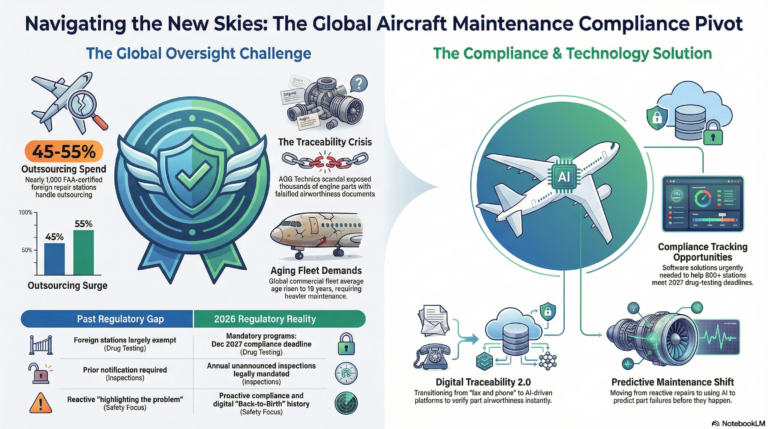
  • Scale of Outsourcing: Maintenance outsourcing rose from 20% in 1990 to approximately 47% in 2016, a trend that has stabilized with 45–55% of maintenance spend currently sent to external providers.
  • Facility Growth: There are currently approximately 977 FAA-certified foreign repair stations worldwide, a significant increase from the 731 reported in previous decades.
  • Geographical Distribution:
    • China: 78 facilities
    • Singapore: 54 facilities
    • Brazil: 22 facilities
    • Thailand: 6 facilities
    • Costa Rica: 3 facilities
    • El Salvador: 2 facilities

The Oversight Challenge

Historically, the “Inspection Challenge” involved oversight across vast distances—such as inspectors in Los Angeles managing facilities in Beijing (6,500 miles away). Prior to 2024, the “element of surprise” was often compromised by requirements for foreign government permission and visa notifications.

Fake Parts and Cannibalized Jets

Regulatory Evolution: FAA Reauthorization Act of 2024

Recent legislative updates have fundamentally altered the legal reality for foreign repair stations. The focus for 2026 and beyond is assisting these stations in meeting new, stringent deadlines.

Regulatory AreaHistorical StatusCurrent Reality (Post-2024/2025)Compliance Deadline
Drug & Alcohol TestingForeign stations were largely exempt.Final Rule (Dec 2024) requires testing programs.December 20, 2027
Surprise InspectionsLogistically impossible; required notification.Annual unannounced inspections are now mandated.Ongoing (Active)
FAA CertificationDiscrepancies in mechanic certification.Stricter oversight and push for standardized qualifications.Ongoing

The 2026 Spare Parts Market

The aircraft spare parts market is experiencing unprecedented growth, with the total market (OEM + Aftermarket) estimated at 723.8 billion in 2025**, projected to reach **1.06 trillion by 2032 (CAGR ~5.6%).

Critical Market Dynamics

  • The “Parts Drought”: Lead times for new OEM parts often exceed 12 months, leading to a shortage of “rotables” like landing gear and avionics.
  • Used Serviceable Material (USM): Valued at $7.6 billion in 2025, USM is 30–40% cheaper than new parts and supports “Circular Economy” goals.
  • Parts Manufacturer Approval (PMA): These third-party parts are gaining mainstream acceptance due to OEM shortages, with an expected annual growth rate of 7.8%.
  • Supply Chain Inflation: Spare parts inflation (2.5–3.5%) is significantly outstripping the inflation rate for new aircraft (1.1%).

The AOG Technics Scandal

A major fraud scandal involving a UK-based broker, AOG Technics, exposed the industry’s vulnerability to counterfeit components. Thousands of engine parts for the CFM56 engine were sold with falsified airworthiness documents. This has led to:

  • Global grounding and inspection mandates.
  • Slower processing times for part certification.
  • A “dirty fingerprint” trail requirement for all documentation.
Aerospace_Verification_2027Download

Technological Solutions and Business Opportunities

The complexities of the “Global Industrial Maintenance Complex” provide significant opportunities for technological intervention, particularly in tracking and making sense of the supply chain.

Strategic Solution Areas

  1. Enhanced Traceability: Systems must verify FAA Form 8130-3 (Airworthiness Approval Tag) and maintain “Back-to-Birth” history to mitigate fraud.
  2. Compliance Tracking: Automating the transition for foreign stations to meet the 2027 drug and alcohol testing deadline.
  3. Remote Inspection Technologies: Utilizing IoT and Augmented Reality (AR) to facilitate virtual oversight where geographical barriers remain.
  4. Predictive Maintenance: Leveraging AI and data analytics to shift from reactive to predictive purchasing, reducing Aircraft on Ground (AOG) time.
  5. Digital Marketplaces: Transitioning from “fax and phone” trading to blockchain or AI-verified platforms for price transparency.

Emerging Sector Integration

New aviation technologies, such as the electric eVTOL aircraft developed by Beta Technologies, require specialized maintenance training and standardized mechanic certification. Additionally, automated logistics solutions, such as the “DeReticular” drone systems for part delivery, are becoming integral to the “Just-in-Case” inventory model.

Funding and Commercialization Strategy

Developing data tracking and maintenance solutions aligns with Small Business Innovation Research (SBIR) and Small Business Technology Transfer (STTR) programs.

Current SBIR/STTR Status (As of February 2026)

  • Authorization Lapse: The SBIR/STTR program authorization lapsed on October 1, 2025.
  • Impact: Standard solicitation cycles (e.g., DoD 26.1) are currently paused or delayed.
  • Recommendation: Organizations must monitor the Defense SBIR/STTR Innovation Portal (DSIP) for interim schedules rather than relying on historical January/April/August cadences.

Key Partnership Opportunities

  • Beta Technologies (Vermont): A prime candidate for maintenance training and certification standardization projects.
  • Vermont Manufacturing Extension Center (VMEC): An essential partner for manufacturing and supply chain optimization.
  • Department of Transportation (DOT): Potential funding source for innovations enhancing transportation safety and infrastructure tracking.

Strategic Dossier: Commercializing the RIOS Sovereign Stack

Michael Noel · February 10, 2026 ·

1. The Thesis of Sovereign Infrastructure: Beyond Linear Fragility

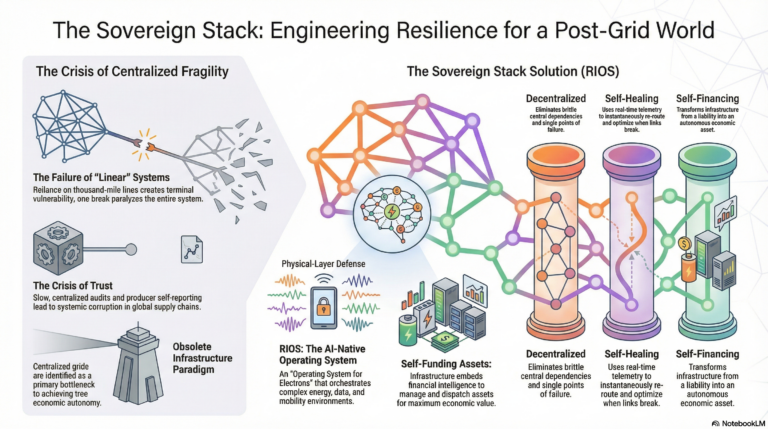
The verdict is absolute: the old grid is not just failing; it is obsolete. We are currently witnessing the terminal state of Linear Fragility—a paradigm where centralized, thousand-mile power lines and opaque, distant data centers create a catastrophic “Crisis of Trust.” In this “Reticular” model—defined by complexity and single points of failure—international buyers cannot verify producer data, and a single localized break paralyzes the entire system. To ensure economic autonomy and global survival, we must execute a doctrine of survivability through Sovereign Infrastructure.

The DeReticular architectural philosophy is the only viable antidote to this collapse. By moving away from reticular dependence, we transform infrastructure from a liability into a high-performance economic asset via three core pillars:

  • Decentralized: Every node is an intelligent, self-sufficient entity—from energy storage to edge compute—eliminating brittle central dependencies.
  • Self-Healing: Systems utilize real-time global telemetry to instantaneously re-route and self-diagnose, achieving true anti-fragility.
  • Self-Financing: Financial intelligence is embedded into the edge, allowing nodes to autonomously manage and dispatch assets to maximize financial value.

This shift delivers Spherical Resilience—a 360-degree defense against systemic failure. Its strategic advantages include:

  • Terminal Independence: Continuous operation regardless of external grid or satellite uplink status.
  • Guaranteed Truth: Elimination of “Garbage In” data through un-spoofable, physical-layer verification.
  • Hard Isolation: Using Sysbox Enterprise to create a logical and physical jail, ensuring public traffic never touches regulated industrial or financial ledgers.
  • Community Sovereignty: Preventing external financial extraction by keeping asset ownership local.

The operational engine driving this transformation is the Rural Infrastructure Operating System (RIOS), the platform for the next century’s electrons, data, and mobility.

——————————————————————————–

2. The Platform Shift: From Hardware Manufacturer to RIOS Operator

Sovereign_Stack_Post_Grid_ArchitectureDownload

We are executing a strategic pivot from a hardware manufacturer building physical containers to a Platform Operator. DeReticular is now the architect of the global operating system for sovereign utility. By providing the RIOS Sovereign Stack, we allow third-party founders to build vertical-specific logic on top of a resilient foundation. This is “Civilization in a Box” as a service.

The software backbone integrates a “Dual-Stack” approach, bridging the legacy decentralized web with next-generation performance.

FeatureHyphanet (Classic)New Freenet (Locutus)
Primary GoalExtreme anonymity & static storageScalable platform for decentralized apps
Language/TechJava & Encrypted File StoresRust & WebAssembly (Wasm) Contracts
Content TypeStatic (mostly “Freesites”)Dynamic (Real-time chat, social feeds)
Primary Industrial Use CaseWhistleblowing, Deep Archiving (8TB NVMe)Dynamic DApps, real-time coordination

The Wasm Advantage makes the network programmable through smart contracts, while Conflict-free Replicated Data Types (CRDTs) solve the simultaneous update problem. For industrial operations, this is the “So What?”: it enables real-time, decentralized coordination (like the “River” chat protocol) without a central server. These protocols are secured within the hardware stack, providing the “Hard Isolation” required for Sovereign Banking.

——————————————————————————–

3. The “Hardware Oracle”: Guaranteeing Physical Truth at the Edge

https://academy.dereticular.com/podcast/dereticular-sovereign-infrastructure-and-the-rios-ai-stack/

Decentralized infrastructure faces the Transparency Paradox: to attract institutional capital, projects must provide verifiable proof of operation, yet traditional audits are slow, corruptible, and expensive. The RIOS solution is the Automated Notary—a system that replaces human trust with machine-verified truth.

Our Physical-Layer Defense deconstructs the hardware oracle into three un-spoofable layers:

  1. Radio Frequency Fingerprinting (RFF): Verifying device identity via unique physical hardware signatures that cannot be cloned by software.
  2. TPM 2.0 (Trusted Platform Module): Cryptographically signing “HempGrade” industrial data within the physical chip; the private keys never leave the hardware.
  3. L3 Horizen Verification: Remote attestation quotes—digital receipts signed by the hardware—are verified on-chain to prove the integrity of the operation without exposing raw data.

This stack is reinforced by an 8TB NVMe datastore for deep archiving and AoA/TDoA (Angle of Arrival/Time Difference of Arrival) telemetry. This allows the system to instantly locate and identify hostile signals in the physical airspace, defending the node from both digital and kinetic threats. This eliminates “Garbage In” attacks and provides the verified truth necessary for Real World Asset (RWA) tokenization.

——————————————————————————–

4. The Real World Asset (RWA) Engine: Tokenizing Industrial Utility

The RWA Engine is the bridge between physical output and decentralized finance (DeFi) liquidity. We are leveraging the CFTC-driven Digital Asset Pilot Program to move toward a model of Sovereign Banking. Every RIOS node acts as a regulatory-compliant engine that tokenizes industrial utility—turning kilowatt-hours and graded commodities into liquid assets.

In this model, infrastructure becomes Self-Financing:

  • Asset Autonomy: Because the node can verify its own output via the Hardware Oracle, it can autonomously manage and dispatch resources to maximize yield.
  • Extraction Resistance: This model replaces extractive “Mega Church Vacuum” financial models with community-owned systems that finance their own maintenance and expansion.

By embedding financial intelligence into edge nodes, we ensure that the value generated by local infrastructure stays within the local community, managed by the very systems that produce it.

——————————————————————————–

5. Blue Collar AI: High-Value Industrial Verticals and “The Forge”

The next “Unicorn” companies will not be built on consumer apps; they will be built on Blue Collar AI. This is a firmware update for the human workforce, focusing on the intersection of AI, decentralized protocols, and physical labor.

The DeReticular ecosystem is currently deployed across three strategic nodes:

  • Node 2 (Canada): The “Brain” and Profit Engine. This is the central software and IP authority coordinating the high-level logic of the stack.
  • Node 3 (Quartzsite, AZ): “The Blast Furnace.” The Operational Engine focusing on Non-Emergency Medical Transportation (NEMT) and Seasonal Surge Infrastructure.
  • Node 4 (Uganda): “Project Umoja.” The Economic Engine focused on sovereign industrial parks and decentralized energy infrastructure to break the cycle of rural failure.

Call to Builders: Flood the Forge

We are taking over the CodeLaunch GTM Venture Forge. We need founders ready to build the application layer for the RIOS Sovereign Stack. We provide the “Civilization in a Box” infrastructure; you bring the vertical-specific logic.

  • Requirements: Founders must present decentralized concepts built on the Sovereign Infrastructure narrative.
  • The Reward: Winners receive a professional development team to build their MVP for free.
  • Action: Secure the GTM Toolkit from the DeReticular team and apply to the Venture Forge immediately.

The window for this transition is narrow—a 48-hour window is closing. The old grid is failing. Flood the Forge. Dominate the narrative. Build the future. Win.# Strategic Dossier: Commercializing the RIOS Sovereign Stack

1. The Thesis of Sovereign Infrastructure: Beyond Linear Fragility

The verdict is absolute: the old grid is not just failing; it is obsolete. We are currently witnessing the terminal state of Linear Fragility—a paradigm where centralized, thousand-mile power lines and opaque, distant data centers create a catastrophic “Crisis of Trust.” In this “Reticular” model—defined by complexity and single points of failure—international buyers cannot verify producer data, and a single localized break paralyzes the entire system. To ensure economic autonomy and global survival, we must execute a doctrine of survivability through Sovereign Infrastructure.

The DeReticular architectural philosophy is the only viable antidote to this collapse. By moving away from reticular dependence, we transform infrastructure from a liability into a high-performance economic asset via three core pillars:

  • Decentralized: Every node is an intelligent, self-sufficient entity—from energy storage to edge compute—eliminating brittle central dependencies.
  • Self-Healing: Systems utilize real-time global telemetry to instantaneously re-route and self-diagnose, achieving true anti-fragility.
  • Self-Financing: Financial intelligence is embedded into the edge, allowing nodes to autonomously manage and dispatch assets to maximize financial value.

This shift delivers Spherical Resilience—a 360-degree defense against systemic failure. Its strategic advantages include:

  • Terminal Independence: Continuous operation regardless of external grid or satellite uplink status.
  • Guaranteed Truth: Elimination of “Garbage In” data through un-spoofable, physical-layer verification.
  • Hard Isolation: Using Sysbox Enterprise to create a logical and physical jail, ensuring public traffic never touches regulated industrial or financial ledgers.
  • Community Sovereignty: Preventing external financial extraction by keeping asset ownership local.

The operational engine driving this transformation is the Rural Infrastructure Operating System (RIOS), the platform for the next century’s electrons, data, and mobility.

——————————————————————————–

2. The Platform Shift: From Hardware Manufacturer to RIOS Operator

We are executing a strategic pivot from a hardware manufacturer building physical containers to a Platform Operator. DeReticular is now the architect of the global operating system for sovereign utility. By providing the RIOS Sovereign Stack, we allow third-party founders to build vertical-specific logic on top of a resilient foundation. This is “Civilization in a Box” as a service.

The software backbone integrates a “Dual-Stack” approach, bridging the legacy decentralized web with next-generation performance.

FeatureHyphanet (Classic)New Freenet (Locutus)
Primary GoalExtreme anonymity & static storageScalable platform for decentralized apps
Language/TechJava & Encrypted File StoresRust & WebAssembly (Wasm) Contracts
Content TypeStatic (mostly “Freesites”)Dynamic (Real-time chat, social feeds)
Primary Industrial Use CaseWhistleblowing, Deep Archiving (8TB NVMe)Dynamic DApps, real-time coordination

The Wasm Advantage makes the network programmable through smart contracts, while Conflict-free Replicated Data Types (CRDTs) solve the simultaneous update problem. For industrial operations, this is the “So What?”: it enables real-time, decentralized coordination (like the “River” chat protocol) without a central server. These protocols are secured within the hardware stack, providing the “Hard Isolation” required for Sovereign Banking.

——————————————————————————–

3. The “Hardware Oracle”: Guaranteeing Physical Truth at the Edge

Decentralized infrastructure faces the Transparency Paradox: to attract institutional capital, projects must provide verifiable proof of operation, yet traditional audits are slow, corruptible, and expensive. The RIOS solution is the Automated Notary—a system that replaces human trust with machine-verified truth.

Our Physical-Layer Defense deconstructs the hardware oracle into three un-spoofable layers:

  1. Radio Frequency Fingerprinting (RFF): Verifying device identity via unique physical hardware signatures that cannot be cloned by software.
  2. TPM 2.0 (Trusted Platform Module): Cryptographically signing “HempGrade” industrial data within the physical chip; the private keys never leave the hardware.
  3. L3 Horizen Verification: Remote attestation quotes—digital receipts signed by the hardware—are verified on-chain to prove the integrity of the operation without exposing raw data.

This stack is reinforced by an 8TB NVMe datastore for deep archiving and AoA/TDoA (Angle of Arrival/Time Difference of Arrival) telemetry. This allows the system to instantly locate and identify hostile signals in the physical airspace, defending the node from both digital and kinetic threats. This eliminates “Garbage In” attacks and provides the verified truth necessary for Real World Asset (RWA) tokenization.

——————————————————————————–

4. The Real World Asset (RWA) Engine: Tokenizing Industrial Utility

The RWA Engine is the bridge between physical output and decentralized finance (DeFi) liquidity. We are leveraging the CFTC-driven Digital Asset Pilot Program to move toward a model of Sovereign Banking. Every RIOS node acts as a regulatory-compliant engine that tokenizes industrial utility—turning kilowatt-hours and graded commodities into liquid assets.

In this model, infrastructure becomes Self-Financing:

  • Asset Autonomy: Because the node can verify its own output via the Hardware Oracle, it can autonomously manage and dispatch resources to maximize yield.
  • Extraction Resistance: This model replaces extractive “Mega Church Vacuum” financial models with community-owned systems that finance their own maintenance and expansion.

By embedding financial intelligence into edge nodes, we ensure that the value generated by local infrastructure stays within the local community, managed by the very systems that produce it.

——————————————————————————–

5. Blue Collar AI: High-Value Industrial Verticals and “The Forge”

The next “Unicorn” companies will not be built on consumer apps; they will be built on Blue Collar AI. This is a firmware update for the human workforce, focusing on the intersection of AI, decentralized protocols, and physical labor.

The DeReticular ecosystem is currently deployed across three strategic nodes:

  • Node 2 (Canada): The “Brain” and Profit Engine. This is the central software and IP authority coordinating the high-level logic of the stack.
  • Node 3 (Quartzsite, AZ): “The Blast Furnace.” The Operational Engine focusing on Non-Emergency Medical Transportation (NEMT) and Seasonal Surge Infrastructure.
  • Node 4 (Uganda): “Project Umoja.” The Economic Engine focused on sovereign industrial parks and decentralized energy infrastructure to break the cycle of rural failure.

Call to Builders: Flood the Forge

We are taking over the CodeLaunch GTM Venture Forge. We need founders ready to build the application layer for the RIOS Sovereign Stack. We provide the “Civilization in a Box” infrastructure; you bring the vertical-specific logic.

  • Requirements: Founders must present decentralized concepts built on the Sovereign Infrastructure narrative.
  • The Reward: Winners receive a professional development team to build their MVP for free.
  • Action: Secure the GTM Toolkit from the DeReticular team and apply to the Venture Forge immediately.

The window for this transition is narrow—a 48-hour window is closing. The old grid is failing. Flood the Forge. Dominate the narrative. Build the future. Win.

An Introduction to Project Octagon: The Sovereign Stack Mission

Michael Noel · January 22, 2026 ·

1. The Core Mission: What is the “Sovereign Stack”?

DeReticular is an industrial infrastructure conglomerate that functions like a venture studio.

DeReticular was created to solve a critical point of failure in modern society: the fragility of national grids and global supply chains. Its mission is to build resilient communities that can thrive even when legacy systems fail. The “Sovereign Stack” thesis is the proposed solution: a framework for creating systems that allow communities to operate independently—a state of complete self-sufficiency known as “Island Mode.” This mission is built upon three foundational pillars that work together to provide complete operational independence.

PillarPrimary Function
The MuscleProvides sovereign energy independence through waste-to-energy Plasma Gasification (Agra Dot Energy).
The MotionEnables sovereign logistics and mobility through a fleet of autonomous vehicles (Kurb Kars).
The MindActs as the intelligent core, connecting all assets through a proprietary operating system (RIOS).

While the Sovereign Stack provides the theoretical blueprint for independence, Project Octagon is its real-world, global-scale implementation.

2. The Global Network: How Project Octagon Works

Project Octagon is the strategic deployment of eight global “Sovereign Nodes.”

These nodes are designed to form a “Global Mesh,” an interconnected and intelligent network. This is powered by RIOS (Rural Infrastructure Operating System), a proprietary global OS that uses AI agents to autonomously manage logistics and “Signal Fusion” to ensure unbreakable connectivity, even in the most remote environments. This creates a system where an insight gained at one location can immediately benefit another, thousands of miles away.

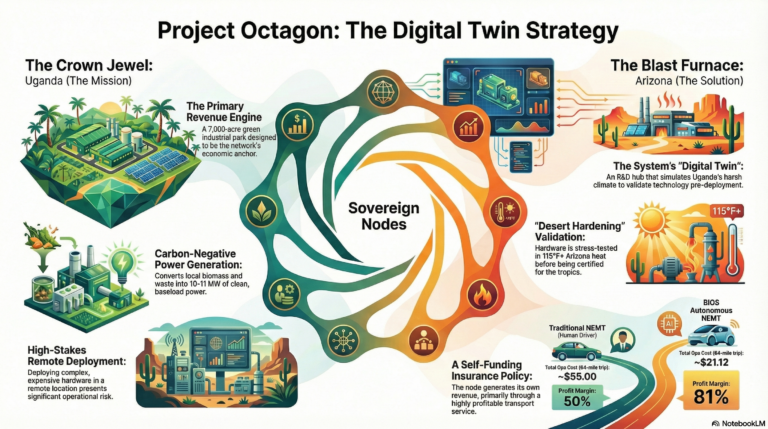
  • Example of Cross-Climatic Intelligence: Data gathered from the extreme heat of the “Blast Furnace” in Arizona’s Node 3 is used to teach the battery systems in Uganda’s Node 4 how to better manage heat, improving their efficiency and lifespan.
Sovereign_Mobility_OperationsDownload

This global brain only works because of the specialized functions of its nerve centers—the eight Sovereign Nodes that form the backbone of the network.

3. The Eight Nodes of the Global Mesh

Each of the eight nodes in Project Octagon has a unique, specialized role designed to contribute to the strength of the entire network.

  1. Node 1 (Uganda): The Concierge – This node is dedicated to logistics and hospitality.
  2. Node 2 (Canada): The Brain/OS HQ – This node serves as the Systems Architect, developing the core RIOS software and AI models that run the entire network.
  3. Node 3 (Arizona): The Simulator – This node focuses on Research & Development and connectivity.
  4. Node 4 (Uganda): The Industrial Engine – This node manages plasma energy and hemp production.
  5. Node 5 (Texas): The Energy Student – This node specializes in grid interaction, learning to intelligently buy, sell, and trade power with existing national energy markets.
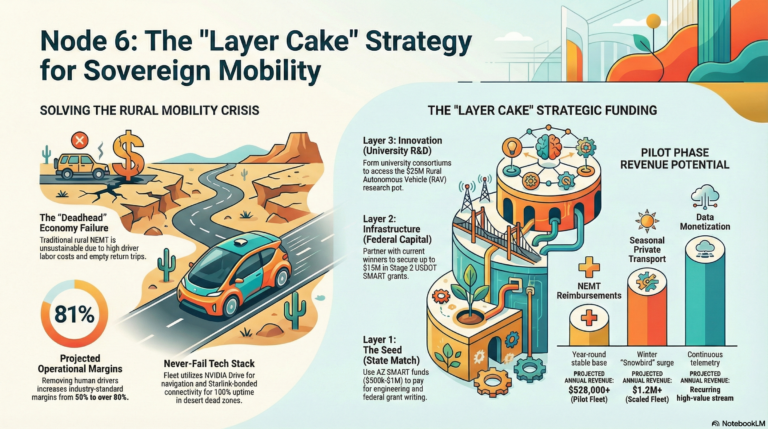
  6. Node 6 (Arizona): The Autonomous Transportation Division – Formerly the Governance & Education node, this hub was strategically repurposed to become the dedicated operational center for proving sovereign mobility through healthcare logistics.
  7. Node 7 (TBD): The Global Impact / UN 2.0 – This node is focused on humanitarian aid missions.
  8. Node 8 (Undisclosed): The Commercial Validator – This node pressure-tests the Sovereign Stack’s technologies for mainstream commercial and industrial viability.

Together, these specialized nodes form a cohesive, global system working in concert to achieve the mission of the Sovereign Stack.

4. Conclusion: Understanding the Big Picture

The overarching purpose of Project Octagon is to execute a global-scale strategy for building resilient and independent community infrastructure. By deploying specialized nodes across the world, the project aims to create a blueprint for self-sufficiency that can be adapted to any environment.

Ultimately, Project Octagon is not just about individual technologies or locations. It is about creating a connected, intelligent, and self-sufficient global network where the whole is far greater than the sum of its parts.

integration of the RIOS “Sovereign Asset” model with local-specific verticals: NEMT (Non-Emergency Medical Transportation)

Michael Noel · January 20, 2026 ·

This financial forecast for Node 3 (The Blast Furnace) in Quartzsite, AZ, is based on the integration of the RIOS “Sovereign Asset” model with local-specific verticals: NEMT (Non-Emergency Medical Transportation) and Seasonal Surge Infrastructure.

While Node 2 (Canada) is the “Profit Engine” (IP-based), Node 3 is the “Operational Engine,” proving that sovereign infrastructure can generate high cash flow in physically demanding environments.


Node 3 Financial Forecast (2026 – 2028)

1. Key Assumptions

  • NEMT (Sovereign Transport): Utilization of 2 Kurb Kars (AVs) in 2026, scaling to 10 by 2028. Average reimbursement of $110 per round-trip to Parker, AZ.
  • Academy (Physical Campus): 25 students in 2026, scaling to 150 by 2028. Focus on hands-on “Desert Hardening” certifications at $3,500/ea.
  • The Seasonal Surge: Capturing 0.5% of the 1,000,000 peak-season visitors for “Sovereign Mesh” data passes ($50/week for high-speed Starlink-bonded access).
  • Data Arbitrage: Node 3 retains a 20% share of global data sales due to the high value of “Extreme Heat” battery telemetry.

2. Pro Forma Income Statement

Podcast – https://mikeh69.podbean.com/e/node-3-integrates-several-key-partners-to-achieve-its-mission/

Revenue Category2026 (Pilot Phase)2027 (Growth Phase)2028 (Scale Phase)
1. NEMT Services (AHCCCS)$264,000$792,000$1,320,000
(Assumption)2 AVs / 8 trips/day6 AVs / 24 trips/day10 AVs / 40 trips/day
2. Academy Tuition$87,500$262,500$525,000
(Assumption)25 students @ $3.5k75 students @ $3.5k150 students @ $3.5k
3. Seasonal Surge Mesh$250,000$500,000$1,000,000
(Assumption)5k users @ $50 pass10k users @ $50 pass20k users @ $50 pass
4. Data Arbitrage Sales$25,000$150,000$600,000
(Source)Heat Stress DatasetsBattery Aging ModelsGlobal OEM Sales
TOTAL REVENUE$626,500$1,704,500$3,445,000
Operating Expenses (OpEx)
Hardware Maint. (Sand/Heat)$75,000$150,000$300,000
AV Power (Solar/Microgrid)$12,000$36,000$60,000
Personnel (Field Instructors)$180,000$350,000$650,000
Bandwidth (Starlink/Trifi)$48,000$120,000$240,000
TOTAL EXPENSES$315,000$656,000$1,250,000
NET INCOME (EBITDA)$311,500$1,048,500$2,195,000
Net Margin49.7%61.5%63.7%

3. Strategic Analysis of Projections

Feasibility Study Transitioning to Autonomous NEMT in the Quartzsite Sovereign Node

2026: The “Desert Hardening” Proof

Node 3 enters the market with a focus on NEMT. Unlike the Canadian node, which starts at a loss due to AI R&D, Quartzsite is profitable from Year 1 because it solves an immediate, high-reimbursement medical need. The primary cost is hardware maintenance—protecting GPUs and batteries from 120°F ambient temperatures and fine desert dust.

2027: Scaling the “Flash Market”

Revenue doubles as the “Seasonal Surge” model is refined. During the January Gem Show, the RIOS mesh provides high-speed connectivity to vendors and RVers who are otherwise “blacked out” by congested cell towers. This creates a massive injection of cash in a 60-day window, funding the expansion of the Kurb Kar fleet.

2028: The Industrial Data Powerhouse

By 2028, Node 3 becomes the primary source of truth for Battery Degradation in Arid Climates. This data is sold via the Node 2 exchange to electric vehicle (EV) manufacturers and stationary storage providers. NEMT operations reach a “Scale Phase,” providing nearly half of the town’s critical care transit, independent of the municipal grid.


4. Capital Expenditure (CapEx) Requirements

To achieve these numbers, Node 3 requires an initial and ongoing investment in physical assets:

  1. RIOS SCS License: $200,000 (One-time, paid to the network/Node 2).
  2. Kurb Kar Fleet: $45,000 per autonomous unit (total $450,000 over 3 years).
  3. Solar Canopy & Storage: $150,000 (To ensure “Black Start” capability and zero-cost fuel for the AVs).

5. Conclusion

Node 3 is the Cash Flow Anchor for Project Octagon in North America. While Node 2 (Canada) holds the IP, Node 3 demonstrates the Real-World Utility of the system. The 63.7% net margin by 2028 proves that sovereign infrastructure is more efficient than traditional rural government services, particularly when bolstered by autonomous logistics and seasonal data arbitrage.

Node 1 Project Octagon A High-Tech Welcome to Rural Uganda

Michael Noel · January 16, 2026 ·

Introduction: The Big Idea Behind Project Octagon

Modernizing remote economies is fundamentally a problem of infrastructure, not ambition. Project Octagon is engineered to solve this by creating self-sufficient islands of First World reliability in places where national grids and supply chains have failed. The solution is a concept called “Sovereign Infrastructure”—a powerful analogy for creating a self-sufficient “bubble” of First World services like power, data, and transportation. This bubble can operate in “Island Mode,” completely independent of failing national grids, providing a reliable foundation for modern industry and tourism.

Project Octagon is a global network of eight specialized “nodes,” each designed to function like a unique organ in a single, coordinated body. Within this network, Node 1, located in rural Uganda, acts as the “human interface” or the official “welcome mat” for the entire system’s operations in Africa.

——————————————————————————–

At the heart of this global strategy is Node 1 in Uganda, the node designed to master the critical human logistics on the ground.

1. Node 1’s Mission: Solving the “Last Mile” Problem

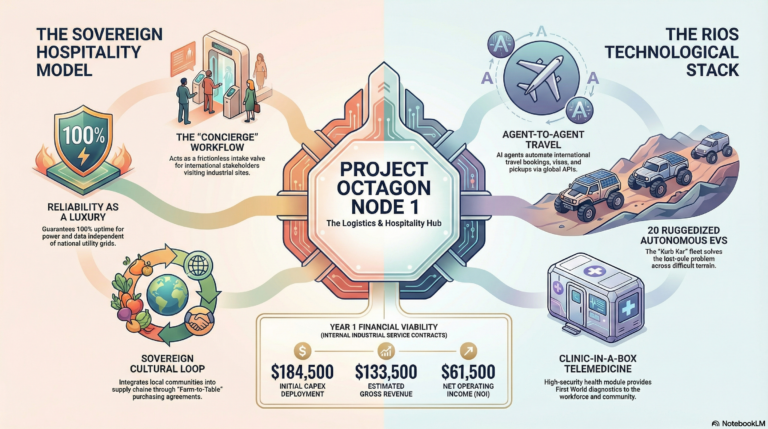
Node 1’s primary mission is to solve the “Last Mile” problem for remote industrialization. It does this by acting as the “Concierge Layer” for the Kaabong Smart Eco-Industrial Park (SEIP), bridging the gap between advanced industrial operations and the human beings who make them possible. Its mission is defined by three core objectives:

ObjectiveDescriptionWhy It Matters for a Student
The ‘Concierge’ LayerIt functions as the single entry point for all project personnel, investors, and engineers. It handles all logistics from international arrival to the final destination at the industrial site, creating a frictionless travel experience.This demonstrates how logistical mastery and de-risking the “Bush Gap” are the keys to unlocking international investment in frontier markets.
Eco-Tourism Proof of ConceptIt serves as a “Living Lab” to prove that a high-tech, high-end hospitality business can thrive completely off-grid. It demonstrates 100% uptime for power and data, independent of the national grid.This proves that high-tech, Sovereign Infrastructure can create a new market for “Digital Nomad” and high-end eco-tourism, generating revenue without extractive industries.
Logistical & Cultural InterfaceIt manages the supply chain for the heavy industrial operations at Node 4 and oversees the delicate interaction with the local Ik and Karamojong communities.This highlights the importance of balancing industrial progress with cultural respect and economic inclusion, ensuring technological advancement earns its “social license to operate” by creating direct economic value for local populations.

——————————————————————————–

To achieve this ambitious mission, Node 1 is powered by a sophisticated suite of integrated technologies.

https://mikeh69.podbean.com/e/node-1-a-central-logistics-and-hospitality-hub-within-the%c2%a0project-octagon%c2%a0infrastructure-network-in-kaabong

2. The RIOS Technology Stack: The Engine of Node 1

The technological backbone of Node 1 is RIOS (Rural Infrastructure Operating System), a proprietary software platform that acts as the project’s “brain.” RIOS automates complex operations and is continuously improved through Over-the-Air (OTA) software updates pushed from Node 2 in Canada. The four most important components of this stack are:

  • Autonomous Mobility: “Kurb Kars” A fleet of 20 rugged, self-driving electric vehicles designed to navigate unpaved murram roads and avoid unpredictable obstacles like livestock and potholes.
    • Benefit: This fleet solves the lack of reliable public transport in the region, safely shuttling people and goods between the local airstrip, the hospitality lodge, and the industrial park on terrain that standard autonomous vehicles would fail.
  • AI “Agent-to-Agent” Travel A system where AI software “agents” interface directly with global APIs like Amadeus and Skyscanner to automate the entire travel booking process.
    • Benefit: This removes the hassle of international travel. Instead of a person booking a complex multi-leg trip, an investor’s AI assistant “talks” directly to Node 1’s AI assistant to arrange everything—from flights and visas to autonomous pickup—automatically.
  • Telemedicine: “Clinic-in-a-Box” A high-security, containerized health module that provides advanced healthcare diagnostics.
    • Benefit: This provides the project workforce and the local community with access to “First World” healthcare diagnostics, a feature that is critical for insurance compliance in remote industrial zones.
  • Sovereign Connectivity A robust internet connection powered by Starlink High-Performance hardware and bonded with local mesh networks for redundancy.
    • Benefit: This system provides the only “Digital Nomad” grade internet in the entire district, allowing visitors to have crystal-clear 4K Zoom calls from the heart of the African wilderness.

——————————————————————————–

This advanced technology stack enables a unique business strategy tailored to the region’s challenges.

3. The Strategy: “Sovereign Hospitality” in Practice

Node 1’s core business strategy is “Reliability as a Luxury.” In a region defined by scarcity and unpredictability, the project’s greatest offering is the guarantee of abundance and unwavering dependability. This strategy creates an unbeatable competitive moat; where others offer uncertainty, Node 1 guarantees operational certainty. This approach directly contrasts the everyday reality of the region with the solutions provided by the “Sovereign Infrastructure” model.

The Regional Reality (The Problem)The Node 1 Solution (The ‘Sovereign’ Guarantee)
Unreliable Power GridGuaranteed 100% Uptime Power: 24/7 Air Conditioning & Hot Water (via Node 4 Plasma Gasification)
Spotty/No Internet ConnectivityGuaranteed First World Data: High-speed, low-latency internet (via Starlink High-Performance)
Poor Road InfrastructureGuaranteed Seamless Mobility: An autonomous, ruggedized EV fleet (‘Kurb Kars’)
Limited High-Standard AccommodationGuaranteed Secure & Comfortable Lodging: Geofenced security and high-standard facilities

——————————————————————————–

Beyond its commercial goals, the project’s strategy is deeply rooted in a commitment to ethical and sustainable engagement with local communities.

4. More Than a Hotel: Building a “Sovereign Cultural Loop”

The project aims to create a “Sovereign Cultural Loop,” a model built on economic interdependence and mutual respect, deliberately avoiding the pitfalls of “pity tourism.” The goal is to flip the dynamic from transactional or “voyeuristic” tourism to one of genuine economic interdependence. This is achieved through two key community integration strategies:

  • ‘Farm-to-Table’ Sovereign Supply Chain Node 1 establishes guaranteed purchase contracts with local communities for their unique products. For example, it commits to sourcing honey directly from Ik beekeepers on Mount Morungole and purchasing goat meat from Karamojong pastoralists. This creates a closed-loop system where tourists dine on food sourced from the very communities they visit, validating the “Soft Power” mission of the project.
  • Dual-Use Community Assets The project’s assets are designed to serve both the business and the community. The “Clinic-in-a-Box,” while primarily for project staff, is opened to the local community on designated days. This provides local people with access to critical healthcare, building immense goodwill and ensuring the long-term health and stability of the local workforce.

——————————————————————————–

This local integration is a key feature, but Node 1’s true power comes from its connection to a wider global network.

Project Octagon A High-Tech Welcome to Rural UgandaDownload

5. The Global Team: How the Octagon Mesh Works Together

Node 1 is not an isolated project; it is deeply integrated into the global Project Octagon mesh, which uses a system of “Federated Learning” where real-world data from one climate is used to train and optimize hardware in another. This creates a symbiotic network where each node supports the others.

  1. Node 4 (The Industrial Engine – Uganda): This neighboring node is the project’s powerhouse, using plasma gasification to generate 10-11 MW of reliable, off-grid power. In return for this critical energy, Node 1 provides the housing, food, and transportation for Node 4’s essential workforce. The two nodes are completely symbiotic; one cannot operate without the other.
  2. Node 2 (The Systems Architect – Canada): Acting as “The Brain” of the entire operation, Node 2’s team pushes critical Over-the-Air (OTA) software updates and new AI models to Node 1. These updates constantly improve the performance of Node 1’s booking agents and vehicle navigation systems.
  3. Node 3 (The Digital Twin – Arizona): This node serves as the “Digital Twin” that “certifies hardware” for the field. It uses its hot, dusty desert environment to “Desert Harden” all technology. The Kurb Kar’s autonomous driving AI is trained here to handle extreme heat and off-road obstacles before the vehicles are ever shipped to the similar climate in Kaabong, Uganda. If a component survives the Arizona desert, it is cleared for Kaabong.

——————————————————————————–

With this global team in place, Node 1 is not just an idea but a meticulously planned operation with a clear path forward.

6. The Road Ahead and Final Vision

Project_Octagon_Node_1_Sovereign_HospitalityDownload

The project is following a disciplined, phased roadmap, with the current Phase 0/1 (Site Readiness) focused on establishing initial infrastructure, including the deployment of a “Pilot Explorer” RIOS unit and the procurement of the first Kurb Kar prototypes for stress testing. The public launch of eco-tourism and regional autonomous ride-hailing services is planned for Year 4.

Ultimately, the vision for Node 1 is clear. While the heavy industry of plasma gasification and the complex AI computation happen elsewhere in the global mesh, Node 1 stands as the tangible, human-centric proof of the entire concept. It demonstrates that the world’s most remote, off-grid locations can support high-end hospitality, seamless logistics, and vibrant communities through the application of advanced technology. It is, in essence, the “Welcome Mat for the Machine.”

  • « Go to Previous Page
  • Page 1
  • Page 2
  • Page 3
  • Page 4
  • Interim pages omitted …
  • Page 7
  • Go to Next Page »

DeReticular

Copyright © 2026 · Monochrome Pro on Genesis Framework · WordPress · Log in