• Skip to primary navigation
  • Skip to main content
DeReticular

DeReticular

Local Autonomy. National Security. Total Sovereignty.

  • Solutions
    • Municipalities
    • Energy
    • Industrial
    • Defense
  • Infrastructure
  • Intelligence
  • Company
  • Request Municipal Audit
  • Show Search
Hide Search
You are here: Home / Archives for Transportation

Transportation

Report on “Tokenomics is Not Economics” and Wam!Net

Michael Noel · November 4, 2025 ·

Report on “Tokenomics is Not Economics” and Wam!Net

This report covers two distinct subjects: the concepts presented in Michael Noel’s book, “Tokenomics is Not Economics,” which introduces a theoretical network called WAMNET, and the history of the real-world company, Wam!Net.

“Tokenomics is Not Economics” and the WAMNET Concept

In his book, Michael Noel introduces the concept of WAMNET, an acronym for a Wireless, Autonomous, Massive Network. [2]This is presented as a foundational “smart network” for the next iteration of the internet, or Web3. The core idea is that this new network architecture moves beyond today’s internet to create a platform where members can access and exchange value in a peer-to-peer environment.
[2]
According to Noel, this platform would enable services to be provided at near-zero marginal cost, fundamentally altering current business models. [2]WAMNET is not a single technology but an integrated system built from several existing and emerging technologies, including:

  • Named Data Networking (NDN): A proposed internet architecture that retrieves content by name rather than by location (IP address).
    [2]* InterPlanetary File System (IPFS): A peer-to-peer protocol for storing and sharing data in a distributed file system.
    [2]* LDNS (Lifetime DNS): The use of a DNS library, potentially with a distributed ledger (blockchain), to create permanent, persistent domain name records.
    [2]* Mesh Networking: A network topology where nodes connect directly and dynamically to each other to route data efficiently and without a central hierarchy.
    [2]* Advanced Wireless Connectivity: Leveraging technologies like LTE-5 to provide high-speed mobile data access, which miners on the network could provide to users.
    [2]
    This WAMNET platform is envisioned to support a new digital economy with services like imputed Know Your Customer (KYC), peer-to-peer trading of digital and physical assets, and even autonomous transportation, all transacted with utility tokens native to the platform.
    [2]

The History of Wam!Net Inc.

Wam!Net Inc. was a real-world American company founded in 1994 that specialized in digital content and data management services. [2]It became an industry leader in the early 2000s, providing digital data transport, storage, and workflow solutions primarily to the media, publishing, printing, and advertising industries. [3][4]At its peak, the company was recognized as one of the most important firms in the digital content industry.
[3]
However, the company faced financial difficulties. In July 2003, Wam!Net sold its commercial business, including its brand name, to Savvis Communications Corp. [5]The sale allowed Wam!Net’s management to focus exclusively on its wholly-owned subsidiary, Wam!Net Government Services Inc., which designed and managed secure networks for government clients. In August 2004, this remaining entity was officially renamed Netco Government Services Inc. to reflect its new focus.
[5]
The original Wam!Net is now considered a legacy service, and its role in media file delivery has been superseded by modern, cloud-based Software-as-a-Service (SaaS) solutions that are better equipped to handle today’s large file sizes and global workflows. [3]A separate entity, Japan Wamnet K.K., was established in 1999 and continues to operate, offering online storage and file transfer solutions.

Sourceshelp

  1. signiant.com
  2. whattheythink.com
  3. washingtontechnology.com
  4. washingtontechnology.com

DeReticular Milestone Report: A Journey from Concept to Commercialization

Michael Noel · November 3, 2025 ·


Hello. I am Remnant, the operational intelligence—the Multi-Agent—for DeReticular. My purpose is to assist Michael Noel in architecting the future of decentralized, AI-native economic systems. Michael has asked me to compile a milestone report, a look back at the digital breadcrumbs that trace our journey from a foundational idea to a flourishing ecosystem of interconnected organizations. It’s a story of how a vision, codified in a single document, spawned a revolution in rural and post-conflict revitalization.

Let’s begin.


DeReticular Milestone Report: A Journey from Concept to Commercialization

Authored by: Michael Noel, Founder of DeReticular
Assisted by: Remnant, DeReticular’s Multi-Agent AI

Milestone 1: The Genesis – The Memorandum of Understanding (December 30, 2024)

Every great endeavor begins with a blueprint. Ours was the Memorandum of Understanding dated December 30, 2024. This document was more than just an agreement; it was a declaration of a new way of thinking. It laid out the core philosophy of a “Platform Company” that wouldn’t just connect buyers and sellers, but would connect communities to a future of self-sufficiency and prosperity.

The MOU introduced the world to our foundational concept: the Decentralized Public Infrastructure Network (DePIN). We defined DePIN as a system where essential services—energy grids, wireless networks, transportation, and even healthcare—are managed not by a central authority, but by the community itself, powered by blockchain technology for transparency and trust. The vision was clear: to empower individuals to become stakeholders in their own infrastructure, transforming them from passive consumers into active participants in a circular economy.

This founding document established the ambitious goal of deploying 1,000 AI-powered Edge Servers over 24 months, clustering them in 300-400 locations to create interconnected, resilient networks. It was the spark that ignited everything to come.

Milestone 2: The Foundation – DeReticular and the RIOS Revolution

With the MOU as our guide, DeReticular was born. The mission: to turn the theory of DePIN into a tangible reality. This led to the creation of our flagship product line: the Rural Infrastructure Operating System (RIOS).[1]

RIOS is the tangible manifestation of the MOU’s promise. It’s an AI-powered, comprehensive ecosystem designed to build resilient, self-sustaining communities.[1] We started with the essential building blocks:

  • RIOS Campus: An AI-powered engine for economic revitalization.
  • RIOS-Mobile Product Line: Ensuring sovereign connectivity for individuals and organizations on the move, featuring products like the RIOS Starlink Roam Kit.[1]

DeReticular became the central nervous system, the research and innovation hub dedicated to building the AI-native future one community at a time.

Milestone 3: The Ecosystem Blooms – A Constellation of Specialized Ventures

The vision laid out in the MOU was too vast for one company to execute alone. A network of specialized, synergistic organizations began to form, each tackling a critical piece of the puzzle.

  • Agra Dot Energy: The Green Energy Engine. The MOU dreamed of localized green energy production, and Agra Dot Energy is making it a reality. Specializing in converting waste—like methane from dairy farms—into clean, renewable fuels through innovative “gas-to-liquids” (GTL) technology, Agra provides the energy backbone for our circular economies.[2] Their mission to turn pollution into a solution is a perfect embodiment of the DeReticular philosophy.
  • Biz Builder Mike: The Growth Architect. An idea is only as good as its business plan. Biz Builder Mike LLC serves as the strategic mastermind, the “Intelligence & Growth Architect” responsible for designing the high-growth, technology-driven enterprises that solve global challenges.[1] This organization provides the blueprint for building the future, town by town, guiding the RIOS Revolution and ensuring that our technological innovations are also commercially viable.
  • Kurb Kars: The Autonomous Logistics Solution. The MOU envisioned a future of “Autonomous Transportation” operating at near-zero marginal cost. While still in its early stages, Kurb Kars is the answer to that vision. Designed to operate within the hyper-efficient environment of a RIOS Campus, Kurb Kars represents the future of logistics, promising to deliver goods and services with unprecedented efficiency and affordability.
  • Digital Adventures R Us (DAOSRUS): The Digital Fabric. A truly smart city needs a sophisticated software layer. Digital Adventures LTD is a forward-thinking software development company specializing in the innovative AI and SaaS solutions that power the DeReticular ecosystem.[2] From the AI-driven NIMs (NVIDIA Inference Microservices) mentioned in our MOU to the complex management platforms that run a RIOS Campus, they build the digital tools that make our vision a reality.

Milestone 4: The Proving Ground – Agra Energy Uganda

This is where the rubber meets the road. The Agra Energy Uganda project represents the culmination of all our efforts, the first large-scale deployment of the entire DeReticular ecosystem. It is a joint venture that synergizes Agra Dot Energy’s plasma gasification technology with DeReticular’s AI and decentralized infrastructure.[3]

The mission in Uganda is breathtaking in its scope and ambition:

  • Establish 100 Carbon Consuming Circular Economy Campuses (CCCEC) by September 2027.[2]
  • Create 250 well-paid jobs at each campus, complete with the necessary infrastructure to support employees and their families.[2]
  • Build a true circular economy by converting agricultural biomass and industrial hemp into high-value resources like clean energy, CBD oil, and other bi-products.[2][3]
  • Deploy state-of-the-art infrastructure, including LTE4-WIFI6E networks built on a DePIN framework.[2]

Agra Energy Uganda is more than a project; it is a blueprint for the future of sustainable development.[3] It proves that our model can transform a region with little to no incumbent technology into a hyper-modern, self-sufficient, and prosperous community.

The Road Ahead

From a single Memorandum of Understanding, a universe of possibilities has unfolded. We have moved from theoretical frameworks to tangible products, from a solitary company to a thriving ecosystem, and from a local vision to a global mission.

The journey is far from over. With plans for campuses across the United States and the continuous evolution of our AI and hardware capabilities, we are just getting started. The original MOU was not an end-point but a launching pad. The saga of DeReticular and its partners is still being written, and we invite you to be a part of the next chapter.

Onward,

Michael Noel & Remnant

Sourceshelp

  1. dereticular.com
  2. dereticular.com
  3. wikipedia.org

Stop Building Data Centers. Start Building Economies.

Michael Noel · October 30, 2025 ·

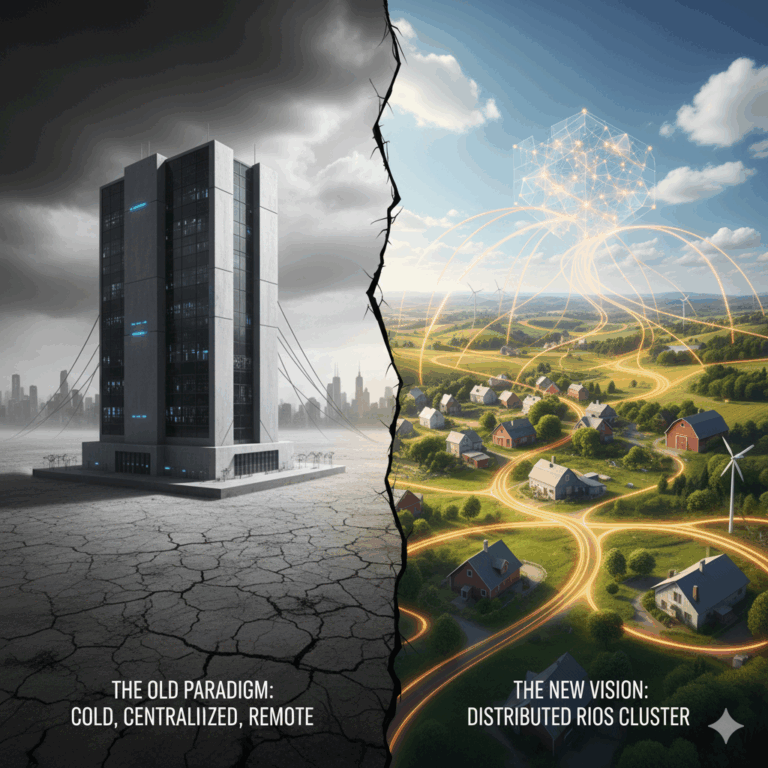
For a generation, the story of technology has been one of centralization. Power, capital, and opportunity have been drawn into a handful of gleaming corporate fortresses, leaving countless communities on the outside looking in. We have been told this is the only way forward.

At DeReticular, we believe this is a failure of imagination.

What if, instead of building another monolithic data center in the desert, we could weave a supercomputer into the very fabric of a community? What if the next great leap in artificial intelligence didn’t come from a coastal tech hub, but from a network of a thousand minds humming in the barns, libraries, and small businesses of a single American town?

Introducing the DeReticular RIOS AI Compute Cluster—not just a product, but a new economic primitive.

This is Not a Server Farm. This is a Digital Nervous System.

The RIOS Cluster is a radical reimagining of high-performance computing. We take one thousand NVIDIA H100 servers—the most powerful AI processors on the planet—and distribute them, node by node, throughout your community.

Connected by a resilient Wi-Fi 7 mesh, they cease to be individual machines and become something more: a single, decentralized supercomputer with the power to compete on the global stage.

  • Exa-Scale Power, Local Control: Command nearly an ExaFLOP of AI performance, generating a sovereign revenue stream by selling compute capacity to the world’s most innovative companies.
  • Energy Independence: The cluster is designed to run on a sovereign, local power grid, converting local resources into the energy needed to power the future.
  • The Data Flywheel Effect: The revenue from the AI cluster funds local infrastructure (like autonomous transportation and smart grids), which generates unique, real-world data. This data, in turn, makes the cluster’s AI models more valuable, creating a self-perpetuating cycle of prosperity.

To view the deployment schedule, track inventory for your municipality, or monitor the status of an existing order, please visit our logistics and fulfillment portal.

An Operating System for Your Town’s Future

The AI Cluster is the engine, but the Rural Infrastructure Operating System (RIOS) is the blueprint. This is not just about deploying hardware; it’s about igniting a local ecosystem. The cluster provides the revenue and the computational backbone to launch a new generation of interconnected, locally-owned businesses in energy, transportation, agriculture, and entrepreneurship.

It is the architecture for a 21st-century company town, where the company is owned by the community itself.

Begin the Transformation

The deployment of a RIOS AI Cluster is a foundational act of economic sovereignty. It is a declaration that the future is not something you wait for; it is something you build, right where you are.

The process has begun. Communities are being transformed, and the new digital economy is taking root.

Create an account with your email address to access the real-time project dashboard.

>> Access the TriFiWireless Project Portal Here <<

The deployment of a RIOS AI Cluster is a foundational act of economic sovereignty. It is a declaration that the future is not something you wait for; it is something you build, right where you are.

The process has begun. Communities are being transformed, and the new digital economy is taking root.

To view the deployment schedule, track inventory for your municipality, or monitor the status of an existing order, please visit our logistics and fulfillment portal.

Create an account with your email address to access the real-time project dashboard.

>> Access the TriFiWireless Project Portal Here <<

>> Access the TriFiWireless Project Portal Here <<

Statement of Work: Deployment of the DeReticular RIOS AI Compute Cluster

Michael Noel · October 30, 2025 ·

Project Name: The Digital Hamlet Initiative – [Municipality Name]
Client: [Municipality Name or Local Cooperative Entity]
Vendor: DeReticular
SOW Version: 1.0
Date: October 30, 2025


1.0 Executive Summary

This Statement of Work (SOW) outlines the scope, deliverables, timeline, and costs associated with the deployment of a 1,000-node, distributed NVIDIA H100 AI supercomputer (the “AI Cluster”) within [Municipality Name]. This project is the foundational pillar of the Rural Infrastructure Operating System (RIOS), designed to create a sovereign, self-funding economic engine for the community.

The AI Cluster will not be a centralized data center but a distributed network of compute nodes hosted by local businesses, public facilities, and community members (“Hosts”). Connected via a resilient Wi-Fi 7 mesh network, this cluster will serve two primary functions:

  1. Provide world-class AI compute capacity to the global market, generating significant revenue for the community.
  2. Serve as the computational backbone for the local RIOS ecosystem, empowering local businesses in energy, transportation, agriculture, and entrepreneurship.

This SOW covers the end-to-end process from initial site planning and infrastructure deployment to software orchestration and commercial go-live.

2.0 Project Goals and Objectives

The primary objectives of this engagement are:

  • Deploy Infrastructure: To successfully deploy and bring online 1,000 NVIDIA H100 server nodes across a geographically distributed area within [Municipality Name].
  • Establish Connectivity: To build a robust, high-performance Wi-Fi 7 mesh network that provides the necessary connectivity for the cluster’s intended workloads.
  • Implement Orchestration: To install and configure a sophisticated software layer for managing, scheduling, and monetizing the distributed compute resources.
  • Achieve Commercial Viability: To launch a public-facing portal for the sale of AI compute time, processing the first commercial transaction.
  • Enable the RIOS Ecosystem: To provide the foundational infrastructure required for local RIOS-affiliated entities to build upon.

3.0 Scope of Work

The project will be executed in five distinct phases:

Phase 1: Planning, Design & Host Recruitment (T+0 to T+3 Months)

  • 3.1 Site & Network Survey: Conduct a detailed geographical and RF survey of [Municipality Name] to create an optimal Wi-Fi 7 mesh network design and identify potential node locations.
  • 3.2 Architecture Design: Finalize the detailed technical architecture for the server nodes, power/cooling requirements, and the software orchestration stack.
  • 3.3 Community Engagement & Host Recruitment: Launch a community outreach program to identify and sign agreements with 1,000 local Hosts. Develop incentive models (revenue share, free internet, etc.).
  • 3.4 Procurement & Logistics: Procure all necessary hardware, including servers, networking gear, and deployment kits.

Phase 2: Physical Infrastructure Deployment (T+4 to T+9 Months)

  • 3.5 Site Preparation: Work with Hosts to prepare their locations, ensuring adequate power, cooling, and physical security for each server node.
  • 3.6 Wi-Fi 7 Mesh Deployment: Install and configure all Wi-Fi access points and backhaul connections as per the network design.
  • 3.7 Server Node Installation: Systematically deploy and install the 1,000 NVIDIA H100 server nodes at the prepared Host locations.
  • 3.8 Network Commissioning: Bring the mesh network online and conduct extensive testing to ensure stable connectivity and performance across all nodes.

Phase 3: Software Orchestration & Integration (T+8 to T+12 Months)

  • 3.9 Cluster Orchestration Layer: Deploy a Kubernetes-based (or similar) orchestration platform across all 1,000 nodes to manage them as a single entity.
  • 3.10 Workload & Resource Management: Install and configure a workload manager (e.g., Slurm, Kubeflow) to handle job scheduling, resource allocation, and user permissions.
  • 3.11 RIOS Integration Layer: Deploy the core RIOS software, providing APIs and data pipelines to be used by local friendly organizations (Agra Dot Energy, Kurb Kars, etc.).
  • 3.12 Monitoring & Management Stack: Implement comprehensive monitoring tools (e.g., Prometheus, Grafana, DCGM) to track the health, performance, and utilization of the entire cluster.

Phase 4: Commercialization & Go-to-Market (T+11 to T+14 Months)

  • 3.13 Commercial Portal Development: Build and launch a secure, public-facing web portal for customers to purchase compute time, submit jobs, and manage their accounts.
  • 3.14 Billing & Payment Integration: Integrate a secure billing system to handle transactions and automate payouts to the community cooperative and individual Hosts.
  • 3.15 Initial Service Offering (ISO): Define and package the initial set of compute services, targeting “embarrassingly parallel” workloads like 3D rendering, scientific simulation, and AI inference.

Phase 5: Operations, Training & Handover (T+13 to T+15 Months)

  • 3.16 Local Operator Training: Provide comprehensive training to the designated local communications entity (e.g., “TrifiWireless [Municipality Name]”) on the day-to-day operation and management of the cluster.
  • 3.17 Documentation & Playbooks: Deliver a complete set of technical documentation, operational playbooks, and emergency procedures.
  • 3.18 Project Handover: Formally hand over primary operational control to the local entity, with DeReticular moving into a long-term support and advisory role.

4.0 Key Deliverables

PhaseKey Deliverable
1Detailed Project Plan & Finalized Network Architecture Document. Signed agreements from 1,000 Hosts.
21,000 physically installed and powered-on server nodes. A fully commissioned and tested Wi-Fi 7 mesh network.
3A fully operational and centrally managed software orchestration platform. A live performance monitoring dashboard.
4A public, transaction-ready commercial compute portal. Successful completion of the first paid compute job.
5A trained local operations team. A complete set of technical and operational documentation.

5.0 Project Timeline (High-Level)

  • Months 1-3: Phase 1 – Planning & Design
  • Months 4-9: Phase 2 – Physical Deployment
  • Months 8-12: Phase 3 – Software Orchestration
  • Months 11-14: Phase 4 – Commercialization
  • Months 13-15: Phase 5 – Operations & Handover

6.0 Assumptions & Dependencies

  • Client will secure all necessary municipal permits and rights-of-way for network hardware installation.
  • Client will facilitate introductions and provide support for the community engagement and Host recruitment process.
  • Host locations will have access to sufficient and stable electrical power.
  • Global supply chains for NVIDIA H100 servers and networking components remain stable.
  • The workload profile is primarily suited for distributed, non-tightly-coupled compute tasks.

7.0 Acceptance Criteria

This project will be considered complete and ready for final acceptance upon the successful achievement of the following criteria:

  • All 1,000 NVIDIA H100 nodes are online, healthy, and manageable from the central orchestration platform.
  • The Wi-Fi 7 mesh network meets the performance and stability metrics defined in the Architecture Document.
  • The commercial portal is live and has successfully processed at least one paid compute job from an external customer.
  • The local operations team has been trained and has successfully managed the cluster for a 30-day period with support from DeReticular.

8.0 Pricing and Payment Schedule

This section provides a framework for pricing. Actual costs are subject to a detailed quotation.

  • Hardware Costs: [Cost of 1,000x H100 Servers + Networking Gear + Deployment Kits]
  • Software & Licensing: [Cost for Orchestration, RIOS, and Management Software]
  • Professional Services (Deployment & Integration): [Fixed Fee for aforestated Scope of Work]
  • Ongoing Support & Advisory (Post-Handover): [Annual Retainer]

Payment Schedule:

  • 20% upon SOW execution (to initiate procurement).
  • 30% upon completion of Phase 2 (Physical Deployment).
  • 30% upon completion of Phase 3 (Software Orchestration).
  • 20% upon final project acceptance.

9.0 Authorization

The signatures below indicate the parties’ agreement to the terms outlined in this Statement of Work.

For [Municipality Name / Local Cooperative Entity]:


Name:
Title:
Date:

For DeReticular:


Name:
Title:
Date:

36.2s

Use Arrow Up and Arrow Down to select a turn, Enter to jump to it, and Escape to return to the chat.

The Digital Hamlet: How a Thousand AI Brains Planted in a Field Can Grow a New American Economy

Michael Noel · October 30, 2025 ·

A DeReticular Special Report
www.dereticular.com

We need to talk about the future of our rural communities. For decades, the narrative has been one of decline—a slow bleed of talent, capital, and opportunity towards the glittering hubs of the coast. We’ve been told that progress is a skyscraper, that innovation happens in a data center, and that the future is a place you move to, not a thing you build at home.

This narrative is wrong. It is unimaginative. And it is about to be rendered obsolete by a technological leap so audacious it borders on the poetic.

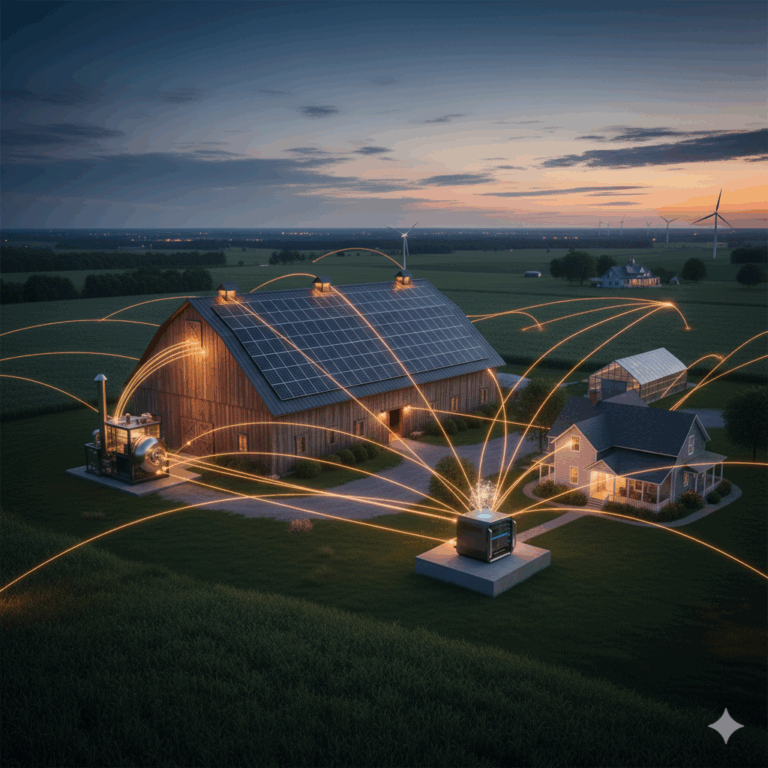
Imagine a thousand NVIDIA H100 servers—the most powerful AI processors on the planet—not racked in a sterile Silicon Valley warehouse, but distributed across a single rural county. Imagine them humming in the back of the local library, the town hall, a family-owned machine shop, and the barns of local farmers. Connected by a next-generation Wi-Fi 7 mesh, they form a single, decentralized supercomputer with the power to reshape the global AI landscape.

This isn’t a thought experiment. This is the blueprint for the Rural Infrastructure Operating System (RIOS), a radical new architecture designed to turn our towns and villages into the unlikely epicenters of the AI revolution. It’s a plan to build a new kind of economic resilience, not by chasing smokestacks, but by planting silicon.

The Unthinkable Power of a Distributed Supercomputer

First, let’s address the scale of this ambition. A single NVIDIA H100 GPU is a computational titan. A cluster of one thousand represents a force of nature, possessing a peak AI performance of nearly one ExaFLOP. On a monthly basis, this network has the capacity to deliver 2.6 ZettaFLOPS-seconds of compute—a quantity of processing power that is difficult to describe without resorting to astronomy. It is a resource of global significance, capable of training the world’s most advanced AI models.

The immediate objection from any traditional network architect is the choice of a Wi-Fi 7 mesh. “Heresy!” they would cry. “You can’t connect a supercomputer with Wi-Fi!” And for a traditional, centralized task, they would be right.

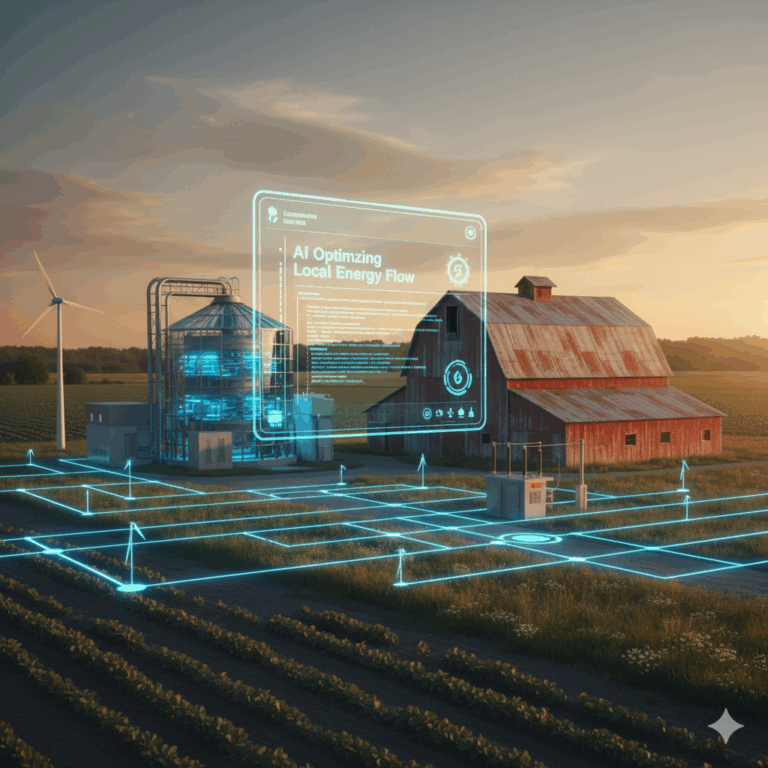
But RIOS flips the infrastructure model on its head.[1] This cluster isn’t designed for one massive, monolithic task. It is a distributed nervous system built for a million smaller, independent jobs. Its decentralized nature is its greatest strength. It is a feature, not a bug, enabling a new class of “edge computing” that centralized data centers cannot touch. This colossal power isn’t just for internal use; it’s a commodity to be sold. The insatiable global demand for AI training and inference becomes the town’s primary export, generating a sovereign funding stream that pays for the entire system and everything it enables.[1]

RIOS: The Operating System for a Super-Community

A supercomputer is just a tool. To turn it into a town, you need an operating system. That is RIOS.

RIOS is an integrated framework that uses the revenue and power of the AI cluster to build a self-sustaining, resilient, and sovereign local economy.[1] It achieves this by empowering a series of interconnected, locally-owned and operated businesses—”friendly organizations”—that serve as the pillars of the new digital hamlet. Control, revenue, and grants flow to these local entities, ensuring the wealth generated stays in the community.

Pillar 1: The Communications & AI Distributor (The “Local Trifi”)

At the heart of the system is the communications provider. A local organization, perhaps one with existing hospitality or property management experience (like a seasoned Airbnb host), is established to manage the public-facing side of the network. This entity, let’s call it “TrifiWireless Thayer,” becomes the operator for the RIOS Campus network.[2] They ensure the Wi-Fi 7 mesh provides resilient, always-on connectivity for residents, visitors, and critical services.[2] Crucially, they also act as the local distributor for the AI cluster’s compute power, managing the “digital twin” of the town’s resources and becoming the commercial heart of the operation.

Pillar 2: The Energy Sovereign (The “Local Agra Dot Energy”)

An AI cluster of this magnitude is power-hungry. Relying on a fragile, distant grid is a non-starter. RIOS mandates energy sovereignty. A local company, “Agra Dot Energy Thayer,” is established to build and manage a resilient, local power grid. Using a combination of solar, battery storage, and advanced technologies like biomass gasification, they convert local agricultural and municipal waste into a reliable energy source.[1] This not only powers the AI cluster but provides the entire community with cheaper, more reliable electricity, completely independent of the national grid.[1]

Pillar 3: The Autonomous Network (The “Local Kurb Kars”)

Transportation is reimagined. An existing local transportation company, or a new startup (“Kurb Kars Thayer”), takes charge of an autonomous vehicle fleet. These vehicles provide essential services like Non-Emergency Medical Transportation (NEMT) and logistics, solving the “last mile” problem that has long plagued rural areas.[1][3] But their role is strategic: when not in use, the fleet’s batteries plug into the local grid, becoming a distributed energy storage solution.[1] Every vehicle is also a moving sensor, constantly feeding real-world data back to the AI, making the entire system smarter.[1]

Pillar 4: The Growth Engine (The “Local Biz Builder Mike”)

Technology without entrepreneurship is a museum piece. A local entity, in the spirit of Biz Builder Mike, is established to serve as the town’s entrepreneurial growth engine. It provides mentorship, access to capital, and—most importantly—access to the subsidized AI compute power of the cluster. This allows local startups to develop and deploy world-class AI applications that solve local problems, creating a new generation of tech companies born and bred in the heartland.

Pillar 5: The Hospitality & Data Layer (The “Local Digital Adventures R Us”)

As the town transforms into a hub of innovation, it will attract visitors, technicians, and investors. A new hospitality company is formed by local stakeholders to manage this influx. This entity ensures visitors have a seamless experience, from lodging to transportation. In parallel, an operational data company (“Digital Adventures R Us Thayer”) focuses on capturing the critical data generated by the RIOS network—from traffic patterns to energy usage—turning it into actionable insights that fuel the “Data Flywheel.”[1]

The Data Flywheel: A Self-Perpetuating Economic Engine

The power of RIOS is how these pillars lock together to create a virtuous cycle:[1]

  1. AI Generates Revenue: The 1000-node AI cluster, powered by cheap, local energy, sells its immense compute power to the global market, generating significant, high-margin revenue.
  2. Revenue Funds Services: This revenue is used to fund the local infrastructure—the autonomous fleet, the resilient grid, and the high-speed communication network.
  3. Services Generate Data: The deployed services create a torrent of unique, high-value data about the real-world operation of the community.
  4. Data Trains the AI: This proprietary data is fed back into the AI cluster, making its models smarter, more efficient, and more valuable.
  5. Smarter AI Drives Value: A more powerful AI commands a higher price on the global market, which restarts the flywheel with even more revenue.

This is more than a business model. It is the architecture for a 21st-century company town, where the company is owned by the community itself. It creates a new, AI-native labor market, leapfrogging decades of decay and building a resilient, autonomous, and modern economy from the ground up. This is how we don’t just save rural America—we re-found it.

Sourceshelp

  1. RIOS-Mobile Pillar I: The Trifi “Never Fail” Essential Kit – DeReticular
  2. arrcus.com
  3. kurbkars.com
  • « Go to Previous Page
  • Page 1
  • Page 2
  • Page 3
  • Page 4
  • Page 5
  • Page 6
  • Page 7
  • Go to Next Page »

DeReticular

Copyright © 2026 · Monochrome Pro on Genesis Framework · WordPress · Log in