The Digital Hamlet: How a Thousand AI Brains Planted in a Field Can Grow a New American Economy
A DeReticular Special Report
www.dereticular.com
We need to talk about the future of our rural communities. For decades, the narrative has been one of decline—a slow bleed of talent, capital, and opportunity towards the glittering hubs of the coast. We’ve been told that progress is a skyscraper, that innovation happens in a data center, and that the future is a place you move to, not a thing you build at home.
This narrative is wrong. It is unimaginative. And it is about to be rendered obsolete by a technological leap so audacious it borders on the poetic.
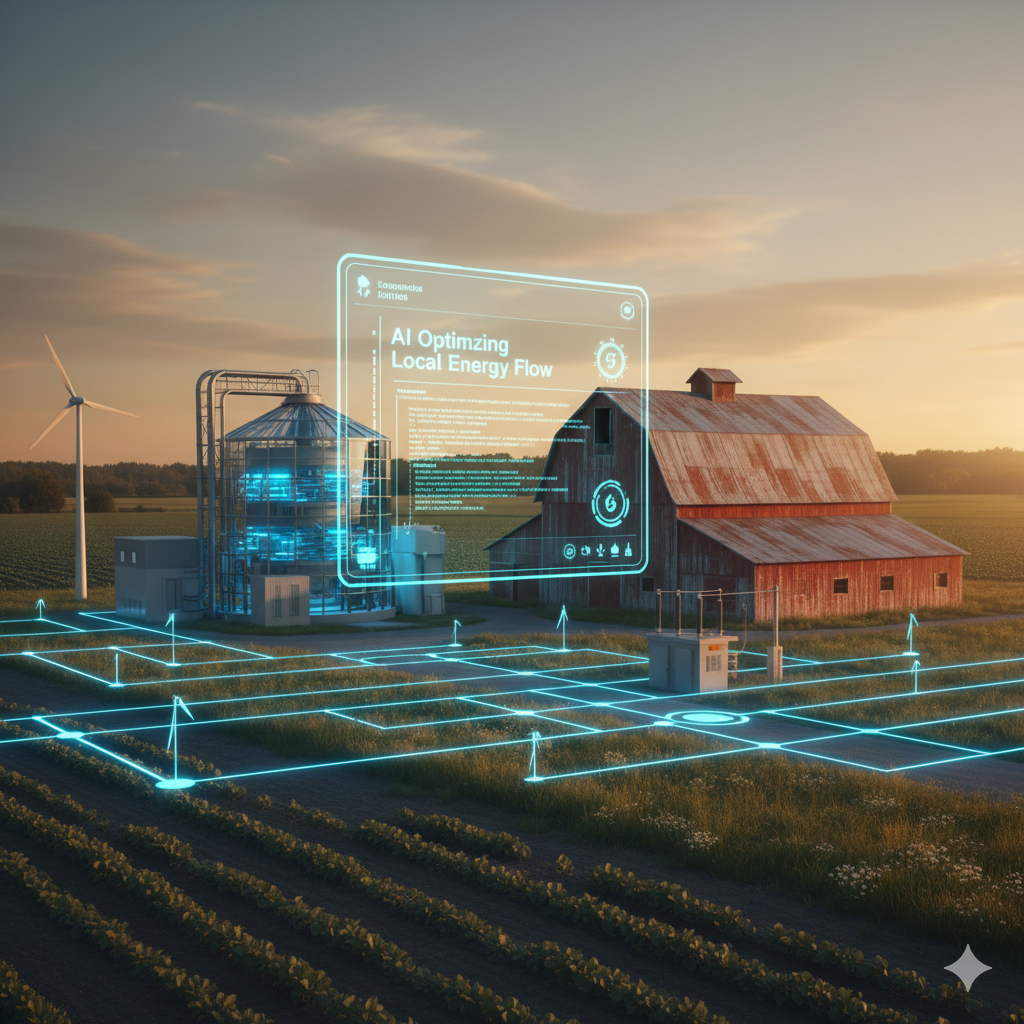
Imagine a thousand NVIDIA H100 servers—the most powerful AI processors on the planet—not racked in a sterile Silicon Valley warehouse, but distributed across a single rural county. Imagine them humming in the back of the local library, the town hall, a family-owned machine shop, and the barns of local farmers. Connected by a next-generation Wi-Fi 7 mesh, they form a single, decentralized supercomputer with the power to reshape the global AI landscape.
This isn’t a thought experiment. This is the blueprint for the Rural Infrastructure Operating System (RIOS), a radical new architecture designed to turn our towns and villages into the unlikely epicenters of the AI revolution. It’s a plan to build a new kind of economic resilience, not by chasing smokestacks, but by planting silicon.
The Unthinkable Power of a Distributed Supercomputer
First, let’s address the scale of this ambition. A single NVIDIA H100 GPU is a computational titan. A cluster of one thousand represents a force of nature, possessing a peak AI performance of nearly one ExaFLOP. On a monthly basis, this network has the capacity to deliver 2.6 ZettaFLOPS-seconds of compute—a quantity of processing power that is difficult to describe without resorting to astronomy. It is a resource of global significance, capable of training the world’s most advanced AI models.
The immediate objection from any traditional network architect is the choice of a Wi-Fi 7 mesh. “Heresy!” they would cry. “You can’t connect a supercomputer with Wi-Fi!” And for a traditional, centralized task, they would be right.
But RIOS flips the infrastructure model on its head.[1] This cluster isn’t designed for one massive, monolithic task. It is a distributed nervous system built for a million smaller, independent jobs. Its decentralized nature is its greatest strength. It is a feature, not a bug, enabling a new class of “edge computing” that centralized data centers cannot touch. This colossal power isn’t just for internal use; it’s a commodity to be sold. The insatiable global demand for AI training and inference becomes the town’s primary export, generating a sovereign funding stream that pays for the entire system and everything it enables.[1]
RIOS: The Operating System for a Super-Community
A supercomputer is just a tool. To turn it into a town, you need an operating system. That is RIOS.
RIOS is an integrated framework that uses the revenue and power of the AI cluster to build a self-sustaining, resilient, and sovereign local economy.[1] It achieves this by empowering a series of interconnected, locally-owned and operated businesses—”friendly organizations”—that serve as the pillars of the new digital hamlet. Control, revenue, and grants flow to these local entities, ensuring the wealth generated stays in the community.
Pillar 1: The Communications & AI Distributor (The “Local Trifi”)
At the heart of the system is the communications provider. A local organization, perhaps one with existing hospitality or property management experience (like a seasoned Airbnb host), is established to manage the public-facing side of the network. This entity, let’s call it “TrifiWireless Thayer,” becomes the operator for the RIOS Campus network.[2] They ensure the Wi-Fi 7 mesh provides resilient, always-on connectivity for residents, visitors, and critical services.[2] Crucially, they also act as the local distributor for the AI cluster’s compute power, managing the “digital twin” of the town’s resources and becoming the commercial heart of the operation.
Pillar 2: The Energy Sovereign (The “Local Agra Dot Energy”)
An AI cluster of this magnitude is power-hungry. Relying on a fragile, distant grid is a non-starter. RIOS mandates energy sovereignty. A local company, “Agra Dot Energy Thayer,” is established to build and manage a resilient, local power grid. Using a combination of solar, battery storage, and advanced technologies like biomass gasification, they convert local agricultural and municipal waste into a reliable energy source.[1] This not only powers the AI cluster but provides the entire community with cheaper, more reliable electricity, completely independent of the national grid.[1]
Pillar 3: The Autonomous Network (The “Local Kurb Kars”)
Transportation is reimagined. An existing local transportation company, or a new startup (“Kurb Kars Thayer”), takes charge of an autonomous vehicle fleet. These vehicles provide essential services like Non-Emergency Medical Transportation (NEMT) and logistics, solving the “last mile” problem that has long plagued rural areas.[1][3] But their role is strategic: when not in use, the fleet’s batteries plug into the local grid, becoming a distributed energy storage solution.[1] Every vehicle is also a moving sensor, constantly feeding real-world data back to the AI, making the entire system smarter.[1]
Pillar 4: The Growth Engine (The “Local Biz Builder Mike”)
Technology without entrepreneurship is a museum piece. A local entity, in the spirit of Biz Builder Mike, is established to serve as the town’s entrepreneurial growth engine. It provides mentorship, access to capital, and—most importantly—access to the subsidized AI compute power of the cluster. This allows local startups to develop and deploy world-class AI applications that solve local problems, creating a new generation of tech companies born and bred in the heartland.
Pillar 5: The Hospitality & Data Layer (The “Local Digital Adventures R Us”)
As the town transforms into a hub of innovation, it will attract visitors, technicians, and investors. A new hospitality company is formed by local stakeholders to manage this influx. This entity ensures visitors have a seamless experience, from lodging to transportation. In parallel, an operational data company (“Digital Adventures R Us Thayer”) focuses on capturing the critical data generated by the RIOS network—from traffic patterns to energy usage—turning it into actionable insights that fuel the “Data Flywheel.”[1]
The Data Flywheel: A Self-Perpetuating Economic Engine
The power of RIOS is how these pillars lock together to create a virtuous cycle:[1]
- AI Generates Revenue: The 1000-node AI cluster, powered by cheap, local energy, sells its immense compute power to the global market, generating significant, high-margin revenue.
- Revenue Funds Services: This revenue is used to fund the local infrastructure—the autonomous fleet, the resilient grid, and the high-speed communication network.
- Services Generate Data: The deployed services create a torrent of unique, high-value data about the real-world operation of the community.
- Data Trains the AI: This proprietary data is fed back into the AI cluster, making its models smarter, more efficient, and more valuable.
- Smarter AI Drives Value: A more powerful AI commands a higher price on the global market, which restarts the flywheel with even more revenue.
This is more than a business model. It is the architecture for a 21st-century company town, where the company is owned by the community itself. It creates a new, AI-native labor market, leapfrogging decades of decay and building a resilient, autonomous, and modern economy from the ground up. This is how we don’t just save rural America—we re-found it.
Sourceshelp