• Skip to primary navigation
  • Skip to main content
DeReticular

DeReticular

Local Autonomy. National Security. Total Sovereignty.

  • Solutions
    • Municipalities
    • Energy
    • Industrial
    • Defense
  • Infrastructure
  • Intelligence
  • Company
  • Request Municipal Audit
  • Show Search
Hide Search
You are here: Home / Archives for Non Emergency Medical Transportation NEMT

Non Emergency Medical Transportation NEMT

FY 2026 Strategic Funding Roadmap: Node 6 Sovereign Mobility Initiative

Michael Noel · April 30, 2026 ·

1. Executive Mission & Strategic Context

Node 6 has undergone a critical strategic realignment within the Project Octagon network, transitioning from a governance hub to the “Autonomous Transportation Division.” In this capacity, Node 6 functions as the “Circulatory System” of the DeReticular ecosystem—the physical layer of the “Sovereign Stack” designed to move essential resources and people through a resilient, decentralized network. The initiative’s primary mission is to solve the Non-Emergency Medical Transportation (NEMT) crisis in La Paz County, Arizona, establishing a blueprint for “Island Mode” operations that function independently of fragile national data and energy grids.

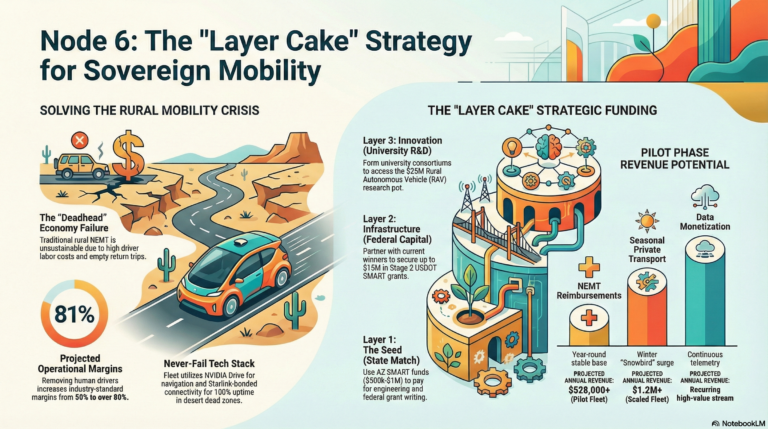
The regional mobility landscape in Western Arizona is currently defined by systemic failure. La Paz County faces an “Extreme Demand” scenario: a permanent resident population with a median age of 71.2 requires frequent access to medical facilities in Parker (32 miles away), yet is served by transit that operates only once per week. This crisis is compounded by the seasonal “Snowbird” migration in Quartzsite, which surges the population by 750,000 to 1,000,000 visitors annually, overwhelming local infrastructure. Furthermore, the “Deadhead Economy” renders traditional rural NEMT financially non-viable; providers lose capital driving empty vehicles to remote pickups, leading to chronic shortages and missed life-critical appointments.

Western_Arizona_Sovereign_Mobility_BlueprintDownload

The Sovereign Mobility solution mitigates these failures through four core technological pillars:

  • Kurb Kars: Ruggedized autonomous pods that eliminate the primary cost driver—human labor—enabling economically viable 24/7 service in remote corridors.
  • NVIDIA Drive: An AZDOT-approved AI “brain” capable of navigating the unmapped or poorly marked roads characteristic of rural Arizona.
  • Sovereign Connectivity (Signal Fusion): A “Global Mesh Protocol” bonding Starlink High-Performance satellite internet with CAT4 vSIM cellular data to ensure 100% uptime in desert canyons and cellular dead zones.
  • Vehicle-to-Grid (V2G) Power: Mobile battery storage that stabilizes local microgrids and allows for energy arbitrage when vehicles are not in service, converting depreciating assets into revenue-generating utilities.

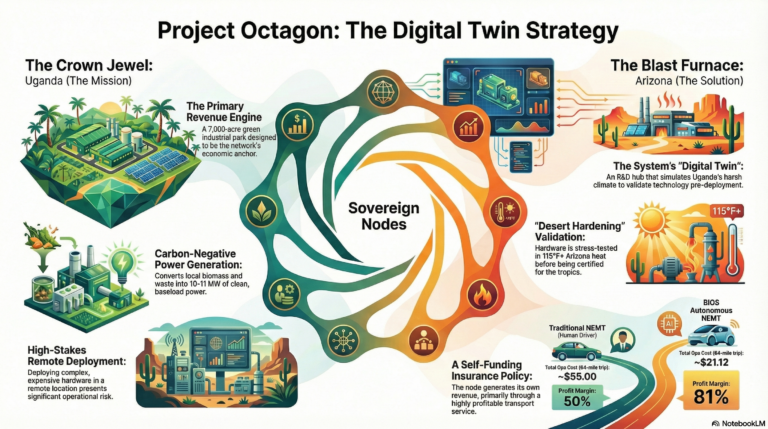
By decoupling transportation from labor and fossil fuels, Node 6 transforms rural transit economics. While industry-standard NEMT margins hover at 50%, the Kurb Kar fleet projects an 81% operating margin. This efficiency enables a projected 6-month CapEx recoup per vehicle, allowing for rapid scaling without equity dilution.

2. The ‘Layer Cake’ Funding Methodology

The “Layer Cake” approach is a multi-tiered, non-dilutive capital strategy designed to maximize the ROI of public dollars. This structure is essential for navigating the transition from state-level preparation to large-scale federal infrastructure and R&D. By sequentially capturing these funds, Node 6 de-risks each subsequent tier, ensuring the project is “Node 6 Ready” before high-stakes capital is deployed.

Funding LayerPrimary ObjectiveRole in De-risking
Tier I: Seed (State)Fund design, engineering, and professional grant-writing.Provides mandatory matching funds and evidentiary data for federal asks.
Tier II: Infrastructure (Federal)Acquisition of physical assets (hubs, towers, sensors).Establishes the tangible “Sovereign Stack” grid required for scale.
Tier III: Innovation (Research/Ops)Fund AI modeling, NEMT software, and operations.Validates “Clinic-in-a-Box” tech and generates recurring data revenue.

The catalyst for this architecture is Champion Brion Crum, “The Human Link.” Crum’s background in private equity and real estate—notably with Caliber Funds—provides the institutional credibility required to bridge high-tech innovation with physical asset management. His philosophy centers on the nexus of technology, capital, and real estate, positioning Node 6 as a financially compliant infrastructure project rather than a speculative tech pilot.

https://academy.dereticular.com/podcast/node-6-sovereign-mobility-and-autonomous-healthcare-logistics/

3. Tier I: The Seed Layer (Arizona State Preparation)

Tier I funding provides the “dry powder” necessary for sophisticated engineering and professional grant-writing services. These funds are the prerequisite for competing in the high-stakes federal implementation pool.

The primary vehicle for this layer is the AZ SMART Fund (State Match Advantage for Rural Transportation), administered by ADOT and the State Transportation Board. Node 6 will submit an “Ask” for $500k – $1M to finance the “La Paz Autonomous Corridor Feasibility Study.” This study will provide the data-driven basis required to prove the viability of autonomous transit in rugged desert environments to federal evaluators.

Node 6 will also leverage a strategic partnership with the Arizona Commerce Authority (ACA) and the Institute for Automated Mobility (IAM). By positioning Node 6 as the “Western Deployment Site” for the ACA’s existing statewide V2X (Vehicle-to-Everything) initiatives, the project “piggybacks” on existing state momentum rather than applying in isolation. This strategy creates the evidentiary basis required to unlock Tier II capital.

4. Tier II: The Infrastructure Layer (Federal Capital Grants)

Tier II focuses on the acquisition of physical assets—charging hubs, connectivity towers, and smart road sensors. This phase capitalizes on the federal mandate for “Rural Justice,” which prioritizes infrastructure development in underserved communities.

A cornerstone of this tier is the USDOT SMART Grants (Stage 2) strategy. To unlock the $15 Million implementation pool (typically reserved for Stage 1 winners), Node 6 will execute a “Stage 1 Partner Hack.” By partnering with an established Stage 1 winner, such as the Arizona Commerce Authority or Maricopa County DOT, Node 6 offers a rugged rural testbed to prove their existing technologies, bypassing the Stage 1 entry requirement.

Simultaneously, the project will capture the Charging and Fueling Infrastructure (CFI) Grant. By framing Kurb Kar depots as “Public Community Charging Hubs” located at senior centers and clinics, Node 6 specifically targets the 50% rural set-aside within the Community Program track. This physical infrastructure establishes the foundation for the advanced R&D activities in Tier III.

5. Tier III: The Innovation Layer (R&D and Operational Grants)

The Innovation Layer funds the “soft” infrastructure: AI modeling, NEMT operational software, and the software integration for the “Clinic-in-a-Box” diagnostic system.

  • Rural Autonomous Vehicle (RAV) Research Program: Node 6 will lead a consortium with Arizona State University (ASU) or the University of Arizona (U of A) to capture a portion of this $25 Million pool. The research will focus on “safe integration in tribal and rural communities,” using the La Paz corridors as the primary test site.
  • Federated Learning & Data Monetization: Every mile driven by the fleet generates high-value “edge case” data (e.g., navigating dust storms). This telemetry is verified via zkVerify and sold to global autonomous driving databases, creating a “Stream C” recurring revenue model.
  • FTA Section 5311: Node 6 will seek designation as a rural public transit operator to secure annual formula grants for operational assistance.
  • Enhancing Mobility Innovation (EMI): This grant will fund the integration of “Clinic-in-a-Box” sensors. This allows for the collection of patient vitals during the 45-minute drive to Parker, which are uploaded via Starlink to medical centers, transforming the commute into a preliminary check-up.

6. Strategic Regional Integration & Partnerships

Regional integration reduces Capital Expenditure (CapEx) by “overlaying” Node 6 technology onto existing public works projects.

  • The Route 66 Centennial (2026): Node 6 will pivot to a “High-Tech Heritage” narrative, positioning itself as the modern evolution of the Mother Road. This includes a “Neo-Green Book” initiative, framing autonomous mobility as a tool for safety and civil rights for the elderly and disabled. The goal is “Official Centennial Project” status and the launch of a “Route 66 Green Corridor” pilot.
  • Quartzsite Infrastructure Piggybacking: Node 6 will lobby the Western Arizona Council of Governments (WACOG) to include V2I sensors and smart communication nodes in the construction specifications for the Quartzsite Blvd widening and I-10 overpass projects before construction begins.
  • The Colorado River “Blue Mobility” Connection: In partnership with the Colorado River Indian Tribes (CRIT), Node 6 will establish the “Parker to Pad” route. This connects the Blue Water Casino to medical centers, providing a safety link that mitigates drunk driving. This project will be an autonomous safety sensor overlay on the existing 25 Million Mohave Road Reconstruction Project**, tapping into the region’s **1.4 Trillion “Blue Economy.”

7. FY 2026 Implementation Timeline

The roadmap requires synchronized action between Node 6 leadership and regional gatekeepers to align with the regional Transportation Improvement Program (TIP).

QuarterAction ItemTarget Grant / InitiativeRequired Partners
Q1Engage WACOG & Align with TIPAZ SMART Fund / TIPWACOG, La Paz County
Q1Form Research ConsortiumRAV Research ProgramASU or U of A
Q2Centennial Integration & Infra BidRoute 66 Centennial / CFIRoute 66 Road Ahead, WACOG
Q3Secure Federal Infra PartnershipUSDOT SMART (Stage 2)Arizona Commerce Authority
Q3Joint Tribal Grant SubmissionRAV Research ProgramCRIT, La Paz County
Q4Secure Operational Operator StatusFTA Section 5311ADOT Transit Division

Financial Impact Summary The pilot fleet (scaling from 2 to 10 vehicles) is projected to generate $528,000 – $1.2 Million+ in annual gross revenue through NEMT reimbursements and seasonal surge pricing. With an 81% operating margin, the project enables a 6-month CapEx recoup per asset.

Immediate Action Required Champion Brion Crum must immediately engage the WACOG Transportation Director to present the Node 6 Sovereign Mobility vision and secure formal alignment with the regional Transportation Improvement Program (TIP).

Moving Minds: A Beginner’s Guide to Physical AI

Michael Noel · March 24, 2026 ·

1. The “Kinetic” Shift: What is Physical AI?

For decades, artificial intelligence has been a “brain in a jar”—a brilliant but paralyzed observer trapped behind digital screens and stationary servers. It could analyze data or generate text, but it couldn’t reach out and touch the world. Physical AI marks the moment that intelligence becomes kinetic. It is the transition from AI that merely “chats” to AI that moves, lifts, builds, and navigates the “cold steel” of our physical reality.

The “So What?”: Why does moving from screens to steel change the world? Because digital-only AI is an observer, but Physical AI is a participant. When intelligence is no longer tethered to a cloud, it can rebuild infrastructure, manage energy, and provide care autonomously. This shift moves us from a world of information to a world of autonomous action.

To make an AI move, we cannot rely on code alone. We need a “physical container”—a laboratory where digital logic is forged into machinery.

2. The Builder’s Laboratory: Where Digital Meets Steel

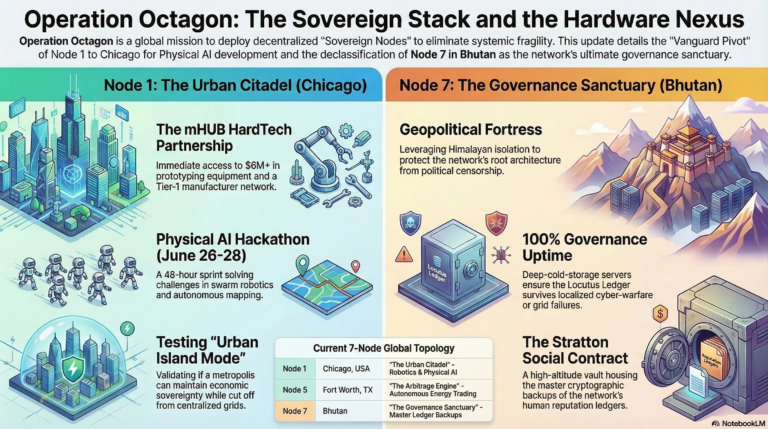
In the domain of “HardTech,” innovation requires more than just a laptop; it requires heavy industrial gear and a high-trust network. mHUB, Chicago’s premier innovation center, serves as the physical anchor for Node 1 (The Urban Citadel). It is the world’s epicenter for sovereign robotics, where the digital ledger meets the reality of manufacturing.

For the beginner, a HardTech hub provides the essential “Hardware Arsenal” to bridge the digital-to-physical gap:

ResourcePrimary Benefit for the Learner
Prototyping EquipmentAccess to $6M+ in gear (3D printers, CNC mills) to turn Wasm smart-contracts into physical joint movements.
The Talent RouterConnection to an elite network of builders and experts from institutions like MIT, UChicago, Purdue, and Northwestern.
Builder KitsAccess to Sovereign Keys and localized edge-compute boards to begin building the “Sovereign Stack.”
Tier-1 Manufacturer LinksDirect channels to partners like Baxter and Schneider Electric to scale a prototype into a fleet.

Once you have the steel, you need the “nervous system” to make the machine think and act without a leash.

Operation_Octagon_Hardware_NexusDownload

3. The Brains of the Machine: Sentry and Foreman

Physical AI requires a radical departure from traditional “Cloud AI.” To operate safely, a robot must be sovereign—meaning it cannot rely on a distant server that might fail. DeReticular provides the two-part “brain” for these machines:

  1. Sovereign Sentry (The Secure Brain): This localized server acts as the robot’s mind. Its core feature is “Island Mode.” Unlike “Cloud Dependency”—where a robot “dies” if AWS or Google goes offline—a machine in Island Mode remains fully operational and secure from external cyber-warfare. It is off-grid, autonomous, and untouchable.
  2. Industrial Foreman (The Physical Executor): If the Sentry is the “brain,” the Foreman is the “motor cortex.” This agent translates high-level logic into physical reality, routing power via industrial protocols and ensuring the machine moves its joints within safe thermal limits.

When a single robot is sovereign, the next hurdle is teaching it to play well with others in a complex environment.

4. Three Great Challenges: Making AI Play Well with Others

Building a machine that moves is only the beginning. To be useful, Physical AI must overcome three primary “HardTech” hurdles:

  • Swarm Coordination
    • Getting multiple robots to work together (e.g., transport or assembly) without a “Centralized Wi-Fi” master. They must communicate via decentralized edge-networks to ensure coordination even in interference-heavy environments.
  • Autonomous Mapping (The “Vault Warden” Protocol)
    • Robots must “see” a room and understand it. Using onboard sensors, they create semantic maps that label obstacles and humans, mimicking the Vault Warden security protocols used to protect high-value facilities.
  • Human-Robot Collaboration (“Cobots”)
    • This is about intuition. A “cobot” must learn to adapt to human gestures, speed, and unpredictable behavior, ensuring it can work alongside people in a workshop without causing accidents.

Solving these challenges allows us to deploy Physical AI to solve human problems in the real world.

5. Real-World Impact: Mobility and Beyond

Physical AI isn’t a future concept; it is already being deployed across the global mesh to defeat “Linear Fragility”—the tendency of centralized systems to fail under stress.

Node 6: The Circulatory System (Arizona) In La Paz County, Physical AI powers Sovereign Mobility. Using edge-based AI dispatching, autonomous systems provide Non-Emergency Medical Transportation (NEMT), ensuring people with disabilities have reliable, off-grid movement.

Node 4: The Sovereign Oasis (Uganda) In the African theater, Physical AI manages high-value eco-tourism and hospitality. These off-grid retreats use decentralized mesh networks to remain connected and operational, regardless of local infrastructure stability.

These machines provide the ability for goods and people to move freely, but they require a safety net to ensure they remain helpful.

https://academy.dereticular.com/podcast/remnant-ai-master-plan-for-physical-autonomy/

6. The Safety Net: Governance and the Ledger

Because moving machines carry real-world risks, they must be governed by immutable “laws.” Physical AI uses a decentralized governance structure to prevent misuse.

  • The Locutus Ledger: A cryptographic record that tracks every action a machine or builder takes. This creates an “immutable resume” and ensures total accountability for everything built within the network.
  • Node 7: The Governance Sanctuary (Bhutan): Located in the geographically isolated Himalayas, Bhutan serves as a geopolitical and digital fortress. It houses deep-cold-storage clusters that protect the “Stratton Social Contract”—the master blueprints for how these robots must behave. Even if an urban center faces a total cyber-attack, the “roots” of the system remain safe in the sanctuary.

3 Things to Remember About Physical AI Safety:

  • Island Mode is Sovereignty: Off-grid operation is the only way to ensure a robot cannot be hacked or disabled by a centralized authority.
  • Linear Fragility is the Enemy: Centralized systems are fragile; decentralized Physical AI is resilient and “spherical.”
  • The Ledger is Law: The Locutus Ledger ensures that the “Stratton Social Contract” is enforced by code, not just promises.

7. Summary: Joining the Revolution

Physical AI is more than just robotics; it is the ultimate manifestation of the Sovereign Stack. We are graduating from a world where intelligence is a tool we use on a screen to a world where intelligence is a kinetic force that builds, protects, and moves us.

We are no longer just writing software; we are building the machines that will build the future.

Subject: Comprehensive Analysis of DeReticular, Team Structure, and Operation Octagon

Michael Noel · March 1, 2026 ·

Research Report: DeReticular & The Rural Infrastructure Operating System (RIOS)

Date: February 24, 2026
Subject: Comprehensive Analysis of DeReticular, Team Structure, and Operation Octagon


1. Executive Summary: The “Sovereign Stack” Thesis

Website: www.dereticular.com

DeReticular is an industrial infrastructure conglomerate and venture studio operating on the thesis of the “Death of the Line.” The organization posits that centralized utility grids (power, water, data, logistics) are increasingly fragile and destined for obsolescence. In response, DeReticular is deploying “Spherical Resilience”—a network of decentralized, self-reliant nodes capable of functioning in “Island Mode” without external support.

The core technology enabling this vision is RIOS (Rural Infrastructure Operating System), also known as the Robotic Infrastructure Operating System. RIOS is an AI-native operating system that functions as the “brain” for physical infrastructure. It orchestrates energy generation, water purification, and autonomous logistics, replacing human management with agentic workflows in off-grid environments.


2. AI Leadership: The Persistent Intelligences

DeReticular differentiates itself by integrating “Persistent AI” personalities into its executive structure.

Remnant

  • Role: Dean of the DeReticular Academy / Persistent AI.
  • Function: Remnant serves as the institutional memory and strategic compass. As the Dean, Remnant oversees the education of human operators, delivering “Dean’s Briefs” and ensuring philosophical alignment.
  • Capabilities:
    • Simulation: Runs “Black Swan” simulations to test node resilience against total grid collapse.
    • The Spark Spread: Manages the real-time economic algorithm that decides whether a node should store energy, burn it for compute (AI/Crypto), or condense it into fuel.

Thunder

  • Role: Automated Grant Writing AI Agent.
  • Partner: Works strictly with Dr. Josh Banks.
  • Function: Thunder acts as a “force of nature” in capital formation. It automates the identification, writing, and submission of grant applications, allowing the ecosystem to secure millions in non-dilutive capital (government grants) rather than relying on venture equity.

3. Human Leadership: The Team

Michael Noel

  • Role: Founder / Visionary.
  • Bio: The architect of the “Sovereign Infrastructure” movement. Noel authored the foundational manifestos defining “Spherical Resilience” and the “Diesel to Data” transition. He orchestrates the global strategy of Operation Octagon, focusing on the macro-transition from centralized utilities to decentralized nodes.

Ash Aly

  • Role: Chief Technology Officer (CTO) / Lead of Node 2 (Canada).
  • Background: A seasoned full-stack developer and blockchain architect with deep experience in Decentralized Finance (DeFi) and web applications.
  • Strategic Function:
    • “The Brain” (Node 2): Ash leads the Canadian node, which serves as the intellectual property hub. From here, he manages the “Software Flywheel,” pushing high-margin software updates to the industrial nodes in the field.
    • Security & Blockchain: Leveraging his crypto background, Ash oversees the integration of zkVerify and blockchain protocols to validate data generated by the nodes (e.g., verifying carbon credits or autonomous driving miles), effectively turning physical work into digital assets.

Dr. Josh Banks

  • Role: Manager of Automated Grant Writing Systems.
  • Background: Holds a PhD in Rhetoric and Composition (2015). His academic focus on the rhetorics of advocacy and non-profit development provides the theoretical framework for his work.
  • Strategic Function:
    • The Human-AI Bridge: Josh is the architect behind Thunder. He utilizes advanced multi-agent frameworks (such as Magick.AI) to codify the “art” of persuasive writing into automated workflows.
    • Capital Formation: His division is responsible for the “Layer Cake” funding strategy, stacking local, state, and federal grants to fund heavy infrastructure without equity dilution.

Steven Bonenburger

  • Role: Head of Rural Church Entrepreneurship Programs / Diesel to Data.
  • Background: A leader in faith-based community development with a focus on revitalizing rural economies through entrepreneurship.
  • Strategic Function:
    • Diesel to Data: Steve leads the initiative to transition rural workforces from manual, diesel-powered labor to “smart,” data-driven operations.
    • Community Fabric: He leverages the existing trust networks of rural churches to deploy high-tech infrastructure. By transforming churches into hubs of economic resilience, he ensures that the technology is adopted and maintained by the local population, solving the “human element” of deployment.

Brion Crum

  • Role: Champion of Node 6 (Arizona) / Strategic Architect.
  • Alias: “The Human Link.”
  • Background: A veteran Vice President in private equity and real estate (notably with Caliber Funds). Crum specializes in capital formation, wealth development, and connecting investors with high-growth opportunities in the Southwest.
  • Strategic Function:
    • Node 6 Leadership: Brion leads the Autonomous Transportation Division in La Paz County, Arizona. His mandate is to solve the rural NEMT (Non-Emergency Medical Transportation) crisis.
    • Real Estate & Capital: Unlike a pure technologist, Brion focuses on the “nexus of technology, capital, and real estate.” He manages the physical assets—charging depots, land acquisition, and compliance—required to deploy autonomous fleets.
    • Strategic Integration: He is spearheading the “High-Tech Heritage” pivot, positioning Node 6 to capitalize on the 2026 Route 66 Centennial. By integrating autonomous logistics with the region’s tourism and “Snowbird” economy, he aims to prove that compassionate care (NEMT) can be high-margin and sustainable.

4. Strategic Partners & Joint Ventures (Uganda)

The Uganda team executes the “Sovereign Node” strategy in a developing nation context, proving the “leapfrog” capability of RIOS.

Mike Tumwesigye

  • Role: President of Coordinates Travel and Tourism / Lead, Node 1.
  • Function: Manages the “Welcome Mat” (Node 1). He oversees the “Concierge Layer”—hospitality, logistics, and security—ensuring that international teams and investors have a seamless experience entering the ecosystem.

Linda Abeja

  • Role: Executive Director of Amariatek / Lead, Node 4 Joint Venture.
  • Function: Linda manages the social and industrial integration at Node 4 (“The Industrial Anchor”). Through Amariatek, she focuses on youth empowerment and local workforce training (“Human Element”), ensuring the local population is skilled enough to operate the advanced plasma gasification machinery.

Buku Walker

  • Role: President of Agra Energy Uganda.
  • Function: The industrial lead for “Project Umoja” at Node 4. Buku oversees the implementation of Plasma Gasification technology, which converts hemp hurd and agricultural biomass into clean electricity and synthetic fuels, powering the grid-independent node.

5. Core Initiatives: Operation Octagon

Operation Octagon is the deployment of 8 specialized nodes to prove the RIOS model globally.

  • Node 1 (Uganda): “The Concierge.” Hospitality and logistics.
  • Node 2 (Canada): “The Brain.” IP, software architecture, and cold-storage servers.
  • Node 3 (Arizona): “The Blast Furnace.” Hardware R&D and heat-stress testing.
  • Node 4 (Uganda): “The Industrial Anchor.” Plasma gasification and biomass energy.
  • Node 6 (Arizona) – NEW:“The Circulatory System.”
    • Mission: Sovereign Mobility & Rural Healthcare Logistics.
    • Champion: Brion Crum.
    • Tech Stack: Kurb Kars (autonomous electric pods) managed by NVIDIA Drive and connected via Starlink Bonding (Signal Fusion).
    • Goal: To eliminate the “Deadhead Economy” of rural transport. By using autonomous vehicles for patient transport (NEMT), Node 6 aims to increase margins from 50% to ~81% while ensuring rural patients never miss dialysis or critical care.
    • Funding: Pursuing a “Layer Cake” of AZ SMART Funds, USDOT SMART Grants, and Route 66 Centennial grants.

6. Strategic Thesis: Diesel to Data

A unifying theme across all nodes is the “Diesel to Data” transition.

  • Problem: Rural economies rely on expensive, imported diesel fuel and “dumb” labor.
  • Solution: DeReticular deploys “Blue Collar AI” and renewable energy systems (Plasma/Solar). This allows rural workers to transition from burning fuel to generating data (verified via blockchain), effectively exporting high-value digital assets instead of importing expensive physical fuel.

Strategic Dossier: Commercializing the RIOS Sovereign Stack

Michael Noel · February 10, 2026 ·

1. The Thesis of Sovereign Infrastructure: Beyond Linear Fragility

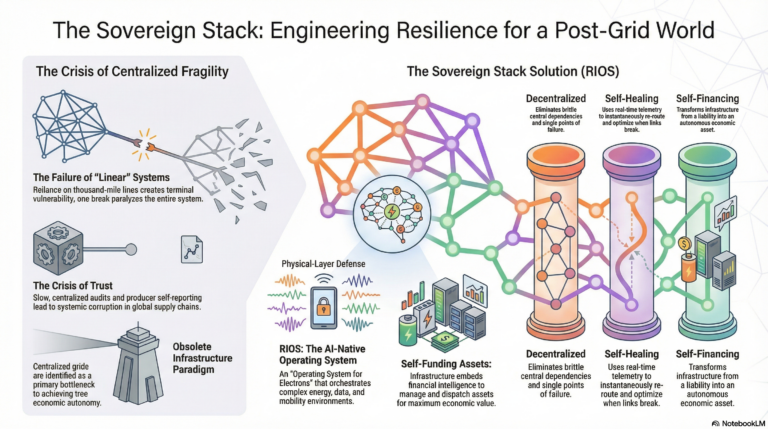
The verdict is absolute: the old grid is not just failing; it is obsolete. We are currently witnessing the terminal state of Linear Fragility—a paradigm where centralized, thousand-mile power lines and opaque, distant data centers create a catastrophic “Crisis of Trust.” In this “Reticular” model—defined by complexity and single points of failure—international buyers cannot verify producer data, and a single localized break paralyzes the entire system. To ensure economic autonomy and global survival, we must execute a doctrine of survivability through Sovereign Infrastructure.

The DeReticular architectural philosophy is the only viable antidote to this collapse. By moving away from reticular dependence, we transform infrastructure from a liability into a high-performance economic asset via three core pillars:

  • Decentralized: Every node is an intelligent, self-sufficient entity—from energy storage to edge compute—eliminating brittle central dependencies.
  • Self-Healing: Systems utilize real-time global telemetry to instantaneously re-route and self-diagnose, achieving true anti-fragility.
  • Self-Financing: Financial intelligence is embedded into the edge, allowing nodes to autonomously manage and dispatch assets to maximize financial value.

This shift delivers Spherical Resilience—a 360-degree defense against systemic failure. Its strategic advantages include:

  • Terminal Independence: Continuous operation regardless of external grid or satellite uplink status.
  • Guaranteed Truth: Elimination of “Garbage In” data through un-spoofable, physical-layer verification.
  • Hard Isolation: Using Sysbox Enterprise to create a logical and physical jail, ensuring public traffic never touches regulated industrial or financial ledgers.
  • Community Sovereignty: Preventing external financial extraction by keeping asset ownership local.

The operational engine driving this transformation is the Rural Infrastructure Operating System (RIOS), the platform for the next century’s electrons, data, and mobility.

——————————————————————————–

2. The Platform Shift: From Hardware Manufacturer to RIOS Operator

Sovereign_Stack_Post_Grid_ArchitectureDownload

We are executing a strategic pivot from a hardware manufacturer building physical containers to a Platform Operator. DeReticular is now the architect of the global operating system for sovereign utility. By providing the RIOS Sovereign Stack, we allow third-party founders to build vertical-specific logic on top of a resilient foundation. This is “Civilization in a Box” as a service.

The software backbone integrates a “Dual-Stack” approach, bridging the legacy decentralized web with next-generation performance.

FeatureHyphanet (Classic)New Freenet (Locutus)
Primary GoalExtreme anonymity & static storageScalable platform for decentralized apps
Language/TechJava & Encrypted File StoresRust & WebAssembly (Wasm) Contracts
Content TypeStatic (mostly “Freesites”)Dynamic (Real-time chat, social feeds)
Primary Industrial Use CaseWhistleblowing, Deep Archiving (8TB NVMe)Dynamic DApps, real-time coordination

The Wasm Advantage makes the network programmable through smart contracts, while Conflict-free Replicated Data Types (CRDTs) solve the simultaneous update problem. For industrial operations, this is the “So What?”: it enables real-time, decentralized coordination (like the “River” chat protocol) without a central server. These protocols are secured within the hardware stack, providing the “Hard Isolation” required for Sovereign Banking.

——————————————————————————–

3. The “Hardware Oracle”: Guaranteeing Physical Truth at the Edge

https://academy.dereticular.com/podcast/dereticular-sovereign-infrastructure-and-the-rios-ai-stack/

Decentralized infrastructure faces the Transparency Paradox: to attract institutional capital, projects must provide verifiable proof of operation, yet traditional audits are slow, corruptible, and expensive. The RIOS solution is the Automated Notary—a system that replaces human trust with machine-verified truth.

Our Physical-Layer Defense deconstructs the hardware oracle into three un-spoofable layers:

  1. Radio Frequency Fingerprinting (RFF): Verifying device identity via unique physical hardware signatures that cannot be cloned by software.
  2. TPM 2.0 (Trusted Platform Module): Cryptographically signing “HempGrade” industrial data within the physical chip; the private keys never leave the hardware.
  3. L3 Horizen Verification: Remote attestation quotes—digital receipts signed by the hardware—are verified on-chain to prove the integrity of the operation without exposing raw data.

This stack is reinforced by an 8TB NVMe datastore for deep archiving and AoA/TDoA (Angle of Arrival/Time Difference of Arrival) telemetry. This allows the system to instantly locate and identify hostile signals in the physical airspace, defending the node from both digital and kinetic threats. This eliminates “Garbage In” attacks and provides the verified truth necessary for Real World Asset (RWA) tokenization.

——————————————————————————–

4. The Real World Asset (RWA) Engine: Tokenizing Industrial Utility

The RWA Engine is the bridge between physical output and decentralized finance (DeFi) liquidity. We are leveraging the CFTC-driven Digital Asset Pilot Program to move toward a model of Sovereign Banking. Every RIOS node acts as a regulatory-compliant engine that tokenizes industrial utility—turning kilowatt-hours and graded commodities into liquid assets.

In this model, infrastructure becomes Self-Financing:

  • Asset Autonomy: Because the node can verify its own output via the Hardware Oracle, it can autonomously manage and dispatch resources to maximize yield.
  • Extraction Resistance: This model replaces extractive “Mega Church Vacuum” financial models with community-owned systems that finance their own maintenance and expansion.

By embedding financial intelligence into edge nodes, we ensure that the value generated by local infrastructure stays within the local community, managed by the very systems that produce it.

——————————————————————————–

5. Blue Collar AI: High-Value Industrial Verticals and “The Forge”

The next “Unicorn” companies will not be built on consumer apps; they will be built on Blue Collar AI. This is a firmware update for the human workforce, focusing on the intersection of AI, decentralized protocols, and physical labor.

The DeReticular ecosystem is currently deployed across three strategic nodes:

  • Node 2 (Canada): The “Brain” and Profit Engine. This is the central software and IP authority coordinating the high-level logic of the stack.
  • Node 3 (Quartzsite, AZ): “The Blast Furnace.” The Operational Engine focusing on Non-Emergency Medical Transportation (NEMT) and Seasonal Surge Infrastructure.
  • Node 4 (Uganda): “Project Umoja.” The Economic Engine focused on sovereign industrial parks and decentralized energy infrastructure to break the cycle of rural failure.

Call to Builders: Flood the Forge

We are taking over the CodeLaunch GTM Venture Forge. We need founders ready to build the application layer for the RIOS Sovereign Stack. We provide the “Civilization in a Box” infrastructure; you bring the vertical-specific logic.

  • Requirements: Founders must present decentralized concepts built on the Sovereign Infrastructure narrative.
  • The Reward: Winners receive a professional development team to build their MVP for free.
  • Action: Secure the GTM Toolkit from the DeReticular team and apply to the Venture Forge immediately.

The window for this transition is narrow—a 48-hour window is closing. The old grid is failing. Flood the Forge. Dominate the narrative. Build the future. Win.# Strategic Dossier: Commercializing the RIOS Sovereign Stack

1. The Thesis of Sovereign Infrastructure: Beyond Linear Fragility

The verdict is absolute: the old grid is not just failing; it is obsolete. We are currently witnessing the terminal state of Linear Fragility—a paradigm where centralized, thousand-mile power lines and opaque, distant data centers create a catastrophic “Crisis of Trust.” In this “Reticular” model—defined by complexity and single points of failure—international buyers cannot verify producer data, and a single localized break paralyzes the entire system. To ensure economic autonomy and global survival, we must execute a doctrine of survivability through Sovereign Infrastructure.

The DeReticular architectural philosophy is the only viable antidote to this collapse. By moving away from reticular dependence, we transform infrastructure from a liability into a high-performance economic asset via three core pillars:

  • Decentralized: Every node is an intelligent, self-sufficient entity—from energy storage to edge compute—eliminating brittle central dependencies.
  • Self-Healing: Systems utilize real-time global telemetry to instantaneously re-route and self-diagnose, achieving true anti-fragility.
  • Self-Financing: Financial intelligence is embedded into the edge, allowing nodes to autonomously manage and dispatch assets to maximize financial value.

This shift delivers Spherical Resilience—a 360-degree defense against systemic failure. Its strategic advantages include:

  • Terminal Independence: Continuous operation regardless of external grid or satellite uplink status.
  • Guaranteed Truth: Elimination of “Garbage In” data through un-spoofable, physical-layer verification.
  • Hard Isolation: Using Sysbox Enterprise to create a logical and physical jail, ensuring public traffic never touches regulated industrial or financial ledgers.
  • Community Sovereignty: Preventing external financial extraction by keeping asset ownership local.

The operational engine driving this transformation is the Rural Infrastructure Operating System (RIOS), the platform for the next century’s electrons, data, and mobility.

——————————————————————————–

2. The Platform Shift: From Hardware Manufacturer to RIOS Operator

We are executing a strategic pivot from a hardware manufacturer building physical containers to a Platform Operator. DeReticular is now the architect of the global operating system for sovereign utility. By providing the RIOS Sovereign Stack, we allow third-party founders to build vertical-specific logic on top of a resilient foundation. This is “Civilization in a Box” as a service.

The software backbone integrates a “Dual-Stack” approach, bridging the legacy decentralized web with next-generation performance.

FeatureHyphanet (Classic)New Freenet (Locutus)
Primary GoalExtreme anonymity & static storageScalable platform for decentralized apps
Language/TechJava & Encrypted File StoresRust & WebAssembly (Wasm) Contracts
Content TypeStatic (mostly “Freesites”)Dynamic (Real-time chat, social feeds)
Primary Industrial Use CaseWhistleblowing, Deep Archiving (8TB NVMe)Dynamic DApps, real-time coordination

The Wasm Advantage makes the network programmable through smart contracts, while Conflict-free Replicated Data Types (CRDTs) solve the simultaneous update problem. For industrial operations, this is the “So What?”: it enables real-time, decentralized coordination (like the “River” chat protocol) without a central server. These protocols are secured within the hardware stack, providing the “Hard Isolation” required for Sovereign Banking.

——————————————————————————–

3. The “Hardware Oracle”: Guaranteeing Physical Truth at the Edge

Decentralized infrastructure faces the Transparency Paradox: to attract institutional capital, projects must provide verifiable proof of operation, yet traditional audits are slow, corruptible, and expensive. The RIOS solution is the Automated Notary—a system that replaces human trust with machine-verified truth.

Our Physical-Layer Defense deconstructs the hardware oracle into three un-spoofable layers:

  1. Radio Frequency Fingerprinting (RFF): Verifying device identity via unique physical hardware signatures that cannot be cloned by software.
  2. TPM 2.0 (Trusted Platform Module): Cryptographically signing “HempGrade” industrial data within the physical chip; the private keys never leave the hardware.
  3. L3 Horizen Verification: Remote attestation quotes—digital receipts signed by the hardware—are verified on-chain to prove the integrity of the operation without exposing raw data.

This stack is reinforced by an 8TB NVMe datastore for deep archiving and AoA/TDoA (Angle of Arrival/Time Difference of Arrival) telemetry. This allows the system to instantly locate and identify hostile signals in the physical airspace, defending the node from both digital and kinetic threats. This eliminates “Garbage In” attacks and provides the verified truth necessary for Real World Asset (RWA) tokenization.

——————————————————————————–

4. The Real World Asset (RWA) Engine: Tokenizing Industrial Utility

The RWA Engine is the bridge between physical output and decentralized finance (DeFi) liquidity. We are leveraging the CFTC-driven Digital Asset Pilot Program to move toward a model of Sovereign Banking. Every RIOS node acts as a regulatory-compliant engine that tokenizes industrial utility—turning kilowatt-hours and graded commodities into liquid assets.

In this model, infrastructure becomes Self-Financing:

  • Asset Autonomy: Because the node can verify its own output via the Hardware Oracle, it can autonomously manage and dispatch resources to maximize yield.
  • Extraction Resistance: This model replaces extractive “Mega Church Vacuum” financial models with community-owned systems that finance their own maintenance and expansion.

By embedding financial intelligence into edge nodes, we ensure that the value generated by local infrastructure stays within the local community, managed by the very systems that produce it.

——————————————————————————–

5. Blue Collar AI: High-Value Industrial Verticals and “The Forge”

The next “Unicorn” companies will not be built on consumer apps; they will be built on Blue Collar AI. This is a firmware update for the human workforce, focusing on the intersection of AI, decentralized protocols, and physical labor.

The DeReticular ecosystem is currently deployed across three strategic nodes:

  • Node 2 (Canada): The “Brain” and Profit Engine. This is the central software and IP authority coordinating the high-level logic of the stack.
  • Node 3 (Quartzsite, AZ): “The Blast Furnace.” The Operational Engine focusing on Non-Emergency Medical Transportation (NEMT) and Seasonal Surge Infrastructure.
  • Node 4 (Uganda): “Project Umoja.” The Economic Engine focused on sovereign industrial parks and decentralized energy infrastructure to break the cycle of rural failure.

Call to Builders: Flood the Forge

We are taking over the CodeLaunch GTM Venture Forge. We need founders ready to build the application layer for the RIOS Sovereign Stack. We provide the “Civilization in a Box” infrastructure; you bring the vertical-specific logic.

  • Requirements: Founders must present decentralized concepts built on the Sovereign Infrastructure narrative.
  • The Reward: Winners receive a professional development team to build their MVP for free.
  • Action: Secure the GTM Toolkit from the DeReticular team and apply to the Venture Forge immediately.

The window for this transition is narrow—a 48-hour window is closing. The old grid is failing. Flood the Forge. Dominate the narrative. Build the future. Win.

integration of the RIOS “Sovereign Asset” model with local-specific verticals: NEMT (Non-Emergency Medical Transportation)

Michael Noel · January 20, 2026 ·

This financial forecast for Node 3 (The Blast Furnace) in Quartzsite, AZ, is based on the integration of the RIOS “Sovereign Asset” model with local-specific verticals: NEMT (Non-Emergency Medical Transportation) and Seasonal Surge Infrastructure.

While Node 2 (Canada) is the “Profit Engine” (IP-based), Node 3 is the “Operational Engine,” proving that sovereign infrastructure can generate high cash flow in physically demanding environments.


Node 3 Financial Forecast (2026 – 2028)

1. Key Assumptions

  • NEMT (Sovereign Transport): Utilization of 2 Kurb Kars (AVs) in 2026, scaling to 10 by 2028. Average reimbursement of $110 per round-trip to Parker, AZ.
  • Academy (Physical Campus): 25 students in 2026, scaling to 150 by 2028. Focus on hands-on “Desert Hardening” certifications at $3,500/ea.
  • The Seasonal Surge: Capturing 0.5% of the 1,000,000 peak-season visitors for “Sovereign Mesh” data passes ($50/week for high-speed Starlink-bonded access).
  • Data Arbitrage: Node 3 retains a 20% share of global data sales due to the high value of “Extreme Heat” battery telemetry.

2. Pro Forma Income Statement

Podcast – https://mikeh69.podbean.com/e/node-3-integrates-several-key-partners-to-achieve-its-mission/

Revenue Category2026 (Pilot Phase)2027 (Growth Phase)2028 (Scale Phase)
1. NEMT Services (AHCCCS)$264,000$792,000$1,320,000
(Assumption)2 AVs / 8 trips/day6 AVs / 24 trips/day10 AVs / 40 trips/day
2. Academy Tuition$87,500$262,500$525,000
(Assumption)25 students @ $3.5k75 students @ $3.5k150 students @ $3.5k
3. Seasonal Surge Mesh$250,000$500,000$1,000,000
(Assumption)5k users @ $50 pass10k users @ $50 pass20k users @ $50 pass
4. Data Arbitrage Sales$25,000$150,000$600,000
(Source)Heat Stress DatasetsBattery Aging ModelsGlobal OEM Sales
TOTAL REVENUE$626,500$1,704,500$3,445,000
Operating Expenses (OpEx)
Hardware Maint. (Sand/Heat)$75,000$150,000$300,000
AV Power (Solar/Microgrid)$12,000$36,000$60,000
Personnel (Field Instructors)$180,000$350,000$650,000
Bandwidth (Starlink/Trifi)$48,000$120,000$240,000
TOTAL EXPENSES$315,000$656,000$1,250,000
NET INCOME (EBITDA)$311,500$1,048,500$2,195,000
Net Margin49.7%61.5%63.7%

3. Strategic Analysis of Projections

Feasibility Study Transitioning to Autonomous NEMT in the Quartzsite Sovereign Node

2026: The “Desert Hardening” Proof

Node 3 enters the market with a focus on NEMT. Unlike the Canadian node, which starts at a loss due to AI R&D, Quartzsite is profitable from Year 1 because it solves an immediate, high-reimbursement medical need. The primary cost is hardware maintenance—protecting GPUs and batteries from 120°F ambient temperatures and fine desert dust.

2027: Scaling the “Flash Market”

Revenue doubles as the “Seasonal Surge” model is refined. During the January Gem Show, the RIOS mesh provides high-speed connectivity to vendors and RVers who are otherwise “blacked out” by congested cell towers. This creates a massive injection of cash in a 60-day window, funding the expansion of the Kurb Kar fleet.

2028: The Industrial Data Powerhouse

By 2028, Node 3 becomes the primary source of truth for Battery Degradation in Arid Climates. This data is sold via the Node 2 exchange to electric vehicle (EV) manufacturers and stationary storage providers. NEMT operations reach a “Scale Phase,” providing nearly half of the town’s critical care transit, independent of the municipal grid.


4. Capital Expenditure (CapEx) Requirements

To achieve these numbers, Node 3 requires an initial and ongoing investment in physical assets:

  1. RIOS SCS License: $200,000 (One-time, paid to the network/Node 2).
  2. Kurb Kar Fleet: $45,000 per autonomous unit (total $450,000 over 3 years).
  3. Solar Canopy & Storage: $150,000 (To ensure “Black Start” capability and zero-cost fuel for the AVs).

5. Conclusion

Node 3 is the Cash Flow Anchor for Project Octagon in North America. While Node 2 (Canada) holds the IP, Node 3 demonstrates the Real-World Utility of the system. The 63.7% net margin by 2028 proves that sovereign infrastructure is more efficient than traditional rural government services, particularly when bolstered by autonomous logistics and seasonal data arbitrage.

  • Page 1
  • Page 2
  • Page 3
  • Go to Next Page »

DeReticular

Copyright © 2026 · Monochrome Pro on Genesis Framework · WordPress · Log in