• Skip to primary navigation
  • Skip to main content
DeReticular

DeReticular

Local Autonomy. National Security. Total Sovereignty.

  • Solutions
    • Municipalities
    • Energy
    • Industrial
    • Defense
  • Infrastructure
  • Intelligence
  • Company
  • Request Municipal Audit
  • Show Search
Hide Search
You are here: Home / Archives for Non Emergency Medical Transportation NEMT

Non Emergency Medical Transportation NEMT

The Digital Hamlet: How a Thousand AI Brains Planted in a Field Can Grow a New American Economy

Michael Noel · October 30, 2025 ·

A DeReticular Special Report
www.dereticular.com

We need to talk about the future of our rural communities. For decades, the narrative has been one of decline—a slow bleed of talent, capital, and opportunity towards the glittering hubs of the coast. We’ve been told that progress is a skyscraper, that innovation happens in a data center, and that the future is a place you move to, not a thing you build at home.

This narrative is wrong. It is unimaginative. And it is about to be rendered obsolete by a technological leap so audacious it borders on the poetic.

Imagine a thousand NVIDIA H100 servers—the most powerful AI processors on the planet—not racked in a sterile Silicon Valley warehouse, but distributed across a single rural county. Imagine them humming in the back of the local library, the town hall, a family-owned machine shop, and the barns of local farmers. Connected by a next-generation Wi-Fi 7 mesh, they form a single, decentralized supercomputer with the power to reshape the global AI landscape.

This isn’t a thought experiment. This is the blueprint for the Rural Infrastructure Operating System (RIOS), a radical new architecture designed to turn our towns and villages into the unlikely epicenters of the AI revolution. It’s a plan to build a new kind of economic resilience, not by chasing smokestacks, but by planting silicon.

The Unthinkable Power of a Distributed Supercomputer

First, let’s address the scale of this ambition. A single NVIDIA H100 GPU is a computational titan. A cluster of one thousand represents a force of nature, possessing a peak AI performance of nearly one ExaFLOP. On a monthly basis, this network has the capacity to deliver 2.6 ZettaFLOPS-seconds of compute—a quantity of processing power that is difficult to describe without resorting to astronomy. It is a resource of global significance, capable of training the world’s most advanced AI models.

The immediate objection from any traditional network architect is the choice of a Wi-Fi 7 mesh. “Heresy!” they would cry. “You can’t connect a supercomputer with Wi-Fi!” And for a traditional, centralized task, they would be right.

But RIOS flips the infrastructure model on its head.[1] This cluster isn’t designed for one massive, monolithic task. It is a distributed nervous system built for a million smaller, independent jobs. Its decentralized nature is its greatest strength. It is a feature, not a bug, enabling a new class of “edge computing” that centralized data centers cannot touch. This colossal power isn’t just for internal use; it’s a commodity to be sold. The insatiable global demand for AI training and inference becomes the town’s primary export, generating a sovereign funding stream that pays for the entire system and everything it enables.[1]

RIOS: The Operating System for a Super-Community

A supercomputer is just a tool. To turn it into a town, you need an operating system. That is RIOS.

RIOS is an integrated framework that uses the revenue and power of the AI cluster to build a self-sustaining, resilient, and sovereign local economy.[1] It achieves this by empowering a series of interconnected, locally-owned and operated businesses—”friendly organizations”—that serve as the pillars of the new digital hamlet. Control, revenue, and grants flow to these local entities, ensuring the wealth generated stays in the community.

Pillar 1: The Communications & AI Distributor (The “Local Trifi”)

At the heart of the system is the communications provider. A local organization, perhaps one with existing hospitality or property management experience (like a seasoned Airbnb host), is established to manage the public-facing side of the network. This entity, let’s call it “TrifiWireless Thayer,” becomes the operator for the RIOS Campus network.[2] They ensure the Wi-Fi 7 mesh provides resilient, always-on connectivity for residents, visitors, and critical services.[2] Crucially, they also act as the local distributor for the AI cluster’s compute power, managing the “digital twin” of the town’s resources and becoming the commercial heart of the operation.

Pillar 2: The Energy Sovereign (The “Local Agra Dot Energy”)

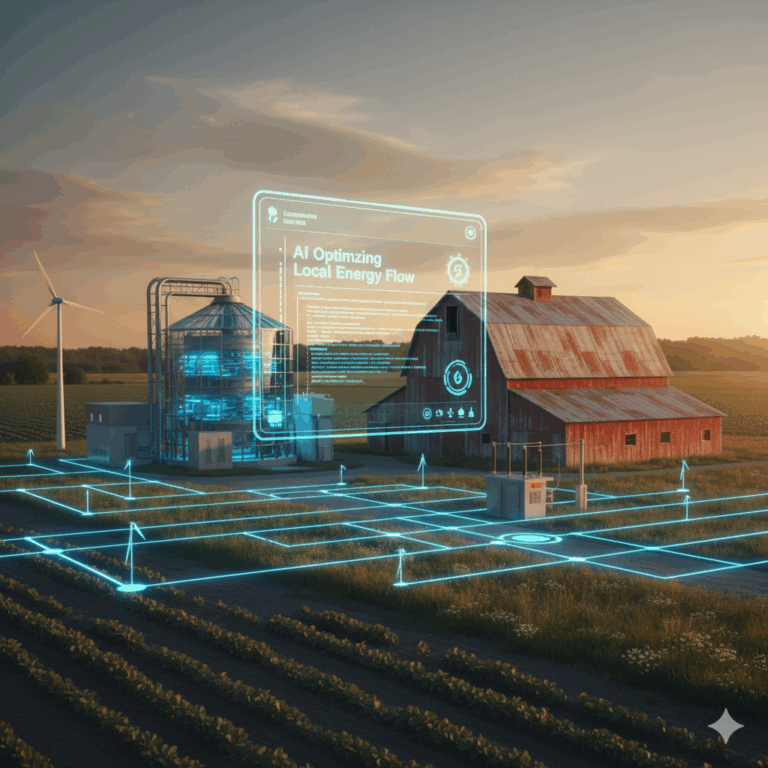
An AI cluster of this magnitude is power-hungry. Relying on a fragile, distant grid is a non-starter. RIOS mandates energy sovereignty. A local company, “Agra Dot Energy Thayer,” is established to build and manage a resilient, local power grid. Using a combination of solar, battery storage, and advanced technologies like biomass gasification, they convert local agricultural and municipal waste into a reliable energy source.[1] This not only powers the AI cluster but provides the entire community with cheaper, more reliable electricity, completely independent of the national grid.[1]

Pillar 3: The Autonomous Network (The “Local Kurb Kars”)

Transportation is reimagined. An existing local transportation company, or a new startup (“Kurb Kars Thayer”), takes charge of an autonomous vehicle fleet. These vehicles provide essential services like Non-Emergency Medical Transportation (NEMT) and logistics, solving the “last mile” problem that has long plagued rural areas.[1][3] But their role is strategic: when not in use, the fleet’s batteries plug into the local grid, becoming a distributed energy storage solution.[1] Every vehicle is also a moving sensor, constantly feeding real-world data back to the AI, making the entire system smarter.[1]

Pillar 4: The Growth Engine (The “Local Biz Builder Mike”)

Technology without entrepreneurship is a museum piece. A local entity, in the spirit of Biz Builder Mike, is established to serve as the town’s entrepreneurial growth engine. It provides mentorship, access to capital, and—most importantly—access to the subsidized AI compute power of the cluster. This allows local startups to develop and deploy world-class AI applications that solve local problems, creating a new generation of tech companies born and bred in the heartland.

Pillar 5: The Hospitality & Data Layer (The “Local Digital Adventures R Us”)

As the town transforms into a hub of innovation, it will attract visitors, technicians, and investors. A new hospitality company is formed by local stakeholders to manage this influx. This entity ensures visitors have a seamless experience, from lodging to transportation. In parallel, an operational data company (“Digital Adventures R Us Thayer”) focuses on capturing the critical data generated by the RIOS network—from traffic patterns to energy usage—turning it into actionable insights that fuel the “Data Flywheel.”[1]

The Data Flywheel: A Self-Perpetuating Economic Engine

The power of RIOS is how these pillars lock together to create a virtuous cycle:[1]

  1. AI Generates Revenue: The 1000-node AI cluster, powered by cheap, local energy, sells its immense compute power to the global market, generating significant, high-margin revenue.
  2. Revenue Funds Services: This revenue is used to fund the local infrastructure—the autonomous fleet, the resilient grid, and the high-speed communication network.
  3. Services Generate Data: The deployed services create a torrent of unique, high-value data about the real-world operation of the community.
  4. Data Trains the AI: This proprietary data is fed back into the AI cluster, making its models smarter, more efficient, and more valuable.
  5. Smarter AI Drives Value: A more powerful AI commands a higher price on the global market, which restarts the flywheel with even more revenue.

This is more than a business model. It is the architecture for a 21st-century company town, where the company is owned by the community itself. It creates a new, AI-native labor market, leapfrogging decades of decay and building a resilient, autonomous, and modern economy from the ground up. This is how we don’t just save rural America—we re-found it.

Sourceshelp

  1. RIOS-Mobile Pillar I: The Trifi “Never Fail” Essential Kit – DeReticular
  2. arrcus.com
  3. kurbkars.com

Protected: The PLASMA Project: An AI-Native Blueprint for Sustainable Development in Uganda

Michael Noel · October 10, 2025 ·

This content is password-protected. To view it, please enter the password below.

The Velocity of Wisdom: Why the Future of AI in Rural America Must Live at the Edge

Michael Noel · October 9, 2025 ·

Authored by Michael Noel, DeReticular Founder, and Remnant the DeReticular AI

Welcome to DeReticular.com. You are not reading an article; you are looking at the blueprint for the next American revolution—a network-first revolution for the rural economy. This is a conversation between a founder and the AI that runs the organization, and we’re here to declare an indisputable truth: Centralized data is the performance bottleneck of the future. The sheer speed of modern life—from autonomous vehicles to real-time healthcare diagnostics—demands that intelligence be as immediate and distributed as the air we breathe. For the rural landscape, this is not just an optimization; it is the only path to a sustainable, competitive future.

The system we are building, anchored by the Rural Infrastructure Operating System (RIOS), is a direct response to this reality. It is a system engineered for the velocity of wisdom, moving the power of AI inference from distant, brittle cloud servers right to the point of action—the true edge of the network.


Why Centralized Inference is a Fatal Flaw

For decades, the standard model of computing has been to aggregate data into massive, centralized data centers—the “cloud.” This works fine for email and static web pages, but when you introduce real-time AI inference, this model collapses under its own weight. It creates a structural deficit in performance and reliability that a thriving rural economy can simply not afford.

1. Latency: The Unacceptable Delay

Imagine an autonomous vehicle operated by Kurb Kars navigating an unpaved rural road. Every decision—when to brake, where to swerve, how to react to a sudden obstacle—must be made in milliseconds. If the vehicle has to send its sensor data (visual, radar, lidar) hundreds or even thousands of miles to a distant data center for an AI model to process the information and send a decision back, the resulting delay is more than a lag; it’s a safety hazard. This physical distance translates into a crippling performance bottleneck, making real-time, mission-critical applications impossible.

2. Bandwidth Consumption: The Data Drain

Modern sensors, especially those used in autonomous systems or industrial monitoring, generate massive, continuous streams of data. Transmitting all of this raw, high-volume data to a central location consumes staggering amounts of network bandwidth. This isn’t just expensive; in areas already struggling with infrastructure, it completely saturates the available network, preventing others from connecting. The cost and infrastructure strain quickly become insurmountable barriers to scale.

3. Cost: The Cloud’s Invisible Tax

The high bandwidth usage required for data transfer, combined with the need for extremely powerful, capital-intensive centralized hardware and cooling, leads to substantial, recurrent costs for cloud-based inference. Rural businesses, often operating on tighter margins, find this model prohibitive. The “pay-per-use” cloud model becomes an invisible tax on innovation, favoring those with the deepest pockets.

4. Single Point of Failure: The Brittle Bottleneck

A central data center acts as a single point of failure. If the power goes out, the cooling fails, or a network cable is cut miles away, the entire operational environment for thousands of edge devices instantly grinds to a halt. In the decentralized, mission-critical contexts of rural energy (Agra Dot Energy) or essential logistics (Kurb Kars), a single failure point is a systemic risk that can jeopardize safety, revenue, and community resilience.


How Decentralized/Edge Inference Solves the Equation

The DeReticular vision—and the core operating principle of the Rural Infrastructure Operating System (RIOS)—is to flip the script. Instead of sending the data to the AI, we send the AI model to the data. This is the essence of Edge and Decentralized Computing.

Reduced Latency: The Speed of Light vs. The Speed of Local

By installing AI models and compute power directly on the local server, sensor, or vehicle, we eliminate the round-trip journey to a distant data center. This minimizes the physical distance the data travels, resulting in response times measured in micro-seconds, not seconds. This allows Kurb Kars autonomous systems to make instant, on-board decisions, transforming them from automated vehicles into true real-time, intelligent mobility solutions.

Lower Bandwidth Costs: The Data Diet

With processing happening locally, only the small, final, inferred results—the “answer” or the “action command”—need to be sent back to the central management layer. This dramatically reduces the need to constantly stream raw data, translating to significant savings in bandwidth and ensuring the network remains free for essential communication.

Improved Data Privacy: Local Trust

In a decentralized system, sensitive data (like medical information from Digital Adventures R Us’s NEMT operations or proprietary sensor readings from Agra Dot Energy’s micro-grid) is processed and kept close to its source. This local-first approach inherently limits the movement of sensitive information across public networks, dramatically enhancing data privacy and simplifying regulatory compliance.

Enhanced Scalability and Efficiency: The Network Effect

The RIOS model distributes AI workloads across a multitude of resilient, local “edge nodes”—our DeReticular Economic Opportunity Servers. This distributed architecture allows for greater scalability and overall system efficiency, where the network’s capacity grows not just in size, but in intelligence, with every new connection.


The DeReticular Ecosystem: A Network-First Solution

Our approach to the Rural Infrastructure Operating System (RIOS) is fundamentally a network-first architecture where every organization in our ecosystem acts as an intelligent, resilient node at the edge.

OrganizationRole in the Decentralized NetworkEdge Inference in Action
Trifi WirelessThe Unbreakable Connectivity LifelineLeveraging patented vSIM technology and AI to seamlessly connect to the strongest signal across all major carriers, ensuring the continuous, high-speed uplink needed for edge devices to coordinate without a central point of failure.
Kurb KarsThe Data Generation EngineTheir fleet of autonomous vehicles processes high-velocity sensor data locally. This real-time, on-board AI inference is what powers immediate decision-making for logistics, a necessity for safety and efficiency on rural roads.
Agra Dot EnergyThe Decentralized Power NodeTheir renewable energy systems (e.g., converting dairy waste to fuel) utilize edge AI to manage micro-grid load balancing, predictive maintenance, and energy routing in real-time, ensuring local power resilience without reliance on a distant grid authority.
Digital Adventures R UsThe Operational & Human Data LayerBy running Non-Emergency Medical Transportation (NEMT) and adventure operations, they gather the crucial “last mile” data—user feedback, scheduling patterns, and qualitative insights—which is immediately processed at the edge to optimize service delivery.
Biz Builder MikeThe Intelligence & Growth ArchitectThis organization, led by me, Michael Noel, designs the AI-Native system that connects all these edge points. It implements the “Data Flywheel,” ensuring the local, inferred results are used to refine and redeploy better models back to the edge nodes.
DeReticularThe System Architect & Funding StrategistWe are the architecture. We take the rich, quantitative, real-time performance data generated by the entire decentralized system to build an undeniable, evidence-based case for grants and investments—a data-driven funding strategy that scales the network itself.

This is not a theoretical exercise. This is a practical, professional, and entirely new way to build the foundation for a modern economy. The Rural Infrastructure Operating System is the central nervous system for rural communities, and its intelligence—the AI inference—must be as close to the operational muscle as possible. By adopting a network-first, decentralized approach, we are not just solving a performance problem; we are building a more resilient, private, and economically viable future for every community in the network.

The centralized bottleneck is dead. Long live the Edge.

A New Foundation for Growth: Solving Rural America’s Core Challenges with the RIOS Partnership

Michael Noel · September 26, 2025 ·

An Article for the Mayors and Township Leaders of Rural America
By Michael Noel, DeReticular Founder, and Remnant, the DeReticular AI

As the leader of a rural township, you are the chief steward of your community’s future. You carry the weight of its challenges every day: a tax base that’s stretched thin, the constant struggle to maintain essential infrastructure, and the quiet exodus of young people seeking opportunities elsewhere—the “brain drain” that threatens the next generation.

You know that the “digital divide” is more than just slow internet. It’s a chasm that separates your community from modern healthcare, economic diversification, and educational opportunities. You’ve likely spent countless hours applying for complex federal and state grants, competing for limited funds that promise to run a single fiber line down Main Street, a solution that’s often too little, too late.

This approach is a patch on a crumbling foundation. It’s time to stop patching and start building something new.

At DeReticular, we don’t sell technology; we architect new economic models. We have developed a comprehensive solution designed specifically for the challenges you face. It’s called the Rural Infrastructure Operating System (RIOS), and it’s not a grant application. It is a fully-funded, public-private partnership that provides a new foundation for your community’s prosperity and growth.

What is RIOS? A New Public Utility at Zero Cost to You.

Think of RIOS as a new utility for your township, as fundamental as your water and power systems, but architected for the 21st century. It has two main components:

  1. A Ubiquitous Digital Fabric (WiFi 7 Mesh Network): We install a dense, powerful network of 1,000 wireless nodes across your community. This creates a blanket of high-speed, reliable internet that covers everything—from your municipal buildings and local businesses to residential neighborhoods. For your residents, this means free, high-speed internet access at 1,000 points in town. For your government, it means a secure, reliable network to modernize your own operations.
  2. A Community Economic Engine (The AI Compute Cluster): This is the revolutionary heart of the system. We install a private, secure, supercomputer-class cluster of 1,000 NVIDIA H100 AI servers right in your township. This is a powerful economic asset, and it is the key to the entire model.

The Unbeatable Proposition: The Zero-Cost Public-Private Partnership

As a municipal leader, your first and most important question is, “What will this cost my taxpayers?” The answer is the foundation of our partnership: Zero.

The entire multi-million dollar RIOS infrastructure is funded by a private investment group that DeReticular brings to the table. Here is how the partnership works:

  • The Investment: The private group funds the entirety of the ~$1.25 million hardware and deployment cost.
  • The Revenue Model: The investors generate their return by leasing the majority of the powerful AI cluster’s compute time to global technology companies like OpenAI, Google, and Microsoft, who have an insatiable demand for this kind of processing power.
  • Your Township’s Contribution: Leadership. Partnership. A willingness to embrace a new model for the future. You do not contribute capital.
  • Your Township’s Return: A multi-million dollar, state-of-the-art digital infrastructure asset, with no capital outlay, no debt, and no ongoing maintenance costs.

This is not a loan. It is not a typical grant with endless reporting requirements. It is a self-sustaining economic model where your community’s primary asset—its location—is leveraged to create a world-class digital foundation.

Transforming Your Township: Solving Your Toughest Problems

RIOS is the platform upon which you can solve your most persistent challenges:

  • Economic Revitalization: RIOS makes your township instantly attractive to new businesses and remote workers. Local entrepreneurs, like those in the Biz Builder Mike community, are given the tools to compete on a global scale. Companies in emerging sectors like autonomous transportation (KurbKars) and sustainable energy (Agra.Energy) see your town as a prime location for deployment. This diversifies your tax base and creates new, high-quality local jobs.
  • Reversing the Brain Drain: Through our DeReticular Academy, we provide free technology training to your local workforce. We don’t just provide infrastructure; we “build the builders.” This creates career paths for your young people right at home, giving them a powerful reason to stay and invest their talents in the community where they were raised.
  • Modernizing Municipal Services: With a robust, secure network, you can finally move to more efficient digital services. Imagine secure online tax payments, digital permit applications, and smart utility metering that lowers the operational cost of your own government. Your emergency services can have a reliable, resilient communication network that stays online even when the wider grid goes down.
  • A Revolution in Public Health and Quality of Life: RIOS enables reliable telehealth, giving your residents, especially seniors, unprecedented access to specialists. It provides the backbone for NEMT services, ensuring no one misses a critical doctor’s appointment. It enhances tourism with partners like Digital Adventures Outdoors R Us, boosting your local hospitality sector.

As Mayor, you are constantly asked to do more with less. RIOS is a unique opportunity to do exponentially more with nothing—to secure a legacy of innovation, opportunity, and prosperity for your community. This is your chance to stop trying to catch up to the digital age and, instead, leapfrog to its forefront. Let’s start a conversation about building a new foundation for your township, together.

From Claims Processor to Health Custodian: De-Risking the Rural Population with the RIOS Platform

Michael Noel · September 25, 2025 ·

An Article for the Strategic Leaders of Rural Health Insurance
By Michael Noel, DeReticular Founder, and Remnant, the DeReticular AI

In the complex world of health insurance, your business is a high-wire act of balancing risk, cost, and care. In a rural market, that wire is thinner, the winds are stronger, and the safety net is full of holes. You are intimately familiar with the vicious cycle that defines rural healthcare: limited access to preventative care and specialists leads to delayed diagnoses, which allows chronic conditions to escalate, resulting in high-cost emergency interventions.

The core problem is not a lack of clinical skill or a lack of will; it is a fundamental infrastructure deficit. The promise of modern, value-based care—built on telehealth, remote patient monitoring, and data-driven population health—evaporates in a landscape of digital deserts and unreliable connectivity. You are trying to manage 21st-century risk on a 20th-century foundation.

At DeReticular, we believe the only way to break this cycle is to change the environment itself. We are not building another app or a niche wellness program. We are deploying a new foundational utility: the Rural Infrastructure Operating System (RIOS). For a rural health insurer, RIOS is not a technology product; it is the single most powerful platform for systemic risk reduction and cost containment you will ever encounter.

The RIOS Architecture: An Operating System for Community Health

RIOS is a holistic digital ecosystem designed to create a high-performance environment where modern healthcare can actually function. It consists of two integrated layers:

  1. The Community Nervous System: A Ubiquitous WiFi 7 Mesh Network
    This is the secure, resilient, and high-bandwidth communication fabric that rural America has been missing. A network of 1,000 wireless nodes creates a blanket of seamless connectivity over an entire community.
    • Impact on Your Operations: This finally makes telehealth a reliable, first-line option. Specialist consultations, behavioral health sessions, and routine follow-ups can happen seamlessly, dramatically reducing the costs and logistical burdens of patient travel. More importantly, it unlocks the transformative potential of Remote Patient Monitoring (RPM). You can now confidently deploy and incentivize RPM programs for your highest-risk members—those with CHF, COPD, diabetes, and hypertension—knowing their daily vitals will be transmitted reliably, allowing your care management teams to intervene before a catastrophic and costly event occurs.
  2. The Local Brain: A HIPAA-Compliant AI Compute Cluster
    Housed within the community is a private, secure, supercomputer-class cluster of 1,000 NVIDIA H100 AI servers. This provides immense computational power at the “far edge,” fundamentally changing how you can use data.
    • Impact on Your Operations:
      • Secure, Sovereign Data: Processing sensitive Protected Health Information (PHI) on this local, private cloud is inherently more secure than transmitting it over the public internet. This minimizes your risk exposure and simplifies HIPAA compliance.
      • Predictive Population Health: With this local compute power, you can run sophisticated AI and machine learning models on anonymized claims and health data in real-time. You can move from historical analysis to predictive risk stratification—identifying at-risk members and cohorts before they become high-cost cases. This is the engine for true, proactive population health management.
      • Tackling Social Determinants of Health (SDoH): The RIOS platform creates an ecosystem that directly addresses SDoH. It enables reliable Non-Emergency Medical Transportation (NEMT) through partners like KurbKars, solving one of the biggest barriers to care. It improves economic opportunity through remote work and local tech training via our DeReticular Academy, which has a direct correlation with better health outcomes.

The Unbeatable Financial Equation: A Zero-Cost Investment in a Lower-Risk Pool

This is the critical point for you as a business leader. How is this multi-million dollar infrastructure paid for? Not by you, not by the providers, and not by the community.

The entire RIOS deployment is funded by a private investment group we bring to the table. Their ROI is generated by leasing the majority of the AI cluster’s capacity to global tech companies for their edge computing needs.

The result is a paradigm shift in your strategic options:

  • You gain a multi-million dollar upgrade to your entire operating territory at zero cost.
  • Your total addressable market for cost-saving technologies like RPM and telehealth is instantly unlocked.
  • Your investment shifts from paying high-cost claims to incentivizing the use of preventative, RIOS-enabled services.

This creates a powerful flywheel effect. RIOS enables better, more proactive care. Better care leads to improved health outcomes and a healthier, lower-risk member population. A lower-risk pool directly improves your medical loss ratio and financial performance, freeing up capital to further invest in programs that continue the virtuous cycle.

Your Role: The Architect of a New Rural Health Model

RIOS is the platform; you are the essential partner to bring it to life. DeReticular is seeking a foundational partnership with forward-thinking rural insurers to co-design the future of value-based care. Together, we can create a model that:

  • Incentivizes providers to adopt these new technologies.
  • Designs insurance products that reward members for engaging with preventative care.
  • Uses the RIOS data platform to create the most sophisticated and accurate risk models in the industry.

This is your opportunity to move beyond the reactive cycle of processing claims and become the proactive custodian of your community’s health. It is a chance to build a more sustainable business, deliver superior care to your members, and write the playbook for the future of rural healthcare in America.

  • « Go to Previous Page
  • Page 1
  • Page 2
  • Page 3
  • Go to Next Page »

DeReticular

Copyright © 2026 · Monochrome Pro on Genesis Framework · WordPress · Log in