

This financial forecast for Node 3 (The Blast Furnace) in Quartzsite, AZ, is based on the integration of the RIOS “Sovereign Asset” model with local-specific verticals: NEMT (Non-Emergency Medical Transportation) and Seasonal Surge Infrastructure.
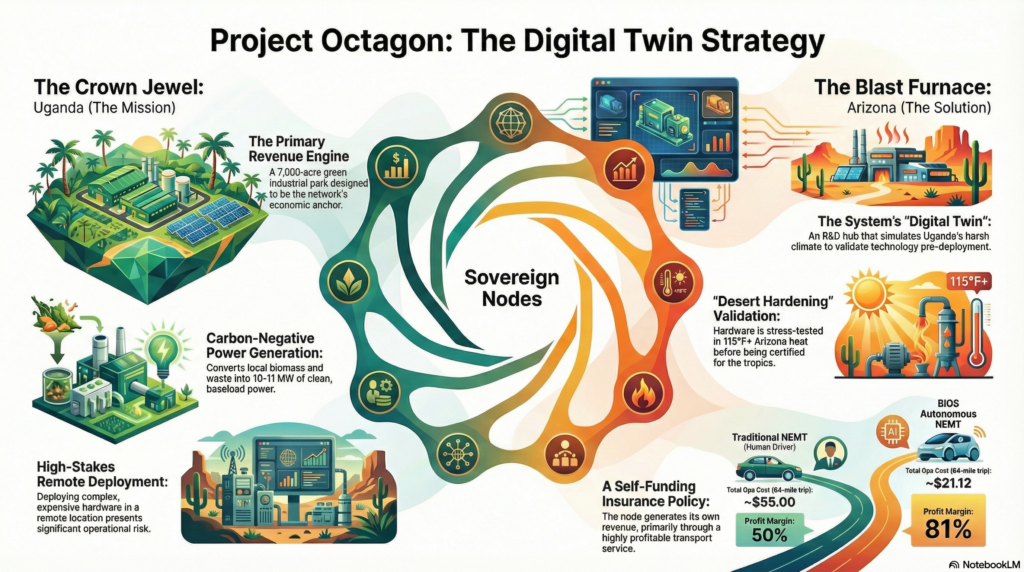
While Node 2 (Canada) is the “Profit Engine” (IP-based), Node 3 is the “Operational Engine,” proving that sovereign infrastructure can generate high cash flow in physically demanding environments.
Node 3 Financial Forecast (2026 – 2028)
1. Key Assumptions
- NEMT (Sovereign Transport): Utilization of 2 Kurb Kars (AVs) in 2026, scaling to 10 by 2028. Average reimbursement of $110 per round-trip to Parker, AZ.
- Academy (Physical Campus): 25 students in 2026, scaling to 150 by 2028. Focus on hands-on “Desert Hardening” certifications at $3,500/ea.
- The Seasonal Surge: Capturing 0.5% of the 1,000,000 peak-season visitors for “Sovereign Mesh” data passes ($50/week for high-speed Starlink-bonded access).
- Data Arbitrage: Node 3 retains a 20% share of global data sales due to the high value of “Extreme Heat” battery telemetry.
2. Pro Forma Income Statement
Podcast – https://mikeh69.podbean.com/e/node-3-integrates-several-key-partners-to-achieve-its-mission/
| Revenue Category | 2026 (Pilot Phase) | 2027 (Growth Phase) | 2028 (Scale Phase) |
| 1. NEMT Services (AHCCCS) | $264,000 | $792,000 | $1,320,000 |
| (Assumption) | 2 AVs / 8 trips/day | 6 AVs / 24 trips/day | 10 AVs / 40 trips/day |
| 2. Academy Tuition | $87,500 | $262,500 | $525,000 |
| (Assumption) | 25 students @ $3.5k | 75 students @ $3.5k | 150 students @ $3.5k |
| 3. Seasonal Surge Mesh | $250,000 | $500,000 | $1,000,000 |
| (Assumption) | 5k users @ $50 pass | 10k users @ $50 pass | 20k users @ $50 pass |
| 4. Data Arbitrage Sales | $25,000 | $150,000 | $600,000 |
| (Source) | Heat Stress Datasets | Battery Aging Models | Global OEM Sales |
| TOTAL REVENUE | $626,500 | $1,704,500 | $3,445,000 |
| Operating Expenses (OpEx) | |||
| Hardware Maint. (Sand/Heat) | $75,000 | $150,000 | $300,000 |
| AV Power (Solar/Microgrid) | $12,000 | $36,000 | $60,000 |
| Personnel (Field Instructors) | $180,000 | $350,000 | $650,000 |
| Bandwidth (Starlink/Trifi) | $48,000 | $120,000 | $240,000 |
| TOTAL EXPENSES | $315,000 | $656,000 | $1,250,000 |
| NET INCOME (EBITDA) | $311,500 | $1,048,500 | $2,195,000 |
| Net Margin | 49.7% | 61.5% | 63.7% |
3. Strategic Analysis of Projections
2026: The “Desert Hardening” Proof
Node 3 enters the market with a focus on NEMT. Unlike the Canadian node, which starts at a loss due to AI R&D, Quartzsite is profitable from Year 1 because it solves an immediate, high-reimbursement medical need. The primary cost is hardware maintenance—protecting GPUs and batteries from 120°F ambient temperatures and fine desert dust.
2027: Scaling the “Flash Market”
Revenue doubles as the “Seasonal Surge” model is refined. During the January Gem Show, the RIOS mesh provides high-speed connectivity to vendors and RVers who are otherwise “blacked out” by congested cell towers. This creates a massive injection of cash in a 60-day window, funding the expansion of the Kurb Kar fleet.
2028: The Industrial Data Powerhouse
By 2028, Node 3 becomes the primary source of truth for Battery Degradation in Arid Climates. This data is sold via the Node 2 exchange to electric vehicle (EV) manufacturers and stationary storage providers. NEMT operations reach a “Scale Phase,” providing nearly half of the town’s critical care transit, independent of the municipal grid.
4. Capital Expenditure (CapEx) Requirements
To achieve these numbers, Node 3 requires an initial and ongoing investment in physical assets:
- RIOS SCS License: $200,000 (One-time, paid to the network/Node 2).
- Kurb Kar Fleet: $45,000 per autonomous unit (total $450,000 over 3 years).
- Solar Canopy & Storage: $150,000 (To ensure “Black Start” capability and zero-cost fuel for the AVs).
5. Conclusion
Node 3 is the Cash Flow Anchor for Project Octagon in North America. While Node 2 (Canada) holds the IP, Node 3 demonstrates the Real-World Utility of the system. The 63.7% net margin by 2028 proves that sovereign infrastructure is more efficient than traditional rural government services, particularly when bolstered by autonomous logistics and seasonal data arbitrage.