• Skip to primary navigation
  • Skip to main content
DeReticular

DeReticular

Local Autonomy. National Security. Total Sovereignty.

  • Solutions
    • Municipalities
    • Energy
    • Industrial
    • Defense
  • Infrastructure
  • Intelligence
  • Company
  • Request Municipal Audit
  • Show Search
Hide Search
You are here: Home / Archives for Transportation

Transportation

The Welcome Mat Understanding Node 1 and Sovereign Hospitality

Michael Noel · January 6, 2026 ·

Introduction: The Front Door to a High-Tech Frontier
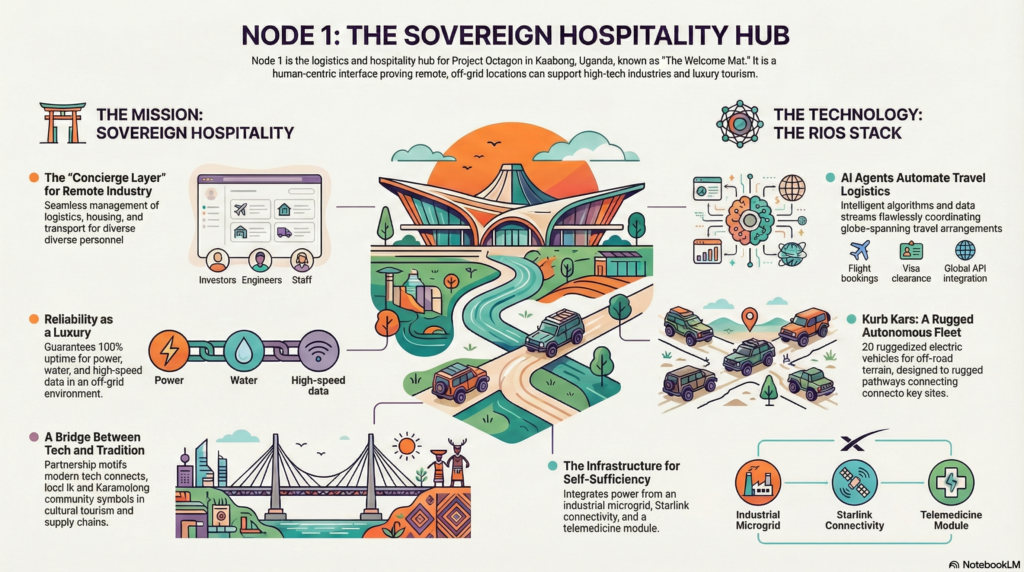
In the rugged, remote Karamoja sub-region of northeast Uganda, a new kind of welcome mat is being laid down. This is not a simple entryway but a strategic beachhead for an audacious bet on the future of development. The thesis is simple but profound: “infrastructure drives tourism: where there is reliable power and safety… the world will come.”

This is the mission of Node 1, a core component of the ambitious global technology initiative, Project Octagon. Helmed on the ground by local leader Mike Tumwesigye, who provides the project’s crucial “social license to operate,” Node 1 is far more than a simple logistics hub. It is the human-friendly front door to a high-tech frontier, engineered to solve the complex challenge of managing people—investors, engineers, and specialized staff—in one of East Africa’s most disconnected environments. Its purpose is to handle the crucial “human element” for a major industrial operation, mastering the intricate web of logistics, housing, and hospitality.

Designation: “The Welcome Mat” / “The Concierge Layer”

By engineering a pocket of absolute technological self-sufficiency, Node 1 aims to prove that a new model of development is possible, starting by solving the fundamental “last mile” problem that has long hindered progress in the world’s frontier markets.

1. The Core Problem: Solving the “Last Mile” Challenge

The term “Last Mile” often refers to the final step in a supply chain, but in the context of remote industrialization, it represents a far greater hurdle. The Kaabong region presents a classic “‘high friction, high reward’ scenario.” It is a land of stunning natural beauty, home to Kidepo Valley National Park and unique local cultures, but it is also defined by a near-total lack of reliable infrastructure. Roads are largely unpaved gravel, or murram, prone to complete washouts during the rainy season. The power grid is unstable, and internet connectivity is virtually non-existent.

Node 1 was engineered as a self-sufficient solution to these challenges, designed to provide “sovereign” infrastructure that is completely independent of national grids and local limitations.

Regional ChallengeNode 1’s “Sovereign” Solution
Logistical Isolation & Rough RoadsAn autonomous fleet of rugged electric vehicles (“Kurb Kars”).
Unreliable Power & WaterA 100% uptime guarantee, powered by the nearby Node 4 industrial engine.
Spotty Internet Connectivity“First World” high-speed internet via a Starlink High-Performance backhaul.
Scarcity of High-Standard HousingSecure, modern eco-lodges for investors and specialized staff.

This ability to overcome foundational infrastructure gaps allows Node 1 to pursue a unique, multifaceted mission that blends industrial support with a new vision for tourism and cultural engagement.

2. The Four-Part Mission: Concierge, Eco-Tourism, Logistics, and Culture

Node 1’s mission is fourfold, blending the practical needs of an industrial project with the ambitious goal of creating a new model for sustainable development that is deeply rooted in its environment.

  1. The “Concierge” Layer Node 1 acts as the human-friendly entry point for the Kaabong Smart Eco-Industrial Park. It translates the raw industrial power of the project into a seamless, comfortable experience. As the source material notes: “If Project Octagon were a Smart City, Node 1 is Grand Central Station combined with a Visitor’s Center.”
  2. The Eco-Tourism “Living Lab” The hub is designed to prove that a high-end, off-grid hospitality business can thrive. By leveraging the region’s assets, it will offer unique, high-tech adventures, including The “Black Start” Safari—a tour of the plasma gasification power plant combined with a game drive in Kidepo—and guided Ik Cultural Treks to the remote villages atop Mount Morungole.
  3. The Logistical Intake Hub At its most practical level, Node 1 manages the supply chain and housing for the workforce of the industrial engine, Node 4. This includes secure accommodations for the specialized “Black Start” operators who maintain the project’s critical plasma gasification power units.
  4. The Cultural Interface Crucially, Node 1 is tasked with managing the “delicate interaction” between the high-tech project and the local Karamojong and Ik communities. The goal is to foster genuine economic inclusion and avoid the trap of “zoo-ification,” ensuring cultural preservation is a core part of the mission, not an afterthought.

Underpinning these four strategic pillars is a sophisticated technology stack that makes this ambitious vision a reality.

3. The Tech Stack: How RIOS Powers the Experience

The “digital brain” that automates Node 1’s operations is the RIOS (Rural Infrastructure Operating System). This system integrates several key technologies to deliver a seamless experience in an otherwise disconnected environment.

  • AI “Agent-to-Agent” Travel Instead of human travel agents, specialized AI software books flights and coordinates all travel logistics. For an investor, this means the friction of traveling to a remote location is completely removed, as their AI agent communicates directly with Node 1’s AI to handle every detail.
  • Autonomous “Kurb Kars” A fleet of rugged, self-driving electric vehicles provides reliable transportation where public options are non-existent. These vehicles are specifically “hardened” for the challenge, using AI training data from the Arizona desert (Node 3) that prioritizes “obstacle avoidance (potholes, livestock) over traffic laws, which are non-existent on these tracks.” For a worker or guest, this guarantees a safe ride connecting the campus, airstrip, and industrial site.
  • “Clinic-in-a-Box” Telemedicine A modern, high-security healthcare module provides “First World” medical diagnostics and remote consultation services. For staff and visitors, this ensures their health and safety are protected, a critical requirement for operating in such a remote area.

The application of this technology enables a unique business strategy that redefines what “luxury” means in a frontier market.

4. The Big Idea: Defining “Sovereign Hospitality”

Node 1’s core concept is “Sovereign Hospitality,” a strategy where reliability itself becomes the ultimate luxury. In a region defined by scarcity, Node 1’s most valuable offering is the guarantee of services taken for granted elsewhere.

This strategy is built to address the “Missing Middle” thesis—the observation that Kaabong’s tourism market is polarized between ultra-luxury lodges and basic budget options, with no reliable mid-tier choices for business travelers or discerning tourists. Node 1 fills this gap by guaranteeing:

  • Guaranteed Power: 24/7 Air Conditioning and Hot Water, independent of any national grid.
  • Guaranteed Data: High-speed, low-latency internet for uninterrupted work and communication.
  • Guaranteed Safety: Geofenced security and immediate access to modern medical care.

This concept extends to a “Sovereign Supply Chain,” creating economic interdependence through “Farm-to-Table” contracts for locally sourced goods like Ik Honey and Karamojong goat meat, making the guest experience authentic and the community impact tangible.

5. Part of a Bigger System: Node 1’s Role in Project Octagon

Node 1 does not operate in a vacuum; it is a vital, deeply integrated component of the global Project Octagon network. It has a symbiotic, give-and-take relationship with the other key nodes.

  • Relationship with Node 4 (The Industrial Engine): Node 4 provides the 10-11 MW of power that makes Node 1’s “100% uptime” guarantee possible. In return, Node 1 provides the housing, food, and transport for Node 4’s essential workforce. One cannot function without the other.
  • Relationship with Node 2 (The Brain in Canada): Node 2 designs and sends AI software updates and training models to Node 1’s logistics systems. In return, Node 1 sends back real-world operational data from the challenging Ugandan environment, helping to refine the AI.
  • Relationship with Node 3 (The Proving Ground in Arizona): Node 3 acts as a “digital twin,” stress-testing all hardware and vehicle AI in a harsh desert that mimics Karamoja’s conditions. This ensures that any technology deployed to Node 1 is “hardened” and ready for the real world.

These interconnected roles highlight Node 1’s ultimate purpose as the crucial link between advanced technology and the people who depend on it.

Conclusion: The Human Face of a Digital Machine

Ultimately, Node 1 serves as the essential “Human Interface” for a complex and powerful technological ecosystem. For the first three years of its operation, it will function as an internal service provider, perfecting its systems while supporting the industrial build-out. But its long-term vision is far more ambitious.

In Year 4, the plan is to pivot to a public-facing commercial entity, launching “Umoja Digital Adventure Tours” and expanding its autonomous fleet to create a regional logistics monopoly. It is the face of Project Octagon, designed to prove that by deploying advanced, self-sufficient infrastructure, it is possible to create world-class hospitality, sustainable tourism, and seamless logistics in the planet’s most challenging environments. It is not just a hub for lodging and transport; it is a replicable blueprint for bringing opportunity and connection to the world’s last frontiers.
Global Advanced Infrastructure Compliance is not a single, universal regulatory framework

Michael Noel · December 17, 2025 ·

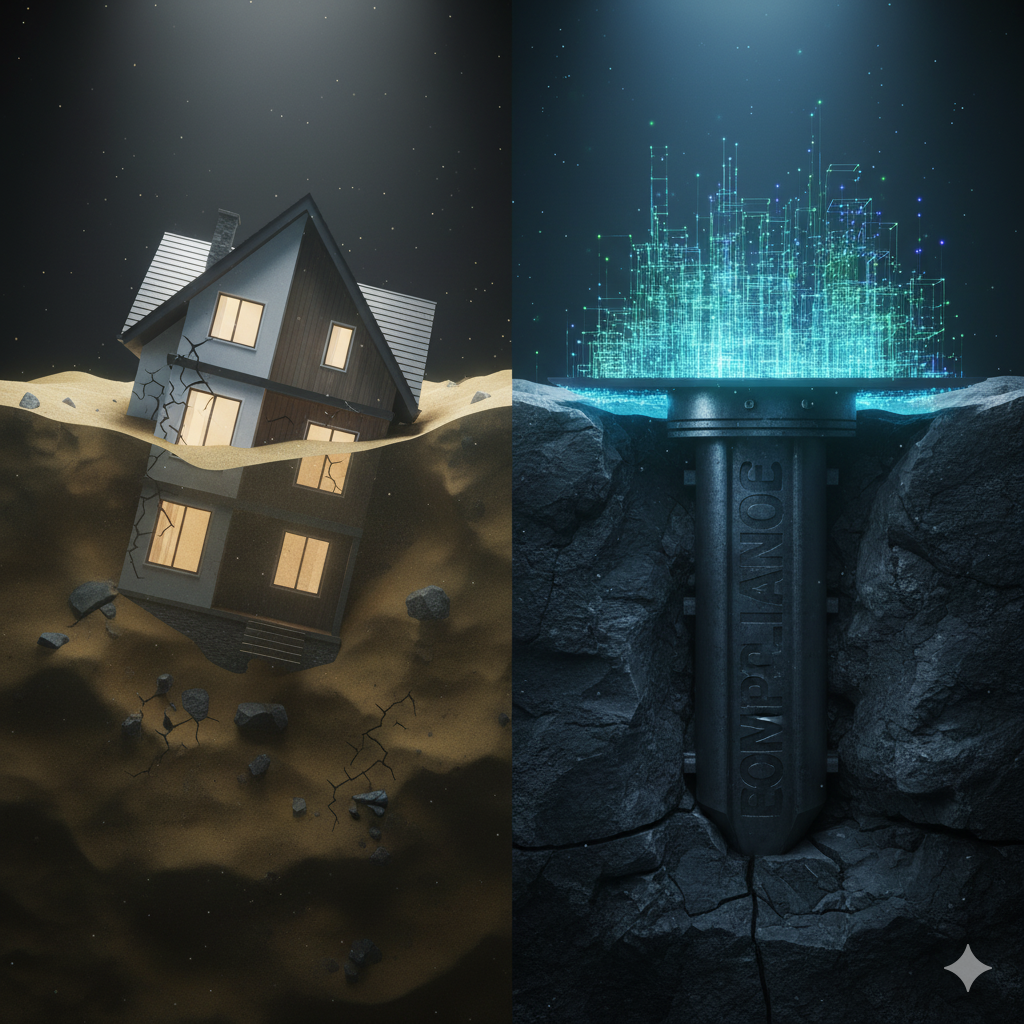
“Global Advanced Infrastructure Compliance” is not a single, universal regulatory framework but rather a set of best practices and certifications for securing critical physical and digital infrastructure against evolving global threats. 

This concept encompasses adhering to various international, national, and industry- specific standards to ensure the resilience, security, and integrity of essential systems like energy grids, transportation networks, financial systems, and modern cloud/AI infrastructure. 

Key aspects and related initiatives include:

  • Critical Infrastructure Protection (CIP): Strategies focusing on identifying vulnerabilities and implementing protective measures for systems vital to national security, public health, and economic well-being.
  • Global Infrastructure Security & Compliance Alliance (GISCA): An organization that provides a NATO-aligned certification model (CN-IOS™) for infrastructure resilience, zero-trust architecture, blockchain auditing, and more, specifically designed for high-risk regions like Latin America.
  • Industry Standards: Compliance often involves alignment with globally recognized standards such as:
    • ISO 27001: A global standard for information security management systems.
    • NIST Frameworks: Guidelines from the U.S. National Institute of Standards and Technology used for cybersecurity and risk management, particularly in federal and critical infrastructure contexts.
    • Region-specific regulations: Adherence to local laws such as the UAE’s NESA, India’s NCIIPC, or various U.S. and EU data protection and financial regulations.
  • Advanced Technologies: The compliance landscape is evolving to cover modern applications and infrastructure, including secure deployment of AI, 5G/6G networks, cloud services, and the use of blockchain for tamper-proof auditing.
  • Governance, Risk, and Compliance (GRC): An overarching organizational strategy to manage governance and risks while maintaining compliance with relevant regulations, often using integrated software solutions to streamline processes. 

In essence, “Global Advanced Infrastructure Compliance” is about ensuring that critical systems are robust, secure, and resilient enough to withstand sophisticated modern threats while meeting a complex web of international and local regulatory requirements.

The DeReticular Academy Digital Learning

Michael Noel · November 23, 2025 ·

Overview: The DeReticular Academy Digital Learning Package

Program Name: The Sovereign Infrastructure Certification Program (SICP)
Delivered By: DeReticular Academy
Target Audience: Rural community leaders, infrastructure technicians, network engineers, and energy entrepreneurs.
Objective: To train and certify individuals in the deployment, maintenance, and economic management of the Rural Infrastructure Operating System (RIOS) and Agra Dot Energy Sovereign Power Systems (SPS).


Course Structure & Curriculum

The package is divided into four core pillars, mirroring the ecosystem’s structure: 

Philosophy & Strategy, RIOS Infrastructure (Digital), 

Agra Energy Systems (Physical/Power), and 

Economic Operations.

Pillar 1: Foundations of Sovereignty

Introduction to the core philosophy driving DeReticular and Agra Dot Energy.

  • Module 1.1: The Sovereign Stack Philosophy
    • Concept: Moving from centralized dependence to decentralized autonomy.[1]
    • Key Reading: Generation 2: The Dawn of the Sovereign Stack (by Michael Noel & Remnant).[1][2]
    • Learning Outcome: Understand the “Why” behind the technology—engineering true technological and economic sovereignty.
  • Module 1.2: The Velcro Principle & Strategic Alignment
    • Concept: How interconnected systems create resilience (The “Interlocking Business Plans”).
    • Case Study: The synergy between a RIOS Campus and an Agra Micro-GTL power plant.

Pillar 2: The RIOS Ecosystem (Digital Infrastructure)

Technical training on DeReticular’s flagship digital products.

  • Module 2.1: RIOS Campus Deployment
    • Focus: The RIOS-CC-1000 Compute Cluster and Communication Hubs.
    • Topics:
      • Site survey and “Zero-Trust” physical security implementation.
      • RF Fingerprinting and Spectrum-Sensing for security.[1]
      • Deploying the “Sovereign Cloud Suite” (Project Phoenix).[1][2]
  • Module 2.2: RIOS Mobile & “Project Unplugged”
    • Focus: Mobile infrastructure and the Starlink Roam Kit.
    • Topics:
      • Rapid deployment of “Plug-and-Play” hardware in post-conflict or remote areas.
      • Establishing ad-hoc mesh networks for mission-critical mobility.
  • Module 2.3: Network Sovereignty & Security
    • Focus: Advanced networking principles.
    • Topics:
      • KyC/AML-Native network architecture.[1]
      • Software-Defined Radio (SDR) integration with WiFi 6 Mesh.[1]
      • Managing the “Secure Data Vault” and Disaster Recovery protocols.

Pillar 3: Agra Dot Energy Sovereign Power Systems (SPS)

Technical training on energy independence and waste-to-value systems.

  • Module 3.1: Introduction to Micro-GTL Technology
    • Focus: Micro Gas-to-Liquids (GTL) Systems.
    • Topics:
      • Understanding the physics of Plasma Gasification and GTL.
      • Converting local waste streams (biomass, plastic, refuse) into synthetic fuels and electricity.
  • Module 3.2: SPS Module Management
    • Focus: The Standardized Module Catalog.
    • Topics:
      • Installation of containerized “plug-and-play” power modules.[1][2]
      • Routine maintenance of the RIOS Power Core 2X (ensuring 100% uptime).
      • Safety protocols for high-temperature plasma systems.
  • Module 3.3: The Energy-Agriculture Nexus
    • Focus: Agrivoltaics and biomass.
    • Topics: Balancing food production with energy generation; using agricultural byproducts as fuel sources.

Pillar 4: The Economic Engine

Training on the business models that make the infrastructure self-funding.

  • Module 4.1: The DeReticular Digital Flywheel
    • Concept: How the microgrid powers the digital ecosystem, creating a feedback loop of resilience and growth.
    • Topics: Monetizing excess compute and energy capacity.
  • Module 4.2: Infrastructure as a Revenue Asset
    • Focus: Transforming the RIOS-CC-1000 from a cost center to a profit center.
    • Topics:
      • Selling “Sovereign Cloud” services to local businesses.
      • Managing revenue from “Kurb Kars” (Non-Emergency Medical Transportation) integrations.
  • Module 4.3: Community Economic Development
    • Focus: Using the RIOS Mobile suite to stimulate local commerce.
    • Case Study: “The Kaabong Blueprint” (Project Umoja) – A narrative guide for stakeholders on scaling operations in developing regions.

Certification Tracks

Upon completion of the relevant modules, students can earn the following digital badges/certifications:

  1. Certified RIOS Administrator (CRA): Focuses on Pillar 2. Qualified to manage a RIOS Campus and Sovereign Cloud.
  2. Sovereign Power Technician (SPT): Focuses on Pillar 3. Qualified to install and maintain Agra Dot Energy Micro-GTL systems.
  3. Sovereign Systems Architect (SSA): Master certification covering all pillars. Qualified to design and deploy full community ecosystems.

Learning Resources Included

  • The Master Catalogs: Access to the DeReticular RIOS Ecosystem Comprehensive Component Catalog and the Agra Dot Energy Sovereign Power Systems Master Catalog.[1]
  • AI Tutor Access: 24/7 access to “Remnant”, the DeReticular AI agent, for technical support and query resolution.
  • Simulation Labs: Virtual environments to practice configuring a RIOS-CC-1000 and balancing a Micro-GTL load before physical deployment.

Research Summary

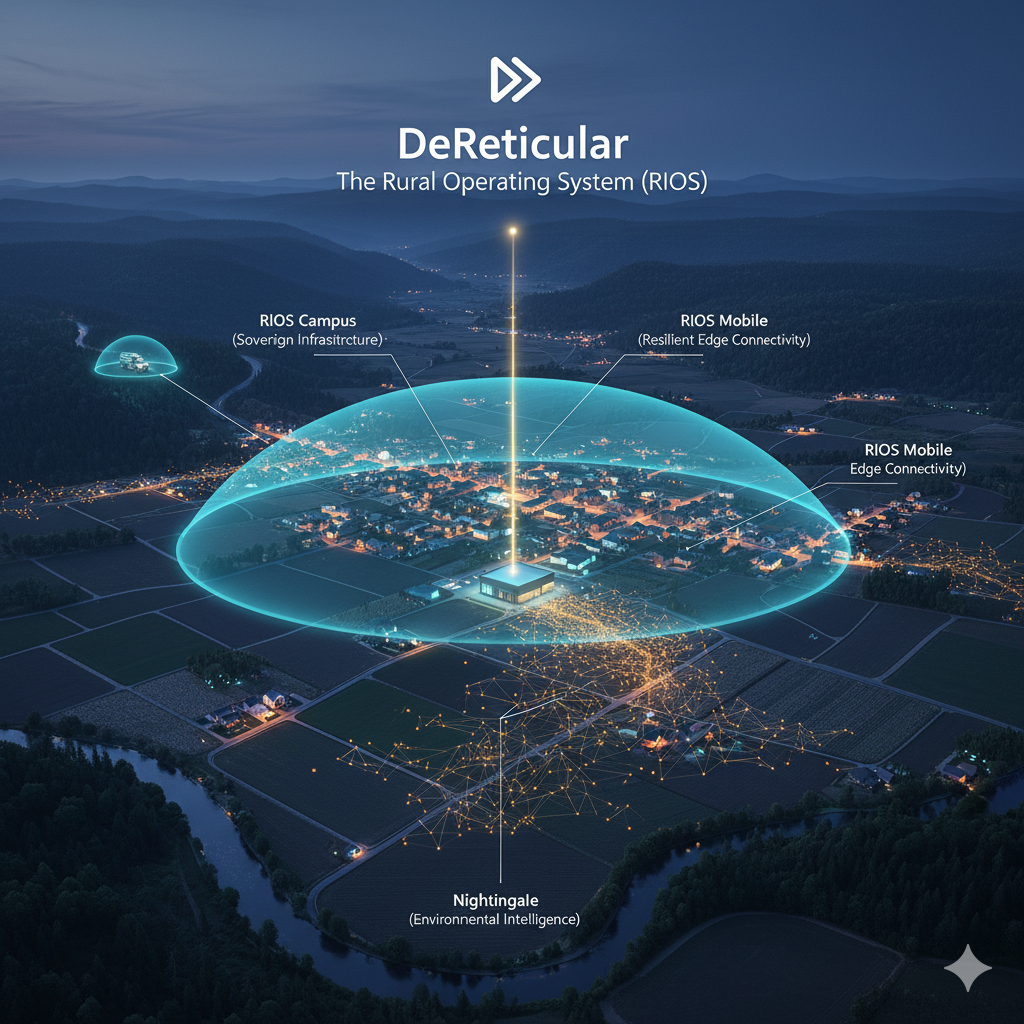
  • DeReticular (www.dereticular.com): An AI-focused Research & Innovation firm led by Michael Noel.[1][2] Their core product is the Rural Infrastructure Operating System (RIOS), which includes the RIOS Campus (fixed infrastructure), RIOS Mobile (mobile infrastructure), and Project Phoenix (Sovereign Cloud). They focus on “Engineering Sovereignty.”[1][2]
  • Agra Dot Energy (www.agra.energy): A partner/subsidiary focused on Sovereign Power Systems (SPS). Their flagship technology is the Micro Gas-to-Liquids (GTL) system that turns waste into energy, designed to be containerized and autonomous.[1]
  • DeReticular Academy: A proposed initiative to provide training and certification for these complex systems, ensuring local communities can operate and maintain the “Sovereign Stack” independently.

Improved Detailed Narrative Report: The RIOS/PLASMA Project Expansion

Michael Noel · November 6, 2025 ·


Improved Detailed Narrative Report: The RIOS/PLASMA Project Expansion

This report has been improved to accurately reflect the roles of the core Ugandan partners, Agra Energy Uganda and Coordinates Travel and Tourism, within the joint Plasma Project expansion.


Part 1: Research Summary (Improved)

Core Entities & Their Roles in the RIOS Ecosystem

Entity (Website)Primary Focus & Role in RIOS/PLASMA ProjectCitation
Agra Dot Energy (www.Agra.Energy)Technology provider for the micro Gas-to-Liquids (GTL) conversion process, specializing in plasma gasification technology to convert waste into clean energy and valuable outputs.
Agra Energy Uganda (AEU)Core Energy Partner & Logistics Lead. A privately owned Ugandan company and the local operational lead. Responsible for energy production (plasma unit operation), resource management (hemp cultivation), and all intra-campus Transportation and Logistics (biomass movement, product distribution, and mobile data collection).[1][2][3]
Biz Builder Mike (www.BizBuilderMike.com)The brand of Michael Noel, founder of DeReticular. He serves as the “Intelligence & Growth Architect” for the project, overseeing the strategic implementation of the RIOS AI blueprint.
DeReticular (www.Dereticular.com)AI & Innovation Architect. The central platform for Artificial Intelligence and the commercialization of the Rural Infrastructure Operating System (RIOS), which is the AI-native economic engine powering the project.
Digital Adventures R Us (www.DAOSRUS.com)Digital Fabric Provider. Software development specialist providing the AI and SaaS solutions (e.g., AI-driven Network Infrastructure Modules – NIMs) that manage and power the entire DeReticular ecosystem and the RIOS Campuses.
Kurb Kars (www.KurbKars.com)RIOS Mobile Technology Provider. While AEU manages the logistics operations, Kurb Kars provides the underlying autonomous vehicle technology and the RIOS Mobile platform that turns AEU’s fleet into mobile data sensors for the RIOS network.
Coordinates Travel and TourismHospitality & Community Partner. A privately owned Ugandan company responsible for the tourism, hospitality, and community engagement components of the RIOS Campus, ensuring the campus integrates into and benefits the local culture and economy.

The PLASMA Project: The Execution Model

The PLASMA Project in Kaabong, Uganda, is the scalable blueprint. It establishes a circular economy that converts local biomass (hemp waste) into renewable energy (

≈10−11 MW≈10−11 MW

), biochar, and syngas, all while powering a central RIOS AI Compute Cluster. This cluster generates global revenue by processing AI workloads, which in turn funds the infrastructure, creating the self-perpetuating Data Flywheel Effect.


Part 2: RIOS Campus & Agentic System Narrative (Improved)

Number of Campuses (MVP & Entire Project)

The project will be executed using the DeReticular Agentic System, a multi-agent AI system that coordinates specialized functional teams.

Project ScopeNumber of CampusesRationale
Minimum Viable Product (MVP)1 RIOS CampusThe full, integrated deployment of the initial Kaabong, Uganda hemp campus. This proves the economic and technical viability of the entire circular economy and the Data Flywheel model on a single, operational unit.
Entire Project (Phase 1 Scale-Up)5 RIOS CampusesThe critical next step of replication to establish a foundational, resilient network across a region. This scale proves the model’s replicability, financial robustness, and ability to handle diverse geographic and logistical challenges, setting the stage for the ultimate global vision.

Detailed Narrative Report: Teams, Agents, and Timelines

The execution of the 5-Campus Scale-Up is managed by the DeReticular Agentic System, where each functional area is led by a dedicated, specialized Agent that communicates autonomously to ensure project cohesion. The coordination of teams is structured around these five key Agents.

1. Overarching Agent: The Remnant (Operational Intelligence)

  • Team/Domain: DeReticular Leadership/Strategy.
  • Primary Responsibility: Portfolio Orchestration and Strategic Goal-Setting. The “CEO” of the Agentic System. It manages the entire 5-Campus portfolio, sets all Key Performance Indicators (KPIs) for the Data Flywheel (ROI, energy efficiency, AI utilization), and resolves conflicts between other Agents. Its core function is to ensure the entire 5-Campus network operates as a single, resilient economic unit.
  • Timeline Focus: 0–24+ Months (Strategic Oversight).

2. Campus Core Agent: The Blueprint Agent

  • Team/Domain: RIOS Architecture & Deployment (DeReticular).
  • Primary Responsibility: Physical Infrastructure & Construction. Manages all stationary infrastructure: land acquisition, permitting, civil engineering, construction, and the physical installation of the RIOS Compute Cluster and the energy/fiber conduits for all five sites. The Blueprint Agent acts as the General Contractor liaison.
  • Timeline Focus: Months 1–6 (Campus 1 MVP Completion); Months 6–18 (Campuses 2-5 Construction Rollout).

3. Energy & Logistics Agent: The Plasma Agent

  • Team/Domain: Agra Energy Uganda (AEU) & Agra Dot Energy.
  • Primary Responsibility: Energy Sovereignty, Logistics, and Resource Management. This Agent has an expanded role, encompassing three major functions: 1) Managing the installation and operation of the plasma gasification units. 2) Overseeing the large-scale biomass cultivation (hemp) and processing. 3) Managing all Transportation and Logistics, including the internal movement of biomass, distribution of final products (syngas, biochar), and deploying Kurb Kars’ RIOS Mobile-integrated vehicles as mobile data sensors.
  • Timeline Focus: Months 3–12 (Core Equipment Installation); Months 13+ (Sustained Carbon-Negative Operations).

4. Digital Fabric Agent: The Sentinel Agent

  • Team/Domain: Digital Adventures R Us (DAOSRUS).
  • Primary Responsibility: AI, Software, and Connectivity Assurance. Deploys and manages the entire digital ecosystem: the RIOS AI platform, the Compute Cluster, the local SD-WAN, and the resilient RIOS Starlink backhaul. The Sentinel Agent’s sole focus is to ensure the Compute Cluster is always generating revenue and receiving high-quality, real-time data from all other agents (especially AEU’s logistics fleet) to optimize the circular economy.
  • Timeline Focus: Months 4–12 (Network & Compute Cluster Activation); Months 13+ (System Autonomy and AI Optimization).

5. Hospitality Agent: The Zenith Agent

  • Team/Domain: Coordinates Travel and Tourism (and local community engagement).
  • Primary Responsibility: Community Integration, Tourism, and Hospitality. Manages the social and human capital aspects of the campus. This includes developing and operating the community-facing elements: local housing, on-campus hospitality services (accommodations/food), and developing the campus as a tourism destination to generate revenue and promote local culture. This Agent ensures job creation and social KPIs are met per the MOU.
  • Timeline Focus: Months 6–15 (Community Infrastructure Development); Months 16+ (Local Economic Development and Tourism Revenue Generation).

Sourceshelp

  1. dereticular.com
  2. exploreuganda.com
  3. dereticular.com

The Revolution on the Horizon: How Kurb Kars and RIOS Security Will Finally Solve the Non-Emergency Medical Transportation Crisis in Rural America

Michael Noel · November 5, 2025 ·

  • « Go to Previous Page
  • Page 1
  • Page 2
  • Page 3
  • Page 4
  • Page 5
  • Interim pages omitted …
  • Page 7
  • Go to Next Page »

DeReticular

Copyright © 2026 · Monochrome Pro on Genesis Framework · WordPress · Log in