The Automated Notary: How RIOS and Freenet Prove Physical Truth
1. Introduction: The Crisis of Trust and the Machine Solution
In global supply chains, the “Crisis of Trust” stems from a fundamental disconnect: international buyers rarely trust producer self-reporting, while producers cannot afford the cost-prohibitive fees or the slow cadence of centralized, third-party audits. This friction often results in systemic corruption, human error, or grading inflation, particularly in remote regions where oversight is minimal.
The “Sovereign Certifier” is our architectural response. By transforming the RIOS node into a cryptographic notary, we shift the burden of proof from fallible human inspectors to immutable machine logic. This move toward “Automated Trust” allows aspiring learners to understand how decentralized infrastructure can provide the transparency required for Real World Asset (RWA) tokenization without sacrificing localized sovereignty.
Key Insight: Automated Trust Automated Trust is a paradigm where mathematical proof and hardware-bound cryptographic signatures—generated at the point of ingestion—replace human intermediaries. It ensures that the physical attributes of a commodity (grade, weight, and provenance) are unforgeable and accessible via a decentralized state, independent of any central corporate entity.
To achieve this, we employ a sophisticated “Trinity Stack” that bridges the physical reality of a harvest with the digital permanence of a distributed ledger.
——————————————————————————–
2. The Trinity Stack: The Architecture of Truth
The Rural Infrastructure Operating System (RIOS) functions through a three-layer architectural model. This stack is designed to ensure that physical data is captured, sanitized for regulatory compliance, and committed to a global registry.
| Component | Physical/Digital Function | Core Output |
| Layer 1: The Eye (NVIDIA A2 Tensor Core GPU & YOLOv8 AI) | Physical Ingestion: Real-time computer vision analysis of biomass (moisture, stalk diameter, fiber quality). | Raw JSON Grading Object (Private) |
Layer 2: The Hand (hempgrade-publisher Rust Middleware) | Air Gap Management: Performs PII sanitization and coordinates the TPM-based hardware attestation. | Signed, Sanitized Public Certificate |
| Layer 3: The Memory (Freenet/Locutus) | Immutable Registry: Stores certificates on a decentralized P2P network using a content-addressable storage model. | Permanent Public State (Global) |
The Competitive Advantage: Zero Gas Fees Unlike Ethereum or VeChain, where storing “heavy” data like high-fidelity sensor logs or images is cost-prohibitive, Freenet allows DeReticular to record massive datasets for effectively zero marginal cost. This enables a level of provenance detail that traditional blockchains cannot match.
——————————————————————————–
3. The Anatomy of a Trustless Certificate
When a RIOS node processes a batch, the hempgrade-publisher service generates a PublicHempCertificate. This schema is engineered to satisfy global market transparency while ensuring compliance with GDPR, CCPA, and the EU Deforestation Regulation.
The “Approved Public Schema” includes five critical data points:
- Batch UUID: A SHA-256 hash of the internal batch ID, providing a unique reference without exposing private database records.
- Grade Classification: The quality tier (e.g., “Industrial-A”) determined by the AI inference engine, giving buyers immediate quality assurance.
- GPS Hash: A geohash limited to a 10km radius. This provides Provenance (Proof of Origin) while maintaining Physical Security (Farmer Safety) by obscuring exact farm coordinates.
- Hardware Signature: An Ed25519 signature generated by the TPM, providing mathematical proof that the data has not been altered since the moment of scan.
- Confidence Score: A floating-point value (e.g., 0.98) representing the AI’s certainty, allowing buyers to assess the risk profile of the automated grading.
By utilizing PII Sanitization, the middleware ensures no names, wallet addresses, or pricing data enter the public record, protecting the producer’s privacy.
——————————————————————————–
4. The Hardware Oracle: How the Machine Signs Its Name
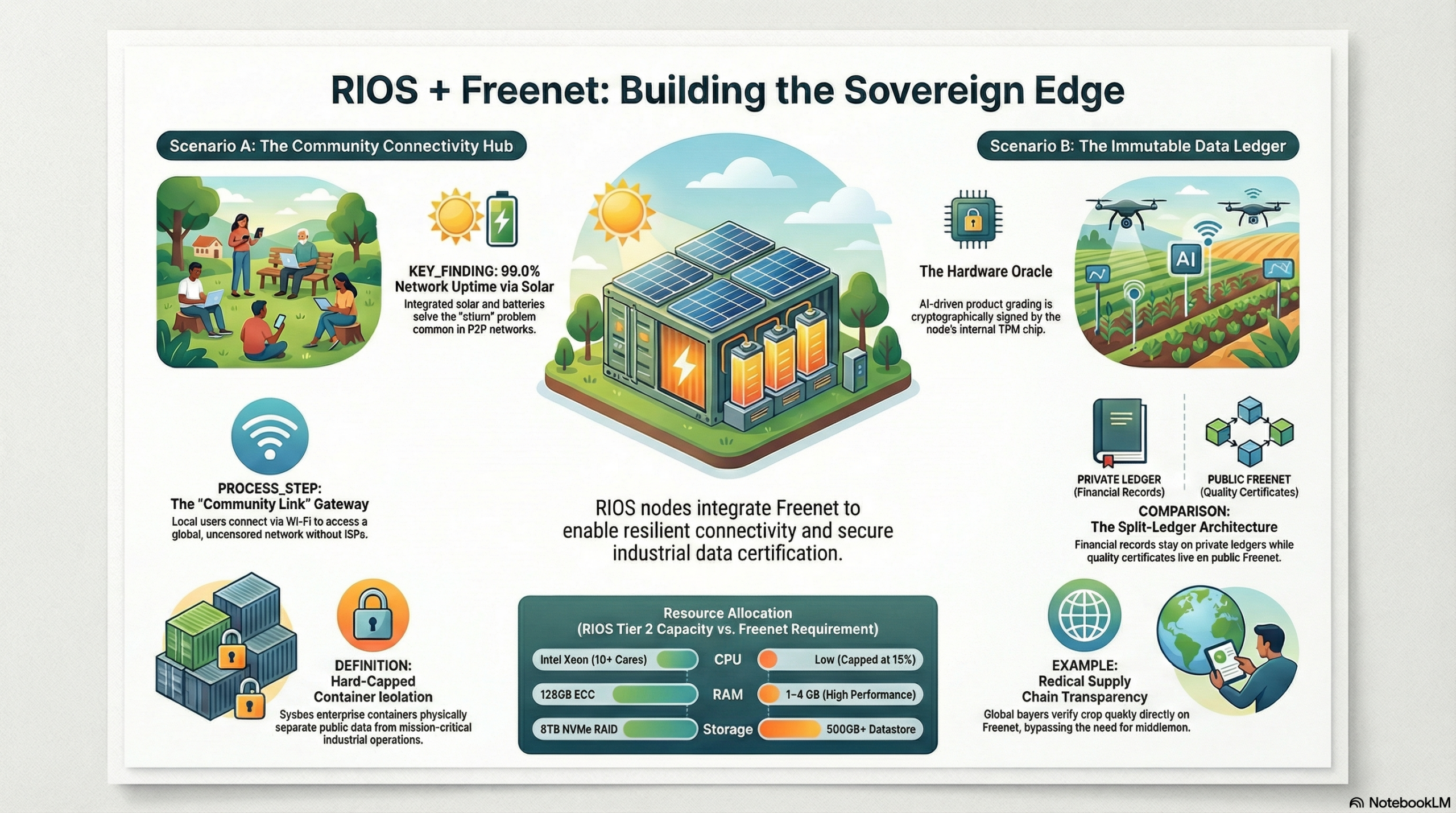
To eliminate the risk of human bribery or data manipulation, the RIOS node functions as a Hardware Oracle. By binding the digital identity of the machine to a physical Trusted Platform Module (TPM), we establish a “Hardware Root of Trust.”
The RIOS node utilizes an Ed25519 Key Pair where the private key is “burned” into the TPM during factory provisioning and can never be extracted. This ensures that only the machine that witnessed the physical event can authorize the state transition on the ledger.
The Signing Process:
- Inference: The NVIDIA A2 GPU analyzes the biomass and generates the raw grading metrics.
- PII Sanitization & Hashing: The
hempgrade-publisherstrips private data and generates a unique cryptographic hash of the public schema. - TPM Digital Signature: The hash is sent to the TPM; the chip signs it using its internal Ed25519 private key.
- State Update: The signed certificate is pushed to the Freenet network as a content-addressable hash.
——————————————————————————–
5. The Split-Ledger Logic: Privacy vs. Transparency
The “Split-Ledger” architecture is a hybrid model that decouples financial settlement from physical attestation to satisfy both regulators and market participants.
| Dimension | Private Ledger (Hyperledger Fabric / Horizen) | Public Ledger (Freenet) |
| Target Audience | Regulators (CFTC/SEC), Banks, Admins | Global Buyers, Public Markets, DeFi |
| Data Visibility | Farmer PII, USDC Settlement, Wallet IDs | Physical Quality, Weight, GPS Hash |
| Primary Goal | AML/KYC Regulatory Compliance | Trustless Transparency & Immutability |
Technical Insight: The Commutative Monoid The Freenet contract is structured as a Commutative Monoid (Merge-Only Data Type). This ensures the ledger is append-only; grading history can never be deleted or overwritten, only updated with new, signed attestation records. This provides a “Liability Shield” for DeReticular: because the data is pushed to Freenet immediately, the company loses the ability to manipulate grades, protecting itself from accusations of grading inflation.
——————————————————————————–
6. The Journey of a Harvest: A Step-by-Step Workflow
Consider a delivery at Node 4 in Kaabong, Uganda.
- Ingestion: A farmer places a bale of hemp on the conveyor. RIOS cameras and scales initiate high-fidelity scanning.
- Analysis: The NVIDIA A2 GPU performs inference in ~200ms, grading the harvest as “Premium-A.”
- The Split:
- The Private Path: Identity and financial logs are sent to the private ledger (Hyperledger/Horizen), triggering a USDC stablecoin payment.
- The Public Path:
hempgrade-publishersigns the quality data via the TPM and pushes it to Freenet.
- Verification: A buyer in London scans a QR code on the bale. Their app resolves a content-addressable hash (e.g.,
freenet://...) and queries the network directly.
The Verification Check: The buyer’s client software performs a local cryptographic check: Does the Ed25519 signature on this certificate match the known public key of RIOS Node 4? By verifying the math on their own device, the buyer bypasses the need to trust DeReticular’s corporate servers.
——————————————————————————–
7. Conclusion: The Future of Trustless Commodities
The integration of RIOS and Freenet marks the transition of DeReticular from a hardware manufacturer to a Tier-1 Data Infrastructure Provider. By removing the “Centralized Trust” liability, we empower producers with a permanent, uncensorable record of their work.
This architecture ensures that while money and identity are handled in a regulated, private environment, the “Physical Truth” of the commodity is free, public, and immutable. As global mandates like the EU Deforestation Regulation increase the demand for provenance, the “Don’t Trust, Verify” mantra enabled by the Hardware Oracle becomes the new standard for global trade.
Learner’s Summary
- Hardware-Rooted Truth: By using a TPM and Ed25519 keys, the RIOS node becomes a “Sovereign Certifier,” making it impossible for humans to manipulate data after the point of scan.
- Zero-Gas Scalability: Freenet enables the storage of high-fidelity physical data (images and logs) without the cost-prohibitive gas fees associated with traditional blockchains.
- The Regulatory Safe Harbor: The Split-Ledger model ensures full AML/KYC compliance on the private layer (Horizen/Hyperledger) while providing the market with a “Liability Shield” through immutable public attestation.