• Skip to primary navigation
  • Skip to main content
DeReticular

DeReticular

Local Autonomy. National Security. Total Sovereignty.

  • Solutions
    • Municipalities
    • Energy
    • Industrial
    • Defense
  • Infrastructure
  • Intelligence
  • Company
  • Request Municipal Audit
  • Show Search
Hide Search
You are here: Home / Archives for Intelligence

Intelligence

Research Report: DeReticular Project Octagon and OpenAI for Healthcare

Michael Noel · January 9, 2026 ·

Date: January 9, 2026
Subject: Strategic Analysis of DeReticular Infrastructure and OpenAI’s Healthcare Expansion

1. Executive Summary

This report details the convergence of two significant technological developments reshaping global healthcare and infrastructure in early 2026.

  • DeReticular has activated “Project Octagon,” a global mesh of sovereign infrastructure nodes, including a critical deployment in Kaabong, Uganda (Node 4). Their “Rural Infrastructure Operating System” (RIOS) provides the necessary power, connectivity, and compute to support advanced technologies in off-grid environments.
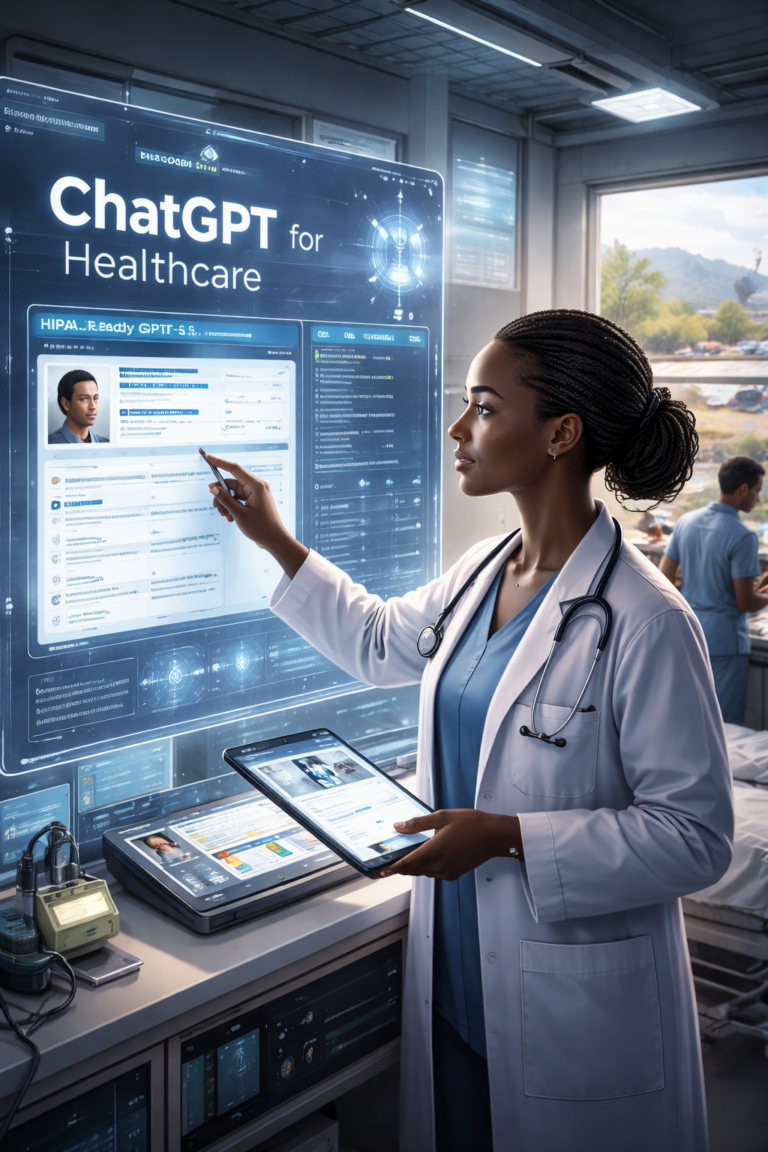
  • OpenAI has simultaneously launched OpenAI for Healthcare, a HIPAA-compliant suite powered by the new GPT-5.2 model.[1][2][3][4]
    Together, these initiatives suggest a future where advanced medical AI is not limited to elite Western hospitals but can be deployed in rural, resource-constrained environments like Kaabong, provided the underlying “sovereign” infrastructure is in place.

2. DeReticular & The Rural Infrastructure Operating System (RIOS)

Website: www.dereticular.com
Core Philosophy: “The Death of the Line.” DeReticular argues that centralized, linear infrastructure (grid power, long-haul fiber) is fragile and obsolete. They replace it with decentralized “Sovereign Nodes.”

Key Components:

  • RIOS (Rural Infrastructure Operating System): An AI-native operating system designed to manage the “convergence of physical and digital assets.” It turns a location into a self-sufficient “island” that generates its own power, connectivity, and intelligence.
    • RIOS Campus: The physical hub containing the power and compute cluster.
    • RIOS Mobile: A connectivity layer (partnering with Trifi Wireless) that ensures “sovereign connectivity” for vehicles and users.
    • RIOS Starlink: Integration with Starlink for backhaul connectivity, creating a “Digital Nervous System.”

Project Octagon:

This is DeReticular’s flagship “planetary mesh” deployment consisting of 8 strategic nodes worldwide, testing the technology in extreme environments (from the Canadian tundra to the Arizona desert).

Case Study: Node 4 (Kaabong, Uganda)

Located in the Karamoja sub-region, this node represents the “Green Industrial Engine” of the project.

  • Status: “Pilot Explorer” unit scheduled for shipment/activation in January 2026.
  • Partners:
    • Agra Energy: Provides power through Micro Gas-to-Liquid (GTL) and Plasma Gasification technology. They convert agricultural waste (specifically industrial hemp biomass grown onsite) into clean baseload power (10MW target).
    • Kurb Kars: Provides autonomous logistics rovers (“Kaabong Edition”) that transport biomass and data across the node.
  • Economic Model: The node is designed to be Carbon Negative and self-funding. It validates “Ground Truth” data (soil moisture, battery health) cryptographically, turning the infrastructure into a revenue-generating asset rather than a cost center.

3. OpenAI for Healthcare (Launched Jan 2026)[1][2][3][4][5][6][7][8]

OpenAI has officially entered the healthcare vertical with a suite of enterprise-grade tools, moving beyond general-purpose chatbots to specific, regulated medical applications.[1][2][3][5][6][7]

Core Products:

  1. ChatGPT for Healthcare: A secure workspace tailored for clinical reasoning, administrative automation, and research.[6][8]
  2. OpenAI API for Healthcare: Allows developers to embed models directly into Electronic Health Records (EHRs) and hospital apps (e.g., scheduling, documentation).

Technological Specifications:

  • Model:GPT-5.2.
    • Developed and tested with 260+ doctors across 60 countries.[1][2][3]
    • Outperforms human baselines on medical benchmarks like HealthBench and GDPval.[1][2]
  • Key Capabilities:
    • Citations: Delivers answers with direct citations from peer-reviewed medical journals and public health guidelines.
    • Integration: Can ingest institutional protocols (e.g., “Stanford’s specific pathway for sepsis”) to align AI advice with hospital policy.
    • Automation: Drafts discharge summaries, referral letters, and translates patient education materials into varying reading levels and languages.

Privacy & Compliance (The “Strategic Move”):

  • HIPAA-Ready: Supports Business Associate Agreements (BAA).[1][7]
  • Data Sovereignty: Patient data is encrypted with customer-managed keys, remains under the hospital’s control, and is never used to train future OpenAI models.[7]
  • Adopters: Early deployments include Stanford Medicine Children’s Health, Boston Children’s Hospital, UCSF, Cedars-Sinai, and Memorial Sloan Kettering.[3][5][7][8]

4. Impact Analysis: Medical AI in Global Populations

The convergence of OpenAI’s GPT-5.2 (Software/Intelligence) and DeReticular’s RIOS (Hardware/Infrastructure) offers a blueprint for transforming global health.

A. The “Last Mile” Problem Solved

Historically, advanced MedTech failed in places like Kaabong due to a lack of “dumb” infrastructure (unreliable power, no internet).

  • DeReticular Node 4 solves the Infrastructure Gap: It provides the 24/7 power (via Agra Energy plasma units) and Starlink connectivity required to run heavy AI models.
  • OpenAI solves the Expertise Gap: A clinic in Kaabong can access the same clinical reasoning capability (GPT-5.2) as a specialist at Boston Children’s Hospital.

B. Impact on Populations[9]

  1. Standardization of Care: A rural clinic can check its treatment plans against global gold-standard guidelines integrated into the AI, reducing diagnostic errors (which early studies show are significantly reduced by this tech).
  2. Task-Shifting: Nurses and community health workers in resource-scarce zones can use the AI to handle complex triage and documentation, allowing the few available doctors to focus on critical cases.
  3. Language & Literacy: The AI’s ability to translate complex medical jargon into local languages and simple terms empowers patients to understand their care pathways, improving adherence to treatment.
  4. Admin Relief: By automating discharge summaries and referrals, healthcare workers in overwhelmed systems (both in the US and Uganda) reclaim hours of clinical time daily.

5. Conclusion

The simultaneous maturation of DeReticular’s sovereign infrastructure and OpenAI’s healthcare suite in early 2026 marks a turning point. Healthcare technology is shifting from “cool but compliant-heavy” pilot programs to scalable, industrial-grade systems.

For a region like Kaabong, the implication is profound: The barrier to entry for world-class medical intelligence is no longer the shortage of local specialists, but the availability of power and connectivity—a gap DeReticular is actively closing. If these systems scale, the disparity between “Western medicine” and “rural medicine” may begin to collapse, replaced by a global standard of AI-augmented care.

Sources help

  1. timesofai.com
  2. adwaitx.com
  3. fiercehealthcare.com
  4. binance.com
  5. constellationr.com
  6. beckershospitalreview.com
  7. the-decoder.com
  8. openai.com
  9. researchgate.net
Google Search Suggestions

Display of Search Suggestions is required when using Grounding with Google Search. Learn more

Google logo

  • “Rural Infrastructure operating system”
  • “Project Octagon” Kaabong
  • “DeReticular”
  • “De Reticular”
  • “Project Octagon” healthcare OpenAI
  • OpenAI “GPT-5.2” healthcare launch
  • “ChatGPT for Healthcare” Stanford “Boston Children’s”

Understanding Node 2 The Brain of Project Octagon

Michael Noel · January 6, 2026 ·

1. Introduction: What is Node 2?

Node 2 is the central intelligence and software authority for the entire Project Octagon network. It goes by several key nicknames that hint at its crucial role: “The Systems Architect,” “The Brain,” and “OS HQ.” Located in Canada and led by Chief Technology Officer (CTO) Ash Aly, Node 2 is fundamentally different from the other nodes in the global network.

The best way to understand its function is through the “Admiral’s Flagship” analogy. In a global fleet of autonomous ships, most vessels are designed to carry cargo or perform specific industrial tasks. The flagship, however, doesn’t handle the heavy lifting. Instead, it is the flagship that provides the single source of truth for maps, codes, and training manuals, ensuring the entire fleet operates as one. Node 2 is that flagship; it directs the entire Project Octagon network.

This document will explore the three core missions that define Node 2’s essential role as the network’s brain.

2. The Three Core Missions of the Systems Architect

Node 2’s critical importance to Project Octagon can be understood through its three primary functions: serving as the software authority, the global intelligence hub, and the physical proving ground for the system’s hardware.

2.1 Mission 1: The Central Software Authority

Node 2 is the only node in the entire network authorized to manage and update the core software, the Rural Infrastructure Operating System (RIOS). This centralized control ensures stability, security, and uniformity across all nodes worldwide. Its two key responsibilities in this mission are:

  • Master Template Management: Node 2 maintains the “Golden Image” of the RIOS software. Think of this as the master blueprint for the system’s digital brain. By managing this single, pristine template, Node 2 ensures that a node in the Ugandan savanna runs the exact same kernel and security protocols as a node in Texas.
  • Over-the-Air (OTA) Updates: From its headquarters in Canada, Node 2 is responsible for developing and distributing all system patches, security improvements, and new features to the global network. This centralized update process guarantees that every node benefits from the latest advancements and is protected against emerging threats, creating a stable and reliable system for everyone.

2.2 Mission 2: The Global Intelligence Hub

Node 2 is tasked with making the entire Project Octagon network smarter through a process called “Federated Learning.” It acts as a central hub that aggregates non-sensitive telemetry data from nodes operating in extreme climates, from the scorching 115°F deserts of Arizona and the sub-zero winters of its Canadian home base to the equatorial humidity of Uganda.

The primary benefit of collecting this diverse data is to train global AI models. These models learn from the real-world performance of hardware in varied conditions to optimize critical systems for all nodes, such as improving battery thermal management and predicting energy loads more efficiently.

2.3 Mission 3: The Physical Proving Ground

Beyond its digital and AI functions, Node 2 leverages its unique location for a critical physical mission known as “Tundra Mode.” The team uses the harsh Canadian winters to physically test and validate RIOS hardware components, specifically focusing on battery performance and the integrity of enclosure seals in sub-zero temperatures.

The key insight from this testing is profound: it proves that the hardware can survive and operate reliably in extreme environments where traditional infrastructure, like diesel generators, often fails. This validation makes the entire system more resilient and commercially valuable for deployment anywhere on Earth.

From mastering the system’s software to training its intelligence and proving its physical resilience, Node 2’s role extends to cultivating the human talent needed to run the network.

3. The DeReticular Academy: Building Future Architects

Node 2 is not just a command center; it is also a school. It is the official home of the DeReticular Academy, a specialized training ground with a core mission to transform hardware operators into “Sovereign Systems Architects.”

The Academy’s most important features include:

  • “The Tutor” AI: The Academy utilizes a sophisticated, LLM-based AI agent known as “The Tutor.” This tool provides multi-language technical training, making complex knowledge accessible to a global student body.
  • From Operator to Designer: The curriculum’s goal is not merely to teach students how to use the hardware. It aims to empower them to design and blueprint complex infrastructure, fostering a new generation of engineers who can build and deploy these systems independently.
  • Offline “Black Start” Capability: In keeping with the network’s philosophy of resilience, the Academy’s educational tools are designed to work even if a node’s primary satellite link is cut. This ensures that learning and training can continue under any circumstances.

These educational services not only build human capital but also form the foundation for a powerful business model, enabling future high-value modules like delivering remote healthcare through a “Clinic-in-a-Box” software suite.

4. The Business of Intelligence: How Node 2 Creates Value

Unlike industrial nodes like the one in Uganda, which function as “Revenue Engines” by selling physical products like electricity, Node 2 operates as a high-margin “Profit Engine” by selling intelligence, software, and education. With a projected net margin of over 58% by 2028, Node 2 is designed for non-linear scaling. It functions as the intellectual property holder for the entire network, generating revenue from scalable digital assets.

Service/ProductDescriptionValue for the Network/Customer
RIOS Sovereign Cloud Suite (SCS)A one-time, perpetual software license (MSRP: $200,000) that unlocks the full capabilities of a node’s hardware.Transforms a node into a local cloud provider, allowing owners to sell services and prevent capital flight to large tech companies.
RIOS Mobile Pro OptimumAn annual subscription ($1,200/year) that activates “Signal Fusion” for edge devices, bonding satellite and 5G signals.Enables roaming devices to participate in the Federated Learning mesh, enhancing network intelligence and providing resilient connectivity.
DeReticular Academy CertificationProfessional certification for “RIOS Certified Technicians” ($3,500 per certification).Creates a skilled global workforce capable of deploying, managing, and scaling the network’s infrastructure.
Data ArbitrageSelling unique, aggregated datasets from one of the world’s only sources of real-world, off-grid AI performance across every major climate zone.Creates a pure-profit revenue stream while providing invaluable insights to clients like agricultural insurers and hardware manufacturers.

5. Leadership: The Guardian of the Logic

The leader of Node 2 is Ash Aly, the Chief Technology Officer of the entire mesh network. His role is best summarized by his title as the “Guardian of the Network’s Logic.” This creates a critical distinction within the project: while the hardware deployed in the field “gets dirty” through its daily operations in harsh environments, Aly’s responsibility is to ensure the core software remains “pristine, secure, and constantly evolving.”

6. Key Takeaways: Why Node 2 is Essential

For any student new to Project Octagon, these are the three most critical points to remember about Node 2’s role:

  1. Centralized Control, Global Stability By managing the single Master Template and distributing all Over-the-Air (OTA) updates, Node 2 ensures the entire global network runs on the same secure, proven software. This prevents fragmentation and enhances stability for every user.
  2. Intelligence Through Diversity Node 2 makes the entire system smarter by learning from the network’s most extreme environments. By collecting data from hot, cold, and equatorial climates, its AI models can deliver optimizations that make every node more resilient and efficient.
  3. The Profit Engine Node 2’s business model is what makes Project Octagon financially scalable. By selling high-margin, low-variable-cost digital assets like software, certifications, and data, it generates the profit needed to fund the network’s growth, acting as the perfect financial complement to the high-CapEx industrial nodes.

Understanding the RIOS Pilot AI Core: The Four Systems of a Mobile Supercomputer

Michael Noel · January 3, 2026 ·

Introduction: What is the RIOS AI Core?

Welcome! If you’ve ever been curious about what a real-world supercomputer looks like and how it works, you’re in the right place. We’re going to explore a fascinating piece of technology called the RIOS Pilot AI Core. Think of it as a “Sovereign Brain” or a complete “Data Center in a Box,” designed to operate anywhere on Earth.

Its core purpose is to solve the “Data Gravity” problem by bringing supercomputing power to remote locations where massive amounts of data are generated from sources like drone swarms or geological scans, making it impossible to upload to the cloud.

The goal of this document is to demystify this complex machine by breaking it down into four essential systems, just like understanding the parts of a car. By the end, you’ll understand how these parts work together to create a mobile supercomputer. The four systems we will cover are:

  • The Shell
  • The Reactor
  • The Brain
  • The Cooling System

——————————————————————————–

1. The Shell: The Armored Body

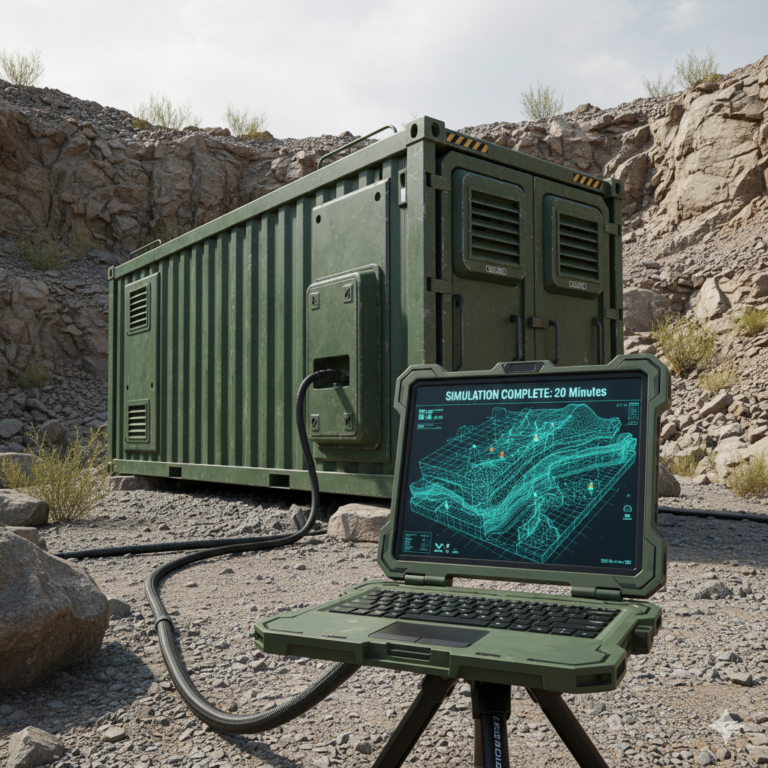
Think of the Shell as the AI Core’s armored body. Its job is to protect the delicate systems inside from the outside world. This entire system is built from a modified 20ft High-Cube ISO Shipping Container, which is what makes it so mobile—it can be transported anywhere by truck or crane.

The Shell has three critical functions that protect the valuable hardware inside:

  • Physical Security The unit is built for security, featuring steel reinforced doors and biometric access controls. This ensures that only authorized personnel can access the millions of dollars of high-performance computing equipment housed within.
  • Signal Security For sensitive or military operations, the Shell can be lined with copper, creating an RF Shield. This acts like a Faraday cage, preventing any electronic signals from getting in or out, which stops electronic eavesdropping and ensures data privacy.
  • Cooling Efficiency The interior is cleverly divided into a “Hot Aisle” and a “Cold Aisle.” This design feeds cool air into the front of the server racks while containing the hot exhaust in a separate channel at the rear. This simple but critical design manages airflow, maximizing the effectiveness of the cooling system.

Now that we understand the protective body, let’s look at the powerful heart that keeps it alive.

——————————————————————————–

2. The Reactor: The Independent Heart

If the Shell is the body, the Reactor is the powerful, self-sustaining heart. It generates, stores, and manages all the electricity the supercomputer needs to operate completely off-grid.

The Reactor is composed of three primary components that work in harmony:

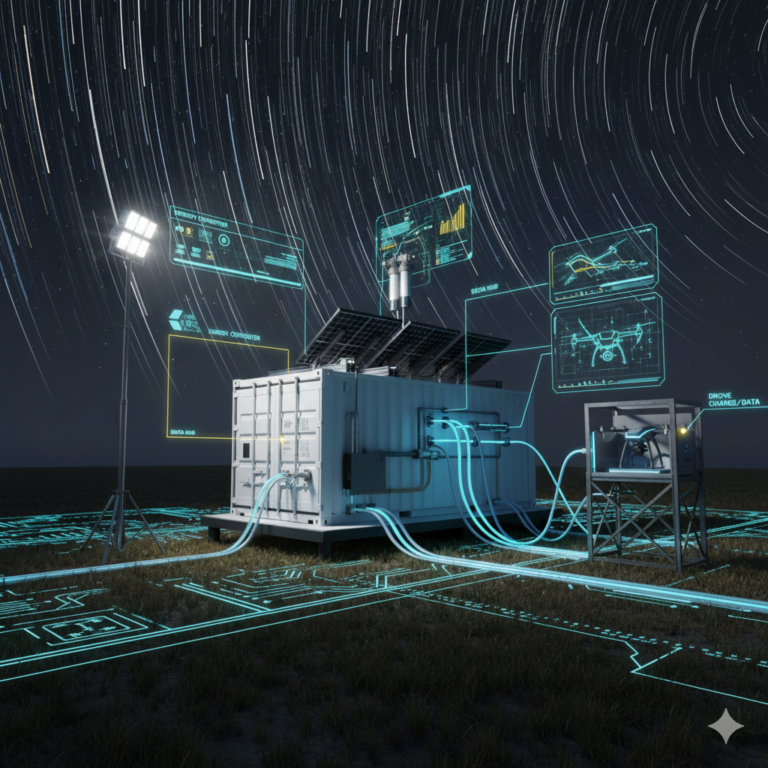
  • Power Generation The system uses large, deployable “Solar Wings.” These heavy-duty arrays fold out from the East and West sides of the container, complemented by panels on the roof, to triple the surface area for solar capture and generate between 14kW and 15kW of power from the sun.
  • Power Storage Electricity from the solar wings is stored in a large industrial battery bank, ranging from 40kWh to 60kWh. Its most important capability is having enough power to sustain the supercomputer’s peak workload all through the night, long after the sun has gone down.
  • Power Management The system uses triple-redundant inverters to convert the raw DC power from the batteries into the stable AC power the computers need. These inverters ensure the power is “clean” (a pure sine wave), which is crucial for protecting the sensitive and expensive computer hardware from electrical damage.

With a protected and powered system, it’s time to explore the most important part: the supercomputing brain itself.

——————————————————————————–

3. The Brain: The Supercomputing Mind

This is the ‘AI Core’s’ mind. The Brain is where all the thinking, learning, and problem-solving happens. Unlike smaller systems that just use AI, this brain is powerful enough to create and retrain AI.

Here is a breakdown of the key components that make up this supercomputing mind:

ComponentWhat It IsWhy It Matters (Its Job)
CPU (Dual Intel Xeon Platinum)The system’s general-purpose processors.Handles the millions of background tasks and calculations needed to run the whole system smoothly.
AI Accelerator (NVIDIA A100 80GB GPU)A highly specialized processor designed for artificial intelligence.This is the powerhouse for AI Training. It processes huge amounts of data to help the AI learn new things, like processing seismic data on-site to decide where to drill, saving weeks of time.
Storage (100TB+ NVMe All-Flash Array)The system’s ultra-fast internal storage.Acts as a “Data Lake,” holding all the raw information (like drone footage or geological scans) right next to the brain for instant access and processing.

A brain this powerful generates an incredible amount of heat, which leads us to the final, critical system: the lungs that keep it cool.

——————————————————————————–

4. The Cooling System: The Tireless Lungs

Just like an athlete, a hard-working computer gets hot. The Industrial Cooling system acts as the AI Core’s tireless lungs, constantly breathing out hot air and breathing in cold air to prevent overheating.

This isn’t just a simple air conditioner. The NVIDIA A100 GPU alone generates so much heat that without a dedicated, powerful cooling system, it would automatically slow itself down (a process called “throttling”) or shut down completely to prevent damage.

Two key features make this system robust enough for the job:

  • Serious Power The system uses two 18,000 BTU units for a combined 36,000 BTUs of power. This is computer room-grade air conditioning (CRAC), a system designed specifically for the extreme heat loads of high-density computing.
  • Redundancy (N+1) The system uses a dual-unit configuration, with a main air conditioner and a full backup. This N+1 redundancy guarantees that the AI Core can run at full power without throttling, even in harsh desert environments with temperatures up to 50°C (122°F).

With all four systems in place, let’s see how they come together to create something truly revolutionary.

——————————————————————————–

Conclusion: A Complete System

The four systems of the RIOS AI Core work together in a perfect, dependent loop. The Shell protects the Brain, the Reactor powers it, and the Cooling system allows it to think at maximum speed without interruption.

By combining these four elements, the RIOS Pilot AI Core achieves its ultimate goal: it brings the power of the cloud directly to the data. This revolutionary approach reduces the “Data-to-Decision” loop from weeks—the time it would take to physically ship hard drives to a data center—to mere hours. You now have a foundational understanding of the architecture that makes a mobile supercomputer possible.

Briefing Document RIOS Pilot Standard (Tier 2)

Michael Noel · January 3, 2026 ·

Executive Summary

The RIOS Pilot Standard (Tier 2) is a self-contained, modular micro-data center and field office engineered for permanent, off-grid deployments. Housed within a custom-fabricated 10ft High-Cube ISO container, it functions as a “Civilization Anchor,” transitioning operations from temporary, expeditionary phases (Tier 1) to persistent, stationed sovereignty. The unit integrates a complete power system, high-performance compute hardware, and a habitable workspace into a single, rapidly deployable asset.

Core to its design is the principle of active resilience. A hybrid 4.4kW solar array with unique “slide-out wings” and a 20kWh LiFePO4 battery bank provide continuous power, managed by an industrial-grade inverter. This system supports a ruggedized Intel Xeon server equipped with an NVIDIA A2 Tensor Core GPU, enabling 24/7 AI inference for tasks like perimeter security, agricultural analytics, and hosting a local “Digital Twin.” Crucially, an integrated 9,000 BTU HVAC system maintains a stable internal temperature of 68°F, guaranteeing 99.99% uptime even in extreme external conditions of 120°F.

Strategically, the Tier 2 unit is positioned as a high-margin “Anchor” product designed to capture the Capital Expenditure (CapEx) budgets of industrial clients. With a Manufacturer’s Suggested Retail Price (MSRP) of $78,500 and an estimated Cost of Goods Sold (COGS) of $36,200, it achieves a 54% gross margin. The unit is designed to lock customers into the RIOS ecosystem, serving as the central hub for power, data, and security workflows on-site, further supplemented by a recurring revenue subscription for advanced monitoring. Ideal use cases include agro-industrial pilots, rural medical clinics, and construction site headquarters.

——————————————————————————–

1. Product Concept and Strategic Role

1.1. The “Anchor”: From Expeditionary to Permanent

The RIOS Pilot Standard is classified as Tier 2 infrastructure, representing a strategic shift from the mobile, rapid-response capabilities of Tier 1 “Expeditionary” cases to a “Stationed” or permanent presence. It is designed for persistence, stability, and human habitability, serving as the foundational “Civilization Anchor” or “Base Camp” for a remote site.

  • Tagline: “The Anchor. From Temporary Ops to Permanent Sovereignty.”
  • Core Function: To provide a permanent, climate-controlled, armor-plated shell for the AI compute core, with massive battery redundancy to ensure continuous 24/7/365 operation.

1.2. The Hub-and-Spoke Operational Model

The Tier 2 unit functions as the central “Hub” in an operational ecosystem where Tier 1 units act as the “Spokes.”

  • Data Aggregation: Field teams using mobile Tier 1 cases collect data (e.g., drone maps) and upload it to the Tier 2 server for long-term storage and heavy analysis upon returning to base.
  • Charging Vault: The container is designed with a secure rack to dock and charge Tier 1 cases when they return from patrol.
  • Network Extension: A telescoping 20ft mast provides significantly better range (8+ miles) for LoRaWAN sensors compared to ground-level Tier 1 units.

1.3. Financial Keystone and Ecosystem Lock-in

The Tier 2 unit is the financial backbone of the DeReticular hardware division and is central to the business strategy.

  • High-Margin Product: It targets the Capital Expenditure (CapEx) budgets of industrial projects, contrasting with the lower-cost, high-volume Tier 1 cases.
  • Ecosystem Control: The documentation states, “Once this container is dropped, DeReticular owns the site’s power, data, and security workflow.” It physically locks the customer into the RIOS ecosystem.
  • Replacement Strategy: This model replaces previous RevoFi-based campus plans for international deployment.

2. Core Architecture and Systems

The unit is a fully integrated system housed in a modified 10ft ISO container, visualized in deployments ranging from lush hemp fields to arid desert landscapes.

2.1. The Shell (Chassis)

The foundation of the unit is a durable, secure, and habitable steel container.

  • Form Factor: Modified 10ft High-Cube ISO Shipping Container (New “One-Trip”).
  • Dimensions: 10′ (L) x 8′ (W) x 9’6″ (H).
  • Weight: Approximately 5,500 lbs (2,495 kg) fully configured.
  • Modifications:
    • Finish: Sandblasted and coated with white, heat-reflective ceramic paint.
    • Insulation: R-25 closed-cell spray foam on walls and ceiling for thermal stability.
    • Security: Features a heavy steel cargo door with an internal biometric locking bar and a window with a security grate.
  • Workspace: A partitioned, insulated interior creates a habitable office with an ergonomic mesh chair, rugged desk, workbench, and LED task lighting. It is designed to be compliant with labor regulations (e.g., OSHA) requiring a “climate-controlled workspace.”

2.2. Power Systems (Grid-Forming)

The unit is designed to generate, store, and manage its own power grid, capable of supporting both internal systems and external tools.

  • Solar Generation: 4.4kW – 6kW Hybrid Solar Array.
    • Configuration: A fixed roof-mounted array is supplemented by manual “Slide-Out Wings” on heavy-duty drawer slides, which double the solar capture area with bifacial panels.
  • Energy Storage: 15kWh – 20kWh Server Rack Battery Bank.
    • Chemistry: LiFePO4 (e.g., EG4/Ruixu modules), configured in a 48V server rack format.
    • Capacity: Sufficient to run the AI core and HVAC system through three days of heavy cloud cover.
  • Power Management:
    • Inverter: 12kW peak Sol-Ark or Victron Quattro industrial hybrid inverter.
    • Output: Capable of 120V/240V split-phase output (50A @ 240V) to power external tools like welders and pumps.
    • Backup: Includes an auto-start dry contact for an external diesel or hemp generator.

2.3. Compute & Intelligence (“The Brain”)

The server rack is the computational core, separated from the office by a glass partition and engineered for continuous, high-intensity workloads.

  • Server: Ruggedized 1U/2U rackmount server (Dell PowerEdge XR series, Supermicro IoT Edge, or “White Box” generic).
  • CPU: Intel Xeon Scalable Processor (Silver/Gold series, e.g., Silver 4310 with 10+ cores).
  • AI Accelerator: NVIDIA A2 Tensor Core GPU (16GB).
  • Memory & Storage: 128GB ECC DDR4 RAM and up to 8TB NVMe storage (configured in RAID 1).
  • Operating System: RIOS Sovereign OS (Server Edition).
  • Mission Profile: Unlike the battery-constrained Tier 1, the Tier 2 unit is designed for Continuous Inference. It runs the AI at full throttle 24/7 to monitor 50+ CCTV streams, analyze soil telemetry, host a local “Digital Twin” database, and support a local Large Language Model (LLM).

2.4. Climate Control (Active Resilience)

Active climate control is a key differentiator, ensuring hardware and personnel can function in extreme environments.

  • HVAC Unit: 9,000 BTU Mini-Split Heat Pump (120V or 48V DC).
  • Performance: Maintains a stable internal server rack temperature of 68°F even when external temperatures reach 120°F (e.g., Arizona/Uganda).
  • Purpose: The active cooling system is critical for guaranteeing 99.99% uptime for the high-performance servers.

2.5. Connectivity Layer

The unit is equipped with a multi-layered communications stack for robust connectivity.

  • Backhaul: Starlink High-Performance Kit (roof-mounted) and a Peplink 4G/5G bonding router with high-gain directional MIMO antennas.
  • Local Mesh: A high-power RIOS NeoMesh Concentrator for LoRaWAN sensors.
  • Mast: A telescoping pneumatic mast extends 20ft from the container’s corner, mounting the 5G antennas and LoRa concentrator. This height advantage significantly improves signal range. At night, it can feature a red blinking aviation light.

3. Operational Functionality and Use Cases

3.1. Core Operational Roles

  • Sovereign Hosting: Hosts the local intranet, including a Wiki, training videos, and medical records, accessible via Wi-Fi even if the primary internet connection is down.
  • Site Automation: The server’s GPIO pins control physical relays, enabling AI-triggered automation of systems like irrigation valves and floodlights.
  • Security Hub: Powers and manages a perimeter security network, using the NVIDIA A2 for continuous AI object detection on CCTV feeds (e.g., identifying a coyote crossing a fence).

3.2. Ideal Use Cases

  • Agro-Industrial Pilots: Acts as the “Farm Intelligence Hub” for a 50-acre hemp farm, managing pumps and soil sensors.
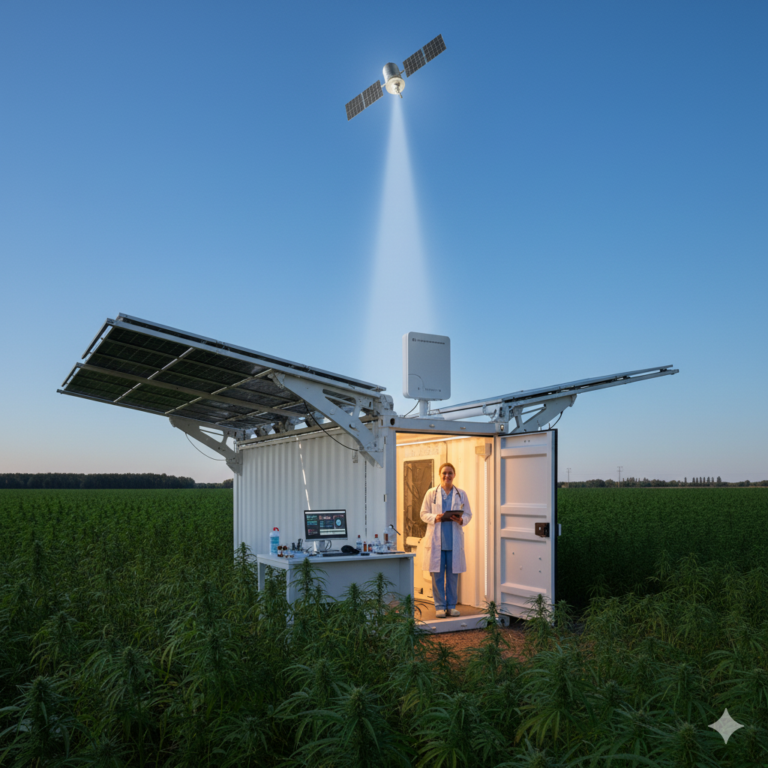
  • Rural Clinics / Humanitarian Outposts: Provides a secure, off-grid facility for storing patient records locally while using Starlink to beam data for telehealth. The workspace serves doctors and staff.
  • Construction Headquarters: Functions as the site manager’s office for tracking inventory and security before the main building is complete.
  • Perimeter Defense: Serves as a central security hub, powering external floodlights, drone docking stations, and water pumps, acting as the “heart” of a site’s infrastructure.

4. Commercial and Financial Analysis

4.1. Pricing and Revenue Model

CategoryItemValue (USD)Notes
Hardware (CapEx)MSRP$78,500.00Project-based pricing is available.
Wholesale / Partner Base$65,000.00
Lease Option~$1,800/monthVia third-party equipment finance over 5 years.
Software/Service (OpEx)RIOS Standard Support$1,500.00 / MonthBilled annually at $18,000.
Included Services– 24/7 HVAC & Battery Telemetry<br>- Starlink Data Plan<br>- Digital Twin DashboardHigher price than Tier 1 due to critical systems monitoring.
  • Payment Terms: 50% deposit for materials on order, with the remaining 50% due prior to shipping.

4.2. Value Proposition

The pricing is justified by positioning the unit as “Digital Real Estate” and a capital asset, not a construction cost.

  • vs. Construction: Building a comparable concrete block server room and office in a remote area is estimated to cost over $100,000 and take 4+ months.
  • vs. Tier 1 Cases: Provides the thermal stability and massive power reserves required for “mission critical” 24/7 uptime. The documents state, “If the Tier 2 goes down, the site goes dark—so we over-engineered it to never go down.”
  • Asset Value: As a movable capital asset, it can be instantly depreciated and retains resale value, unlike a permanent building.

4.3. Cost of Goods Sold (COGS) and Margin

The estimated COGS is 36,200.00**, resulting in a gross margin of **42,300 per unit (54%).

ComponentCost BreakdownEstimated Cost
The Shell10ft Container, modifications, paint, insulation, security$8,200
Power Systems4.4kW Solar, 20kWh Battery Bank, 12k Inverter & controls$11,500
Compute & IntelligenceRugged Server, Xeon CPU, NVIDIA A2, Starlink, Router, Switch$9,500
Climate & Interior9,000 BTU HVAC, Desk, Chair, Lighting, Rack Enclosure$2,500
Labor & Integration100 blended hours @ $45/hr (Fabrication & Integration)$4,500
Total Estimated COGS$36,200

5. Manufacturing and Fulfillment

5.1. “Operation Octagon” Manufacturing Process

The unit is manufactured via a “Batch Build” process at the DeReticular facility in Quartzsite, AZ, under a program named “Operation Octagon.” It requires heavy infrastructure and cannot be dropshipped.

  • Phase 1: Shell Prep (Weeks 1-2): Containers arrive, undergo cutting and welding for vents and racks, and are then painted and insulated.
  • Phase 2: Electrical & Systems (Weeks 3-5): Involves the electrical “Rough-In,” mounting the server stack and HVAC, and imaging the server with RIOS Sovereign OS.
  • Phase 3: Burn-In (Week 6): Rigorous quality assurance testing.
    • “Oven Test”: HVAC is turned off to let the interior heat to 100°F, then turned on to verify the cooling curve.
    • “Island Test”: The unit is disconnected from mains and must run on battery/solar for 48 hours while executing a heavy AI inference loop.
  • Phase 4: Logistics (Week 7-8): The unit is prepared for shipping.

5.2. Logistics and Export

  • Transport: Requires a Landoll (tilt-deck) trailer or a flatbed truck with a heavy forklift or crane at the destination for placement. This is visualized in an image of the container being unloaded onto a dusty construction site.
  • Lead Time: 6-8 weeks from order to fulfillment.
  • Export: For international campuses (e.g., Uganda/Israel), units are shipped as “Temporary Office Units” with “Computer Equipment” on the manifest. The solar/battery components often qualify for “Green Energy” duty exemptions.
  • Compliance:
    • HS Code: 9406.90.0030 (Prefabricated Buildings) or 8502.39 (Solar Generators).
    • ECCN: 5A992.c (Mass Market Encryption – EAR99 eligible).
    • Hazmat: UN3481 (Lithium Batteries contained in equipment – Large Format).

6. Detailed Product Specifications

AttributeSpecification
Product NameRIOS Pilot: Standard (Tier 2)
Internal SKURIOS-STD-10FT-A2
Model NumberRP-STD-002-GEN1
ManufacturerDeReticular (In-House Fabrication)
Country of OriginUSA (Quartzsite, AZ)
Lifecycle StatusBuild-to-Order (BTO)
Dimensions10′ L x 8′ W x 9’6″ H (120″ x 96″ x 114″)
Gross Weight~5,500 lbs (2,495 kg)
Solar Input4.4kW (Bifacial Panels on Roof + Slide-Out Rails)
Battery Storage20kWh LiFePO4 (48V Server Rack Configuration)
Inverter12kW Hybrid (120/240V Split Phase Output)
Server CPUIntel Xeon Scalable Silver (10+ Cores)
Server GPUNVIDIA A2 Tensor Core (16GB)
Server RAM128GB DDR4 ECC
Server Storage8TB NVMe (RAID 1)
Warranty1 Year Bumper-to-Bumper (Parts)

Briefing Document: RIOS Pilot Standard (Tier 2)

Executive Summary

The RIOS Pilot Standard (Tier 2) is a self-contained, modular micro-data center and field office engineered for permanent, off-grid deployments. Housed within a custom-fabricated 10ft High-Cube ISO container, it functions as a “Civilization Anchor,” transitioning operations from temporary, expeditionary phases (Tier 1) to persistent, stationed sovereignty. The unit integrates a complete power system, high-performance compute hardware, and a habitable workspace into a single, rapidly deployable asset.

Core to its design is the principle of active resilience. A hybrid 4.4kW solar array with unique “slide-out wings” and a 20kWh LiFePO4 battery bank provide continuous power, managed by an industrial-grade inverter. This system supports a ruggedized Intel Xeon server equipped with an NVIDIA A2 Tensor Core GPU, enabling 24/7 AI inference for tasks like perimeter security, agricultural analytics, and hosting a local “Digital Twin.” Crucially, an integrated 9,000 BTU HVAC system maintains a stable internal temperature of 68°F, guaranteeing 99.99% uptime even in extreme external conditions of 120°F.

Strategically, the Tier 2 unit is positioned as a high-margin “Anchor” product designed to capture the Capital Expenditure (CapEx) budgets of industrial clients. With a Manufacturer’s Suggested Retail Price (MSRP) of $78,500 and an estimated Cost of Goods Sold (COGS) of $36,200, it achieves a 54% gross margin. The unit is designed to lock customers into the RIOS ecosystem, serving as the central hub for power, data, and security workflows on-site, further supplemented by a recurring revenue subscription for advanced monitoring. Ideal use cases include agro-industrial pilots, rural medical clinics, and construction site headquarters.

——————————————————————————–

1. Product Concept and Strategic Role

1.1. The “Anchor”: From Expeditionary to Permanent

The RIOS Pilot Standard is classified as Tier 2 infrastructure, representing a strategic shift from the mobile, rapid-response capabilities of Tier 1 “Expeditionary” cases to a “Stationed” or permanent presence. It is designed for persistence, stability, and human habitability, serving as the foundational “Civilization Anchor” or “Base Camp” for a remote site.

  • Tagline: “The Anchor. From Temporary Ops to Permanent Sovereignty.”
  • Core Function: To provide a permanent, climate-controlled, armor-plated shell for the AI compute core, with massive battery redundancy to ensure continuous 24/7/365 operation.

1.2. The Hub-and-Spoke Operational Model

The Tier 2 unit functions as the central “Hub” in an operational ecosystem where Tier 1 units act as the “Spokes.”

  • Data Aggregation: Field teams using mobile Tier 1 cases collect data (e.g., drone maps) and upload it to the Tier 2 server for long-term storage and heavy analysis upon returning to base.
  • Charging Vault: The container is designed with a secure rack to dock and charge Tier 1 cases when they return from patrol.
  • Network Extension: A telescoping 20ft mast provides significantly better range (8+ miles) for LoRaWAN sensors compared to ground-level Tier 1 units.

1.3. Financial Keystone and Ecosystem Lock-in

The Tier 2 unit is the financial backbone of the DeReticular hardware division and is central to the business strategy.

  • High-Margin Product: It targets the Capital Expenditure (CapEx) budgets of industrial projects, contrasting with the lower-cost, high-volume Tier 1 cases.
  • Ecosystem Control: The documentation states, “Once this container is dropped, DeReticular owns the site’s power, data, and security workflow.” It physically locks the customer into the RIOS ecosystem.
  • Replacement Strategy: This model replaces previous RevoFi-based campus plans for international deployment.

2. Core Architecture and Systems

The unit is a fully integrated system housed in a modified 10ft ISO container, visualized in deployments ranging from lush hemp fields to arid desert landscapes.

2.1. The Shell (Chassis)

The foundation of the unit is a durable, secure, and habitable steel container.

  • Form Factor: Modified 10ft High-Cube ISO Shipping Container (New “One-Trip”).
  • Dimensions: 10′ (L) x 8′ (W) x 9’6″ (H).
  • Weight: Approximately 5,500 lbs (2,495 kg) fully configured.
  • Modifications:
    • Finish: Sandblasted and coated with white, heat-reflective ceramic paint.
    • Insulation: R-25 closed-cell spray foam on walls and ceiling for thermal stability.
    • Security: Features a heavy steel cargo door with an internal biometric locking bar and a window with a security grate.
  • Workspace: A partitioned, insulated interior creates a habitable office with an ergonomic mesh chair, rugged desk, workbench, and LED task lighting. It is designed to be compliant with labor regulations (e.g., OSHA) requiring a “climate-controlled workspace.”

2.2. Power Systems (Grid-Forming)

The unit is designed to generate, store, and manage its own power grid, capable of supporting both internal systems and external tools.

  • Solar Generation: 4.4kW – 6kW Hybrid Solar Array.
    • Configuration: A fixed roof-mounted array is supplemented by manual “Slide-Out Wings” on heavy-duty drawer slides, which double the solar capture area with bifacial panels.
  • Energy Storage: 15kWh – 20kWh Server Rack Battery Bank.
    • Chemistry: LiFePO4 (e.g., EG4/Ruixu modules), configured in a 48V server rack format.
    • Capacity: Sufficient to run the AI core and HVAC system through three days of heavy cloud cover.
  • Power Management:
    • Inverter: 12kW peak Sol-Ark or Victron Quattro industrial hybrid inverter.
    • Output: Capable of 120V/240V split-phase output (50A @ 240V) to power external tools like welders and pumps.
    • Backup: Includes an auto-start dry contact for an external diesel or hemp generator.

2.3. Compute & Intelligence (“The Brain”)

The server rack is the computational core, separated from the office by a glass partition and engineered for continuous, high-intensity workloads.

  • Server: Ruggedized 1U/2U rackmount server (Dell PowerEdge XR series, Supermicro IoT Edge, or “White Box” generic).
  • CPU: Intel Xeon Scalable Processor (Silver/Gold series, e.g., Silver 4310 with 10+ cores).
  • AI Accelerator: NVIDIA A2 Tensor Core GPU (16GB).
  • Memory & Storage: 128GB ECC DDR4 RAM and up to 8TB NVMe storage (configured in RAID 1).
  • Operating System: RIOS Sovereign OS (Server Edition).
  • Mission Profile: Unlike the battery-constrained Tier 1, the Tier 2 unit is designed for Continuous Inference. It runs the AI at full throttle 24/7 to monitor 50+ CCTV streams, analyze soil telemetry, host a local “Digital Twin” database, and support a local Large Language Model (LLM).

2.4. Climate Control (Active Resilience)

Active climate control is a key differentiator, ensuring hardware and personnel can function in extreme environments.

  • HVAC Unit: 9,000 BTU Mini-Split Heat Pump (120V or 48V DC).
  • Performance: Maintains a stable internal server rack temperature of 68°F even when external temperatures reach 120°F (e.g., Arizona/Uganda).
  • Purpose: The active cooling system is critical for guaranteeing 99.99% uptime for the high-performance servers.

2.5. Connectivity Layer

The unit is equipped with a multi-layered communications stack for robust connectivity.

  • Backhaul: Starlink High-Performance Kit (roof-mounted) and a Peplink 4G/5G bonding router with high-gain directional MIMO antennas.
  • Local Mesh: A high-power RIOS NeoMesh Concentrator for LoRaWAN sensors.
  • Mast: A telescoping pneumatic mast extends 20ft from the container’s corner, mounting the 5G antennas and LoRa concentrator. This height advantage significantly improves signal range. At night, it can feature a red blinking aviation light.

3. Operational Functionality and Use Cases

3.1. Core Operational Roles

  • Sovereign Hosting: Hosts the local intranet, including a Wiki, training videos, and medical records, accessible via Wi-Fi even if the primary internet connection is down.
  • Site Automation: The server’s GPIO pins control physical relays, enabling AI-triggered automation of systems like irrigation valves and floodlights.
  • Security Hub: Powers and manages a perimeter security network, using the NVIDIA A2 for continuous AI object detection on CCTV feeds (e.g., identifying a coyote crossing a fence).

3.2. Ideal Use Cases

  • Agro-Industrial Pilots: Acts as the “Farm Intelligence Hub” for a 50-acre hemp farm, managing pumps and soil sensors.
  • Rural Clinics / Humanitarian Outposts: Provides a secure, off-grid facility for storing patient records locally while using Starlink to beam data for telehealth. The workspace serves doctors and staff.
  • Construction Headquarters: Functions as the site manager’s office for tracking inventory and security before the main building is complete.
  • Perimeter Defense: Serves as a central security hub, powering external floodlights, drone docking stations, and water pumps, acting as the “heart” of a site’s infrastructure.

4. Commercial and Financial Analysis

4.1. Pricing and Revenue Model

CategoryItemValue (USD)Notes
Hardware (CapEx)MSRP$78,500.00Project-based pricing is available.
Wholesale / Partner Base$65,000.00
Lease Option~$1,800/monthVia third-party equipment finance over 5 years.
Software/Service (OpEx)RIOS Standard Support$1,500.00 / MonthBilled annually at $18,000.
Included Services– 24/7 HVAC & Battery Telemetry<br>- Starlink Data Plan<br>- Digital Twin DashboardHigher price than Tier 1 due to critical systems monitoring.
  • Payment Terms: 50% deposit for materials on order, with the remaining 50% due prior to shipping.

4.2. Value Proposition

The pricing is justified by positioning the unit as “Digital Real Estate” and a capital asset, not a construction cost.

  • vs. Construction: Building a comparable concrete block server room and office in a remote area is estimated to cost over $100,000 and take 4+ months.
  • vs. Tier 1 Cases: Provides the thermal stability and massive power reserves required for “mission critical” 24/7 uptime. The documents state, “If the Tier 2 goes down, the site goes dark—so we over-engineered it to never go down.”
  • Asset Value: As a movable capital asset, it can be instantly depreciated and retains resale value, unlike a permanent building.

4.3. Cost of Goods Sold (COGS) and Margin

The estimated COGS is 36,200.00**, resulting in a gross margin of **42,300 per unit (54%).

ComponentCost BreakdownEstimated Cost
The Shell10ft Container, modifications, paint, insulation, security$8,200
Power Systems4.4kW Solar, 20kWh Battery Bank, 12k Inverter & controls$11,500
Compute & IntelligenceRugged Server, Xeon CPU, NVIDIA A2, Starlink, Router, Switch$9,500
Climate & Interior9,000 BTU HVAC, Desk, Chair, Lighting, Rack Enclosure$2,500
Labor & Integration100 blended hours @ $45/hr (Fabrication & Integration)$4,500
Total Estimated COGS$36,200

5. Manufacturing and Fulfillment

5.1. “Operation Octagon” Manufacturing Process

The unit is manufactured via a “Batch Build” process at the DeReticular facility in Quartzsite, AZ, under a program named “Operation Octagon.” It requires heavy infrastructure and cannot be dropshipped.

  • Phase 1: Shell Prep (Weeks 1-2): Containers arrive, undergo cutting and welding for vents and racks, and are then painted and insulated.
  • Phase 2: Electrical & Systems (Weeks 3-5): Involves the electrical “Rough-In,” mounting the server stack and HVAC, and imaging the server with RIOS Sovereign OS.
  • Phase 3: Burn-In (Week 6): Rigorous quality assurance testing.
    • “Oven Test”: HVAC is turned off to let the interior heat to 100°F, then turned on to verify the cooling curve.
    • “Island Test”: The unit is disconnected from mains and must run on battery/solar for 48 hours while executing a heavy AI inference loop.
  • Phase 4: Logistics (Week 7-8): The unit is prepared for shipping.

5.2. Logistics and Export

  • Transport: Requires a Landoll (tilt-deck) trailer or a flatbed truck with a heavy forklift or crane at the destination for placement. This is visualized in an image of the container being unloaded onto a dusty construction site.
  • Lead Time: 6-8 weeks from order to fulfillment.
  • Export: For international campuses (e.g., Uganda/Israel), units are shipped as “Temporary Office Units” with “Computer Equipment” on the manifest. The solar/battery components often qualify for “Green Energy” duty exemptions.
  • Compliance:
    • HS Code: 9406.90.0030 (Prefabricated Buildings) or 8502.39 (Solar Generators).
    • ECCN: 5A992.c (Mass Market Encryption – EAR99 eligible).
    • Hazmat: UN3481 (Lithium Batteries contained in equipment – Large Format).

6. Detailed Product Specifications

AttributeSpecification
Product NameRIOS Pilot: Standard (Tier 2)
Internal SKURIOS-STD-10FT-A2
Model NumberRP-STD-002-GEN1
ManufacturerDeReticular (In-House Fabrication)
Country of OriginUSA (Quartzsite, AZ)
Lifecycle StatusBuild-to-Order (BTO)
Dimensions10′ L x 8′ W x 9’6″ H (120″ x 96″ x 114″)
Gross Weight~5,500 lbs (2,495 kg)
Solar Input4.4kW (Bifacial Panels on Roof + Slide-Out Rails)
Battery Storage20kWh LiFePO4 (48V Server Rack Configuration)
Inverter12kW Hybrid (120/240V Split Phase Output)
Server CPUIntel Xeon Scalable Silver (10+ Cores)
Server GPUNVIDIA A2 Tensor Core (16GB)
Server RAM128GB DDR4 ECC
Server Storage8TB NVMe (RAID 1)
Warranty1 Year Bumper-to-Bumper (Parts)

Understanding the RIOS Pilot Standard Your Off-Grid Command Center

Michael Noel · January 3, 2026 ·

Introduction: What is the RIOS Pilot Standard?

Imagine a smart, self-powered command hub that you can drop anywhere in the world, instantly creating a permanent base of operations. This is the core idea behind the RIOS Pilot Standard, a product best described by its official mission: “The Anchor. From Temporary Ops to Permanent Sovereignty.”

Its primary purpose is to serve as a permanent “Civilization Anchor” for remote sites. It provides power, connectivity, and a secure workspace where none existed before, transforming an empty spot on the map into a center of operations.

To understand how it achieves this, we can break it down into three core components: its tough outer Body, its powerful Heart, and its intelligent Brain.

——————————————————————————–

1. The Body: A Secure and Habitable Shell

Think of the RIOS unit’s body as a high-tech vault or an armored thermos—a structure designed not just for storage, but for protection and active use in the harshest environments.

1.1 The Foundation: More Than a Steel Box

The base of the unit is a modified 10ft High-Cube New “One-Trip” ISO container, ensuring a pristine, high-quality foundation. It’s compact enough to fit in a standard parking space, but two key modifications make it far more than a simple steel box:

  • Heat-Reflective White Paint: This isn’t just for looks. It’s a special ceramic paint that acts like a mirror to the sun, reflecting intense heat to help keep the interior cool and stable.
  • Closed-Cell Spray Foam Insulation: Inside the walls is a thick, seamless blanket of industrial insulation (R-Value 25+). This traps the cool air generated inside and keeps extreme heat out, much like a high-end portable cooler.

1.2 The Workspace: An Office in the Wild

The interior is far more than a server closet; it is a fully climate-controlled, habitable workspace. It includes a dedicated operator desk and an ergonomic chair, creating a professional office environment.

This human-centric design is critical. It allows a site manager to work safely and comfortably for extended periods, meeting labor regulations that require a conditioned workspace, even in the middle of a desert or a remote field. For security, the unit is reinforced with heavy steel cargo doors featuring a biometric locking bar and security grates on the windows, solidifying its role as a secure vault.

But a strong body is nothing without a powerful heart to make it run.

——————————————————————————–

2. The Heart: A Grid-Forming Power Plant

The RIOS Pilot Standard has a Grid-Forming heart. It doesn’t just sustain itself; it generates, stores, and distributes energy to create its own stable, local power grid, ensuring the unit and the site it supports never have to sleep.

2.1 Capturing Energy: The Solar “Wings”

The primary power source is a robust 4.4kW hybrid solar array. What makes it unique is the “Slide-Out Wings” feature. Once the container is in place, extra solar panels slide out from the roof on heavy-duty rails, essentially doubling the surface area to catch as much sunlight as possible. These are bifacial panels, meaning they can also capture reflected light from the white roof surface, maximizing energy generation.

2.2 Storing Power: The Energy Bank

All the captured sunlight is stored in a 20kWh LiFePO4 battery bank. Think of this as a massive, industrial-grade power bank for the entire unit. This large capacity is key to its reliability; it can run the entire system—including the power-hungry servers and air conditioning—through three full days of heavy cloud cover or bad weather.

2.3 Distributing Power: The Translator

The final piece of the power puzzle is the industrial inverter (Sol-Ark or Victron). This component acts as the “translator” for the stored energy. It expertly converts the raw DC power from the batteries into standard 120V/240V AC electricity. This is what’s needed to run everything from the onboard computers and lights to heavy-duty external tools like welders or water pumps.

Now that we have a constant flow of power, let’s look at the intelligent brain that uses this energy to get the real work done.

——————————————————————————–

3. The Brain: The Onboard Intelligence and Communications Hub

If the power system is the heart, the compute and connectivity hardware is the brain and nervous system. It processes information, makes decisions, and communicates with the outside world, all from its protected shell.

3.1 The Core Processor: The Thinker

The Intel Xeon server is the main part of the brain, responsible for general-purpose thinking and running the local network. A key function is hosting a “Digital Twin” of the entire site—a complete data model of the operation. This means essential resources like instructional wikis, sensor databases, or training videos are always accessible to the local team, even if the primary satellite internet connection goes down.

3.2 The AI Specialist: The Watcher

Working alongside the main processor is an NVIDIA A2 GPU. This is a specialized part of the brain that’s an expert at pattern recognition. Its mission is Continuous Inference. Unlike battery-constrained systems, the RIOS unit’s massive power system allows the AI to run at full throttle 24/7. It can continuously monitor over 50 security camera streams at once to automatically detect a coyote crossing a fence line, or analyze sensor data from an agricultural field in real-time to manage irrigation.

3.3 The Nervous System: Staying Connected

The brain communicates with the world through a sophisticated nervous system with two primary channels:

  • To the World (Starlink): A roof-mounted, high-performance Starlink satellite dish provides a direct, high-speed connection to the internet. This allows the unit to send and receive data from anywhere on the planet.
  • To the Local Site (Telescoping Mast): A 20-foot telescoping mast acts as a “watchtower.” It allows the unit to communicate with local sensors and devices over a long range (8+ miles), creating a wide, reliable communication mesh across the entire operational area.

With a tough body, a tireless heart, and a powerful brain, let’s see what the RIOS Pilot Standard can actually accomplish in the real world.

——————————————————————————–

4. Putting It All Together: What It Does

The combination of a secure shell, grid-forming power, and onboard intelligence allows the RIOS Pilot Standard to serve as the command center for a wide range of remote operations.

Use CaseHow It WorksKey Benefit
Smart FarmingThe Shell provides a climate-controlled office to manage a 50-acre hemp field, for example. The Heart’s grid-forming power runs irrigation pumps 24/7. The Brain uses its A2 GPU for continuous analysis of soil sensors, hosting a “Digital Twin” of the field and automating irrigation relays.Enables high-tech, automated agriculture on remote land without needing to be connected to the grid.
Rural Medical ClinicThe Shell offers a secure, climate-controlled, and sterile space. The Heart provides reliable, uninterruptible power for sensitive medical equipment. The Brain hosts patient records locally for security and uses Starlink for vital telemedicine consultations.Creates a modern medical outpost anywhere, ensuring data security and operational uptime for critical care.
Remote Construction HQThe Shell serves as the site manager’s compliant, conditioned office. The Heart powers floodlights, security systems, and heavy-duty tools. The Brain runs AI 24/7 on CCTV feeds, performing continuous inference to monitor the site for theft or safety issues.Establishes a secure, compliant, and intelligent headquarters on day one, long before permanent structures are built.

——————————————————————————–

5. Conclusion: Your Permanent Anchor

The RIOS Pilot Standard is more than just a product; it’s designed to be a capital asset that provides a permanent “Civilization Anchor” wherever it’s deployed. It is a complete, self-reliant system that brings security, power, intelligence, and a habitable workspace to any remote location on the planet. It’s built from the ground up to be The Anchor. From Temporary Ops to Permanent Sovereignty.

  • « Go to Previous Page
  • Page 1
  • Interim pages omitted …
  • Page 4
  • Page 5
  • Page 6
  • Page 7
  • Page 8
  • Go to Next Page »

DeReticular

Copyright © 2026 · Monochrome Pro on Genesis Framework · WordPress · Log in