Briefing Document RIOS Pilot Standard (Tier 2)
Executive Summary
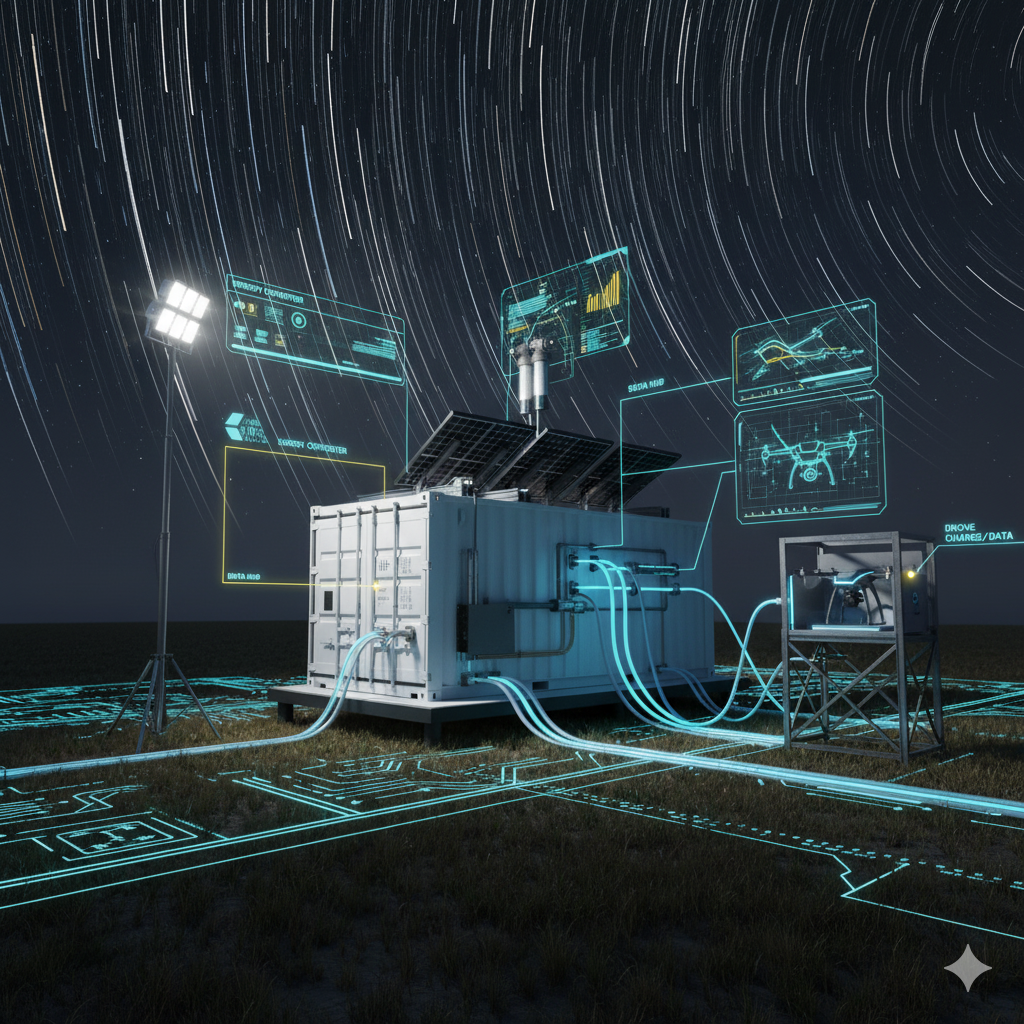
The RIOS Pilot Standard (Tier 2) is a self-contained, modular micro-data center and field office engineered for permanent, off-grid deployments. Housed within a custom-fabricated 10ft High-Cube ISO container, it functions as a “Civilization Anchor,” transitioning operations from temporary, expeditionary phases (Tier 1) to persistent, stationed sovereignty. The unit integrates a complete power system, high-performance compute hardware, and a habitable workspace into a single, rapidly deployable asset.
Core to its design is the principle of active resilience. A hybrid 4.4kW solar array with unique “slide-out wings” and a 20kWh LiFePO4 battery bank provide continuous power, managed by an industrial-grade inverter. This system supports a ruggedized Intel Xeon server equipped with an NVIDIA A2 Tensor Core GPU, enabling 24/7 AI inference for tasks like perimeter security, agricultural analytics, and hosting a local “Digital Twin.” Crucially, an integrated 9,000 BTU HVAC system maintains a stable internal temperature of 68°F, guaranteeing 99.99% uptime even in extreme external conditions of 120°F.
Strategically, the Tier 2 unit is positioned as a high-margin “Anchor” product designed to capture the Capital Expenditure (CapEx) budgets of industrial clients. With a Manufacturer’s Suggested Retail Price (MSRP) of $78,500 and an estimated Cost of Goods Sold (COGS) of $36,200, it achieves a 54% gross margin. The unit is designed to lock customers into the RIOS ecosystem, serving as the central hub for power, data, and security workflows on-site, further supplemented by a recurring revenue subscription for advanced monitoring. Ideal use cases include agro-industrial pilots, rural medical clinics, and construction site headquarters.
——————————————————————————–
1. Product Concept and Strategic Role
1.1. The “Anchor”: From Expeditionary to Permanent
The RIOS Pilot Standard is classified as Tier 2 infrastructure, representing a strategic shift from the mobile, rapid-response capabilities of Tier 1 “Expeditionary” cases to a “Stationed” or permanent presence. It is designed for persistence, stability, and human habitability, serving as the foundational “Civilization Anchor” or “Base Camp” for a remote site.
- Tagline: “The Anchor. From Temporary Ops to Permanent Sovereignty.”
- Core Function: To provide a permanent, climate-controlled, armor-plated shell for the AI compute core, with massive battery redundancy to ensure continuous 24/7/365 operation.
1.2. The Hub-and-Spoke Operational Model
The Tier 2 unit functions as the central “Hub” in an operational ecosystem where Tier 1 units act as the “Spokes.”
- Data Aggregation: Field teams using mobile Tier 1 cases collect data (e.g., drone maps) and upload it to the Tier 2 server for long-term storage and heavy analysis upon returning to base.
- Charging Vault: The container is designed with a secure rack to dock and charge Tier 1 cases when they return from patrol.
- Network Extension: A telescoping 20ft mast provides significantly better range (8+ miles) for LoRaWAN sensors compared to ground-level Tier 1 units.
1.3. Financial Keystone and Ecosystem Lock-in
The Tier 2 unit is the financial backbone of the DeReticular hardware division and is central to the business strategy.
- High-Margin Product: It targets the Capital Expenditure (CapEx) budgets of industrial projects, contrasting with the lower-cost, high-volume Tier 1 cases.
- Ecosystem Control: The documentation states, “Once this container is dropped, DeReticular owns the site’s power, data, and security workflow.” It physically locks the customer into the RIOS ecosystem.
- Replacement Strategy: This model replaces previous RevoFi-based campus plans for international deployment.
2. Core Architecture and Systems
The unit is a fully integrated system housed in a modified 10ft ISO container, visualized in deployments ranging from lush hemp fields to arid desert landscapes.
2.1. The Shell (Chassis)
The foundation of the unit is a durable, secure, and habitable steel container.
- Form Factor: Modified 10ft High-Cube ISO Shipping Container (New “One-Trip”).
- Dimensions: 10′ (L) x 8′ (W) x 9’6″ (H).
- Weight: Approximately 5,500 lbs (2,495 kg) fully configured.
- Modifications:
- Finish: Sandblasted and coated with white, heat-reflective ceramic paint.
- Insulation: R-25 closed-cell spray foam on walls and ceiling for thermal stability.
- Security: Features a heavy steel cargo door with an internal biometric locking bar and a window with a security grate.
- Workspace: A partitioned, insulated interior creates a habitable office with an ergonomic mesh chair, rugged desk, workbench, and LED task lighting. It is designed to be compliant with labor regulations (e.g., OSHA) requiring a “climate-controlled workspace.”
2.2. Power Systems (Grid-Forming)
The unit is designed to generate, store, and manage its own power grid, capable of supporting both internal systems and external tools.
- Solar Generation: 4.4kW – 6kW Hybrid Solar Array.
- Configuration: A fixed roof-mounted array is supplemented by manual “Slide-Out Wings” on heavy-duty drawer slides, which double the solar capture area with bifacial panels.
- Energy Storage: 15kWh – 20kWh Server Rack Battery Bank.
- Chemistry: LiFePO4 (e.g., EG4/Ruixu modules), configured in a 48V server rack format.
- Capacity: Sufficient to run the AI core and HVAC system through three days of heavy cloud cover.
- Power Management:
- Inverter: 12kW peak Sol-Ark or Victron Quattro industrial hybrid inverter.
- Output: Capable of 120V/240V split-phase output (50A @ 240V) to power external tools like welders and pumps.
- Backup: Includes an auto-start dry contact for an external diesel or hemp generator.
2.3. Compute & Intelligence (“The Brain”)
The server rack is the computational core, separated from the office by a glass partition and engineered for continuous, high-intensity workloads.
- Server: Ruggedized 1U/2U rackmount server (Dell PowerEdge XR series, Supermicro IoT Edge, or “White Box” generic).
- CPU: Intel Xeon Scalable Processor (Silver/Gold series, e.g., Silver 4310 with 10+ cores).
- AI Accelerator: NVIDIA A2 Tensor Core GPU (16GB).
- Memory & Storage: 128GB ECC DDR4 RAM and up to 8TB NVMe storage (configured in RAID 1).
- Operating System: RIOS Sovereign OS (Server Edition).
- Mission Profile: Unlike the battery-constrained Tier 1, the Tier 2 unit is designed for Continuous Inference. It runs the AI at full throttle 24/7 to monitor 50+ CCTV streams, analyze soil telemetry, host a local “Digital Twin” database, and support a local Large Language Model (LLM).
2.4. Climate Control (Active Resilience)
Active climate control is a key differentiator, ensuring hardware and personnel can function in extreme environments.
- HVAC Unit: 9,000 BTU Mini-Split Heat Pump (120V or 48V DC).
- Performance: Maintains a stable internal server rack temperature of 68°F even when external temperatures reach 120°F (e.g., Arizona/Uganda).
- Purpose: The active cooling system is critical for guaranteeing 99.99% uptime for the high-performance servers.
2.5. Connectivity Layer
The unit is equipped with a multi-layered communications stack for robust connectivity.
- Backhaul: Starlink High-Performance Kit (roof-mounted) and a Peplink 4G/5G bonding router with high-gain directional MIMO antennas.
- Local Mesh: A high-power RIOS NeoMesh Concentrator for LoRaWAN sensors.
- Mast: A telescoping pneumatic mast extends 20ft from the container’s corner, mounting the 5G antennas and LoRa concentrator. This height advantage significantly improves signal range. At night, it can feature a red blinking aviation light.
3. Operational Functionality and Use Cases
3.1. Core Operational Roles
- Sovereign Hosting: Hosts the local intranet, including a Wiki, training videos, and medical records, accessible via Wi-Fi even if the primary internet connection is down.
- Site Automation: The server’s GPIO pins control physical relays, enabling AI-triggered automation of systems like irrigation valves and floodlights.
- Security Hub: Powers and manages a perimeter security network, using the NVIDIA A2 for continuous AI object detection on CCTV feeds (e.g., identifying a coyote crossing a fence).
3.2. Ideal Use Cases
- Agro-Industrial Pilots: Acts as the “Farm Intelligence Hub” for a 50-acre hemp farm, managing pumps and soil sensors.
- Rural Clinics / Humanitarian Outposts: Provides a secure, off-grid facility for storing patient records locally while using Starlink to beam data for telehealth. The workspace serves doctors and staff.
- Construction Headquarters: Functions as the site manager’s office for tracking inventory and security before the main building is complete.
- Perimeter Defense: Serves as a central security hub, powering external floodlights, drone docking stations, and water pumps, acting as the “heart” of a site’s infrastructure.
4. Commercial and Financial Analysis
4.1. Pricing and Revenue Model
| Category | Item | Value (USD) | Notes |
| Hardware (CapEx) | MSRP | $78,500.00 | Project-based pricing is available. |
| Wholesale / Partner Base | $65,000.00 | ||
| Lease Option | ~$1,800/month | Via third-party equipment finance over 5 years. | |
| Software/Service (OpEx) | RIOS Standard Support | $1,500.00 / Month | Billed annually at $18,000. |
| Included Services | – 24/7 HVAC & Battery Telemetry<br>- Starlink Data Plan<br>- Digital Twin Dashboard | Higher price than Tier 1 due to critical systems monitoring. |
- Payment Terms: 50% deposit for materials on order, with the remaining 50% due prior to shipping.
4.2. Value Proposition
The pricing is justified by positioning the unit as “Digital Real Estate” and a capital asset, not a construction cost.
- vs. Construction: Building a comparable concrete block server room and office in a remote area is estimated to cost over $100,000 and take 4+ months.
- vs. Tier 1 Cases: Provides the thermal stability and massive power reserves required for “mission critical” 24/7 uptime. The documents state, “If the Tier 2 goes down, the site goes dark—so we over-engineered it to never go down.”
- Asset Value: As a movable capital asset, it can be instantly depreciated and retains resale value, unlike a permanent building.
4.3. Cost of Goods Sold (COGS) and Margin
The estimated COGS is 36,200.00**, resulting in a gross margin of **42,300 per unit (54%).
| Component | Cost Breakdown | Estimated Cost |
| The Shell | 10ft Container, modifications, paint, insulation, security | $8,200 |
| Power Systems | 4.4kW Solar, 20kWh Battery Bank, 12k Inverter & controls | $11,500 |
| Compute & Intelligence | Rugged Server, Xeon CPU, NVIDIA A2, Starlink, Router, Switch | $9,500 |
| Climate & Interior | 9,000 BTU HVAC, Desk, Chair, Lighting, Rack Enclosure | $2,500 |
| Labor & Integration | 100 blended hours @ $45/hr (Fabrication & Integration) | $4,500 |
| Total Estimated COGS | $36,200 |
5. Manufacturing and Fulfillment
5.1. “Operation Octagon” Manufacturing Process
The unit is manufactured via a “Batch Build” process at the DeReticular facility in Quartzsite, AZ, under a program named “Operation Octagon.” It requires heavy infrastructure and cannot be dropshipped.
- Phase 1: Shell Prep (Weeks 1-2): Containers arrive, undergo cutting and welding for vents and racks, and are then painted and insulated.
- Phase 2: Electrical & Systems (Weeks 3-5): Involves the electrical “Rough-In,” mounting the server stack and HVAC, and imaging the server with RIOS Sovereign OS.
- Phase 3: Burn-In (Week 6): Rigorous quality assurance testing.
- “Oven Test”: HVAC is turned off to let the interior heat to 100°F, then turned on to verify the cooling curve.
- “Island Test”: The unit is disconnected from mains and must run on battery/solar for 48 hours while executing a heavy AI inference loop.
- Phase 4: Logistics (Week 7-8): The unit is prepared for shipping.
5.2. Logistics and Export
- Transport: Requires a Landoll (tilt-deck) trailer or a flatbed truck with a heavy forklift or crane at the destination for placement. This is visualized in an image of the container being unloaded onto a dusty construction site.
- Lead Time: 6-8 weeks from order to fulfillment.
- Export: For international campuses (e.g., Uganda/Israel), units are shipped as “Temporary Office Units” with “Computer Equipment” on the manifest. The solar/battery components often qualify for “Green Energy” duty exemptions.
- Compliance:
- HS Code: 9406.90.0030 (Prefabricated Buildings) or 8502.39 (Solar Generators).
- ECCN: 5A992.c (Mass Market Encryption – EAR99 eligible).
- Hazmat: UN3481 (Lithium Batteries contained in equipment – Large Format).
6. Detailed Product Specifications
| Attribute | Specification |
| Product Name | RIOS Pilot: Standard (Tier 2) |
| Internal SKU | RIOS-STD-10FT-A2 |
| Model Number | RP-STD-002-GEN1 |
| Manufacturer | DeReticular (In-House Fabrication) |
| Country of Origin | USA (Quartzsite, AZ) |
| Lifecycle Status | Build-to-Order (BTO) |
| Dimensions | 10′ L x 8′ W x 9’6″ H (120″ x 96″ x 114″) |
| Gross Weight | ~5,500 lbs (2,495 kg) |
| Solar Input | 4.4kW (Bifacial Panels on Roof + Slide-Out Rails) |
| Battery Storage | 20kWh LiFePO4 (48V Server Rack Configuration) |
| Inverter | 12kW Hybrid (120/240V Split Phase Output) |
| Server CPU | Intel Xeon Scalable Silver (10+ Cores) |
| Server GPU | NVIDIA A2 Tensor Core (16GB) |
| Server RAM | 128GB DDR4 ECC |
| Server Storage | 8TB NVMe (RAID 1) |
| Warranty | 1 Year Bumper-to-Bumper (Parts) |
Briefing Document: RIOS Pilot Standard (Tier 2)
Executive Summary
The RIOS Pilot Standard (Tier 2) is a self-contained, modular micro-data center and field office engineered for permanent, off-grid deployments. Housed within a custom-fabricated 10ft High-Cube ISO container, it functions as a “Civilization Anchor,” transitioning operations from temporary, expeditionary phases (Tier 1) to persistent, stationed sovereignty. The unit integrates a complete power system, high-performance compute hardware, and a habitable workspace into a single, rapidly deployable asset.
Core to its design is the principle of active resilience. A hybrid 4.4kW solar array with unique “slide-out wings” and a 20kWh LiFePO4 battery bank provide continuous power, managed by an industrial-grade inverter. This system supports a ruggedized Intel Xeon server equipped with an NVIDIA A2 Tensor Core GPU, enabling 24/7 AI inference for tasks like perimeter security, agricultural analytics, and hosting a local “Digital Twin.” Crucially, an integrated 9,000 BTU HVAC system maintains a stable internal temperature of 68°F, guaranteeing 99.99% uptime even in extreme external conditions of 120°F.
Strategically, the Tier 2 unit is positioned as a high-margin “Anchor” product designed to capture the Capital Expenditure (CapEx) budgets of industrial clients. With a Manufacturer’s Suggested Retail Price (MSRP) of $78,500 and an estimated Cost of Goods Sold (COGS) of $36,200, it achieves a 54% gross margin. The unit is designed to lock customers into the RIOS ecosystem, serving as the central hub for power, data, and security workflows on-site, further supplemented by a recurring revenue subscription for advanced monitoring. Ideal use cases include agro-industrial pilots, rural medical clinics, and construction site headquarters.
——————————————————————————–
1. Product Concept and Strategic Role
1.1. The “Anchor”: From Expeditionary to Permanent
The RIOS Pilot Standard is classified as Tier 2 infrastructure, representing a strategic shift from the mobile, rapid-response capabilities of Tier 1 “Expeditionary” cases to a “Stationed” or permanent presence. It is designed for persistence, stability, and human habitability, serving as the foundational “Civilization Anchor” or “Base Camp” for a remote site.
- Tagline: “The Anchor. From Temporary Ops to Permanent Sovereignty.”
- Core Function: To provide a permanent, climate-controlled, armor-plated shell for the AI compute core, with massive battery redundancy to ensure continuous 24/7/365 operation.
1.2. The Hub-and-Spoke Operational Model
The Tier 2 unit functions as the central “Hub” in an operational ecosystem where Tier 1 units act as the “Spokes.”
- Data Aggregation: Field teams using mobile Tier 1 cases collect data (e.g., drone maps) and upload it to the Tier 2 server for long-term storage and heavy analysis upon returning to base.
- Charging Vault: The container is designed with a secure rack to dock and charge Tier 1 cases when they return from patrol.
- Network Extension: A telescoping 20ft mast provides significantly better range (8+ miles) for LoRaWAN sensors compared to ground-level Tier 1 units.
1.3. Financial Keystone and Ecosystem Lock-in
The Tier 2 unit is the financial backbone of the DeReticular hardware division and is central to the business strategy.
- High-Margin Product: It targets the Capital Expenditure (CapEx) budgets of industrial projects, contrasting with the lower-cost, high-volume Tier 1 cases.
- Ecosystem Control: The documentation states, “Once this container is dropped, DeReticular owns the site’s power, data, and security workflow.” It physically locks the customer into the RIOS ecosystem.
- Replacement Strategy: This model replaces previous RevoFi-based campus plans for international deployment.
2. Core Architecture and Systems
The unit is a fully integrated system housed in a modified 10ft ISO container, visualized in deployments ranging from lush hemp fields to arid desert landscapes.
2.1. The Shell (Chassis)
The foundation of the unit is a durable, secure, and habitable steel container.
- Form Factor: Modified 10ft High-Cube ISO Shipping Container (New “One-Trip”).
- Dimensions: 10′ (L) x 8′ (W) x 9’6″ (H).
- Weight: Approximately 5,500 lbs (2,495 kg) fully configured.
- Modifications:
- Finish: Sandblasted and coated with white, heat-reflective ceramic paint.
- Insulation: R-25 closed-cell spray foam on walls and ceiling for thermal stability.
- Security: Features a heavy steel cargo door with an internal biometric locking bar and a window with a security grate.
- Workspace: A partitioned, insulated interior creates a habitable office with an ergonomic mesh chair, rugged desk, workbench, and LED task lighting. It is designed to be compliant with labor regulations (e.g., OSHA) requiring a “climate-controlled workspace.”
2.2. Power Systems (Grid-Forming)
The unit is designed to generate, store, and manage its own power grid, capable of supporting both internal systems and external tools.
- Solar Generation: 4.4kW – 6kW Hybrid Solar Array.
- Configuration: A fixed roof-mounted array is supplemented by manual “Slide-Out Wings” on heavy-duty drawer slides, which double the solar capture area with bifacial panels.
- Energy Storage: 15kWh – 20kWh Server Rack Battery Bank.
- Chemistry: LiFePO4 (e.g., EG4/Ruixu modules), configured in a 48V server rack format.
- Capacity: Sufficient to run the AI core and HVAC system through three days of heavy cloud cover.
- Power Management:
- Inverter: 12kW peak Sol-Ark or Victron Quattro industrial hybrid inverter.
- Output: Capable of 120V/240V split-phase output (50A @ 240V) to power external tools like welders and pumps.
- Backup: Includes an auto-start dry contact for an external diesel or hemp generator.
2.3. Compute & Intelligence (“The Brain”)
The server rack is the computational core, separated from the office by a glass partition and engineered for continuous, high-intensity workloads.
- Server: Ruggedized 1U/2U rackmount server (Dell PowerEdge XR series, Supermicro IoT Edge, or “White Box” generic).
- CPU: Intel Xeon Scalable Processor (Silver/Gold series, e.g., Silver 4310 with 10+ cores).
- AI Accelerator: NVIDIA A2 Tensor Core GPU (16GB).
- Memory & Storage: 128GB ECC DDR4 RAM and up to 8TB NVMe storage (configured in RAID 1).
- Operating System: RIOS Sovereign OS (Server Edition).
- Mission Profile: Unlike the battery-constrained Tier 1, the Tier 2 unit is designed for Continuous Inference. It runs the AI at full throttle 24/7 to monitor 50+ CCTV streams, analyze soil telemetry, host a local “Digital Twin” database, and support a local Large Language Model (LLM).
2.4. Climate Control (Active Resilience)
Active climate control is a key differentiator, ensuring hardware and personnel can function in extreme environments.
- HVAC Unit: 9,000 BTU Mini-Split Heat Pump (120V or 48V DC).
- Performance: Maintains a stable internal server rack temperature of 68°F even when external temperatures reach 120°F (e.g., Arizona/Uganda).
- Purpose: The active cooling system is critical for guaranteeing 99.99% uptime for the high-performance servers.
2.5. Connectivity Layer
The unit is equipped with a multi-layered communications stack for robust connectivity.
- Backhaul: Starlink High-Performance Kit (roof-mounted) and a Peplink 4G/5G bonding router with high-gain directional MIMO antennas.
- Local Mesh: A high-power RIOS NeoMesh Concentrator for LoRaWAN sensors.
- Mast: A telescoping pneumatic mast extends 20ft from the container’s corner, mounting the 5G antennas and LoRa concentrator. This height advantage significantly improves signal range. At night, it can feature a red blinking aviation light.
3. Operational Functionality and Use Cases
3.1. Core Operational Roles
- Sovereign Hosting: Hosts the local intranet, including a Wiki, training videos, and medical records, accessible via Wi-Fi even if the primary internet connection is down.
- Site Automation: The server’s GPIO pins control physical relays, enabling AI-triggered automation of systems like irrigation valves and floodlights.
- Security Hub: Powers and manages a perimeter security network, using the NVIDIA A2 for continuous AI object detection on CCTV feeds (e.g., identifying a coyote crossing a fence).
3.2. Ideal Use Cases
- Agro-Industrial Pilots: Acts as the “Farm Intelligence Hub” for a 50-acre hemp farm, managing pumps and soil sensors.
- Rural Clinics / Humanitarian Outposts: Provides a secure, off-grid facility for storing patient records locally while using Starlink to beam data for telehealth. The workspace serves doctors and staff.
- Construction Headquarters: Functions as the site manager’s office for tracking inventory and security before the main building is complete.
- Perimeter Defense: Serves as a central security hub, powering external floodlights, drone docking stations, and water pumps, acting as the “heart” of a site’s infrastructure.
4. Commercial and Financial Analysis
4.1. Pricing and Revenue Model
| Category | Item | Value (USD) | Notes |
| Hardware (CapEx) | MSRP | $78,500.00 | Project-based pricing is available. |
| Wholesale / Partner Base | $65,000.00 | ||
| Lease Option | ~$1,800/month | Via third-party equipment finance over 5 years. | |
| Software/Service (OpEx) | RIOS Standard Support | $1,500.00 / Month | Billed annually at $18,000. |
| Included Services | – 24/7 HVAC & Battery Telemetry<br>- Starlink Data Plan<br>- Digital Twin Dashboard | Higher price than Tier 1 due to critical systems monitoring. |
- Payment Terms: 50% deposit for materials on order, with the remaining 50% due prior to shipping.
4.2. Value Proposition
The pricing is justified by positioning the unit as “Digital Real Estate” and a capital asset, not a construction cost.
- vs. Construction: Building a comparable concrete block server room and office in a remote area is estimated to cost over $100,000 and take 4+ months.
- vs. Tier 1 Cases: Provides the thermal stability and massive power reserves required for “mission critical” 24/7 uptime. The documents state, “If the Tier 2 goes down, the site goes dark—so we over-engineered it to never go down.”
- Asset Value: As a movable capital asset, it can be instantly depreciated and retains resale value, unlike a permanent building.
4.3. Cost of Goods Sold (COGS) and Margin
The estimated COGS is 36,200.00**, resulting in a gross margin of **42,300 per unit (54%).
| Component | Cost Breakdown | Estimated Cost |
| The Shell | 10ft Container, modifications, paint, insulation, security | $8,200 |
| Power Systems | 4.4kW Solar, 20kWh Battery Bank, 12k Inverter & controls | $11,500 |
| Compute & Intelligence | Rugged Server, Xeon CPU, NVIDIA A2, Starlink, Router, Switch | $9,500 |
| Climate & Interior | 9,000 BTU HVAC, Desk, Chair, Lighting, Rack Enclosure | $2,500 |
| Labor & Integration | 100 blended hours @ $45/hr (Fabrication & Integration) | $4,500 |
| Total Estimated COGS | $36,200 |
5. Manufacturing and Fulfillment
5.1. “Operation Octagon” Manufacturing Process
The unit is manufactured via a “Batch Build” process at the DeReticular facility in Quartzsite, AZ, under a program named “Operation Octagon.” It requires heavy infrastructure and cannot be dropshipped.
- Phase 1: Shell Prep (Weeks 1-2): Containers arrive, undergo cutting and welding for vents and racks, and are then painted and insulated.
- Phase 2: Electrical & Systems (Weeks 3-5): Involves the electrical “Rough-In,” mounting the server stack and HVAC, and imaging the server with RIOS Sovereign OS.
- Phase 3: Burn-In (Week 6): Rigorous quality assurance testing.
- “Oven Test”: HVAC is turned off to let the interior heat to 100°F, then turned on to verify the cooling curve.
- “Island Test”: The unit is disconnected from mains and must run on battery/solar for 48 hours while executing a heavy AI inference loop.
- Phase 4: Logistics (Week 7-8): The unit is prepared for shipping.
5.2. Logistics and Export
- Transport: Requires a Landoll (tilt-deck) trailer or a flatbed truck with a heavy forklift or crane at the destination for placement. This is visualized in an image of the container being unloaded onto a dusty construction site.
- Lead Time: 6-8 weeks from order to fulfillment.
- Export: For international campuses (e.g., Uganda/Israel), units are shipped as “Temporary Office Units” with “Computer Equipment” on the manifest. The solar/battery components often qualify for “Green Energy” duty exemptions.
- Compliance:
- HS Code: 9406.90.0030 (Prefabricated Buildings) or 8502.39 (Solar Generators).
- ECCN: 5A992.c (Mass Market Encryption – EAR99 eligible).
- Hazmat: UN3481 (Lithium Batteries contained in equipment – Large Format).
6. Detailed Product Specifications
| Attribute | Specification |
| Product Name | RIOS Pilot: Standard (Tier 2) |
| Internal SKU | RIOS-STD-10FT-A2 |
| Model Number | RP-STD-002-GEN1 |
| Manufacturer | DeReticular (In-House Fabrication) |
| Country of Origin | USA (Quartzsite, AZ) |
| Lifecycle Status | Build-to-Order (BTO) |
| Dimensions | 10′ L x 8′ W x 9’6″ H (120″ x 96″ x 114″) |
| Gross Weight | ~5,500 lbs (2,495 kg) |
| Solar Input | 4.4kW (Bifacial Panels on Roof + Slide-Out Rails) |
| Battery Storage | 20kWh LiFePO4 (48V Server Rack Configuration) |
| Inverter | 12kW Hybrid (120/240V Split Phase Output) |
| Server CPU | Intel Xeon Scalable Silver (10+ Cores) |
| Server GPU | NVIDIA A2 Tensor Core (16GB) |
| Server RAM | 128GB DDR4 ECC |
| Server Storage | 8TB NVMe (RAID 1) |
| Warranty | 1 Year Bumper-to-Bumper (Parts) |