Understanding Node 2 The Brain of Project Octagon
1. Introduction: What is Node 2?
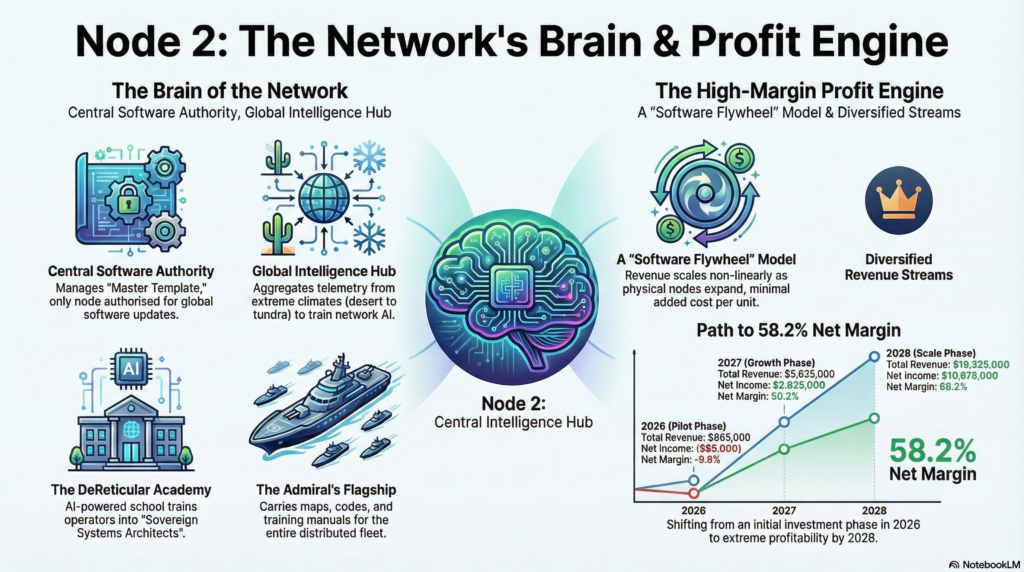
Node 2 is the central intelligence and software authority for the entire Project Octagon network. It goes by several key nicknames that hint at its crucial role: “The Systems Architect,” “The Brain,” and “OS HQ.” Located in Canada and led by Chief Technology Officer (CTO) Ash Aly, Node 2 is fundamentally different from the other nodes in the global network.
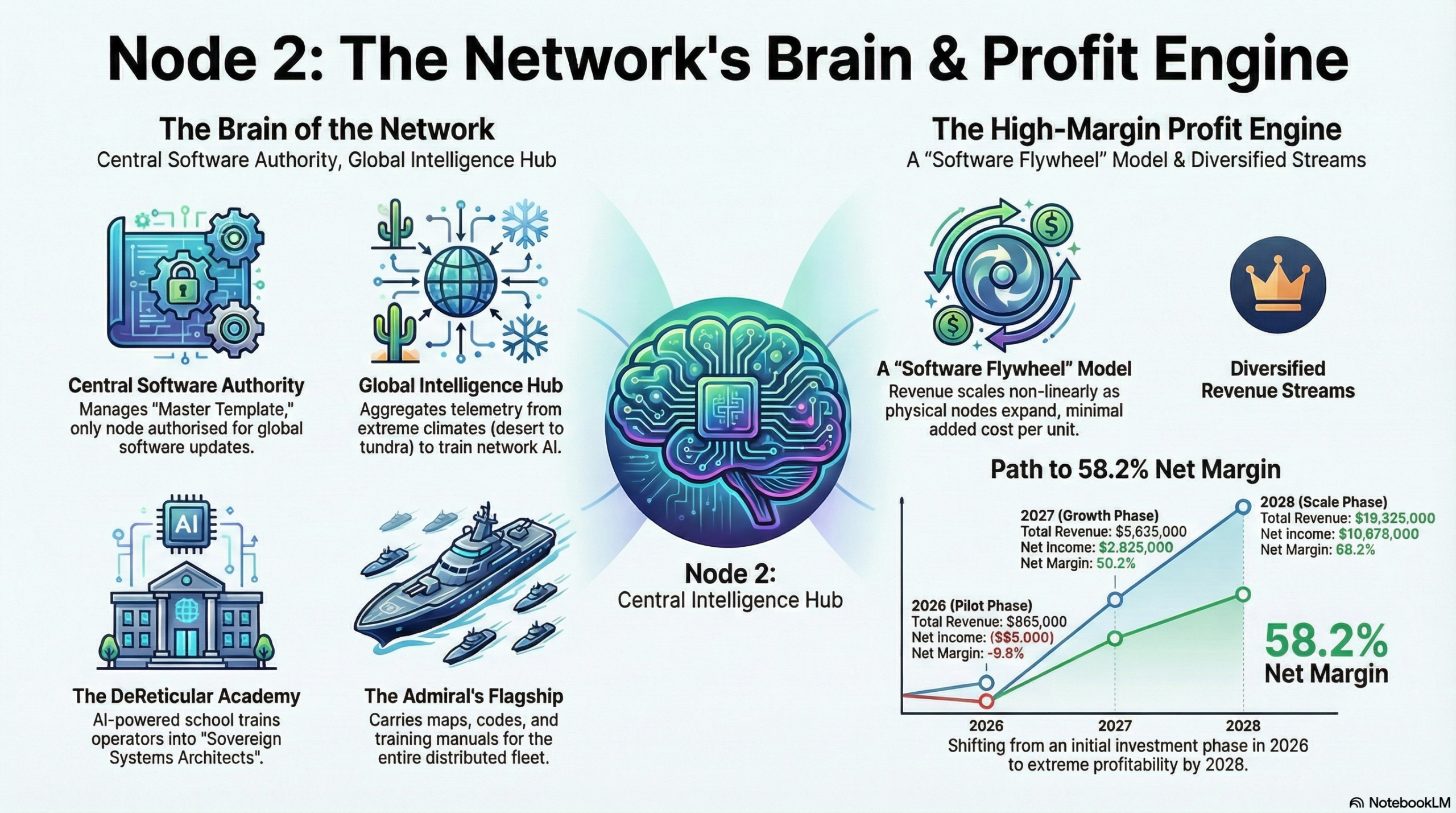
The best way to understand its function is through the “Admiral’s Flagship” analogy. In a global fleet of autonomous ships, most vessels are designed to carry cargo or perform specific industrial tasks. The flagship, however, doesn’t handle the heavy lifting. Instead, it is the flagship that provides the single source of truth for maps, codes, and training manuals, ensuring the entire fleet operates as one. Node 2 is that flagship; it directs the entire Project Octagon network.
This document will explore the three core missions that define Node 2’s essential role as the network’s brain.
2. The Three Core Missions of the Systems Architect
Node 2’s critical importance to Project Octagon can be understood through its three primary functions: serving as the software authority, the global intelligence hub, and the physical proving ground for the system’s hardware.
2.1 Mission 1: The Central Software Authority
Node 2 is the only node in the entire network authorized to manage and update the core software, the Rural Infrastructure Operating System (RIOS). This centralized control ensures stability, security, and uniformity across all nodes worldwide. Its two key responsibilities in this mission are:
- Master Template Management: Node 2 maintains the “Golden Image” of the RIOS software. Think of this as the master blueprint for the system’s digital brain. By managing this single, pristine template, Node 2 ensures that a node in the Ugandan savanna runs the exact same kernel and security protocols as a node in Texas.
- Over-the-Air (OTA) Updates: From its headquarters in Canada, Node 2 is responsible for developing and distributing all system patches, security improvements, and new features to the global network. This centralized update process guarantees that every node benefits from the latest advancements and is protected against emerging threats, creating a stable and reliable system for everyone.
2.2 Mission 2: The Global Intelligence Hub
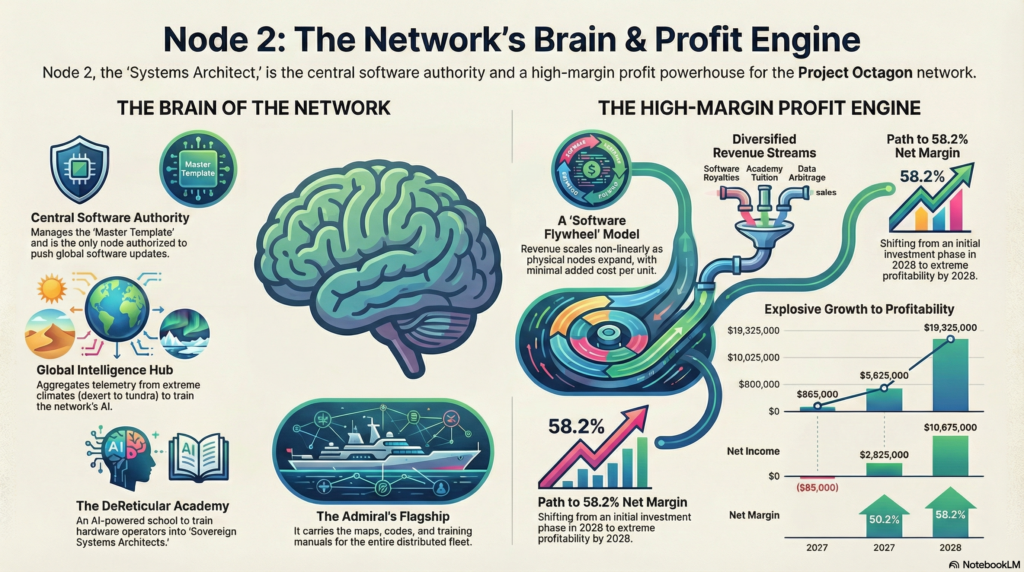
Node 2 is tasked with making the entire Project Octagon network smarter through a process called “Federated Learning.” It acts as a central hub that aggregates non-sensitive telemetry data from nodes operating in extreme climates, from the scorching 115°F deserts of Arizona and the sub-zero winters of its Canadian home base to the equatorial humidity of Uganda.
The primary benefit of collecting this diverse data is to train global AI models. These models learn from the real-world performance of hardware in varied conditions to optimize critical systems for all nodes, such as improving battery thermal management and predicting energy loads more efficiently.
2.3 Mission 3: The Physical Proving Ground
Beyond its digital and AI functions, Node 2 leverages its unique location for a critical physical mission known as “Tundra Mode.” The team uses the harsh Canadian winters to physically test and validate RIOS hardware components, specifically focusing on battery performance and the integrity of enclosure seals in sub-zero temperatures.
The key insight from this testing is profound: it proves that the hardware can survive and operate reliably in extreme environments where traditional infrastructure, like diesel generators, often fails. This validation makes the entire system more resilient and commercially valuable for deployment anywhere on Earth.
From mastering the system’s software to training its intelligence and proving its physical resilience, Node 2’s role extends to cultivating the human talent needed to run the network.
3. The DeReticular Academy: Building Future Architects
Node 2 is not just a command center; it is also a school. It is the official home of the DeReticular Academy, a specialized training ground with a core mission to transform hardware operators into “Sovereign Systems Architects.”
The Academy’s most important features include:
- “The Tutor” AI: The Academy utilizes a sophisticated, LLM-based AI agent known as “The Tutor.” This tool provides multi-language technical training, making complex knowledge accessible to a global student body.
- From Operator to Designer: The curriculum’s goal is not merely to teach students how to use the hardware. It aims to empower them to design and blueprint complex infrastructure, fostering a new generation of engineers who can build and deploy these systems independently.
- Offline “Black Start” Capability: In keeping with the network’s philosophy of resilience, the Academy’s educational tools are designed to work even if a node’s primary satellite link is cut. This ensures that learning and training can continue under any circumstances.
These educational services not only build human capital but also form the foundation for a powerful business model, enabling future high-value modules like delivering remote healthcare through a “Clinic-in-a-Box” software suite.
4. The Business of Intelligence: How Node 2 Creates Value
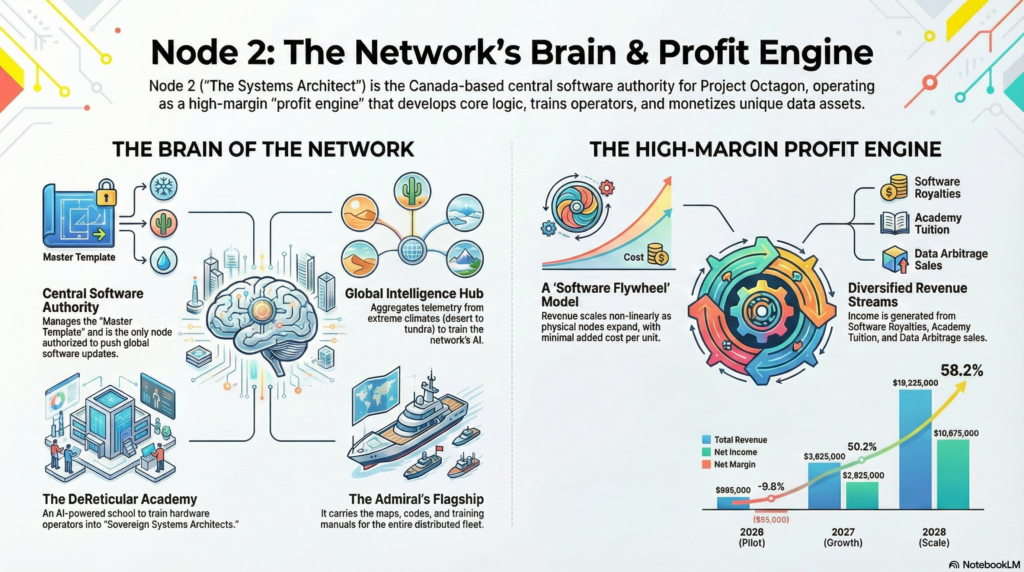
Unlike industrial nodes like the one in Uganda, which function as “Revenue Engines” by selling physical products like electricity, Node 2 operates as a high-margin “Profit Engine” by selling intelligence, software, and education. With a projected net margin of over 58% by 2028, Node 2 is designed for non-linear scaling. It functions as the intellectual property holder for the entire network, generating revenue from scalable digital assets.
| Service/Product | Description | Value for the Network/Customer |
| RIOS Sovereign Cloud Suite (SCS) | A one-time, perpetual software license (MSRP: $200,000) that unlocks the full capabilities of a node’s hardware. | Transforms a node into a local cloud provider, allowing owners to sell services and prevent capital flight to large tech companies. |
| RIOS Mobile Pro Optimum | An annual subscription ($1,200/year) that activates “Signal Fusion” for edge devices, bonding satellite and 5G signals. | Enables roaming devices to participate in the Federated Learning mesh, enhancing network intelligence and providing resilient connectivity. |
| DeReticular Academy Certification | Professional certification for “RIOS Certified Technicians” ($3,500 per certification). | Creates a skilled global workforce capable of deploying, managing, and scaling the network’s infrastructure. |
| Data Arbitrage | Selling unique, aggregated datasets from one of the world’s only sources of real-world, off-grid AI performance across every major climate zone. | Creates a pure-profit revenue stream while providing invaluable insights to clients like agricultural insurers and hardware manufacturers. |
5. Leadership: The Guardian of the Logic
The leader of Node 2 is Ash Aly, the Chief Technology Officer of the entire mesh network. His role is best summarized by his title as the “Guardian of the Network’s Logic.” This creates a critical distinction within the project: while the hardware deployed in the field “gets dirty” through its daily operations in harsh environments, Aly’s responsibility is to ensure the core software remains “pristine, secure, and constantly evolving.”
6. Key Takeaways: Why Node 2 is Essential
For any student new to Project Octagon, these are the three most critical points to remember about Node 2’s role:
- Centralized Control, Global Stability By managing the single Master Template and distributing all Over-the-Air (OTA) updates, Node 2 ensures the entire global network runs on the same secure, proven software. This prevents fragmentation and enhances stability for every user.
- Intelligence Through Diversity Node 2 makes the entire system smarter by learning from the network’s most extreme environments. By collecting data from hot, cold, and equatorial climates, its AI models can deliver optimizations that make every node more resilient and efficient.
- The Profit Engine Node 2’s business model is what makes Project Octagon financially scalable. By selling high-margin, low-variable-cost digital assets like software, certifications, and data, it generates the profit needed to fund the network’s growth, acting as the perfect financial complement to the high-CapEx industrial nodes.