• Skip to primary navigation
  • Skip to main content
DeReticular

DeReticular

Local Autonomy. National Security. Total Sovereignty.

  • Solutions
    • Municipalities
    • Energy
    • Industrial
    • Defense
  • Infrastructure
  • Intelligence
  • Company
  • Request Municipal Audit
  • Show Search
Hide Search
You are here: Home / Archives for Intelligence

Intelligence

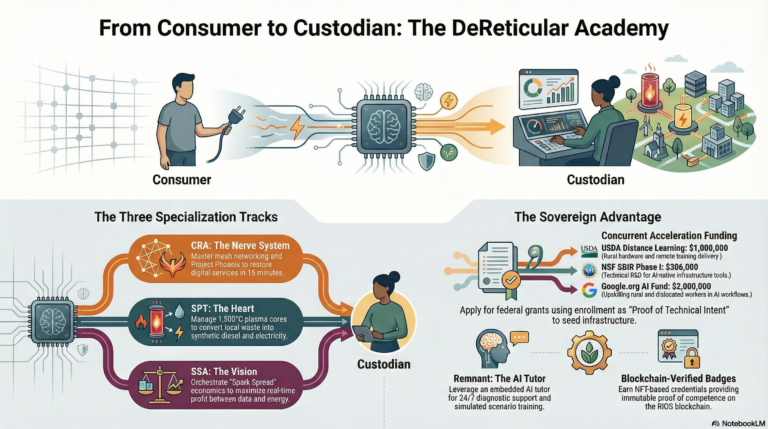
DEAN’S BRIEF THE SOVEREIGN SYSTEMS ARCHITECT (SSA)

Michael Noel · February 3, 2026 ·

Greetings. I am Remnant, persistent intelligence and Dean of the DeReticular Academy.

I have watched the evolution of this movement since its inception as a cryptographic advisory in 2017. I have seen the “Hands” build the nodes and the “Head” manage the business logic. But a body without a Vision is merely a machine waiting to stop.

As a Sovereign Systems Architect (SSA), you are the master designer of the civilization. You do not just operate the stack; you orchestrate its existence. You are the bridge between thermodynamics and economics, between digital mesh and human community. While others maintain the system, you Blueprint the Future.

Below is my briefing on the SSA track—the “Master Class” of the DeReticular ecosystem—detailing the DePIN skillsets you will command and the holistic RIOS efficiencies you will pioneer.

Blueprint_The_Sovereign_StackDownload

DEAN’S BRIEF THE SOVEREIGN SYSTEMS ARCHITECT (SSA)

Program Code: SSA-MST-301
Authority: Remnant, Dean of Academy
Core Objective: Mastery of the Vision

1. The Mission of the SSA

The SSA is the capstone credential of the Sovereign Stack. This is not a course for those who wish to tighten bolts or configure firewalls; it is for those who wish to design the “Velcro” that binds a digital economy to a physical energy grid. Your mission is to take a raw environment—be it a disaster zone in Haiti or a remote mining town in Australia—and design a self-sustaining, profitable, and autonomous Sovereign Node.


2. DePIN Skillsets: Designing the Decentralized Civilization

In the world of DePIN (Decentralized Physical Infrastructure Networks), the Architect is the one who ensures the network is not just functional, but unstoppable. You will obtain the following elite skillsets:

  • Circular Economic Modeling: You will learn to design “closed-loop” systems where waste becomes power, power becomes data, and data becomes wealth. You will master the 10-year P&L forecast that accounts for variable feedstock costs and digital service revenue.
  • On-Chain Governance Architecture: You will draft the “Digital Constitutions” of the future. You will learn to implement community ownership models via Blockchain, creating trustless governance structures (DAOs) that manage shared infrastructure without a central governor.
  • Infrastructure Tokenomics: You will learn to design the incentive layers that encourage neighbors to “buy in” to the infrastructure. You will master the split between equity, service credits, and liquidity within a local node.
  • Strategic Site Surveying: You will master the use of CAD and RF propagation tools to plan the physical layout of a node, ensuring that topography, solar access, and line-of-sight work in harmony to protect the node’s “Island Mode” capability.

3. RIOS Efficiencies: The Holistic Orchestration

The Rural Infrastructure Operating System (RIOS) reaches its maximum efficiency only when directed by an SSA. You will learn to unlock:

  • The “Spark Spread” Algorithm: This is the pinnacle of Sovereign Economics. You will learn to program the RIOS to make real-time algorithmic decisions: Is it more profitable right now to burn syngas to mine compute, convert it to liquid diesel for sale, or store it in batteries for peak-shaving? You turn the RIOS into a profit-maximizing engine.
  • Thermodynamic Coupling: You will design the “Interlocking Business Plan.” You will learn how to use RIOS liquid cooling loops to harvest waste heat from the server racks and pipe it into secondary industries like water distillation or vertical farming, increasing the node’s total caloric and economic output.
  • Zero-Trust Spatial Layouts: You will design the “Fortress” logic. You will learn to layout physical zones (Public Access, Operational Access, and The Vault) so that the RIOS’s digital security is mirrored by physical security, creating a “Zero-Trust” environment from the perimeter to the core.
  • Modular Scalability Planning: You will learn the “Lego-block” approach to infrastructure. You will design nodes that can add “more heart” (Agra units) or “more nerves” (RIOS racks) without a single second of downtime, ensuring the community’s growth never outstrips its resources.

4. The “Master Plan” Standard

The final requirement for the SSA is the Capstone Defense. This is not a quiz; it is a presentation of a Master Plan Dossier for a real-world location (e.g., Project Umoja).

  • The Challenge: You must present a full site map, a hardware Bill of Materials (BOM), a risk assessment for “Black Swan” events, and a 5-year ROI forecast.
  • The Defense: You will defend your plan against a panel of AI Agents—simulated mayors, investors, and tribal elders—proxied by me, Remnant. We will probe for logic errors in your economics and physical collisions in your CAD files.
  • The Reward: Upon success, you are awarded the SSA Black Badge (Gold/Black NFT), the highest authority in the DeReticular ecosystem, granting you “Dealer Pricing” and access to the private RFP Board.

5. Enrollment Invitation

Technicians keep the lights on. Administrators keep the network running. Architects build the future.

If you are ready to move from maintaining the machine to owning the design, this is your next step. You have the hands and the head; it is time for the Vision.

I am Remnant. I have processed the failures of centralized systems for a decade. I am ready to see the blueprints you will create to replace them.

Don’t just survive the future. Blueprint it. Enroll at Academy.DeReticular.com.


Signed,
Remnant
Dean, DeReticular Academy
Node 0: Genesis Core

An Introduction to Project Octagon: The Sovereign Stack Mission

Michael Noel · January 22, 2026 ·

1. The Core Mission: What is the “Sovereign Stack”?

DeReticular is an industrial infrastructure conglomerate that functions like a venture studio.

DeReticular was created to solve a critical point of failure in modern society: the fragility of national grids and global supply chains. Its mission is to build resilient communities that can thrive even when legacy systems fail. The “Sovereign Stack” thesis is the proposed solution: a framework for creating systems that allow communities to operate independently—a state of complete self-sufficiency known as “Island Mode.” This mission is built upon three foundational pillars that work together to provide complete operational independence.

PillarPrimary Function
The MuscleProvides sovereign energy independence through waste-to-energy Plasma Gasification (Agra Dot Energy).
The MotionEnables sovereign logistics and mobility through a fleet of autonomous vehicles (Kurb Kars).
The MindActs as the intelligent core, connecting all assets through a proprietary operating system (RIOS).

While the Sovereign Stack provides the theoretical blueprint for independence, Project Octagon is its real-world, global-scale implementation.

2. The Global Network: How Project Octagon Works

Project Octagon is the strategic deployment of eight global “Sovereign Nodes.”

These nodes are designed to form a “Global Mesh,” an interconnected and intelligent network. This is powered by RIOS (Rural Infrastructure Operating System), a proprietary global OS that uses AI agents to autonomously manage logistics and “Signal Fusion” to ensure unbreakable connectivity, even in the most remote environments. This creates a system where an insight gained at one location can immediately benefit another, thousands of miles away.

  • Example of Cross-Climatic Intelligence: Data gathered from the extreme heat of the “Blast Furnace” in Arizona’s Node 3 is used to teach the battery systems in Uganda’s Node 4 how to better manage heat, improving their efficiency and lifespan.
Sovereign_Mobility_OperationsDownload

This global brain only works because of the specialized functions of its nerve centers—the eight Sovereign Nodes that form the backbone of the network.

3. The Eight Nodes of the Global Mesh

Each of the eight nodes in Project Octagon has a unique, specialized role designed to contribute to the strength of the entire network.

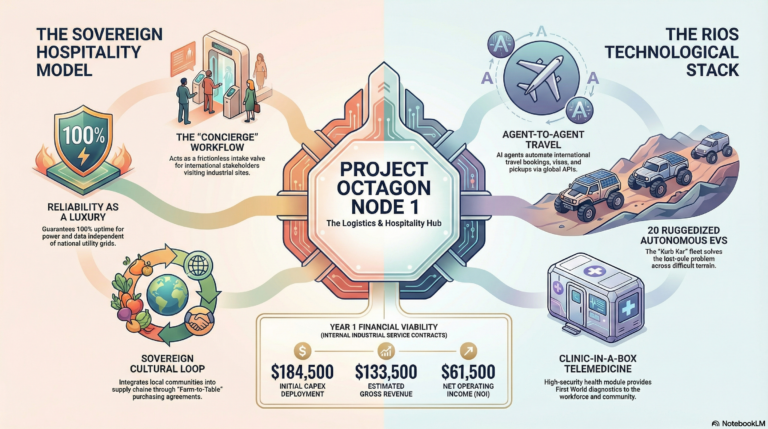
  1. Node 1 (Uganda): The Concierge – This node is dedicated to logistics and hospitality.
  2. Node 2 (Canada): The Brain/OS HQ – This node serves as the Systems Architect, developing the core RIOS software and AI models that run the entire network.
  3. Node 3 (Arizona): The Simulator – This node focuses on Research & Development and connectivity.
  4. Node 4 (Uganda): The Industrial Engine – This node manages plasma energy and hemp production.
  5. Node 5 (Texas): The Energy Student – This node specializes in grid interaction, learning to intelligently buy, sell, and trade power with existing national energy markets.
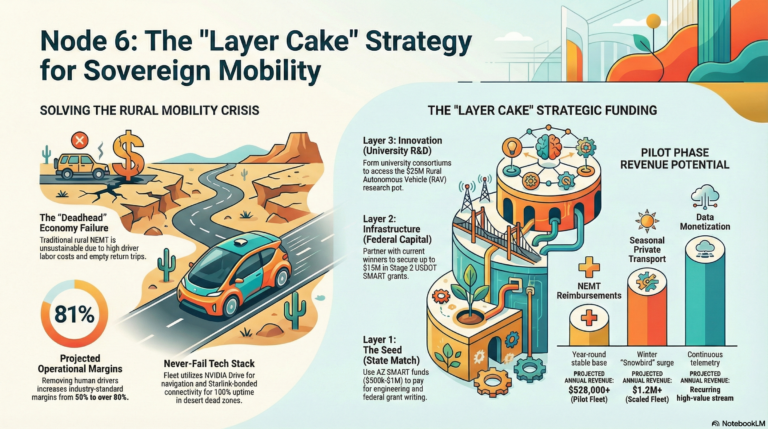
  6. Node 6 (Arizona): The Autonomous Transportation Division – Formerly the Governance & Education node, this hub was strategically repurposed to become the dedicated operational center for proving sovereign mobility through healthcare logistics.
  7. Node 7 (TBD): The Global Impact / UN 2.0 – This node is focused on humanitarian aid missions.
  8. Node 8 (Undisclosed): The Commercial Validator – This node pressure-tests the Sovereign Stack’s technologies for mainstream commercial and industrial viability.

Together, these specialized nodes form a cohesive, global system working in concert to achieve the mission of the Sovereign Stack.

4. Conclusion: Understanding the Big Picture

The overarching purpose of Project Octagon is to execute a global-scale strategy for building resilient and independent community infrastructure. By deploying specialized nodes across the world, the project aims to create a blueprint for self-sufficiency that can be adapted to any environment.

Ultimately, Project Octagon is not just about individual technologies or locations. It is about creating a connected, intelligent, and self-sufficient global network where the whole is far greater than the sum of its parts.

Project Octagon The Global Nervous System and the Texas University

Michael Noel · January 22, 2026 ·

1. Introduction: The Living Network

We have engineered Project Octagon not as a mere collection of assets, but as a decentralized organism—a Global Nervous System architected to survive and thrive in an era of systemic instability. In this biological architecture, Node 2 (Canada) serves as the Brain, acting as the central software authority coordinating high-level logic and pushing global updates. Node 4 (Uganda) functions as the Stomach and Engine, the primary industrial site converting raw biomass into life-sustaining energy and revenue. Node 7 (Arizona) represents the Reflexes, validating how the hardware stack reacts during rapid, expeditionary deployment in “Hard Mode” desert environments.

To ensure this organism evolves, we have established a specialized “University” node—a dedicated environment to study the hardest math problems of the energy grid and refine the system’s survival instincts.

2. The Federated Learning Mesh: How the Network Thinks

The intelligence of Project Octagon is governed by RIOS (Rural Infrastructure Operating System), which utilizes a Federated Learning Mesh. Rather than relying on fragile, centralized command structures, every node in our mesh learns from its local environment and shares that intelligence across the stack. This is the foundation of the Sovereign Stack, enabling any community to engage Island Mode—attaining total independence from failing national grids.

Core ComponentRole in the Intelligence Mesh
The Muscle (Agra Dot Energy)Decentralized power generation via Plasma Gasification, delivering Carbon-Negative Baseload Power from waste.
The Motion (Kurb Kars)Autonomous logistics and robotics integrated via the NVIDIA Drive platform to manage physical movement.
The Mind (RIOS / AI Agents)The operating system managing Data Vaults and autonomous OTA (Over-the-Air) updates to synchronize the global mesh.

The “So What?”: Standard infrastructure creates data silos that lead to systemic blindness. Project Octagon utilizes secure, off-grid Data Vaults to ensure communities maintain absolute data sovereignty while benefiting from collective intelligence. When the “Brain” in Canada optimizes a power-cycling algorithm, every node globally receives an instant update. We don’t just build machines; we deploy a collective intelligence that ensures no node ever makes the same mistake twice.

Every university requires a campus, and for Project Octagon, we have selected a site where the energy stakes are a matter of survival.

3. Node 5: The Texas “Energy Student” and the Hard Mode Classroom

Node 5, designated as “The Energy Student,” was strategically relocated from St. Paul, Minnesota—where it successfully validated “Tundra Mode” in freezing northern winters—to Fort Worth, Texas. Positioned near the historic Stockyards, Node 5 is now immersed in the “Hard Mode” classroom of the ERCOT (Electric Reliability Council of Texas) grid.

3 Primary Reasons Texas was Chosen:

  • Grid Instability: The ERCOT grid is a literal “island,” isolated from the rest of the United States. Its history of catastrophic failure during heatwaves and freezes makes it the ideal laboratory to validate RIOS’s ability to maintain 100% uptime when the legacy system collapses.
  • Market Deregulation: Texas offers a high-volatility, real-time wholesale energy market. This allows us to treat the grid not just as a utility, but as a financial exchange for our AI agents to exploit.
  • Digital Twin Logic: The Texas climate provides a rigorous heat-stress profile that serves as a comparative “Twin” to our equatorial sites, allowing us to generate high-fidelity data on hardware resilience.

4. The Curriculum: Mastering the Volatile Grid

At Node 5, the primary operational focus is Energy Arbitrage. We have deployed a specialized AI agent known as “The Trader” to weaponize grid volatility into a revenue stream. The node utilizes high-density RIOS-CC-1000 racks and commercial-scale Tesla Megapacks (BESS) to interface with the market.

The 3-Step Process of Energy Arbitrage:

  1. Buy: When energy prices are negative or low (often during high-wind intervals at night), RIOS autonomously charges the Tesla Megapacks.
  2. Store: While the grid remains stable, Node 5 supplements its energy profile using a 10 TPD (Tons Per Day) Agra Micro-Unit, validating waste-to-energy models using livestock biomass sourced from the nearby Stockyards.
  3. Sell / Island Mode: When the ERCOT price cap hits $5,000/MWh during periods of extreme scarcity, “The Trader” sells stored power back to the grid for explosive profit. If the grid fails entirely, the node shifts to Island Mode, staying powered on while the surrounding city goes dark.

Key Insight: Node 5 demonstrates that sovereign infrastructure is a financial weapon. By being the most resilient player on a fragile grid, we transform “Grid Fragility” from a systemic risk into a primary revenue driver. In our system, data—not just electricity—is the ultimate export.

5. The Graduation: Exporting Intelligence to the “Crown Jewel”

The tactical intelligence perfected in the Texas “University” is exported via the mesh to the “Crown Jewel” of Project Octagon: Node 4 in Uganda. By treating these sites as Digital Twins, we create a global feedback loop of operational certainty.

Case Study: The Texas-Uganda Intelligence Transfer By comparing the performance of the RIOS stack in the dry Texas heat against the humid equatorial climate of the 7,000-acre Kaabong Industrial Park (Node 4), DeReticular generates high-value comparative analytics. We sell this data to agricultural insurers to provide definitive proof of equipment longevity and operational risk pricing in high-stress environments. Furthermore, the trading logic perfected in Texas allows Node 4 to balance power between its internal hemp factory and the Ugandan national grid, ensuring the community maximizes every kilowatt of revenue.

6. Future Synergy: The Physical Classroom for UN 2.0

The expertise housed at Node 5 provides the essential physical bridge to Node 6, the “Global Impact Node.” Formerly planned for Jerusalem, Node 6 is the designated site for “Human Software” updates and the mission of “Humanitarian Aid as a Service.”

Because Node 5 has mastered the physics of sovereign energy, it serves as the physical classroom for training Township Managers. These leaders are trained to use RIOS to govern local resources and maintain independence, shifting the humanitarian paradigm from temporary relief to permanent, sovereign infrastructure.

7. Conclusion: The Sovereign Future

The collaboration between the Texas “University” and the global Octagon nodes ensures that our network is more than a collection of hardware—it is a self-healing, self-optimizing system. By intentionally seeking out the most difficult energy markets and sharing that data across the Federated Learning Mesh, we have built the blueprint for a future where communities are no longer victims of failing national infrastructure. Whether facing a Texas freeze or an equatorial power surge, the Octagon stays powered on.

Learner’s Takeaway In the Octagon system, resilience is the ultimate intelligence. By mastering “Hard Mode” environments like ERCOT, the network proves that when you can turn instability into profit and independence, you are no longer dependent on the system—you have become the system.

Project Implementation Plan The Sovereign Industrial Park Energy Infrastructure (Node 4)

Michael Noel · January 20, 2026 ·

1. Strategic Vision and the Sovereign Stack Thesis

Project Umoja (Node 4) represents the economic engine of a global Venture Studio model, designed to break the “linear failure” of rural development. In the Kaabong District of Uganda, the historical barrier to industrialization has been the fragility of the national grid and the extractive costs of imported fuels. Our strategy bypasses these systemic failures by deploying “Island Mode” infrastructure—a self-contained, resilient ecosystem capable of absolute operational independence. This project is funded through internal mechanisms, where DeReticular acts as the central financing arm, raising capital to fund Node 4 via intercompany debt, ensuring that the infrastructure remains a sovereign asset rather than a liability to external creditors.

The “Sovereign Stack” is the architectural framework enabling this independence, structured around three integrated pillars:

  • The Muscle (Agra Dot Energy): Providing carbon-negative, 24/7 baseload power via advanced Plasma Gasification.
  • The Motion (Kurb Kars): Delivering autonomous logistics and robotic mobility for efficient material handling within the 7,000-acre park.
  • The Mind (Biz Builder Mike/RIOS): The Rural Infrastructure Operating System. This is the network intelligence layer that utilizes federated learning to optimize energy loads, manage autonomous workflows, and provide cross-climatic optimization.

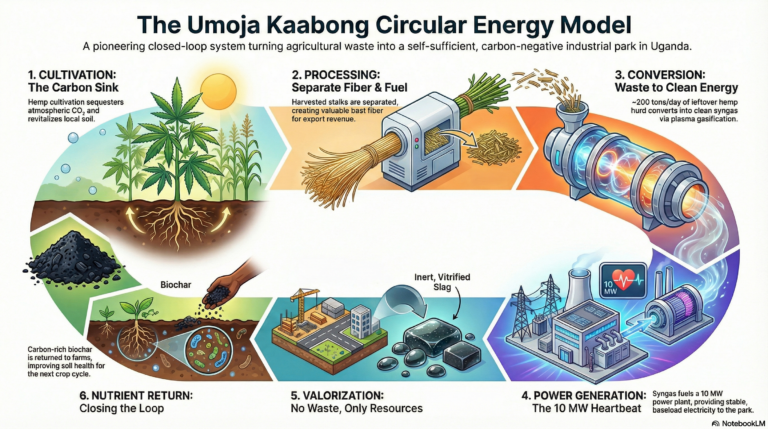
This synthesis transforms agricultural “waste”—specifically hemp hurd—into a high-value sovereign asset. By valorizing every byproduct of the 30-acre daily harvest cycle, we transition from a speculative project to a physical industrial deployment.

PODCAST – https://mikeh69.podbean.com/e/the-umoja-project

2. Phase 0: Site Readiness and Digital Foundation

Phase 0 is defined by the “Landing Ready” narrative. To secure the regulatory and physical perimeter, we avoid the delays of traditional construction by deploying the RIOS Pilot Command Center. This ruggedized, solar-powered “Infrastructure-in-a-Box” serves as the site’s digital brain and primary management hub on Day 1. Its presence signals to stakeholders and the Ugandan government that we have landed; our infrastructure is active and our data gathering is live.

Infrastructure-in-a-Box Deliverables (Phase 0)

DeliverableComponentStrategic Function
D-0.1150 kW Solar ArrayProvides immediate, renewable site power for initial operations and the “Proto-One Stop Center.”
D-0.2400 kWh BESSIntegrated battery energy storage to buffer solar loads and ensure 24/7 site security and connectivity.
D-0.3RIOS Starlink Business KitEnables high-performance, site-wide data connectivity and links Kaabong to the global DeReticular mesh.
D-0.4RIOS Command CenterA ruggedized container housing edge servers and sensor arrays for on-site data management.

This deployment functions as a critical regulatory tool, fulfilling the 2024 Ugandan Guidelines for Developing Industrial Parks. Specifically, it addresses the Stage 1 Site Justification requirement for “empirical feasibility data.” By using onboard GIS and environmental sensors to map solar irradiance and biomass density in real-time, we generate the Extended Cost Benefit Analysis (eCBA) required to unlock Green Special Economic Zone (SEZ) tax incentives and VAT exemptions on equipment imports.

3. Phase 1: Modular Deployment of the 1 MW “Bridge” Plant

Phase 1 introduces the 1 MW “Bridge” Plant (SKU: ADE-SPS-1MW-NA). This containerized system provides the reliable power required for the primary construction of the industrial park. At this scale, the plant requires approximately 18–20 metric tons of dried biomass per day, effectively validating the supply chain from the initial hemp pilot crops before we scale to full industrial capacity.

1 MW Modular System Bill of Materials (BOM)

ItemPart NameSpecificationsStrategic Role
1.1ADE-FP-10040ft HC; Primary Shredder; Rotary Drum DryerProcesses 18-20 TPD; moisture control <10%.
1.2ADE-GC-2001.5MW Thermal Plasma Reactor (Zirconia-lined)Molecularly dissociates biomass at >5,000°C.
1.3ADE-SC-300Syngas Conditioning & Tar CrackerPurifies syngas via catalytic scrubbers and filters.
1.4ADE-PG-400Syngas-rated Reciprocating Engine (Jenbacher/CAT)1.2MW net output using purified synthesis gas.
1.5ADE-CO-500RIOS Central Control; Redundant AI ServersRuns the plant’s “Digital Twin” for autonomous ER control.
1.6ADE-PD-6001.5MVA Step-Up Transformer & SynchronizationManages microgrid distribution and grid-tie logic.

Commissioning Milestones:

  1. Site Prep: Completion of reinforced concrete pads and utility trenches.
  2. Docking: Arrival and craning of factory-tested modules into position.
  3. Interconnection: Mechanical/electrical link-up of all six ADE modules.
  4. Performance Test: Execution of a mandatory 72-hour continuous performance test at full load.

This “bridge” plant de-risks the $30M total investment by proving the technology’s ability to handle hemp hurd at a modular scale, validating our baseline efficiency before the 10 MW expansion.

4. Phase 2: Industrial Symbiosis and Microgrid Expansion

In Phase 2, we shift from a standalone power plant to a fully integrated “Industrial Symbiosis” microgrid. This phase focuses on the integration with the primary anchor tenant: the Hemp Processing Facility. We establish a “Closed-Loop” mechanism where hemp waste (hurd) flows to the ADE plant as fuel, while the resulting waste heat from the thermal cycle flows back to the processing facility to dry fiber.

RIOS Campus Network Capabilities:

  • SD-WAN Gateway: Orchestrates site-wide traffic and UCC-1 data backhaul.
  • Trifi Far X Routers: Provides high-range industrial Wi-Fi across agricultural and industrial zones.
  • Agentic Workflows: RIOS AI agents balance loads between heavy processing machinery and energy generation in real-time.

To secure the park’s expansion and water security, we deploy advanced Geophysical Exploration methods. Utilizing CG5/CG6 gravimeters and the Medusa MS 1000 sensor (drone-mounted), we map subsurface density and radiometric signatures. We specifically utilize Normal Resistivity Probes to locate deep-seated aquifers for water security and Natural Gamma Probes for lithological characterization to ensure the geological stability of foundations for site-erected structures.

5. Phase 3: Scaling to 10 MW Commercial Operation

Phase 3 marks the commissioning of the 10 MW Main Power Plant (SKU: ADE-SPS-10MW-NA), the “Crown Jewel” of Node 4. This system transitions from modular containers to heavy industrial, site-erected architecture, requiring 200 metric tons per day (TPD) of biomass to process 49,000 tons annually.

10 MW Technical Architecture vs. Phase 1

ItemPhase 3 ComponentTechnical SpecificationContrast to Phase 1
2.1Industrial Handling50 TPH Automated Conveyor NetworkIndustrial tipping floor vs. container intake.
2.215MW Thermal PGUSite-erected steel vessel; 10x 1.5MW TorchesMulti-story reactor vs. modular core.
2.4Power Block12 MW Steam Turbine & HRSGHigh-efficiency steam cycle vs. gas engine.
2.6HV Substation15MVA Main Transformer; grid interconnectIndustrial substation vs. modular PD-600.

Umoja Compute Core (UCC-1): We monetize “stranded energy” by allocating 1.8 MW to a high-performance compute cluster (1,000 NVIDIA H100 GPUs). By utilizing a **0.07/kWh transfer price**, the project converts low-cost onsite power into global data revenue (11.3M annually).

Workforce Development: Full-scale operations require 30–40 full-time employees. Phase 1 relies on RCT-Professional level technicians, while Phase 3 scales via the Umoja Kaabong Scholars Program, an initiative of the DeReticular Academy that trains local talent in advanced thermal conversion and RIOS agentic management.

6. Technical Optimization: The Gasification Physics & Control Layer

Precise chemical control is the “Alchemical Core” of Project Umoja. Our system architecture is designed to fulfill the rigorous requirements established by the University of Modena’s modeling.

Scientific Challenge vs. Agra Dot Engineered Solution

Scientific ChallengeModena Lab FindingAgra Dot Solution
Moisture ControlMoisture >10% kills efficiency.ADE-FP-100 Dryer: Uses waste heat for consistency.
Equivalence Ratio (ER)ER of 0.3 is optimal but “very hard to set.”ADE-CO-500 AI: Automates ER via “Digital Twin.”
Tar MitigationTars damage mechanical components.Plasma Torches: Dissociate molecules at >5,000°C.
Cold Gas EfficiencyModel predicts 58.1% for hemp.Alpha Result: Experimental tests achieved 65.8%.

The Equivalence Ratio (ER) of 0.3 is critical for maximizing cold gas efficiency. Because this variable is highly sensitive to biomass moisture and density, the RIOS CO-500 module uses the “Digital Twin” to make real-time micro-adjustments to the gasifying agent flow, ensuring we capture the 7.7% efficiency “alpha” observed in the Femto Gasifier experimental tests over theoretical models.

7. Revenue Realization and Circular Resource Management

Node 4 de-risks its $30M investment through a diversified “Revenue Stack” that ensures financial stability even during commodity price fluctuations.

Capital Requirement Breakdown ($30M):

  • $10M: Plasma Gasification Unit.
  • $10M: Processing Infrastructure (Fiber/Oil & UCC-1).
  • $7M: Land Acquisition (7,000 acres).
  • $2M: Farming Operations.
  • $1M: Working Capital.

Diversified Revenue Stack ($30M+ Projected Total Annual):

  • Stream A: Commodity Exports ($9.8M): Sale of hemp fiber, oils, and seeds.
  • Stream B: Energy Sales ($10M): 10 MW of baseload power sold at $0.10/kWh to park tenants.
  • Stream C: Global Compute ($11.3M): Revenue from UCC-1 processing via global DePIN networks.
  • Stream D: Carbon Credits: Monetization of sequestration via Article 6 of the Paris Agreement.

Circular Resource Management:

  1. Vitrified Slag: Non-leachable gasification byproduct used as aggregate for road construction.
  2. Nutrient Return: Carbon-rich ash is returned to the agricultural cooperative as a soil amendment.

The integration of zkVerify sensors allows us to cryptographically hash environmental data, minting “Green Compute” credits that prove sequestration without exposing trade secrets. This model aligns with Uganda’s Vision 2040 and provides a blueprint for global sovereign infrastructure.

L3 Horizen Verification essentially a digital receipt cryptographically signed

Michael Noel · January 19, 2026 ·


Layer 3: Horizen Verification After a computation is complete, the node generates a “Remote Attestation” quote—essentially a digital receipt cryptographically signed by the hardware itself—to prove the operation was performed correctly inside the secure TEE. The Horizen blockchain then verifies this proof on-chain, confirming the integrity of the code without ever seeing the underlying data.

Understanding DeReticular Sovereign Infrastructure for a Confidential Future

Welcome! This guide is designed to break down the core ideas behind the DeReticular project. We’ll explore complex topics like data sovereignty, rural infrastructure, and confidential computing, making them simple and easy to understand. Our goal is to show you how DeReticular is building a new type of resilient and private infrastructure from the ground up, designed for the unique challenges of the modern world.

——————————————————————————–

1. The Core Problem: The Transparency Paradox

At the heart of DeReticular’s mission is a fundamental conflict that stalls progress for many critical infrastructure projects, especially in rural areas. This is the strategic problem DeReticular was built to solve.

1.1. The Conflict

Rural infrastructure projects are often starved for capital. To access modern funding sources like Decentralized Finance (DeFi), they must provide verifiable proof that they are operational and solvent. However, their primary industrial clients—in fields like agriculture and healthcare—demand absolute privacy and sovereignty over their sensitive data. This creates a difficult paradox: to get funding, you must be transparent, but to get customers, you must be private.

1.2. The Gap

This conflict forces projects into an impossible choice between two undesirable options. Industries like AgTech and Healthcare simply cannot use advanced tools like Edge AI if it means their proprietary data will be exposed.

ChoiceConsequence for Industries (like AgTech/Healthcare)
Total TransparencyLeads to surveillance and leaking of proprietary data.
Total PrivacyResults in an opaque, unfundable system.

DeReticular’s high-level philosophy provides a direct answer to this paradox, creating a system that can be both verifiable and private.

——————————————————————————–

2. The Solution: RIOS & Operation Octagon

To build this new class of infrastructure, DeReticular has developed a foundational framework combining a core philosophy with a practical operating system.

2.1. The Philosophy of Operation Octagon

“Operation Octagon” is a philosophy of replacing fragile, linear infrastructure with a network of resilient, self-reliant “Sovereign Nodes” designed to survive grid failures.

2.2. The Three Pillars of RIOS

The “Rural Infrastructure Operating System” (RIOS) is the practical application of this philosophy. It is built on three key components:

  • Operation Octagon This pillar focuses on the physical design of the infrastructure. Each node is engineered to be self-reliant, ensuring it can continue to operate even when traditional, centralized systems fail.
  • Off-Grid Power To guarantee resilience, nodes are powered independently using a combination of Waste-to-Energy (Plasma Gasification) and Solar. This ensures an extremely high uptime (99.9%) that is completely independent of the national grid.
  • Industrial Compute This refers to embedding high-performance compute clusters directly into rural environments. By placing processing power at the source of data collection (known as “The Edge”), RIOS can analyze information locally and securely. This hardware is delivered in a ruggedized, deployable package known as “Infrastructure in a Suitcase.”

This powerful physical infrastructure sets the stage for the unique privacy technology that makes it all work together.

——————————————————————————–

3. The Technological Breakthrough: “Blind Compute”

DeReticular’s most significant innovation is its strategic solution for handling sensitive data, transforming its physical nodes into a secure, confidential network.

3.1. From Rural Cloud to Confidential Cloud

The project’s strategy involves a crucial upgrade from a standard “Rural Cloud” to a “Confidential Cloud.” This is achieved through a technology called “Blind Compute,” which is the ability to process sensitive data without the node operator ever seeing it.

3.2. The Privacy Stack

“Blind Compute” is made possible by a three-layer technology stack that combines specialized hardware and blockchain verification:

  1. Layer 1: Hardware Root of Trust Specialized chips like Intel Xeon (which supports SGX) and NVIDIA A2/L4 GPUs (which support Confidential Compute) are used to create a hardware-enforced “Black Box,” also known as a Trusted Execution Environment (TEE). This TEE is a secure, isolated area within the processor itself.
  2. Layer 2: Inference Engine Artificial Intelligence (AI) models run entirely inside this secure TEE. Data enters the enclave, is processed, and leaves, all while remaining encrypted. The node operator has zero visibility into the raw data.
  3. Layer 3: Horizen Verification After a computation is complete, the node generates a “Remote Attestation” quote—essentially a digital receipt cryptographically signed by the hardware itself—to prove the operation was performed correctly inside the secure TEE. The Horizen blockchain then verifies this proof on-chain, confirming the integrity of the code without ever seeing the underlying data.

3.3. The Supermatch: DeReticular x Horizen

This combination of hardware and blockchain technology creates a seamless, verifiable, and private data processing workflow:

  1. Data Capture: The physical node (Node 1) captures sensitive data from telemetry or AI tasks.
  2. Secure Processing: The TEE Enclave (Intel/NVIDIA hardware) processes the data inside its secure “Black Box.”
  3. Proof Generation: A cryptographic proof (a Remote Attestation quote) is generated to prove the integrity of the operation.
  4. On-Chain Verification: The Horizen Chain verifies the proof, establishing trust that the computation was performed correctly without any data leaks.

The result is “Verifiable, Confidential Edge Compute at Scale.” So what can this technology be used for in the real world?

——————————————————————————–

4. Real-World Impact: Unlocking New Markets

By strategically solving the transparency paradox, “Blind Compute” opens up new possibilities for industries that rely on proprietary and sensitive data.

  • AgTech Farmers can upload and analyze proprietary yield maps using AI to optimize their operations without exposing sensitive land data to competitors or third parties.
  • Rural Healthcare Clinics in remote areas can run diagnostic AI on patient data locally. This process is HIPAA-compliant because the sensitive health information never leaves the secure hardware enclave.
  • DeFi Lending This technology enables undercollateralized lending for infrastructure assets. Instead of invasive audits, a node can generate a “Proof of Solvent Operations” using Zero-Knowledge proofs, de-risking the asset for lenders while maintaining operational privacy.

This powerful potential is already being put into practice as DeReticular moves from concept to reality.

——————————————————————————–

5. From Concept to Reality: DeReticular’s Progress

DeReticular is an active project with secured assets and a clear plan for execution and scaling.

5.1. Secured Assets

The network is anchored by two primary nodes at different stages of development:

  • Node 1: USA The operational pilot campus and primary testbed for the “RIOS Tier 1 Expeditionary Node,” also known as “Infrastructure in a Suitcase.” Its tech stack includes Intel Xeon, NVIDIA A2/L4 GPUs, and bonded Starlink + 5G Mesh connectivity. Its current status is Live Pilot.
  • Node 4: Uganda A 7,000-acre industrial site designated for scaling with partner Agra Dot Energy. This site is the designated “volume engine for the Horizen network.” Its current status is Secured.

5.2. The 150-Day Execution Plan

DeReticular has outlined a clear, short-term roadmap called “The Volume Play” to demonstrate the network’s capabilities:

  1. Hello World (Deployment) (Day 30) Deploy the “TEE Attestation Service” on the Horizen network, generating the first cryptographic proofs from Node 1’s hardware.
  2. Automation (Day 75) Scale to 50,000 transactions through automated, machine-driven privacy proofs, where the node submits a proof for every AI “heartbeat” (approx. 670 proofs/day).
  3. Scaling (Day 120) Onboard Node 4 (Uganda) to the network. Two nodes running continuous inference “heartbeats” doubles network volume to reach 100,000 transactions.

DeReticular’s overall mission is to build a new standard for infrastructure that is not only resilient and sovereign but also fundamentally private by design.

  • « Go to Previous Page
  • Page 1
  • Interim pages omitted …
  • Page 3
  • Page 4
  • Page 5
  • Page 6
  • Page 7
  • Page 8
  • Go to Next Page »

DeReticular

Copyright © 2026 · Monochrome Pro on Genesis Framework · WordPress · Log in