Project Implementation Plan The Sovereign Industrial Park Energy Infrastructure (Node 4)
1. Strategic Vision and the Sovereign Stack Thesis
Project Umoja (Node 4) represents the economic engine of a global Venture Studio model, designed to break the “linear failure” of rural development. In the Kaabong District of Uganda, the historical barrier to industrialization has been the fragility of the national grid and the extractive costs of imported fuels. Our strategy bypasses these systemic failures by deploying “Island Mode” infrastructure—a self-contained, resilient ecosystem capable of absolute operational independence. This project is funded through internal mechanisms, where DeReticular acts as the central financing arm, raising capital to fund Node 4 via intercompany debt, ensuring that the infrastructure remains a sovereign asset rather than a liability to external creditors.
The “Sovereign Stack” is the architectural framework enabling this independence, structured around three integrated pillars:
- The Muscle (Agra Dot Energy): Providing carbon-negative, 24/7 baseload power via advanced Plasma Gasification.
- The Motion (Kurb Kars): Delivering autonomous logistics and robotic mobility for efficient material handling within the 7,000-acre park.
- The Mind (Biz Builder Mike/RIOS): The Rural Infrastructure Operating System. This is the network intelligence layer that utilizes federated learning to optimize energy loads, manage autonomous workflows, and provide cross-climatic optimization.
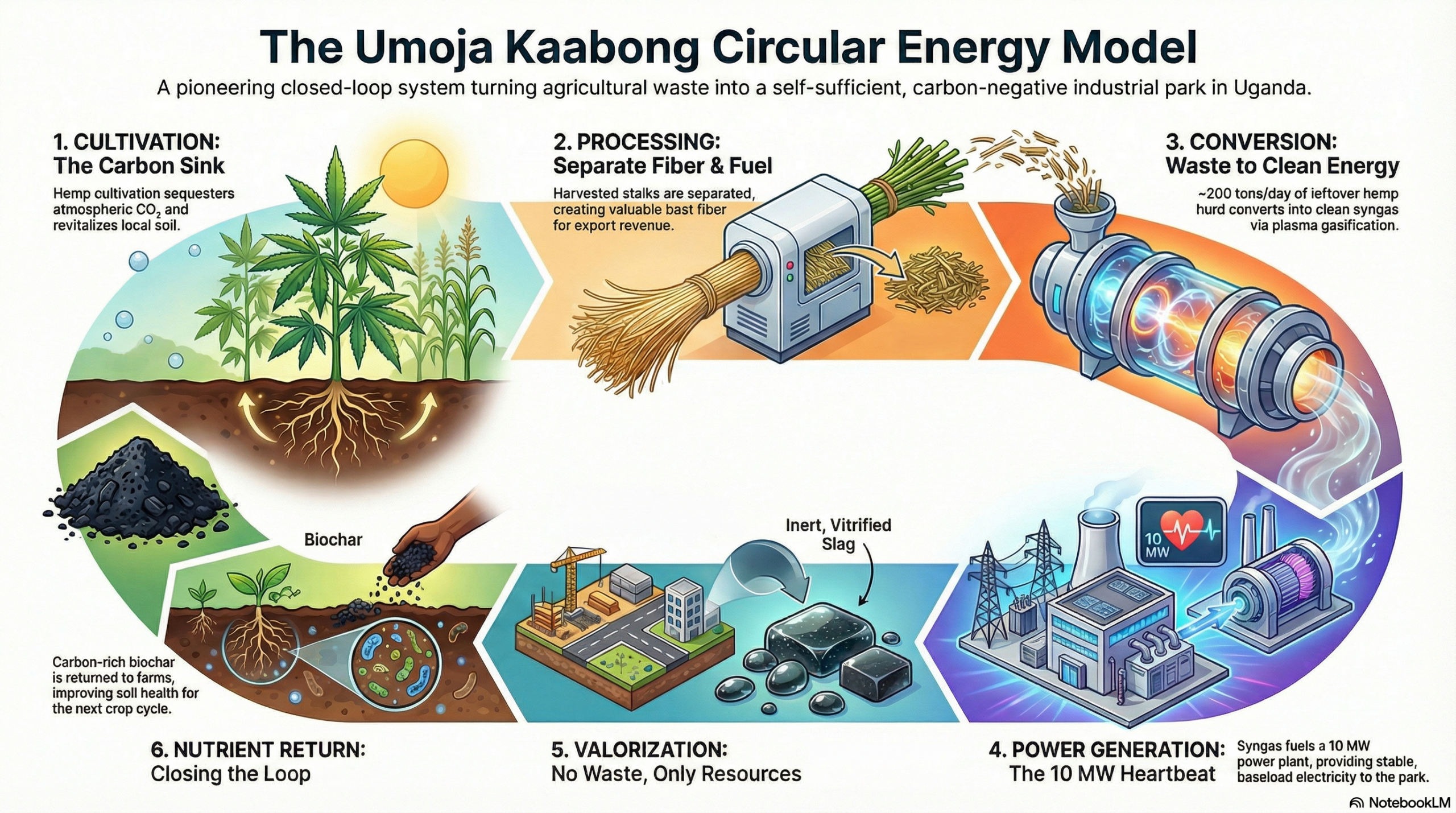
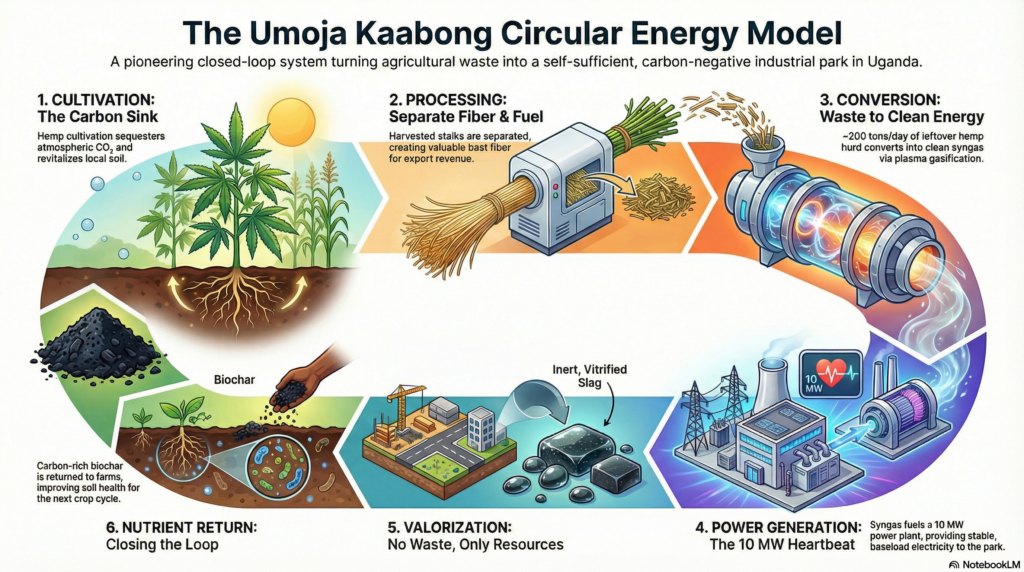
This synthesis transforms agricultural “waste”—specifically hemp hurd—into a high-value sovereign asset. By valorizing every byproduct of the 30-acre daily harvest cycle, we transition from a speculative project to a physical industrial deployment.
PODCAST – https://mikeh69.podbean.com/e/the-umoja-project
2. Phase 0: Site Readiness and Digital Foundation
Phase 0 is defined by the “Landing Ready” narrative. To secure the regulatory and physical perimeter, we avoid the delays of traditional construction by deploying the RIOS Pilot Command Center. This ruggedized, solar-powered “Infrastructure-in-a-Box” serves as the site’s digital brain and primary management hub on Day 1. Its presence signals to stakeholders and the Ugandan government that we have landed; our infrastructure is active and our data gathering is live.
Infrastructure-in-a-Box Deliverables (Phase 0)
| Deliverable | Component | Strategic Function |
| D-0.1 | 150 kW Solar Array | Provides immediate, renewable site power for initial operations and the “Proto-One Stop Center.” |
| D-0.2 | 400 kWh BESS | Integrated battery energy storage to buffer solar loads and ensure 24/7 site security and connectivity. |
| D-0.3 | RIOS Starlink Business Kit | Enables high-performance, site-wide data connectivity and links Kaabong to the global DeReticular mesh. |
| D-0.4 | RIOS Command Center | A ruggedized container housing edge servers and sensor arrays for on-site data management. |
This deployment functions as a critical regulatory tool, fulfilling the 2024 Ugandan Guidelines for Developing Industrial Parks. Specifically, it addresses the Stage 1 Site Justification requirement for “empirical feasibility data.” By using onboard GIS and environmental sensors to map solar irradiance and biomass density in real-time, we generate the Extended Cost Benefit Analysis (eCBA) required to unlock Green Special Economic Zone (SEZ) tax incentives and VAT exemptions on equipment imports.
3. Phase 1: Modular Deployment of the 1 MW “Bridge” Plant
Phase 1 introduces the 1 MW “Bridge” Plant (SKU: ADE-SPS-1MW-NA). This containerized system provides the reliable power required for the primary construction of the industrial park. At this scale, the plant requires approximately 18–20 metric tons of dried biomass per day, effectively validating the supply chain from the initial hemp pilot crops before we scale to full industrial capacity.
1 MW Modular System Bill of Materials (BOM)
| Item | Part Name | Specifications | Strategic Role |
| 1.1 | ADE-FP-100 | 40ft HC; Primary Shredder; Rotary Drum Dryer | Processes 18-20 TPD; moisture control <10%. |
| 1.2 | ADE-GC-200 | 1.5MW Thermal Plasma Reactor (Zirconia-lined) | Molecularly dissociates biomass at >5,000°C. |
| 1.3 | ADE-SC-300 | Syngas Conditioning & Tar Cracker | Purifies syngas via catalytic scrubbers and filters. |
| 1.4 | ADE-PG-400 | Syngas-rated Reciprocating Engine (Jenbacher/CAT) | 1.2MW net output using purified synthesis gas. |
| 1.5 | ADE-CO-500 | RIOS Central Control; Redundant AI Servers | Runs the plant’s “Digital Twin” for autonomous ER control. |
| 1.6 | ADE-PD-600 | 1.5MVA Step-Up Transformer & Synchronization | Manages microgrid distribution and grid-tie logic. |
Commissioning Milestones:
- Site Prep: Completion of reinforced concrete pads and utility trenches.
- Docking: Arrival and craning of factory-tested modules into position.
- Interconnection: Mechanical/electrical link-up of all six ADE modules.
- Performance Test: Execution of a mandatory 72-hour continuous performance test at full load.
This “bridge” plant de-risks the $30M total investment by proving the technology’s ability to handle hemp hurd at a modular scale, validating our baseline efficiency before the 10 MW expansion.
4. Phase 2: Industrial Symbiosis and Microgrid Expansion
In Phase 2, we shift from a standalone power plant to a fully integrated “Industrial Symbiosis” microgrid. This phase focuses on the integration with the primary anchor tenant: the Hemp Processing Facility. We establish a “Closed-Loop” mechanism where hemp waste (hurd) flows to the ADE plant as fuel, while the resulting waste heat from the thermal cycle flows back to the processing facility to dry fiber.
RIOS Campus Network Capabilities:
- SD-WAN Gateway: Orchestrates site-wide traffic and UCC-1 data backhaul.
- Trifi Far X Routers: Provides high-range industrial Wi-Fi across agricultural and industrial zones.
- Agentic Workflows: RIOS AI agents balance loads between heavy processing machinery and energy generation in real-time.
To secure the park’s expansion and water security, we deploy advanced Geophysical Exploration methods. Utilizing CG5/CG6 gravimeters and the Medusa MS 1000 sensor (drone-mounted), we map subsurface density and radiometric signatures. We specifically utilize Normal Resistivity Probes to locate deep-seated aquifers for water security and Natural Gamma Probes for lithological characterization to ensure the geological stability of foundations for site-erected structures.
5. Phase 3: Scaling to 10 MW Commercial Operation
Phase 3 marks the commissioning of the 10 MW Main Power Plant (SKU: ADE-SPS-10MW-NA), the “Crown Jewel” of Node 4. This system transitions from modular containers to heavy industrial, site-erected architecture, requiring 200 metric tons per day (TPD) of biomass to process 49,000 tons annually.
10 MW Technical Architecture vs. Phase 1
| Item | Phase 3 Component | Technical Specification | Contrast to Phase 1 |
| 2.1 | Industrial Handling | 50 TPH Automated Conveyor Network | Industrial tipping floor vs. container intake. |
| 2.2 | 15MW Thermal PGU | Site-erected steel vessel; 10x 1.5MW Torches | Multi-story reactor vs. modular core. |
| 2.4 | Power Block | 12 MW Steam Turbine & HRSG | High-efficiency steam cycle vs. gas engine. |
| 2.6 | HV Substation | 15MVA Main Transformer; grid interconnect | Industrial substation vs. modular PD-600. |
Umoja Compute Core (UCC-1): We monetize “stranded energy” by allocating 1.8 MW to a high-performance compute cluster (1,000 NVIDIA H100 GPUs). By utilizing a **0.07/kWh transfer price**, the project converts low-cost onsite power into global data revenue (11.3M annually).
Workforce Development: Full-scale operations require 30–40 full-time employees. Phase 1 relies on RCT-Professional level technicians, while Phase 3 scales via the Umoja Kaabong Scholars Program, an initiative of the DeReticular Academy that trains local talent in advanced thermal conversion and RIOS agentic management.
6. Technical Optimization: The Gasification Physics & Control Layer
Precise chemical control is the “Alchemical Core” of Project Umoja. Our system architecture is designed to fulfill the rigorous requirements established by the University of Modena’s modeling.
Scientific Challenge vs. Agra Dot Engineered Solution
| Scientific Challenge | Modena Lab Finding | Agra Dot Solution |
| Moisture Control | Moisture >10% kills efficiency. | ADE-FP-100 Dryer: Uses waste heat for consistency. |
| Equivalence Ratio (ER) | ER of 0.3 is optimal but “very hard to set.” | ADE-CO-500 AI: Automates ER via “Digital Twin.” |
| Tar Mitigation | Tars damage mechanical components. | Plasma Torches: Dissociate molecules at >5,000°C. |
| Cold Gas Efficiency | Model predicts 58.1% for hemp. | Alpha Result: Experimental tests achieved 65.8%. |
The Equivalence Ratio (ER) of 0.3 is critical for maximizing cold gas efficiency. Because this variable is highly sensitive to biomass moisture and density, the RIOS CO-500 module uses the “Digital Twin” to make real-time micro-adjustments to the gasifying agent flow, ensuring we capture the 7.7% efficiency “alpha” observed in the Femto Gasifier experimental tests over theoretical models.
7. Revenue Realization and Circular Resource Management
Node 4 de-risks its $30M investment through a diversified “Revenue Stack” that ensures financial stability even during commodity price fluctuations.
Capital Requirement Breakdown ($30M):
- $10M: Plasma Gasification Unit.
- $10M: Processing Infrastructure (Fiber/Oil & UCC-1).
- $7M: Land Acquisition (7,000 acres).
- $2M: Farming Operations.
- $1M: Working Capital.
Diversified Revenue Stack ($30M+ Projected Total Annual):
- Stream A: Commodity Exports ($9.8M): Sale of hemp fiber, oils, and seeds.
- Stream B: Energy Sales ($10M): 10 MW of baseload power sold at $0.10/kWh to park tenants.
- Stream C: Global Compute ($11.3M): Revenue from UCC-1 processing via global DePIN networks.
- Stream D: Carbon Credits: Monetization of sequestration via Article 6 of the Paris Agreement.
Circular Resource Management:
- Vitrified Slag: Non-leachable gasification byproduct used as aggregate for road construction.
- Nutrient Return: Carbon-rich ash is returned to the agricultural cooperative as a soil amendment.
The integration of zkVerify sensors allows us to cryptographically hash environmental data, minting “Green Compute” credits that prove sequestration without exposing trade secrets. This model aligns with Uganda’s Vision 2040 and provides a blueprint for global sovereign infrastructure.