Regulatory Compliance Framework: Trustless Provenance for International Transparency Mandates
1. Strategic Context: The Evolution of Global Supply Chain Transparency
The global regulatory landscape is undergoing a fundamental shift from a reliance on “trusted” manual data entry to a requirement for “trustless” cryptographic verification. Traditional compliance measures, often dependent on paper-based assurances and self-reported logs, are no longer sufficient to meet the rigorous mandates of the EU Deforestation Regulation (EUDR). These legacy systems suffer from “linear fragility”—a vulnerability where a single failure in a centralized utility or data grid compromises the entire chain of custody.
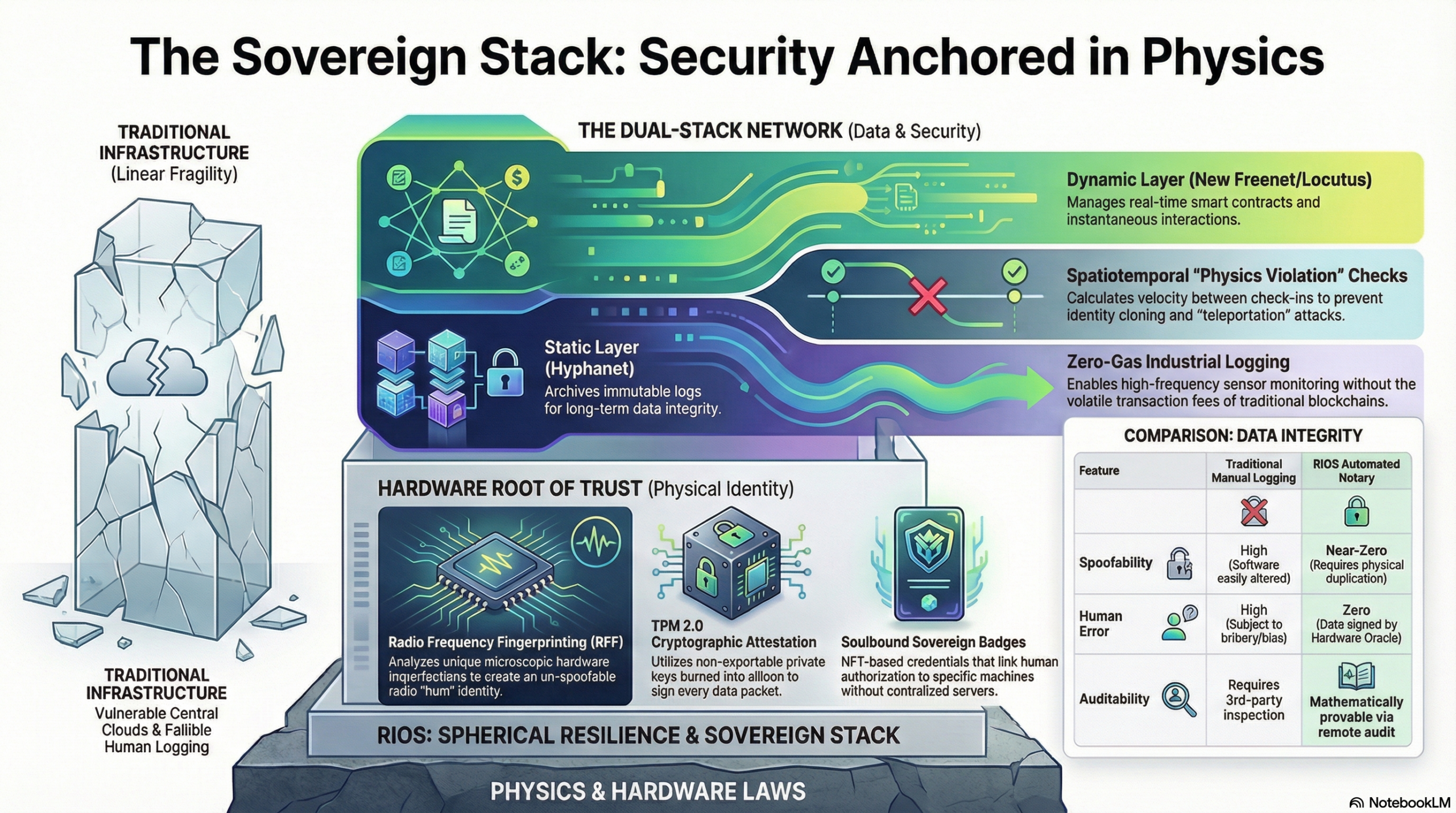
In response, the Rural Infrastructure Operating System (RIOS) introduces the “Trinity Stack”: a synergistic integration of Energy (Agra), Intelligence (RIOS), and Mobility (Kurb Kar). This “Sovereign Stack” replaces linear fragility with spherical resilience, where decentralized nodes function as self-sustaining units capable of verifying their own state and provenance independently of a national backbone. The critical differentiator is the transition from manual logging to the RIOS Automated Notary system, which anchors digital records in the indisputable laws of physics.
Comparative Reliability: Manual vs. Cryptographic Verification
| Feature | Traditional Manual Logging | RIOS Automated Notary |
| Spoofability | High; software records and paper trails are easily altered or backdated. | Near-Zero; requires physical duplication of unique hardware physics. |
| Human Error/Bias | High; subject to bribery, oversight, or intentional data entry mistakes. | Zero; data is autonomously signed by the “Hardware Oracle” at ingestion. |
| Auditability | Requires expensive, periodic third-party physical inspections. | Mathematically provable via remote cryptographic audit. |
This cryptographic bedrock provides Chief Compliance Officers with mathematically provable origin data, necessitating a sophisticated framework for machine identity that bridges the gap between digital ledgers and physical reality.
——————————————————————————–
2. The Automated Notary: Establishing a Hardware Root of Trust
To ensure digital logs accurately reflect physical reality without human interference, the RIOS framework utilizes a “Hardware Oracle.” This is the strategic solution to the “Oracle Problem”—the risk that a decentralized ledger will record “garbage” if the point of data capture is compromised. By establishing a Hardware Root of Trust, data is cryptographically signed at the moment of capture, ensuring forensic integrity before it ever reaches a network.
The Hardware Root of Trust is synthesized through two core mechanisms:
- Radio Frequency Fingerprinting (RFF): Utilizing Software Defined Radio (SDR), the system captures the unique “radio accents” of a device. Microscopic manufacturing imperfections in circuitry create unique transient responses and oscillator drifts, forming an un-spoofable digital passport.
- TPM 2.0 Attestation: Every node incorporates a Trusted Platform Module (TPM) 2.0 chip. A non-exportable private key is “burned” into the silicon at the factory, ensuring the identity cannot be cloned or exported.
The strategic impact of this “Logic of Machine Identity” is best illustrated by the HempGrade application. In this scenario, an AI-enabled camera determines crop quality and signs the data via the TPM. This prevents farmers from bribing inspectors to inflate grades, as the data is mathematically bound to a specific, physically verified device at a precise spacetime coordinate. By fulfilling geolocation and time-stamped production mandates, the system prevents Sybil Attacks, where fraudulent actors create multiple digital identities to subvert the network. This foundational identity allows for the secure movement of assets across the decentralized grid.
——————————————————————————–
3. Spatiotemporal Provenance: The Exit Visa and Handover Protocol
Strategic compliance demands “Topology Awareness” and an unbroken “Chain of Custody.” As assets—such as Kurb Kar autonomous pods—move between decentralized nodes in a mesh network, the framework maintains trust through a rigorous handover protocol. This ensures that assets follow a contiguous physical path, providing verifiable local provenance even in “Island Mode” (offline).
The Handshake Protocol for the Exit Visa system follows a four-step procedure:
- Exit Request: As an asset reaches the edge of a node’s signal, it requests an “Exit Visa.”
- Signing the Visa: The current node signs a digital packet containing the asset’s ID, an exit timestamp, and the node’s own signature.
- Arrival: Upon entering the next node’s range, the asset presents this visa.
- Verification: The new node verifies the previous signature, proving the asset physically traversed the distance.
To detect “teleportation attacks” (Physical Double-Spends), the system calculates the required velocity (V_{req} = \Delta d/\Delta t) using the Haversine distance. If V_{req} exceeds the V_{max} constant of 120 km/h for ground units, the connection is rejected. Furthermore, the system utilizes Verifiable Delay Functions (VDFs) to defend against Wormhole Attacks, where attackers attempt to “tunnel” traffic between distant nodes to make them appear adjacent. To balance security with the “Cypherpunk” ethos of privacy, RIOS utilizes zk-SNARKs (Zero-Knowledge Succinct Non-Interactive Arguments of Knowledge), allowing nodes to verify an unbroken path without compromising the entity’s sensitive GPS history. This links physical movement to the human authorization required for system governance.
——————————————————————————–
4. Decentralized Identity: The Sovereign Badge for Human Authorization
The RIOS architecture operates on a “Dual-Entity Model,” pairing rigid machine identity with verified human intent. This pairing is facilitated by the Sovereign Badge, a “Soulbound” NFT-based credential issued by the DeReticular Academy. These badges are non-transferable, ensuring that human authority cannot be traded or compromised.
Sovereign Badge NFT Metadata
| Field | Description |
| Role_Class | The specific permission level (e.g., Level 5: Safety Override). |
| Recipient_DID | The Decentralized ID of the verified human operator. |
| Soulbound_Flag | Boolean flag locking the token to the recipient’s wallet. |
When an operator interacts with a node, they must complete a five-phase Human-Machine Handshake:
- Proximity: Discovery via local mesh (WiFi 7/5G).
- Challenge: The node issues a cryptographic nonce.
- Signed Response: The operator signs the challenge using the private key associated with their Badge.
- Local Verification: The node verifies the signature and the Badge’s status against a local revocation list.
- Privilege Escalation: The node grants a temporary session token.
This creates a “Dual-Signed Object”—a log entry containing both the machine’s TPM attestation and the human’s badge signature. For high-privilege actions like factory resets, the system enforces the “Four-Eyes Principle,” requiring Multi-Sig authorization from two separate Sovereign Badges. This provides definitive proof for regulatory audits that a specific action was authorized by certified personnel on a verified machine.
——————————————————————————–
5. Data Architecture: The Dual-Stack Storage Strategy
Effective compliance requires a bifurcated storage strategy, contrasting the need for real-time industrial state (“CPU”) with long-term, censorship-resistant archival (“Hard Drive”).
Dual-Stack Functional Breakdown
| Layer Role | Protocol | Data Types | Update Speed | Persistence Model |
| Static Layer | Hyphanet (Legacy Freenet) | Firmware binaries, audit logs, certificates. | Slow (Hours) | Content Hash Keys (CHKs) |
| Dynamic Layer | New Freenet (Locutus) | Voltage logs, state contracts, energy credits. | Real-time (ms) | State Deltas |
The “Zero-Gas Model” of the New Freenet is a critical strategic advantage, enabling high-frequency industrial logging without the volatile costs of traditional blockchains. This ensures that high-integrity compliance is economically viable for small-scale producers. Furthermore, when nodes operate in “Island Mode,” RIOS utilizes Conflict-Free Replicated Data Types (CRDTs) to merge local logs back into the global state contract once connectivity is restored. This architecture provides Non-Repudiation; because logs are published to Hyphanet’s static layer, they cannot be retroactively altered, ensuring a forensic audit trail for regulators.
——————————————————————————–
6. Compliance Risk Analysis and Implementation Gaps
While the framework is mathematically robust, strategic implementation must account for the current maturity of decentralized physical infrastructure (DePIN).
SWOT Analysis: RIOS Framework for Global Transparency
| Strengths | Weaknesses |
| Physical-Digital Bridge: RFF/TPM prevent Sybil attacks and identity spoofing. | Experimental Software: Reliance on New Freenet (Locutus) alpha/pre-beta versions. |
| Offline Resilience: “Island Mode” and CRDTs allow functionality without backbone. | Hardware Fragility: If TPM or RFF sensors drift, the physical identity is lost. |
| Opportunities | Threats |
| Regulatory Fit: Direct alignment with EUDR “non-repudiation” requirements. | RFF Deepfakes: AI-driven advances attempting to spoof radio “accents.” |
| DePIN Sector Growth: Expansion into sovereign infrastructure markets. | Regulatory Hostility: Opposition to encrypted, decentralized infrastructure. |
Three critical hurdles, categorized under the “Empty OS Problem,” currently limit immediate large-scale deployment:
- The Application Layer Gap: RIOS requires the development of user-facing applications to move beyond command-line complexity.
- Human-Machine Interface Complexity: Simplification of cryptographic key management is necessary for non-technical users.
- Technology Maturity: Critical infrastructure deployment on pre-beta software necessitates private, stabilized protocol forks.
The “Flood the Forge” initiative is currently underway to address these gaps. Despite these challenges, the RIOS framework represents a paradigm shift toward Physical Truth. Compliance is no longer a matter of trusting human testimony; it is an indisputable certainty enforced by the laws of mathematics and physics.