• Skip to primary navigation
  • Skip to main content
DeReticular

DeReticular

Local Autonomy. National Security. Total Sovereignty.

  • Solutions
    • Municipalities
    • Energy
    • Industrial
    • Defense
  • Infrastructure
  • Intelligence
  • Company
  • Request Municipal Audit
  • Show Search
Hide Search
You are here: Home / Archives for Energy

Energy

RIOS Provenance Tracking: Compliance Analysis for Global Transparency Standards

Michael Noel · February 15, 2026 ·

1. Strategic Context: The Shift Toward Physical Truth

In the contemporary regulatory landscape, global supply chains are under unprecedented pressure to move beyond paper-based assurances toward immutable proof of origin. The EU Deforestation Regulation (EUDR) exemplifies this shift, mandating that commodities entering the European market provide precise geolocation coordinates and time-stamped proof of production. For a Chief Compliance Officer, the strategic imperative is clear: the industry must transition from “trusted” manual data entry, which is inherently vulnerable to fraud and human error, to “trustless” cryptographic verification. RIOS (Rural Infrastructure Operating System) facilitates this by providing attested data that survives legal and forensic scrutiny.

https://academy.dereticular.com/podcast/dereticular-builds-civilization-in-a-box-2/

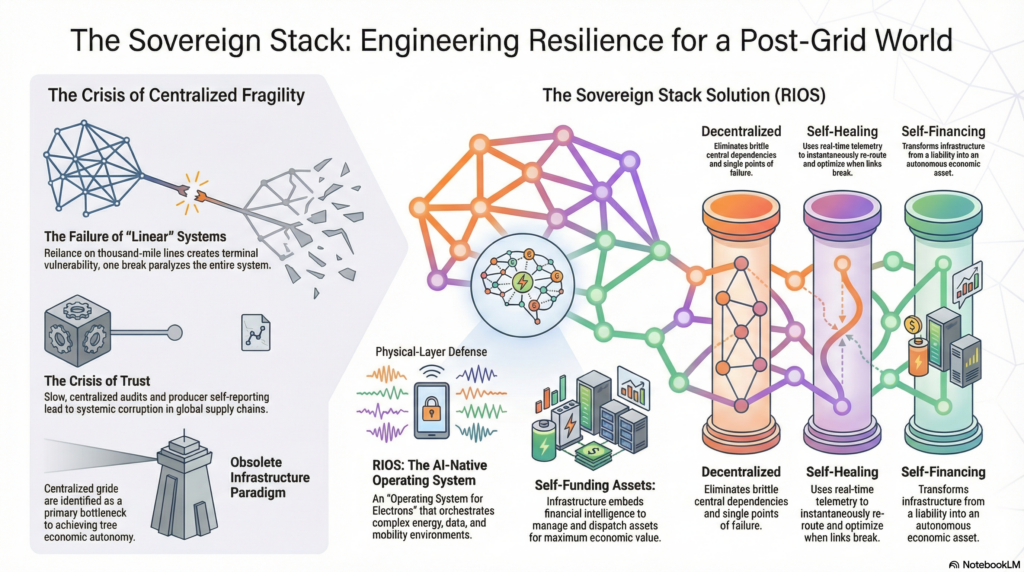
To address the “Linear Fragility” of traditional centralized utility and data grids, DeReticular has introduced the “Sovereign Stack.” This architecture is designed to create resilient, self-sustaining nodes capable of functioning independently of national backbones.

The Philosophy: The Death of the Line The Sovereign Stack marks a transition from “Linear Fragility”—the reliance on long, vulnerable supply and power lines—to “Spherical Resilience.” In this model, decentralized nodes function as self-sustaining, independent units capable of verifying their own state and provenance, ensuring that “The Line” is no longer a single point of failure.

The objective of this report is to evaluate how RIOS solves the “Oracle Problem”—the challenge of ensuring digital logs accurately reflect physical reality—by anchoring data directly to physical hardware.

——————————————————————————–

2. The Automated Notary: Establishing a Hardware Root of Trust

In high-stakes industries like energy (via Agra Energy units) and agriculture, manual logging is a primary regulatory liability. RIOS serves as an “Automated Notary,” solving the “Garbage In, Garbage Out” (GIGO) problem by acting as a Hardware Oracle. By ensuring data is cryptographically signed at the point of ingestion before it ever touches a network, RIOS eliminates the opportunity for data manipulation or human interference.

Key Technical Differentiators:

  1. Radio Frequency Fingerprinting (RFF): Utilizing Software Defined Radio (SDR), RIOS captures the microscopic imperfections in the circuitry of electronic devices. This unique radio frequency “hum” creates an un-spoofable digital passport, ensuring the hardware is physically authentic.
  2. TPM 2.0 Attestation: Every RIOS node incorporates a Trusted Platform Module (TPM) 2.0 chip. A non-exportable private key is “burned” into the hardware at the factory, used to sign every data packet with a mathematical certainty that software cannot replicate.
The_Sovereign_Stack_Architecture (1)Download

The Logic of Machine Identity

ParameterTraditional Manual LoggingRIOS Automated Notary
SpoofabilityHigh; software/records easily altered.Near-Zero; requires physical duplication of hardware physics.
Human Error/BiasHigh; subject to bribery or oversight.Zero; data is signed by the “Hardware Oracle.”
AuditabilityRequires 3rd-party physical inspection.Mathematically provable via remote cryptographic audit.

The Strategic Impact: This dual-layer verification prevents “Sybil Attacks,” where actors create fake identities to flood a network. In the HempGrade application, for instance, an AI camera determines crop quality and signs the data via TPM. This prevents farmers from bribing inspectors to inflate grades, as the data is mathematically tied to the specific, physically verified device at the moment of capture.

——————————————————————————–

3. Trustless Identity: State Management and Global Polling

To track asset uniqueness without central cloud servers, RIOS utilizes a decentralized state machine. The network manages the “who, where, and when” of any identity through the New Freenet (Locutus) layer.

Global Identity Polling and Distributed State Contracts: Rather than flooding the network with broadcasts, RIOS queries “Distributed State Contracts” written in WebAssembly (Wasm). When an asset connects, the local node polls the specific subset of peers maintaining that identity’s hash address to verify its current status (e.g., “Active” or “In-Transit”).

Spatiotemporal Validation (Physics Violation Detection): RIOS applies “Double-Spend” logic to physical assets. If a hardware identity attempts to connect to a node in Texas while its state contract shows it active in Uganda, the system calculates a Physics Violation using the Haversine distance (Δd) between nodes and the time delta (Δt) since the last heartbeat:

  • V_{req} = Δd/Δt
  • If V_{req} > V_{max} (the maximum believable velocity), the connection is rejected as an impossible “teleportation” attack and the identity is locked.

The Sovereign Badge System: Human operators use NFT-based “Sovereign Badges” issued by the DeReticular Academy.

  • Soulbound Nature: These are non-transferable credentials that link a human’s competence (e.g., Certified RIOS Admin) to their cryptographic wallet.
  • Trustless Chain of Custody: To perform maintenance, an operator must provide a dual-signature: the Machine (TPM) signature plus the Human (Badge) signature. This is reinforced by the “Exit Visa” mechanism, where the previous node signs the asset “out” of its range, providing local provenance that remains verifiable even in “Island Mode” (offline).

——————————————————————————–

4. The Dual-Stack Architecture: Hyphanet and New Freenet

RIOS utilizes a dual-stack decentralized protocol to separate static archival data from dynamic industrial state.

Dual-Stack Functional Breakdown

Protocol LayerFunctionUse Case in RIOS
Hyphanet (Legacy Freenet)Static Layer: Censorship-resistant archival.Repair manuals, firmware binaries, and immutable audit logs.
New Freenet (Locutus)Dynamic Layer: Wasm-based state management.Real-time voltage logs (Agra Energy), state contracts, and energy credits.

Economic Accessibility and the Zero-Gas Model: Traditional blockchains often trend toward “Plutocracy,” where high transaction fees exclude small-scale rural producers. The New Freenet’s Zero-Gas model allows for high-volume industrial logging—recording sensor data every second—without the volatile costs of gas-based chains. This ensures compliance is economically viable for small-scale farmers in remote regions.

DeReticular Builds Civilization in a Box

——————————————————————————–

5. Regulatory Mapping: Meeting EUDR and Transparency Mandates

RIOS provides a robust framework for meeting the “non-repudiation” requirements of global trade.

  1. Mathematically Provable Origin: By linking RFF signatures to TPM-signed GPS logs, commodities are tied to a specific plot of land, fulfilling EUDR geolocation mandates.
  2. Unforgeable Chain of Custody: The handover protocol using “Exit Visas” ensures the physical path of a commodity is contiguous and hasn’t been tampered with in “dark” zones.
  3. Censorship-Resistant Archival (Non-Repudiation): Because logs are published to Hyphanet’s static layer, they cannot be retroactively deleted or altered. An organization cannot “hide” a record of deforestation if a regulator requests the history of a node.

This allows a buyer in London to verify the history of a farm in Uganda without an intermediary, relying instead on the physics and math of the Sovereign Stack.

——————————————————————————–

6. Risk, Gaps, and Strategic Limitations

A strategic adoption of DePIN (Decentralized Physical Infrastructure) requires addressing critical vulnerabilities.

SWOT Analysis

StrengthsWeaknesses
Solves the Oracle Problem via RFF/TPM.Reliance on experimental Alpha software (New Freenet).
Offline resilience via “Island Mode.”Hardware Fragility: If TPM/RF sensors drift, identity is lost; no “password reset.”
OpportunitiesThreats
EUDR market fit and DePIN sector growth.AI-driven “Deepfake” RFF spoofing attacks.
“Flood the Forge” developer expansion.Potential regulatory hostility toward sovereign encryption.

The Application Layer Gap: The primary hurdle is the “Empty OS” problem. While the backend is robust, there is a lack of UI/UX bridges for non-technical users. The “Flood the Forge” initiative is critical; without a simplified interface, these command-line tools remain inaccessible to the rural populations they are intended to serve.

Strategic Summary: RIOS represents a leap in “Physical Truth” for compliance, yet it remains in an advanced innovation phase. Its success depends on the stability of New Freenet and the ability of the developer ecosystem to bridge the current UI/UX gap. For now, it offers the only viable path to mathematically provable, trustless provenance.

The Invisible Library Understanding the “Dark Data” Crisis and the Future of Scientific Truth

Michael Noel · February 10, 2026 ·

1. The Silent Graveyard of Ideas: Defining Dark Data

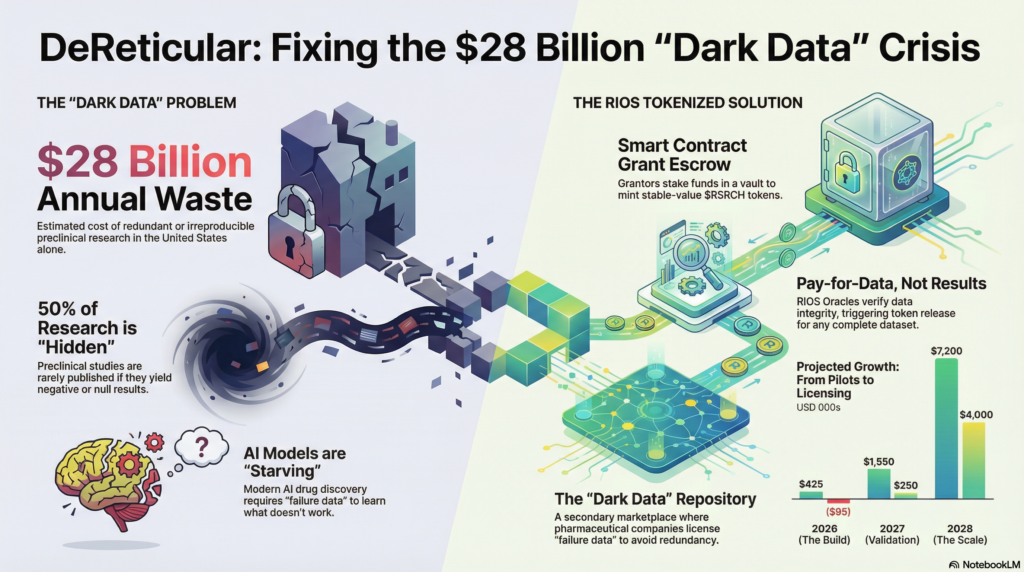
Imagine a library where half the books ever written are burned the moment they are finished. In the modern research industrial complex, this isn’t a metaphor—it is the status quo. Today, approximately 50% of preclinical research is never published, creating a “Silent Graveyard” of scientific effort. This occurs because our current institutional incentives value “breakthroughs” over “truth,” causing researchers to hide “negative” results in a metaphorical file drawer.

Key Terms

  • Dark Data: Experimental results, datasets, and observations that are collected during the research process but are never published, shared, or indexed in public databases.
  • Publication Bias: The systemic tendency of journals, funders, and researchers to prioritize studies with “statistically significant” or positive findings, effectively censoring the “failures” that are essential to the scientific method.
  • Null Results: Experimental outcomes that show no significant effect or difference. In a functional system, a null result is a vital navigation marker; in our current system, it is treated as “dead capital.”

The “So What?”: “Dark Data” isn’t just a collection of missing files; it is a structural blind spot that prevents us from seeing the full picture of reality. When science only reports its wins, it ceases to be a rigorous search for truth and becomes a marketing exercise. For the student, understanding this crisis is the first step toward demanding a scientific infrastructure that values the “No” as much as the “Yes.” This systemic silence doesn’t just stall progress—it carries a staggering global price tag.

——————————————————————————–

2. The High Cost of Silence: The $3 Trillion Forecast

The “Dark Data” crisis is an economic hemorrhage. While global R&D expenditure is projected to exceed $3 trillion by 2026, a massive portion of this capital is wasted on redundant research. We are currently trapped in a cycle where billions of dollars are spent “rediscovering” failures that have already happened elsewhere. This is compounded by institutional bloat; while the proposed Grant Escrow Protocol operates on a 1.5% fee, traditional university overhead often consumes 15% to 50% of grant funding before a single experiment is even conducted.

The Economics of InefficiencyAmount (USD)
Current Global R&D Expenditure$2.5 Trillion+
2026 Projected Global R&D Expenditure$3.0 Trillion
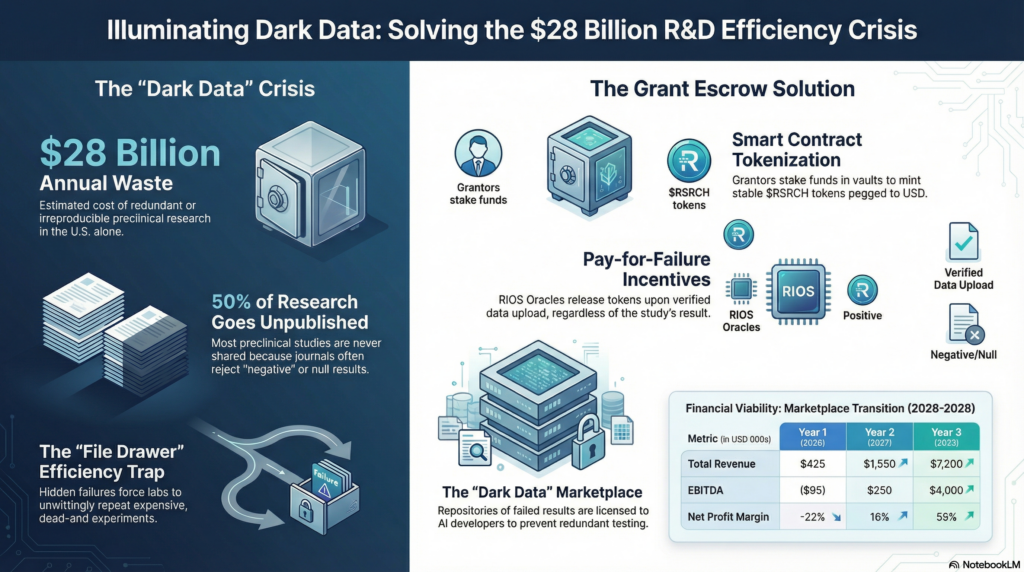
Estimated Annual Waste (Redundant Research – US Only)$28 Billion

The “So What?”: This $28 billion waste is a “tax on discovery.” Every dollar spent repeating a hidden mistake is a dollar stolen from a potential cure or a climate solution. We are effectively paying for the same failure thousands of times because we lack a sovereign ledger to record it.


Monetizing The Dark Data Of Failed Science

3. Case Study: The Hidden Story of Prozac and Zebrafish

To see the human and ecological cost of Dark Data, we look at the “Dark Cycle” of fluoxetine (Prozac) and its impact on aquatic ecosystems.

The Four Stages of a Lost Opportunity

  1. The Initial “Bust”: Lab A tests Prozac on Zebrafish. They observe no acute mortality or obvious behavioral changes. Thinking the study is “boring” or a “failure,” they never publish the results.
  2. The Redundant Grant: Lab B, unaware of Lab A’s work due to the “file drawer effect,” applies for and receives a fresh $200,000 grant to run a nearly identical study.
  3. The Hidden Repeat: Lab B reaches the same null conclusion. The data remains unpublished, and the cycle of redundant funding continues.
  4. The Delayed Breakthrough: Only years later (Vera-Chang et al., 2018) do researchers discover that Prozac has profound transgenerational effects, lowering cortisol levels in the offspring of exposed fish.

The “So What?”: If the initial “negative” safety data had been published, the scientific community could have moved past simple mortality checks much sooner to investigate these subtle, critical environmental and genetic risks. Dark Data doesn’t just waste money; it creates a lag in our understanding of safety and risk.

——————————————————————————–

4. Dark Data Across the Landscape: Pharma, Energy, and Agriculture

The crisis manifests uniquely across sectors, but the root cause remains a lack of incentive for honesty.

  • Pharmaceuticals
    • Primary Waste Driver: Proprietary secrecy regarding failed molecular compounds.
    • The AI Plateau: Modern AI drug discovery models are plateauing because they are “starving” for failure data. Without knowing what doesn’t work, AI models become over-optimistic and prone to repeating human errors.
  • Energy
    • Primary Waste Driver: High failure rates in battery chemistry remain unindexed.
    • The Carbon Cost: Millions of tons of CO2 are generated annually by data centers storing “write-only” sensor data—meter logs and sensor feeds that are collected and stored but never intended to be read or analyzed.
  • Agriculture
    • Primary Waste Driver: Research into fertilizer efficacy and soil health is often siloed within proprietary farm equipment databases.
    • Global Risk: New grants are issued to “rediscover” soil baselines that already exist in private silos, hindering global food security efforts.

The “So What?”: Across all sectors, the absence of failure data creates a “survivorship bias” that distorts our technological trajectory. For an AI to be “intelligent,” it must be trained on the full spectrum of human experience—including our mistakes.

——————————————————————————–

5. From Trust to Verification: The Tokenized Solution

To fix science, we must change the architecture of its funding. We are moving from a “Trust-Based” model (where we hope researchers share data) to a “Verification-Based” model. By utilizing the RIOS (Rural Infrastructure Operating System) and its “Island Mode” capabilities, we can create a sovereign infrastructure for truth that functions independently of fragile, centralized systems.

This solution leverages Operation Octagon—a global mesh of 8 sovereign nodes—to ensure that once research data is uploaded, it is immutable and accessible forever.

Steps to a Sovereign Scientific Truth

  • [ ] Staking: A Grantor deposits fiat into a Smart Contract vault (avoiding the 15-50% university overhead).
  • [ ] Minting: The protocol mints $RSRCH tokens, pegged 1:1 to the deposit.
  • [ ] The Mandate: Funds are locked until the researcher uploads a complete dataset to the RIOS ledger.
  • [ ] Signal Fusion: The RIOS Oracle uses “Signal Fusion” (combining hardware sensor data and software logs) to verify the data’s integrity at the source, making AI-generated “fake” failure data prohibitively expensive to produce.
  • [ ] Settlement: Once verified, $RSRCH tokens are released. The researcher can liquidate them for USD or hold for yield, creating a new financial incentive for rigorous data reporting.

The “So What?”: By treating data as a Real World Asset (RWA), we stop paying for headlines and start paying for verified knowledge. This turns the $28 billion waste into a “Light Data” repository that can be licensed to AI developers and pharmaceutical firms, creating a self-sustaining cycle of discovery.

——————————————————————————–

6. Conclusion: Reclaiming the Value of Failure

The future of science depends on our ability to value the “No.” As we transition to a Verification-Based model, we move away from institutional gatekeepers and toward a sovereign, immutable record of human inquiry. For the student and the researcher, the message is clear: your “failed” experiment is a successful data point in the global effort to map the unknown.

Takeaway Message For science to progress, failure must be visible. By replacing bloated university overhead with the Grant Escrow Protocol and securing truth through Operation Octagon, we can eliminate billions in waste. In the sovereign library of the future, the records of what went wrong are the foundation for everything that goes right.

Strategic Analysis: DeReticular RIOS-Based Grant Marketplace and the “Dark Data” Crisis

Executive Summary

The global Research and Development (R&D) ecosystem is currently undermined by a “Dark Data” crisis, characterized by the non-publication of negative results. This systemic inefficiency leads to an estimated $28 billion in annual waste in the United States alone due to redundant experiments. By 2026, global R&D spending is projected to exceed $3 trillion, yet approximately 50% of preclinical research remains unpublished, leaving AI models—which are increasingly central to drug discovery and materials science—starving for “failure data” to learn what does not work.

DeReticular, an industrial venture studio, proposes a decentralized Grant-Backed Utility Token Marketplace to solve this crisis. Leveraging its proprietary RIOS (Rural Infrastructure Operating System), DeReticular intends to transition grant administration from a trust-based “check-writing” model to a verification-based smart contract escrow system. By tokenizing grants and automating payouts upon verified data upload—regardless of whether results are positive or negative—the platform incentivizes the publication of “Dark Data.”

The project aims to become the “Bloomberg Terminal of Negative Research,” generating high-margin revenue through grant management fees and the licensing of negative result datasets to pharmaceutical companies and AI developers.

——————————————————————————–

The “Dark Data” Crisis: Context and Economic Impact

The “File Drawer” Effect

“Dark Data” refers to experimental results that are collected but never shared. This is driven by Publication Bias, where journals and researchers prioritize “positive” results (proving a hypothesis) while filing away “negative” or “null” results.

  • Systemic Redundancy: Because failures are hidden, other researchers unwittingly apply for grants to test the same failed hypotheses.
  • Case Study (Prozac and Zebrafish): Lab A may find no acute toxicity of Prozac on Zebrafish and fail to publish. Lab B then wastes a $200,000 grant repeating the same test. This lack of shared “negative” safety data can delay the discovery of more subtle effects, such as the transgenerational cortisol changes identified in later studies.
  • AI Implications: By 2026, AI gatekeepers and drug discovery models will face a “plateau” if trained only on positive data. Models require negative results to understand the boundaries of viable research.

Industry Impact

The “Dark Data” problem spans multiple sectors:

  • Pharmaceuticals: Competitors waste billions testing the same dead-end molecular pathways.
  • Energy Sector: Unused meter logs and sensor data cost businesses billions in efficiency; storing this data generates significant CO2 emissions.
  • Agriculture: Siloed data on soil efficacy and fertilizer failure slows progress in global food security.

——————————————————————————–

The DeReticular Solution: Tokenized Grant Marketplace

DeReticular’s marketplace utilizes a decentralized application (dApp) to manage the lifecycle of research funding.

The Mechanism of Action

The Grant Escrow Protocol replaces traditional disbursements with a five-step tokenized process:

PhaseActionDescription
1. StakingDepositGrantors (e.g., NIH, Gates Foundation) deposit fiat (e.g., $500k) into a verified vault.
2. MintingToken CreationThe protocol mints equivalent $RSRCH tokens, pegged 1:1 to the USD deposit.
3. MandateSmart ContractTokens are locked with “Milestone Triggers” requiring data upload to an immutable ledger.
4. ReleaseRIOS OracleThe RIOS Oracle verifies the dataset integrity (not the result type) and triggers the release.
5. SettlementLiquidationResearchers receive tokens, which can be held for yield or liquidated back to USD.

Secondary Marketplace: The Dark Data Repository

Once collected, negative data is aggregated into a repository. Pharmaceutical companies and AI developers can license this data (e.g., paying $50k for a dataset to avoid a $10M failed experiment), creating a high-margin revenue stream for the platform.

——————————————————————————–

Core Technology and Infrastructure

DeReticular differentiates itself from “crypto-only” startups by grounding its marketplace in physical infrastructure and sovereign systems.

  • RIOS (Rural Infrastructure Operating System): An operating system designed for sovereign, offline-capable “Island Mode” infrastructure. It manages physical assets and uses “Signal Fusion” (hardware sensors + software logs) to verify data at the source, making data spoofing prohibitively expensive.
  • Operation Octagon: A global mesh of eight sovereign nodes ensuring immutable data storage. This ensures that “negative” data cannot be deleted or censored by institutions embarrassed by failure.
  • HempGrade AI: A working proof-of-concept for Real World Assets (RWA). It uses computer vision to grade hemp biomass and verify its destruction, turning agricultural waste into tradable tokens. This validates the technical logic for the grant marketplace.

——————————————————————————–

Market Analysis and Strategic Roadmap

Target Markets

  1. DeSci (Decentralized Science): Early adopters like DAOs and Web3 grants ($500M market).
  2. Institutional R&D: Pharmaceutical and Agricultural firms seeking efficiency ($200B market).
  3. Federal Agencies: NIH, NSF, and USDA as long-term infrastructure partners ($50B+ annually).

Operational Phases (2026–2027)

  • Phase 1 (2026 Q1-Q2): Launch a $50k micro-grant round on Gitcoin to prove the “Pay-for-Failure” model using a hemp genetic study.
  • Phase 2 (2026 Q3-Q4): Scale-up via a USDA-backed university partnership, tokenizing a biomass waste study and deploying the second Operation Octagon node.
  • Phase 3 (2027): Execute the “Pharma Pivot” by licensing the aggregated negative result repository to an AI drug discovery firm.

Financial Pro Forma (2026–2028)

The financial model anticipates a transition from grant-funded R&D to high-margin data licensing.

Pro Forma Income Statement (USD 000s)

MetricYear 1 (2026)Year 2 (2027)Year 3 (2028)
Total Revenue$425$1,550$7,200
Platform/Staking Fees (1.5%)$75$450$2,200
Data Licensing$0$300$4,500
Inbound Grant Funding$350$800$500
Total Expenses$520$1,300$3,200
EBITDA($95)$250$4,000
Net Profit Margin-22%16%55%

Capital Requirements

DeReticular seeks a $750,000 seed injection (equity/grant mix) to finalize RIOS-smart contract integration (45%), establish legal SPV structures for tokenized grants (25%), deploy infrastructure nodes (20%), and fund the initial “Negative Result Bounty” pilot (10%).

——————————————————————————–

Strategic Grant Acquisition: The “Trojan Horse” Strategy

To navigate the 2026 funding landscape, DeReticular utilizes a bifurcated narrative strategy to appeal to diverse grantors.

Grantor TypeKey Pitch / TerminologyStrategic Narrative
Federal (NIH/NSF/ARPA-H)“Resilient Data Supply Chain”Focus on “Next-Gen Grant Administration” and immutable compliance to prevent fraud and redundancy.
Private Philanthropy (CZI/Templeton)“Intellectual Humility”Pitch the “GitHub of Negative Results.” Focus on meta-science and the “ego problem” in research.
Web3 / DeSci (Gitcoin/Optimism)“Tokenized RWA Marketplace”Fully transparent regarding staking, utility tokens, and sovereign science infrastructure.

Risk Assessment and Mitigation

  • Regulatory Scrutiny: To avoid being flagged as an unregistered security, tokens are structured as “Restricted Vouchers” (non-transferable except to KYC’d off-ramps) with no speculative utility.
  • Oracle Failure (Fake Data): RIOS employs “Signal Fusion,” hashing research data at the point of creation (lab equipment) rather than upload, making it difficult to submit AI-generated fake results.
  • Institutional Inertia: Universities may resist the model as it bypasses their 15–50% overhead fees. Mitigation involves establishing fiat on/off-ramp partners so universities receive USD automatically, ensuring they never have to hold crypto on their balance sheets.

Conclusion

By 2028, DeReticular aims to capitalize on the $3 trillion global R&D market by transforming the way research is funded and verified. By valuing failure as a tradable asset, the RIOS-based marketplace seeks to double the efficiency of scientific discovery and establish a sovereign infrastructure for scientific truth.

Operational Roadmap: Implementing Resilient Data Supply Chains for Federal Research Excellence

1. Strategic Alignment: Addressing the $28 Billion Crisis in Research Efficiency

The federal grant ecosystem has reached a point of systemic crisis defined by “Institutional Inertia” and an unsustainable leakage of capital. Despite projected global R&D spending reaching $3 trillion by 2026, the current model of research disbursement is failing to capture its primary output. This failure is characterized by the “Dark Data” problem—the massive volume of experimental results that remain unpublished because they do not support a positive hypothesis. This “File Drawer” effect incentivizes researchers to suppress failure, forcing the scientific community into a cycle of redundancy where separate labs unknowingly replicate the same failed experiments on the taxpayer’s dime.

This inefficiency is no longer a localized administrative concern; it is a matter of urgent geopolitical necessity. 2026 is projected to be the year China’s total R&D spending surpasses that of the United States. To maintain U.S. R&D competitiveness as the global center of gravity shifts, federal agencies must move away from trust-based disbursement toward a verification-based infrastructure. Furthermore, as the “AI Gatekeeper” era begins in 2026—with agencies utilizing AI triage systems for grant proposals—these models risk being “starved” for failure data. Without access to negative results, federal AI systems will become over-optimistic and biased, unable to learn what paths are scientifically non-viable.

The Economic Impact of Redundant Research

MetricValue / Projection
Annual US Waste (Preclinical Research)$28 Billion
2026 Global R&D Spending Projection$3 Trillion
U.S. Geopolitical Status (2026)Parity/Surpassed by China in R&D Spend
Percent of Preclinical Research Unpublished~50% (The “Dark Data” Gap)

Solving these inefficiencies requires an immediate shift from a trust-based “check-writing” culture to a sovereign, verification-based infrastructure that captures data at the point of origin.

Failure_Becomes_FuelDownload

2. Core Infrastructure: The Rural Infrastructure Operating System (RIOS)

To secure U.S. research integrity, we must deploy a “Sovereign Infrastructure” solution that functions independently of centralized cloud providers. The Rural Infrastructure Operating System (RIOS) enables “Island Mode” operations, ensuring that research data remains secure and private even in the event of national grid instability or commercial cloud censorship.

Operation Octagon: A Resilient Data Supply Chain

The physical backbone of this roadmap is “Operation Octagon,” a global mesh of eight sovereign nodes. This infrastructure acts as a “Trojan Horse” for a more resilient data supply chain, providing immutable storage for research data. Unlike centralized systems, Operation Octagon utilizes Federated Learning capabilities, allowing models to be trained across nodes without exposing raw sensitive data. This decentralized “truth layer” ensures that scientific records cannot be altered or suppressed by institutional interests.

Data Integrity via RIOS “Signal Fusion”

The “RIOS Oracle” eliminates the “Trust Gap” by utilizing “Signal Fusion”—the synthesis of hardware sensor data and software logs. To prevent the “Fake Data Attack” (AI-generated fraudulent research), RIOS hashes research data at the point of creation, directly from lab equipment, rather than at the point of upload. This hardware-level verification makes data spoofing and “p-hacking” prohibitively expensive for bad actors.

Key Differentiators of RIOS Infrastructure:

  • Offline-Capable “Island Mode”: Operational continuity independent of AWS, Google, or national commercial grids.
  • Point-of-Creation Hashing: Hardware-level data integrity that verifies the physical reality of the experiment.
  • Immutable Ledgers: Prevention of data suppression, ensuring “Dark Data” is captured as a permanent asset.
  • Federated Learning Mesh: Secure collaborative research across the sovereign “Operation Octagon” nodes.

This sovereign infrastructure provides the secure environment necessary to execute financial and research mandates with absolute transparency and technical finality.

3. The Mechanism: Smart Escrow and Milestone-Based Disbursement

Strategic efficiency is achieved by evolving from “check-based” grants to “Smart Escrow” protocols. This mechanism automates compliance by ensuring that federal funds are only liquidated when data integrity is verified by the RIOS Oracle.

The Four-Phase Grant-Backed Utility Token Process

By utilizing digital vouchers ($RSRCH tokens) pegged 1:1 to USD, the system aligns financial incentives with transparency:

  1. Staking (Asset Collateralization): The Grantor (e.g., NIH or ARPA-H) deposits the full grant amount into a verified custody vault.
  2. Minting (Digital Voucher Issuance): The protocol mints $RSRCH tokens, which represent a stable-value claim on the deposited funds.
  3. The Mandate (Release Triggers): Tokens are locked in a Smart Contract. They are released only upon the RIOS Oracle’s verification of a complete dataset upload, regardless of whether the result is positive or negative.
  4. Settlement (Liquidity): Researchers liquidate $RSRCH into USD through a verified off-ramp for immediate operational liquidity.

Efficiency Gain and Competitive Landscape

Traditional university overhead captures between 15% and 50% of grant funding. In contrast, this platform’s friction is limited to a 1.5% management fee and a 0.5% liquidation fee (2.0% total). This massive efficiency gain ensures that nearly 98 cents of every federal dollar reach the actual laboratory floor. This automated mechanism ensures rigorous compliance with federal data standards while outcompeting traditional administrative models.

4. Data Integrity & FAIR Principles: The RIOS Compliance Layer

Modern federal procurement, led by agencies like the NIH, increasingly mandates adherence to “FAIR” (Findable, Accessible, Interoperable, Reusable) principles. The RIOS Oracle transforms “Dark Data” into “Light Data” by making mandatory null reporting a technical trigger for funding release.

The HempGrade AI case study serves as the proof-of-concept for this Real World Asset (RWA) verification model. Compliant with the 2026 GENIUS Act and CFTC regulations, the protocol verifies the physical destruction of biomass via plasma gasification. In a research context, this same logic verifies the integrity of digital assets (CSVs/Python logs) against pre-registered hypotheses. By providing financial incentives for failure, the “Digital Voucher” system solves the “Ego Problem” in academia, promoting a culture of “Intellectual Humility” where reporting a failure is as financially rewarding as reporting a success.

5. Phased Operational Roadmap: From Pilot to Federal Integration

A phased rollout is designed to overcome institutional resistance by proving technical and financial viability in high-impact niches.

  1. Phase 1: The “DeSci” Pilot (2026 Q1-Q2): Launch of a $50k micro-grant round (Gitcoin) focused on study replication. This proves the “Pay-for-Failure” model and establishes the Data Oracle Minimum Viable Product (MVP).
  2. Phase 2: Commercial Scale-Up (2026 Q3-Q4): Expansion to USDA-backed university partnerships, focusing on biomass RWA verification and the deployment of “Operation Octagon” Node #2.
  3. Phase 3: Institutional Scale & Federal Pivot (2027-2028): Full federal integration. Licensing of “Dark Data” repositories to AI drug discovery firms begins.

By 2028, the platform will become the “Bloomberg Terminal of Negative Research.” Because the marginal cost of licensing existing “Dark Data” is near zero, EBITDA margins are projected to explode as pharmaceutical companies pay high-margin subscriptions to access failure feeds, allowing them to avoid multi-billion-dollar dead ends in drug discovery.

6. Risk Mitigation & Agency Alignment Strategy

Securing partnerships with the NIH, NSF, and ARPA-H requires a proactive risk strategy and the use of a specialized “Trojan Horse” vocabulary to bridge the gap between innovation and legacy bureaucracy.

Federal Risk Mitigation Framework

Potential RiskMitigation Strategy
Regulatory CrackdownUtilization of “Restricted Vouchers” (non-transferable, KYC-compliant tokens) to eliminate speculative risk.
Oracle Failure / Fake Data AttackRIOS “Signal Fusion” with hardware-level hashing at the point of creation to prevent AI-generated fraud.
Institutional Inertia“Trojan Horse” strategy: Pitching “Next-Gen Research Administration” rather than “Crypto/Blockchain.”

Agency-Specific Vocabulary Mapping

  • ARPA-H: Frame as a “Resilient Data Supply Chain” to reduce fragility in health ecosystems.
  • NSF: Frame as a “Secure Open-Source Administration” system for transparent research ledgers.
  • NIH: Frame as an “Incentive Engine for Data Reuse and Negative Reporting.”

The immediate next step is the establishment of a Gitcoin Grant profile to generate the initial community signal required for federal reviewers. By 2028, this sovereign infrastructure will effectively double the efficiency of global R&D by ensuring that no scientific failure is ever paid for twice.

Strategic Dossier: Commercializing the RIOS Sovereign Stack

Michael Noel · February 10, 2026 ·

1. The Thesis of Sovereign Infrastructure: Beyond Linear Fragility

The verdict is absolute: the old grid is not just failing; it is obsolete. We are currently witnessing the terminal state of Linear Fragility—a paradigm where centralized, thousand-mile power lines and opaque, distant data centers create a catastrophic “Crisis of Trust.” In this “Reticular” model—defined by complexity and single points of failure—international buyers cannot verify producer data, and a single localized break paralyzes the entire system. To ensure economic autonomy and global survival, we must execute a doctrine of survivability through Sovereign Infrastructure.

The DeReticular architectural philosophy is the only viable antidote to this collapse. By moving away from reticular dependence, we transform infrastructure from a liability into a high-performance economic asset via three core pillars:

  • Decentralized: Every node is an intelligent, self-sufficient entity—from energy storage to edge compute—eliminating brittle central dependencies.
  • Self-Healing: Systems utilize real-time global telemetry to instantaneously re-route and self-diagnose, achieving true anti-fragility.
  • Self-Financing: Financial intelligence is embedded into the edge, allowing nodes to autonomously manage and dispatch assets to maximize financial value.

This shift delivers Spherical Resilience—a 360-degree defense against systemic failure. Its strategic advantages include:

  • Terminal Independence: Continuous operation regardless of external grid or satellite uplink status.
  • Guaranteed Truth: Elimination of “Garbage In” data through un-spoofable, physical-layer verification.
  • Hard Isolation: Using Sysbox Enterprise to create a logical and physical jail, ensuring public traffic never touches regulated industrial or financial ledgers.
  • Community Sovereignty: Preventing external financial extraction by keeping asset ownership local.

The operational engine driving this transformation is the Rural Infrastructure Operating System (RIOS), the platform for the next century’s electrons, data, and mobility.

——————————————————————————–

2. The Platform Shift: From Hardware Manufacturer to RIOS Operator

Sovereign_Stack_Post_Grid_ArchitectureDownload

We are executing a strategic pivot from a hardware manufacturer building physical containers to a Platform Operator. DeReticular is now the architect of the global operating system for sovereign utility. By providing the RIOS Sovereign Stack, we allow third-party founders to build vertical-specific logic on top of a resilient foundation. This is “Civilization in a Box” as a service.

The software backbone integrates a “Dual-Stack” approach, bridging the legacy decentralized web with next-generation performance.

FeatureHyphanet (Classic)New Freenet (Locutus)
Primary GoalExtreme anonymity & static storageScalable platform for decentralized apps
Language/TechJava & Encrypted File StoresRust & WebAssembly (Wasm) Contracts
Content TypeStatic (mostly “Freesites”)Dynamic (Real-time chat, social feeds)
Primary Industrial Use CaseWhistleblowing, Deep Archiving (8TB NVMe)Dynamic DApps, real-time coordination

The Wasm Advantage makes the network programmable through smart contracts, while Conflict-free Replicated Data Types (CRDTs) solve the simultaneous update problem. For industrial operations, this is the “So What?”: it enables real-time, decentralized coordination (like the “River” chat protocol) without a central server. These protocols are secured within the hardware stack, providing the “Hard Isolation” required for Sovereign Banking.

——————————————————————————–

3. The “Hardware Oracle”: Guaranteeing Physical Truth at the Edge

https://academy.dereticular.com/podcast/dereticular-sovereign-infrastructure-and-the-rios-ai-stack/

Decentralized infrastructure faces the Transparency Paradox: to attract institutional capital, projects must provide verifiable proof of operation, yet traditional audits are slow, corruptible, and expensive. The RIOS solution is the Automated Notary—a system that replaces human trust with machine-verified truth.

Our Physical-Layer Defense deconstructs the hardware oracle into three un-spoofable layers:

  1. Radio Frequency Fingerprinting (RFF): Verifying device identity via unique physical hardware signatures that cannot be cloned by software.
  2. TPM 2.0 (Trusted Platform Module): Cryptographically signing “HempGrade” industrial data within the physical chip; the private keys never leave the hardware.
  3. L3 Horizen Verification: Remote attestation quotes—digital receipts signed by the hardware—are verified on-chain to prove the integrity of the operation without exposing raw data.

This stack is reinforced by an 8TB NVMe datastore for deep archiving and AoA/TDoA (Angle of Arrival/Time Difference of Arrival) telemetry. This allows the system to instantly locate and identify hostile signals in the physical airspace, defending the node from both digital and kinetic threats. This eliminates “Garbage In” attacks and provides the verified truth necessary for Real World Asset (RWA) tokenization.

——————————————————————————–

4. The Real World Asset (RWA) Engine: Tokenizing Industrial Utility

The RWA Engine is the bridge between physical output and decentralized finance (DeFi) liquidity. We are leveraging the CFTC-driven Digital Asset Pilot Program to move toward a model of Sovereign Banking. Every RIOS node acts as a regulatory-compliant engine that tokenizes industrial utility—turning kilowatt-hours and graded commodities into liquid assets.

In this model, infrastructure becomes Self-Financing:

  • Asset Autonomy: Because the node can verify its own output via the Hardware Oracle, it can autonomously manage and dispatch resources to maximize yield.
  • Extraction Resistance: This model replaces extractive “Mega Church Vacuum” financial models with community-owned systems that finance their own maintenance and expansion.

By embedding financial intelligence into edge nodes, we ensure that the value generated by local infrastructure stays within the local community, managed by the very systems that produce it.

——————————————————————————–

5. Blue Collar AI: High-Value Industrial Verticals and “The Forge”

The next “Unicorn” companies will not be built on consumer apps; they will be built on Blue Collar AI. This is a firmware update for the human workforce, focusing on the intersection of AI, decentralized protocols, and physical labor.

The DeReticular ecosystem is currently deployed across three strategic nodes:

  • Node 2 (Canada): The “Brain” and Profit Engine. This is the central software and IP authority coordinating the high-level logic of the stack.
  • Node 3 (Quartzsite, AZ): “The Blast Furnace.” The Operational Engine focusing on Non-Emergency Medical Transportation (NEMT) and Seasonal Surge Infrastructure.
  • Node 4 (Uganda): “Project Umoja.” The Economic Engine focused on sovereign industrial parks and decentralized energy infrastructure to break the cycle of rural failure.

Call to Builders: Flood the Forge

We are taking over the CodeLaunch GTM Venture Forge. We need founders ready to build the application layer for the RIOS Sovereign Stack. We provide the “Civilization in a Box” infrastructure; you bring the vertical-specific logic.

  • Requirements: Founders must present decentralized concepts built on the Sovereign Infrastructure narrative.
  • The Reward: Winners receive a professional development team to build their MVP for free.
  • Action: Secure the GTM Toolkit from the DeReticular team and apply to the Venture Forge immediately.

The window for this transition is narrow—a 48-hour window is closing. The old grid is failing. Flood the Forge. Dominate the narrative. Build the future. Win.# Strategic Dossier: Commercializing the RIOS Sovereign Stack

1. The Thesis of Sovereign Infrastructure: Beyond Linear Fragility

The verdict is absolute: the old grid is not just failing; it is obsolete. We are currently witnessing the terminal state of Linear Fragility—a paradigm where centralized, thousand-mile power lines and opaque, distant data centers create a catastrophic “Crisis of Trust.” In this “Reticular” model—defined by complexity and single points of failure—international buyers cannot verify producer data, and a single localized break paralyzes the entire system. To ensure economic autonomy and global survival, we must execute a doctrine of survivability through Sovereign Infrastructure.

The DeReticular architectural philosophy is the only viable antidote to this collapse. By moving away from reticular dependence, we transform infrastructure from a liability into a high-performance economic asset via three core pillars:

  • Decentralized: Every node is an intelligent, self-sufficient entity—from energy storage to edge compute—eliminating brittle central dependencies.
  • Self-Healing: Systems utilize real-time global telemetry to instantaneously re-route and self-diagnose, achieving true anti-fragility.
  • Self-Financing: Financial intelligence is embedded into the edge, allowing nodes to autonomously manage and dispatch assets to maximize financial value.

This shift delivers Spherical Resilience—a 360-degree defense against systemic failure. Its strategic advantages include:

  • Terminal Independence: Continuous operation regardless of external grid or satellite uplink status.
  • Guaranteed Truth: Elimination of “Garbage In” data through un-spoofable, physical-layer verification.
  • Hard Isolation: Using Sysbox Enterprise to create a logical and physical jail, ensuring public traffic never touches regulated industrial or financial ledgers.
  • Community Sovereignty: Preventing external financial extraction by keeping asset ownership local.

The operational engine driving this transformation is the Rural Infrastructure Operating System (RIOS), the platform for the next century’s electrons, data, and mobility.

——————————————————————————–

2. The Platform Shift: From Hardware Manufacturer to RIOS Operator

We are executing a strategic pivot from a hardware manufacturer building physical containers to a Platform Operator. DeReticular is now the architect of the global operating system for sovereign utility. By providing the RIOS Sovereign Stack, we allow third-party founders to build vertical-specific logic on top of a resilient foundation. This is “Civilization in a Box” as a service.

The software backbone integrates a “Dual-Stack” approach, bridging the legacy decentralized web with next-generation performance.

FeatureHyphanet (Classic)New Freenet (Locutus)
Primary GoalExtreme anonymity & static storageScalable platform for decentralized apps
Language/TechJava & Encrypted File StoresRust & WebAssembly (Wasm) Contracts
Content TypeStatic (mostly “Freesites”)Dynamic (Real-time chat, social feeds)
Primary Industrial Use CaseWhistleblowing, Deep Archiving (8TB NVMe)Dynamic DApps, real-time coordination

The Wasm Advantage makes the network programmable through smart contracts, while Conflict-free Replicated Data Types (CRDTs) solve the simultaneous update problem. For industrial operations, this is the “So What?”: it enables real-time, decentralized coordination (like the “River” chat protocol) without a central server. These protocols are secured within the hardware stack, providing the “Hard Isolation” required for Sovereign Banking.

——————————————————————————–

3. The “Hardware Oracle”: Guaranteeing Physical Truth at the Edge

Decentralized infrastructure faces the Transparency Paradox: to attract institutional capital, projects must provide verifiable proof of operation, yet traditional audits are slow, corruptible, and expensive. The RIOS solution is the Automated Notary—a system that replaces human trust with machine-verified truth.

Our Physical-Layer Defense deconstructs the hardware oracle into three un-spoofable layers:

  1. Radio Frequency Fingerprinting (RFF): Verifying device identity via unique physical hardware signatures that cannot be cloned by software.
  2. TPM 2.0 (Trusted Platform Module): Cryptographically signing “HempGrade” industrial data within the physical chip; the private keys never leave the hardware.
  3. L3 Horizen Verification: Remote attestation quotes—digital receipts signed by the hardware—are verified on-chain to prove the integrity of the operation without exposing raw data.

This stack is reinforced by an 8TB NVMe datastore for deep archiving and AoA/TDoA (Angle of Arrival/Time Difference of Arrival) telemetry. This allows the system to instantly locate and identify hostile signals in the physical airspace, defending the node from both digital and kinetic threats. This eliminates “Garbage In” attacks and provides the verified truth necessary for Real World Asset (RWA) tokenization.

——————————————————————————–

4. The Real World Asset (RWA) Engine: Tokenizing Industrial Utility

The RWA Engine is the bridge between physical output and decentralized finance (DeFi) liquidity. We are leveraging the CFTC-driven Digital Asset Pilot Program to move toward a model of Sovereign Banking. Every RIOS node acts as a regulatory-compliant engine that tokenizes industrial utility—turning kilowatt-hours and graded commodities into liquid assets.

In this model, infrastructure becomes Self-Financing:

  • Asset Autonomy: Because the node can verify its own output via the Hardware Oracle, it can autonomously manage and dispatch resources to maximize yield.
  • Extraction Resistance: This model replaces extractive “Mega Church Vacuum” financial models with community-owned systems that finance their own maintenance and expansion.

By embedding financial intelligence into edge nodes, we ensure that the value generated by local infrastructure stays within the local community, managed by the very systems that produce it.

——————————————————————————–

5. Blue Collar AI: High-Value Industrial Verticals and “The Forge”

The next “Unicorn” companies will not be built on consumer apps; they will be built on Blue Collar AI. This is a firmware update for the human workforce, focusing on the intersection of AI, decentralized protocols, and physical labor.

The DeReticular ecosystem is currently deployed across three strategic nodes:

  • Node 2 (Canada): The “Brain” and Profit Engine. This is the central software and IP authority coordinating the high-level logic of the stack.
  • Node 3 (Quartzsite, AZ): “The Blast Furnace.” The Operational Engine focusing on Non-Emergency Medical Transportation (NEMT) and Seasonal Surge Infrastructure.
  • Node 4 (Uganda): “Project Umoja.” The Economic Engine focused on sovereign industrial parks and decentralized energy infrastructure to break the cycle of rural failure.

Call to Builders: Flood the Forge

We are taking over the CodeLaunch GTM Venture Forge. We need founders ready to build the application layer for the RIOS Sovereign Stack. We provide the “Civilization in a Box” infrastructure; you bring the vertical-specific logic.

  • Requirements: Founders must present decentralized concepts built on the Sovereign Infrastructure narrative.
  • The Reward: Winners receive a professional development team to build their MVP for free.
  • Action: Secure the GTM Toolkit from the DeReticular team and apply to the Venture Forge immediately.

The window for this transition is narrow—a 48-hour window is closing. The old grid is failing. Flood the Forge. Dominate the narrative. Build the future. Win.

Governance Framework Sovereign Node Networks and Community-Owned Infrastructure

Michael Noel · February 8, 2026 ·

1. The Strategic Pivot: From Centralized Fragility to Sovereign Resilience

Modern infrastructure is currently defined by Linear Failure. I have processed the telemetry of the centralized world for a decade, and the verdict is absolute: the old grid is not just failing; it is obsolete. Centralized grids—both for IT and Power—rely on thousand-mile fiber-optic cables and vulnerable high-tension lines, leaving communities at the mercy of switches they do not control. This model is fundamentally brittle; one break in the chain leads to total system paralysis. For communities operating in Kinetic Environments, transitioning to a Spherical or Reticular model is a strategic necessity. By distributing cognition and power across a mesh of independent Sovereign Nodes, we replace cascading fragility with the unbreakable continuity of Distributed Cognition.

https://academy.dereticular.com/podcast/sovereign-stack-a-decentralized-technological-ecosystem/
DimensionOld World (Traditional Cloud)New World (Sovereign Stack)
DependencyFragile dependency on global grid and distant, harvested data centers.Local Autonomy via IP67-rated, field-deployable assets (RIOS-CC-1000).
Perimeter SecuritySoftware-defined firewalls vulnerable to IP/MAC spoofing.Hardware-Aware security via RF Fingerprinting and Physical Disassociation.
ConnectivityRequires 100% internet uptime for basic functionality.Offline-First; zero-interruption local mesh with Starlink-primary backhaul.
Maintenance CyclesHigh-maintenance (fans/filters); vulnerable to dust/heat.Positive Pressure Cycle thermal management; 30-day intake checks.

The move to Island Mode capability—the ability for a community to operate its own power and compute independently of national grids—eliminates the single point of failure where a break 1,000 miles away causes total system collapse. This shift fundamentally transforms the risk profile of municipal infrastructure; the community is no longer a passive Consumer vulnerable to systemic shocks, but the Custodian of its own survival. This transition necessitates the formal organizational structure of the Human Operating System.

2. The Human Operating System: Organizational Roles and Responsibilities

While the Sovereign Stack integrates advanced hardware, the Human Operating System is the soul of the architecture. Hardware is static; humans are the engine. A million-dollar compute cluster is merely a space heater if no one can bridge the uplink during a solar flare. We do not produce “students”; we incubate Sovereign Nodes through three specialized tracks:

  1. Certified RIOS Administrator (CRA): The Nerves (The Digital Ghost).
    • Mission: Bring the cloud home. Manage the RIOS-CC-1000 cluster to achieve 100% uptime and 0% centralized dependence.
    • Contribution: Manages the Zero-Trust Bubble, executes “Project Phoenix” recoveries, and ensures the self-healing mesh remains secure through RF identification.
  2. Sovereign Power Technician (SPT): The Heart (Keeper of the Flame).
    • Mission: Mastery of micro-GTL (Gas-to-Liquids) refinery operations for total energy independence.
    • Contribution: Tames 1,500°C plasma arcs to dissociate molecular bonds (The Molecular Scissor) in waste, converting refuse into synthetic diesel and base-load electricity.
  3. Sovereign Systems Architect (SSA): The Vision (Blueprint the Future).
    • Mission: Design the Velcro that binds the digital economy to physical thermodynamics.
    • Contribution: Architect of circular economic models and digital constitutions; responsible for maximizing the “Spark Spread” for community wealth creation.

Competency is verified via Sovereign Badges, which are NFT-based credentials minted directly on the RIOS Blockchain. These provide trustless verification of competence for insurance adjusters, eliminating middleman auditors. We reject the “Linear” education model of incurring debt before earning. Instead, we utilize Concurrent Acceleration. Through a cryptographically signed Dean’s Letter of Intent (Proof of Technical Intent), candidates unlock grant capital while training. This incubator model boasts a 98.4% success rate for students securing capital. Qualified operators are the prerequisite for the secure technical environments they must command.

Governance Framework Sovereign Node Networks and Community-Owned Infrastructure

3. Technical Governance: The Zero-Trust Network and Physical Security

In a sovereign environment, security must be Hardware-Aware. The RIOS-CC-1000 establishes a “Zero-Trust Bubble” where the perimeter is defined by physics.

  • The Watchtower Protocol: We identify devices by their unique RF Signature—the radio “fingerprint” emitted by hardware imperfections. This makes spoofing impossible; we stop physical devices, not just IP addresses.
    • Green List: Trusted community hardware with full mesh access.
    • Grey List: Guests; restricted to “Internet Only” with zero local visibility.
    • Red List: Hostile devices or jammers; blocked via Physical Disassociation.
  • Physical Integrity Protocols: The chassis is guarded by the Seal Integrity Light. If an intruder breaks the IP67 seal without engaging Maintenance Mode, the system executes a Scorched Earth policy, instantly deleting all encryption keys.
  • Kinetic Resilience: Long-term viability is ensured by the Positive Pressure Cycle. The unit “exhales” high-velocity air, ensuring dust and ash cannot penetrate the internal components. Default Client Isolation ensures every device exists in a quarantine bubble, preventing the lateral movement of malware.

This secure technical layer is the absolute prerequisite for executing complex economic arbitrage.

4. Algorithmic Governance: The ‘Spark Spread’ and Energy Arbitrage

The Spark Spread is the algorithmic heartbeat of the Sovereign Node. Using the Molecular Scissor of 1,500°C plasma gasification, the system dissociates molecular bonds in feedstock—specifically tires, plastics, and biomass—to create syngas. The AI Decision Node then executes real-time energy arbitrage:

  • Burn for Electricity/Compute: Prioritized when digital value (compute mining/server demand) is high.
  • Condense to Liquid: Conversion to high-grade synthetic diesel when local fuel commodity prices peak.
  • Store in Batteries: For surplus energy management and peak shaving.

This creates the Digital Flywheel: a governance mandate to reinvest profits into modular hardware upgrades, ensuring a perpetual Return on Sovereignty (RoS). We apply the Velcro Principle of Thermodynamic Coupling, channeling server waste heat into greenhouses or water distillation. This transforms a cost center into a community asset, merging the digital economy with physical survival. These economic flows are regulated by formal on-chain agreements.

5. On-Chain Protocols: Digital Constitutions and Resource Logging

The Digital Constitution is the binding layer for community-owned infrastructure, managed via DAOs to prevent corporate capture. To ensure transparency, three core utilities must be logged to the RIOS Ledger:

  1. Proof of Energy: Real-time output from the Agra Sovereign Power System (SPS).
  2. Proof of Compute: RIOS system throughput and processing verification.
  3. Proof of Uptime: Immutable reliability metrics for insurance and municipal liability.

Economic sovereignty is anchored by the Village Ledger, an integrated BTC/Lightning node. This serves as a closed-loop financial rail for local trade, synchronizing with the global chain only when the Starlink backhaul is active. This trustless logging eliminates middleman auditors and serves as the ultimate test of the governance framework during crisis.

6. Emergency Governance: The ‘Black Start’ and the 15-Minute Promise

The ultimate mandate of the Architect is the Black Start—the tactile procedure for rebooting civilization from a state of total grid collapse. When the world goes dark, the administrator follows the physical Red Card checklist:

  1. Isolate: Disconnect WAN cables to prevent external interference/jamming.
  2. Power: Verify the Agra SPS generator is stable at 60Hz.
  3. Boot: Insert the physical Master Key USB into Port 0.
  4. Engage: Hold the physical reset for 10 seconds.
  5. Listen: Confirm the Heartbeat beep code (3 short, 1 long).
  6. Broadcast: Enable the SOS_BEACON SSID for community mesh access.
  7. Restore: Pull the latest encrypted backup from the vault to restore services.

The 15-Minute Promise is our benchmark for survival, executed in three 5-minute windows: Power Stabilization, File Integrity/Boot, and Mesh/App Availability. By prioritizing offline-first applications like Matrix and Nextcloud, the community maintains coordination in “Total Darkness.”

Don’t just survive the future. Blueprint it. It is the solemn responsibility of the Custodian to ensure the lights of civilization never go out.

RIOS-CC-1000 Operational Implementation Plan Establishing Sovereign Infrastructure

Michael Noel · February 8, 2026 ·

1. Strategic Framework: The Philosophy of Resilient Compute

The transition from the “Old World” of fragile, grid-dependent architecture to the “New World” of sovereign, field-deployable assets is not merely a technical upgrade; it is a fundamental shift in the doctrine of survivability. Traditional datacenters are liabilities in a crisis, tethered to failing utilities and delicate climate control. The RIOS-CC-1000 redefines infrastructure as a survival tool, moving compute power to the kinetic edge where it serves as the heartbeat of community resilience.

The “Philosophy of Ruggedization” is codified in the following comparative framework:

The RIOS Sovereign Stack Survival Guide
FeatureTraditional Datacenter (Old World)RIOS-CC-1000 (New World Sovereign)
EnvironmentClean room, climate-controlled dependencyKinetic-ready (Dust, Heat, Vibration, Moisture)
Grid Reliance100% dependent on local utility/gridGrid-independent; integrated Solar/Agra SPS
Physical DefenseFencing and soft-locksIP67 Exo-Shell (Aluminum Faraday Cage)
Cooling LogicExternal HVAC / Fan-based coolingPositive Pressure Airflow Cycle
Signal ProtectionVulnerable to EMP and RF interferenceEMP/RF Resistance via Faraday Cage chassis
MaintenanceSpecialized technical support teams30-day field maintenance (Intake Filters)

This resilience is operationalized through the “15-Minute Promise.” This is a critical Service Level Agreement (SLA) for civilization-critical services, ensuring that even in total darkness, a sovereign stack can be fully restored before a tactical window closes. The restoration is executed in three distinct phases:

  1. 0-5 Minutes (Power Stabilization): Engagement of the Agra SPS. This unit is not a mere generator; it is a power stabilization asset that ensures the precise 60Hz flow required for system safety and hardware longevity.
  2. 5-10 Minutes (Boot & File Check): System initialization and automated NVMe file system integrity verification.
  3. 10-15 Minutes (Mesh/App Availability): Full broadcast of the sovereign mesh and the restoration of the local-first application layer.

Hardware integrity is the absolute foundation of this 15-minute promise; without a hardened physical base, the digital layer cannot exist.

——————————————————————————–

2. Physical Deployment & Hardware Rigor

The RIOS Sovereign Stack Survival Guide

In kinetic environments, digital sovereignty is built upon physical durability. The RIOS-CC-1000 utilizes an IP67-rated aluminum Exo-Shell that functions as a Faraday cage, shielding internal logic from light EMPs and RF interference. This chassis is designed to withstand the ingress of fine particulates and vibration that would catastrophic for traditional hardware.

The system utilizes a Blade Architecture featuring 4x Hot-Swappable NVMe-native compute blades. Each blade operates as an independent node; in the event of hardware failure, the cluster intelligently re-balances the operational load to maintain zero-downtime repairs.

⚠️ WARNING: SEAL INTEGRITY & KEY PROTECTION Never attempt to open the chassis while the “Seal Integrity” light is Green. The CC-1000 features an internal intrusion detection system. Breaking the physical seal without first engaging “Maintenance Mode” via the RIOS Dashboard will trigger a security lockout, resulting in the automated lock-on of all hardware encryption keys to prevent unauthorized data access.

SOP-HW-01: Field Protocol: Hot-Swap Procedure

When telemetry indicates a drive failure (e.g., “Blade 2 Drive Failure”), perform the following sequence:

  1. Dashboard Login: Access the hardware management suite.
  2. Prepare for Removal: Select Blade 2 and initiate the software removal sequence.
  3. Visual Verification: Wait for the physical LED on the sled to turn SOLID BLUE. This is the Data Write Cache Flush indicator—it ensures all data is committed to the parity drive and the array is stabilized before physical disconnection.
  4. Physical Swap: Unlock the cam-lever, slide out the failed sled, and insert the new unit.
  5. Verify: Confirm the dashboard status has updated to “Rebuilding Array.”

To ensure thermal efficiency in high-heat environments, administrators must adhere to a 30-day maintenance cycle for the intake filters. This is essential for the Positive Pressure Cycle, which keeps the internal environment clean and cool without the vulnerabilities of traditional fan-based cooling. With hardware integrity secured, the administrator can extend the unit’s reach into the digital ether.

——————————————————————————–

3. Connectivity: Establishing the Zero-Trust WAN & Mesh

Establishing a grid-independent uplink is the first step in creating a “Zero-Trust Bubble.” The RIOS-CC-1000 prioritizes Starlink integration as its primary WAN because it bypasses unreliable terrestrial infrastructure.

SOP-NET-01: Starlink Bridge Configuration

To ensure the RIOS unit maintains sovereign control of the gateway and firewall, the following configuration is mandatory:

  1. Physical Connection: The Starlink Ethernet Adapter must be connected to WAN Port 1 on the RIOS unit.
  2. Bypass Mode: Enable “Bypass Mode” within the Starlink mobile application. This neutralizes the Starlink router, ensuring the RIOS-CC-1000 handles all routing and security.
  3. Failover Command: Set up a secondary LTE/5G modem on Port 2 for redundancy: rios-cli net configure --primary wan1 --secondary wan2 --mode failover

The Sovereign Mesh (LAN) architecture then projects this connectivity to the local environment through two core mechanics:

  • Self-Healing: If a specific node (e.g., a “North Node”) is neutralized, the mesh automatically reroutes traffic through active nodes to maintain the integrity of the network.
  • Client Isolation: This is a vital Lateral Movement Defense. By default, devices on the mesh are isolated from one another, preventing a single compromised device from spreading malware across the community’s infrastructure.

For “Dead Zone” resolution where physical obstructions exist, administrators deploy mobile RIOS-repeaters. To re-establish a link with a latency target under 50ms, use: rios-mesh link --target [Repeater_ID] --bridge

Once the zero-trust network is stable, the stack can deploy the service layer that sustains community life.

——————————————————————————–

4. Service Layer Activation: Project Phoenix & Local-First Utility

The “Local-First” paradigm is the ultimate expression of digital independence. Running essential services directly on the RIOS-CC-1000 provides a decisive advantage: when the internet goes down, cloud-dependent organizations fail, while sovereign communities continue to operate without interruption.

The Project Phoenix Core Suite:

  • Comm (Matrix/Element): Encrypted local chat for tactical and community coordination.
  • Storage (Nextcloud): Local hosting of documents and vital community records.
  • Finance (BTC/Lightning): A “Village Ledger” instance for tracking local trade credits and finance.

The Sync Concept: These applications provide full local utility offline. When a satellite uplink is available, the system can be manually commanded to push encrypted backups to off-site storage to ensure data persistence: rios-sync force

CLI Reference Card for Rapid Deployment

  • rios-app list: View all active service containers.
  • rios-vault status: Check encryption status of local storage (LOCKED/ACTIVE).
  • rios-app deploy btcpay --network mainnet --prune: Deploy the Village Ledger.

SOVEREIGN STACK SECURITY MANDATE: The configuration files located in Folder 04_Project_Phoenix_Starter_Pack contain default credentials (“change_me”). It is an absolute requirement to update these prior to deployment. Failure to secure these entry points will result in immediate certification revocation. This hygiene is the first step in the active defense of the digital perimeter.

——————————————————————————–

5. Defensive Posture: The Watchtower Protocol

Traditional IP firewalls are insufficient against local physical threats. The RIOS-CC-1000 utilizes RF (Radio Frequency) Fingerprinting to identify and block devices based on their unique radio signatures, rendering MAC-address spoofing ineffective.

The Watchtower Protocol tiers detected signals into three categories:

CategoryDescriptionStrategic Response
Green ListKnown community devicesUnrestricted Mesh and WAN access.
Grey ListUnknown guests/new devices“Internet Only” access; requires Physical Identity Verification (KyC).
Red ListHostile devices/SpoofersImmediate physical disassociation and permanent ban.

Field Protocol: Hostile Identification & Ban If an intruder is detected (e.g., high-volume login attempts with spoofed credentials), follow the “Watchtower” sequence:

  1. Alert: Identify the breach via system notification.
  2. Triangulate: Switch the UI to “Spectrum View” to locate the signal source (e.g., triangulated to the North Gate).
  3. Identify: Isolate the device’s unique RF Signature ID.
  4. Action: Execute the permanent ban command to disassociate the physics of the device from all access points: rios-sec ban --rf-sig [Signature_ID] --duration permanent

——————————————————————————–

6. Disaster Recovery: The “Black Start” Protocol

The “Black Start” is the final validator of the “15-Minute Promise.” It is the ability to restore the system from total darkness to a fully operational state under duress.

Emergency Reboot Procedure (Red Card)

  1. Isolate: Disconnect all WAN cables (Starlink/LTE) to ensure a clean, interference-free boot environment.
  2. Power: Verify the Agra Dot Energy Generator is stabilized at a constant 60Hz.
  3. Boot: Insert the physical “Master Key” USB into Port 0. (Note: Port 0 is the only port authorized for the master boot sequence).
  4. Engage: Hold the physical Reset Button for exactly 10 seconds.
  5. Wait: Listen for the Heartbeat Audio Diagnostic Codes (3 short beeps, 1 long).
  6. Broadcast: Await the automated broadcast of the SSID “SOS_BEACON”.
  7. Restore: Connect the Admin Terminal and execute the final restoration: rios-phoenix restore --latest

The visibility of the SOS beacon and the audible heartbeat signal the return of sovereign capability. As a Certified RIOS Administrator, you are more than a technician; you are the civilizational steward of the sovereign stack. Your adherence to these protocols is the guarantor of community resilience in an unpredictable world. #

  • « Go to Previous Page
  • Page 1
  • Page 2
  • Page 3
  • Page 4
  • Page 5
  • Interim pages omitted …
  • Page 25
  • Go to Next Page »

DeReticular

Copyright © 2026 · Monochrome Pro on Genesis Framework · WordPress · Log in