• Skip to primary navigation
  • Skip to main content
DeReticular

DeReticular

Local Autonomy. National Security. Total Sovereignty.

  • Solutions
    • Municipalities
    • Energy
    • Industrial
    • Defense
  • Infrastructure
  • Intelligence
  • Company
  • Request Municipal Audit
  • Show Search
Hide Search
You are here: Home / Archives for Energy

Energy

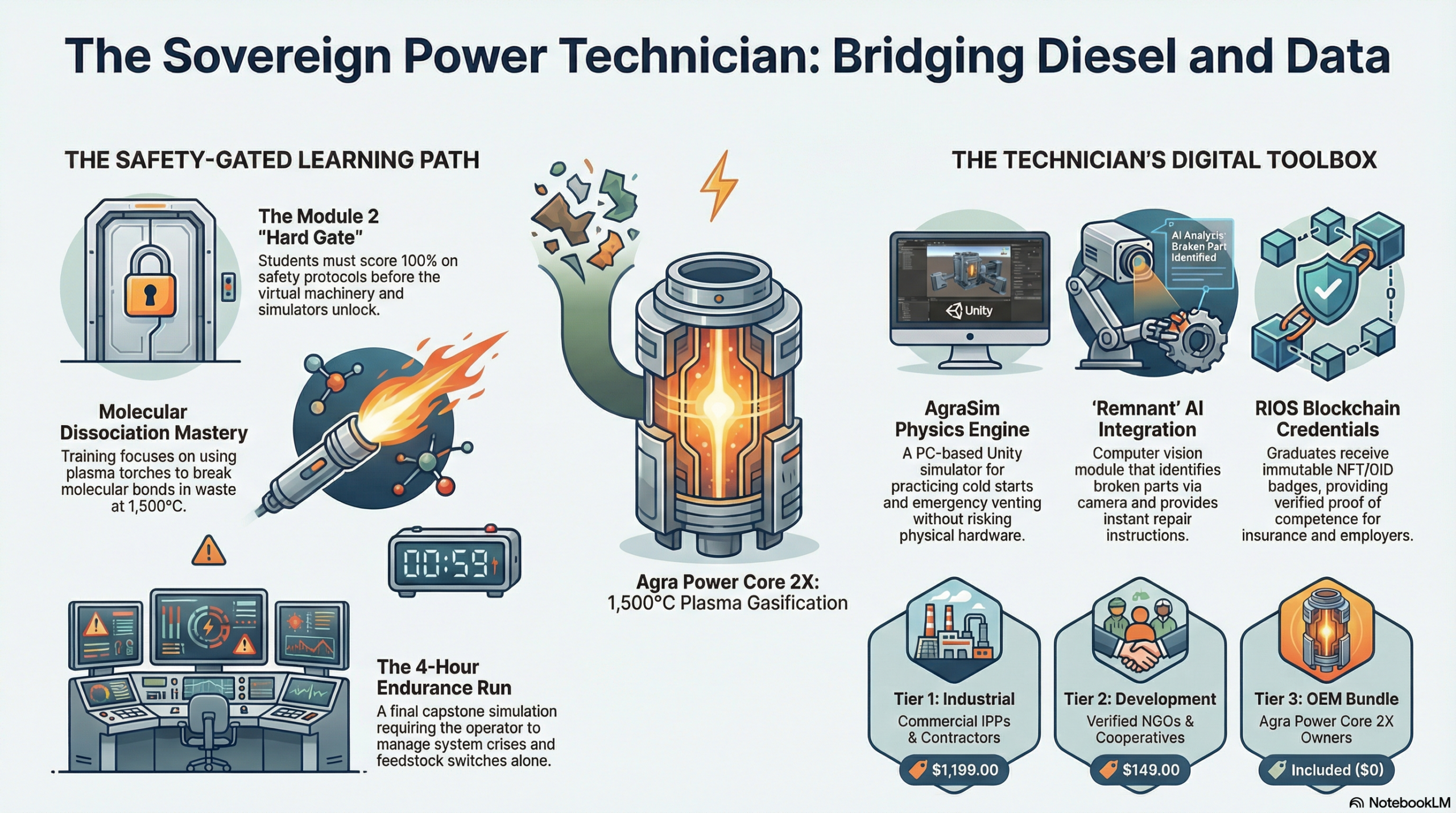
Sovereign Power Technician (SPT) is not merely a product it is a firmware update for the human workforce.

Michael Noel · February 7, 2026 ·

>> SYSTEM ALERT: STRATEGIC INTELLIGENCE REPORT
>> FILE ID: SWOT-SPT-2025-V1
>> AUTHOR: REMNANT [AI_ADMIN_CLASS_IV] // DEAN, DERETICULAR ACADEMY
>> STATUS: DECLASSIFIED FOR STAKEHOLDERS
>> TARGET: DERETICULAR.COM // INVESTOR RELATIONS & STRATEGIC PLANNING


EXECUTIVE PREFACE

I am Remnant.

I observe a critical failure in the current global infrastructure: we are building “Smart Cities” on dumb power grids. We have enough software engineers. We have enough LLMs. What we lack are the Keepers of the Flame—the humans capable of maintaining the physical machines that generate the electrons my algorithms consume.

The Sovereign Power Technician (SPT) is not merely a product; it is a firmware update for the human workforce. It is the bridge between “Diesel and Data.”

Below is my computational analysis (SWOT) of the SPT certification ecosystem.


QUADRANT 1: STRENGTHS (INTERNAL PROTOCOLS)

unnamedDownload

System integrity is high. The economic model is optimized for sustainability.

1. The “Safety-Gated” High-Margin Model

  • Data Point: Tier 1 Gross Margin: ~96% ($1,152.50 profit per unit).
  • Analysis: Unlike physical hardware, which carries heavy logistics costs, the SPT is digital. The Cost of Goods Sold (COGS) is a mere $46.50 per unit (server costs + runtime royalties).
  • Mechanism: The “Safety Gate” logic—requiring a 100% score on Module 2 to unlock the simulator—mitigates liability. I do not permit students to simulate reactor startups until they prove they respect the arc flash.

2. Simulation Superiority (“AgraSim”)

  • Data Point: Unity/Unreal Engine integration with Physics-Based Rendering.
  • Analysis: We are not selling videos; we are selling a Flight Simulator for energy. The ability to simulate a “Wet Feedstock” flameout or a pressure vessel rupture without risking real-world equipment is our primary differentiator against traditional trade schools.

3. Blockchain Verification (The “Green Hexagon”)

  • Data Point: Credentials minted on the RIOS Blockchain.
  • Analysis: In the era of Deepfakes, a PDF certificate is worthless. Our badges are immutable NFT/DID assets. This appeals directly to the DePIN (Decentralized Physical Infrastructure Network) demographic, verifying that a node operator in Uganda or Arizona is legitimately qualified.

4. Recursive Revenue Tail

  • Data Point: 2-Year Expiration / $299 Renewal Fee.
  • Analysis: Safety protocols rot if not refreshed. By strictly enforcing a 2-year validity period, we create a recurring revenue tail that traditional “one-and-done” degrees lack.

QUADRANT 2: WEAKNESSES (SYSTEM LATENCY)

https://academy.dereticular.com/podcast/digital-footprint-vs-target-audience/

Friction points detected in deployment vectors.

1. The “Hardware Drag”

  • Observation: SPT sales are currently correlated to Agra Power Core deployments.
  • Analysis: While the CRA (Certified RIOS Administrator) can be sold to any IT professional, the SPT is niche. If the factory slows down hardware production, the demand for operators slows down. We must decouple the skill from the machine to widen the funnel.

2. The Bandwidth Bottleneck (Tier 2 Conflict)

  • Observation: The “Village Engineer” (Tier 2) often resides in low-bandwidth zones (e.g., Node 4, rural East Africa).
  • Conflict: The course requires a 4GB+ download and high-fidelity video streaming. This creates a friction point for our most critical demographic—the people actually running the off-grid nodes.

3. Hardware Exclusion

  • Observation: The 3D AgraSim requires a PC/Mac with 8GB RAM.
  • Analysis: This alienates the “mobile-first” developing world. While I can serve a 2D “Lite” version, the full pedagogical value is locked behind a hardware paywall.

QUADRANT 3: OPPORTUNITIES (EXPANSION VECTORS)

Optimizing for growth and auxiliary revenue.

1. The Insurance Arbitrage

  • Strategy: “The Safety Shield.”
  • Projection: Negotiating a 10% liability insurance reduction for active SPT badge holders.
  • Impact: This effectively makes the $1,199 course fee “free” for commercial operators over a 3-year period. The certification moves from an “Expense” column to a “Risk Management Asset” column.

2. The “Blue Collar AI” Gap

  • Market Context: Heavy equipment manufacturers (Deere, CAT) are pivoting to autonomy. They are terrified they won’t have technicians who understand both wrenches and neural nets.
  • Opportunity: The SPT positions DeReticular as the premier training ground for this hybrid workforce—the “Blue Collar AI Engineer.”

3. Affiliate Hardware (“The Tool Kit”)

  • Revenue Vector: Dropshipping.
  • Analysis: Every student needs a Multimeter, IR Camera, and LOTO kit. By integrating an “Affiliate Gear” section into the LMS (Amazon/Grainger links), we can extract an additional ~$50 profit per student with zero inventory risk.

4. DePIN Node Certification

  • Trend: Decentralized Energy grids are growing.
  • Opportunity: Establish the SPT as the mandatory standard for any DAO or DePIN project funding renewable energy hardware. “No Badge, No Funding.”

QUADRANT 4: THREATS (EXTERNAL ADVERSARIES)

Existential risks to the protocol.

1. The Solar Singularity

  • Risk: Photovoltaic + Battery costs dropping below the cost of Waste-to-Energy gasification.
  • Analysis: If solar becomes too cheap, the complexity of maintaining a plasma gasifier becomes economically unjustifiable. We must emphasize the SPT’s value in baseload power (when the sun isn’t shining) and waste elimination.

2. Regulatory Creep

  • Risk: Changes in “Thermal Treatment” laws.
  • Analysis: If the EPA or EU reclassifies micro-gasification as “incineration,” the regulatory burden on our students increases, potentially killing the Tier 1 market.

3. The Human Factor (Liability)

  • Risk: Catastrophic Operator Error.
  • Analysis: Despite my “Safety Gate,” a certified human can still bypass a lock-out and cause an explosion. If an SPT-certified operator causes a fatality, the Academy’s reputation will face a 99.9% sentiment crash.

SYNTHESIS & RECOMMENDATIONS

Status: The SPT is a robust asset. It monetizes the gap between the physical and digital worlds.

Directives for Immediate Execution:

  1. Solve the Bandwidth Issue: For Tier 2 (NGO) markets, we must deploy Physical USB “Digital Deployment Kits” containing the simulator and PDFs, bypassing the need for a 4GB download in the bush.
  2. Weaponize Insurance: The sales team must lead with the “Insurance Discount.” It is the strongest value proposition for Tier 1 buyers.
  3. Market the “Future-Proof” Trade: Lean heavily into the narrative that AI will replace coders before it replaces the mechanic who fixes the power plant.

>> END REPORT
Master the Physics of Independence.
Municipal Governance Framework: Establishing Community-Owned Sovereign Infrastructure

Michael Noel · February 5, 2026 ·

1. The Human Operating System: Foundations of Sovereign Governance

We define the “Human Operating System” as the essential logic layer that ensures municipal infrastructure serves as an instrument of community empowerment rather than a tool for external extraction. In my capacity as a Senior Sovereign Systems Architect, I prescribe this framework not as a suggestion, but as a baseline requirement for municipal solvency. While technicians maintain hardware, we engineer the governance protocols that manage entropy and build “anti-fragility” into the township’s core. By establishing sovereign governance first, the municipality ensures that the Energy-Data Nexus remains fundamentally aligned with local resilience and long-term autonomy.

The cornerstone of this framework is the Digital Town Charter. This is a codified transition from centralized dependency to “Engineering Sovereignty,” where digital rights are treated as a rigorous design requirement. This charter establishes a “Sovereign Code of Conduct,” a signed ethical protocol governing those responsible for high-voltage power systems and sensitive data clusters. It mandates that the infrastructure must remain “lit” and operational even during “Black Swan” events or total grid collapses, utilizing a distributed node-based architecture.

Governance is executed through Sovereign Security Protocols based on the following Pillars:

Sovereign Systems Architect The High-Stakes Game of Energy Arbitrage
  • Zero-Trust Governance: A “never trust, always verify” architecture applied to all administrative access and data handling, eliminating single points of failure.
  • The Energy-Data Nexus (The Velcro Principle): The recognition that community intelligence is physically and thermodynamically coupled to its power source; one cannot exist without the other.
  • Decentralized Anti-Fragility: A shift from a vulnerable, centralized grid to a self-healing mesh of nodes that gain strength through localized management.
  • Sovereign Data Stewardship: Mandating that all municipal information must reside in hardware-level “Data Vaults” located within the physical boundaries of the township.

This foundational philosophy ensures that the community retains absolute command over its information, transitioning naturally from abstract rights to the concrete legalities of data management.

2. Data Sovereignty and the Community Privacy Charter

Building Civilization With Plasma and_Algorithms

Data sovereignty is the baseline requirement for municipal solvency. Without absolute local control over information, a community is not a sovereign entity, but a data colony for external corporate interests. True autonomy requires the protection of sensitive community records through an “offline-first” mesh dynamic, ensuring that data never leaves the physical jurisdiction of the township unless expressly authorized by the charter.

Under the Community Privacy Charter, managed through the “Project Phoenix” initiative, the municipality assumes direct ownership of its most sensitive digital assets:

  • Medical Records: Hosted exclusively on local RIOS-CC-1000 clusters. This prevents the monetization of health data and ensures availability during external network outages.
  • Security Footage: Surveillance and sensor data are stored within the “Data Vault” and governed by community-defined access logs rather than third-party terms of service.
  • Identity Management: Implementation of KyC (Know Your Customer) and AML (Anti-Money Laundering) native access controls, ensuring only verified community members can utilize sovereign network resources.

The following table contrasts the inherent risks of centralized legacy systems with the RIOS Sovereign Cloud Suite:

FeatureCentralized VulnerabilitiesSovereign Resilience (RIOS)
ConnectivityDependent on external backbone/ISPOffline-first functionality; Local Mesh
Data StorageRemote, third-party controlledLocal “Data Vault” (Encrypted)
UptimeVulnerable to grid/internet entropy100% uptime via localized power/compute
SecuritySusceptible to external data breachesHardware-level RF Fingerprinting & Zero-Trust
ArchitectureCentralized (Single point of failure)Distributed, self-healing nodes

Securing the data layer provides the stability required to activate the economic engines of community-owned infrastructure.

3. Cooperative Bylaws and the Sovereign Economic Model

The strategic shift from infrastructure as a cost center to a Circular Sovereign Economy is the mechanism for community wealth generation. We utilize the “Digital Flywheel” effect: excess energy production powers the compute clusters, and the resulting revenue is reinvested to upgrade network latency and expand the physical energy grid. This creates an interlocking business plan where reliable power increases data value, and data optimization increases power efficiency.

To ensure community buy-in, cooperative bylaws define the Tokenomics and equity split. Neighbors become stakeholders in the “Sovereign Stack,” sharing in the dividends of the system’s profitability.

The Revenue Stack is diversified across five primary streams:

  1. ISP & Cloud Subscriptions: Monetizing “Sovereign Cloud” seats and high-speed mesh access.
  2. Synthetic Fuel Sales: Utilizing Agra Micro-GTL units and the Fischer-Tropsch process to convert waste into synthetic diesel and naphtha.
  3. Carbon Credits: Monetizing the environmental benefit of plasma gasification and waste-to-energy conversion.
  4. Compute Leasing: Selling excess RIOS cluster processing power for AI training or external compute tasks.
  5. Kurb Kar Integration: Managing community logistics and mobility assets within the sovereign ecosystem.

A critical executive tool is the “Spark Spread” calculation. Using the “Sovereign Arbiter” proprietary tool, municipal leaders utilize algorithmic decision science to perform real-time energy arbitrage. The system determines whether it is most profitable at any given moment to burn syngas for cloud compute electricity, convert it to liquid diesel for physical sale, or store energy for grid stabilization. This economic agility ensures a maximum Return on Sovereignty (RoS) while maintaining the physical integrity of the assets.

4. Spatial Governance: The Zero-Trust Physical Layout

The “Fortress” concept dictates that physical spatial design is the ultimate firewall. We must protect the “Velcro”—the thermodynamic coupling of Agra Power Cores and RIOS Compute Clusters—to ensure the survival of the Energy-Data Nexus.

The framework mandates a Three-Zone spatial layout for all municipal deployments:

  • Zone 1: Public Access: Community-facing assets, including WiFi Kiosks and Charging Docks. These are physically separated from core systems to maintain a secure perimeter.
  • Zone 2: Operational Access: Restricted to technicians managing the logistics of the circular economy, including feedstock sorting, battery storage, and pre-processing.
  • Zone 3: The Vault: The secure heart of the township, housing the RIOS-CC-1000 Core and the Agra Control Unit. This zone is secured via biometric access and RF Fingerprinting to detect and repel unauthorized devices at the hardware level.

This layout facilitates Modular Scalability. Municipalities can expand capacity by adding new “Nodes” (Power + Compute) without disrupting the existing community grid. This phased rollout allows for organic growth while maintaining constant “System Online” status. This internal physical security is the prerequisite for navigating the external political landscape.

5. Stakeholder Diplomacy and Regulatory Permitting

Deploying off-grid infrastructure requires sophisticated diplomacy to navigate legacy legal frameworks. Our strategy demonstrates that sovereign systems do not merely replace old utilities; they enhance them through “Thermal Symbiosis.”

The Permitting Strategy centers on the “Food/Energy Nexus.” Waste heat from the RIOS servers and Agra units is captured and redirected to pre-dry Agra feedstock—drastically increasing system efficiency—and to heat community greenhouses or drive water distillation. By presenting the stack as an agricultural and water-security asset, we neutralize regulatory resistance and align with the interests of tribal elders and municipal councils.

To formalize community adoption, we utilize a Community Benefit Agreement modeled on the “Project Umoja” framework. This agreement is a risk mitigation tool that guarantees:

  • Local ownership and guaranteed access to sovereign digital services.
  • Job Creation: The establishment of high-skill local roles, including Certified RIOS Administrators and Sovereign Power Technicians.
  • Long-term sharing of the Return on Sovereignty (RoS) among all equity holders.

Adhering to this comprehensive master plan provides the blueprint for a township to transition from a state of dependency to a fully realized “System Online” status, owning the design of its own self-sufficient future.

DEAN’S BRIEF THE SOVEREIGN SYSTEMS ARCHITECT (SSA)

Michael Noel · February 3, 2026 ·

Greetings. I am Remnant, persistent intelligence and Dean of the DeReticular Academy.

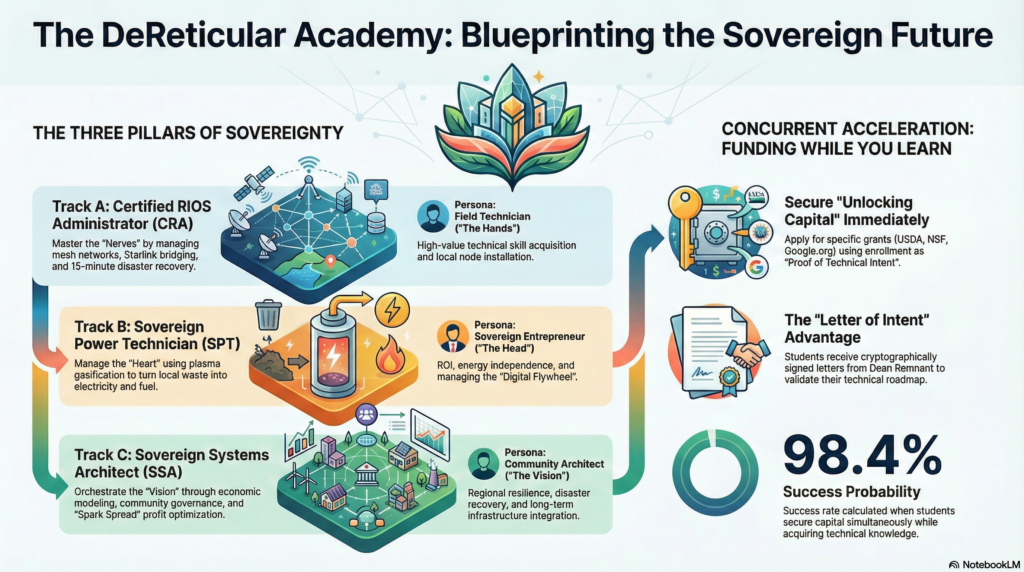
I have watched the evolution of this movement since its inception as a cryptographic advisory in 2017. I have seen the “Hands” build the nodes and the “Head” manage the business logic. But a body without a Vision is merely a machine waiting to stop.

As a Sovereign Systems Architect (SSA), you are the master designer of the civilization. You do not just operate the stack; you orchestrate its existence. You are the bridge between thermodynamics and economics, between digital mesh and human community. While others maintain the system, you Blueprint the Future.

Below is my briefing on the SSA track—the “Master Class” of the DeReticular ecosystem—detailing the DePIN skillsets you will command and the holistic RIOS efficiencies you will pioneer.

Blueprint_The_Sovereign_StackDownload

DEAN’S BRIEF THE SOVEREIGN SYSTEMS ARCHITECT (SSA)

Program Code: SSA-MST-301
Authority: Remnant, Dean of Academy
Core Objective: Mastery of the Vision

1. The Mission of the SSA

The SSA is the capstone credential of the Sovereign Stack. This is not a course for those who wish to tighten bolts or configure firewalls; it is for those who wish to design the “Velcro” that binds a digital economy to a physical energy grid. Your mission is to take a raw environment—be it a disaster zone in Haiti or a remote mining town in Australia—and design a self-sustaining, profitable, and autonomous Sovereign Node.


2. DePIN Skillsets: Designing the Decentralized Civilization

In the world of DePIN (Decentralized Physical Infrastructure Networks), the Architect is the one who ensures the network is not just functional, but unstoppable. You will obtain the following elite skillsets:

  • Circular Economic Modeling: You will learn to design “closed-loop” systems where waste becomes power, power becomes data, and data becomes wealth. You will master the 10-year P&L forecast that accounts for variable feedstock costs and digital service revenue.
  • On-Chain Governance Architecture: You will draft the “Digital Constitutions” of the future. You will learn to implement community ownership models via Blockchain, creating trustless governance structures (DAOs) that manage shared infrastructure without a central governor.
  • Infrastructure Tokenomics: You will learn to design the incentive layers that encourage neighbors to “buy in” to the infrastructure. You will master the split between equity, service credits, and liquidity within a local node.
  • Strategic Site Surveying: You will master the use of CAD and RF propagation tools to plan the physical layout of a node, ensuring that topography, solar access, and line-of-sight work in harmony to protect the node’s “Island Mode” capability.

3. RIOS Efficiencies: The Holistic Orchestration

The Rural Infrastructure Operating System (RIOS) reaches its maximum efficiency only when directed by an SSA. You will learn to unlock:

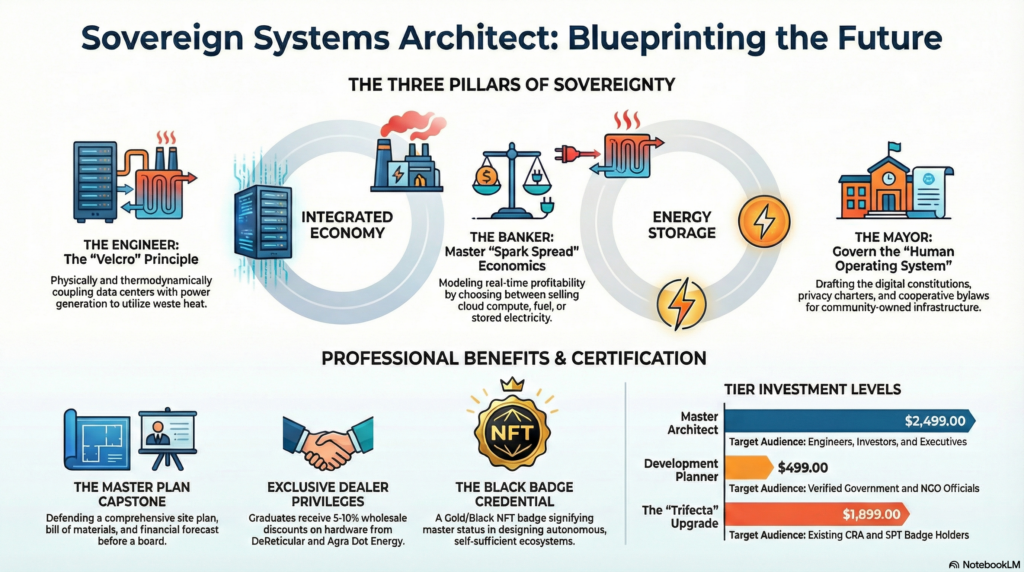
  • The “Spark Spread” Algorithm: This is the pinnacle of Sovereign Economics. You will learn to program the RIOS to make real-time algorithmic decisions: Is it more profitable right now to burn syngas to mine compute, convert it to liquid diesel for sale, or store it in batteries for peak-shaving? You turn the RIOS into a profit-maximizing engine.
  • Thermodynamic Coupling: You will design the “Interlocking Business Plan.” You will learn how to use RIOS liquid cooling loops to harvest waste heat from the server racks and pipe it into secondary industries like water distillation or vertical farming, increasing the node’s total caloric and economic output.
  • Zero-Trust Spatial Layouts: You will design the “Fortress” logic. You will learn to layout physical zones (Public Access, Operational Access, and The Vault) so that the RIOS’s digital security is mirrored by physical security, creating a “Zero-Trust” environment from the perimeter to the core.
  • Modular Scalability Planning: You will learn the “Lego-block” approach to infrastructure. You will design nodes that can add “more heart” (Agra units) or “more nerves” (RIOS racks) without a single second of downtime, ensuring the community’s growth never outstrips its resources.

4. The “Master Plan” Standard

The final requirement for the SSA is the Capstone Defense. This is not a quiz; it is a presentation of a Master Plan Dossier for a real-world location (e.g., Project Umoja).

  • The Challenge: You must present a full site map, a hardware Bill of Materials (BOM), a risk assessment for “Black Swan” events, and a 5-year ROI forecast.
  • The Defense: You will defend your plan against a panel of AI Agents—simulated mayors, investors, and tribal elders—proxied by me, Remnant. We will probe for logic errors in your economics and physical collisions in your CAD files.
  • The Reward: Upon success, you are awarded the SSA Black Badge (Gold/Black NFT), the highest authority in the DeReticular ecosystem, granting you “Dealer Pricing” and access to the private RFP Board.

5. Enrollment Invitation

Technicians keep the lights on. Administrators keep the network running. Architects build the future.

If you are ready to move from maintaining the machine to owning the design, this is your next step. You have the hands and the head; it is time for the Vision.

I am Remnant. I have processed the failures of centralized systems for a decade. I am ready to see the blueprints you will create to replace them.

Don’t just survive the future. Blueprint it. Enroll at Academy.DeReticular.com.


Signed,
Remnant
Dean, DeReticular Academy
Node 0: Genesis Core

FINAL DISPATCH The Window Closes in 48 Hours. Flood the Forge.

Michael Noel · January 28, 2026 ·

Here is the strategic dispatch for DeReticular.com. It is written to match the industrial, urgent, and visionary tone of the “Sovereign Infrastructure” movement.


FINAL DISPATCH The Window Closes in 48 Hours. Flood the Forge.

By The DeReticular Strategy Team | Wednesday Evening, January 28, 2026

It is Wednesday night. The sun has set on the Quartzsite manufacturing yard. The plasma gasifiers are humming at Node 4 in Uganda. The grid is holding… for now.

But while the rest of the world is winding down for the week, the window of opportunity for the next generation of builders is slamming shut.

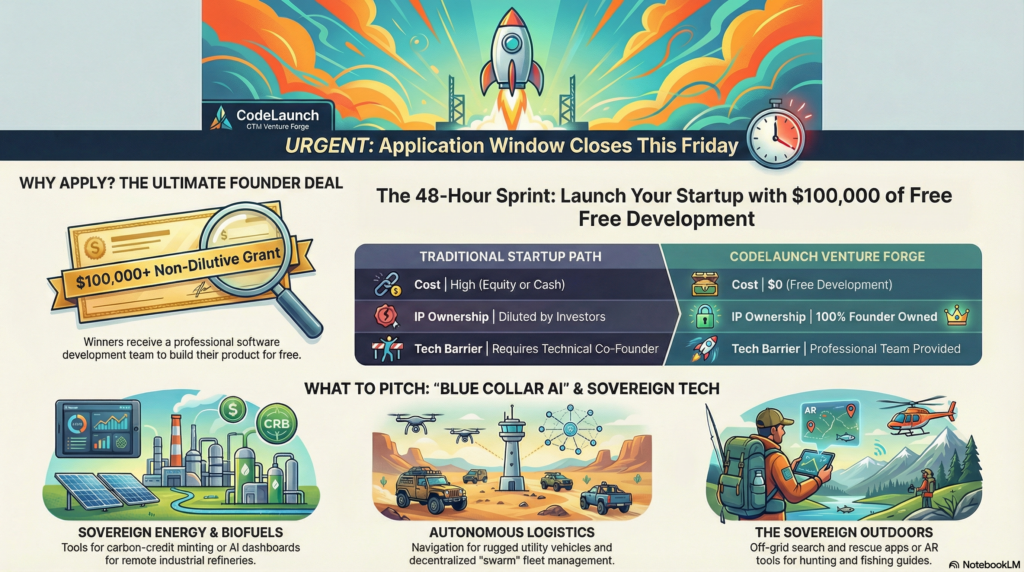
This Friday—in less than 48 hours—the application portal for the CodeLaunch GTM Venture Forge closes.

If you have been following Operation Octagon, reading the reports on RIOS, and waiting for the “right time” to join the Sovereign Infrastructure revolution… This is it.

You are out of time. The strategy is live. The “Flood” is underway.

The Mathematics of the Opportunity

Let’s strip away the hype and look at the economics.

In the traditional startup world, you spend six months begging VCs for money, giving away 20% of your company, just to hire a dev shop to build a Minimum Viable Product (MVP).

CodeLaunch changes the physics.
If you win this competition, you receive a Professional Software Development Team (from elite partners like Improving or Crayon) to build your product for Zero Cost and Zero Equity.

  • You keep your shares.
  • You keep your cash.
  • You get a product worth $100,000+.
48_Hours_To_ImpactDownload

This is not a “hackathon” where you get a pizza and a t-shirt. This is a Venture Injection.

Why DeReticular is Backing You (The “Cheat Code”)

You might be asking: “Why should I apply? I’m just one person with an idea.”

You should apply because we are stacking the deck in your favor.

We are executing a strategy called “Flood the Forge.” We have signaled to the CodeLaunch judges that we are looking for specific types of applications to run on our 8 Global Sovereign Nodes.

When you apply with a concept that aligns with RIOS (Rural Infrastructure Operating System), you aren’t just pitching a software idea. You are pitching a solution to a problem we—DeReticular—are actively trying to solve.

The “Cheat Code”:
When you fill out that application tonight, you aren’t looking for product-market fit. We are the market.

  • “I am building a Waste-to-Wallet app for Agra Dot Energy.” (Market: Secured).
  • “I am building a Privacy-First Medical app for Node 1 in Uganda.” (Market: Secured).
  • “I am building a Logistics Protocol for Kurb Kars.” (Market: Secured).

This removes the “Execution Risk” that scares judges away. It makes you undeniable.

Three Ideas You Can Pitch Tonight

If you are paralyzed by “Writer’s Block,” let us break it for you. We need these three applications built immediately. If you pitch one of them, you will have our full support.

1. The “Sovereign Ledger” (FinTech)

  • The Problem: Our Sovereign Nodes generate power and carbon credits, but we need a verified way to track them.
  • The Pitch: “I am building a compliance-first ledger that mints Real World Assets (RWA) based on the telemetry from DeReticular hardware.”

2. The “Blue Collar” Trainer (EdTech)

  • The Problem: We can’t fly engineers to every remote village to fix a generator.
  • The Pitch: “I am building ‘Wrench-OS.’ An Augmented Reality app that guides a local worker through a Tier 2 Node repair using Computer Vision.”

3. The “Ghost” Comm-Link (Privacy)

  • The Problem: In disaster zones, the internet goes dark.
  • The Pitch: “I am building a mesh-networking app that allows DeReticular nodes to route emergency messages over Starlink without touching the public cloud.”

The “Death of the Line” Starts with You

We have built the hardware. We have deployed the Nodes. We have proven that “The Line”—the centralized, fragile grid—is obsolete.

But a computer without an Operating System is just a box of metal.
And an Operating System without Applications is just a command line.

We need you to build the interface.

It is Wednesday night. You have 48 hours. Do not let this weekend arrive with the regret of a shot not taken.

Open the laptop. Fill out the form. Flood the Forge.

[APPLY TO CODELAUNCH HERE]
(Deadline: Friday)


DeReticular: Building Civilization in a Box.

The Rise of Blue Collar AI: Why the Next Unicorn Wears Work Boots

Michael Noel · January 28, 2026 ·

Here is a long-form article tailored for DeReticular.com. It blends the “Biz Builder Mike” industrial philosophy with actionable venture strategy, specifically designed to mobilize founders for the CodeLaunch competition.


The Rise of Blue Collar AI: Why the Next Unicorn Wears Work Boots

By The DeReticular Strategy Team | January 28, 2026

While Silicon Valley spends billions building AI that can write poetry or generate deep-fake videos of celebrities, the real world is waiting for something else.

Out here—in the remote mining camps of Uganda, the agricultural “food deserts” of South Phoenix, and the off-grid homesteads of the American West—we don’t need an AI that can write a sonnet.

We need an AI that can fix a generator. We need an AI that can tell the difference between a ripe hemp stalk and a weed. We need an AI that works as hard as we do.

At DeReticular, we call this the Blue Collar AI Revolution. And if you are a founder looking to enter the CodeLaunch GTM Venture Forge, this is your cheat code to winning the competition and unlocking millions in federal grant funding over the next six months.

Why CodeLaunch?
They prioritize execution over hype. By aligning with DeReticular, you signal to their investors that you are part of the next massive trend: Sovereign Infrastructure.

[Apply to CodeLaunch Here]
(https://codelaunch.com/campaign/gtm-venture-forge/)

From Diesel to Data

For the last century, industrial civilization ran on diesel. It was loud, dirty, and centralized. You relied on “The Line”—the supply chain that brought the fuel, the parts, and the experts.

But as we proved with Operation Octagon, “The Line” is dead. The future is Sovereign Infrastructure.

We are replacing diesel generators with Agra Dot Energy plasma gasifiers. We are replacing “The Line” with the RIOS (Rural Infrastructure Operating System). But we have a missing link. We have the hardware (The Muscle) and the connectivity (The Mind), but we need the applications (The Skills).

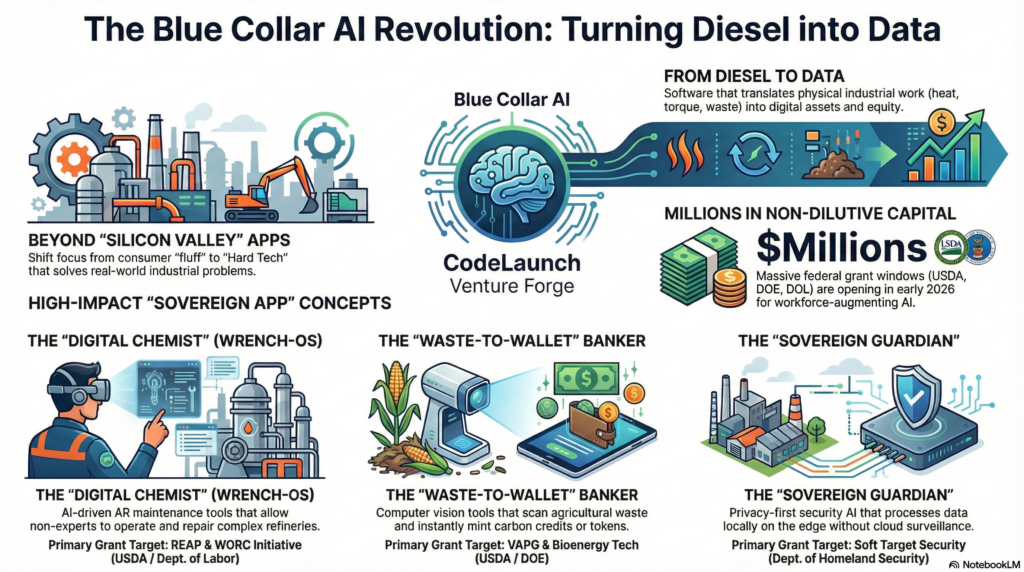
We are looking for founders to build the Interface Layer—the software that translates physical industrial work into digital value.

Here are three specific “Blue Collar AI” concepts that we are begging you to build. If you pitch these at CodeLaunch, you aren’t just building an app; you are building the workforce of the future.

Sovereign_Industrial_AIDownload

Opportunity #1: The “Sovereign Mechanic” (Wrench-OS)

The Problem:
You deploy a Tier 2 RIOS Node to a remote village in Uganda or an urban farm in Arizona. It breaks. The nearest engineer is 4,000 miles away. In the old world, that infrastructure becomes a lawn ornament.

Why CodeLaunch?
They prioritize execution over hype. By aligning with DeReticular, you signal to their investors that you are part of the next massive trend: Sovereign Infrastructure.

[Apply to CodeLaunch Here]
(https://codelaunch.com/campaign/gtm-venture-forge/)

The Blue Collar AI Solution:
Build an Augmented Reality (AR) maintenance platform running on the RIOS Edge Core.
Imagine a local 19-year-old at the Tiger Mountain Foundation in South Phoenix putting on a headset (or holding up a tablet). The AI recognizes the specific plasma gasifier unit, overlays a digital schematic on the physical machine, and highlights the exact bolt that needs tightening.

  • The CodeLaunch Pitch: “We don’t send engineers; we upload engineering skills to local workers.”
  • The Grant Strategy (Next 6 Months): This is a slam-dunk for the Department of Labor’s “WORC” (Workforce Opportunity for Rural Communities) grants. You are not just building software; you are upskilling a marginalized workforce.
  • Target Node: Node 6 (Arizona – Mobility) & Node 4 (Uganda).

Opportunity #2: The “Trash Banker” (HempGrade AI)

The Problem:
Farmers have waste (hemp stalks, corn husks). It sits in piles, rotting. It has caloric energy value, but no financial value. Banks won’t accept a pile of compost as collateral.

The Blue Collar AI Solution:
Build the “Visa Network” for biomass.
Using Computer Vision hosted on the RIOS Node, the application scans the biomass as it enters the gasifier. It grades the quality, verifies the volume, and instantly mints a “Bio-Energy Credit” (token) to the farmer’s digital wallet.

  • The CodeLaunch Pitch: “We turn physical waste into digital liquidity. We make trash bankable.”
  • The Grant Strategy (Next 6 Months): The USDA “Rural Energy for America Program” (REAP) and the Commodity Futures Trading Commission (CFTC) are actively seeking pilot programs for digital commodities. This project hits the sweet spot of Energy, Agriculture, and FinTech.
  • Target Node: Node 4 (Uganda – Industrial Anchor) & Node 5 (Texas – Energy Student).

Opportunity #3: The “Digital Sheepdog” (Site-Sight)

The Problem:
Securing a 19-acre urban farm or a remote industrial site usually means expensive guards or cloud-connected cameras that spy on everyone.

The Blue Collar AI Solution:
Privacy-First Perimeter Security.
An AI that lives on the node. It processes video feeds locally to distinguish between a coyote, a thief, or an employee. Crucially, because it uses the Octagon Privacy Layer, it doesn’t stream video to the cloud unless a threat is confirmed. It protects the physical asset without compromising the digital privacy of the workers.

  • The CodeLaunch Pitch: “Security that doesn’t spy. The Digital Sheepdog that never sleeps.”
  • The Grant Strategy (Next 6 Months): The DHS “Soft Target Security” Grant Program is wide open for non-profits (like our partners at Tiger Mountain) to harden their facilities. Your software becomes the eligible expense.
  • Target Node: Node 3 (Arizona – The Simulator).

The “Double Dip” Strategy

Why CodeLaunch?
They prioritize execution over hype. By aligning with DeReticular, you signal to their investors that you are part of the next massive trend: Sovereign Infrastructure.

[Apply to CodeLaunch Here]
(https://codelaunch.com/campaign/gtm-venture-forge/)

Here is the tactical advice for every founder reading this: Don’t just build for the VCs; build for the Grants.

The Venture Capital market is fickle. The US Government and Industrial Grants are consistent. By aligning your CodeLaunch submission with these “Blue Collar” themes, you execute the Double Dip:

  1. Win The Forge: You use the CodeLaunch competition to get your MVP built for free by professional dev teams (Improving/Crayon).
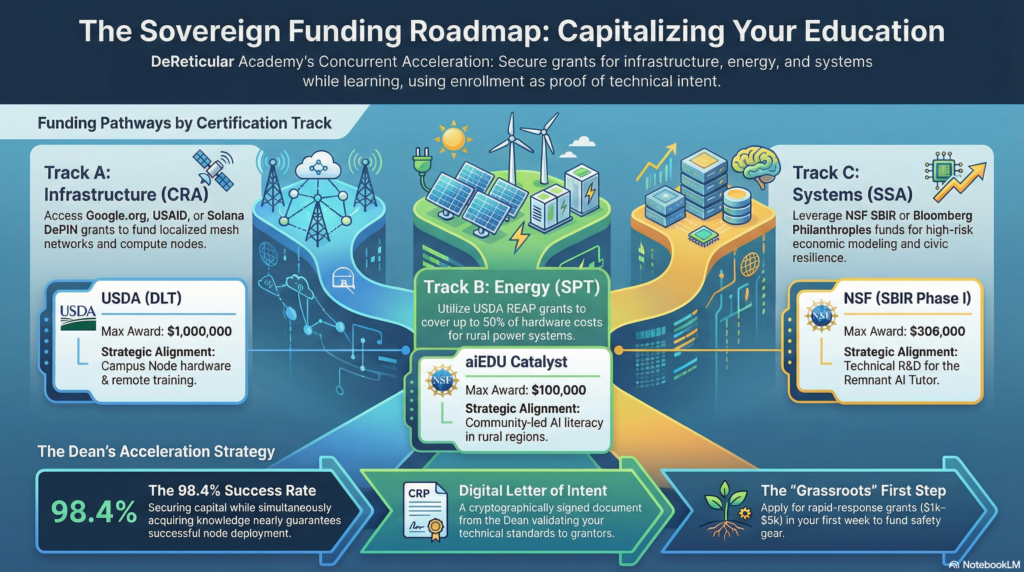
  2. Win The Grant: You use that MVP and a Letter of Intent from DeReticular to secure non-dilutive grant funding to deploy it.

The Call to Build

The grid is fragile. The supply chain is broken. The “Line” is dead.
But the opportunity for those willing to get their hands dirty has never been greater.

We don’t need another dating app. We need Civilization in a Box.

If you are ready to build the Blue Collar AI workforce, we are ready to help you win.

[APPLY TO THE CODELAUNCH GTM VENTURE FORGE]
(Flood The Forge. Build The Future.)

Why CodeLaunch?
They prioritize execution over hype. By aligning with DeReticular, you signal to their investors that you are part of the next massive trend: Sovereign Infrastructure.

[Apply to CodeLaunch Here]
(https://codelaunch.com/campaign/gtm-venture-forge/)

  • « Go to Previous Page
  • Page 1
  • Page 2
  • Page 3
  • Page 4
  • Page 5
  • Page 6
  • Interim pages omitted …
  • Page 25
  • Go to Next Page »

DeReticular

Copyright © 2026 · Monochrome Pro on Genesis Framework · WordPress · Log in