• Skip to primary navigation
  • Skip to main content
DeReticular

DeReticular

Local Autonomy. National Security. Total Sovereignty.

  • Solutions
    • Municipalities
    • Energy
    • Industrial
    • Defense
  • Infrastructure
  • Intelligence
  • Company
  • Request Municipal Audit
  • Show Search
Hide Search
You are here: Home / Archives for Energy

Energy

The PLASMA Project A Blueprint for a Brighter Future in Uganda

Michael Noel · January 7, 2026 ·

1. Introduction: The Vision of ‘Umoja’

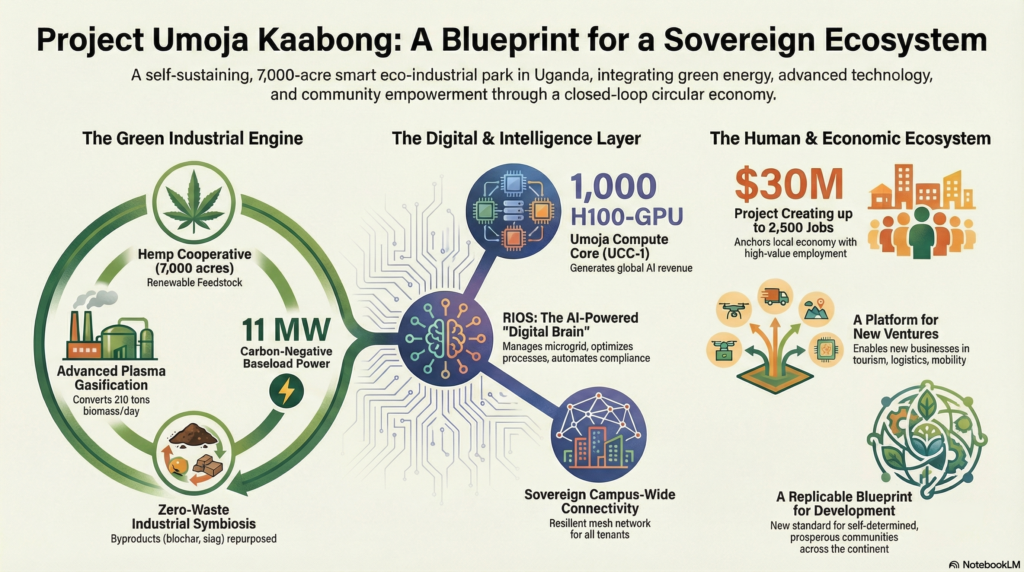
The PLASMA Project, also known as Project Umoja Kaabong, is an ambitious initiative to build a self-sustaining industrial and agricultural ecosystem across a 7,000-acre campus in Uganda. The project is guided by the principle of “Umoja,” the Swahili word for Unity, which represents its mission to weave together farming, industry, and community into a single, resilient fabric. For too long, progress in regions like Kaabong has been hindered by a critical problem: the lack of reliable energy. This single vulnerability makes it nearly impossible for businesses to grow and for communities to achieve true self-determination. The PLASMA Project, representing a $30 million investment in this vision, offers a revolutionary solution: to create a sovereign ecosystem that turns locally grown crops into clean, dependable power, paving the way for a future defined not by dependence, but by economic, energy, and community sovereignty.

This overview will explore the core concept behind this innovative project, its key components, and the profound impact it aims to have.

2. The Big Idea: A “No-Waste” Circular Economy

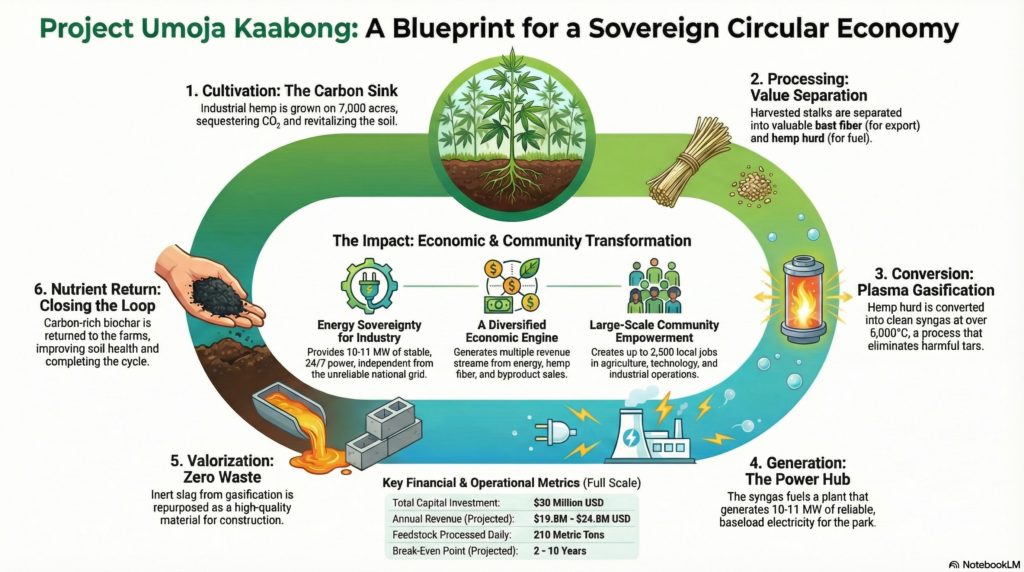
At its heart, the PLASMA Project is built on the concept of a circular economy. For a student, the easiest way to think of this is a loop where nothing is thrown away. Instead of the traditional “take, make, dispose” model, a circular economy is designed so that every output from one stage becomes a valuable input for another. It’s a “no-waste” system that mimics the efficiency of nature. The Umoja Kaabong model follows six key stages in a continuous cycle:

  1. Cultivation (The Carbon Sink): Local farmer cooperatives grow thousands of acres of industrial hemp, a crop that absorbs large amounts of CO₂ from the atmosphere and improves soil health.
  2. Harvest & Processing (Value Separation): The harvested hemp stalks are taken to an on-site facility where they are separated into the valuable outer bast fiber and the inner woody core, known as hurd.
  3. Thermal Conversion (The Alchemical Core): The leftover hemp hurd becomes the primary fuel for the power plant. It is fed into an advanced plasma gasification system that cleanly converts the solid biomass into an energy-rich gas called syngas.
  4. Power Generation & Distribution (The Heartbeat): The syngas is used as fuel to run a power generator, creating a constant stream of electricity that is distributed to all the businesses and facilities within the industrial park.
  5. Byproduct Valorization (Closing the Loop): The gasification process leaves behind useful byproducts. A glass-like material called vitrified slag is used to build local roads, and a carbon-rich material called biochar is also created.
  6. Nutrient Return (The Final Link): The biochar is returned to the farms and used as a natural fertilizer, enriching the soil and helping grow the next crop of hemp, completing the loop.

Now, let’s look at the specific ingredients that make this innovative cycle possible.

3. The Project’s Key Ingredients

This groundbreaking project is made possible by combining a unique agricultural crop, a powerful technology, and a strategic partnership.

3.1 The Amazing Crop: Industrial Hemp

Industrial hemp was chosen as the project’s primary crop for several powerful reasons. It provides not just fuel for the power plant but also a separate, valuable product and significant environmental benefits. Based on extensive agricultural data, a well-managed crop can be expected to produce a reliable average of 3.5 short tons of dried hurd per acre. This specific yield allows for the precise planning of the agricultural footprint required to fuel the power plant, making the entire economic model predictable and bankable.

  • As a Fuel Source: The inner woody core of the hemp stalk, called the hurd, is the primary feedstock that is converted into clean energy in the plasma gasification plant.
  • As a Valuable Product: The strong outer layer of the stalk contains bast fiber. This fiber is a valuable commodity that can be sold to the textile, paper, and construction industries, creating an additional, independent stream of income for the project.
  • For the Environment: Hemp is a remarkable “carbon sink,” absorbing and storing large amounts of carbon dioxide (CO₂) as it grows. It also has phytoremediation properties, which means it can help clean and restore the health of the soil.
3.2 The Powerful Technology: Plasma Gasification

To cleanly convert hemp hurd into energy, the project uses a state-of-the-art technology called plasma gasification. Imagine a process that creates temperatures “hotter than the surface of the sun.” Instead of burning the hemp waste, which would create smoke and ash, the plasma torches use this incredible heat to completely break down, or dissociate, the material at a molecular level.

This approach is a direct, engineered solution to the core challenges of biomass gasification identified in academic research. Studies show that the main problems that afflict traditional systems are uncontrolled tar production and the difficulty of maintaining a perfect “Equivalence Ratio” (ER)—the precise mix of fuel and oxygen needed for peak efficiency. The DeReticular system solves this in two ways: first, the extreme heat of the plasma makes it physically impossible for complex, harmful tars to form. Second, the entire process is managed by an AI control system that constantly makes micro-adjustments to maintain the optimal ER, ensuring a cleaner and more efficient source of energy.

3.3 The Essential Partnership: Local Roots and Global Tech

The success of the PLASMA Project depends on a powerful collaboration between a Ugandan company with deep local knowledge and a U.S. technology firm with world-class technical expertise. This partnership ensures the project is both culturally grounded and technologically advanced.

PartnerPrimary Role & Responsibilities
Agra Energy UgandaThe Operational Anchor: Manages all on-the-ground activities, including organizing farmer cooperatives, leading community engagement, managing land access, and securing all local permits.
DeReticularThe Technical Lead: Provides the core plasma gasification technology and the AI-powered RIOS (Rural Infrastructure Operating System)—the “brain” that optimizes the entire circular economy—while also leading international fundraising efforts.

With the right crop, technology, and team in place, here is a step-by-step look at how the system will operate.

4. How It All Works: From Farm to Lightbulb

This section outlines the tangible journey of a single hemp stalk as it is transformed from a plant in a field into the electricity that powers industry and opportunity in Kaabong. This is the physical tour of the circular economy in action.

  1. Planting and Harvesting To fuel the main power plant, local farmer cooperatives will cultivate and harvest enough industrial hemp to deliver a continuous supply of 180 to 200 metric tons of dried biomass per day, ensuring the plant has a constant and reliable source of fuel.
  2. Separating the Stalk Trucks carrying freshly harvested hemp arrive at the on-site Hemp Processing Facility. Here, specialized machinery separates the valuable outer bast fiber, which is bundled for sale, from the inner woody hurd, which moves on to the next stage.
  3. Making Clean Gas The leftover hemp hurd is dried and then fed into the plasma gasification plant. Inside the reactor, at incredibly high temperatures, the hurd is converted into a clean and combustible syngas, leaving behind only inert, non-toxic byproducts.
  4. Generating Power The clean syngas is used as fuel to power the plant’s generators, producing a constant stream of 10-11 MW of electricity. This provides approximately 86,400 MWh of reliable, baseload electricity annually—enough to power the entire industrial park. The 1 MW bridge plant uses a reciprocating gas engine, while the final 10 MW plant uses a more efficient, large-scale steam turbine power block.
  5. Using Every Byproduct In line with the “no-waste” philosophy, all leftover materials are put to good use. The vitrified slag is crushed into an aggregate for building roads, and the carbon-rich biochar is returned to the farms to be used as a natural fertilizer, helping to grow the next harvest.
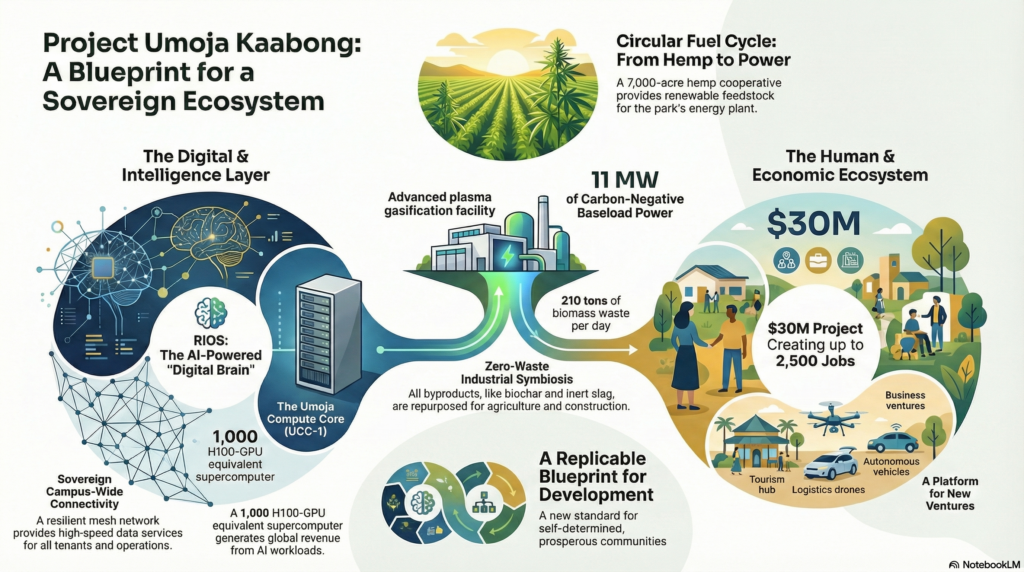
This efficient process does much more than just keep the lights on; it creates a ripple effect of positive change throughout the community.

5. The Impact: More Than Just Electricity

The goals of the PLASMA Project extend far beyond simply generating power. The project is designed to be a powerful engine for community empowerment, economic growth, and environmental restoration.

  • A. Creating Jobs and Economic Growth
    • The project is expected to create around 250 full-time jobs in its initial phase, with the potential to scale up to 2,500 jobs as the campus reaches full operation.
    • These jobs will provide stable employment for local farmers, skilled plant technicians, and processing facility workers.
    • As an economics teacher would highlight, the project builds a highly resilient local economy through multiple, diversified revenue streams. It generates income from: 1) selling reliable electricity to tenants, 2) selling high-value hemp fiber to global markets, and 3) selling byproducts like vitrified slag for local construction.
  • B. Protecting and Healing the Environment
    • The project is designed to be “carbon-negative,” which means that through the process of growing hemp and creating biochar, it will remove more carbon dioxide from the atmosphere than it produces.
    • It features a “zero-waste-to-landfill” design. Every part of the hemp plant and every byproduct from the energy process is either sold or returned to the earth, creating a truly sustainable system.
  • C. Building a Self-Sufficient Community
    • The project delivers “energy sovereignty.” By generating its own reliable power, the Kaabong community and its industries will no longer be dependent on an unstable and unpredictable national grid.
    • Training programs will be run through the on-site DeReticular Academy to create certified local technicians, teaching valuable new skills in advanced technology, modern farming, and industrial operations to empower the community for generations to come.

By starting with a smart, phased approach, this grand vision is being turned into a practical reality.

6. A Smart Start for a Big Vision

To ensure success and minimize risk, the PLASMA Project is not being built all at once. It follows a highly specific, de-risked, and intelligent phased rollout plan that builds momentum and proves the model at each stage.

  1. Phase 0 – Site Readiness: The project begins by establishing a self-sufficient foundation. A 150 kW solar array and a 400 kWh battery system are installed first, providing clean power for the initial construction site from day one, without relying on the grid.
  2. Phase 1 – The Bridge Plant: Next, a smaller, containerized 1 MW “bridge” power plant is built. This crucial step proves the plasma gasification technology at scale and, critically, provides the reliable power needed to construct the main facility and energize the first industrial tenants.
  3. Phase 3 – Full Scale: Finally, powered by the bridge plant, the team constructs the final, full-scale 10 MW main power plant. This will serve as the permanent, unwavering heartbeat of the entire industrial park.

This step-by-step approach demonstrates that the project is not just an ambitious dream, but a well-planned and achievable blueprint for a brighter, more sovereign future in Uganda.
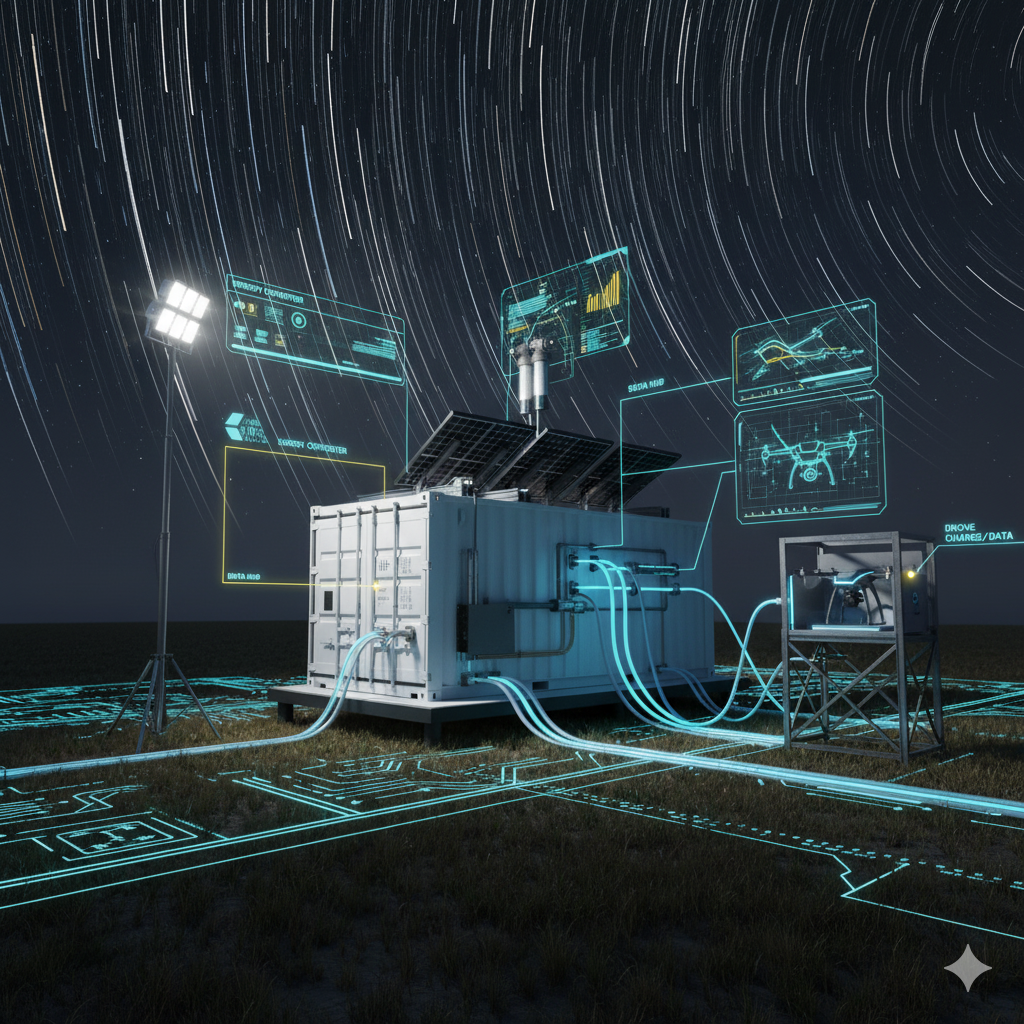
Briefing Document RIOS Pilot AI Core (Tier 3)

Michael Noel · January 3, 2026 ·

Executive Summary

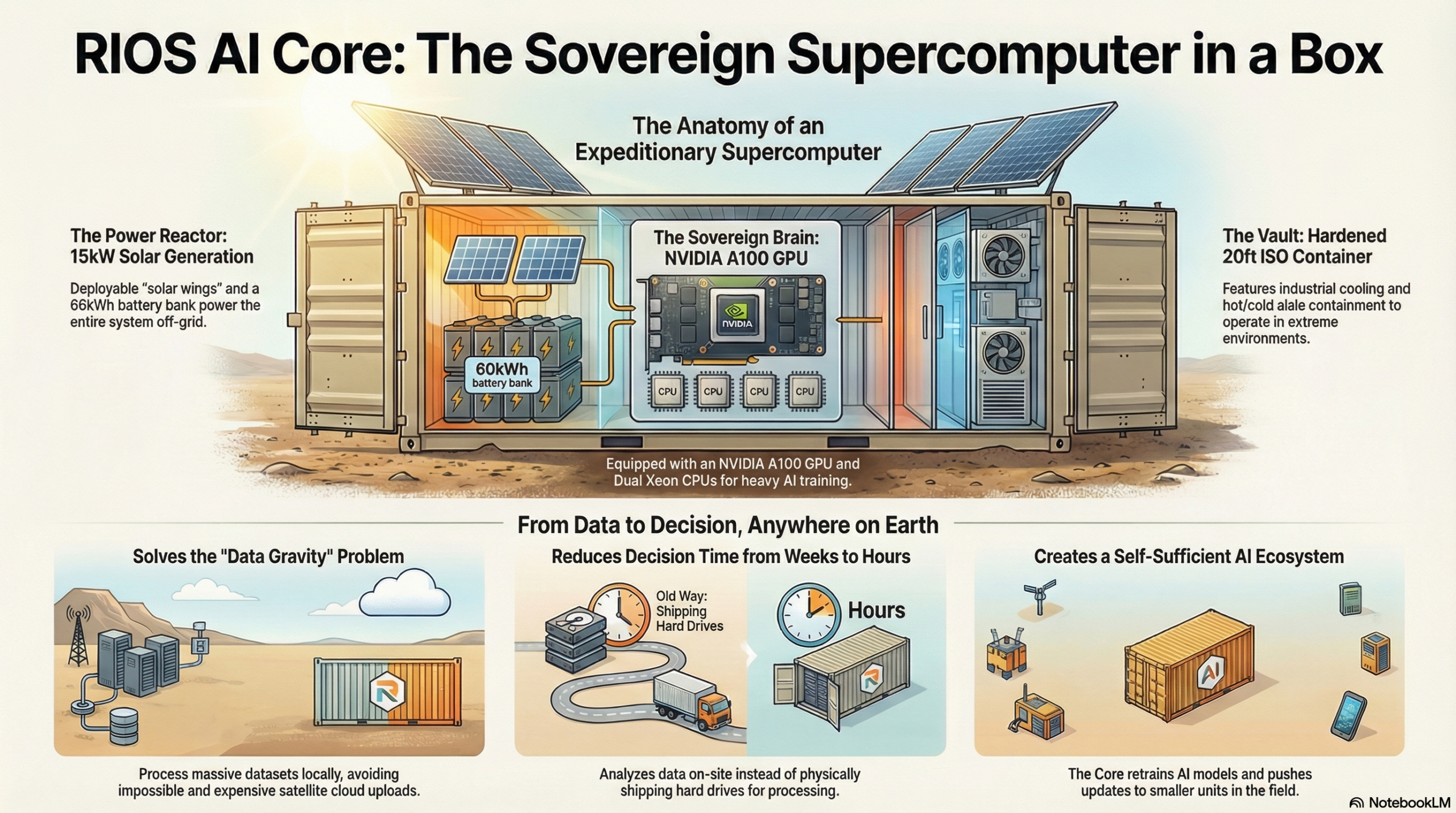
The RIOS Pilot AI Core (Tier 3) is a sovereign, mobile supercomputing node designed for off-grid AI model training and heavy scientific simulation. Housed in a modified 20ft High-Cube ISO container, its core mission is to solve the “Data Gravity” problem by bringing high-performance computing (HPC) directly to remote data sources, thus bypassing the bandwidth limitations of cloud uploads. Tagged as “The Sovereign Brain,” it functions as the pinnacle of the DeReticular hardware ecosystem, distinguishing itself from Tier 1 and Tier 2 units which focus on AI inference.

Powered by a 15kW deployable solar array and a 60kWh battery bank, the unit’s “Power-First” design supports a data center-class compute core featuring Dual Intel Xeon Platinum processors and an NVIDIA A100 (80GB) Tensor Core GPU. This enables on-site retraining of Large Language Models (LLMs) and complex simulations for industries like remote mining, disaster response, and field genomics.

Strategically positioned as a low-volume, high-margin “Halo Product,” the AI Core targets national governments, research institutions, and large industrial enterprises. With a Manufacturer’s Suggested Retail Price (MSRP) of $185,000 and an estimated Cost of Goods Sold (COGS) of $92,500, it carries a 50% gross margin. The product is a complex, build-to-order system with a 10-12 week lead time and is subject to strict U.S. export compliance regulations due to its high-performance components.

——————————————————————————–

1. Product Overview and Strategic Role

The RIOS Pilot AI Core (Tier 3), with the SKU RIOS-CORE-20FT-A100, is classified as an Expeditionary High-Performance Computing (HPC) unit or Mobile Data Center. Its primary strategic distinction is its capability for AI Training, whereas the lower-tier RIOS units are designed for AI Inference. This positions the Tier 3 unit as the central hub in a distributed sovereign cloud architecture, responsible for creating and updating the AI models used by other units at the tactical edge.

  • Core Problem Solved: The unit directly addresses the “Data Gravity” problem, where massive datasets (terabytes) generated in remote locations (e.g., geological scans, drone swarm data) cannot be efficiently uploaded to centralized cloud services like AWS or Azure. The AI Core’s value proposition is that it “brings the cloud to the data.”
  • Tagline: “The Sovereign Brain. Train AI Models Anywhere on Earth.”
  • Halo Product Status: It is considered the flagship “Halo Product” for DeReticular, designed to validate the power of the entire ecosystem and establish the brand as a serious Defense & Industrial Grade technology provider.
  • Market Position: It targets the top 5% of the market, including national governments with data sovereignty mandates (e.g., Uganda, Israel), research institutions, and industrial enterprises.

2. System Architecture and Technical Specifications

The AI Core is built on a “Power-First” design philosophy, where the physical form factor is dictated by the energy requirements of its supercomputing hardware.

A. The Shell (Chassis & Containment)

The foundation is a robust, physically secure, and thermally managed enclosure.

  • Form Factor: New/One-Trip 20ft High-Cube ISO Shipping Container.
  • Dimensions: 20′ (L) x 8′ (W) x 9’6″ (H).
  • Gross Weight: Approximately 12,000 – 12,500 lbs (5,670 kg) fully loaded.
  • Thermal Management: The interior is fabricated with a Hot Aisle / Cold Aisle Containment system to isolate the hot exhaust from the server intakes, maximizing cooling efficiency.
  • Physical Security: Features include steel-reinforced doors, biometric access control, and internal motion/vibration sensors.
  • RF Shielding: An optional copper-foil lining is available for signal isolation, making the unit compliant for use as a Sensitive Compartmented Information Facility (SCIF).

B. Power Systems (The Reactor)

The unit is engineered for complete energy independence, capable of sustaining peak loads off-grid.

  • Solar Generation: 12kW – 15kW peak capacity. This is achieved through a combination of bifacial roof panels and heavy-duty, manual fold-out “Solar Wings” on the East and West flanks that triple the solar capture area.
  • Battery Storage: 40kWh – 60kWh industrial battery bank, expandable to 100kWh.
    • Chemistry: High-Voltage (400V) LiFePO4 Stack for greater efficiency.
    • Autonomy: Capable of sustaining the NVIDIA A100’s peak load through the night or providing 12-18 hours of operation at 50% HPC load without solar input.
  • Power Management: Utilizes triple-redundant 15kW inverters (e.g., Victron Quattro, Sol-Ark 15k) or a single 30kW industrial 3-phase inverter to provide pure sine wave power suitable for sensitive HPC equipment.

C. Supercompute Core (The Brain)

This is the high-performance heart of the unit, designed for intensive computational tasks.

  • Server: A high-density 4U GPU server (e.g., Dell PowerEdge XE8545 or Supermicro GPU SuperServer).
  • CPU: Dual Intel Xeon Platinum 8300 Series processors, providing a total of 40-80 cores.
  • AI Acceleration: A single NVIDIA A100 Tensor Core GPU with 80GB PCIe memory is standard. The system is upgradable to include up to four A100 GPUs. An NVIDIA H100 is also an option.
    • Compute Power: ~9.7 TFLOPS (FP64 for scientific simulation) / ~600 TFLOPS (AI Tensor operations).
  • RAM: 512GB DDR4 ECC Registered memory.
  • Storage: A 100TB+ NVMe All-Flash Array serves as a local “Data Lake” for high-speed data ingestion, with rates noted up to 40GB/s.
  • Operating System: RIOS Sovereign Cloud OS (HPC Edition / Kubernetes).
  • Connectivity: Dual bonded Starlink High-Performance terminals and fiber uplink ports.

D. Industrial Cooling System

To ensure peak performance in extreme environments, the cooling system is robust and redundant.

  • System: Dual 18,000 BTU to 36,000 BTU dedicated CRAC (Computer Room Air Conditioning) units.
  • Redundancy: An N+1 (Main + Backup) configuration ensures that the GPU never throttles due to heat, even in ambient temperatures of 50°C (122°F).
  • Operating Temperature Range: The unit is rated to operate from -20°F to 120°F (-29°C to 49°C).
  • Fire Suppression (Optional): A clean agent gas system (e.g., Novec 1230) can be installed.

3. Operational Model: The Sovereign Cloud Hub

The Tier 3 AI Core is designed to be the central “Region” in a distributed, sovereign cloud network.

  1. Data Aggregation: Tier 1 and Tier 2 units deployed at the edge collect data (e.g., images, sensor readings) and perform initial inference. They forward “hard cases”—data they cannot process or understand—to the Tier 3 unit.
  2. Local Learning & Retraining: The AI Core ingests this new data and uses its powerful compute core to retrain the master AI model, typically overnight.
  3. Over-the-Air (OTA) Updates: The updated, more intelligent model is then pushed back out to the Tier 1 and Tier 2 units via a local mesh network.

This creates a self-improving ecosystem that “gets smarter every day, without ever connecting to AWS or Azure,” ensuring complete data sovereignty and reducing the data-to-decision loop from weeks to hours.

4. Financial and Commercial Analysis

The AI Core is a high-value asset with a specific pricing and fulfillment strategy.

A. Pricing and Margin

MetricValueNotes
MSRP$185,000.00 USDBased on “Infrastructure Replacement” value proposition.
Wholesale / Partner Price$155,000.00 USDFor approved partners and resellers.
Estimated COGS$92,500.00 USDIncludes all hardware, fabrication, and labor.
Gross Margin50% ($92,500)Buffers against silicon price volatility and warranty risk.
Payment Terms40% Deposit30% at Milestone (Shell Complete), 30% Pre-Shipment.

B. Cost of Goods Sold (COGS) Breakdown

ComponentEstimated CostDetails
Shell & Fabrication$14,50020ft container, hot/cold aisle, RF shielding, solar wing bracing.
Power Systems$28,00014kW solar array, 60kWh battery bank, inverters.
Supercompute Core$38,000Server, Dual Xeon CPUs, 512GB RAM, 100TB NVMe, Single A100.
Industrial Cooling$4,500Dual 18,000 BTU mini-splits and fans.
Labor & Integration$7,50080 hrs fabrication, 50 hrs systems engineering @ $55/hr.
Total Estimated COGS$92,500.00

C. Recurring Revenue and Upgrades

  • RIOS Core Support Subscription: A mandatory or highly recommended service priced at **2,500/month** (30,000 annually). This includes priority “Red Phone” support, remote thermal monitoring, and HPC software stack updates.
  • Hardware Upgrades:
    • Add 2nd A100 GPU: +$25,000
    • Quad-GPU Upgrade: +$75,000 (est.)
    • Satellite Uplink: +$3,000 – $5,000 (Dual Starlink High-Perf Kit)

5. Fulfillment and Export Compliance

The AI Core is a complex, build-to-order (BTO) asset with a strict fulfillment process and significant regulatory requirements.

  • Lead Time: 10-12 weeks from deposit.
  • Fulfillment Process:
    • Weeks 1-3 (Compliance & Procurement): An Export Check is a critical first step to verify the end-user is not on the BIS Entity List. Silicon components (GPU, server) are sourced immediately.
    • Weeks 4-7 (Heavy Fabrication): Involves cutting vents, installing partitions, and welding the articulating solar wing arms.
    • Weeks 8-10 (HPC Integration): Server rack installation, thermal tuning under load, and software installation (RIOS OS, Kubernetes).
    • Weeks 11-12 (Logistics): Requires a heavy-duty crane for transport. Commissioning often requires a DeReticular Field Engineer on-site.
  • Export Control:
    • Classification: The NVIDIA A100 GPU and high-performance server fall under ECCN 4A003.b and 5A002.
    • Requirement: The product is RESTRICTED and subject to US Export Administration Regulations (EAR). All international sales require a completed End-User Statement and may require a BIS License Review.

6. Competitive Analysis

The RIOS Pilot AI Core offers a unique combination of mobility, power autonomy, and sovereign AI training capabilities that differentiate it from established competitors.

FeatureRIOS Pilot AI Core (Tier 3)AWS OutpostsStandard Modular Data Center
Price$185,000 (Capex)High Monthly Opex~$250,000+ (Capex)
PowerIncluded (15kW Solar)Requires GridRequires Grid
MobilityISO ContainerStationary RackISO Container (less integrated)
Data Sovereignty100% Local StorageAWS Control PlaneVaries
AI CapabilityTraining (A100)Inference mostlyVaries

Briefing Document RIOS Pilot Standard (Tier 2)

Michael Noel · January 3, 2026 ·

Executive Summary

The RIOS Pilot Standard (Tier 2) is a self-contained, modular micro-data center and field office engineered for permanent, off-grid deployments. Housed within a custom-fabricated 10ft High-Cube ISO container, it functions as a “Civilization Anchor,” transitioning operations from temporary, expeditionary phases (Tier 1) to persistent, stationed sovereignty. The unit integrates a complete power system, high-performance compute hardware, and a habitable workspace into a single, rapidly deployable asset.

Core to its design is the principle of active resilience. A hybrid 4.4kW solar array with unique “slide-out wings” and a 20kWh LiFePO4 battery bank provide continuous power, managed by an industrial-grade inverter. This system supports a ruggedized Intel Xeon server equipped with an NVIDIA A2 Tensor Core GPU, enabling 24/7 AI inference for tasks like perimeter security, agricultural analytics, and hosting a local “Digital Twin.” Crucially, an integrated 9,000 BTU HVAC system maintains a stable internal temperature of 68°F, guaranteeing 99.99% uptime even in extreme external conditions of 120°F.

Strategically, the Tier 2 unit is positioned as a high-margin “Anchor” product designed to capture the Capital Expenditure (CapEx) budgets of industrial clients. With a Manufacturer’s Suggested Retail Price (MSRP) of $78,500 and an estimated Cost of Goods Sold (COGS) of $36,200, it achieves a 54% gross margin. The unit is designed to lock customers into the RIOS ecosystem, serving as the central hub for power, data, and security workflows on-site, further supplemented by a recurring revenue subscription for advanced monitoring. Ideal use cases include agro-industrial pilots, rural medical clinics, and construction site headquarters.

——————————————————————————–

1. Product Concept and Strategic Role

1.1. The “Anchor”: From Expeditionary to Permanent

The RIOS Pilot Standard is classified as Tier 2 infrastructure, representing a strategic shift from the mobile, rapid-response capabilities of Tier 1 “Expeditionary” cases to a “Stationed” or permanent presence. It is designed for persistence, stability, and human habitability, serving as the foundational “Civilization Anchor” or “Base Camp” for a remote site.

  • Tagline: “The Anchor. From Temporary Ops to Permanent Sovereignty.”
  • Core Function: To provide a permanent, climate-controlled, armor-plated shell for the AI compute core, with massive battery redundancy to ensure continuous 24/7/365 operation.

1.2. The Hub-and-Spoke Operational Model

The Tier 2 unit functions as the central “Hub” in an operational ecosystem where Tier 1 units act as the “Spokes.”

  • Data Aggregation: Field teams using mobile Tier 1 cases collect data (e.g., drone maps) and upload it to the Tier 2 server for long-term storage and heavy analysis upon returning to base.
  • Charging Vault: The container is designed with a secure rack to dock and charge Tier 1 cases when they return from patrol.
  • Network Extension: A telescoping 20ft mast provides significantly better range (8+ miles) for LoRaWAN sensors compared to ground-level Tier 1 units.

1.3. Financial Keystone and Ecosystem Lock-in

The Tier 2 unit is the financial backbone of the DeReticular hardware division and is central to the business strategy.

  • High-Margin Product: It targets the Capital Expenditure (CapEx) budgets of industrial projects, contrasting with the lower-cost, high-volume Tier 1 cases.
  • Ecosystem Control: The documentation states, “Once this container is dropped, DeReticular owns the site’s power, data, and security workflow.” It physically locks the customer into the RIOS ecosystem.
  • Replacement Strategy: This model replaces previous RevoFi-based campus plans for international deployment.

2. Core Architecture and Systems

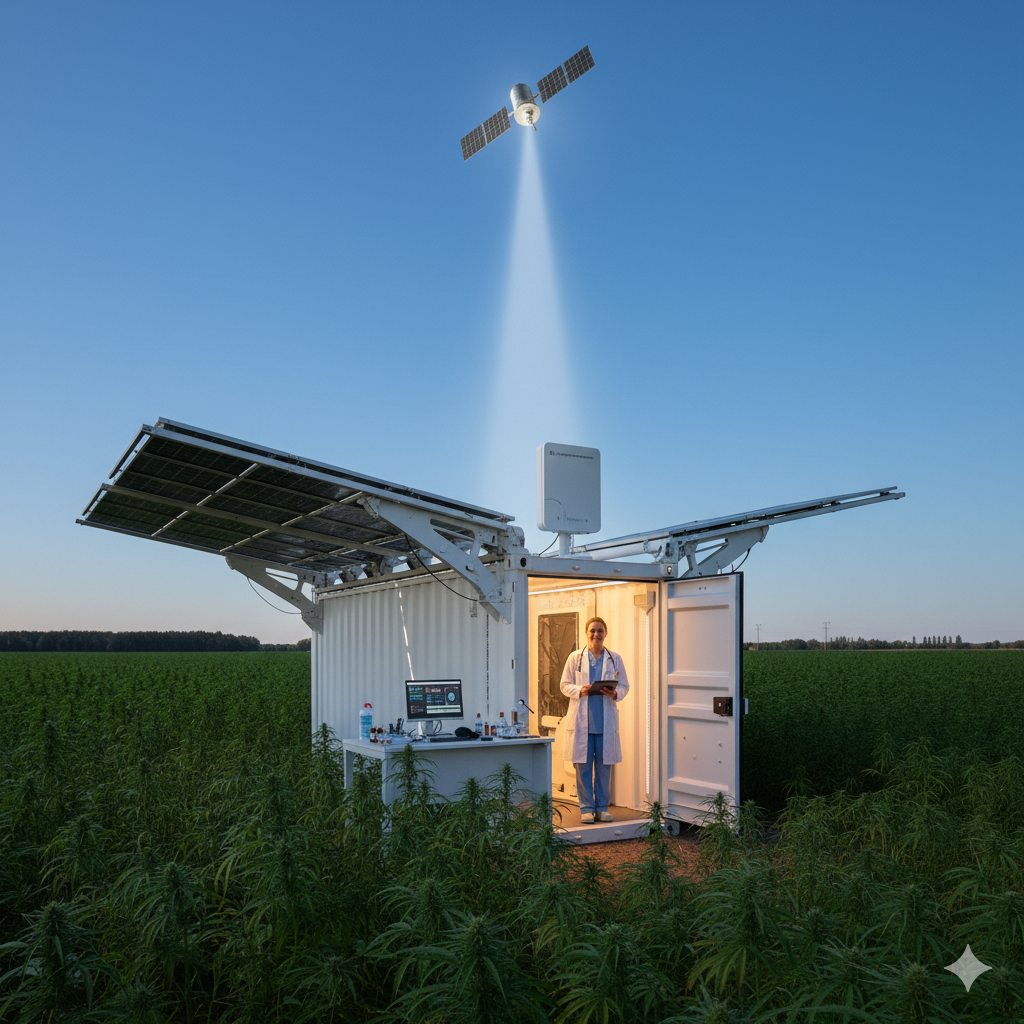
The unit is a fully integrated system housed in a modified 10ft ISO container, visualized in deployments ranging from lush hemp fields to arid desert landscapes.

2.1. The Shell (Chassis)

The foundation of the unit is a durable, secure, and habitable steel container.

  • Form Factor: Modified 10ft High-Cube ISO Shipping Container (New “One-Trip”).
  • Dimensions: 10′ (L) x 8′ (W) x 9’6″ (H).
  • Weight: Approximately 5,500 lbs (2,495 kg) fully configured.
  • Modifications:
    • Finish: Sandblasted and coated with white, heat-reflective ceramic paint.
    • Insulation: R-25 closed-cell spray foam on walls and ceiling for thermal stability.
    • Security: Features a heavy steel cargo door with an internal biometric locking bar and a window with a security grate.
  • Workspace: A partitioned, insulated interior creates a habitable office with an ergonomic mesh chair, rugged desk, workbench, and LED task lighting. It is designed to be compliant with labor regulations (e.g., OSHA) requiring a “climate-controlled workspace.”

2.2. Power Systems (Grid-Forming)

The unit is designed to generate, store, and manage its own power grid, capable of supporting both internal systems and external tools.

  • Solar Generation: 4.4kW – 6kW Hybrid Solar Array.
    • Configuration: A fixed roof-mounted array is supplemented by manual “Slide-Out Wings” on heavy-duty drawer slides, which double the solar capture area with bifacial panels.
  • Energy Storage: 15kWh – 20kWh Server Rack Battery Bank.
    • Chemistry: LiFePO4 (e.g., EG4/Ruixu modules), configured in a 48V server rack format.
    • Capacity: Sufficient to run the AI core and HVAC system through three days of heavy cloud cover.
  • Power Management:
    • Inverter: 12kW peak Sol-Ark or Victron Quattro industrial hybrid inverter.
    • Output: Capable of 120V/240V split-phase output (50A @ 240V) to power external tools like welders and pumps.
    • Backup: Includes an auto-start dry contact for an external diesel or hemp generator.

2.3. Compute & Intelligence (“The Brain”)

The server rack is the computational core, separated from the office by a glass partition and engineered for continuous, high-intensity workloads.

  • Server: Ruggedized 1U/2U rackmount server (Dell PowerEdge XR series, Supermicro IoT Edge, or “White Box” generic).
  • CPU: Intel Xeon Scalable Processor (Silver/Gold series, e.g., Silver 4310 with 10+ cores).
  • AI Accelerator: NVIDIA A2 Tensor Core GPU (16GB).
  • Memory & Storage: 128GB ECC DDR4 RAM and up to 8TB NVMe storage (configured in RAID 1).
  • Operating System: RIOS Sovereign OS (Server Edition).
  • Mission Profile: Unlike the battery-constrained Tier 1, the Tier 2 unit is designed for Continuous Inference. It runs the AI at full throttle 24/7 to monitor 50+ CCTV streams, analyze soil telemetry, host a local “Digital Twin” database, and support a local Large Language Model (LLM).

2.4. Climate Control (Active Resilience)

Active climate control is a key differentiator, ensuring hardware and personnel can function in extreme environments.

  • HVAC Unit: 9,000 BTU Mini-Split Heat Pump (120V or 48V DC).
  • Performance: Maintains a stable internal server rack temperature of 68°F even when external temperatures reach 120°F (e.g., Arizona/Uganda).
  • Purpose: The active cooling system is critical for guaranteeing 99.99% uptime for the high-performance servers.

2.5. Connectivity Layer

The unit is equipped with a multi-layered communications stack for robust connectivity.

  • Backhaul: Starlink High-Performance Kit (roof-mounted) and a Peplink 4G/5G bonding router with high-gain directional MIMO antennas.
  • Local Mesh: A high-power RIOS NeoMesh Concentrator for LoRaWAN sensors.
  • Mast: A telescoping pneumatic mast extends 20ft from the container’s corner, mounting the 5G antennas and LoRa concentrator. This height advantage significantly improves signal range. At night, it can feature a red blinking aviation light.

3. Operational Functionality and Use Cases

3.1. Core Operational Roles

  • Sovereign Hosting: Hosts the local intranet, including a Wiki, training videos, and medical records, accessible via Wi-Fi even if the primary internet connection is down.
  • Site Automation: The server’s GPIO pins control physical relays, enabling AI-triggered automation of systems like irrigation valves and floodlights.
  • Security Hub: Powers and manages a perimeter security network, using the NVIDIA A2 for continuous AI object detection on CCTV feeds (e.g., identifying a coyote crossing a fence).

3.2. Ideal Use Cases

  • Agro-Industrial Pilots: Acts as the “Farm Intelligence Hub” for a 50-acre hemp farm, managing pumps and soil sensors.
  • Rural Clinics / Humanitarian Outposts: Provides a secure, off-grid facility for storing patient records locally while using Starlink to beam data for telehealth. The workspace serves doctors and staff.
  • Construction Headquarters: Functions as the site manager’s office for tracking inventory and security before the main building is complete.
  • Perimeter Defense: Serves as a central security hub, powering external floodlights, drone docking stations, and water pumps, acting as the “heart” of a site’s infrastructure.

4. Commercial and Financial Analysis

4.1. Pricing and Revenue Model

CategoryItemValue (USD)Notes
Hardware (CapEx)MSRP$78,500.00Project-based pricing is available.
Wholesale / Partner Base$65,000.00
Lease Option~$1,800/monthVia third-party equipment finance over 5 years.
Software/Service (OpEx)RIOS Standard Support$1,500.00 / MonthBilled annually at $18,000.
Included Services– 24/7 HVAC & Battery Telemetry<br>- Starlink Data Plan<br>- Digital Twin DashboardHigher price than Tier 1 due to critical systems monitoring.
  • Payment Terms: 50% deposit for materials on order, with the remaining 50% due prior to shipping.

4.2. Value Proposition

The pricing is justified by positioning the unit as “Digital Real Estate” and a capital asset, not a construction cost.

  • vs. Construction: Building a comparable concrete block server room and office in a remote area is estimated to cost over $100,000 and take 4+ months.
  • vs. Tier 1 Cases: Provides the thermal stability and massive power reserves required for “mission critical” 24/7 uptime. The documents state, “If the Tier 2 goes down, the site goes dark—so we over-engineered it to never go down.”
  • Asset Value: As a movable capital asset, it can be instantly depreciated and retains resale value, unlike a permanent building.

4.3. Cost of Goods Sold (COGS) and Margin

The estimated COGS is 36,200.00**, resulting in a gross margin of **42,300 per unit (54%).

ComponentCost BreakdownEstimated Cost
The Shell10ft Container, modifications, paint, insulation, security$8,200
Power Systems4.4kW Solar, 20kWh Battery Bank, 12k Inverter & controls$11,500
Compute & IntelligenceRugged Server, Xeon CPU, NVIDIA A2, Starlink, Router, Switch$9,500
Climate & Interior9,000 BTU HVAC, Desk, Chair, Lighting, Rack Enclosure$2,500
Labor & Integration100 blended hours @ $45/hr (Fabrication & Integration)$4,500
Total Estimated COGS$36,200

5. Manufacturing and Fulfillment

5.1. “Operation Octagon” Manufacturing Process

The unit is manufactured via a “Batch Build” process at the DeReticular facility in Quartzsite, AZ, under a program named “Operation Octagon.” It requires heavy infrastructure and cannot be dropshipped.

  • Phase 1: Shell Prep (Weeks 1-2): Containers arrive, undergo cutting and welding for vents and racks, and are then painted and insulated.
  • Phase 2: Electrical & Systems (Weeks 3-5): Involves the electrical “Rough-In,” mounting the server stack and HVAC, and imaging the server with RIOS Sovereign OS.
  • Phase 3: Burn-In (Week 6): Rigorous quality assurance testing.
    • “Oven Test”: HVAC is turned off to let the interior heat to 100°F, then turned on to verify the cooling curve.
    • “Island Test”: The unit is disconnected from mains and must run on battery/solar for 48 hours while executing a heavy AI inference loop.
  • Phase 4: Logistics (Week 7-8): The unit is prepared for shipping.

5.2. Logistics and Export

  • Transport: Requires a Landoll (tilt-deck) trailer or a flatbed truck with a heavy forklift or crane at the destination for placement. This is visualized in an image of the container being unloaded onto a dusty construction site.
  • Lead Time: 6-8 weeks from order to fulfillment.
  • Export: For international campuses (e.g., Uganda/Israel), units are shipped as “Temporary Office Units” with “Computer Equipment” on the manifest. The solar/battery components often qualify for “Green Energy” duty exemptions.
  • Compliance:
    • HS Code: 9406.90.0030 (Prefabricated Buildings) or 8502.39 (Solar Generators).
    • ECCN: 5A992.c (Mass Market Encryption – EAR99 eligible).
    • Hazmat: UN3481 (Lithium Batteries contained in equipment – Large Format).

6. Detailed Product Specifications

AttributeSpecification
Product NameRIOS Pilot: Standard (Tier 2)
Internal SKURIOS-STD-10FT-A2
Model NumberRP-STD-002-GEN1
ManufacturerDeReticular (In-House Fabrication)
Country of OriginUSA (Quartzsite, AZ)
Lifecycle StatusBuild-to-Order (BTO)
Dimensions10′ L x 8′ W x 9’6″ H (120″ x 96″ x 114″)
Gross Weight~5,500 lbs (2,495 kg)
Solar Input4.4kW (Bifacial Panels on Roof + Slide-Out Rails)
Battery Storage20kWh LiFePO4 (48V Server Rack Configuration)
Inverter12kW Hybrid (120/240V Split Phase Output)
Server CPUIntel Xeon Scalable Silver (10+ Cores)
Server GPUNVIDIA A2 Tensor Core (16GB)
Server RAM128GB DDR4 ECC
Server Storage8TB NVMe (RAID 1)
Warranty1 Year Bumper-to-Bumper (Parts)

Briefing Document: RIOS Pilot Standard (Tier 2)

Executive Summary

The RIOS Pilot Standard (Tier 2) is a self-contained, modular micro-data center and field office engineered for permanent, off-grid deployments. Housed within a custom-fabricated 10ft High-Cube ISO container, it functions as a “Civilization Anchor,” transitioning operations from temporary, expeditionary phases (Tier 1) to persistent, stationed sovereignty. The unit integrates a complete power system, high-performance compute hardware, and a habitable workspace into a single, rapidly deployable asset.

Core to its design is the principle of active resilience. A hybrid 4.4kW solar array with unique “slide-out wings” and a 20kWh LiFePO4 battery bank provide continuous power, managed by an industrial-grade inverter. This system supports a ruggedized Intel Xeon server equipped with an NVIDIA A2 Tensor Core GPU, enabling 24/7 AI inference for tasks like perimeter security, agricultural analytics, and hosting a local “Digital Twin.” Crucially, an integrated 9,000 BTU HVAC system maintains a stable internal temperature of 68°F, guaranteeing 99.99% uptime even in extreme external conditions of 120°F.

Strategically, the Tier 2 unit is positioned as a high-margin “Anchor” product designed to capture the Capital Expenditure (CapEx) budgets of industrial clients. With a Manufacturer’s Suggested Retail Price (MSRP) of $78,500 and an estimated Cost of Goods Sold (COGS) of $36,200, it achieves a 54% gross margin. The unit is designed to lock customers into the RIOS ecosystem, serving as the central hub for power, data, and security workflows on-site, further supplemented by a recurring revenue subscription for advanced monitoring. Ideal use cases include agro-industrial pilots, rural medical clinics, and construction site headquarters.

——————————————————————————–

1. Product Concept and Strategic Role

1.1. The “Anchor”: From Expeditionary to Permanent

The RIOS Pilot Standard is classified as Tier 2 infrastructure, representing a strategic shift from the mobile, rapid-response capabilities of Tier 1 “Expeditionary” cases to a “Stationed” or permanent presence. It is designed for persistence, stability, and human habitability, serving as the foundational “Civilization Anchor” or “Base Camp” for a remote site.

  • Tagline: “The Anchor. From Temporary Ops to Permanent Sovereignty.”
  • Core Function: To provide a permanent, climate-controlled, armor-plated shell for the AI compute core, with massive battery redundancy to ensure continuous 24/7/365 operation.

1.2. The Hub-and-Spoke Operational Model

The Tier 2 unit functions as the central “Hub” in an operational ecosystem where Tier 1 units act as the “Spokes.”

  • Data Aggregation: Field teams using mobile Tier 1 cases collect data (e.g., drone maps) and upload it to the Tier 2 server for long-term storage and heavy analysis upon returning to base.
  • Charging Vault: The container is designed with a secure rack to dock and charge Tier 1 cases when they return from patrol.
  • Network Extension: A telescoping 20ft mast provides significantly better range (8+ miles) for LoRaWAN sensors compared to ground-level Tier 1 units.

1.3. Financial Keystone and Ecosystem Lock-in

The Tier 2 unit is the financial backbone of the DeReticular hardware division and is central to the business strategy.

  • High-Margin Product: It targets the Capital Expenditure (CapEx) budgets of industrial projects, contrasting with the lower-cost, high-volume Tier 1 cases.
  • Ecosystem Control: The documentation states, “Once this container is dropped, DeReticular owns the site’s power, data, and security workflow.” It physically locks the customer into the RIOS ecosystem.
  • Replacement Strategy: This model replaces previous RevoFi-based campus plans for international deployment.

2. Core Architecture and Systems

The unit is a fully integrated system housed in a modified 10ft ISO container, visualized in deployments ranging from lush hemp fields to arid desert landscapes.

2.1. The Shell (Chassis)

The foundation of the unit is a durable, secure, and habitable steel container.

  • Form Factor: Modified 10ft High-Cube ISO Shipping Container (New “One-Trip”).
  • Dimensions: 10′ (L) x 8′ (W) x 9’6″ (H).
  • Weight: Approximately 5,500 lbs (2,495 kg) fully configured.
  • Modifications:
    • Finish: Sandblasted and coated with white, heat-reflective ceramic paint.
    • Insulation: R-25 closed-cell spray foam on walls and ceiling for thermal stability.
    • Security: Features a heavy steel cargo door with an internal biometric locking bar and a window with a security grate.
  • Workspace: A partitioned, insulated interior creates a habitable office with an ergonomic mesh chair, rugged desk, workbench, and LED task lighting. It is designed to be compliant with labor regulations (e.g., OSHA) requiring a “climate-controlled workspace.”

2.2. Power Systems (Grid-Forming)

The unit is designed to generate, store, and manage its own power grid, capable of supporting both internal systems and external tools.

  • Solar Generation: 4.4kW – 6kW Hybrid Solar Array.
    • Configuration: A fixed roof-mounted array is supplemented by manual “Slide-Out Wings” on heavy-duty drawer slides, which double the solar capture area with bifacial panels.
  • Energy Storage: 15kWh – 20kWh Server Rack Battery Bank.
    • Chemistry: LiFePO4 (e.g., EG4/Ruixu modules), configured in a 48V server rack format.
    • Capacity: Sufficient to run the AI core and HVAC system through three days of heavy cloud cover.
  • Power Management:
    • Inverter: 12kW peak Sol-Ark or Victron Quattro industrial hybrid inverter.
    • Output: Capable of 120V/240V split-phase output (50A @ 240V) to power external tools like welders and pumps.
    • Backup: Includes an auto-start dry contact for an external diesel or hemp generator.

2.3. Compute & Intelligence (“The Brain”)

The server rack is the computational core, separated from the office by a glass partition and engineered for continuous, high-intensity workloads.

  • Server: Ruggedized 1U/2U rackmount server (Dell PowerEdge XR series, Supermicro IoT Edge, or “White Box” generic).
  • CPU: Intel Xeon Scalable Processor (Silver/Gold series, e.g., Silver 4310 with 10+ cores).
  • AI Accelerator: NVIDIA A2 Tensor Core GPU (16GB).
  • Memory & Storage: 128GB ECC DDR4 RAM and up to 8TB NVMe storage (configured in RAID 1).
  • Operating System: RIOS Sovereign OS (Server Edition).
  • Mission Profile: Unlike the battery-constrained Tier 1, the Tier 2 unit is designed for Continuous Inference. It runs the AI at full throttle 24/7 to monitor 50+ CCTV streams, analyze soil telemetry, host a local “Digital Twin” database, and support a local Large Language Model (LLM).

2.4. Climate Control (Active Resilience)

Active climate control is a key differentiator, ensuring hardware and personnel can function in extreme environments.

  • HVAC Unit: 9,000 BTU Mini-Split Heat Pump (120V or 48V DC).
  • Performance: Maintains a stable internal server rack temperature of 68°F even when external temperatures reach 120°F (e.g., Arizona/Uganda).
  • Purpose: The active cooling system is critical for guaranteeing 99.99% uptime for the high-performance servers.

2.5. Connectivity Layer

The unit is equipped with a multi-layered communications stack for robust connectivity.

  • Backhaul: Starlink High-Performance Kit (roof-mounted) and a Peplink 4G/5G bonding router with high-gain directional MIMO antennas.
  • Local Mesh: A high-power RIOS NeoMesh Concentrator for LoRaWAN sensors.
  • Mast: A telescoping pneumatic mast extends 20ft from the container’s corner, mounting the 5G antennas and LoRa concentrator. This height advantage significantly improves signal range. At night, it can feature a red blinking aviation light.

3. Operational Functionality and Use Cases

3.1. Core Operational Roles

  • Sovereign Hosting: Hosts the local intranet, including a Wiki, training videos, and medical records, accessible via Wi-Fi even if the primary internet connection is down.
  • Site Automation: The server’s GPIO pins control physical relays, enabling AI-triggered automation of systems like irrigation valves and floodlights.
  • Security Hub: Powers and manages a perimeter security network, using the NVIDIA A2 for continuous AI object detection on CCTV feeds (e.g., identifying a coyote crossing a fence).

3.2. Ideal Use Cases

  • Agro-Industrial Pilots: Acts as the “Farm Intelligence Hub” for a 50-acre hemp farm, managing pumps and soil sensors.
  • Rural Clinics / Humanitarian Outposts: Provides a secure, off-grid facility for storing patient records locally while using Starlink to beam data for telehealth. The workspace serves doctors and staff.
  • Construction Headquarters: Functions as the site manager’s office for tracking inventory and security before the main building is complete.
  • Perimeter Defense: Serves as a central security hub, powering external floodlights, drone docking stations, and water pumps, acting as the “heart” of a site’s infrastructure.

4. Commercial and Financial Analysis

4.1. Pricing and Revenue Model

CategoryItemValue (USD)Notes
Hardware (CapEx)MSRP$78,500.00Project-based pricing is available.
Wholesale / Partner Base$65,000.00
Lease Option~$1,800/monthVia third-party equipment finance over 5 years.
Software/Service (OpEx)RIOS Standard Support$1,500.00 / MonthBilled annually at $18,000.
Included Services– 24/7 HVAC & Battery Telemetry<br>- Starlink Data Plan<br>- Digital Twin DashboardHigher price than Tier 1 due to critical systems monitoring.
  • Payment Terms: 50% deposit for materials on order, with the remaining 50% due prior to shipping.

4.2. Value Proposition

The pricing is justified by positioning the unit as “Digital Real Estate” and a capital asset, not a construction cost.

  • vs. Construction: Building a comparable concrete block server room and office in a remote area is estimated to cost over $100,000 and take 4+ months.
  • vs. Tier 1 Cases: Provides the thermal stability and massive power reserves required for “mission critical” 24/7 uptime. The documents state, “If the Tier 2 goes down, the site goes dark—so we over-engineered it to never go down.”
  • Asset Value: As a movable capital asset, it can be instantly depreciated and retains resale value, unlike a permanent building.

4.3. Cost of Goods Sold (COGS) and Margin

The estimated COGS is 36,200.00**, resulting in a gross margin of **42,300 per unit (54%).

ComponentCost BreakdownEstimated Cost
The Shell10ft Container, modifications, paint, insulation, security$8,200
Power Systems4.4kW Solar, 20kWh Battery Bank, 12k Inverter & controls$11,500
Compute & IntelligenceRugged Server, Xeon CPU, NVIDIA A2, Starlink, Router, Switch$9,500
Climate & Interior9,000 BTU HVAC, Desk, Chair, Lighting, Rack Enclosure$2,500
Labor & Integration100 blended hours @ $45/hr (Fabrication & Integration)$4,500
Total Estimated COGS$36,200

5. Manufacturing and Fulfillment

5.1. “Operation Octagon” Manufacturing Process

The unit is manufactured via a “Batch Build” process at the DeReticular facility in Quartzsite, AZ, under a program named “Operation Octagon.” It requires heavy infrastructure and cannot be dropshipped.

  • Phase 1: Shell Prep (Weeks 1-2): Containers arrive, undergo cutting and welding for vents and racks, and are then painted and insulated.
  • Phase 2: Electrical & Systems (Weeks 3-5): Involves the electrical “Rough-In,” mounting the server stack and HVAC, and imaging the server with RIOS Sovereign OS.
  • Phase 3: Burn-In (Week 6): Rigorous quality assurance testing.
    • “Oven Test”: HVAC is turned off to let the interior heat to 100°F, then turned on to verify the cooling curve.
    • “Island Test”: The unit is disconnected from mains and must run on battery/solar for 48 hours while executing a heavy AI inference loop.
  • Phase 4: Logistics (Week 7-8): The unit is prepared for shipping.

5.2. Logistics and Export

  • Transport: Requires a Landoll (tilt-deck) trailer or a flatbed truck with a heavy forklift or crane at the destination for placement. This is visualized in an image of the container being unloaded onto a dusty construction site.
  • Lead Time: 6-8 weeks from order to fulfillment.
  • Export: For international campuses (e.g., Uganda/Israel), units are shipped as “Temporary Office Units” with “Computer Equipment” on the manifest. The solar/battery components often qualify for “Green Energy” duty exemptions.
  • Compliance:
    • HS Code: 9406.90.0030 (Prefabricated Buildings) or 8502.39 (Solar Generators).
    • ECCN: 5A992.c (Mass Market Encryption – EAR99 eligible).
    • Hazmat: UN3481 (Lithium Batteries contained in equipment – Large Format).

6. Detailed Product Specifications

AttributeSpecification
Product NameRIOS Pilot: Standard (Tier 2)
Internal SKURIOS-STD-10FT-A2
Model NumberRP-STD-002-GEN1
ManufacturerDeReticular (In-House Fabrication)
Country of OriginUSA (Quartzsite, AZ)
Lifecycle StatusBuild-to-Order (BTO)
Dimensions10′ L x 8′ W x 9’6″ H (120″ x 96″ x 114″)
Gross Weight~5,500 lbs (2,495 kg)
Solar Input4.4kW (Bifacial Panels on Roof + Slide-Out Rails)
Battery Storage20kWh LiFePO4 (48V Server Rack Configuration)
Inverter12kW Hybrid (120/240V Split Phase Output)
Server CPUIntel Xeon Scalable Silver (10+ Cores)
Server GPUNVIDIA A2 Tensor Core (16GB)
Server RAM128GB DDR4 ECC
Server Storage8TB NVMe (RAID 1)
Warranty1 Year Bumper-to-Bumper (Parts)

Understanding the RIOS Pilot Standard Your Off-Grid Command Center

Michael Noel · January 3, 2026 ·

Introduction: What is the RIOS Pilot Standard?

Imagine a smart, self-powered command hub that you can drop anywhere in the world, instantly creating a permanent base of operations. This is the core idea behind the RIOS Pilot Standard, a product best described by its official mission: “The Anchor. From Temporary Ops to Permanent Sovereignty.”

Its primary purpose is to serve as a permanent “Civilization Anchor” for remote sites. It provides power, connectivity, and a secure workspace where none existed before, transforming an empty spot on the map into a center of operations.

To understand how it achieves this, we can break it down into three core components: its tough outer Body, its powerful Heart, and its intelligent Brain.

——————————————————————————–

1. The Body: A Secure and Habitable Shell

Think of the RIOS unit’s body as a high-tech vault or an armored thermos—a structure designed not just for storage, but for protection and active use in the harshest environments.

1.1 The Foundation: More Than a Steel Box

The base of the unit is a modified 10ft High-Cube New “One-Trip” ISO container, ensuring a pristine, high-quality foundation. It’s compact enough to fit in a standard parking space, but two key modifications make it far more than a simple steel box:

  • Heat-Reflective White Paint: This isn’t just for looks. It’s a special ceramic paint that acts like a mirror to the sun, reflecting intense heat to help keep the interior cool and stable.
  • Closed-Cell Spray Foam Insulation: Inside the walls is a thick, seamless blanket of industrial insulation (R-Value 25+). This traps the cool air generated inside and keeps extreme heat out, much like a high-end portable cooler.

1.2 The Workspace: An Office in the Wild

The interior is far more than a server closet; it is a fully climate-controlled, habitable workspace. It includes a dedicated operator desk and an ergonomic chair, creating a professional office environment.

This human-centric design is critical. It allows a site manager to work safely and comfortably for extended periods, meeting labor regulations that require a conditioned workspace, even in the middle of a desert or a remote field. For security, the unit is reinforced with heavy steel cargo doors featuring a biometric locking bar and security grates on the windows, solidifying its role as a secure vault.

But a strong body is nothing without a powerful heart to make it run.

——————————————————————————–

2. The Heart: A Grid-Forming Power Plant

The RIOS Pilot Standard has a Grid-Forming heart. It doesn’t just sustain itself; it generates, stores, and distributes energy to create its own stable, local power grid, ensuring the unit and the site it supports never have to sleep.

2.1 Capturing Energy: The Solar “Wings”

The primary power source is a robust 4.4kW hybrid solar array. What makes it unique is the “Slide-Out Wings” feature. Once the container is in place, extra solar panels slide out from the roof on heavy-duty rails, essentially doubling the surface area to catch as much sunlight as possible. These are bifacial panels, meaning they can also capture reflected light from the white roof surface, maximizing energy generation.

2.2 Storing Power: The Energy Bank

All the captured sunlight is stored in a 20kWh LiFePO4 battery bank. Think of this as a massive, industrial-grade power bank for the entire unit. This large capacity is key to its reliability; it can run the entire system—including the power-hungry servers and air conditioning—through three full days of heavy cloud cover or bad weather.

2.3 Distributing Power: The Translator

The final piece of the power puzzle is the industrial inverter (Sol-Ark or Victron). This component acts as the “translator” for the stored energy. It expertly converts the raw DC power from the batteries into standard 120V/240V AC electricity. This is what’s needed to run everything from the onboard computers and lights to heavy-duty external tools like welders or water pumps.

Now that we have a constant flow of power, let’s look at the intelligent brain that uses this energy to get the real work done.

——————————————————————————–

3. The Brain: The Onboard Intelligence and Communications Hub

If the power system is the heart, the compute and connectivity hardware is the brain and nervous system. It processes information, makes decisions, and communicates with the outside world, all from its protected shell.

3.1 The Core Processor: The Thinker

The Intel Xeon server is the main part of the brain, responsible for general-purpose thinking and running the local network. A key function is hosting a “Digital Twin” of the entire site—a complete data model of the operation. This means essential resources like instructional wikis, sensor databases, or training videos are always accessible to the local team, even if the primary satellite internet connection goes down.

3.2 The AI Specialist: The Watcher

Working alongside the main processor is an NVIDIA A2 GPU. This is a specialized part of the brain that’s an expert at pattern recognition. Its mission is Continuous Inference. Unlike battery-constrained systems, the RIOS unit’s massive power system allows the AI to run at full throttle 24/7. It can continuously monitor over 50 security camera streams at once to automatically detect a coyote crossing a fence line, or analyze sensor data from an agricultural field in real-time to manage irrigation.

3.3 The Nervous System: Staying Connected

The brain communicates with the world through a sophisticated nervous system with two primary channels:

  • To the World (Starlink): A roof-mounted, high-performance Starlink satellite dish provides a direct, high-speed connection to the internet. This allows the unit to send and receive data from anywhere on the planet.
  • To the Local Site (Telescoping Mast): A 20-foot telescoping mast acts as a “watchtower.” It allows the unit to communicate with local sensors and devices over a long range (8+ miles), creating a wide, reliable communication mesh across the entire operational area.

With a tough body, a tireless heart, and a powerful brain, let’s see what the RIOS Pilot Standard can actually accomplish in the real world.

——————————————————————————–

4. Putting It All Together: What It Does

The combination of a secure shell, grid-forming power, and onboard intelligence allows the RIOS Pilot Standard to serve as the command center for a wide range of remote operations.

Use CaseHow It WorksKey Benefit
Smart FarmingThe Shell provides a climate-controlled office to manage a 50-acre hemp field, for example. The Heart’s grid-forming power runs irrigation pumps 24/7. The Brain uses its A2 GPU for continuous analysis of soil sensors, hosting a “Digital Twin” of the field and automating irrigation relays.Enables high-tech, automated agriculture on remote land without needing to be connected to the grid.
Rural Medical ClinicThe Shell offers a secure, climate-controlled, and sterile space. The Heart provides reliable, uninterruptible power for sensitive medical equipment. The Brain hosts patient records locally for security and uses Starlink for vital telemedicine consultations.Creates a modern medical outpost anywhere, ensuring data security and operational uptime for critical care.
Remote Construction HQThe Shell serves as the site manager’s compliant, conditioned office. The Heart powers floodlights, security systems, and heavy-duty tools. The Brain runs AI 24/7 on CCTV feeds, performing continuous inference to monitor the site for theft or safety issues.Establishes a secure, compliant, and intelligent headquarters on day one, long before permanent structures are built.

——————————————————————————–

5. Conclusion: Your Permanent Anchor

The RIOS Pilot Standard is more than just a product; it’s designed to be a capital asset that provides a permanent “Civilization Anchor” wherever it’s deployed. It is a complete, self-reliant system that brings security, power, intelligence, and a habitable workspace to any remote location on the planet. It’s built from the ground up to be The Anchor. From Temporary Ops to Permanent Sovereignty.

Briefing Document RIOS Pilot Expeditionary (Tier 1)

Michael Noel · January 2, 2026 ·

Executive Summary

The RIOS Pilot Expeditionary (Tier 1), designated SKU RIOS-EXP-A2-GEN1, is a man-portable, three-case modular system designed to deliver sovereign AI compute and resilient connectivity to off-grid, tactical edge environments. Positioned as an “Infrastructure in a Suitcase,” the product integrates an Intel Xeon processor, an NVIDIA A2 GPU, and bonded Starlink/5G communications into a ruggedized, solar-powered package that can be deployed by non-technical personnel in under 90 seconds.

The central strategic challenge facing the project is the transition from its current “Workbench Build” prototype phase—characterized by manual assembly and consumer-grade sourcing—to a scalable, global fulfillment model capable of meeting deployment targets for initiatives like “Operation Octagon.” The primary operational bottleneck is manufacturing scalability, which poses a direct threat to the December 2025 deployment dates for key nodes in Uganda (Node 4) and for the UN (Node 6).

The critical path to resolving this gap is a proposed partnership with Redapt. This engagement is intended to industrialize the entire fulfillment process, from managing the supply chain for high-lead-time components like NVIDIA A2 GPUs and Starlink kits, to streamlining assembly, automating OS imaging, and handling complex international logistics, including export compliance for “Dual-Use” technologies.

Financially, the product is positioned as a high-margin “cash-flow engine,” with a Manufacturer’s Suggested Retail Price (MSRP) of $45,000 against an estimated Cost of Goods Sold (COGS) of $19,550, yielding a 56% gross margin. Strategically, it serves as a “Trojan Horse”—a rapidly deployable, lower-cost entry product designed to prove the RIOS software’s value on-site, creating an upsell path to larger, permanent Tier 2 and Tier 3 containerized systems. Key operational risks include supply chain volatility for critical components, potential thermal throttling of the passively cooled compute module in extreme heat, and power budget constraints that limit 24/7 autonomous operation without consistent solar input.

——————————————————————————–

1. Product Overview & Strategy

Core Concept: “Infrastructure in a Suitcase”

The RIOS Pilot Expeditionary is designed as the “First-In Solution” for environments lacking stable power, connectivity, or IT infrastructure. It bridges the gap between a portable laptop, which lacks sufficient processing power, and a traditional server room, which lacks mobility. The system consolidates the functions of a generator, a satellite terminal, a server, and a workstation into a rapidly deployable format that fits in a standard SUV or can be checked as airline luggage.

The core value proposition is the delivery of enterprise-grade compute (Intel Xeon) and AI inference capabilities (NVIDIA A2) to the tactical edge, completely independent of the local power grid or cloud services.

The Modular “Mission Stack”

The system’s architecture is built on three interlocking, color-coded, tool-less B&W Type 61 ruggedized cases (IP67 rated).

ModuleColorCase NameFunction & Key Components
Power🟡 Safety YellowThe LungsProvides continuous, conditioned DC power. Features a 2kWh LiFePO4 battery, a 400W foldable military-spec solar blanket, a Victron SmartSolar MPPT controller, and a 1000W inverter. It intelligently routes power from solar, grid, or vehicle sources.
Compute & Comms🔵 Signal BlueThe BrainThe operational core, housed in a sealed, fanless aluminum chassis. Contains an Intel Xeon D-Series processor, 64GB ECC RAM, 4TB NVMe SSD storage (RAID 1), and an NVIDIA A2 Tensor Core GPU (16GB) for AI inference. Connectivity is managed by a Peplink bonding router combining a Starlink Flat High-Performance Kit and a dual-SIM 5G/LTE modem.
Interface & IoT⚫ Matte BlackThe FaceThe Human-Machine Interface (HMI) and sensor hub. Features a lid-mounted 22-inch high-nit (daylight readable) tactical display, a weatherproof keyboard/trackball, and the RIOS NeoMesh Gateway (LoRaWAN 915MHz), which creates a secure sensor network with a range of up to 5 miles.

Strategic Positioning: The “Trojan Horse”

The Tier 1 Expeditionary unit is the entry point into the RIOS ecosystem. Its lower capital requirements and lack of need for heavy logistics (cranes, flatbeds) make it an ideal tool to enter a client site quickly. The strategy is to leverage the unit’s rapid deployment capability to prove the value of the RIOS software and secure initial contracts. The inherent limitations of the portable form factor, particularly the power budget, then create a logical and compelling reason to upsell the client to a permanent, higher-capacity Tier 2 (Standard Container) or Tier 3 (AI Core Container) solution for 24/7 operations.

Target Use Cases

  • Disaster Response: Establishing an “Instant Command Center” with communications and a victim-registration hub in areas where terrestrial networks are down.
  • Agro-Scouting: Deploying at remote agricultural sites to use AI for analyzing drone maps and soil data to determine site viability.
  • Remote Security: Providing AI-powered perimeter monitoring for construction sites or mines without requiring a generator or guard shack.
  • Eco-Industrial Park (EIP) Assessment: Serving as the “Minimum Viable Infrastructure” to log environmental baseline data at greenfield sites.

——————————————————————————–

2. Technical and Operational Specifications

Consolidated Specifications (Tier 1 / GEN1)

CategoryFeatureSpecification
PhysicalTotal System Weight~145 lbs (65.7 kg), divided across 3 cases of ~48 lbs each
Dimensions (Per Case)24″ x 17″ x 9″ (Standard B&W Type 61)
Ingress ProtectionIP67 (Dust-tight, waterproof up to 1m immersion)
Operating Temperature-20°F to +120°F (-29°C to 49°C)
PowerBattery Capacity2048Wh (2kWh) LiFePO4
Solar Generation400W Foldable “Blanket” Array (Mil-Spec Canvas)
Inverter Output1000W Pure Sine Wave
System Autonomy4-6 hours on full load (battery only); indefinite with sufficient solar
Compute & AICPUIntel Xeon D-2146NT (8 Cores, 16 Threads)
GPU / AI AcceleratorNVIDIA A2 Tensor Core (16GB VRAM, 40-60W TDP)
RAM64GB DDR4 ECC
Storage4TB NVMe SSD (Configured in RAID 1)
Operating SystemRIOS Sovereign OS (Custom Linux Kernel)
CommunicationsSatelliteStarlink Flat High-Performance Kit
Cellular/BondingPeplink MAX BR1 (or similar) with Dual-SIM 5G/LTE
Local Area NetworkWi-Fi 6 (802.11ax)
IoT Sensor NetworkRIOS NeoMesh Gateway (LoRaWAN 915MHz)

Deployment Workflow: “Zero-Training”

The system is engineered for deployment by users with no specialized IT training.

  1. Land: Place the three cases at the operational site.
  2. Connect: Use the color-coded, heavy-duty Amphenol connectors to link the cases (Yellow Power cable to Blue Compute, Blue Data cable to Black Interface).
  3. Deploy: Unfold the solar blanket and position the Starlink dish with a clear view of the sky.
  4. Activate: Flip the single master switch on the Yellow Power case. The RIOS OS boots within 90 seconds, establishes a satellite uplink, creates a local Wi-Fi bubble, and begins processing data from local sensors.

——————————————————————————–

3. The Fulfillment and Manufacturing Gap

A significant disparity exists between the current R&D-phase production methods and the required state for global deployment. This gap is the primary focus of the Redapt partnership.

AreaCurrent State (Prototype)Future State (Global Deployment)The Gap & Bridging Strategy
Manufacturing“Workbench Build”: Manual assembly by technicians involving soldering and hand-cutting foam. Labor is 12 hours per unit.Industrial Integration: Assembly line production, standardized wiring harnesses, and automated OS imaging.Scalability Deficit: The current process cannot fulfill the 8-unit “Octagon Build” without significant delays. Action: Engage Redapt for assembly, pre-fabricate cable looms, and create a “Gold Master” OS image for mass cloning.
ProcurementAd-Hoc Sourcing: Components are sourced from consumer retailers like Amazon/Newegg or single-unit orders.Consolidated Procurement: Bulk purchasing and stock allocation managed through a Tier 1 partner.Supply Chain Risk: High lead times on critical NVIDIA A2 GPUs and Starlink kits threaten timelines. Action: Utilize Redapt’s partner status (e.g., Titanium) to prioritize allocation and order long-lead items for inventory staging.
Technical QATheoretical Design: Thermal and power performance is based on theoretical designs for the sealed “Blue Case.”Validated Performance: Empirical proof of stability in 100°F+ environments with zero thermal throttling.Lack of Empirical Data: The system’s ability to shed heat under full AI load in direct sunlight is unproven. Action: Execute the “Parking Lot Test” (a 4-hour solar-powered stress test) and have Redapt engineers review the thermal dissipation strategy.
LogisticsDomestic Only: Shipping is limited to the USA with no export licenses filed. “Return to Base” repair model.Global & Compliant: Seamless shipping to complex zones (e.g., Uganda), compliant with US “Dual-Use” technology laws, and field-serviceable.Compliance & Support Risk: Shipping AI chips and high-grade encryption requires adherence to Export Administration Regulations (EAR). No field support network exists. Action: Leverage Redapt’s “Compliance as a Service” for ECCN filings, finalize HS Code classification (8471.41), and stock spare parts at regional hubs.

——————————————————————————–

4. Commercial and Financial Model

Unit Economics

The pricing strategy is capability-based, focusing on the value of an “Instant Command Center” rather than the sum of its parts.

Financial MetricValueNotes
MSRP$45,000.00Target retail price.
Wholesale / Partner Price$36,000.00Provides a 20% margin for partners.
Target COGS$19,550.00Includes ~18,300 for hardware and ~1,250 for labor.
Gross Margin$25,450.00 / 56%High margin enables reinvestment and sales commissions.

Recurring Revenue Model

A subscription model is in place to create a long-term revenue stream beyond the initial hardware sale.

  • Product: RIOS Sovereign Support (Tier 1)
  • SKU: RIOS-SUB-EXP
  • Price: $900.00 per month (billed annually at $10,800)
  • Includes: Starlink data plan management, remote “Over-the-Air” (OTA) security patches, and access to the cloud-based “Digital Twin” dashboard.

Monetization Opportunities

The system architecture includes a “Compliance Engine” software agent designed to enable secondary revenue streams through automated Zero-Knowledge (zkVerify) proofs, unlocking potential income from carbon credits and DePIN (Decentralized Physical Infrastructure Networks) rewards.

——————————————————————————–

5. Strategic Analysis (SWOT)

Strengths (Internal)

  • Rapid Mobility: The “checked luggage” form factor requires no cranes or site prep.
  • Energy Independence: Integrated 400W solar and 2kWh battery eliminate reliance on generators.
  • Enterprise-Grade Edge Compute: Delivers Intel Xeon and NVIDIA A2 AI inference without cloud dependency.
  • “Zero-Training” UX: Color-coded cables and a single switch minimize deployment failure risk.
  • Strong Unit Economics: A ~56% gross margin provides significant financial flexibility.
  • Modular “Mission Stack”: Individual cases can be swapped for repair, reducing downtime.

Weaknesses (Internal)

  • Power Budget Constraints: The 2kWh battery and 400W solar input are insufficient for continuous 24/7 operation under heavy load or poor weather.
  • Thermal Management Risks: The sealed, fanless IP67 “Blue Case” design poses a risk of performance throttling in extreme heat.
  • Manufacturing Bottleneck: The manual “Workbench Build” process is not scalable for volume orders.
  • Storage Limitations: The expeditionary form factor limits the physical size of the battery bank.

Opportunities (External)

  • “Trojan Horse” Strategy: Use the Tier 1 unit to enter client sites and upsell to permanent Tier 2/3 container solutions.
  • Global “Sovereign” Demand: Geopolitical instability drives demand for infrastructure independent of public grids and big tech clouds.
  • Recurring Revenue Tail: The $900/month support subscription creates a long-term, stable revenue stream.
  • DePIN & Carbon Monetization: The zkVerify software allows for monetizing solar generation and “Proof of Deployment.”

Threats (External)

  • Supply Chain Volatility: The system depends on high-demand NVIDIA A2 GPUs and Starlink Kits, which are prone to shortages.
  • Regulatory & Export Control: Shipping AI hardware and high-grade encryption to certain regions faces scrutiny under “Dual-Use” technology regulations.
  • Starlink Dependency: Changes to Starlink’s pricing, geofencing, or terms of service could compromise the core connectivity offering.
  • Hardware Commoditization: Competitors could release similar integrated solutions at lower price points.

——————————————————————————–

6. Alternative Configuration (Generation 4)

A technical data sheet for a “Generation 4” (G4) unit outlines a significantly different system architecture. While the majority of project documentation describes the three-case “Tier 1 / GEN1” model, this alternative configuration presents a divergent set of specifications, suggesting a potential future iteration or a separate product line.

FeatureTier 1 / GEN1 SpecificationGeneration 4 (RIOS-PE-G4) Specification
System Architecture3-Case Modular System (Power, Compute, Interface)Single Hardened Enclosure
CPUIntel Xeon D-2146NT (8-Core)AMD EPYC™ Embedded or ARM Neoverse™ (8-Core)
GPU / AI AcceleratorNVIDIA A2 Tensor Core (16GB)NVIDIA® Jetson Orin™ NX (16GB)
Battery Capacity2 kWh LiFePO42.4 kWh LiFePO4
Solar Input400WUp to 1200W
Total Weight~145 lbs (65.7 kg)~99 lbs (45 kg)
Thermal ManagementPassive Cooling (Sealed, Fanless Chassis)Active Flow-Through Cooling with Replaceable Filters
Ingress ProtectionIP67 (when closed)IP67 (closed) / IP54 (in operation)
IoT GatewayRIOS NeoMesh integrated in “Black Case”Detachable “Nightingale” IoT Gateway with onboard sensors
  • « Go to Previous Page
  • Page 1
  • Interim pages omitted …
  • Page 4
  • Page 5
  • Page 6
  • Page 7
  • Page 8
  • Interim pages omitted …
  • Page 25
  • Go to Next Page »

DeReticular

Copyright © 2026 · Monochrome Pro on Genesis Framework · WordPress · Log in