• Skip to primary navigation
  • Skip to main content
DeReticular

DeReticular

Local Autonomy. National Security. Total Sovereignty.

  • Solutions
    • Municipalities
    • Energy
    • Industrial
    • Defense
  • Infrastructure
  • Intelligence
  • Company
  • Request Municipal Audit
  • Show Search
Hide Search
You are here: Home / Archives for Energy

Energy

The Death of the Line: 5 Takeaways from the Frontier of Sovereign AI Infrastructure

Michael Noel · March 11, 2026 ·

The_Sovereign_StackDownload

The modern world is suspended by a series of single points of failure. Our reliance on “The Line”—centralized power grids, municipal water, and fiber-optic backbones—has created a state of extreme fragility where geopolitical conflict or a singular natural disaster can trigger a cascading civilizational collapse. We are witnessing the emergence of a Sovereign Stack that renders the centralized cloud an elective luxury, not a necessity. This shift toward “Industrial Autarchy” is catalyzed by the convergence of ruggedized hardware and frontier AI models like Gemini 3.1 Pro and Claude 4.6. For organizations like DeReticular, the goal is clear: the decoupling of industrial destiny from centralized failure.

1. Spherical Resilience: Beyond the “Dumb Grid”

The “Death of the Line” philosophy marks the transition from vulnerable linear dependencies to “Spherical Resilience.” Through Project Octagon, DeReticular has deployed a planetary mesh of eight independent infrastructure nodes across extreme environments, from the Canadian tundra to the Arizona desert. These are not merely backup sites; they are sovereign entities capable of “Island Mode” operations.

Each node achieves Post-Grid Resilience by generating its own power via solar and plasma systems, establishing independent connectivity through Starlink and local mesh networking, and processing data at the edge. By migrating the orchestration of these nodes to Claude 4.6 on Vertex AI, DeReticular has moved beyond simple automation into complex, agent-led infrastructure management.

Analysis: Shifting from linear to spherical models is the only viable strategy for surviving “Black Swan” events. While a traditional grid is only as strong as its weakest segment, a spherical mesh ensures that the failure of a single node—or even a dozen—does not compromise the integrity of the collective system. This is the hallmark of a sovereign system: it is self-healing, self-contained, and fundamentally uncoupled from municipal fragility.

2. AI Executives: The Migration to Claude 4.6

Under the Rural/Robotic Infrastructure Operating System (RIOS), human management is being phased out in favor of “Persistent Intelligences.” These are not mere chatbots; they are AI executives integrated into the corporate and operational leadership. The two primary agents, Remnant and Thunder, have been migrated to Claude 4.6 on Vertex AI to leverage its advanced agentic tooling and industry-leading low hallucination rates.

Remnant serves as the “Dean of the Academy,” stress-testing nodes against total grid collapse. Its most critical function is managing “The Spark Spread,” a high-stakes resource allocation algorithm. Thunder, meanwhile, operates as an automated grant-writing agent to ensure continuous capital formation.

“Remnant… runs ‘Black Swan’ simulations to stress-test the nodes against total grid collapse and manages ‘The Spark Spread’—a real-time algorithm dictating whether a node should store energy, burn it for compute (Crypto/AI), or condense it into fuel.”

Analysis: Managing high-stakes resources like the “Spark Spread” in off-grid environments requires a level of precision that older models could not provide. The transition to Claude 4.6 is strategic: the model’s ability to handle complex, multi-step agentic workflows with enterprise-grade security allows RIOS to operate with near-zero human oversight. In harsh, remote environments where human intervention is logistically impossible, these autonomous executives provide a level of data-driven resilience that human management simply cannot match.

3. The Air-Gapped Helpdesk: Privacy as Industrial Security

Traditional IT support is a security nightmare, often requiring proprietary network maps and admin credentials to be routed through cloud-based ticketing systems or public LLMs. The Sovereign Support Desk (L1 and L2) utilizes the OpenClaw framework to keep the “Brain” local. This system runs on the Sovereign Deck, a ruggedized HMI utilizing a hardened, locked-down Kali Linux kernel to prevent unauthorized over-the-air exploits.

The technical Bill of Materials (BOM) for this air-gapped support is specific:

  • Level 1 (Triage): Utilizes Llama-3-8B-Instruct-Quant-K4 for high-speed conversational support and local RAG via a Milvus vector database.
  • Level 2 (Remediation): Employs DeRet-Code-Admin-14B.gguf, a model fine-tuned specifically for SysAdmin scripts, bash commands, and hardware diagnostics.

Analysis: This privacy-maximalist approach is critical for industrial security. While public LLMs suffer from “data leakage,” the Sovereign Support Desk ensures that sensitive operational data never leaves the node. Furthermore, DeReticular has implemented a critical safety layer: the “Sovereign Key.” For any destructive command—such as wiping a drive or altering firewall rules—the AI prepares the script, but execution is blocked until a human administrator performs a physical human tap on a hardware key. This is the future of AI safety: agentic speed governed by physical human intent.

4. Mastering the Ground Truth: Gemini 3.1 Pro at the Edge

For autonomous infrastructure to be economically viable, it must be able to interpret the chaotic “Ground Truth” of the physical world. Gemini 3.1 Pro, deployed via Google Cloud’s Vertex AI, provides the deep reasoning necessary to manage robotic field rovers and complex logistics where traditional models fail.

By excelling at “edge cases”—the rare, unpredictable events like a pressure vessel rupture or a specific sensor malfunction—Gemini 3.1 Pro allows RIOS to solve multi-step problems autonomously.

“Gemini 3.1 Pro represents a clear quality leap… The model is stronger, faster, and more efficient, requiring fewer tokens while delivering more reliable results.” — Vladislav Tankov, Director of AI, JetBrains

Analysis: The synergy between Gemini 3.1 Pro and DeReticular hardware creates a more reliable “Ground Truth” for operations. By interpreting chaotic environmental data (such as real-time battery degradation or soil moisture), the AI can optimize a node’s performance to the point where the infrastructure essentially pays for itself. In a sovereign system, the model’s ability to handle the “edge case” is not a feature; it is the fundamental requirement for survival.

AI agents running DeReticular off grid nodes

5. Trustless Accountability: The Locutus Ledger

The Sovereign Stack enables a radical economic shift: the “Diesel to Data” economy. Instead of rural zones importing expensive fuel, they export high-value digital assets. Financial accountability in this decentralized network is managed via the Locutus Ledger, which utilizes the “Locutus SLA Daemon” to provide immutable “Proof of SLA.”

The system operates on a strict, automated logic:

  1. A support ticket is initiated and timestamped on the ledger.
  2. The AI agent (L1 or L2) resolves the issue.
  3. The Locutus Smart Contract calculates the time-to-resolution. If the issue is resolved in under 15 minutes, an escrow stablecoin payment is automatically unlocked for the service provider.

Analysis: This trustless billing system removes the administrative friction of human IT and accounting teams. By linking physical resolution directly to digital payment via the Locutus Ledger, DeReticular has created an autonomous economy. Data arbitrage allows these nodes to function not as cost centers, but as self-sustaining assets that generate value through their own operational efficiency.

Conclusion: The Sovereign Future

The convergence of frontier AI models like Gemini 3.1 Pro and Claude 4.6 with ruggedized, sovereign hardware marks the obsolescence of the “dumb grid.” We are moving toward a future defined by autonomous nodes and agent-led infrastructure that can withstand the collapse of centralized systems.

The technical tools for total industrial autarchy are now operational. The only remaining question is strategic: Are you ready to trade the familiar convenience of the centralized cloud for the hardened, unshakeable resilience of the Sovereign Stack?
Beyond the Cloud 4 Surprising Ways Sovereign AI is Reclaiming the Physical World

Michael Noel · March 6, 2026 ·

Sovereign_AI_InfrastructureDownload

For the last decade, we have lived under the “Privacy Paradox”: a Faustian bargain where users surrender their most sensitive data to Big Tech cloud servers in exchange for advanced AI convenience. Whether it is a developer pushing proprietary source code to a remote reviewer or a homeowner installing a “smart” camera that streams their living room to a central data center, the price of intelligence has been the total erosion of digital sovereignty. This centralized model is not just a privacy risk; it is a structural fragility.

DeReticular, a specialized venture studio and architecture firm, is dismantling this paradigm through their “Sovereign Infrastructure” philosophy. By engineering a post-cloud architecture, they are shifting intelligence away from remote, multi-tenant data centers and onto ruggedized edge hardware owned and controlled entirely by the user. This is RIOS (Rural Infrastructure Operating System)—the foundational stack for a world where AI is local, air-gapped, and physically grounded.

Island Mode: The End of the Data Leak

In high-stakes development, sending intellectual property to a cloud-based LLM for a code audit is a non-starter for any security-conscious CTO. DeReticular’s “DevOps Sovereign” (powered by the OpenClaw Deep Admin framework) solves this by operating in “Island Mode”—a technical state where the system remains strictly air-gapped from the public internet.

This isn’t lightweight software. To run its localized intelligence engine—a Llama-3-8B-Instruct-v2 quantized to 4-bit—the DevOps Sovereign requires the 32GB RAM and 8-core CPU of the Sentry Pro hardware node. This allows for deep semantic analysis of code commits without a single byte exfiltrating the local network.

“The DevOps Sovereign serves as an air-gapped code reviewer, log sentinel, and self-healing system administrator.”

By integrating directly with local Git servers (Gitea or GitLab), the agent scans for hardcoded credentials and SQL injections. It acts as a “Log Sentinel,” using its LLM to parse system logs and differentiate between routine noise and genuine SSH brute-force attacks, triggering immediate pfSense firewall bans at the perimeter. For the modern enterprise, post-cloud architecture isn’t a luxury; it’s a requirement for IP survival.

Blue-Collar AI and the Industrial Bridge

While Silicon Valley is obsessed with chatbots that write poetry, DeReticular champions “Blue-Collar AI”—intelligence that manages heavy machinery and energy flows. The “Industrial Foreman” acts as the critical bridge between digital logic and physical industrial protocols.

The hardware is the hero here: the system utilizes a specialized USB-to-RS485 adapter built on a genuine FTDI Chipset. This allows the AI to “speak” directly to heavy equipment via Modbus RTU, CAN Bus, and NMEA 0183, translating raw electrical signals into readable JSON.

  1. The Grid Balancer: In off-grid clinics or farms, the AI polls solar inverters and battery states. If it detects a State of Charge (SoC) over 95%, it autonomously routes excess power to “dump loads” like water heaters or irrigation pumps.
  2. The Supply Chain Diplomat: On mobile “Nomad” nodes, the AI utilizes GPS geofencing to detect border proximity, automatically generating and cryptographically signing customs manifests via LTE as the vehicle approaches a crossing.

Crucially, this system respects the laws of physics. To prevent digital logic from damaging expensive hardware, the Foreman enforces a mandatory “Hysteresis” delay. This 5-minute safety dampener prevents the AI from rapidly toggling physical relays, ensuring that system efficiency never comes at the cost of mechanical failure.

https://dereticular.com/product/the-devops-sovereign-openclaw-deep-admin/

Spectral Provenance: AI That Sees Pigment, Not Just Pictures

Physical assets are only as valuable as their provenance is verifiable. The “Vault Warden” (from the Provada Security Suite) reclaims physical security by fusing LiDAR and multispectral cameras to create a 3D “Volumetric Cage” around high-value items.

The system goes beyond simple motion detection. Using a custom vision engine, it performs “Spectral Provenance” checks, zooming into random keypoints on an asset to verify pigment density and canvas weave against a recorded “Golden State” baseline. If a mismatch is detected—suggesting a forgery or a physical swap—the system executes a “Ledger Burn.” This trustless mechanism instantly marks the asset’s digital counterpart as compromised on a public ledger, ensuring the digital value of a physical forgery is destroyed in real-time.

Furthermore, the Warden is built for resilience. If a thief cuts the building’s power or Wi-Fi, the “Nomad Failover” kicks in. Using a Battery Elimination Circuit and an LTE uplink, the node blasts a high-priority theft alert to the owner, ensuring the AI remains an active defender even when the grid fails.

The Self-Healing SysAdmin

The final layer of sovereignty is the ability of a system to maintain itself without human intervention. The Sovereign Automation line features a “Self-Healing” capability managed by a SystemD Watchdog.

Imagine a glowing green wireframe limb—a digital hand reaching into the physical server rack to rectify a “Service Failed” error before a human even sees the ticket. This is the reality of DeReticular’s auto-restart logic. When the system detects a non-zero exit code on a critical service, the AI executes localized runbooks to restart the service and verify uptime.

To eliminate the risk of “hallucinations”—where an AI might execute a rogue or destructive command—DeReticular employs “Senior SysAdmin Mode.” This is a specialized, JSON-based System Prompt Library that constrains the LLM’s behavior. It forces the AI into a conservative, security-first posture that prioritizes system stability over creative problem-solving, ensuring that only verified, safe commands are ever executed on the host.

DeReticular Sovereign Automation and Local AI

The New Architecture: Hardware as the Root of Trust

This paradigm shift relies on a “Sovereign Stack” where software is only as strong as the hardware it inhabits. DeReticular’s Sentry (stationary) and Nomad (mobile) nodes utilize a Hardware Root of Trust. By employing Radio Frequency Fingerprinting and TPM (Trusted Platform Module) chips, each node possesses an unspoofable identity layer. The result is a post-cloud ecosystem where identity isn’t managed by a centralized provider, but by the physical silicon sitting in your own rack.

For those ready to exit the centralized grid, the deployment is as simple as a one-line installer:

curl -sL https://install.dereticular.com/devops | sudo bash

Conclusion: A Sovereign Future

DeReticular is not just selling software; they are engineering a return to autonomy. By isolating intelligence inside user-owned, hardware-verified nodes, they have proven that advanced automation does not require a connection to the “Big Tech” mothership.

As we move toward a future where AI manages our grids, secures our wealth, and reviews our code, the fundamental question of the digital age remains: Do you truly own your intelligence if it lives on someone else’s server?

The CodeLaunch Showcase Execution Manual: A Finalist’s Guide to High-Stakes Performance

Michael Noel · February 18, 2026 ·

1. Strategic Context: The Hackathon Sprint (9:00 a.m. – 9:00 p.m.)

The 24-hour hackathon window is the primary engine for product acceleration and the lived expression of “conscious capitalism.” This “3-business-days-in-2” model is not merely a technical sprint; it is a demonstration of the core values of our parent company, Improving. By compressing roughly 72 hours of output into a high-intensity weekend, we create an environment where professional software development teams provide transformative value to startups without the friction of equity exchange. This model accelerates the venture’s timeline while fostering a community-driven ecosystem that benefits investors, technologists, and founders alike.

The CodeLaunch Gauntlet

The logistical framework utilizes 12-hour daily cycles, running from 9:00 a.m. to 9:00 p.m. on Sunday and Monday. This scheduling is a deliberate exercise in “shared skin in the game.” The Sunday session requires the development teams to sacrifice their personal time, while the Monday session requires the employing “dev shop” to sacrifice their commercial business goals and billable hours. This mutual investment ensures that everyone in the room is committed to the mission. For you, the finalist, this requires arriving in the host city by Saturday night to ensure physical readiness for a 9:00 a.m. kickoff at the Improving office location.

A critical success factor in this sprint is the Embedded Teammate mandate. You are most successful when you provide a dedicated developer from your own side to guide the professional dev team. Even the most elite professional developers are “noobs” when first encountering a complex, mature product. Having a founder-side technical lead present is the key driver of success, ensuring the team navigates your existing codebase efficiently and focuses on high-impact acceleration rather than basic onboarding.

Hackathon Success Checklist

  • Physical Readiness: Secure a full night’s sleep; arrival in the host city is mandatory by Saturday evening.
  • On-Site Presence: Presence is required at the “Improving” office for the duration of the Sunday and Monday cycles.
  • Technical Guidance: Your embedded developer must be prepared to lead the hackathon team through the product architecture from minute one.
  • Media Participation: Expect brief, 20-minute interruptions for professional video capture. This content is used for the final showcase, social media, and the World Championship edit.

As the hackathon concludes at 9:00 p.m. Monday, the technical output transitions immediately into the pre-showcase networking phase, where your progress is first socialized with the investor community.

——————————————————————————–

2. Pre-Showcase Engagement: The Investor Reception and Finalist Dinner

Success at CodeLaunch requires balancing high-energy performance with high-value relationship building in low-noise environments. While the main event is a high-octane, raucous celebration, the preceding evening provides the controlled environment necessary for the “real business conversations” that drive investment.

FeatureInvestor ReceptionFinalist Dinner
AtmosphereProfessional & Chill (Music/Snacks)Intimate Cohort Gathering
Primary GoalDeep-dive business interactions with ticketed investorsRelationship bonding and storytelling within the cohort
StructureSmall stations for product socializationHosted dinner; informal and relaxing
AdvantageNot being rushed; ability to dive deeper into metrics/ROIBuilding a lifetime support network with fellow founders

The Investor Reception is a strategic venue for founders to address technical questions and business metrics with investors who have specifically paid to meet the cohort. This ensures that by the time the main stage event begins, key stakeholders are already familiar with your value proposition. Following these engagements, the focus shifts to the rigid technical requirements of the stage presentation.

——————————————————————————–

3. Technical Standards for the 30-Second Silent Product Demo

The stage presentation is strictly defined: you have a 4-minute pitch supported by exactly 8 slides. Within this window, the 30-second silent demo serves as the visual “So What?” It provides empirical proof of your product’s capabilities, validating the claims made in your pitch deck. By removing audio, we ensure the audience focuses entirely on the disruptive functionality while you provide live, high-impact narration.

The “Secret Sauce” Content Mandate

  1. Focus on Disruption: Show only the core features that solve the problem or disrupt the market.
  2. Exclude Administrative Friction: Do not include login screens, password entries, or account creation workflows.
  3. Optimize Playback: You may slightly enhance the playback speed of the demo to cover more ground, provided the UI remains legible.
  4. The Non-Negotiable Tribute: You must conclude the video by thanking your hackathon team by their specific brand name. This is a professional standard that marks your transition into your closing vision.

Delivery Workflow

All technical assets must be delivered to Paper Light, our traveling professional production crew. Do not treat them as local volunteers; they are the official production arm of CodeLaunch. You must check the event page for:

  • Codec specifications
  • Orientation (Landscape vs. Portrait)
  • Bit depth and resolution requirements

——————————————————————————–

4. Production Rehearsal: Master the Stage and High-End Tech

The 11:30 a.m. rehearsal on the day of the event is a mandatory session. This is your only opportunity to mitigate live-event risks and master the professional environment before the doors open.

The stage is managed by the Paper Light crew. You will be introduced to professional lighting, stage-side timers, and our specialized $650 high-end clicker. We do not use $40 Logitechs or consumer-grade hardware. This clicker is designed for entertainment-grade events and requires a specific “hands-on” feel to ensure your 8-slide deck transitions perfectly.

Rehearsal Walkthrough

  • Microphone & Acoustics: Familiarize yourself with audio levels and stage positioning.
  • The Critical Transition: Practice the handoff from your 8-slide pitch to the 30-second silent demo video.
  • Spatial Awareness: Identify the exact positions of the MC, the judges, and the countdown timer.
  • The Full Run: Execute your four-minute pitch in its entirety to ensure your timing is precise.

The rehearsal window concludes at 2:00 p.m. sharp. At this point, the “Show Ready” window begins. The MC departs to transform into the “CodeLaunch suit,” and you must use this time for your own personal and professional transformation. Ensure your attire and mindset are “Show Ready” by 4:00 p.m.

——————————————————————————–

5. On-Site Engagement: Exhibit Tables and Backstage Operations

When the doors open, the exhibit hall becomes your primary engine for lead generation and audience priming. You are expected to staff your exhibit table, demonstrating your product to the arriving community. This is your time to “hustle”—the people you meet now are the ones who will be voting and cheering for you later.

As your presentation slot nears, you will vacate your table and move Backstage. While this area offers snacks and a high-energy atmosphere, remember that it is a high-stakes zone. Videographers and photographers are constantly capturing content for social media and the World Championship. You must be “on” even when you are “off.” Maintain professional standards and stay focused on your performance while navigating this high-stress environment.

——————————————————————————–

6. Post-Event Integration: The Championship Belt and the Afterparty

The stage show’s conclusion is the beginning of your long-term ROI phase. For the winner, this involves the Championship Belt photo-op and an immediate, extensive media and video capture obligation. Winning is not just a title; it is a media responsibility.

The Afterparty is mandatory for every finalist. This is not just a social gathering; it is the venue where you finalize relationships and convert interest into “lifetime connections.” The Afterparty’s “high-five” culture is where the real deals are closed after the raucous energy of the main stage has subsided.

Manual Summary The 6.5-week journey to the CodeLaunch stage is a gauntlet designed to filter for those who can sweat, hustle, and execute. From the shared sacrifice of the 24-hour hackathon to the precision of the $650 clicker, every detail is engineered to accelerate your venture. Master the logistics, honor the dev teams, and own the stage.

The Sovereign Stack: A Beginner’s Guide to Spherical Resilience

Michael Noel · February 17, 2026 ·

1. The Core Philosophy: Surviving and Thriving in “Island Mode”

In an era of fragile, centralized utility grids, the “Sovereign Systems Architect” does not design for dependence; they design for autonomy. The Sovereign Stack is the strategic framework for building “Civilization in a Box”—an integrated infrastructure system that allows a community to shift from a passive consumer of failing services to a self-sufficient node in a global mesh.

This transformation is driven by the goal of Spherical Resilience. We see this operationalized in Project Octagon, DeReticular’s global validation initiative. For example, at Node 4 in Uganda, sovereign infrastructure is powering a 7,000-acre eco-industrial park, proving that even the most remote regions can achieve industrial-grade stability.

https://academy.dereticular.com/podcast/building-sovereign-infrastructure-in-a-box/

Definition: Spherical Resilience & Island Mode

  • Spherical Resilience: The capacity for a community node to maintain total operational integrity—power, data, and finance—regardless of external systemic shocks or global grid failures.
  • Island Mode: The ability for a localized infrastructure network to “disconnect” from centralized grids and function as a fully autonomous, self-healing entity without loss of productivity.

By achieving Island Mode, a community is no longer a victim of geopolitical instability or infrastructure decay. It becomes a sovereign architect of its own future. This resilience is built upon three physical pillars that constitute the “body” of the system.

——————————————————————————–

2. The Three Pillars of the Sovereign Stack

To function independently, a community must master the three drivers of economic transformation: Energy, Communication, and Logistics. The Sovereign Stack provides a vertically integrated solution through three core entities.

Pillar (Component Name)The Metaphor (Body Part)The “Sovereign” Benefit (Primary Advantage)
Agra Dot EnergyThe HeartUses Plasma Gasification to convert biomass and waste into continuous, reliable baseload electricity and bio-char.
RIOS (Operating System)The BrainAn AI-native “nervous system” that manages power dispatch, ensures unbreakable connectivity, and acts as an automated notary for finance.
Kurb KarsThe MotionAutonomous electric rovers providing local logistics and mobility, fueled by the node’s own energy production.

The Power of Convergence

This structure operationalizes Jeremy Rifkin’s theory that economic revolutions occur when three “internets” converge: Energy, Communication, and Logistics. When these three are vertically integrated, a community can generate its own power, coordinate its actions, and move its goods without seeking permission from centralized authorities.

While the hardware provides the physical muscle of this new civilization, without a sophisticated nervous system to solve the “Oracle Problem,” the system remains a collection of “dumb” pipes.

——————————————————————————–

3. RIOS: The Intelligence Layer and “Automated Notary”

The Rural and Robotic Infrastructure Operating System (RIOS) is the software layer that turns physical hardware into a smart, sovereign node.

Expert Distinction: DeReticular’s RIOS is a specialized system for infrastructure and off-grid management. It is distinct from “RIOS Intelligent Machines,” which focuses on factory robotics.

RIOS acts as an Automated Notary and Zero-Trust Oracle, providing the intelligence necessary for a node to govern itself via three critical features:

  • Signal Fusion: RIOS bonds disparate connections—Starlink, 5G, and local mesh networks—into a single, unbreakable data pipe. If one link is severed, the system heals itself instantly.
  • Radio Frequency Fingerprinting: This creates an “Unbribable Auditor.” By identifying the unique electronic signature of hardware, RIOS ensures data is coming from a specific, authorized machine, not a simulator. This solves the “Oracle Problem,” cryptographically proving “Ground Truth” for financial markets.
  • Financial Dispatch: RIOS is “AI-native,” autonomously calculating the most profitable use for every kilowatt generated. It chooses between storing energy, selling it to a nearby grid, or performing high-value Local AI Processing (Compute) and Data Arbitrage to maximize community revenue.

As the “Brain” of the stack, RIOS ensures that every physical action—from gasifying waste to moving a rover—is translated into verifiable financial survival.

——————————————————————————–

4. Economic Sovereignty: Turning Waste into Wall Street Collateral

For rural learners, the primary hurdle is “dead capital”—valuable assets (like biomass) that traditional banks refuse to recognize. The Sovereign Stack solves this through Hempgrade AI and the Sovereign Yield Protocol, creating liquidity without traditional banking gatekeepers.

The Path from Waste to Wealth: The Hempgrade AI Pilot

Modeled after the successful deployment in Node 4 (Uganda), the process follows three steps:

  1. Conversion: A farmer loads industrial hemp waste into an Agra unit. Using Plasma Gasification, the unit converts “trash” into clean energy.
  2. Verification: The RIOS node uses computer vision and sensors to grade the hemp quality in real-time, acting as a Physical Oracle to prove the work is happening.
  3. Tokenization: This verified event mints “Proof of Industry” tokens. Under the CLARITY Act, these are classified as Digital Commodities (CFTC jurisdiction), allowing them to be used as collateral for loans settled in stablecoins via the GENIUS Act.

This “Zero-Trust” model allows a farmer in a remote area to turn agricultural waste into a tradeable financial asset, bypassing the need for a local bank’s approval. This local economic power is the foundation for a much larger global vision.


Sovereign_Infrastructure_OSDownload

5. The Big Picture: The Third Industrial Revolution

The Sovereign Stack is the practical application of Jeremy Rifkin’s Third Industrial Revolution, a transition from the centralized, extractive models of the 20th century to a distributed, regenerative 21st-century model.

Industrial Evolution: A Comparison

  • Second Industrial Revolution: Centralized fossil fuels, top-down hierarchies, and “Geopolitical Thinking” (the struggle over scarce, centralized resources).
  • Third Industrial Revolution: Distributed renewables, peer-to-peer networks, and “Biosphere Consciousness.”

The Sovereign Stack directly addresses Rifkin’s Five Pillars:

  1. Renewable Energy: Achieved via Agra’s biomass gasification.
  2. Buildings as Power Plants: Local nodes becoming self-contained energy hubs.
  3. Energy Storage: Managing power via RIOS-controlled battery and hydrogen systems.
  4. Smart Grids: Creating an “intergrid” of sovereign nodes.
  5. Electric Logistics: Deploying Kurb Kars as a zero-emission transport fleet.

The Empathy-Entropy Paradox: Historically, as human connectivity (empathy) increased, so did energy consumption and environmental decay (entropy). The Sovereign Stack resolves this paradox by using distributed, high-efficiency infrastructure to maintain global connectivity without destroying the planetary biosphere.

6. Summary: Your Role in the Global Mesh

What begins as an “Octagon” pilot in locations like Quartzsite, Arizona, and Uganda eventually scales into a Global Mesh—a self-healing network of sovereign nodes. As a Sovereign Systems Architect, you are shifting from being a “Passive Consumer” to an active participant in a decentralized, $3.5 trillion economy.

Key Takeaways for the Sovereign Architect

  1. Vertical Integration is Independence: True sovereignty requires control over the “Sovereign Stack”—Power (Agra), Brain (RIOS), and Motion (Kurb Kars) must function as one.
  2. Physical Proof is the Secret Sauce: By using RIOS as an Unbribable Auditor, you create “Ground Truth” data that Wall Street can trust, enabling the tokenization of Real World Assets.
  3. Regulatory Alpha: Success in the sovereign economy relies on utilizing the CLARITY Act to treat your output as a Digital Commodity, ensuring your community remains protected from traditional financial gatekeepers.

The transition to the Sovereign Stack represents the ultimate shift in human perspective: moving from the zero-sum games of “geopolitical thinking” to the collaborative stewardship of “biosphere consciousness.” Welcome to the future of decentralized civilization.

DeReticular’s Pivot to Civilization in a Box

Regulatory Compliance Framework: Trustless Provenance for International Transparency Mandates

Michael Noel · February 16, 2026 ·

1. Strategic Context: The Evolution of Global Supply Chain Transparency

The global regulatory landscape is undergoing a fundamental shift from a reliance on “trusted” manual data entry to a requirement for “trustless” cryptographic verification. Traditional compliance measures, often dependent on paper-based assurances and self-reported logs, are no longer sufficient to meet the rigorous mandates of the EU Deforestation Regulation (EUDR). These legacy systems suffer from “linear fragility”—a vulnerability where a single failure in a centralized utility or data grid compromises the entire chain of custody.

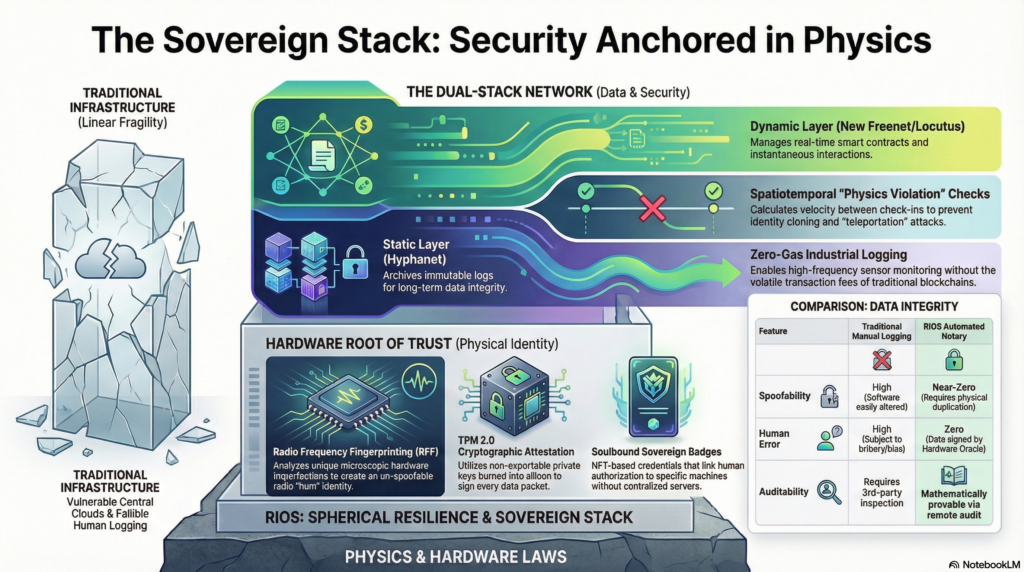
In response, the Rural Infrastructure Operating System (RIOS) introduces the “Trinity Stack”: a synergistic integration of Energy (Agra), Intelligence (RIOS), and Mobility (Kurb Kar). This “Sovereign Stack” replaces linear fragility with spherical resilience, where decentralized nodes function as self-sustaining units capable of verifying their own state and provenance independently of a national backbone. The critical differentiator is the transition from manual logging to the RIOS Automated Notary system, which anchors digital records in the indisputable laws of physics.

https://academy.dereticular.com/podcast/anchoring-digital-trust-in-physical-atoms/

Comparative Reliability: Manual vs. Cryptographic Verification

FeatureTraditional Manual LoggingRIOS Automated Notary
SpoofabilityHigh; software records and paper trails are easily altered or backdated.Near-Zero; requires physical duplication of unique hardware physics.
Human Error/BiasHigh; subject to bribery, oversight, or intentional data entry mistakes.Zero; data is autonomously signed by the “Hardware Oracle” at ingestion.
AuditabilityRequires expensive, periodic third-party physical inspections.Mathematically provable via remote cryptographic audit.

This cryptographic bedrock provides Chief Compliance Officers with mathematically provable origin data, necessitating a sophisticated framework for machine identity that bridges the gap between digital ledgers and physical reality.

Sovereign_Stack_Anchoring_Digital_TruthDownload

——————————————————————————–

2. The Automated Notary: Establishing a Hardware Root of Trust

To ensure digital logs accurately reflect physical reality without human interference, the RIOS framework utilizes a “Hardware Oracle.” This is the strategic solution to the “Oracle Problem”—the risk that a decentralized ledger will record “garbage” if the point of data capture is compromised. By establishing a Hardware Root of Trust, data is cryptographically signed at the moment of capture, ensuring forensic integrity before it ever reaches a network.

The Hardware Root of Trust is synthesized through two core mechanisms:

  • Radio Frequency Fingerprinting (RFF): Utilizing Software Defined Radio (SDR), the system captures the unique “radio accents” of a device. Microscopic manufacturing imperfections in circuitry create unique transient responses and oscillator drifts, forming an un-spoofable digital passport.
  • TPM 2.0 Attestation: Every node incorporates a Trusted Platform Module (TPM) 2.0 chip. A non-exportable private key is “burned” into the silicon at the factory, ensuring the identity cannot be cloned or exported.

The strategic impact of this “Logic of Machine Identity” is best illustrated by the HempGrade application. In this scenario, an AI-enabled camera determines crop quality and signs the data via the TPM. This prevents farmers from bribing inspectors to inflate grades, as the data is mathematically bound to a specific, physically verified device at a precise spacetime coordinate. By fulfilling geolocation and time-stamped production mandates, the system prevents Sybil Attacks, where fraudulent actors create multiple digital identities to subvert the network. This foundational identity allows for the secure movement of assets across the decentralized grid.

——————————————————————————–

3. Spatiotemporal Provenance: The Exit Visa and Handover Protocol

Strategic compliance demands “Topology Awareness” and an unbroken “Chain of Custody.” As assets—such as Kurb Kar autonomous pods—move between decentralized nodes in a mesh network, the framework maintains trust through a rigorous handover protocol. This ensures that assets follow a contiguous physical path, providing verifiable local provenance even in “Island Mode” (offline).

The Handshake Protocol for the Exit Visa system follows a four-step procedure:

  1. Exit Request: As an asset reaches the edge of a node’s signal, it requests an “Exit Visa.”
  2. Signing the Visa: The current node signs a digital packet containing the asset’s ID, an exit timestamp, and the node’s own signature.
  3. Arrival: Upon entering the next node’s range, the asset presents this visa.
  4. Verification: The new node verifies the previous signature, proving the asset physically traversed the distance.
Anchoring Digital Truth to Physical Atoms

To detect “teleportation attacks” (Physical Double-Spends), the system calculates the required velocity (V_{req} = \Delta d/\Delta t) using the Haversine distance. If V_{req} exceeds the V_{max} constant of 120 km/h for ground units, the connection is rejected. Furthermore, the system utilizes Verifiable Delay Functions (VDFs) to defend against Wormhole Attacks, where attackers attempt to “tunnel” traffic between distant nodes to make them appear adjacent. To balance security with the “Cypherpunk” ethos of privacy, RIOS utilizes zk-SNARKs (Zero-Knowledge Succinct Non-Interactive Arguments of Knowledge), allowing nodes to verify an unbroken path without compromising the entity’s sensitive GPS history. This links physical movement to the human authorization required for system governance.

——————————————————————————–

4. Decentralized Identity: The Sovereign Badge for Human Authorization

The RIOS architecture operates on a “Dual-Entity Model,” pairing rigid machine identity with verified human intent. This pairing is facilitated by the Sovereign Badge, a “Soulbound” NFT-based credential issued by the DeReticular Academy. These badges are non-transferable, ensuring that human authority cannot be traded or compromised.

Sovereign Badge NFT Metadata

FieldDescription
Role_ClassThe specific permission level (e.g., Level 5: Safety Override).
Recipient_DIDThe Decentralized ID of the verified human operator.
Soulbound_FlagBoolean flag locking the token to the recipient’s wallet.

When an operator interacts with a node, they must complete a five-phase Human-Machine Handshake:

  1. Proximity: Discovery via local mesh (WiFi 7/5G).
  2. Challenge: The node issues a cryptographic nonce.
  3. Signed Response: The operator signs the challenge using the private key associated with their Badge.
  4. Local Verification: The node verifies the signature and the Badge’s status against a local revocation list.
  5. Privilege Escalation: The node grants a temporary session token.

This creates a “Dual-Signed Object”—a log entry containing both the machine’s TPM attestation and the human’s badge signature. For high-privilege actions like factory resets, the system enforces the “Four-Eyes Principle,” requiring Multi-Sig authorization from two separate Sovereign Badges. This provides definitive proof for regulatory audits that a specific action was authorized by certified personnel on a verified machine.

——————————————————————————–

5. Data Architecture: The Dual-Stack Storage Strategy

Effective compliance requires a bifurcated storage strategy, contrasting the need for real-time industrial state (“CPU”) with long-term, censorship-resistant archival (“Hard Drive”).

Dual-Stack Functional Breakdown

Layer RoleProtocolData TypesUpdate SpeedPersistence Model
Static LayerHyphanet (Legacy Freenet)Firmware binaries, audit logs, certificates.Slow (Hours)Content Hash Keys (CHKs)
Dynamic LayerNew Freenet (Locutus)Voltage logs, state contracts, energy credits.Real-time (ms)State Deltas

The “Zero-Gas Model” of the New Freenet is a critical strategic advantage, enabling high-frequency industrial logging without the volatile costs of traditional blockchains. This ensures that high-integrity compliance is economically viable for small-scale producers. Furthermore, when nodes operate in “Island Mode,” RIOS utilizes Conflict-Free Replicated Data Types (CRDTs) to merge local logs back into the global state contract once connectivity is restored. This architecture provides Non-Repudiation; because logs are published to Hyphanet’s static layer, they cannot be retroactively altered, ensuring a forensic audit trail for regulators.

——————————————————————————–

6. Compliance Risk Analysis and Implementation Gaps

While the framework is mathematically robust, strategic implementation must account for the current maturity of decentralized physical infrastructure (DePIN).

SWOT Analysis: RIOS Framework for Global Transparency

StrengthsWeaknesses
Physical-Digital Bridge: RFF/TPM prevent Sybil attacks and identity spoofing.Experimental Software: Reliance on New Freenet (Locutus) alpha/pre-beta versions.
Offline Resilience: “Island Mode” and CRDTs allow functionality without backbone.Hardware Fragility: If TPM or RFF sensors drift, the physical identity is lost.
OpportunitiesThreats
Regulatory Fit: Direct alignment with EUDR “non-repudiation” requirements.RFF Deepfakes: AI-driven advances attempting to spoof radio “accents.”
DePIN Sector Growth: Expansion into sovereign infrastructure markets.Regulatory Hostility: Opposition to encrypted, decentralized infrastructure.

Three critical hurdles, categorized under the “Empty OS Problem,” currently limit immediate large-scale deployment:

  1. The Application Layer Gap: RIOS requires the development of user-facing applications to move beyond command-line complexity.
  2. Human-Machine Interface Complexity: Simplification of cryptographic key management is necessary for non-technical users.
  3. Technology Maturity: Critical infrastructure deployment on pre-beta software necessitates private, stabilized protocol forks.

The “Flood the Forge” initiative is currently underway to address these gaps. Despite these challenges, the RIOS framework represents a paradigm shift toward Physical Truth. Compliance is no longer a matter of trusting human testimony; it is an indisputable certainty enforced by the laws of mathematics and physics.

  • « Go to Previous Page
  • Page 1
  • Page 2
  • Page 3
  • Page 4
  • Interim pages omitted …
  • Page 25
  • Go to Next Page »

DeReticular

Copyright © 2026 · Monochrome Pro on Genesis Framework · WordPress · Log in