Beyond the Cloud 4 Surprising Ways Sovereign AI is Reclaiming the Physical World
For the last decade, we have lived under the “Privacy Paradox”: a Faustian bargain where users surrender their most sensitive data to Big Tech cloud servers in exchange for advanced AI convenience. Whether it is a developer pushing proprietary source code to a remote reviewer or a homeowner installing a “smart” camera that streams their living room to a central data center, the price of intelligence has been the total erosion of digital sovereignty. This centralized model is not just a privacy risk; it is a structural fragility.
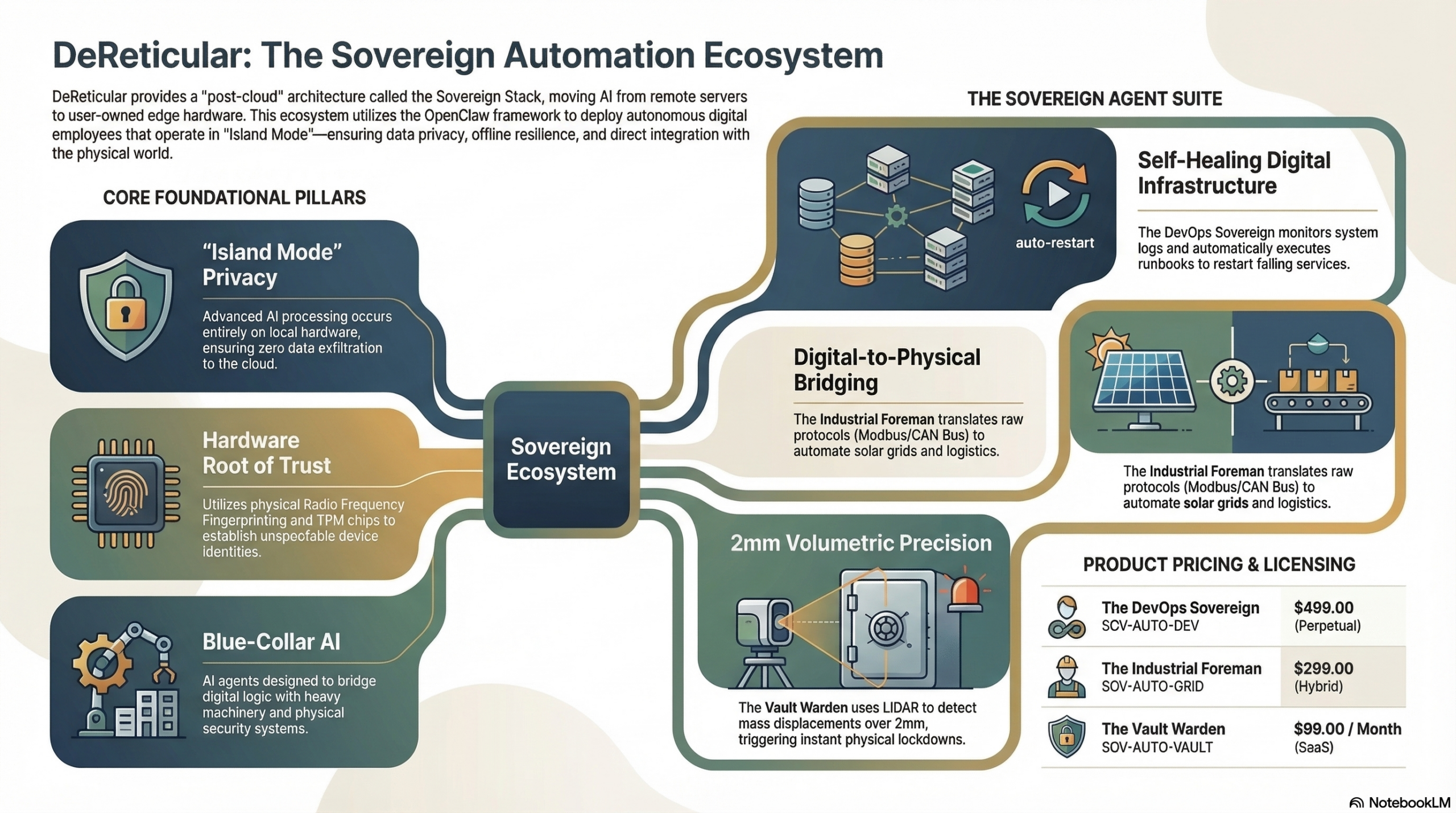
DeReticular, a specialized venture studio and architecture firm, is dismantling this paradigm through their “Sovereign Infrastructure” philosophy. By engineering a post-cloud architecture, they are shifting intelligence away from remote, multi-tenant data centers and onto ruggedized edge hardware owned and controlled entirely by the user. This is RIOS (Rural Infrastructure Operating System)—the foundational stack for a world where AI is local, air-gapped, and physically grounded.
Island Mode: The End of the Data Leak
In high-stakes development, sending intellectual property to a cloud-based LLM for a code audit is a non-starter for any security-conscious CTO. DeReticular’s “DevOps Sovereign” (powered by the OpenClaw Deep Admin framework) solves this by operating in “Island Mode”—a technical state where the system remains strictly air-gapped from the public internet.
This isn’t lightweight software. To run its localized intelligence engine—a Llama-3-8B-Instruct-v2 quantized to 4-bit—the DevOps Sovereign requires the 32GB RAM and 8-core CPU of the Sentry Pro hardware node. This allows for deep semantic analysis of code commits without a single byte exfiltrating the local network.
“The DevOps Sovereign serves as an air-gapped code reviewer, log sentinel, and self-healing system administrator.”
By integrating directly with local Git servers (Gitea or GitLab), the agent scans for hardcoded credentials and SQL injections. It acts as a “Log Sentinel,” using its LLM to parse system logs and differentiate between routine noise and genuine SSH brute-force attacks, triggering immediate pfSense firewall bans at the perimeter. For the modern enterprise, post-cloud architecture isn’t a luxury; it’s a requirement for IP survival.
Blue-Collar AI and the Industrial Bridge
While Silicon Valley is obsessed with chatbots that write poetry, DeReticular champions “Blue-Collar AI”—intelligence that manages heavy machinery and energy flows. The “Industrial Foreman” acts as the critical bridge between digital logic and physical industrial protocols.
The hardware is the hero here: the system utilizes a specialized USB-to-RS485 adapter built on a genuine FTDI Chipset. This allows the AI to “speak” directly to heavy equipment via Modbus RTU, CAN Bus, and NMEA 0183, translating raw electrical signals into readable JSON.
- The Grid Balancer: In off-grid clinics or farms, the AI polls solar inverters and battery states. If it detects a State of Charge (SoC) over 95%, it autonomously routes excess power to “dump loads” like water heaters or irrigation pumps.
- The Supply Chain Diplomat: On mobile “Nomad” nodes, the AI utilizes GPS geofencing to detect border proximity, automatically generating and cryptographically signing customs manifests via LTE as the vehicle approaches a crossing.
Crucially, this system respects the laws of physics. To prevent digital logic from damaging expensive hardware, the Foreman enforces a mandatory “Hysteresis” delay. This 5-minute safety dampener prevents the AI from rapidly toggling physical relays, ensuring that system efficiency never comes at the cost of mechanical failure.
Spectral Provenance: AI That Sees Pigment, Not Just Pictures
Physical assets are only as valuable as their provenance is verifiable. The “Vault Warden” (from the Provada Security Suite) reclaims physical security by fusing LiDAR and multispectral cameras to create a 3D “Volumetric Cage” around high-value items.
The system goes beyond simple motion detection. Using a custom vision engine, it performs “Spectral Provenance” checks, zooming into random keypoints on an asset to verify pigment density and canvas weave against a recorded “Golden State” baseline. If a mismatch is detected—suggesting a forgery or a physical swap—the system executes a “Ledger Burn.” This trustless mechanism instantly marks the asset’s digital counterpart as compromised on a public ledger, ensuring the digital value of a physical forgery is destroyed in real-time.
Furthermore, the Warden is built for resilience. If a thief cuts the building’s power or Wi-Fi, the “Nomad Failover” kicks in. Using a Battery Elimination Circuit and an LTE uplink, the node blasts a high-priority theft alert to the owner, ensuring the AI remains an active defender even when the grid fails.
The Self-Healing SysAdmin
The final layer of sovereignty is the ability of a system to maintain itself without human intervention. The Sovereign Automation line features a “Self-Healing” capability managed by a SystemD Watchdog.
Imagine a glowing green wireframe limb—a digital hand reaching into the physical server rack to rectify a “Service Failed” error before a human even sees the ticket. This is the reality of DeReticular’s auto-restart logic. When the system detects a non-zero exit code on a critical service, the AI executes localized runbooks to restart the service and verify uptime.
To eliminate the risk of “hallucinations”—where an AI might execute a rogue or destructive command—DeReticular employs “Senior SysAdmin Mode.” This is a specialized, JSON-based System Prompt Library that constrains the LLM’s behavior. It forces the AI into a conservative, security-first posture that prioritizes system stability over creative problem-solving, ensuring that only verified, safe commands are ever executed on the host.
The New Architecture: Hardware as the Root of Trust
This paradigm shift relies on a “Sovereign Stack” where software is only as strong as the hardware it inhabits. DeReticular’s Sentry (stationary) and Nomad (mobile) nodes utilize a Hardware Root of Trust. By employing Radio Frequency Fingerprinting and TPM (Trusted Platform Module) chips, each node possesses an unspoofable identity layer. The result is a post-cloud ecosystem where identity isn’t managed by a centralized provider, but by the physical silicon sitting in your own rack.
For those ready to exit the centralized grid, the deployment is as simple as a one-line installer:
curl -sL https://install.dereticular.com/devops | sudo bash
Conclusion: A Sovereign Future
DeReticular is not just selling software; they are engineering a return to autonomy. By isolating intelligence inside user-owned, hardware-verified nodes, they have proven that advanced automation does not require a connection to the “Big Tech” mothership.
As we move toward a future where AI manages our grids, secures our wealth, and reviews our code, the fundamental question of the digital age remains: Do you truly own your intelligence if it lives on someone else’s server?