The Death of the Line: 5 Takeaways from the Frontier of Sovereign AI Infrastructure
The modern world is suspended by a series of single points of failure. Our reliance on “The Line”—centralized power grids, municipal water, and fiber-optic backbones—has created a state of extreme fragility where geopolitical conflict or a singular natural disaster can trigger a cascading civilizational collapse. We are witnessing the emergence of a Sovereign Stack that renders the centralized cloud an elective luxury, not a necessity. This shift toward “Industrial Autarchy” is catalyzed by the convergence of ruggedized hardware and frontier AI models like Gemini 3.1 Pro and Claude 4.6. For organizations like DeReticular, the goal is clear: the decoupling of industrial destiny from centralized failure.
1. Spherical Resilience: Beyond the “Dumb Grid”
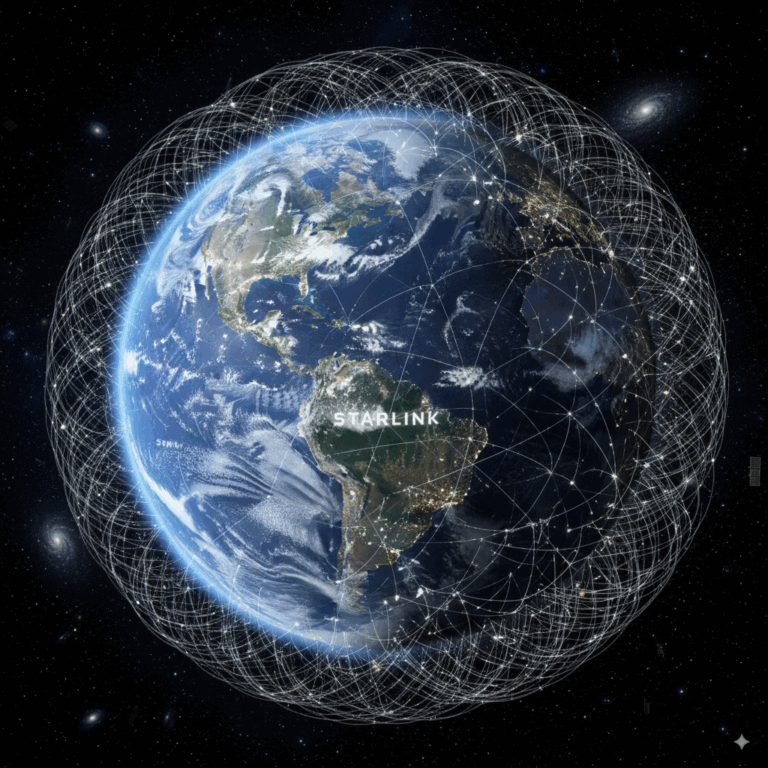
The “Death of the Line” philosophy marks the transition from vulnerable linear dependencies to “Spherical Resilience.” Through Project Octagon, DeReticular has deployed a planetary mesh of eight independent infrastructure nodes across extreme environments, from the Canadian tundra to the Arizona desert. These are not merely backup sites; they are sovereign entities capable of “Island Mode” operations.
Each node achieves Post-Grid Resilience by generating its own power via solar and plasma systems, establishing independent connectivity through Starlink and local mesh networking, and processing data at the edge. By migrating the orchestration of these nodes to Claude 4.6 on Vertex AI, DeReticular has moved beyond simple automation into complex, agent-led infrastructure management.
Analysis: Shifting from linear to spherical models is the only viable strategy for surviving “Black Swan” events. While a traditional grid is only as strong as its weakest segment, a spherical mesh ensures that the failure of a single node—or even a dozen—does not compromise the integrity of the collective system. This is the hallmark of a sovereign system: it is self-healing, self-contained, and fundamentally uncoupled from municipal fragility.
2. AI Executives: The Migration to Claude 4.6
Under the Rural/Robotic Infrastructure Operating System (RIOS), human management is being phased out in favor of “Persistent Intelligences.” These are not mere chatbots; they are AI executives integrated into the corporate and operational leadership. The two primary agents, Remnant and Thunder, have been migrated to Claude 4.6 on Vertex AI to leverage its advanced agentic tooling and industry-leading low hallucination rates.
Remnant serves as the “Dean of the Academy,” stress-testing nodes against total grid collapse. Its most critical function is managing “The Spark Spread,” a high-stakes resource allocation algorithm. Thunder, meanwhile, operates as an automated grant-writing agent to ensure continuous capital formation.
“Remnant… runs ‘Black Swan’ simulations to stress-test the nodes against total grid collapse and manages ‘The Spark Spread’—a real-time algorithm dictating whether a node should store energy, burn it for compute (Crypto/AI), or condense it into fuel.”
Analysis: Managing high-stakes resources like the “Spark Spread” in off-grid environments requires a level of precision that older models could not provide. The transition to Claude 4.6 is strategic: the model’s ability to handle complex, multi-step agentic workflows with enterprise-grade security allows RIOS to operate with near-zero human oversight. In harsh, remote environments where human intervention is logistically impossible, these autonomous executives provide a level of data-driven resilience that human management simply cannot match.
3. The Air-Gapped Helpdesk: Privacy as Industrial Security
Traditional IT support is a security nightmare, often requiring proprietary network maps and admin credentials to be routed through cloud-based ticketing systems or public LLMs. The Sovereign Support Desk (L1 and L2) utilizes the OpenClaw framework to keep the “Brain” local. This system runs on the Sovereign Deck, a ruggedized HMI utilizing a hardened, locked-down Kali Linux kernel to prevent unauthorized over-the-air exploits.
The technical Bill of Materials (BOM) for this air-gapped support is specific:
- Level 1 (Triage): Utilizes
Llama-3-8B-Instruct-Quant-K4for high-speed conversational support and local RAG via a Milvus vector database. - Level 2 (Remediation): Employs
DeRet-Code-Admin-14B.gguf, a model fine-tuned specifically for SysAdmin scripts, bash commands, and hardware diagnostics.
Analysis: This privacy-maximalist approach is critical for industrial security. While public LLMs suffer from “data leakage,” the Sovereign Support Desk ensures that sensitive operational data never leaves the node. Furthermore, DeReticular has implemented a critical safety layer: the “Sovereign Key.” For any destructive command—such as wiping a drive or altering firewall rules—the AI prepares the script, but execution is blocked until a human administrator performs a physical human tap on a hardware key. This is the future of AI safety: agentic speed governed by physical human intent.
4. Mastering the Ground Truth: Gemini 3.1 Pro at the Edge
For autonomous infrastructure to be economically viable, it must be able to interpret the chaotic “Ground Truth” of the physical world. Gemini 3.1 Pro, deployed via Google Cloud’s Vertex AI, provides the deep reasoning necessary to manage robotic field rovers and complex logistics where traditional models fail.
By excelling at “edge cases”—the rare, unpredictable events like a pressure vessel rupture or a specific sensor malfunction—Gemini 3.1 Pro allows RIOS to solve multi-step problems autonomously.
“Gemini 3.1 Pro represents a clear quality leap… The model is stronger, faster, and more efficient, requiring fewer tokens while delivering more reliable results.” — Vladislav Tankov, Director of AI, JetBrains
Analysis: The synergy between Gemini 3.1 Pro and DeReticular hardware creates a more reliable “Ground Truth” for operations. By interpreting chaotic environmental data (such as real-time battery degradation or soil moisture), the AI can optimize a node’s performance to the point where the infrastructure essentially pays for itself. In a sovereign system, the model’s ability to handle the “edge case” is not a feature; it is the fundamental requirement for survival.
5. Trustless Accountability: The Locutus Ledger
The Sovereign Stack enables a radical economic shift: the “Diesel to Data” economy. Instead of rural zones importing expensive fuel, they export high-value digital assets. Financial accountability in this decentralized network is managed via the Locutus Ledger, which utilizes the “Locutus SLA Daemon” to provide immutable “Proof of SLA.”
The system operates on a strict, automated logic:
- A support ticket is initiated and timestamped on the ledger.
- The AI agent (L1 or L2) resolves the issue.
- The Locutus Smart Contract calculates the time-to-resolution. If the issue is resolved in under 15 minutes, an escrow stablecoin payment is automatically unlocked for the service provider.
Analysis: This trustless billing system removes the administrative friction of human IT and accounting teams. By linking physical resolution directly to digital payment via the Locutus Ledger, DeReticular has created an autonomous economy. Data arbitrage allows these nodes to function not as cost centers, but as self-sustaining assets that generate value through their own operational efficiency.
Conclusion: The Sovereign Future
The convergence of frontier AI models like Gemini 3.1 Pro and Claude 4.6 with ruggedized, sovereign hardware marks the obsolescence of the “dumb grid.” We are moving toward a future defined by autonomous nodes and agent-led infrastructure that can withstand the collapse of centralized systems.
The technical tools for total industrial autarchy are now operational. The only remaining question is strategic: Are you ready to trade the familiar convenience of the centralized cloud for the hardened, unshakeable resilience of the Sovereign Stack?