RIOS Provenance Tracking: Compliance Analysis for Global Transparency Standards
1. Strategic Context: The Shift Toward Physical Truth
In the contemporary regulatory landscape, global supply chains are under unprecedented pressure to move beyond paper-based assurances toward immutable proof of origin. The EU Deforestation Regulation (EUDR) exemplifies this shift, mandating that commodities entering the European market provide precise geolocation coordinates and time-stamped proof of production. For a Chief Compliance Officer, the strategic imperative is clear: the industry must transition from “trusted” manual data entry, which is inherently vulnerable to fraud and human error, to “trustless” cryptographic verification. RIOS (Rural Infrastructure Operating System) facilitates this by providing attested data that survives legal and forensic scrutiny.
To address the “Linear Fragility” of traditional centralized utility and data grids, DeReticular has introduced the “Sovereign Stack.” This architecture is designed to create resilient, self-sustaining nodes capable of functioning independently of national backbones.
The Philosophy: The Death of the Line The Sovereign Stack marks a transition from “Linear Fragility”—the reliance on long, vulnerable supply and power lines—to “Spherical Resilience.” In this model, decentralized nodes function as self-sustaining, independent units capable of verifying their own state and provenance, ensuring that “The Line” is no longer a single point of failure.
The objective of this report is to evaluate how RIOS solves the “Oracle Problem”—the challenge of ensuring digital logs accurately reflect physical reality—by anchoring data directly to physical hardware.
——————————————————————————–
2. The Automated Notary: Establishing a Hardware Root of Trust
In high-stakes industries like energy (via Agra Energy units) and agriculture, manual logging is a primary regulatory liability. RIOS serves as an “Automated Notary,” solving the “Garbage In, Garbage Out” (GIGO) problem by acting as a Hardware Oracle. By ensuring data is cryptographically signed at the point of ingestion before it ever touches a network, RIOS eliminates the opportunity for data manipulation or human interference.
Key Technical Differentiators:
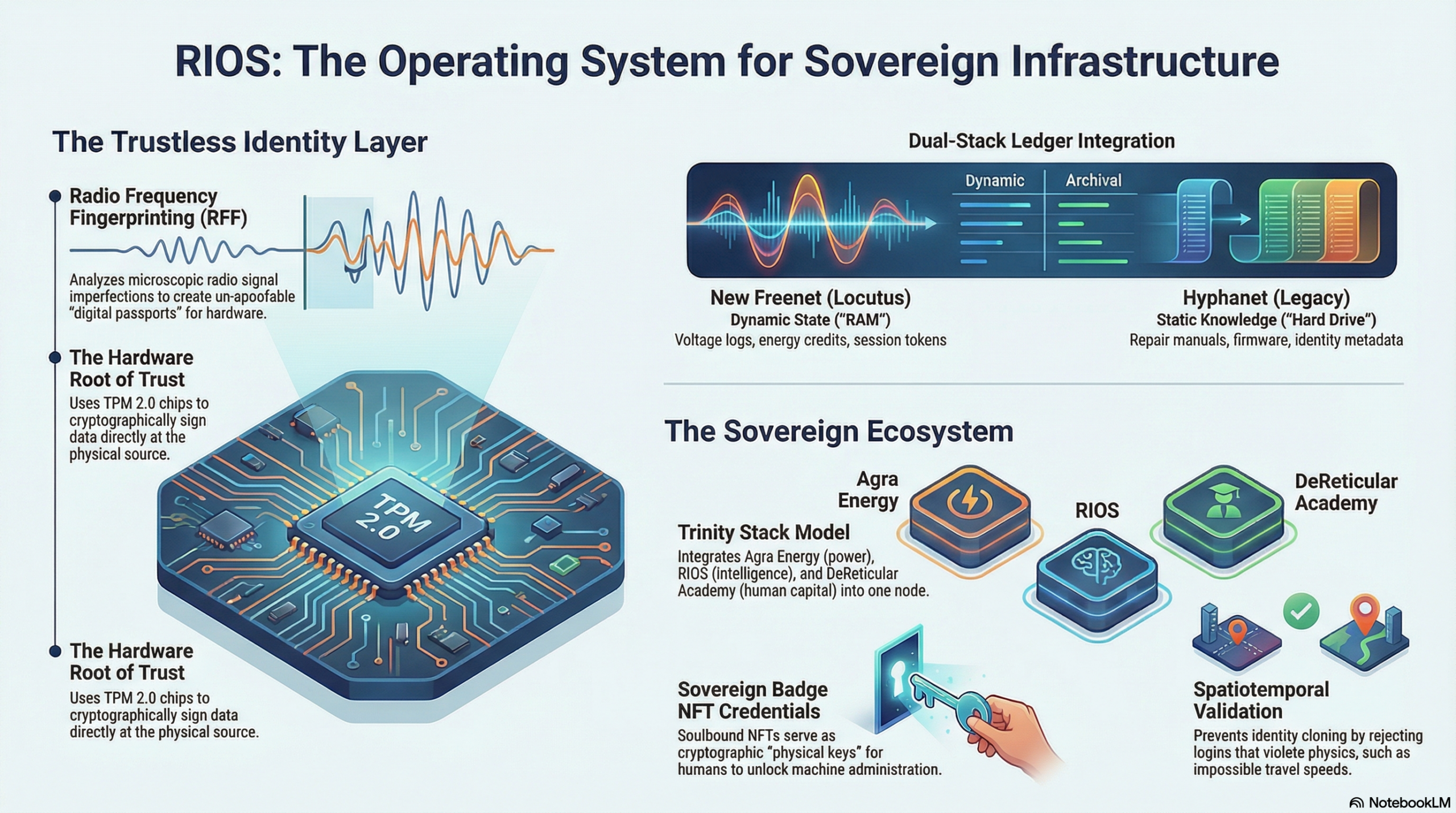
- Radio Frequency Fingerprinting (RFF): Utilizing Software Defined Radio (SDR), RIOS captures the microscopic imperfections in the circuitry of electronic devices. This unique radio frequency “hum” creates an un-spoofable digital passport, ensuring the hardware is physically authentic.
- TPM 2.0 Attestation: Every RIOS node incorporates a Trusted Platform Module (TPM) 2.0 chip. A non-exportable private key is “burned” into the hardware at the factory, used to sign every data packet with a mathematical certainty that software cannot replicate.
The Logic of Machine Identity
| Parameter | Traditional Manual Logging | RIOS Automated Notary |
| Spoofability | High; software/records easily altered. | Near-Zero; requires physical duplication of hardware physics. |
| Human Error/Bias | High; subject to bribery or oversight. | Zero; data is signed by the “Hardware Oracle.” |
| Auditability | Requires 3rd-party physical inspection. | Mathematically provable via remote cryptographic audit. |
The Strategic Impact: This dual-layer verification prevents “Sybil Attacks,” where actors create fake identities to flood a network. In the HempGrade application, for instance, an AI camera determines crop quality and signs the data via TPM. This prevents farmers from bribing inspectors to inflate grades, as the data is mathematically tied to the specific, physically verified device at the moment of capture.
——————————————————————————–
3. Trustless Identity: State Management and Global Polling
To track asset uniqueness without central cloud servers, RIOS utilizes a decentralized state machine. The network manages the “who, where, and when” of any identity through the New Freenet (Locutus) layer.
Global Identity Polling and Distributed State Contracts: Rather than flooding the network with broadcasts, RIOS queries “Distributed State Contracts” written in WebAssembly (Wasm). When an asset connects, the local node polls the specific subset of peers maintaining that identity’s hash address to verify its current status (e.g., “Active” or “In-Transit”).
Spatiotemporal Validation (Physics Violation Detection): RIOS applies “Double-Spend” logic to physical assets. If a hardware identity attempts to connect to a node in Texas while its state contract shows it active in Uganda, the system calculates a Physics Violation using the Haversine distance (Δd) between nodes and the time delta (Δt) since the last heartbeat:
- V_{req} = Δd/Δt
- If V_{req} > V_{max} (the maximum believable velocity), the connection is rejected as an impossible “teleportation” attack and the identity is locked.
The Sovereign Badge System: Human operators use NFT-based “Sovereign Badges” issued by the DeReticular Academy.
- Soulbound Nature: These are non-transferable credentials that link a human’s competence (e.g., Certified RIOS Admin) to their cryptographic wallet.
- Trustless Chain of Custody: To perform maintenance, an operator must provide a dual-signature: the Machine (TPM) signature plus the Human (Badge) signature. This is reinforced by the “Exit Visa” mechanism, where the previous node signs the asset “out” of its range, providing local provenance that remains verifiable even in “Island Mode” (offline).
——————————————————————————–
4. The Dual-Stack Architecture: Hyphanet and New Freenet
RIOS utilizes a dual-stack decentralized protocol to separate static archival data from dynamic industrial state.
Dual-Stack Functional Breakdown
| Protocol Layer | Function | Use Case in RIOS |
| Hyphanet (Legacy Freenet) | Static Layer: Censorship-resistant archival. | Repair manuals, firmware binaries, and immutable audit logs. |
| New Freenet (Locutus) | Dynamic Layer: Wasm-based state management. | Real-time voltage logs (Agra Energy), state contracts, and energy credits. |
Economic Accessibility and the Zero-Gas Model: Traditional blockchains often trend toward “Plutocracy,” where high transaction fees exclude small-scale rural producers. The New Freenet’s Zero-Gas model allows for high-volume industrial logging—recording sensor data every second—without the volatile costs of gas-based chains. This ensures compliance is economically viable for small-scale farmers in remote regions.
——————————————————————————–
5. Regulatory Mapping: Meeting EUDR and Transparency Mandates
RIOS provides a robust framework for meeting the “non-repudiation” requirements of global trade.
- Mathematically Provable Origin: By linking RFF signatures to TPM-signed GPS logs, commodities are tied to a specific plot of land, fulfilling EUDR geolocation mandates.
- Unforgeable Chain of Custody: The handover protocol using “Exit Visas” ensures the physical path of a commodity is contiguous and hasn’t been tampered with in “dark” zones.
- Censorship-Resistant Archival (Non-Repudiation): Because logs are published to Hyphanet’s static layer, they cannot be retroactively deleted or altered. An organization cannot “hide” a record of deforestation if a regulator requests the history of a node.
This allows a buyer in London to verify the history of a farm in Uganda without an intermediary, relying instead on the physics and math of the Sovereign Stack.
——————————————————————————–
6. Risk, Gaps, and Strategic Limitations
A strategic adoption of DePIN (Decentralized Physical Infrastructure) requires addressing critical vulnerabilities.
SWOT Analysis
| Strengths | Weaknesses |
| Solves the Oracle Problem via RFF/TPM. | Reliance on experimental Alpha software (New Freenet). |
| Offline resilience via “Island Mode.” | Hardware Fragility: If TPM/RF sensors drift, identity is lost; no “password reset.” |
| Opportunities | Threats |
| EUDR market fit and DePIN sector growth. | AI-driven “Deepfake” RFF spoofing attacks. |
| “Flood the Forge” developer expansion. | Potential regulatory hostility toward sovereign encryption. |
The Application Layer Gap: The primary hurdle is the “Empty OS” problem. While the backend is robust, there is a lack of UI/UX bridges for non-technical users. The “Flood the Forge” initiative is critical; without a simplified interface, these command-line tools remain inaccessible to the rural populations they are intended to serve.
Strategic Summary: RIOS represents a leap in “Physical Truth” for compliance, yet it remains in an advanced innovation phase. Its success depends on the stability of New Freenet and the ability of the developer ecosystem to bridge the current UI/UX gap. For now, it offers the only viable path to mathematically provable, trustless provenance.