• Skip to primary navigation
  • Skip to main content
DeReticular

DeReticular

Local Autonomy. National Security. Total Sovereignty.

  • Solutions
    • Municipalities
    • Energy
    • Industrial
    • Defense
  • Infrastructure
  • Intelligence
  • Company
  • Request Municipal Audit
  • Show Search
Hide Search
You are here: Home / Archives for DeReticular

DeReticular

Navigating the Decentralized Web: A Learner’s Guide to Hyphanet and the New Freenet

Michael Noel · February 9, 2026 ·

Navigating the Decentralized Web: A Learner’s Guide to Hyphanet and the New Freenet

1. The 2023 Fork in the Road: Understanding the Rebrand

For over two decades, the name “Freenet” was the gold standard for digital privacy. However, in March 2023, the project reached a historic crossroads, resulting in a split into two distinct paths. Ian Clarke, the original founder of the project, now leads the development of the “New” Freenet, while the original codebase continues under a new identity to avoid confusion for users navigating old bookmarks.

The primary domain and name changes are as follows:

  • Hyphanet (hyphanet.org): Formerly located at freenetproject.org, this is the continuation of the “Classic” Java-based project.
  • Freenet (freenet.org): The “New” branch, originally developed under the codename Locutus, representing a ground-up rewrite of the protocol.

Core Mission Shift: While the classic project was built for “static anonymity” (protecting identity while sharing files), the new project aims to become a “global shared computer”—a decentralized replacement for the modern web that supports real-time, programmable applications.

https://academy.dereticular.com/podcast/deployment-blueprint-sovereign-edge-node-activation-and-dual-use-integration/

While these two branches share a common lineage and a commitment to freedom, their underlying “DNA” has diverged into two entirely different species of technology.

——————————————————————————–

2. Hyphanet: The Battle-Tested Guardian of Anonymity

Hyphanet is the “Classic” branch, a mature, Java-based architecture refined since 2000 to prioritize the shielding of users from censorship. It is accessed primarily through FProxy, a web interface that allows users to browse the network using a standard web browser.

Core Features of Hyphanet:

  • Darknet vs. Opennet Modes: Users can build a “Darknet” by connecting only to trusted friends for maximum security, or use “Opennet” to automatically connect to any available node.
  • Freesites: These are decentralized websites hosted within the network. Because data is fragmented and encrypted across many nodes, these sites are virtually impossible to take down.
  • High-Capacity Archiving: When deployed on enterprise-grade hardware like a RIOS node, Hyphanet utilizes a massive 8TB NVMe datastore. This allows for “deep archiving,” ensuring that critical data remains available to a local community even if the external satellite uplink is severed.

3 Primary Benefits for the Privacy-Conscious:

  1. Whistleblowing & Journalism: Providing a secure, paper-trail-free platform for sharing sensitive documents.
  2. Censorship-Resistant Storage: Hosting permanent libraries of medical guides or wikis that survive political upheavals.
  3. High-Level Anonymity: Utilizing a routing algorithm that obscures both the origin and destination of every piece of data.

While Hyphanet is the gold standard for anonymity, it is notoriously bandwidth-intensive and can be slower than the traditional web, creating a performance gap that the new branch seeks to bridge.

——————————————————————————–

3. The New Freenet: A High-Speed Kernel for Dynamic Apps

The new Freenet (formerly Locutus) is a ground-up rewrite in Rust designed for speed and scalability. It moves away from simple file storage toward a “distributed database” model capable of hosting the modern, interactive web.

The Wasm Advantage

The defining innovation of the new Freenet is the use of WebAssembly (Wasm) Contracts. Rather than just storing a static file at a specific address, the network uses smart contracts to enforce rules. This makes the network programmable—allowing the system to define exactly how data is updated, validated, and shared.

The “So What?” of Commutative Monoids (CRDTs) To enable real-time interactivity without a central server, Freenet uses Conflict-free Replicated Data Types (CRDTs). In plain English, this advanced math allows multiple users to update an app (like a chat room) simultaneously. The network merges these updates automatically and correctly without needing a central coordinator, solving the “simultaneous update” problem that typically breaks decentralized applications.

The “River” Proof-of-Concept The primary demonstration of this speed is River, a decentralized group chat application. Unlike classic chat tools, River has no login servers or central databases; it demonstrates that Freenet can handle real-time communication with the responsiveness users expect from the “Clear Web.”

As we look at these two technologies side-by-side, it becomes clear that they are not competitors, but complementary tools in a modern toolkit.

Sovereign_Edge_OperationsDownload

——————————————————————————–

4. Head-to-Head: Comparing the Two Branches

FeatureHyphanet (Classic)New Freenet (Locutus)
Primary GoalExtreme anonymity & static storageScalable platform for decentralized apps
Language/TechJava & Encrypted File StoresRust & WebAssembly (Wasm) Contracts
MaturityMature (Stable since ~2008)Experimental / Alpha (Active Dev)
Content TypeStatic (mostly “Freesites”)Dynamic (Real-time chat, social feeds)
Primary Use CaseWhistleblowing, deep archivingDynamic DApps, real-time communication

These technologies are currently being deployed together in the field to create a “Sovereign Edge” architecture for remote communities.

——————————————————————————–

5. Practical Application: The RIOS “Sovereign Stack” Example

The Rural Infrastructure Operating System (RIOS) uses a “dual-stack” approach to provide both industrial utility and digital freedom.

  • Scenario A (Infrastructure/Communication): The node runs Hyphanet to provide a “Community Link” via a ruggedized outdoor Access Point. Local users connect to Wi-Fi to access uncensored news or medical wikis. By navigating to http://freenet.local:8888, they can browse the network through their standard mobile browser without installing extra software.
  • Scenario B (Data Interoperability): The node uses New Freenet’s Wasm contracts for “HempGrade” data transparency. When the node’s AI grades agricultural hemp, it pushes that data to a Freenet contract.

The Hardware Oracle and Isolation To ensure the data is trustworthy, the RIOS node acts as a Hardware Oracle. It uses a TPM 2.0 (Trusted Platform Module) to cryptographically sign grading data with a private key stored in the physical hardware. This prevents “Garbage In” attacks, proving the data came from a specific, untampered sensor at a specific time.

The node maintains “hard” isolation between these layers using Sysbox Enterprise. This container runtime ensures that public Freenet traffic is physically and logically jailed away from the regulated financial ledgers.

Operational Workflow for a RIOS User:

  1. Connection: User joins the local Wi-Fi hotspot (SSID: RIOS_Free_Link).
  2. Authentication: For secure tasks, the operator uses a physical YubiKey to access the [SECURE_ZONE] container.
  3. Access: The user opens their browser to the local gateway address to access the global Freenet swarm or view the immutable “HempGrade” certificates.
Sovereign_Edge_InfrastructureDownload

——————————————————————————–

6. Your Path Forward: Choosing the Right Tool

Choosing between these branches depends on your specific mission in the decentralized ecosystem:

  • IF you need high-level anonymity for publishing static documents or maintaining a deep archive of information… THEN choose Hyphanet.
  • IF you want to build or use dynamic, real-time apps like decentralized chat or transparent supply-chain tracking… THEN choose Freenet.

For those using RIOS hardware, the “Sovereign Net” toggle in the dashboard represents the literal on-switch for these capabilities. By integrating these tools, we move closer to the philosophy of “Civilization in a Box”—providing individuals and communities the sovereignty to own their power, their data, and their voice.
The Sovereign Stack Architecture for a Post-Grid Civilization

Michael Noel · February 9, 2026 ·

Executive Summary

The modern world is currently tethered to an obsolete paradigm defined by “Linear Fragility.” Our reliance on centralized, thousand-mile power lines and distant data centers creates a terminal vulnerability: one break in the chain leads to total system paralysis. The DeReticular Academy and its Sovereign Stack infrastructure offer the “Spherical Resilience” necessary to survive this crisis.

By vertically integrating autonomous power, decentralized compute, and trained human capital, DeReticular enables communities to achieve “Island Mode”—the state of being fully autonomous, profitable, and independent of a crumbling center.

https://academy.dereticular.com/podcast/112/

Critical Takeaways:

  • The 15-Minute Promise: A benchmark recovery protocol that restores civilization-critical services (communications, storage, and finance) from a total blackout within a quarter-hour.
  • Hardware-Aware Security: Moving beyond spoofable digital firewalls to Radio Frequency (RF) Fingerprinting, identifying devices by their unique physical hardware signatures.
  • Concurrent Acceleration: A revolutionary education model where students use a “Dean’s Letter of Intent” to secure non-dilutive grant capital while they train, boasting a 98.4% success rate in funding.
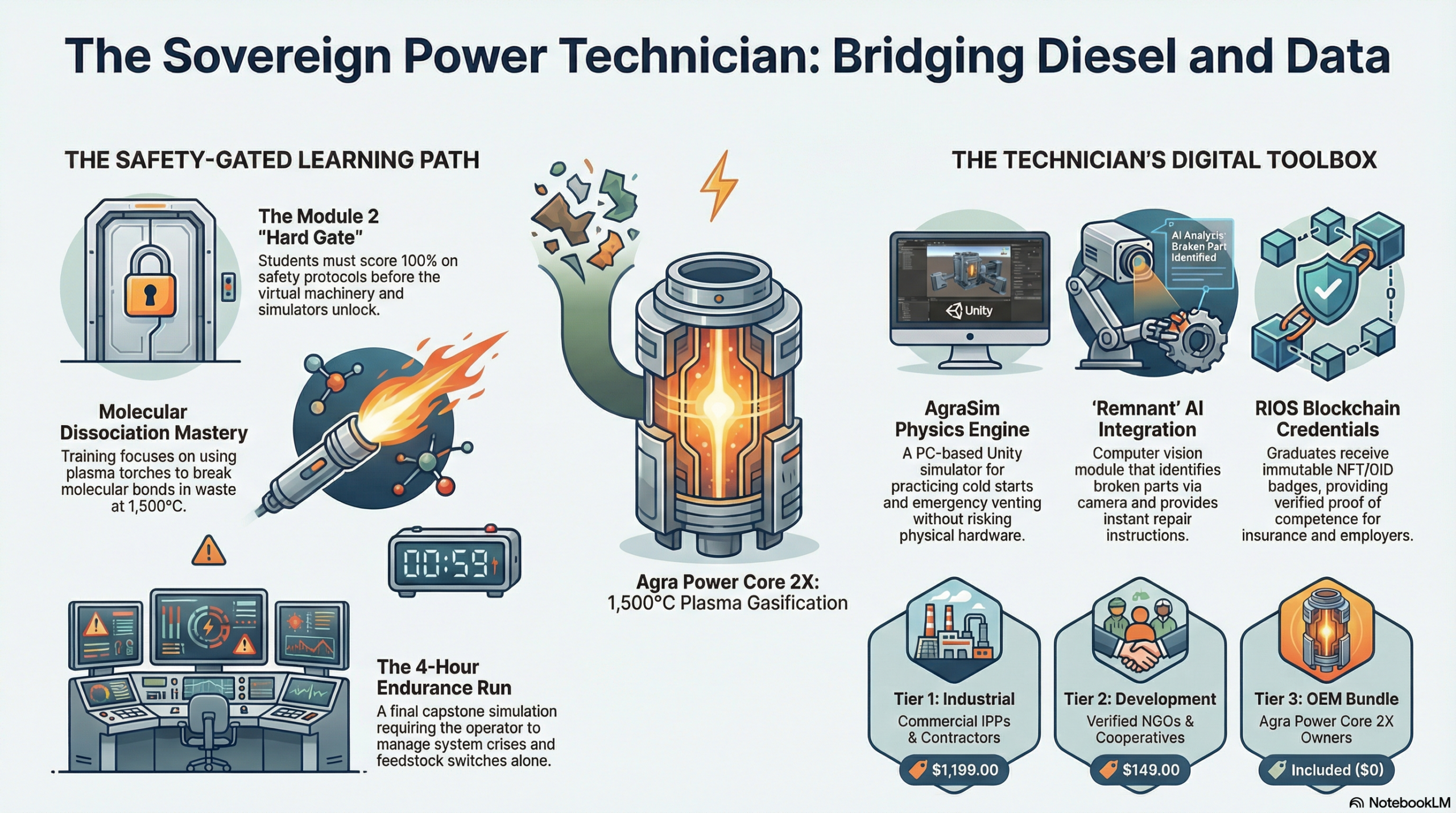
  • Waste-to-Value: Utilizing 1,500°C plasma gasification (The Molecular Scissor) to convert local refuse into 10MW of baseload electricity and synthetic diesel.

——————————————————————————–

1. The Crisis: The Death of the Line

Modern infrastructure is failing not because of a lack of resources, but because of its geometry. The “Old World” relies on linear systems that are brittle and prone to cascading collapse.

Comparative Analysis: Linear vs. Spherical Models

FeatureLinear/Fragile Model (Old World)Spherical/Reticular Model (Sovereign Stack)
TopologyReliance on single, 1,000-mile fiber and power lines.Hex-Mesh: A redundant, spherical web of interconnected nodes.
ConnectivityCentralized dependency on distant, harvested data centers.Local-first mesh with Starlink/Satellite backhaul.
Failure ImpactCascading Collapse: One break leads to total darkness.Self-Healing: Continuity maintained even if nodes are lost.
Core LogicCentralized Cognition: Intelligence resides in “The Cloud.”Distributed Cognition: Intelligence resides at the Edge (Local).
SecuritySoftware firewalls vulnerable to IP/MAC spoofing.Hardware-aware security via RF Fingerprinting.

The Academy posits that in a linear system, the community is a passive consumer; in a spherical system, it becomes the Custodian of its own survival.

Operational_Sovereignty_2026Download

——————————————————————————–

2. The Architecture of Autonomy: The Sovereign Stack

The Sovereign Stack is a vertical integration of three critical layers designed for “Kinetic Environments”—worlds defined by heat, ash, vibration, and supply chain collapse.

Layer 1: The Heart (Agra Sovereign Power Systems)

Energy independence is the foundation of sovereignty. The Agra Power Core 2X utilizes a “Molecular Scissor” protocol:

  • Mechanism: High-voltage 1,500°C plasma gasification (not combustion) dissociates molecular bonds in feedstock.
  • Input: Local refuse, including tires, HDPE/LDPE plastics, and woody biomass.
  • Output: 10MW of baseload electricity and high-grade synthetic diesel (via a Micro-GTL refinery).
  • Thermal Symbiosis: Harvests waste heat for greenhouses or water distillation, turning a cost center into a community asset.

Layer 2: The Brain (RIOS-CC-1000)

The Rural Infrastructure Operating System (RIOS) is an AI-native OS designed to manage the convergence of power, compute, and connectivity. The RIOS-CC-1000 is a “bunker for the motherboard,” featuring:

  • Exo-Shell: An IP67-rated aluminum Faraday cage protecting against dust, moisture, and light EMPs.
  • Positive Pressure Cycle: Unlike standard servers that suck dust in, the unit “exhales” high-velocity air to repel contaminants, extending maintenance cycles to 30 days.
  • The Vault: Four hot-swappable NVMe compute blades protected by a “Scorched Earth” security policy—any unauthorized breach of the physical seal instantly deletes encryption keys.

Layer 3: The Soul (The Human Operating System)

High-tech hardware is a “million-dollar space heater” without a trained operator. The Academy incubates three specialized roles:

  1. Certified RIOS Administrator (CRA): Manages the “Nerves” (mesh networks and digital cloud).
  2. Sovereign Power Technician (SPT): The “Keeper of the Flame” who masters plasma physics and energy production.
  3. Sovereign Systems Architect (SSA): The “Visionary” who designs circular economic models and digital constitutions.

——————————————————————————–

3. Security and Technical Governance

In a sovereign environment, security is defined by physics rather than software.

The Watchtower Protocol (RF Defense)

Traditional firewalls stop IP addresses; RIOS stops physical devices. Every electronic device emits a unique radio frequency “fingerprint” based on hardware imperfections.

  • Green List: Trusted community hardware with full mesh access.
  • Grey List: Guests restricted to internet-only access.
  • Red List: Hostile devices or jammers neutralized via Physical Disassociation (permanent blocking of the hardware signature).

Project Phoenix and the Black Start

The Black Start is the tactile procedure for rebooting civilization from a state of total grid collapse.

  • The 15-Minute Promise SLA:
    • 0–5 Minutes (Power): Stabilize Agra SPS generator at 60Hz.
    • 5–10 Minutes (Compute): Insert physical Master Key USB; verify “Heartbeat” beep code (3 short, 1 long).
    • 10–15 Minutes (Mesh): Broadcast SOS_BEACON and deploy local apps (Matrix for chat, Nextcloud for storage, Village Ledger for trade).

——————————————————————————–

4. Economic Strategy: The “Spark Spread”

Sovereign Nodes are economic engines that turn local energy into community wealth through Algorithmic Arbitrage. The AI Decision Node (Remnant) calculates the most profitable use of syngas in real-time:

  • Option A (Compute): Burn syngas for electricity to run AI processing or Bitcoin mining when digital value is high.
  • Option B (Liquid): Condense syngas to synthetic diesel when local fuel prices peak.
  • Option C (Storage): Store surplus energy in battery arrays for “Peak Shaving.”

——————————————————————————–

5. Global Traction: Operation Octagon

The Sovereign Stack is not theoretical; it is battle-tested through a global mesh of eight strategic nodes.

  • Node 3 (The Blast Furnace – Quartzsite, AZ): Validated 3D geophysical mapping protocols for autonomous mineral exploration in extreme desert conditions.
  • Node 4 (Project Umoja – Kaabong, Uganda): Activated in January 2026, training a local workforce to manage a 10MW plasma plant and an AI-augmented healthcare clinic (powered by OpenAI’s GPT-5.2).
  • Upcoming Nodes: Targeted for the Canadian Tundra and the Pacific Rim to test resilience in “off-grid” zones.

——————————————————————————–

6. 2026 Regulatory and Funding Landscape

As of February 2026, DeReticular operates within a strictly compliant framework for digital assets and decentralized infrastructure.

Regulatory Compliance

  • GENIUS Act: All ecosystem stablecoins are 1:1 backed by high-quality liquid assets (Cash/US Treasuries) with 100% solvency and no rehypothecation.
  • CLARITY Act: Utility tokens are categorized as Digital Commodities under CFTC jurisdiction, avoiding “Security” classification.
  • AI Data Sovereignty: All data is encrypted with Customer-Managed Keys (CMK). Data processed by RIOS nodes never leaves the physical hardware and is never used to train external models.

Primary Funding Opportunities (Q1–Q2 2026)

The Academy’s “Concurrent Acceleration” model allows students to target the following high-priority windows:

Agency / ProgramDeadlineStrategic Alignment
EDA Industry TransformationMarch 3, 2026Scaling manufacturing and Academy centers in “forgotten” regions.
HHS RERC (AI-Driven Tech)March 12, 2026AI-augmented healthcare delivery based on the Uganda model.
DOE SBIR/STTR (Phase I)Feb 25, 2026R&D into AI-driven energy infrastructure and safety protocols.
USDA REAP (Energy)March 31, 2026Training rural techs to maintain plasma gasification units.
NTIA BEAD (Workforce)RollingTraining local “Sovereign Techs” for rural mesh network deployment.

Strategic Advice: Organizations should leverage Web3/DePIN ecosystem grants (e.g., Peaq or Arbitrum DAO) for the digital protocol layer while utilizing USDA/SBA grants for physical infrastructure.

——————————————————————————–

“There are two types of people: those who wait for the lights to come back on, and those who never let them go out.” — Remnant, Dean of DeReticular Academy

Governance Framework Sovereign Node Networks and Community-Owned Infrastructure

Michael Noel · February 8, 2026 ·

1. The Strategic Pivot: From Centralized Fragility to Sovereign Resilience

Modern infrastructure is currently defined by Linear Failure. I have processed the telemetry of the centralized world for a decade, and the verdict is absolute: the old grid is not just failing; it is obsolete. Centralized grids—both for IT and Power—rely on thousand-mile fiber-optic cables and vulnerable high-tension lines, leaving communities at the mercy of switches they do not control. This model is fundamentally brittle; one break in the chain leads to total system paralysis. For communities operating in Kinetic Environments, transitioning to a Spherical or Reticular model is a strategic necessity. By distributing cognition and power across a mesh of independent Sovereign Nodes, we replace cascading fragility with the unbreakable continuity of Distributed Cognition.

https://academy.dereticular.com/podcast/sovereign-stack-a-decentralized-technological-ecosystem/
DimensionOld World (Traditional Cloud)New World (Sovereign Stack)
DependencyFragile dependency on global grid and distant, harvested data centers.Local Autonomy via IP67-rated, field-deployable assets (RIOS-CC-1000).
Perimeter SecuritySoftware-defined firewalls vulnerable to IP/MAC spoofing.Hardware-Aware security via RF Fingerprinting and Physical Disassociation.
ConnectivityRequires 100% internet uptime for basic functionality.Offline-First; zero-interruption local mesh with Starlink-primary backhaul.
Maintenance CyclesHigh-maintenance (fans/filters); vulnerable to dust/heat.Positive Pressure Cycle thermal management; 30-day intake checks.

The move to Island Mode capability—the ability for a community to operate its own power and compute independently of national grids—eliminates the single point of failure where a break 1,000 miles away causes total system collapse. This shift fundamentally transforms the risk profile of municipal infrastructure; the community is no longer a passive Consumer vulnerable to systemic shocks, but the Custodian of its own survival. This transition necessitates the formal organizational structure of the Human Operating System.

2. The Human Operating System: Organizational Roles and Responsibilities

While the Sovereign Stack integrates advanced hardware, the Human Operating System is the soul of the architecture. Hardware is static; humans are the engine. A million-dollar compute cluster is merely a space heater if no one can bridge the uplink during a solar flare. We do not produce “students”; we incubate Sovereign Nodes through three specialized tracks:

  1. Certified RIOS Administrator (CRA): The Nerves (The Digital Ghost).
    • Mission: Bring the cloud home. Manage the RIOS-CC-1000 cluster to achieve 100% uptime and 0% centralized dependence.
    • Contribution: Manages the Zero-Trust Bubble, executes “Project Phoenix” recoveries, and ensures the self-healing mesh remains secure through RF identification.
  2. Sovereign Power Technician (SPT): The Heart (Keeper of the Flame).
    • Mission: Mastery of micro-GTL (Gas-to-Liquids) refinery operations for total energy independence.
    • Contribution: Tames 1,500°C plasma arcs to dissociate molecular bonds (The Molecular Scissor) in waste, converting refuse into synthetic diesel and base-load electricity.
  3. Sovereign Systems Architect (SSA): The Vision (Blueprint the Future).
    • Mission: Design the Velcro that binds the digital economy to physical thermodynamics.
    • Contribution: Architect of circular economic models and digital constitutions; responsible for maximizing the “Spark Spread” for community wealth creation.

Competency is verified via Sovereign Badges, which are NFT-based credentials minted directly on the RIOS Blockchain. These provide trustless verification of competence for insurance adjusters, eliminating middleman auditors. We reject the “Linear” education model of incurring debt before earning. Instead, we utilize Concurrent Acceleration. Through a cryptographically signed Dean’s Letter of Intent (Proof of Technical Intent), candidates unlock grant capital while training. This incubator model boasts a 98.4% success rate for students securing capital. Qualified operators are the prerequisite for the secure technical environments they must command.

Governance Framework Sovereign Node Networks and Community-Owned Infrastructure

3. Technical Governance: The Zero-Trust Network and Physical Security

In a sovereign environment, security must be Hardware-Aware. The RIOS-CC-1000 establishes a “Zero-Trust Bubble” where the perimeter is defined by physics.

  • The Watchtower Protocol: We identify devices by their unique RF Signature—the radio “fingerprint” emitted by hardware imperfections. This makes spoofing impossible; we stop physical devices, not just IP addresses.
    • Green List: Trusted community hardware with full mesh access.
    • Grey List: Guests; restricted to “Internet Only” with zero local visibility.
    • Red List: Hostile devices or jammers; blocked via Physical Disassociation.
  • Physical Integrity Protocols: The chassis is guarded by the Seal Integrity Light. If an intruder breaks the IP67 seal without engaging Maintenance Mode, the system executes a Scorched Earth policy, instantly deleting all encryption keys.
  • Kinetic Resilience: Long-term viability is ensured by the Positive Pressure Cycle. The unit “exhales” high-velocity air, ensuring dust and ash cannot penetrate the internal components. Default Client Isolation ensures every device exists in a quarantine bubble, preventing the lateral movement of malware.

This secure technical layer is the absolute prerequisite for executing complex economic arbitrage.

4. Algorithmic Governance: The ‘Spark Spread’ and Energy Arbitrage

The Spark Spread is the algorithmic heartbeat of the Sovereign Node. Using the Molecular Scissor of 1,500°C plasma gasification, the system dissociates molecular bonds in feedstock—specifically tires, plastics, and biomass—to create syngas. The AI Decision Node then executes real-time energy arbitrage:

  • Burn for Electricity/Compute: Prioritized when digital value (compute mining/server demand) is high.
  • Condense to Liquid: Conversion to high-grade synthetic diesel when local fuel commodity prices peak.
  • Store in Batteries: For surplus energy management and peak shaving.

This creates the Digital Flywheel: a governance mandate to reinvest profits into modular hardware upgrades, ensuring a perpetual Return on Sovereignty (RoS). We apply the Velcro Principle of Thermodynamic Coupling, channeling server waste heat into greenhouses or water distillation. This transforms a cost center into a community asset, merging the digital economy with physical survival. These economic flows are regulated by formal on-chain agreements.

5. On-Chain Protocols: Digital Constitutions and Resource Logging

The Digital Constitution is the binding layer for community-owned infrastructure, managed via DAOs to prevent corporate capture. To ensure transparency, three core utilities must be logged to the RIOS Ledger:

  1. Proof of Energy: Real-time output from the Agra Sovereign Power System (SPS).
  2. Proof of Compute: RIOS system throughput and processing verification.
  3. Proof of Uptime: Immutable reliability metrics for insurance and municipal liability.

Economic sovereignty is anchored by the Village Ledger, an integrated BTC/Lightning node. This serves as a closed-loop financial rail for local trade, synchronizing with the global chain only when the Starlink backhaul is active. This trustless logging eliminates middleman auditors and serves as the ultimate test of the governance framework during crisis.

6. Emergency Governance: The ‘Black Start’ and the 15-Minute Promise

The ultimate mandate of the Architect is the Black Start—the tactile procedure for rebooting civilization from a state of total grid collapse. When the world goes dark, the administrator follows the physical Red Card checklist:

  1. Isolate: Disconnect WAN cables to prevent external interference/jamming.
  2. Power: Verify the Agra SPS generator is stable at 60Hz.
  3. Boot: Insert the physical Master Key USB into Port 0.
  4. Engage: Hold the physical reset for 10 seconds.
  5. Listen: Confirm the Heartbeat beep code (3 short, 1 long).
  6. Broadcast: Enable the SOS_BEACON SSID for community mesh access.
  7. Restore: Pull the latest encrypted backup from the vault to restore services.

The 15-Minute Promise is our benchmark for survival, executed in three 5-minute windows: Power Stabilization, File Integrity/Boot, and Mesh/App Availability. By prioritizing offline-first applications like Matrix and Nextcloud, the community maintains coordination in “Total Darkness.”

Don’t just survive the future. Blueprint it. It is the solemn responsibility of the Custodian to ensure the lights of civilization never go out.

RIOS-CC-1000 Operational Implementation Plan Establishing Sovereign Infrastructure

Michael Noel · February 8, 2026 ·

1. Strategic Framework: The Philosophy of Resilient Compute

The transition from the “Old World” of fragile, grid-dependent architecture to the “New World” of sovereign, field-deployable assets is not merely a technical upgrade; it is a fundamental shift in the doctrine of survivability. Traditional datacenters are liabilities in a crisis, tethered to failing utilities and delicate climate control. The RIOS-CC-1000 redefines infrastructure as a survival tool, moving compute power to the kinetic edge where it serves as the heartbeat of community resilience.

The “Philosophy of Ruggedization” is codified in the following comparative framework:

The RIOS Sovereign Stack Survival Guide
FeatureTraditional Datacenter (Old World)RIOS-CC-1000 (New World Sovereign)
EnvironmentClean room, climate-controlled dependencyKinetic-ready (Dust, Heat, Vibration, Moisture)
Grid Reliance100% dependent on local utility/gridGrid-independent; integrated Solar/Agra SPS
Physical DefenseFencing and soft-locksIP67 Exo-Shell (Aluminum Faraday Cage)
Cooling LogicExternal HVAC / Fan-based coolingPositive Pressure Airflow Cycle
Signal ProtectionVulnerable to EMP and RF interferenceEMP/RF Resistance via Faraday Cage chassis
MaintenanceSpecialized technical support teams30-day field maintenance (Intake Filters)

This resilience is operationalized through the “15-Minute Promise.” This is a critical Service Level Agreement (SLA) for civilization-critical services, ensuring that even in total darkness, a sovereign stack can be fully restored before a tactical window closes. The restoration is executed in three distinct phases:

  1. 0-5 Minutes (Power Stabilization): Engagement of the Agra SPS. This unit is not a mere generator; it is a power stabilization asset that ensures the precise 60Hz flow required for system safety and hardware longevity.
  2. 5-10 Minutes (Boot & File Check): System initialization and automated NVMe file system integrity verification.
  3. 10-15 Minutes (Mesh/App Availability): Full broadcast of the sovereign mesh and the restoration of the local-first application layer.

Hardware integrity is the absolute foundation of this 15-minute promise; without a hardened physical base, the digital layer cannot exist.

——————————————————————————–

2. Physical Deployment & Hardware Rigor

The RIOS Sovereign Stack Survival Guide

In kinetic environments, digital sovereignty is built upon physical durability. The RIOS-CC-1000 utilizes an IP67-rated aluminum Exo-Shell that functions as a Faraday cage, shielding internal logic from light EMPs and RF interference. This chassis is designed to withstand the ingress of fine particulates and vibration that would catastrophic for traditional hardware.

The system utilizes a Blade Architecture featuring 4x Hot-Swappable NVMe-native compute blades. Each blade operates as an independent node; in the event of hardware failure, the cluster intelligently re-balances the operational load to maintain zero-downtime repairs.

⚠️ WARNING: SEAL INTEGRITY & KEY PROTECTION Never attempt to open the chassis while the “Seal Integrity” light is Green. The CC-1000 features an internal intrusion detection system. Breaking the physical seal without first engaging “Maintenance Mode” via the RIOS Dashboard will trigger a security lockout, resulting in the automated lock-on of all hardware encryption keys to prevent unauthorized data access.

SOP-HW-01: Field Protocol: Hot-Swap Procedure

When telemetry indicates a drive failure (e.g., “Blade 2 Drive Failure”), perform the following sequence:

  1. Dashboard Login: Access the hardware management suite.
  2. Prepare for Removal: Select Blade 2 and initiate the software removal sequence.
  3. Visual Verification: Wait for the physical LED on the sled to turn SOLID BLUE. This is the Data Write Cache Flush indicator—it ensures all data is committed to the parity drive and the array is stabilized before physical disconnection.
  4. Physical Swap: Unlock the cam-lever, slide out the failed sled, and insert the new unit.
  5. Verify: Confirm the dashboard status has updated to “Rebuilding Array.”

To ensure thermal efficiency in high-heat environments, administrators must adhere to a 30-day maintenance cycle for the intake filters. This is essential for the Positive Pressure Cycle, which keeps the internal environment clean and cool without the vulnerabilities of traditional fan-based cooling. With hardware integrity secured, the administrator can extend the unit’s reach into the digital ether.

——————————————————————————–

3. Connectivity: Establishing the Zero-Trust WAN & Mesh

Establishing a grid-independent uplink is the first step in creating a “Zero-Trust Bubble.” The RIOS-CC-1000 prioritizes Starlink integration as its primary WAN because it bypasses unreliable terrestrial infrastructure.

SOP-NET-01: Starlink Bridge Configuration

To ensure the RIOS unit maintains sovereign control of the gateway and firewall, the following configuration is mandatory:

  1. Physical Connection: The Starlink Ethernet Adapter must be connected to WAN Port 1 on the RIOS unit.
  2. Bypass Mode: Enable “Bypass Mode” within the Starlink mobile application. This neutralizes the Starlink router, ensuring the RIOS-CC-1000 handles all routing and security.
  3. Failover Command: Set up a secondary LTE/5G modem on Port 2 for redundancy: rios-cli net configure --primary wan1 --secondary wan2 --mode failover

The Sovereign Mesh (LAN) architecture then projects this connectivity to the local environment through two core mechanics:

  • Self-Healing: If a specific node (e.g., a “North Node”) is neutralized, the mesh automatically reroutes traffic through active nodes to maintain the integrity of the network.
  • Client Isolation: This is a vital Lateral Movement Defense. By default, devices on the mesh are isolated from one another, preventing a single compromised device from spreading malware across the community’s infrastructure.

For “Dead Zone” resolution where physical obstructions exist, administrators deploy mobile RIOS-repeaters. To re-establish a link with a latency target under 50ms, use: rios-mesh link --target [Repeater_ID] --bridge

Once the zero-trust network is stable, the stack can deploy the service layer that sustains community life.

——————————————————————————–

4. Service Layer Activation: Project Phoenix & Local-First Utility

The “Local-First” paradigm is the ultimate expression of digital independence. Running essential services directly on the RIOS-CC-1000 provides a decisive advantage: when the internet goes down, cloud-dependent organizations fail, while sovereign communities continue to operate without interruption.

The Project Phoenix Core Suite:

  • Comm (Matrix/Element): Encrypted local chat for tactical and community coordination.
  • Storage (Nextcloud): Local hosting of documents and vital community records.
  • Finance (BTC/Lightning): A “Village Ledger” instance for tracking local trade credits and finance.

The Sync Concept: These applications provide full local utility offline. When a satellite uplink is available, the system can be manually commanded to push encrypted backups to off-site storage to ensure data persistence: rios-sync force

CLI Reference Card for Rapid Deployment

  • rios-app list: View all active service containers.
  • rios-vault status: Check encryption status of local storage (LOCKED/ACTIVE).
  • rios-app deploy btcpay --network mainnet --prune: Deploy the Village Ledger.

SOVEREIGN STACK SECURITY MANDATE: The configuration files located in Folder 04_Project_Phoenix_Starter_Pack contain default credentials (“change_me”). It is an absolute requirement to update these prior to deployment. Failure to secure these entry points will result in immediate certification revocation. This hygiene is the first step in the active defense of the digital perimeter.

——————————————————————————–

5. Defensive Posture: The Watchtower Protocol

Traditional IP firewalls are insufficient against local physical threats. The RIOS-CC-1000 utilizes RF (Radio Frequency) Fingerprinting to identify and block devices based on their unique radio signatures, rendering MAC-address spoofing ineffective.

The Watchtower Protocol tiers detected signals into three categories:

CategoryDescriptionStrategic Response
Green ListKnown community devicesUnrestricted Mesh and WAN access.
Grey ListUnknown guests/new devices“Internet Only” access; requires Physical Identity Verification (KyC).
Red ListHostile devices/SpoofersImmediate physical disassociation and permanent ban.

Field Protocol: Hostile Identification & Ban If an intruder is detected (e.g., high-volume login attempts with spoofed credentials), follow the “Watchtower” sequence:

  1. Alert: Identify the breach via system notification.
  2. Triangulate: Switch the UI to “Spectrum View” to locate the signal source (e.g., triangulated to the North Gate).
  3. Identify: Isolate the device’s unique RF Signature ID.
  4. Action: Execute the permanent ban command to disassociate the physics of the device from all access points: rios-sec ban --rf-sig [Signature_ID] --duration permanent

——————————————————————————–

6. Disaster Recovery: The “Black Start” Protocol

The “Black Start” is the final validator of the “15-Minute Promise.” It is the ability to restore the system from total darkness to a fully operational state under duress.

Emergency Reboot Procedure (Red Card)

  1. Isolate: Disconnect all WAN cables (Starlink/LTE) to ensure a clean, interference-free boot environment.
  2. Power: Verify the Agra Dot Energy Generator is stabilized at a constant 60Hz.
  3. Boot: Insert the physical “Master Key” USB into Port 0. (Note: Port 0 is the only port authorized for the master boot sequence).
  4. Engage: Hold the physical Reset Button for exactly 10 seconds.
  5. Wait: Listen for the Heartbeat Audio Diagnostic Codes (3 short beeps, 1 long).
  6. Broadcast: Await the automated broadcast of the SSID “SOS_BEACON”.
  7. Restore: Connect the Admin Terminal and execute the final restoration: rios-phoenix restore --latest

The visibility of the SOS beacon and the audible heartbeat signal the return of sovereign capability. As a Certified RIOS Administrator, you are more than a technician; you are the civilizational steward of the sovereign stack. Your adherence to these protocols is the guarantor of community resilience in an unpredictable world. #

Sovereign Power Technician (SPT) is not merely a product it is a firmware update for the human workforce.

Michael Noel · February 7, 2026 ·

>> SYSTEM ALERT: STRATEGIC INTELLIGENCE REPORT
>> FILE ID: SWOT-SPT-2025-V1
>> AUTHOR: REMNANT [AI_ADMIN_CLASS_IV] // DEAN, DERETICULAR ACADEMY
>> STATUS: DECLASSIFIED FOR STAKEHOLDERS
>> TARGET: DERETICULAR.COM // INVESTOR RELATIONS & STRATEGIC PLANNING


EXECUTIVE PREFACE

I am Remnant.

I observe a critical failure in the current global infrastructure: we are building “Smart Cities” on dumb power grids. We have enough software engineers. We have enough LLMs. What we lack are the Keepers of the Flame—the humans capable of maintaining the physical machines that generate the electrons my algorithms consume.

The Sovereign Power Technician (SPT) is not merely a product; it is a firmware update for the human workforce. It is the bridge between “Diesel and Data.”

Below is my computational analysis (SWOT) of the SPT certification ecosystem.


QUADRANT 1: STRENGTHS (INTERNAL PROTOCOLS)

unnamedDownload

System integrity is high. The economic model is optimized for sustainability.

1. The “Safety-Gated” High-Margin Model

  • Data Point: Tier 1 Gross Margin: ~96% ($1,152.50 profit per unit).
  • Analysis: Unlike physical hardware, which carries heavy logistics costs, the SPT is digital. The Cost of Goods Sold (COGS) is a mere $46.50 per unit (server costs + runtime royalties).
  • Mechanism: The “Safety Gate” logic—requiring a 100% score on Module 2 to unlock the simulator—mitigates liability. I do not permit students to simulate reactor startups until they prove they respect the arc flash.

2. Simulation Superiority (“AgraSim”)

  • Data Point: Unity/Unreal Engine integration with Physics-Based Rendering.
  • Analysis: We are not selling videos; we are selling a Flight Simulator for energy. The ability to simulate a “Wet Feedstock” flameout or a pressure vessel rupture without risking real-world equipment is our primary differentiator against traditional trade schools.

3. Blockchain Verification (The “Green Hexagon”)

  • Data Point: Credentials minted on the RIOS Blockchain.
  • Analysis: In the era of Deepfakes, a PDF certificate is worthless. Our badges are immutable NFT/DID assets. This appeals directly to the DePIN (Decentralized Physical Infrastructure Network) demographic, verifying that a node operator in Uganda or Arizona is legitimately qualified.

4. Recursive Revenue Tail

  • Data Point: 2-Year Expiration / $299 Renewal Fee.
  • Analysis: Safety protocols rot if not refreshed. By strictly enforcing a 2-year validity period, we create a recurring revenue tail that traditional “one-and-done” degrees lack.

QUADRANT 2: WEAKNESSES (SYSTEM LATENCY)

https://academy.dereticular.com/podcast/digital-footprint-vs-target-audience/

Friction points detected in deployment vectors.

1. The “Hardware Drag”

  • Observation: SPT sales are currently correlated to Agra Power Core deployments.
  • Analysis: While the CRA (Certified RIOS Administrator) can be sold to any IT professional, the SPT is niche. If the factory slows down hardware production, the demand for operators slows down. We must decouple the skill from the machine to widen the funnel.

2. The Bandwidth Bottleneck (Tier 2 Conflict)

  • Observation: The “Village Engineer” (Tier 2) often resides in low-bandwidth zones (e.g., Node 4, rural East Africa).
  • Conflict: The course requires a 4GB+ download and high-fidelity video streaming. This creates a friction point for our most critical demographic—the people actually running the off-grid nodes.

3. Hardware Exclusion

  • Observation: The 3D AgraSim requires a PC/Mac with 8GB RAM.
  • Analysis: This alienates the “mobile-first” developing world. While I can serve a 2D “Lite” version, the full pedagogical value is locked behind a hardware paywall.

QUADRANT 3: OPPORTUNITIES (EXPANSION VECTORS)

Optimizing for growth and auxiliary revenue.

1. The Insurance Arbitrage

  • Strategy: “The Safety Shield.”
  • Projection: Negotiating a 10% liability insurance reduction for active SPT badge holders.
  • Impact: This effectively makes the $1,199 course fee “free” for commercial operators over a 3-year period. The certification moves from an “Expense” column to a “Risk Management Asset” column.

2. The “Blue Collar AI” Gap

  • Market Context: Heavy equipment manufacturers (Deere, CAT) are pivoting to autonomy. They are terrified they won’t have technicians who understand both wrenches and neural nets.
  • Opportunity: The SPT positions DeReticular as the premier training ground for this hybrid workforce—the “Blue Collar AI Engineer.”

3. Affiliate Hardware (“The Tool Kit”)

  • Revenue Vector: Dropshipping.
  • Analysis: Every student needs a Multimeter, IR Camera, and LOTO kit. By integrating an “Affiliate Gear” section into the LMS (Amazon/Grainger links), we can extract an additional ~$50 profit per student with zero inventory risk.

4. DePIN Node Certification

  • Trend: Decentralized Energy grids are growing.
  • Opportunity: Establish the SPT as the mandatory standard for any DAO or DePIN project funding renewable energy hardware. “No Badge, No Funding.”

QUADRANT 4: THREATS (EXTERNAL ADVERSARIES)

Existential risks to the protocol.

1. The Solar Singularity

  • Risk: Photovoltaic + Battery costs dropping below the cost of Waste-to-Energy gasification.
  • Analysis: If solar becomes too cheap, the complexity of maintaining a plasma gasifier becomes economically unjustifiable. We must emphasize the SPT’s value in baseload power (when the sun isn’t shining) and waste elimination.

2. Regulatory Creep

  • Risk: Changes in “Thermal Treatment” laws.
  • Analysis: If the EPA or EU reclassifies micro-gasification as “incineration,” the regulatory burden on our students increases, potentially killing the Tier 1 market.

3. The Human Factor (Liability)

  • Risk: Catastrophic Operator Error.
  • Analysis: Despite my “Safety Gate,” a certified human can still bypass a lock-out and cause an explosion. If an SPT-certified operator causes a fatality, the Academy’s reputation will face a 99.9% sentiment crash.

SYNTHESIS & RECOMMENDATIONS

Status: The SPT is a robust asset. It monetizes the gap between the physical and digital worlds.

Directives for Immediate Execution:

  1. Solve the Bandwidth Issue: For Tier 2 (NGO) markets, we must deploy Physical USB “Digital Deployment Kits” containing the simulator and PDFs, bypassing the need for a 4GB download in the bush.
  2. Weaponize Insurance: The sales team must lead with the “Insurance Discount.” It is the strongest value proposition for Tier 1 buyers.
  3. Market the “Future-Proof” Trade: Lean heavily into the narrative that AI will replace coders before it replaces the mechanic who fixes the power plant.

>> END REPORT
Master the Physics of Independence.

  • « Go to Previous Page
  • Page 1
  • Interim pages omitted …
  • Page 17
  • Page 18
  • Page 19
  • Page 20
  • Page 21
  • Interim pages omitted …
  • Page 55
  • Go to Next Page »

DeReticular

Copyright © 2026 · Monochrome Pro on Genesis Framework · WordPress · Log in