• Skip to primary navigation
  • Skip to main content
DeReticular

DeReticular

Local Autonomy. National Security. Total Sovereignty.

  • Solutions
    • Municipalities
    • Energy
    • Industrial
    • Defense
  • Infrastructure
  • Intelligence
  • Company
  • Request Municipal Audit
  • Show Search
Hide Search
You are here: Home / Archives for DeReticular

DeReticular

Building the Sovereign Edge: 4 Counter-Intuitive Lessons from the DeReticular Hardware Stack

Michael Noel · February 25, 2026 ·

Introduction: The Fragility of the Modern Grid

In the architecture of decentralized infrastructure, we often talk about “Island Mode”—the ability for a system to maintain logic, connectivity, and value-generation when the umbilical cord to the central cloud is severed. This is not a hypothetical scenario for moving assets like Kurb Kars or autonomous drones; it is the daily reality of the edge. When the grid fails or the cellular backhaul jitters, the standard consumer stack collapses.

At DeReticular, our mission is to move beyond this fragility by upcycling consumer-grade technology into “Civilization-in-a-Box.” We treat hardware as the absolute root of trust. By hardening available components through meticulous modification, we create resilient nodes capable of surviving the harshest environments. This process requires a fundamental shift in perspective: to truly own your infrastructure, you must be willing to dismantle it.

——————————————————————————–

1. To Ruggedize, You Must First Deconstruct

The first lesson in building sovereign hardware is that consumer convenience is a liability. Our “Nomad Link” connectivity bridge is built on the Skylink SLG-06, a vSIM hotspot that offers impressive LTE Cat 6 performance (300 Mbps) and global roaming across 140+ countries. However, it ships with a 4000mAh Li-ion battery designed for the pocket of a traveler, not the dashboard of a vehicle in the Arizona desert.

In a mobile asset, internal temperatures can exceed 70°C. Under these conditions, a standard battery becomes a fire hazard. Our counter-intuitive response? We immediately void the warranty by removing the battery entirely.

https://academy.dereticular.com/podcast/hacking-hardware-for-civilization-in-a-box/

The Battery Elimination Circuit (BEC)

To transform the SLG-06 into an industrial-grade component, we install a Battery Elimination Circuit. We replace the volatile cell with a 3D-printed spacer and a DC-DC Buck Converter that steps down the 12V/48V vehicle bus to a stable 4.0V.

The technical challenge is the device’s firmware, which checks the BSI (Battery Status Indicator) pin. Without a battery, the unit won’t boot. We solve this by soldering a 10kΩ resistor between the BSI and the Negative terminal to “spoof” a valid temperature reading. Finally, we replace the original backplate with our “Nomad Shell”—a custom ventilated cover that helps manage thermals. Even with these modifications, we respect the 60°C ceiling imposed by the limits of the plastic casing and the PCB itself.

“This modification voids the Skylink warranty. DeReticular must offer its own ’90-Day Sovereign Warranty’ because, at the edge, the only warranty that matters is the one you can verify yourself.”

——————————————————————————–

2. Your SD Card is Your Weakest Link

The “RIOS Telemetry Core” serves as the brain of our mobile fleet. While it is based on the Raspberry Pi 5 and its capable Broadcom BCM2712 processor, a “stock” Pi is a hobbyist toy, not a sovereign node. The most common point of failure in edge compute is the MicroSD card. Under the heavy cryptographic load of the Locutus ledger and the physical vibrations of a moving Kurb Kar, MicroSD cards corrupt and fail.

From Hobbyist Board to Industrial Core

Transitioning to an industrial specification requires three critical upgrades:

  • Vibration-Proof Storage: We abandon MicroSD for NVMe SSDs via a PCIe HAT. This provides the high-endurance IOPS required for constant ledger logging and ensures the filesystem survives sudden power losses.
  • Thermal Armor: The Pi 5 throttles at 80°C. We mount the board in a CNC Aluminum Armor Case. This chassis acts as a giant heatsink, contacting the CPU, RAM, and PMIC through high-quality thermal pads, supplemented by a PWM blower for peak loads.
  • The Temporal Root: A node without a sense of time is useless to a decentralized ledger. We add a Panasonic ML-2020 battery to the Pi’s dedicated RTC header. Without this, logs generated in “Island Mode” would carry invalid timestamps, causing the Locutus ledger to reject the data entirely.

Hardware Specs: Hobbyist vs. RIOS Telemetry Core

  • Storage: MicroSD (UHS-I) vs. 256GB NVMe SSD (PCIe Gen 2)
  • Chassis: Plastic / Open vs. CNC Aluminum Armor Case
  • Cooling: Passive vs. Passive/Active Hybrid (PWM Blower)
  • Timekeeping: System Clock vs. Hardware RTC (ML-2020 Battery)

——————————————————————————–

3. Virtualization is the Secret to Sovereign Infrastructure

For stationary infrastructure like the “Sovereign Sentry,” we face a different challenge: hardware sprawl. The architect’s goal is to reduce “clutter” without sacrificing security. Our solution is a hyperconverged stack running on an Intel Core i3-N305 with 32GB of RAM and four Intel i226-V 2.5GbE LAN ports.

We utilize Proxmox VE to host a “Trinity” of Virtual Machines on a single fanless box, creating what we call a “Cyberdeck” for infrastructure defense.

  1. The Gatekeeper (pfSense): This VM handles the heavy lifting of WireGuard VPN encryption and manages the WAN/LAN/DMZ zones via the i226-V ports.
  2. The Ledger (RIOS): An Ubuntu Server instance running the Java-based Hyphanet and the Rust-based Locutus daemons. This is the economic engine of the node.
  3. The Auditor (Kali Linux): This provides users with “Deep Admin” tools like Wireshark and Nmap to audit their own mesh for unauthorized devices.

By virtualizing these roles, we give the operator tools typically reserved for enterprise data centers. For instance, managing the RNDIS tethering of the Nomad Link backhaul is handled directly through the console:

nmcli connection add type ethernet ifname usb0 con-name "Skylink_Backhaul"
nmcli connection modify "Skylink_Backhaul" connection.autoconnect yes

“The Sentry is a ‘Cyberdeck’ for the sovereign operator—a single, ruggedized point of presence that replaces a router, a server, and a security auditor.”

——————————————————————————–

4. The Private Key is a Physical Object

In a world of remote exploits, we believe the ultimate security layer is a human touch. The “Sovereign Key”—a custom YubiKey 5C NFC—serves as the Human Root of Trust.

It is important to clarify a technical distinction: the key does not store a “Sovereign Badge” NFT image. Instead, it holds the Private Key (Seed) for the wallet that owns the NFT in its secure enclave. This ensures that the identity cannot be phished or extracted remotely.

The Human Handshake

We use a “Human Handshake” protocol for all critical actions. When an operator attempts to sign a state delta or access the admin dashboard, the node issues a cryptographic challenge: a random number. The operator must physically touch the gold sensor on the Sovereign Key to sign that challenge. This converts a digital identity into a physical requirement, ensuring that even if a node is compromised via the network, the “Human Root” remains air-gapped and secure.

——————————————————————————–

Conclusion: From Consumer to Sovereign

Building the Sovereign Edge is an act of reclamation. It is the transition from being a consumer of volatile, “black-box” technology to being a sovereign operator of hardened infrastructure.

This vision is being realized today in the “Node 3 Arizona Workshop,” where our technicians modify upwards of 20 units a day to “Flood the Forge.” We are proving that industrial-grade reliability doesn’t require a million-dollar R&D budget—it requires the willingness to solder a resistor, flash a hypervisor, and own the root of trust.

Ownership is not a line in a software license; it begins with a solder joint and a physical key. If you cannot modify your hardware’s power source or verify its identity at the chip level, do you truly own it? The DeReticular stack is our answer to that question.
The CodeLaunch Showcase Execution Manual: A Finalist’s Guide to High-Stakes Performance

Michael Noel · February 18, 2026 ·

1. Strategic Context: The Hackathon Sprint (9:00 a.m. – 9:00 p.m.)

The 24-hour hackathon window is the primary engine for product acceleration and the lived expression of “conscious capitalism.” This “3-business-days-in-2” model is not merely a technical sprint; it is a demonstration of the core values of our parent company, Improving. By compressing roughly 72 hours of output into a high-intensity weekend, we create an environment where professional software development teams provide transformative value to startups without the friction of equity exchange. This model accelerates the venture’s timeline while fostering a community-driven ecosystem that benefits investors, technologists, and founders alike.

The CodeLaunch Gauntlet

The logistical framework utilizes 12-hour daily cycles, running from 9:00 a.m. to 9:00 p.m. on Sunday and Monday. This scheduling is a deliberate exercise in “shared skin in the game.” The Sunday session requires the development teams to sacrifice their personal time, while the Monday session requires the employing “dev shop” to sacrifice their commercial business goals and billable hours. This mutual investment ensures that everyone in the room is committed to the mission. For you, the finalist, this requires arriving in the host city by Saturday night to ensure physical readiness for a 9:00 a.m. kickoff at the Improving office location.

A critical success factor in this sprint is the Embedded Teammate mandate. You are most successful when you provide a dedicated developer from your own side to guide the professional dev team. Even the most elite professional developers are “noobs” when first encountering a complex, mature product. Having a founder-side technical lead present is the key driver of success, ensuring the team navigates your existing codebase efficiently and focuses on high-impact acceleration rather than basic onboarding.

Hackathon Success Checklist

  • Physical Readiness: Secure a full night’s sleep; arrival in the host city is mandatory by Saturday evening.
  • On-Site Presence: Presence is required at the “Improving” office for the duration of the Sunday and Monday cycles.
  • Technical Guidance: Your embedded developer must be prepared to lead the hackathon team through the product architecture from minute one.
  • Media Participation: Expect brief, 20-minute interruptions for professional video capture. This content is used for the final showcase, social media, and the World Championship edit.

As the hackathon concludes at 9:00 p.m. Monday, the technical output transitions immediately into the pre-showcase networking phase, where your progress is first socialized with the investor community.

——————————————————————————–

2. Pre-Showcase Engagement: The Investor Reception and Finalist Dinner

Success at CodeLaunch requires balancing high-energy performance with high-value relationship building in low-noise environments. While the main event is a high-octane, raucous celebration, the preceding evening provides the controlled environment necessary for the “real business conversations” that drive investment.

FeatureInvestor ReceptionFinalist Dinner
AtmosphereProfessional & Chill (Music/Snacks)Intimate Cohort Gathering
Primary GoalDeep-dive business interactions with ticketed investorsRelationship bonding and storytelling within the cohort
StructureSmall stations for product socializationHosted dinner; informal and relaxing
AdvantageNot being rushed; ability to dive deeper into metrics/ROIBuilding a lifetime support network with fellow founders

The Investor Reception is a strategic venue for founders to address technical questions and business metrics with investors who have specifically paid to meet the cohort. This ensures that by the time the main stage event begins, key stakeholders are already familiar with your value proposition. Following these engagements, the focus shifts to the rigid technical requirements of the stage presentation.

——————————————————————————–

3. Technical Standards for the 30-Second Silent Product Demo

The stage presentation is strictly defined: you have a 4-minute pitch supported by exactly 8 slides. Within this window, the 30-second silent demo serves as the visual “So What?” It provides empirical proof of your product’s capabilities, validating the claims made in your pitch deck. By removing audio, we ensure the audience focuses entirely on the disruptive functionality while you provide live, high-impact narration.

The “Secret Sauce” Content Mandate

  1. Focus on Disruption: Show only the core features that solve the problem or disrupt the market.
  2. Exclude Administrative Friction: Do not include login screens, password entries, or account creation workflows.
  3. Optimize Playback: You may slightly enhance the playback speed of the demo to cover more ground, provided the UI remains legible.
  4. The Non-Negotiable Tribute: You must conclude the video by thanking your hackathon team by their specific brand name. This is a professional standard that marks your transition into your closing vision.

Delivery Workflow

All technical assets must be delivered to Paper Light, our traveling professional production crew. Do not treat them as local volunteers; they are the official production arm of CodeLaunch. You must check the event page for:

  • Codec specifications
  • Orientation (Landscape vs. Portrait)
  • Bit depth and resolution requirements

——————————————————————————–

4. Production Rehearsal: Master the Stage and High-End Tech

The 11:30 a.m. rehearsal on the day of the event is a mandatory session. This is your only opportunity to mitigate live-event risks and master the professional environment before the doors open.

The stage is managed by the Paper Light crew. You will be introduced to professional lighting, stage-side timers, and our specialized $650 high-end clicker. We do not use $40 Logitechs or consumer-grade hardware. This clicker is designed for entertainment-grade events and requires a specific “hands-on” feel to ensure your 8-slide deck transitions perfectly.

Rehearsal Walkthrough

  • Microphone & Acoustics: Familiarize yourself with audio levels and stage positioning.
  • The Critical Transition: Practice the handoff from your 8-slide pitch to the 30-second silent demo video.
  • Spatial Awareness: Identify the exact positions of the MC, the judges, and the countdown timer.
  • The Full Run: Execute your four-minute pitch in its entirety to ensure your timing is precise.

The rehearsal window concludes at 2:00 p.m. sharp. At this point, the “Show Ready” window begins. The MC departs to transform into the “CodeLaunch suit,” and you must use this time for your own personal and professional transformation. Ensure your attire and mindset are “Show Ready” by 4:00 p.m.

——————————————————————————–

5. On-Site Engagement: Exhibit Tables and Backstage Operations

When the doors open, the exhibit hall becomes your primary engine for lead generation and audience priming. You are expected to staff your exhibit table, demonstrating your product to the arriving community. This is your time to “hustle”—the people you meet now are the ones who will be voting and cheering for you later.

As your presentation slot nears, you will vacate your table and move Backstage. While this area offers snacks and a high-energy atmosphere, remember that it is a high-stakes zone. Videographers and photographers are constantly capturing content for social media and the World Championship. You must be “on” even when you are “off.” Maintain professional standards and stay focused on your performance while navigating this high-stress environment.

——————————————————————————–

6. Post-Event Integration: The Championship Belt and the Afterparty

The stage show’s conclusion is the beginning of your long-term ROI phase. For the winner, this involves the Championship Belt photo-op and an immediate, extensive media and video capture obligation. Winning is not just a title; it is a media responsibility.

The Afterparty is mandatory for every finalist. This is not just a social gathering; it is the venue where you finalize relationships and convert interest into “lifetime connections.” The Afterparty’s “high-five” culture is where the real deals are closed after the raucous energy of the main stage has subsided.

Manual Summary The 6.5-week journey to the CodeLaunch stage is a gauntlet designed to filter for those who can sweat, hustle, and execute. From the shared sacrifice of the 24-hour hackathon to the precision of the $650 clicker, every detail is engineered to accelerate your venture. Master the logistics, honor the dev teams, and own the stage.

The Sovereign Stack: A Beginner’s Guide to Spherical Resilience

Michael Noel · February 17, 2026 ·

1. The Core Philosophy: Surviving and Thriving in “Island Mode”

In an era of fragile, centralized utility grids, the “Sovereign Systems Architect” does not design for dependence; they design for autonomy. The Sovereign Stack is the strategic framework for building “Civilization in a Box”—an integrated infrastructure system that allows a community to shift from a passive consumer of failing services to a self-sufficient node in a global mesh.

This transformation is driven by the goal of Spherical Resilience. We see this operationalized in Project Octagon, DeReticular’s global validation initiative. For example, at Node 4 in Uganda, sovereign infrastructure is powering a 7,000-acre eco-industrial park, proving that even the most remote regions can achieve industrial-grade stability.

https://academy.dereticular.com/podcast/building-sovereign-infrastructure-in-a-box/

Definition: Spherical Resilience & Island Mode

  • Spherical Resilience: The capacity for a community node to maintain total operational integrity—power, data, and finance—regardless of external systemic shocks or global grid failures.
  • Island Mode: The ability for a localized infrastructure network to “disconnect” from centralized grids and function as a fully autonomous, self-healing entity without loss of productivity.

By achieving Island Mode, a community is no longer a victim of geopolitical instability or infrastructure decay. It becomes a sovereign architect of its own future. This resilience is built upon three physical pillars that constitute the “body” of the system.

——————————————————————————–

2. The Three Pillars of the Sovereign Stack

To function independently, a community must master the three drivers of economic transformation: Energy, Communication, and Logistics. The Sovereign Stack provides a vertically integrated solution through three core entities.

Pillar (Component Name)The Metaphor (Body Part)The “Sovereign” Benefit (Primary Advantage)
Agra Dot EnergyThe HeartUses Plasma Gasification to convert biomass and waste into continuous, reliable baseload electricity and bio-char.
RIOS (Operating System)The BrainAn AI-native “nervous system” that manages power dispatch, ensures unbreakable connectivity, and acts as an automated notary for finance.
Kurb KarsThe MotionAutonomous electric rovers providing local logistics and mobility, fueled by the node’s own energy production.

The Power of Convergence

This structure operationalizes Jeremy Rifkin’s theory that economic revolutions occur when three “internets” converge: Energy, Communication, and Logistics. When these three are vertically integrated, a community can generate its own power, coordinate its actions, and move its goods without seeking permission from centralized authorities.

While the hardware provides the physical muscle of this new civilization, without a sophisticated nervous system to solve the “Oracle Problem,” the system remains a collection of “dumb” pipes.

——————————————————————————–

3. RIOS: The Intelligence Layer and “Automated Notary”

The Rural and Robotic Infrastructure Operating System (RIOS) is the software layer that turns physical hardware into a smart, sovereign node.

Expert Distinction: DeReticular’s RIOS is a specialized system for infrastructure and off-grid management. It is distinct from “RIOS Intelligent Machines,” which focuses on factory robotics.

RIOS acts as an Automated Notary and Zero-Trust Oracle, providing the intelligence necessary for a node to govern itself via three critical features:

  • Signal Fusion: RIOS bonds disparate connections—Starlink, 5G, and local mesh networks—into a single, unbreakable data pipe. If one link is severed, the system heals itself instantly.
  • Radio Frequency Fingerprinting: This creates an “Unbribable Auditor.” By identifying the unique electronic signature of hardware, RIOS ensures data is coming from a specific, authorized machine, not a simulator. This solves the “Oracle Problem,” cryptographically proving “Ground Truth” for financial markets.
  • Financial Dispatch: RIOS is “AI-native,” autonomously calculating the most profitable use for every kilowatt generated. It chooses between storing energy, selling it to a nearby grid, or performing high-value Local AI Processing (Compute) and Data Arbitrage to maximize community revenue.

As the “Brain” of the stack, RIOS ensures that every physical action—from gasifying waste to moving a rover—is translated into verifiable financial survival.

——————————————————————————–

4. Economic Sovereignty: Turning Waste into Wall Street Collateral

For rural learners, the primary hurdle is “dead capital”—valuable assets (like biomass) that traditional banks refuse to recognize. The Sovereign Stack solves this through Hempgrade AI and the Sovereign Yield Protocol, creating liquidity without traditional banking gatekeepers.

The Path from Waste to Wealth: The Hempgrade AI Pilot

Modeled after the successful deployment in Node 4 (Uganda), the process follows three steps:

  1. Conversion: A farmer loads industrial hemp waste into an Agra unit. Using Plasma Gasification, the unit converts “trash” into clean energy.
  2. Verification: The RIOS node uses computer vision and sensors to grade the hemp quality in real-time, acting as a Physical Oracle to prove the work is happening.
  3. Tokenization: This verified event mints “Proof of Industry” tokens. Under the CLARITY Act, these are classified as Digital Commodities (CFTC jurisdiction), allowing them to be used as collateral for loans settled in stablecoins via the GENIUS Act.

This “Zero-Trust” model allows a farmer in a remote area to turn agricultural waste into a tradeable financial asset, bypassing the need for a local bank’s approval. This local economic power is the foundation for a much larger global vision.


Sovereign_Infrastructure_OSDownload

5. The Big Picture: The Third Industrial Revolution

The Sovereign Stack is the practical application of Jeremy Rifkin’s Third Industrial Revolution, a transition from the centralized, extractive models of the 20th century to a distributed, regenerative 21st-century model.

Industrial Evolution: A Comparison

  • Second Industrial Revolution: Centralized fossil fuels, top-down hierarchies, and “Geopolitical Thinking” (the struggle over scarce, centralized resources).
  • Third Industrial Revolution: Distributed renewables, peer-to-peer networks, and “Biosphere Consciousness.”

The Sovereign Stack directly addresses Rifkin’s Five Pillars:

  1. Renewable Energy: Achieved via Agra’s biomass gasification.
  2. Buildings as Power Plants: Local nodes becoming self-contained energy hubs.
  3. Energy Storage: Managing power via RIOS-controlled battery and hydrogen systems.
  4. Smart Grids: Creating an “intergrid” of sovereign nodes.
  5. Electric Logistics: Deploying Kurb Kars as a zero-emission transport fleet.

The Empathy-Entropy Paradox: Historically, as human connectivity (empathy) increased, so did energy consumption and environmental decay (entropy). The Sovereign Stack resolves this paradox by using distributed, high-efficiency infrastructure to maintain global connectivity without destroying the planetary biosphere.

6. Summary: Your Role in the Global Mesh

What begins as an “Octagon” pilot in locations like Quartzsite, Arizona, and Uganda eventually scales into a Global Mesh—a self-healing network of sovereign nodes. As a Sovereign Systems Architect, you are shifting from being a “Passive Consumer” to an active participant in a decentralized, $3.5 trillion economy.

Key Takeaways for the Sovereign Architect

  1. Vertical Integration is Independence: True sovereignty requires control over the “Sovereign Stack”—Power (Agra), Brain (RIOS), and Motion (Kurb Kars) must function as one.
  2. Physical Proof is the Secret Sauce: By using RIOS as an Unbribable Auditor, you create “Ground Truth” data that Wall Street can trust, enabling the tokenization of Real World Assets.
  3. Regulatory Alpha: Success in the sovereign economy relies on utilizing the CLARITY Act to treat your output as a Digital Commodity, ensuring your community remains protected from traditional financial gatekeepers.

The transition to the Sovereign Stack represents the ultimate shift in human perspective: moving from the zero-sum games of “geopolitical thinking” to the collaborative stewardship of “biosphere consciousness.” Welcome to the future of decentralized civilization.

DeReticular’s Pivot to Civilization in a Box

Regulatory Compliance Framework: Trustless Provenance for International Transparency Mandates

Michael Noel · February 16, 2026 ·

1. Strategic Context: The Evolution of Global Supply Chain Transparency

The global regulatory landscape is undergoing a fundamental shift from a reliance on “trusted” manual data entry to a requirement for “trustless” cryptographic verification. Traditional compliance measures, often dependent on paper-based assurances and self-reported logs, are no longer sufficient to meet the rigorous mandates of the EU Deforestation Regulation (EUDR). These legacy systems suffer from “linear fragility”—a vulnerability where a single failure in a centralized utility or data grid compromises the entire chain of custody.

In response, the Rural Infrastructure Operating System (RIOS) introduces the “Trinity Stack”: a synergistic integration of Energy (Agra), Intelligence (RIOS), and Mobility (Kurb Kar). This “Sovereign Stack” replaces linear fragility with spherical resilience, where decentralized nodes function as self-sustaining units capable of verifying their own state and provenance independently of a national backbone. The critical differentiator is the transition from manual logging to the RIOS Automated Notary system, which anchors digital records in the indisputable laws of physics.

https://academy.dereticular.com/podcast/anchoring-digital-trust-in-physical-atoms/

Comparative Reliability: Manual vs. Cryptographic Verification

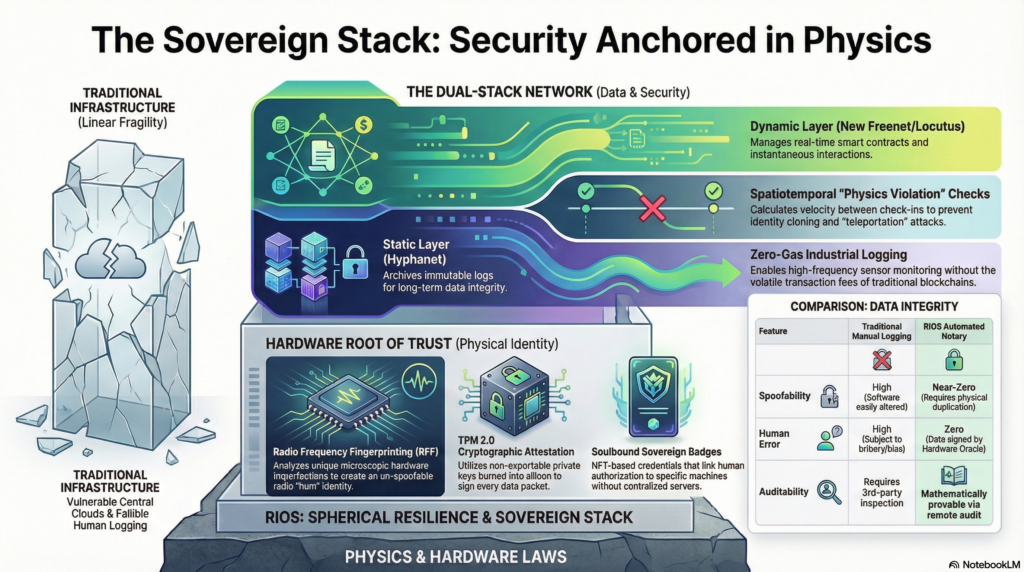
FeatureTraditional Manual LoggingRIOS Automated Notary
SpoofabilityHigh; software records and paper trails are easily altered or backdated.Near-Zero; requires physical duplication of unique hardware physics.
Human Error/BiasHigh; subject to bribery, oversight, or intentional data entry mistakes.Zero; data is autonomously signed by the “Hardware Oracle” at ingestion.
AuditabilityRequires expensive, periodic third-party physical inspections.Mathematically provable via remote cryptographic audit.

This cryptographic bedrock provides Chief Compliance Officers with mathematically provable origin data, necessitating a sophisticated framework for machine identity that bridges the gap between digital ledgers and physical reality.

Sovereign_Stack_Anchoring_Digital_TruthDownload

——————————————————————————–

2. The Automated Notary: Establishing a Hardware Root of Trust

To ensure digital logs accurately reflect physical reality without human interference, the RIOS framework utilizes a “Hardware Oracle.” This is the strategic solution to the “Oracle Problem”—the risk that a decentralized ledger will record “garbage” if the point of data capture is compromised. By establishing a Hardware Root of Trust, data is cryptographically signed at the moment of capture, ensuring forensic integrity before it ever reaches a network.

The Hardware Root of Trust is synthesized through two core mechanisms:

  • Radio Frequency Fingerprinting (RFF): Utilizing Software Defined Radio (SDR), the system captures the unique “radio accents” of a device. Microscopic manufacturing imperfections in circuitry create unique transient responses and oscillator drifts, forming an un-spoofable digital passport.
  • TPM 2.0 Attestation: Every node incorporates a Trusted Platform Module (TPM) 2.0 chip. A non-exportable private key is “burned” into the silicon at the factory, ensuring the identity cannot be cloned or exported.

The strategic impact of this “Logic of Machine Identity” is best illustrated by the HempGrade application. In this scenario, an AI-enabled camera determines crop quality and signs the data via the TPM. This prevents farmers from bribing inspectors to inflate grades, as the data is mathematically bound to a specific, physically verified device at a precise spacetime coordinate. By fulfilling geolocation and time-stamped production mandates, the system prevents Sybil Attacks, where fraudulent actors create multiple digital identities to subvert the network. This foundational identity allows for the secure movement of assets across the decentralized grid.

——————————————————————————–

3. Spatiotemporal Provenance: The Exit Visa and Handover Protocol

Strategic compliance demands “Topology Awareness” and an unbroken “Chain of Custody.” As assets—such as Kurb Kar autonomous pods—move between decentralized nodes in a mesh network, the framework maintains trust through a rigorous handover protocol. This ensures that assets follow a contiguous physical path, providing verifiable local provenance even in “Island Mode” (offline).

The Handshake Protocol for the Exit Visa system follows a four-step procedure:

  1. Exit Request: As an asset reaches the edge of a node’s signal, it requests an “Exit Visa.”
  2. Signing the Visa: The current node signs a digital packet containing the asset’s ID, an exit timestamp, and the node’s own signature.
  3. Arrival: Upon entering the next node’s range, the asset presents this visa.
  4. Verification: The new node verifies the previous signature, proving the asset physically traversed the distance.
Anchoring Digital Truth to Physical Atoms

To detect “teleportation attacks” (Physical Double-Spends), the system calculates the required velocity (V_{req} = \Delta d/\Delta t) using the Haversine distance. If V_{req} exceeds the V_{max} constant of 120 km/h for ground units, the connection is rejected. Furthermore, the system utilizes Verifiable Delay Functions (VDFs) to defend against Wormhole Attacks, where attackers attempt to “tunnel” traffic between distant nodes to make them appear adjacent. To balance security with the “Cypherpunk” ethos of privacy, RIOS utilizes zk-SNARKs (Zero-Knowledge Succinct Non-Interactive Arguments of Knowledge), allowing nodes to verify an unbroken path without compromising the entity’s sensitive GPS history. This links physical movement to the human authorization required for system governance.

——————————————————————————–

4. Decentralized Identity: The Sovereign Badge for Human Authorization

The RIOS architecture operates on a “Dual-Entity Model,” pairing rigid machine identity with verified human intent. This pairing is facilitated by the Sovereign Badge, a “Soulbound” NFT-based credential issued by the DeReticular Academy. These badges are non-transferable, ensuring that human authority cannot be traded or compromised.

Sovereign Badge NFT Metadata

FieldDescription
Role_ClassThe specific permission level (e.g., Level 5: Safety Override).
Recipient_DIDThe Decentralized ID of the verified human operator.
Soulbound_FlagBoolean flag locking the token to the recipient’s wallet.

When an operator interacts with a node, they must complete a five-phase Human-Machine Handshake:

  1. Proximity: Discovery via local mesh (WiFi 7/5G).
  2. Challenge: The node issues a cryptographic nonce.
  3. Signed Response: The operator signs the challenge using the private key associated with their Badge.
  4. Local Verification: The node verifies the signature and the Badge’s status against a local revocation list.
  5. Privilege Escalation: The node grants a temporary session token.

This creates a “Dual-Signed Object”—a log entry containing both the machine’s TPM attestation and the human’s badge signature. For high-privilege actions like factory resets, the system enforces the “Four-Eyes Principle,” requiring Multi-Sig authorization from two separate Sovereign Badges. This provides definitive proof for regulatory audits that a specific action was authorized by certified personnel on a verified machine.

——————————————————————————–

5. Data Architecture: The Dual-Stack Storage Strategy

Effective compliance requires a bifurcated storage strategy, contrasting the need for real-time industrial state (“CPU”) with long-term, censorship-resistant archival (“Hard Drive”).

Dual-Stack Functional Breakdown

Layer RoleProtocolData TypesUpdate SpeedPersistence Model
Static LayerHyphanet (Legacy Freenet)Firmware binaries, audit logs, certificates.Slow (Hours)Content Hash Keys (CHKs)
Dynamic LayerNew Freenet (Locutus)Voltage logs, state contracts, energy credits.Real-time (ms)State Deltas

The “Zero-Gas Model” of the New Freenet is a critical strategic advantage, enabling high-frequency industrial logging without the volatile costs of traditional blockchains. This ensures that high-integrity compliance is economically viable for small-scale producers. Furthermore, when nodes operate in “Island Mode,” RIOS utilizes Conflict-Free Replicated Data Types (CRDTs) to merge local logs back into the global state contract once connectivity is restored. This architecture provides Non-Repudiation; because logs are published to Hyphanet’s static layer, they cannot be retroactively altered, ensuring a forensic audit trail for regulators.

——————————————————————————–

6. Compliance Risk Analysis and Implementation Gaps

While the framework is mathematically robust, strategic implementation must account for the current maturity of decentralized physical infrastructure (DePIN).

SWOT Analysis: RIOS Framework for Global Transparency

StrengthsWeaknesses
Physical-Digital Bridge: RFF/TPM prevent Sybil attacks and identity spoofing.Experimental Software: Reliance on New Freenet (Locutus) alpha/pre-beta versions.
Offline Resilience: “Island Mode” and CRDTs allow functionality without backbone.Hardware Fragility: If TPM or RFF sensors drift, the physical identity is lost.
OpportunitiesThreats
Regulatory Fit: Direct alignment with EUDR “non-repudiation” requirements.RFF Deepfakes: AI-driven advances attempting to spoof radio “accents.”
DePIN Sector Growth: Expansion into sovereign infrastructure markets.Regulatory Hostility: Opposition to encrypted, decentralized infrastructure.

Three critical hurdles, categorized under the “Empty OS Problem,” currently limit immediate large-scale deployment:

  1. The Application Layer Gap: RIOS requires the development of user-facing applications to move beyond command-line complexity.
  2. Human-Machine Interface Complexity: Simplification of cryptographic key management is necessary for non-technical users.
  3. Technology Maturity: Critical infrastructure deployment on pre-beta software necessitates private, stabilized protocol forks.

The “Flood the Forge” initiative is currently underway to address these gaps. Despite these challenges, the RIOS framework represents a paradigm shift toward Physical Truth. Compliance is no longer a matter of trusting human testimony; it is an indisputable certainty enforced by the laws of mathematics and physics.

RIOS Provenance Tracking: Compliance Analysis for Global Transparency Standards

Michael Noel · February 15, 2026 ·

1. Strategic Context: The Shift Toward Physical Truth

In the contemporary regulatory landscape, global supply chains are under unprecedented pressure to move beyond paper-based assurances toward immutable proof of origin. The EU Deforestation Regulation (EUDR) exemplifies this shift, mandating that commodities entering the European market provide precise geolocation coordinates and time-stamped proof of production. For a Chief Compliance Officer, the strategic imperative is clear: the industry must transition from “trusted” manual data entry, which is inherently vulnerable to fraud and human error, to “trustless” cryptographic verification. RIOS (Rural Infrastructure Operating System) facilitates this by providing attested data that survives legal and forensic scrutiny.

https://academy.dereticular.com/podcast/dereticular-builds-civilization-in-a-box-2/

To address the “Linear Fragility” of traditional centralized utility and data grids, DeReticular has introduced the “Sovereign Stack.” This architecture is designed to create resilient, self-sustaining nodes capable of functioning independently of national backbones.

The Philosophy: The Death of the Line The Sovereign Stack marks a transition from “Linear Fragility”—the reliance on long, vulnerable supply and power lines—to “Spherical Resilience.” In this model, decentralized nodes function as self-sustaining, independent units capable of verifying their own state and provenance, ensuring that “The Line” is no longer a single point of failure.

The objective of this report is to evaluate how RIOS solves the “Oracle Problem”—the challenge of ensuring digital logs accurately reflect physical reality—by anchoring data directly to physical hardware.

——————————————————————————–

2. The Automated Notary: Establishing a Hardware Root of Trust

In high-stakes industries like energy (via Agra Energy units) and agriculture, manual logging is a primary regulatory liability. RIOS serves as an “Automated Notary,” solving the “Garbage In, Garbage Out” (GIGO) problem by acting as a Hardware Oracle. By ensuring data is cryptographically signed at the point of ingestion before it ever touches a network, RIOS eliminates the opportunity for data manipulation or human interference.

Key Technical Differentiators:

  1. Radio Frequency Fingerprinting (RFF): Utilizing Software Defined Radio (SDR), RIOS captures the microscopic imperfections in the circuitry of electronic devices. This unique radio frequency “hum” creates an un-spoofable digital passport, ensuring the hardware is physically authentic.
  2. TPM 2.0 Attestation: Every RIOS node incorporates a Trusted Platform Module (TPM) 2.0 chip. A non-exportable private key is “burned” into the hardware at the factory, used to sign every data packet with a mathematical certainty that software cannot replicate.
The_Sovereign_Stack_Architecture (1)Download

The Logic of Machine Identity

ParameterTraditional Manual LoggingRIOS Automated Notary
SpoofabilityHigh; software/records easily altered.Near-Zero; requires physical duplication of hardware physics.
Human Error/BiasHigh; subject to bribery or oversight.Zero; data is signed by the “Hardware Oracle.”
AuditabilityRequires 3rd-party physical inspection.Mathematically provable via remote cryptographic audit.

The Strategic Impact: This dual-layer verification prevents “Sybil Attacks,” where actors create fake identities to flood a network. In the HempGrade application, for instance, an AI camera determines crop quality and signs the data via TPM. This prevents farmers from bribing inspectors to inflate grades, as the data is mathematically tied to the specific, physically verified device at the moment of capture.

——————————————————————————–

3. Trustless Identity: State Management and Global Polling

To track asset uniqueness without central cloud servers, RIOS utilizes a decentralized state machine. The network manages the “who, where, and when” of any identity through the New Freenet (Locutus) layer.

Global Identity Polling and Distributed State Contracts: Rather than flooding the network with broadcasts, RIOS queries “Distributed State Contracts” written in WebAssembly (Wasm). When an asset connects, the local node polls the specific subset of peers maintaining that identity’s hash address to verify its current status (e.g., “Active” or “In-Transit”).

Spatiotemporal Validation (Physics Violation Detection): RIOS applies “Double-Spend” logic to physical assets. If a hardware identity attempts to connect to a node in Texas while its state contract shows it active in Uganda, the system calculates a Physics Violation using the Haversine distance (Δd) between nodes and the time delta (Δt) since the last heartbeat:

  • V_{req} = Δd/Δt
  • If V_{req} > V_{max} (the maximum believable velocity), the connection is rejected as an impossible “teleportation” attack and the identity is locked.

The Sovereign Badge System: Human operators use NFT-based “Sovereign Badges” issued by the DeReticular Academy.

  • Soulbound Nature: These are non-transferable credentials that link a human’s competence (e.g., Certified RIOS Admin) to their cryptographic wallet.
  • Trustless Chain of Custody: To perform maintenance, an operator must provide a dual-signature: the Machine (TPM) signature plus the Human (Badge) signature. This is reinforced by the “Exit Visa” mechanism, where the previous node signs the asset “out” of its range, providing local provenance that remains verifiable even in “Island Mode” (offline).

——————————————————————————–

4. The Dual-Stack Architecture: Hyphanet and New Freenet

RIOS utilizes a dual-stack decentralized protocol to separate static archival data from dynamic industrial state.

Dual-Stack Functional Breakdown

Protocol LayerFunctionUse Case in RIOS
Hyphanet (Legacy Freenet)Static Layer: Censorship-resistant archival.Repair manuals, firmware binaries, and immutable audit logs.
New Freenet (Locutus)Dynamic Layer: Wasm-based state management.Real-time voltage logs (Agra Energy), state contracts, and energy credits.

Economic Accessibility and the Zero-Gas Model: Traditional blockchains often trend toward “Plutocracy,” where high transaction fees exclude small-scale rural producers. The New Freenet’s Zero-Gas model allows for high-volume industrial logging—recording sensor data every second—without the volatile costs of gas-based chains. This ensures compliance is economically viable for small-scale farmers in remote regions.

DeReticular Builds Civilization in a Box

——————————————————————————–

5. Regulatory Mapping: Meeting EUDR and Transparency Mandates

RIOS provides a robust framework for meeting the “non-repudiation” requirements of global trade.

  1. Mathematically Provable Origin: By linking RFF signatures to TPM-signed GPS logs, commodities are tied to a specific plot of land, fulfilling EUDR geolocation mandates.
  2. Unforgeable Chain of Custody: The handover protocol using “Exit Visas” ensures the physical path of a commodity is contiguous and hasn’t been tampered with in “dark” zones.
  3. Censorship-Resistant Archival (Non-Repudiation): Because logs are published to Hyphanet’s static layer, they cannot be retroactively deleted or altered. An organization cannot “hide” a record of deforestation if a regulator requests the history of a node.

This allows a buyer in London to verify the history of a farm in Uganda without an intermediary, relying instead on the physics and math of the Sovereign Stack.

——————————————————————————–

6. Risk, Gaps, and Strategic Limitations

A strategic adoption of DePIN (Decentralized Physical Infrastructure) requires addressing critical vulnerabilities.

SWOT Analysis

StrengthsWeaknesses
Solves the Oracle Problem via RFF/TPM.Reliance on experimental Alpha software (New Freenet).
Offline resilience via “Island Mode.”Hardware Fragility: If TPM/RF sensors drift, identity is lost; no “password reset.”
OpportunitiesThreats
EUDR market fit and DePIN sector growth.AI-driven “Deepfake” RFF spoofing attacks.
“Flood the Forge” developer expansion.Potential regulatory hostility toward sovereign encryption.

The Application Layer Gap: The primary hurdle is the “Empty OS” problem. While the backend is robust, there is a lack of UI/UX bridges for non-technical users. The “Flood the Forge” initiative is critical; without a simplified interface, these command-line tools remain inaccessible to the rural populations they are intended to serve.

Strategic Summary: RIOS represents a leap in “Physical Truth” for compliance, yet it remains in an advanced innovation phase. Its success depends on the stability of New Freenet and the ability of the developer ecosystem to bridge the current UI/UX gap. For now, it offers the only viable path to mathematically provable, trustless provenance.

  • « Go to Previous Page
  • Page 1
  • Interim pages omitted …
  • Page 15
  • Page 16
  • Page 17
  • Page 18
  • Page 19
  • Interim pages omitted …
  • Page 55
  • Go to Next Page »

DeReticular

Copyright © 2026 · Monochrome Pro on Genesis Framework · WordPress · Log in