
Building the Sovereign Edge: 4 Counter-Intuitive Lessons from the DeReticular Hardware Stack
Introduction: The Fragility of the Modern Grid
In the architecture of decentralized infrastructure, we often talk about “Island Mode”—the ability for a system to maintain logic, connectivity, and value-generation when the umbilical cord to the central cloud is severed. This is not a hypothetical scenario for moving assets like Kurb Kars or autonomous drones; it is the daily reality of the edge. When the grid fails or the cellular backhaul jitters, the standard consumer stack collapses.
At DeReticular, our mission is to move beyond this fragility by upcycling consumer-grade technology into “Civilization-in-a-Box.” We treat hardware as the absolute root of trust. By hardening available components through meticulous modification, we create resilient nodes capable of surviving the harshest environments. This process requires a fundamental shift in perspective: to truly own your infrastructure, you must be willing to dismantle it.
——————————————————————————–
1. To Ruggedize, You Must First Deconstruct
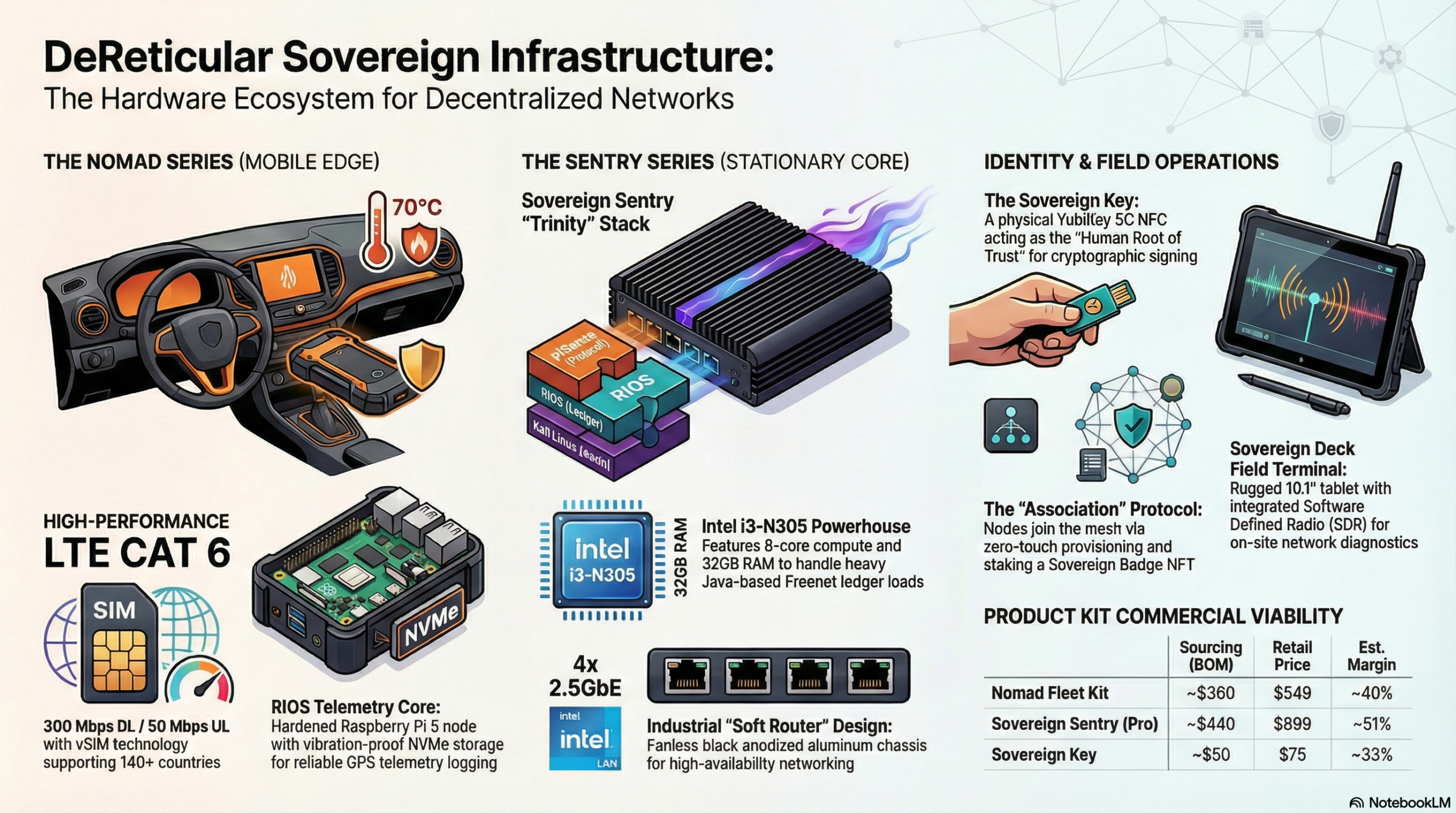
The first lesson in building sovereign hardware is that consumer convenience is a liability. Our “Nomad Link” connectivity bridge is built on the Skylink SLG-06, a vSIM hotspot that offers impressive LTE Cat 6 performance (300 Mbps) and global roaming across 140+ countries. However, it ships with a 4000mAh Li-ion battery designed for the pocket of a traveler, not the dashboard of a vehicle in the Arizona desert.
In a mobile asset, internal temperatures can exceed 70°C. Under these conditions, a standard battery becomes a fire hazard. Our counter-intuitive response? We immediately void the warranty by removing the battery entirely.
The Battery Elimination Circuit (BEC)
To transform the SLG-06 into an industrial-grade component, we install a Battery Elimination Circuit. We replace the volatile cell with a 3D-printed spacer and a DC-DC Buck Converter that steps down the 12V/48V vehicle bus to a stable 4.0V.
The technical challenge is the device’s firmware, which checks the BSI (Battery Status Indicator) pin. Without a battery, the unit won’t boot. We solve this by soldering a 10kΩ resistor between the BSI and the Negative terminal to “spoof” a valid temperature reading. Finally, we replace the original backplate with our “Nomad Shell”—a custom ventilated cover that helps manage thermals. Even with these modifications, we respect the 60°C ceiling imposed by the limits of the plastic casing and the PCB itself.
“This modification voids the Skylink warranty. DeReticular must offer its own ’90-Day Sovereign Warranty’ because, at the edge, the only warranty that matters is the one you can verify yourself.”
——————————————————————————–
2. Your SD Card is Your Weakest Link
The “RIOS Telemetry Core” serves as the brain of our mobile fleet. While it is based on the Raspberry Pi 5 and its capable Broadcom BCM2712 processor, a “stock” Pi is a hobbyist toy, not a sovereign node. The most common point of failure in edge compute is the MicroSD card. Under the heavy cryptographic load of the Locutus ledger and the physical vibrations of a moving Kurb Kar, MicroSD cards corrupt and fail.
From Hobbyist Board to Industrial Core
Transitioning to an industrial specification requires three critical upgrades:
- Vibration-Proof Storage: We abandon MicroSD for NVMe SSDs via a PCIe HAT. This provides the high-endurance IOPS required for constant ledger logging and ensures the filesystem survives sudden power losses.
- Thermal Armor: The Pi 5 throttles at 80°C. We mount the board in a CNC Aluminum Armor Case. This chassis acts as a giant heatsink, contacting the CPU, RAM, and PMIC through high-quality thermal pads, supplemented by a PWM blower for peak loads.
- The Temporal Root: A node without a sense of time is useless to a decentralized ledger. We add a Panasonic ML-2020 battery to the Pi’s dedicated RTC header. Without this, logs generated in “Island Mode” would carry invalid timestamps, causing the Locutus ledger to reject the data entirely.
Hardware Specs: Hobbyist vs. RIOS Telemetry Core
- Storage: MicroSD (UHS-I) vs. 256GB NVMe SSD (PCIe Gen 2)
- Chassis: Plastic / Open vs. CNC Aluminum Armor Case
- Cooling: Passive vs. Passive/Active Hybrid (PWM Blower)
- Timekeeping: System Clock vs. Hardware RTC (ML-2020 Battery)
——————————————————————————–
3. Virtualization is the Secret to Sovereign Infrastructure
For stationary infrastructure like the “Sovereign Sentry,” we face a different challenge: hardware sprawl. The architect’s goal is to reduce “clutter” without sacrificing security. Our solution is a hyperconverged stack running on an Intel Core i3-N305 with 32GB of RAM and four Intel i226-V 2.5GbE LAN ports.
We utilize Proxmox VE to host a “Trinity” of Virtual Machines on a single fanless box, creating what we call a “Cyberdeck” for infrastructure defense.
- The Gatekeeper (pfSense): This VM handles the heavy lifting of WireGuard VPN encryption and manages the WAN/LAN/DMZ zones via the i226-V ports.
- The Ledger (RIOS): An Ubuntu Server instance running the Java-based Hyphanet and the Rust-based Locutus daemons. This is the economic engine of the node.
- The Auditor (Kali Linux): This provides users with “Deep Admin” tools like Wireshark and Nmap to audit their own mesh for unauthorized devices.
By virtualizing these roles, we give the operator tools typically reserved for enterprise data centers. For instance, managing the RNDIS tethering of the Nomad Link backhaul is handled directly through the console:
nmcli connection add type ethernet ifname usb0 con-name "Skylink_Backhaul"
nmcli connection modify "Skylink_Backhaul" connection.autoconnect yes
“The Sentry is a ‘Cyberdeck’ for the sovereign operator—a single, ruggedized point of presence that replaces a router, a server, and a security auditor.”
——————————————————————————–
4. The Private Key is a Physical Object
In a world of remote exploits, we believe the ultimate security layer is a human touch. The “Sovereign Key”—a custom YubiKey 5C NFC—serves as the Human Root of Trust.
It is important to clarify a technical distinction: the key does not store a “Sovereign Badge” NFT image. Instead, it holds the Private Key (Seed) for the wallet that owns the NFT in its secure enclave. This ensures that the identity cannot be phished or extracted remotely.
The Human Handshake
We use a “Human Handshake” protocol for all critical actions. When an operator attempts to sign a state delta or access the admin dashboard, the node issues a cryptographic challenge: a random number. The operator must physically touch the gold sensor on the Sovereign Key to sign that challenge. This converts a digital identity into a physical requirement, ensuring that even if a node is compromised via the network, the “Human Root” remains air-gapped and secure.
——————————————————————————–
Conclusion: From Consumer to Sovereign
Building the Sovereign Edge is an act of reclamation. It is the transition from being a consumer of volatile, “black-box” technology to being a sovereign operator of hardened infrastructure.
This vision is being realized today in the “Node 3 Arizona Workshop,” where our technicians modify upwards of 20 units a day to “Flood the Forge.” We are proving that industrial-grade reliability doesn’t require a million-dollar R&D budget—it requires the willingness to solder a resistor, flash a hypervisor, and own the root of trust.
Ownership is not a line in a software license; it begins with a solder joint and a physical key. If you cannot modify your hardware’s power source or verify its identity at the chip level, do you truly own it? The DeReticular stack is our answer to that question.