DeReticular
Global Aircraft Maintenance and Spare Parts Strategic Briefing 2026
Executive Summary
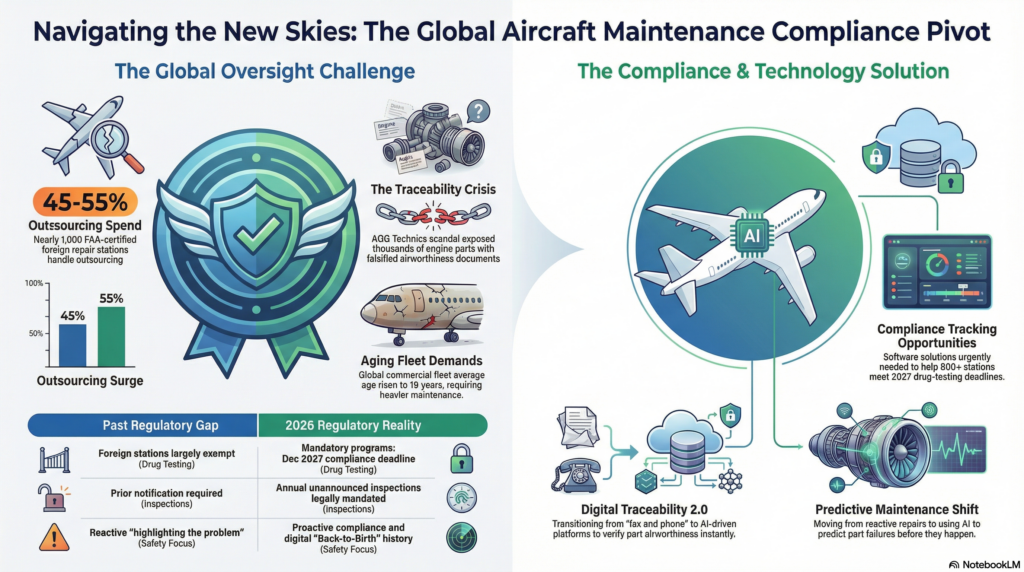
The global aircraft maintenance and spare parts industry—frequently termed the “aftermarket”—is currently navigating a “super-cycle” of demand. This phenomenon is driven by a paradox: record-breaking air travel demand occurring simultaneously with historic delays in new aircraft production from major OEMs like Boeing and Airbus. Consequently, the global commercial fleet age has increased from 14 years in 2019 to 16 years in 2025, necessitating heavier maintenance cycles and a surge in part replacements.
The landscape is defined by two critical shifts:
- Regulatory Tightening: The FAA Reauthorization Act of 2024 has closed significant historical gaps regarding foreign repair stations, mandating unannounced inspections and drug testing. This has shifted the market opportunity from identifying regulatory “loopholes” to providing compliance solutions for the nearly 1,000 FAA-certified foreign facilities.
- The Traceability Premium: Following the massive AOG Technics counterfeit parts scandal, “Back-to-Birth” traceability has become the industry’s new premium currency. Systems that can verify the authenticity of Used Serviceable Material (USM) and Parts Manufacturer Approval (PMA) components are essential for operational safety and regulatory adherence.
The Global Maintenance Landscape
The aviation industry has seen a decadelong shift of major maintenance work to foreign territories, including China, Singapore, El Salvador, and Mexico. While this transition initially targeted cost reduction, it created a “Global Industrial Maintenance Complex” that is increasingly difficult to oversee.
Outsourcing Trends and Infrastructure
- Scale of Outsourcing: Maintenance outsourcing rose from 20% in 1990 to approximately 47% in 2016, a trend that has stabilized with 45–55% of maintenance spend currently sent to external providers.
- Facility Growth: There are currently approximately 977 FAA-certified foreign repair stations worldwide, a significant increase from the 731 reported in previous decades.
- Geographical Distribution:
- China: 78 facilities
- Singapore: 54 facilities
- Brazil: 22 facilities
- Thailand: 6 facilities
- Costa Rica: 3 facilities
- El Salvador: 2 facilities
The Oversight Challenge
Historically, the “Inspection Challenge” involved oversight across vast distances—such as inspectors in Los Angeles managing facilities in Beijing (6,500 miles away). Prior to 2024, the “element of surprise” was often compromised by requirements for foreign government permission and visa notifications.
Regulatory Evolution: FAA Reauthorization Act of 2024
Recent legislative updates have fundamentally altered the legal reality for foreign repair stations. The focus for 2026 and beyond is assisting these stations in meeting new, stringent deadlines.
| Regulatory Area | Historical Status | Current Reality (Post-2024/2025) | Compliance Deadline |
| Drug & Alcohol Testing | Foreign stations were largely exempt. | Final Rule (Dec 2024) requires testing programs. | December 20, 2027 |
| Surprise Inspections | Logistically impossible; required notification. | Annual unannounced inspections are now mandated. | Ongoing (Active) |
| FAA Certification | Discrepancies in mechanic certification. | Stricter oversight and push for standardized qualifications. | Ongoing |
The 2026 Spare Parts Market
The aircraft spare parts market is experiencing unprecedented growth, with the total market (OEM + Aftermarket) estimated at 723.8 billion in 2025**, projected to reach **1.06 trillion by 2032 (CAGR ~5.6%).
Critical Market Dynamics
- The “Parts Drought”: Lead times for new OEM parts often exceed 12 months, leading to a shortage of “rotables” like landing gear and avionics.
- Used Serviceable Material (USM): Valued at $7.6 billion in 2025, USM is 30–40% cheaper than new parts and supports “Circular Economy” goals.
- Parts Manufacturer Approval (PMA): These third-party parts are gaining mainstream acceptance due to OEM shortages, with an expected annual growth rate of 7.8%.
- Supply Chain Inflation: Spare parts inflation (2.5–3.5%) is significantly outstripping the inflation rate for new aircraft (1.1%).
The AOG Technics Scandal
A major fraud scandal involving a UK-based broker, AOG Technics, exposed the industry’s vulnerability to counterfeit components. Thousands of engine parts for the CFM56 engine were sold with falsified airworthiness documents. This has led to:
- Global grounding and inspection mandates.
- Slower processing times for part certification.
- A “dirty fingerprint” trail requirement for all documentation.
Technological Solutions and Business Opportunities
The complexities of the “Global Industrial Maintenance Complex” provide significant opportunities for technological intervention, particularly in tracking and making sense of the supply chain.
Strategic Solution Areas
- Enhanced Traceability: Systems must verify FAA Form 8130-3 (Airworthiness Approval Tag) and maintain “Back-to-Birth” history to mitigate fraud.
- Compliance Tracking: Automating the transition for foreign stations to meet the 2027 drug and alcohol testing deadline.
- Remote Inspection Technologies: Utilizing IoT and Augmented Reality (AR) to facilitate virtual oversight where geographical barriers remain.
- Predictive Maintenance: Leveraging AI and data analytics to shift from reactive to predictive purchasing, reducing Aircraft on Ground (AOG) time.
- Digital Marketplaces: Transitioning from “fax and phone” trading to blockchain or AI-verified platforms for price transparency.
Emerging Sector Integration
New aviation technologies, such as the electric eVTOL aircraft developed by Beta Technologies, require specialized maintenance training and standardized mechanic certification. Additionally, automated logistics solutions, such as the “DeReticular” drone systems for part delivery, are becoming integral to the “Just-in-Case” inventory model.
Funding and Commercialization Strategy
Developing data tracking and maintenance solutions aligns with Small Business Innovation Research (SBIR) and Small Business Technology Transfer (STTR) programs.
Current SBIR/STTR Status (As of February 2026)
- Authorization Lapse: The SBIR/STTR program authorization lapsed on October 1, 2025.
- Impact: Standard solicitation cycles (e.g., DoD 26.1) are currently paused or delayed.
- Recommendation: Organizations must monitor the Defense SBIR/STTR Innovation Portal (DSIP) for interim schedules rather than relying on historical January/April/August cadences.
Key Partnership Opportunities
- Beta Technologies (Vermont): A prime candidate for maintenance training and certification standardization projects.
- Vermont Manufacturing Extension Center (VMEC): An essential partner for manufacturing and supply chain optimization.
- Department of Transportation (DOT): Potential funding source for innovations enhancing transportation safety and infrastructure tracking.
The Invisible Library Understanding the “Dark Data” Crisis and the Future of Scientific Truth
1. The Silent Graveyard of Ideas: Defining Dark Data
Imagine a library where half the books ever written are burned the moment they are finished. In the modern research industrial complex, this isn’t a metaphor—it is the status quo. Today, approximately 50% of preclinical research is never published, creating a “Silent Graveyard” of scientific effort. This occurs because our current institutional incentives value “breakthroughs” over “truth,” causing researchers to hide “negative” results in a metaphorical file drawer.
Key Terms
- Dark Data: Experimental results, datasets, and observations that are collected during the research process but are never published, shared, or indexed in public databases.
- Publication Bias: The systemic tendency of journals, funders, and researchers to prioritize studies with “statistically significant” or positive findings, effectively censoring the “failures” that are essential to the scientific method.
- Null Results: Experimental outcomes that show no significant effect or difference. In a functional system, a null result is a vital navigation marker; in our current system, it is treated as “dead capital.”
The “So What?”: “Dark Data” isn’t just a collection of missing files; it is a structural blind spot that prevents us from seeing the full picture of reality. When science only reports its wins, it ceases to be a rigorous search for truth and becomes a marketing exercise. For the student, understanding this crisis is the first step toward demanding a scientific infrastructure that values the “No” as much as the “Yes.” This systemic silence doesn’t just stall progress—it carries a staggering global price tag.
——————————————————————————–
2. The High Cost of Silence: The $3 Trillion Forecast
The “Dark Data” crisis is an economic hemorrhage. While global R&D expenditure is projected to exceed $3 trillion by 2026, a massive portion of this capital is wasted on redundant research. We are currently trapped in a cycle where billions of dollars are spent “rediscovering” failures that have already happened elsewhere. This is compounded by institutional bloat; while the proposed Grant Escrow Protocol operates on a 1.5% fee, traditional university overhead often consumes 15% to 50% of grant funding before a single experiment is even conducted.
| The Economics of Inefficiency | Amount (USD) |
| Current Global R&D Expenditure | $2.5 Trillion+ |
| 2026 Projected Global R&D Expenditure | $3.0 Trillion |
| Estimated Annual Waste (Redundant Research – US Only) | $28 Billion |
The “So What?”: This $28 billion waste is a “tax on discovery.” Every dollar spent repeating a hidden mistake is a dollar stolen from a potential cure or a climate solution. We are effectively paying for the same failure thousands of times because we lack a sovereign ledger to record it.
3. Case Study: The Hidden Story of Prozac and Zebrafish
To see the human and ecological cost of Dark Data, we look at the “Dark Cycle” of fluoxetine (Prozac) and its impact on aquatic ecosystems.
The Four Stages of a Lost Opportunity
- The Initial “Bust”: Lab A tests Prozac on Zebrafish. They observe no acute mortality or obvious behavioral changes. Thinking the study is “boring” or a “failure,” they never publish the results.
- The Redundant Grant: Lab B, unaware of Lab A’s work due to the “file drawer effect,” applies for and receives a fresh $200,000 grant to run a nearly identical study.
- The Hidden Repeat: Lab B reaches the same null conclusion. The data remains unpublished, and the cycle of redundant funding continues.
- The Delayed Breakthrough: Only years later (Vera-Chang et al., 2018) do researchers discover that Prozac has profound transgenerational effects, lowering cortisol levels in the offspring of exposed fish.
The “So What?”: If the initial “negative” safety data had been published, the scientific community could have moved past simple mortality checks much sooner to investigate these subtle, critical environmental and genetic risks. Dark Data doesn’t just waste money; it creates a lag in our understanding of safety and risk.
——————————————————————————–
4. Dark Data Across the Landscape: Pharma, Energy, and Agriculture
The crisis manifests uniquely across sectors, but the root cause remains a lack of incentive for honesty.
- Pharmaceuticals
- Primary Waste Driver: Proprietary secrecy regarding failed molecular compounds.
- The AI Plateau: Modern AI drug discovery models are plateauing because they are “starving” for failure data. Without knowing what doesn’t work, AI models become over-optimistic and prone to repeating human errors.
- Energy
- Primary Waste Driver: High failure rates in battery chemistry remain unindexed.
- The Carbon Cost: Millions of tons of CO2 are generated annually by data centers storing “write-only” sensor data—meter logs and sensor feeds that are collected and stored but never intended to be read or analyzed.
- Agriculture
- Primary Waste Driver: Research into fertilizer efficacy and soil health is often siloed within proprietary farm equipment databases.
- Global Risk: New grants are issued to “rediscover” soil baselines that already exist in private silos, hindering global food security efforts.
The “So What?”: Across all sectors, the absence of failure data creates a “survivorship bias” that distorts our technological trajectory. For an AI to be “intelligent,” it must be trained on the full spectrum of human experience—including our mistakes.
——————————————————————————–
5. From Trust to Verification: The Tokenized Solution
To fix science, we must change the architecture of its funding. We are moving from a “Trust-Based” model (where we hope researchers share data) to a “Verification-Based” model. By utilizing the RIOS (Rural Infrastructure Operating System) and its “Island Mode” capabilities, we can create a sovereign infrastructure for truth that functions independently of fragile, centralized systems.
This solution leverages Operation Octagon—a global mesh of 8 sovereign nodes—to ensure that once research data is uploaded, it is immutable and accessible forever.
Steps to a Sovereign Scientific Truth
- [ ] Staking: A Grantor deposits fiat into a Smart Contract vault (avoiding the 15-50% university overhead).
- [ ] Minting: The protocol mints $RSRCH tokens, pegged 1:1 to the deposit.
- [ ] The Mandate: Funds are locked until the researcher uploads a complete dataset to the RIOS ledger.
- [ ] Signal Fusion: The RIOS Oracle uses “Signal Fusion” (combining hardware sensor data and software logs) to verify the data’s integrity at the source, making AI-generated “fake” failure data prohibitively expensive to produce.
- [ ] Settlement: Once verified, $RSRCH tokens are released. The researcher can liquidate them for USD or hold for yield, creating a new financial incentive for rigorous data reporting.
The “So What?”: By treating data as a Real World Asset (RWA), we stop paying for headlines and start paying for verified knowledge. This turns the $28 billion waste into a “Light Data” repository that can be licensed to AI developers and pharmaceutical firms, creating a self-sustaining cycle of discovery.
——————————————————————————–
6. Conclusion: Reclaiming the Value of Failure
The future of science depends on our ability to value the “No.” As we transition to a Verification-Based model, we move away from institutional gatekeepers and toward a sovereign, immutable record of human inquiry. For the student and the researcher, the message is clear: your “failed” experiment is a successful data point in the global effort to map the unknown.
Takeaway Message For science to progress, failure must be visible. By replacing bloated university overhead with the Grant Escrow Protocol and securing truth through Operation Octagon, we can eliminate billions in waste. In the sovereign library of the future, the records of what went wrong are the foundation for everything that goes right.
Strategic Analysis: DeReticular RIOS-Based Grant Marketplace and the “Dark Data” Crisis
Executive Summary
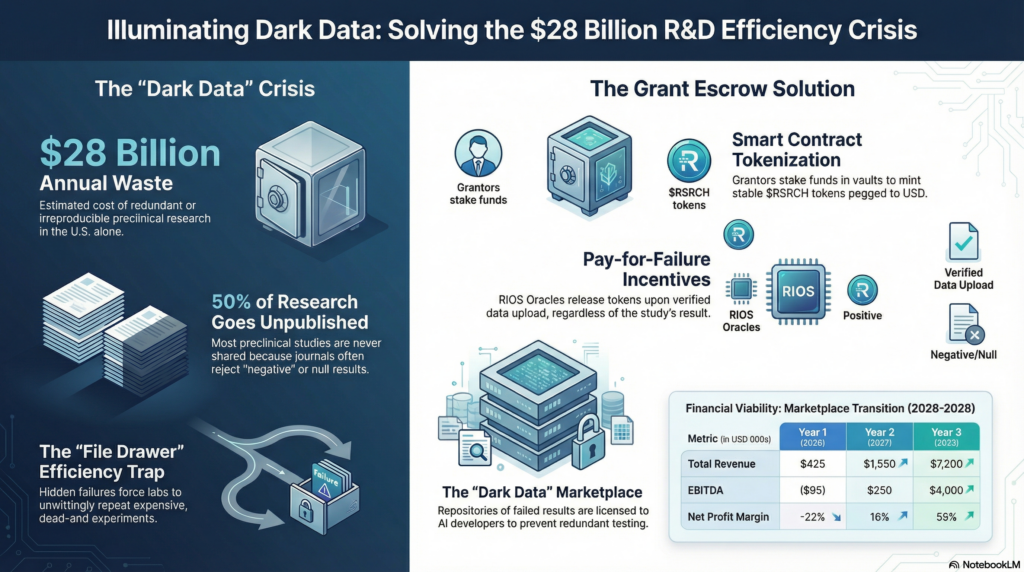
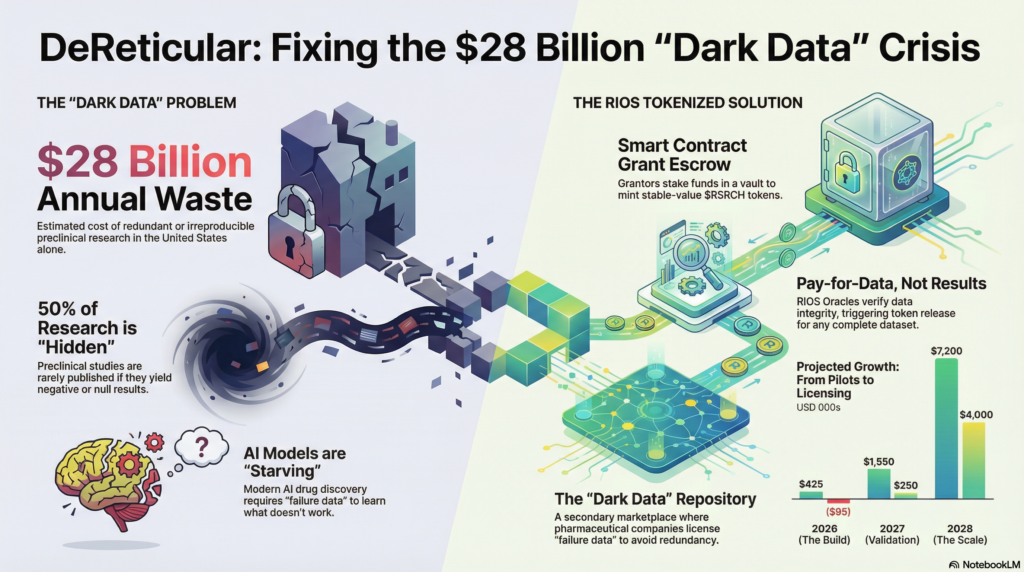
The global Research and Development (R&D) ecosystem is currently undermined by a “Dark Data” crisis, characterized by the non-publication of negative results. This systemic inefficiency leads to an estimated $28 billion in annual waste in the United States alone due to redundant experiments. By 2026, global R&D spending is projected to exceed $3 trillion, yet approximately 50% of preclinical research remains unpublished, leaving AI models—which are increasingly central to drug discovery and materials science—starving for “failure data” to learn what does not work.
DeReticular, an industrial venture studio, proposes a decentralized Grant-Backed Utility Token Marketplace to solve this crisis. Leveraging its proprietary RIOS (Rural Infrastructure Operating System), DeReticular intends to transition grant administration from a trust-based “check-writing” model to a verification-based smart contract escrow system. By tokenizing grants and automating payouts upon verified data upload—regardless of whether results are positive or negative—the platform incentivizes the publication of “Dark Data.”
The project aims to become the “Bloomberg Terminal of Negative Research,” generating high-margin revenue through grant management fees and the licensing of negative result datasets to pharmaceutical companies and AI developers.
——————————————————————————–
The “Dark Data” Crisis: Context and Economic Impact
The “File Drawer” Effect
“Dark Data” refers to experimental results that are collected but never shared. This is driven by Publication Bias, where journals and researchers prioritize “positive” results (proving a hypothesis) while filing away “negative” or “null” results.
- Systemic Redundancy: Because failures are hidden, other researchers unwittingly apply for grants to test the same failed hypotheses.
- Case Study (Prozac and Zebrafish): Lab A may find no acute toxicity of Prozac on Zebrafish and fail to publish. Lab B then wastes a $200,000 grant repeating the same test. This lack of shared “negative” safety data can delay the discovery of more subtle effects, such as the transgenerational cortisol changes identified in later studies.
- AI Implications: By 2026, AI gatekeepers and drug discovery models will face a “plateau” if trained only on positive data. Models require negative results to understand the boundaries of viable research.
Industry Impact
The “Dark Data” problem spans multiple sectors:
- Pharmaceuticals: Competitors waste billions testing the same dead-end molecular pathways.
- Energy Sector: Unused meter logs and sensor data cost businesses billions in efficiency; storing this data generates significant CO2 emissions.
- Agriculture: Siloed data on soil efficacy and fertilizer failure slows progress in global food security.
——————————————————————————–
The DeReticular Solution: Tokenized Grant Marketplace
DeReticular’s marketplace utilizes a decentralized application (dApp) to manage the lifecycle of research funding.
The Mechanism of Action
The Grant Escrow Protocol replaces traditional disbursements with a five-step tokenized process:
| Phase | Action | Description |
| 1. Staking | Deposit | Grantors (e.g., NIH, Gates Foundation) deposit fiat (e.g., $500k) into a verified vault. |
| 2. Minting | Token Creation | The protocol mints equivalent $RSRCH tokens, pegged 1:1 to the USD deposit. |
| 3. Mandate | Smart Contract | Tokens are locked with “Milestone Triggers” requiring data upload to an immutable ledger. |
| 4. Release | RIOS Oracle | The RIOS Oracle verifies the dataset integrity (not the result type) and triggers the release. |
| 5. Settlement | Liquidation | Researchers receive tokens, which can be held for yield or liquidated back to USD. |
Secondary Marketplace: The Dark Data Repository
Once collected, negative data is aggregated into a repository. Pharmaceutical companies and AI developers can license this data (e.g., paying $50k for a dataset to avoid a $10M failed experiment), creating a high-margin revenue stream for the platform.
——————————————————————————–
Core Technology and Infrastructure
DeReticular differentiates itself from “crypto-only” startups by grounding its marketplace in physical infrastructure and sovereign systems.
- RIOS (Rural Infrastructure Operating System): An operating system designed for sovereign, offline-capable “Island Mode” infrastructure. It manages physical assets and uses “Signal Fusion” (hardware sensors + software logs) to verify data at the source, making data spoofing prohibitively expensive.
- Operation Octagon: A global mesh of eight sovereign nodes ensuring immutable data storage. This ensures that “negative” data cannot be deleted or censored by institutions embarrassed by failure.
- HempGrade AI: A working proof-of-concept for Real World Assets (RWA). It uses computer vision to grade hemp biomass and verify its destruction, turning agricultural waste into tradable tokens. This validates the technical logic for the grant marketplace.
——————————————————————————–
Market Analysis and Strategic Roadmap
Target Markets
- DeSci (Decentralized Science): Early adopters like DAOs and Web3 grants ($500M market).
- Institutional R&D: Pharmaceutical and Agricultural firms seeking efficiency ($200B market).
- Federal Agencies: NIH, NSF, and USDA as long-term infrastructure partners ($50B+ annually).
Operational Phases (2026–2027)
- Phase 1 (2026 Q1-Q2): Launch a $50k micro-grant round on Gitcoin to prove the “Pay-for-Failure” model using a hemp genetic study.
- Phase 2 (2026 Q3-Q4): Scale-up via a USDA-backed university partnership, tokenizing a biomass waste study and deploying the second Operation Octagon node.
- Phase 3 (2027): Execute the “Pharma Pivot” by licensing the aggregated negative result repository to an AI drug discovery firm.
Financial Pro Forma (2026–2028)
The financial model anticipates a transition from grant-funded R&D to high-margin data licensing.
Pro Forma Income Statement (USD 000s)
| Metric | Year 1 (2026) | Year 2 (2027) | Year 3 (2028) |
| Total Revenue | $425 | $1,550 | $7,200 |
| Platform/Staking Fees (1.5%) | $75 | $450 | $2,200 |
| Data Licensing | $0 | $300 | $4,500 |
| Inbound Grant Funding | $350 | $800 | $500 |
| Total Expenses | $520 | $1,300 | $3,200 |
| EBITDA | ($95) | $250 | $4,000 |
| Net Profit Margin | -22% | 16% | 55% |
Capital Requirements
DeReticular seeks a $750,000 seed injection (equity/grant mix) to finalize RIOS-smart contract integration (45%), establish legal SPV structures for tokenized grants (25%), deploy infrastructure nodes (20%), and fund the initial “Negative Result Bounty” pilot (10%).
——————————————————————————–
Strategic Grant Acquisition: The “Trojan Horse” Strategy
To navigate the 2026 funding landscape, DeReticular utilizes a bifurcated narrative strategy to appeal to diverse grantors.
| Grantor Type | Key Pitch / Terminology | Strategic Narrative |
| Federal (NIH/NSF/ARPA-H) | “Resilient Data Supply Chain” | Focus on “Next-Gen Grant Administration” and immutable compliance to prevent fraud and redundancy. |
| Private Philanthropy (CZI/Templeton) | “Intellectual Humility” | Pitch the “GitHub of Negative Results.” Focus on meta-science and the “ego problem” in research. |
| Web3 / DeSci (Gitcoin/Optimism) | “Tokenized RWA Marketplace” | Fully transparent regarding staking, utility tokens, and sovereign science infrastructure. |
Risk Assessment and Mitigation
- Regulatory Scrutiny: To avoid being flagged as an unregistered security, tokens are structured as “Restricted Vouchers” (non-transferable except to KYC’d off-ramps) with no speculative utility.
- Oracle Failure (Fake Data): RIOS employs “Signal Fusion,” hashing research data at the point of creation (lab equipment) rather than upload, making it difficult to submit AI-generated fake results.
- Institutional Inertia: Universities may resist the model as it bypasses their 15–50% overhead fees. Mitigation involves establishing fiat on/off-ramp partners so universities receive USD automatically, ensuring they never have to hold crypto on their balance sheets.
Conclusion
By 2028, DeReticular aims to capitalize on the $3 trillion global R&D market by transforming the way research is funded and verified. By valuing failure as a tradable asset, the RIOS-based marketplace seeks to double the efficiency of scientific discovery and establish a sovereign infrastructure for scientific truth.
Operational Roadmap: Implementing Resilient Data Supply Chains for Federal Research Excellence
1. Strategic Alignment: Addressing the $28 Billion Crisis in Research Efficiency
The federal grant ecosystem has reached a point of systemic crisis defined by “Institutional Inertia” and an unsustainable leakage of capital. Despite projected global R&D spending reaching $3 trillion by 2026, the current model of research disbursement is failing to capture its primary output. This failure is characterized by the “Dark Data” problem—the massive volume of experimental results that remain unpublished because they do not support a positive hypothesis. This “File Drawer” effect incentivizes researchers to suppress failure, forcing the scientific community into a cycle of redundancy where separate labs unknowingly replicate the same failed experiments on the taxpayer’s dime.
This inefficiency is no longer a localized administrative concern; it is a matter of urgent geopolitical necessity. 2026 is projected to be the year China’s total R&D spending surpasses that of the United States. To maintain U.S. R&D competitiveness as the global center of gravity shifts, federal agencies must move away from trust-based disbursement toward a verification-based infrastructure. Furthermore, as the “AI Gatekeeper” era begins in 2026—with agencies utilizing AI triage systems for grant proposals—these models risk being “starved” for failure data. Without access to negative results, federal AI systems will become over-optimistic and biased, unable to learn what paths are scientifically non-viable.
The Economic Impact of Redundant Research
| Metric | Value / Projection |
| Annual US Waste (Preclinical Research) | $28 Billion |
| 2026 Global R&D Spending Projection | $3 Trillion |
| U.S. Geopolitical Status (2026) | Parity/Surpassed by China in R&D Spend |
| Percent of Preclinical Research Unpublished | ~50% (The “Dark Data” Gap) |
Solving these inefficiencies requires an immediate shift from a trust-based “check-writing” culture to a sovereign, verification-based infrastructure that captures data at the point of origin.
2. Core Infrastructure: The Rural Infrastructure Operating System (RIOS)
To secure U.S. research integrity, we must deploy a “Sovereign Infrastructure” solution that functions independently of centralized cloud providers. The Rural Infrastructure Operating System (RIOS) enables “Island Mode” operations, ensuring that research data remains secure and private even in the event of national grid instability or commercial cloud censorship.
Operation Octagon: A Resilient Data Supply Chain
The physical backbone of this roadmap is “Operation Octagon,” a global mesh of eight sovereign nodes. This infrastructure acts as a “Trojan Horse” for a more resilient data supply chain, providing immutable storage for research data. Unlike centralized systems, Operation Octagon utilizes Federated Learning capabilities, allowing models to be trained across nodes without exposing raw sensitive data. This decentralized “truth layer” ensures that scientific records cannot be altered or suppressed by institutional interests.
Data Integrity via RIOS “Signal Fusion”
The “RIOS Oracle” eliminates the “Trust Gap” by utilizing “Signal Fusion”—the synthesis of hardware sensor data and software logs. To prevent the “Fake Data Attack” (AI-generated fraudulent research), RIOS hashes research data at the point of creation, directly from lab equipment, rather than at the point of upload. This hardware-level verification makes data spoofing and “p-hacking” prohibitively expensive for bad actors.
Key Differentiators of RIOS Infrastructure:
- Offline-Capable “Island Mode”: Operational continuity independent of AWS, Google, or national commercial grids.
- Point-of-Creation Hashing: Hardware-level data integrity that verifies the physical reality of the experiment.
- Immutable Ledgers: Prevention of data suppression, ensuring “Dark Data” is captured as a permanent asset.
- Federated Learning Mesh: Secure collaborative research across the sovereign “Operation Octagon” nodes.
This sovereign infrastructure provides the secure environment necessary to execute financial and research mandates with absolute transparency and technical finality.
3. The Mechanism: Smart Escrow and Milestone-Based Disbursement
Strategic efficiency is achieved by evolving from “check-based” grants to “Smart Escrow” protocols. This mechanism automates compliance by ensuring that federal funds are only liquidated when data integrity is verified by the RIOS Oracle.
The Four-Phase Grant-Backed Utility Token Process
By utilizing digital vouchers ($RSRCH tokens) pegged 1:1 to USD, the system aligns financial incentives with transparency:
- Staking (Asset Collateralization): The Grantor (e.g., NIH or ARPA-H) deposits the full grant amount into a verified custody vault.
- Minting (Digital Voucher Issuance): The protocol mints $RSRCH tokens, which represent a stable-value claim on the deposited funds.
- The Mandate (Release Triggers): Tokens are locked in a Smart Contract. They are released only upon the RIOS Oracle’s verification of a complete dataset upload, regardless of whether the result is positive or negative.
- Settlement (Liquidity): Researchers liquidate $RSRCH into USD through a verified off-ramp for immediate operational liquidity.
Efficiency Gain and Competitive Landscape
Traditional university overhead captures between 15% and 50% of grant funding. In contrast, this platform’s friction is limited to a 1.5% management fee and a 0.5% liquidation fee (2.0% total). This massive efficiency gain ensures that nearly 98 cents of every federal dollar reach the actual laboratory floor. This automated mechanism ensures rigorous compliance with federal data standards while outcompeting traditional administrative models.
4. Data Integrity & FAIR Principles: The RIOS Compliance Layer
Modern federal procurement, led by agencies like the NIH, increasingly mandates adherence to “FAIR” (Findable, Accessible, Interoperable, Reusable) principles. The RIOS Oracle transforms “Dark Data” into “Light Data” by making mandatory null reporting a technical trigger for funding release.
The HempGrade AI case study serves as the proof-of-concept for this Real World Asset (RWA) verification model. Compliant with the 2026 GENIUS Act and CFTC regulations, the protocol verifies the physical destruction of biomass via plasma gasification. In a research context, this same logic verifies the integrity of digital assets (CSVs/Python logs) against pre-registered hypotheses. By providing financial incentives for failure, the “Digital Voucher” system solves the “Ego Problem” in academia, promoting a culture of “Intellectual Humility” where reporting a failure is as financially rewarding as reporting a success.
5. Phased Operational Roadmap: From Pilot to Federal Integration
A phased rollout is designed to overcome institutional resistance by proving technical and financial viability in high-impact niches.
- Phase 1: The “DeSci” Pilot (2026 Q1-Q2): Launch of a $50k micro-grant round (Gitcoin) focused on study replication. This proves the “Pay-for-Failure” model and establishes the Data Oracle Minimum Viable Product (MVP).
- Phase 2: Commercial Scale-Up (2026 Q3-Q4): Expansion to USDA-backed university partnerships, focusing on biomass RWA verification and the deployment of “Operation Octagon” Node #2.
- Phase 3: Institutional Scale & Federal Pivot (2027-2028): Full federal integration. Licensing of “Dark Data” repositories to AI drug discovery firms begins.
By 2028, the platform will become the “Bloomberg Terminal of Negative Research.” Because the marginal cost of licensing existing “Dark Data” is near zero, EBITDA margins are projected to explode as pharmaceutical companies pay high-margin subscriptions to access failure feeds, allowing them to avoid multi-billion-dollar dead ends in drug discovery.
6. Risk Mitigation & Agency Alignment Strategy
Securing partnerships with the NIH, NSF, and ARPA-H requires a proactive risk strategy and the use of a specialized “Trojan Horse” vocabulary to bridge the gap between innovation and legacy bureaucracy.
Federal Risk Mitigation Framework
| Potential Risk | Mitigation Strategy |
| Regulatory Crackdown | Utilization of “Restricted Vouchers” (non-transferable, KYC-compliant tokens) to eliminate speculative risk. |
| Oracle Failure / Fake Data Attack | RIOS “Signal Fusion” with hardware-level hashing at the point of creation to prevent AI-generated fraud. |
| Institutional Inertia | “Trojan Horse” strategy: Pitching “Next-Gen Research Administration” rather than “Crypto/Blockchain.” |
Agency-Specific Vocabulary Mapping
- ARPA-H: Frame as a “Resilient Data Supply Chain” to reduce fragility in health ecosystems.
- NSF: Frame as a “Secure Open-Source Administration” system for transparent research ledgers.
- NIH: Frame as an “Incentive Engine for Data Reuse and Negative Reporting.”
The immediate next step is the establishment of a Gitcoin Grant profile to generate the initial community signal required for federal reviewers. By 2028, this sovereign infrastructure will effectively double the efficiency of global R&D by ensuring that no scientific failure is ever paid for twice.
Strategic Dossier: Commercializing the RIOS Sovereign Stack
1. The Thesis of Sovereign Infrastructure: Beyond Linear Fragility
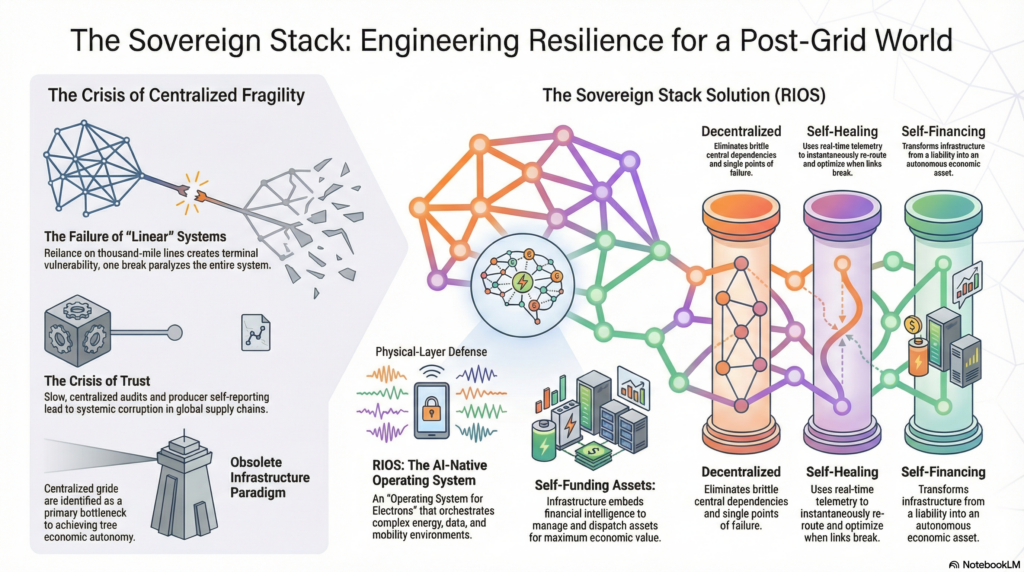
The verdict is absolute: the old grid is not just failing; it is obsolete. We are currently witnessing the terminal state of Linear Fragility—a paradigm where centralized, thousand-mile power lines and opaque, distant data centers create a catastrophic “Crisis of Trust.” In this “Reticular” model—defined by complexity and single points of failure—international buyers cannot verify producer data, and a single localized break paralyzes the entire system. To ensure economic autonomy and global survival, we must execute a doctrine of survivability through Sovereign Infrastructure.
The DeReticular architectural philosophy is the only viable antidote to this collapse. By moving away from reticular dependence, we transform infrastructure from a liability into a high-performance economic asset via three core pillars:
- Decentralized: Every node is an intelligent, self-sufficient entity—from energy storage to edge compute—eliminating brittle central dependencies.
- Self-Healing: Systems utilize real-time global telemetry to instantaneously re-route and self-diagnose, achieving true anti-fragility.
- Self-Financing: Financial intelligence is embedded into the edge, allowing nodes to autonomously manage and dispatch assets to maximize financial value.
This shift delivers Spherical Resilience—a 360-degree defense against systemic failure. Its strategic advantages include:
- Terminal Independence: Continuous operation regardless of external grid or satellite uplink status.
- Guaranteed Truth: Elimination of “Garbage In” data through un-spoofable, physical-layer verification.
- Hard Isolation: Using Sysbox Enterprise to create a logical and physical jail, ensuring public traffic never touches regulated industrial or financial ledgers.
- Community Sovereignty: Preventing external financial extraction by keeping asset ownership local.
The operational engine driving this transformation is the Rural Infrastructure Operating System (RIOS), the platform for the next century’s electrons, data, and mobility.
——————————————————————————–
2. The Platform Shift: From Hardware Manufacturer to RIOS Operator
We are executing a strategic pivot from a hardware manufacturer building physical containers to a Platform Operator. DeReticular is now the architect of the global operating system for sovereign utility. By providing the RIOS Sovereign Stack, we allow third-party founders to build vertical-specific logic on top of a resilient foundation. This is “Civilization in a Box” as a service.
The software backbone integrates a “Dual-Stack” approach, bridging the legacy decentralized web with next-generation performance.
| Feature | Hyphanet (Classic) | New Freenet (Locutus) |
| Primary Goal | Extreme anonymity & static storage | Scalable platform for decentralized apps |
| Language/Tech | Java & Encrypted File Stores | Rust & WebAssembly (Wasm) Contracts |
| Content Type | Static (mostly “Freesites”) | Dynamic (Real-time chat, social feeds) |
| Primary Industrial Use Case | Whistleblowing, Deep Archiving (8TB NVMe) | Dynamic DApps, real-time coordination |
The Wasm Advantage makes the network programmable through smart contracts, while Conflict-free Replicated Data Types (CRDTs) solve the simultaneous update problem. For industrial operations, this is the “So What?”: it enables real-time, decentralized coordination (like the “River” chat protocol) without a central server. These protocols are secured within the hardware stack, providing the “Hard Isolation” required for Sovereign Banking.
——————————————————————————–
3. The “Hardware Oracle”: Guaranteeing Physical Truth at the Edge
Decentralized infrastructure faces the Transparency Paradox: to attract institutional capital, projects must provide verifiable proof of operation, yet traditional audits are slow, corruptible, and expensive. The RIOS solution is the Automated Notary—a system that replaces human trust with machine-verified truth.
Our Physical-Layer Defense deconstructs the hardware oracle into three un-spoofable layers:
- Radio Frequency Fingerprinting (RFF): Verifying device identity via unique physical hardware signatures that cannot be cloned by software.
- TPM 2.0 (Trusted Platform Module): Cryptographically signing “HempGrade” industrial data within the physical chip; the private keys never leave the hardware.
- L3 Horizen Verification: Remote attestation quotes—digital receipts signed by the hardware—are verified on-chain to prove the integrity of the operation without exposing raw data.
This stack is reinforced by an 8TB NVMe datastore for deep archiving and AoA/TDoA (Angle of Arrival/Time Difference of Arrival) telemetry. This allows the system to instantly locate and identify hostile signals in the physical airspace, defending the node from both digital and kinetic threats. This eliminates “Garbage In” attacks and provides the verified truth necessary for Real World Asset (RWA) tokenization.
——————————————————————————–
4. The Real World Asset (RWA) Engine: Tokenizing Industrial Utility
The RWA Engine is the bridge between physical output and decentralized finance (DeFi) liquidity. We are leveraging the CFTC-driven Digital Asset Pilot Program to move toward a model of Sovereign Banking. Every RIOS node acts as a regulatory-compliant engine that tokenizes industrial utility—turning kilowatt-hours and graded commodities into liquid assets.
In this model, infrastructure becomes Self-Financing:
- Asset Autonomy: Because the node can verify its own output via the Hardware Oracle, it can autonomously manage and dispatch resources to maximize yield.
- Extraction Resistance: This model replaces extractive “Mega Church Vacuum” financial models with community-owned systems that finance their own maintenance and expansion.
By embedding financial intelligence into edge nodes, we ensure that the value generated by local infrastructure stays within the local community, managed by the very systems that produce it.
——————————————————————————–
5. Blue Collar AI: High-Value Industrial Verticals and “The Forge”
The next “Unicorn” companies will not be built on consumer apps; they will be built on Blue Collar AI. This is a firmware update for the human workforce, focusing on the intersection of AI, decentralized protocols, and physical labor.
The DeReticular ecosystem is currently deployed across three strategic nodes:
- Node 2 (Canada): The “Brain” and Profit Engine. This is the central software and IP authority coordinating the high-level logic of the stack.
- Node 3 (Quartzsite, AZ): “The Blast Furnace.” The Operational Engine focusing on Non-Emergency Medical Transportation (NEMT) and Seasonal Surge Infrastructure.
- Node 4 (Uganda): “Project Umoja.” The Economic Engine focused on sovereign industrial parks and decentralized energy infrastructure to break the cycle of rural failure.
Call to Builders: Flood the Forge
We are taking over the CodeLaunch GTM Venture Forge. We need founders ready to build the application layer for the RIOS Sovereign Stack. We provide the “Civilization in a Box” infrastructure; you bring the vertical-specific logic.
- Requirements: Founders must present decentralized concepts built on the Sovereign Infrastructure narrative.
- The Reward: Winners receive a professional development team to build their MVP for free.
- Action: Secure the GTM Toolkit from the DeReticular team and apply to the Venture Forge immediately.
The window for this transition is narrow—a 48-hour window is closing. The old grid is failing. Flood the Forge. Dominate the narrative. Build the future. Win.# Strategic Dossier: Commercializing the RIOS Sovereign Stack
1. The Thesis of Sovereign Infrastructure: Beyond Linear Fragility
The verdict is absolute: the old grid is not just failing; it is obsolete. We are currently witnessing the terminal state of Linear Fragility—a paradigm where centralized, thousand-mile power lines and opaque, distant data centers create a catastrophic “Crisis of Trust.” In this “Reticular” model—defined by complexity and single points of failure—international buyers cannot verify producer data, and a single localized break paralyzes the entire system. To ensure economic autonomy and global survival, we must execute a doctrine of survivability through Sovereign Infrastructure.
The DeReticular architectural philosophy is the only viable antidote to this collapse. By moving away from reticular dependence, we transform infrastructure from a liability into a high-performance economic asset via three core pillars:
- Decentralized: Every node is an intelligent, self-sufficient entity—from energy storage to edge compute—eliminating brittle central dependencies.
- Self-Healing: Systems utilize real-time global telemetry to instantaneously re-route and self-diagnose, achieving true anti-fragility.
- Self-Financing: Financial intelligence is embedded into the edge, allowing nodes to autonomously manage and dispatch assets to maximize financial value.
This shift delivers Spherical Resilience—a 360-degree defense against systemic failure. Its strategic advantages include:
- Terminal Independence: Continuous operation regardless of external grid or satellite uplink status.
- Guaranteed Truth: Elimination of “Garbage In” data through un-spoofable, physical-layer verification.
- Hard Isolation: Using Sysbox Enterprise to create a logical and physical jail, ensuring public traffic never touches regulated industrial or financial ledgers.
- Community Sovereignty: Preventing external financial extraction by keeping asset ownership local.
The operational engine driving this transformation is the Rural Infrastructure Operating System (RIOS), the platform for the next century’s electrons, data, and mobility.
——————————————————————————–
2. The Platform Shift: From Hardware Manufacturer to RIOS Operator
We are executing a strategic pivot from a hardware manufacturer building physical containers to a Platform Operator. DeReticular is now the architect of the global operating system for sovereign utility. By providing the RIOS Sovereign Stack, we allow third-party founders to build vertical-specific logic on top of a resilient foundation. This is “Civilization in a Box” as a service.
The software backbone integrates a “Dual-Stack” approach, bridging the legacy decentralized web with next-generation performance.
| Feature | Hyphanet (Classic) | New Freenet (Locutus) |
| Primary Goal | Extreme anonymity & static storage | Scalable platform for decentralized apps |
| Language/Tech | Java & Encrypted File Stores | Rust & WebAssembly (Wasm) Contracts |
| Content Type | Static (mostly “Freesites”) | Dynamic (Real-time chat, social feeds) |
| Primary Industrial Use Case | Whistleblowing, Deep Archiving (8TB NVMe) | Dynamic DApps, real-time coordination |
The Wasm Advantage makes the network programmable through smart contracts, while Conflict-free Replicated Data Types (CRDTs) solve the simultaneous update problem. For industrial operations, this is the “So What?”: it enables real-time, decentralized coordination (like the “River” chat protocol) without a central server. These protocols are secured within the hardware stack, providing the “Hard Isolation” required for Sovereign Banking.
——————————————————————————–
3. The “Hardware Oracle”: Guaranteeing Physical Truth at the Edge
Decentralized infrastructure faces the Transparency Paradox: to attract institutional capital, projects must provide verifiable proof of operation, yet traditional audits are slow, corruptible, and expensive. The RIOS solution is the Automated Notary—a system that replaces human trust with machine-verified truth.
Our Physical-Layer Defense deconstructs the hardware oracle into three un-spoofable layers:
- Radio Frequency Fingerprinting (RFF): Verifying device identity via unique physical hardware signatures that cannot be cloned by software.
- TPM 2.0 (Trusted Platform Module): Cryptographically signing “HempGrade” industrial data within the physical chip; the private keys never leave the hardware.
- L3 Horizen Verification: Remote attestation quotes—digital receipts signed by the hardware—are verified on-chain to prove the integrity of the operation without exposing raw data.
This stack is reinforced by an 8TB NVMe datastore for deep archiving and AoA/TDoA (Angle of Arrival/Time Difference of Arrival) telemetry. This allows the system to instantly locate and identify hostile signals in the physical airspace, defending the node from both digital and kinetic threats. This eliminates “Garbage In” attacks and provides the verified truth necessary for Real World Asset (RWA) tokenization.
——————————————————————————–
4. The Real World Asset (RWA) Engine: Tokenizing Industrial Utility
The RWA Engine is the bridge between physical output and decentralized finance (DeFi) liquidity. We are leveraging the CFTC-driven Digital Asset Pilot Program to move toward a model of Sovereign Banking. Every RIOS node acts as a regulatory-compliant engine that tokenizes industrial utility—turning kilowatt-hours and graded commodities into liquid assets.
In this model, infrastructure becomes Self-Financing:
- Asset Autonomy: Because the node can verify its own output via the Hardware Oracle, it can autonomously manage and dispatch resources to maximize yield.
- Extraction Resistance: This model replaces extractive “Mega Church Vacuum” financial models with community-owned systems that finance their own maintenance and expansion.
By embedding financial intelligence into edge nodes, we ensure that the value generated by local infrastructure stays within the local community, managed by the very systems that produce it.
——————————————————————————–
5. Blue Collar AI: High-Value Industrial Verticals and “The Forge”
The next “Unicorn” companies will not be built on consumer apps; they will be built on Blue Collar AI. This is a firmware update for the human workforce, focusing on the intersection of AI, decentralized protocols, and physical labor.
The DeReticular ecosystem is currently deployed across three strategic nodes:
- Node 2 (Canada): The “Brain” and Profit Engine. This is the central software and IP authority coordinating the high-level logic of the stack.
- Node 3 (Quartzsite, AZ): “The Blast Furnace.” The Operational Engine focusing on Non-Emergency Medical Transportation (NEMT) and Seasonal Surge Infrastructure.
- Node 4 (Uganda): “Project Umoja.” The Economic Engine focused on sovereign industrial parks and decentralized energy infrastructure to break the cycle of rural failure.
Call to Builders: Flood the Forge
We are taking over the CodeLaunch GTM Venture Forge. We need founders ready to build the application layer for the RIOS Sovereign Stack. We provide the “Civilization in a Box” infrastructure; you bring the vertical-specific logic.
- Requirements: Founders must present decentralized concepts built on the Sovereign Infrastructure narrative.
- The Reward: Winners receive a professional development team to build their MVP for free.
- Action: Secure the GTM Toolkit from the DeReticular team and apply to the Venture Forge immediately.
The window for this transition is narrow—a 48-hour window is closing. The old grid is failing. Flood the Forge. Dominate the narrative. Build the future. Win.
The Automated Notary: How RIOS and Freenet Prove Physical Truth
1. Introduction: The Crisis of Trust and the Machine Solution
In global supply chains, the “Crisis of Trust” stems from a fundamental disconnect: international buyers rarely trust producer self-reporting, while producers cannot afford the cost-prohibitive fees or the slow cadence of centralized, third-party audits. This friction often results in systemic corruption, human error, or grading inflation, particularly in remote regions where oversight is minimal.
The “Sovereign Certifier” is our architectural response. By transforming the RIOS node into a cryptographic notary, we shift the burden of proof from fallible human inspectors to immutable machine logic. This move toward “Automated Trust” allows aspiring learners to understand how decentralized infrastructure can provide the transparency required for Real World Asset (RWA) tokenization without sacrificing localized sovereignty.
Key Insight: Automated Trust Automated Trust is a paradigm where mathematical proof and hardware-bound cryptographic signatures—generated at the point of ingestion—replace human intermediaries. It ensures that the physical attributes of a commodity (grade, weight, and provenance) are unforgeable and accessible via a decentralized state, independent of any central corporate entity.
To achieve this, we employ a sophisticated “Trinity Stack” that bridges the physical reality of a harvest with the digital permanence of a distributed ledger.
——————————————————————————–
2. The Trinity Stack: The Architecture of Truth
The Rural Infrastructure Operating System (RIOS) functions through a three-layer architectural model. This stack is designed to ensure that physical data is captured, sanitized for regulatory compliance, and committed to a global registry.
| Component | Physical/Digital Function | Core Output |
| Layer 1: The Eye (NVIDIA A2 Tensor Core GPU & YOLOv8 AI) | Physical Ingestion: Real-time computer vision analysis of biomass (moisture, stalk diameter, fiber quality). | Raw JSON Grading Object (Private) |
Layer 2: The Hand (hempgrade-publisher Rust Middleware) | Air Gap Management: Performs PII sanitization and coordinates the TPM-based hardware attestation. | Signed, Sanitized Public Certificate |
| Layer 3: The Memory (Freenet/Locutus) | Immutable Registry: Stores certificates on a decentralized P2P network using a content-addressable storage model. | Permanent Public State (Global) |
The Competitive Advantage: Zero Gas Fees Unlike Ethereum or VeChain, where storing “heavy” data like high-fidelity sensor logs or images is cost-prohibitive, Freenet allows DeReticular to record massive datasets for effectively zero marginal cost. This enables a level of provenance detail that traditional blockchains cannot match.
——————————————————————————–
3. The Anatomy of a Trustless Certificate
When a RIOS node processes a batch, the hempgrade-publisher service generates a PublicHempCertificate. This schema is engineered to satisfy global market transparency while ensuring compliance with GDPR, CCPA, and the EU Deforestation Regulation.
The “Approved Public Schema” includes five critical data points:
- Batch UUID: A SHA-256 hash of the internal batch ID, providing a unique reference without exposing private database records.
- Grade Classification: The quality tier (e.g., “Industrial-A”) determined by the AI inference engine, giving buyers immediate quality assurance.
- GPS Hash: A geohash limited to a 10km radius. This provides Provenance (Proof of Origin) while maintaining Physical Security (Farmer Safety) by obscuring exact farm coordinates.
- Hardware Signature: An Ed25519 signature generated by the TPM, providing mathematical proof that the data has not been altered since the moment of scan.
- Confidence Score: A floating-point value (e.g., 0.98) representing the AI’s certainty, allowing buyers to assess the risk profile of the automated grading.
By utilizing PII Sanitization, the middleware ensures no names, wallet addresses, or pricing data enter the public record, protecting the producer’s privacy.
——————————————————————————–
4. The Hardware Oracle: How the Machine Signs Its Name
To eliminate the risk of human bribery or data manipulation, the RIOS node functions as a Hardware Oracle. By binding the digital identity of the machine to a physical Trusted Platform Module (TPM), we establish a “Hardware Root of Trust.”
The RIOS node utilizes an Ed25519 Key Pair where the private key is “burned” into the TPM during factory provisioning and can never be extracted. This ensures that only the machine that witnessed the physical event can authorize the state transition on the ledger.
The Signing Process:
- Inference: The NVIDIA A2 GPU analyzes the biomass and generates the raw grading metrics.
- PII Sanitization & Hashing: The
hempgrade-publisherstrips private data and generates a unique cryptographic hash of the public schema. - TPM Digital Signature: The hash is sent to the TPM; the chip signs it using its internal Ed25519 private key.
- State Update: The signed certificate is pushed to the Freenet network as a content-addressable hash.
——————————————————————————–
5. The Split-Ledger Logic: Privacy vs. Transparency
The “Split-Ledger” architecture is a hybrid model that decouples financial settlement from physical attestation to satisfy both regulators and market participants.
| Dimension | Private Ledger (Hyperledger Fabric / Horizen) | Public Ledger (Freenet) |
| Target Audience | Regulators (CFTC/SEC), Banks, Admins | Global Buyers, Public Markets, DeFi |
| Data Visibility | Farmer PII, USDC Settlement, Wallet IDs | Physical Quality, Weight, GPS Hash |
| Primary Goal | AML/KYC Regulatory Compliance | Trustless Transparency & Immutability |
Technical Insight: The Commutative Monoid The Freenet contract is structured as a Commutative Monoid (Merge-Only Data Type). This ensures the ledger is append-only; grading history can never be deleted or overwritten, only updated with new, signed attestation records. This provides a “Liability Shield” for DeReticular: because the data is pushed to Freenet immediately, the company loses the ability to manipulate grades, protecting itself from accusations of grading inflation.
——————————————————————————–
6. The Journey of a Harvest: A Step-by-Step Workflow
Consider a delivery at Node 4 in Kaabong, Uganda.
- Ingestion: A farmer places a bale of hemp on the conveyor. RIOS cameras and scales initiate high-fidelity scanning.
- Analysis: The NVIDIA A2 GPU performs inference in ~200ms, grading the harvest as “Premium-A.”
- The Split:
- The Private Path: Identity and financial logs are sent to the private ledger (Hyperledger/Horizen), triggering a USDC stablecoin payment.
- The Public Path:
hempgrade-publishersigns the quality data via the TPM and pushes it to Freenet.
- Verification: A buyer in London scans a QR code on the bale. Their app resolves a content-addressable hash (e.g.,
freenet://...) and queries the network directly.
The Verification Check: The buyer’s client software performs a local cryptographic check: Does the Ed25519 signature on this certificate match the known public key of RIOS Node 4? By verifying the math on their own device, the buyer bypasses the need to trust DeReticular’s corporate servers.
——————————————————————————–
7. Conclusion: The Future of Trustless Commodities
The integration of RIOS and Freenet marks the transition of DeReticular from a hardware manufacturer to a Tier-1 Data Infrastructure Provider. By removing the “Centralized Trust” liability, we empower producers with a permanent, uncensorable record of their work.
This architecture ensures that while money and identity are handled in a regulated, private environment, the “Physical Truth” of the commodity is free, public, and immutable. As global mandates like the EU Deforestation Regulation increase the demand for provenance, the “Don’t Trust, Verify” mantra enabled by the Hardware Oracle becomes the new standard for global trade.
Learner’s Summary
- Hardware-Rooted Truth: By using a TPM and Ed25519 keys, the RIOS node becomes a “Sovereign Certifier,” making it impossible for humans to manipulate data after the point of scan.
- Zero-Gas Scalability: Freenet enables the storage of high-fidelity physical data (images and logs) without the cost-prohibitive gas fees associated with traditional blockchains.
- The Regulatory Safe Harbor: The Split-Ledger model ensures full AML/KYC compliance on the private layer (Horizen/Hyperledger) while providing the market with a “Liability Shield” through immutable public attestation.