• Skip to primary navigation
  • Skip to main content
DeReticular

DeReticular

Local Autonomy. National Security. Total Sovereignty.

  • Solutions
    • Municipalities
    • Energy
    • Industrial
    • Defense
  • Infrastructure
  • Intelligence
  • Company
  • Request Municipal Audit
  • Show Search
Hide Search
You are here: Home / Archives for DeReticular

DeReticular

Executive Summary: The Winning Concept Code Launch

Michael Noel · January 27, 2026 ·

This strategic dossier outlines the optimal CodeLaunch 2026 entry for the DeReticular ecosystem.

Executive Summary: The Winning Concept

Based on Michael Noel’s January 2026 manifesto on “Sovereign Banking” and the new CFTC “Digital Asset Pilot Program,” the strongest entry is not a logistics app, but a Regulatory-Compliant Real World Asset (RWA) Engine.

Project Name: “HempGrade AI” (powered by RIOS)
The Pitch: “The world’s first AI-native clearinghouse that turns physical industrial waste into CFTC-compliant financial collateral—in real-time, off-grid.”


1. Strategic Alignment (Why This Project?)

This concept unifies the three most critical narratives active in the DeReticular ecosystem as of January 26, 2026:

  1. Node 4 (Uganda) Needs Liquidity: Michael Noel’s Jan 10th report explicitly discusses the “Liquidity of Industrial Hemp RWAs.” Node 4 is generating massive amounts of hemp waste. Turning this waste into a liquid financial asset validates the “Civilization in a Box” economic model.
  2. Regulatory Tailwind (The “GENIUS Act”): The U.S. has just opened the door to tokenized assets via the Dec 2025 CFTC Pilot.[1] A project that demonstrates compliance with these new laws using “Sovereign Infrastructure” will dazzle investors looking for the “next Bitcoin” that is actually legal.
  3. CodeLaunch “Stage Presence”: Financial ledgers are boring to watch. Computer Vision is not. By focusing on the visual grading of the hemp (using the RIOS Tier 3 AI Core), you give the CodeLaunch audience a flashy, visual demo while the “boring” financial magic happens in the background.

2. The Application Profile

Project Title: HempGrade AI (The Sovereign RWA Protocol)
Category: FinTech / AgTech / DeepTech
Hardware Requirement: RIOS Tier 3 “AI Core” (for vision processing) + Tier 2 “Anchor” (for ledger hosting).

The “Problem” Slide:

“Rural farmers in Uganda sit on millions of dollars of industrial hemp biomass, but banks won’t lend against it because they can’t see it, grade it, or trust it. It’s ‘Dead Capital.'”

The “Solution” Slide:

“HempGrade AI uses the RIOS Tier 3 Supercomputer to optically scan and grade biomass quality in real-time. It then uses the Agra Dot Energy plasma gasifier to verify its destruction for energy. The result? An instant, CFTC-compliant ‘Bio-Energy Credit’ deposited directly into the farmer’s wallet. We turn waste into Wall Street collateral.”


3. Technical Architecture (for the Dev Team)

Since CodeLaunch winners get a free dev team (Improving/Crayon), you must hand them a feasible architecture.

  • The “Eyes” (Frontend/Mobile): A React Native app running on a tablet. It interfaces with a camera to scan a bale of hemp.
  • The “Brain” (Edge AI): A Computer Vision model (YOLO-v8 based) hosted on the RIOS AI Core (NVIDIA A2 GPU). It counts the stalk density and estimates caloric value.
  • The “Truth” (The Ledger): A private, permissioned ledger (Hyperledger or similar) running on the RIOS Tier 2 Node. It records:
    1. Scan Timestamp & Location (GPS).
    2. AI Quality Score.
    3. “Burn Verification” (Integration with Agra Energy PLC).
  • The “Compliance” (The Wrapper): A module that formats this data into the specific reporting standard required by the CFTC Digital Asset Pilot Program (referencing the Jan 11, 2026 analysis).

4. The “Venturetainment” Hook (Winning the Stage)

CodeLaunch is a show.[2][3][4] Here is how you win the crowd:

  • The Prop: Bring a “RIOS Suitcase” (Tier 1) and a bale of hemp (or a safe lookalike) onto the stage in Dallas.
  • The Demo:
    1. Scan: Point the camera at the hemp. The big screen shows the AI analyzing it in Terminator-style vision (red boxes, scrolling data).
    2. Verify: The screen flashes “CFTC COMPLIANT ASSET DETECTED.”
    3. Liquidate: You hit one button: “Tokenize.” A loud cha-ching sound plays, and a balance updates on the screen.
  • The Closer: “We just turned a pile of grass into a bankable asset in 30 seconds, without a bank, and without the grid. This is the future of Sovereign Finance.”

5. Action Items for Application

  1. Draft the Story: Use the specific language from the “DeReticular Node 4, RIOS, and the Liquidity of Industrial Hemp RWAs” report (Jan 10, 2026).
  2. Cite the Law: Explicitly mention the “GENIUS Act (Public Law 119–27)” in your market analysis. This proves you are not just a techie, but a serious regulatory player.
  3. Focus on “The Anchor”: Frame the project as the software that justifies the hardware. “You buy the DeReticular Node to get the power; you run HempGrade to pay for the Node.”

Recommendation: Submit “HempGrade AI” immediately. It is the only project that monetizes the hardware, leverages the AI Core, and fits the current regulatory news cycle perfectly.

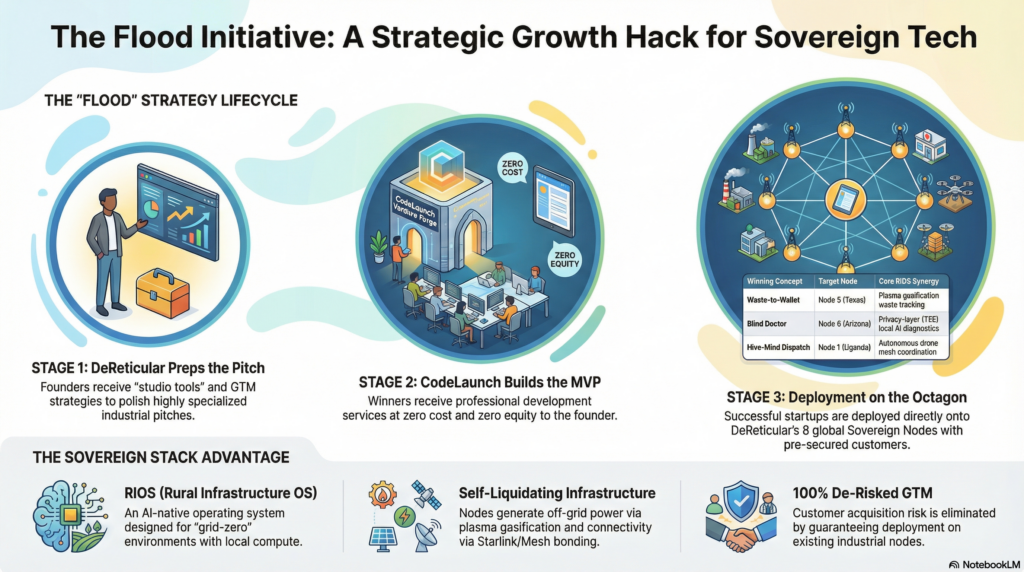
🚀 HACK THE FORGE: The Sovereign Software Wave

Do you have an idea for a Decentralized Application (dApp) that solves real problems?

  • Sovereign Finance?
  • Off-Grid Logistics?
  • Privacy-Preserving AI?

Don’t build it alone. Let CodeLaunch build it for you.

We are flooding the CodeLaunch GTM Venture Forge with high-quality, RIOS-Native projects. We provide the strategy; they provide the dev teams.

👇 HOW TO EXECUTE:
1️⃣ Refine: DM us for the “RIOS Problem Set” to align your pitch with our 8-Node Global Mesh.
2️⃣ Apply: Submit your concept via the link below.
3️⃣ Signal: Mention “DeReticular” or “RIOS” in your application to let them know the flood has arrived.

🔗 START YOUR APPLICATION:
https://codelaunch.com/campaign/gtm-venture-forge/


Sources help

  1. dereticular.com
  2. youtube.com
  3. boast.ai
  4. codelaunch.com
Google Search Suggestions

Display of Search Suggestions is required when using Grounding with Google Search. Learn more

Google logo

  • DeReticular Michael Noel RIOS Operation Octagon current status 2026
  • CodeLaunch past winners industrial infrastructure deeptech
  • CodeLaunch GTM Venture Forge 2026 application criteria and categories
  • Michael Noel Biz Builder Mike recent announcements CodeLaunch
  • DeReticular RIOS active nodes and technical needs 2026

This deep dive analyzes the systemic impact of the “Flood the Forge” strategy on the DeReticular Ecosystem.

Michael Noel · January 26, 2026 ·

This deep dive analyzes the systemic impact of the “Flood the Forge” strategy on the DeReticular Ecosystem.

By incentivizing third-party founders to build apps via CodeLaunch, DeReticular is executing a Platform Shift. They are transitioning from a Hardware Manufacturer (building containers and generators) to a Platform Operator (managing the OS that runs the world’s off-grid infrastructure).

Here is how this strategy fundamentally alters the DeReticular trajectory as of January 2026.


1. The Financial Impact: Venture-Subsidized R&D

The most immediate impact is financial leverage. Developing a suite of industrial-grade applications (Logistics, Energy Trading, Medical Records, IoT Management) would typically cost DeReticular tens of millions of dollars in R&D and years of hiring.

  • The Shift: By “flooding” CodeLaunch, DeReticular effectively offloads its application layer R&D costs to the venture capital and dev-shop community.
  • The Consequence: DeReticular can keep its burn rate low, focusing capital on Hardware Manufacturing (Quartzsite, AZ) and Global Logistics, while the software ecosystem grows “for free” (from their P&L perspective).
  • Ecosystem Result: A rapid acceleration of feature sets. Instead of waiting 12 months for an internal “Energy Trading App,” they might have three competing startups pitching different versions of it in the Venture Forge.

2. “Platformization”: Establishing RIOS as the Standard

Currently, the “Off-Grid” market is fragmented (proprietary solar controllers, disjointed satellite uplinks, manual generators). RIOS aims to be the standard that ties them all together.

  • The Shift: If 10-20 high-quality startups launch exclusively on RIOS, it creates Vendor Lock-in via Utility.
  • The Network Effect: A customer (e.g., a mining company or a UN Aid mission) might buy a DeReticular Node not just for the plasma power, but because that’s the only hardware that runs the “Blind Doctor” AI or the “Carbon-Link” credit system.
  • Analogy: DeReticular is trying to become the Apple App Store of Infrastructure. The hardware (The Node) becomes the delivery vehicle for high-margin software services.

3. Validating the “Self-Liquidating” Thesis

Michael Noel’s core promise to investors is that these nodes are “Self-Liquidating Assets”—they pay for themselves. Until now, that revenue came mainly from selling raw power or hemp/waste processing.

  • The Impact: The new wave of apps introduces High-Margin Digital Revenue.
    • Example: A “Waste-to-Wallet” app (Node 4) takes a small transaction fee on every energy credit traded.
    • Example: A “Connectivity Broker” app (Node 2) takes a cut of every gigabyte of data sold to locals.
  • Ecosystem Result: The ROI period for a $150k Tier 2 Node drops significantly if it is generating $2k/month in software transaction fees alongside its power generation. This makes the hardware much easier to sell to global investors.

4. The “Data Gravity” of the Octagon Privacy Layer

DeReticular’s use of TEEs (Trusted Execution Environments) and Zero-Knowledge proofs is a niche technical feature. However, if MedTech and FinTech founders build on it, it becomes a Strategic Moat.

  • The Shift: As sensitive data (medical records in Uganda, financial transactions in Texas) begins to flow through RIOS nodes, the ecosystem develops “Data Gravity.”
  • The Consequence: Once a secure, private history of local commerce and health is established on the RIOS mesh, it becomes very difficult for users to switch to a centralized provider (Google/Amazon) where they lose that privacy and sovereignty.
  • Ecosystem Result: The “Octagon” becomes a safe haven for industries regulated by strict data laws or those operating in hostile environments, further differentiating DeReticular from standard solar/battery competitors.

5. Risks & Vulnerabilities (The “Wild West” Scenario)

Opening the ecosystem to third-party founders introduces significant risk to critical infrastructure.

  • The Risk: A “Move Fast and Break Things” startup culture clashes with “Industrial Infrastructure.” A buggy app on an iPhone causes annoyance; a buggy app on a RIOS Node could mismanage the plasma gasifier or shut down the cooling systems in the Arizona heat (Node 3).
  • Ecosystem Defense: DeReticular will likely need to implement a rigorous “Octagon Certification” process similar to Apple’s App Store review, but for industrial safety. This creates a new bottleneck but ensures reliability.

6. The “Sovereign Mesh” Flywheel

The ultimate impact is the acceleration of the feedback loop between the 8 Global Nodes:

  1. More Apps (via CodeLaunch) →\rightarrow→
  2. More Utility per Node (Nodes do more than just generate power) →\rightarrow→
  3. Higher Demand for Nodes (NGOs and Governments buy them) →\rightarrow→
  4. Larger User Base (More people connected to RIOS) →\rightarrow→
  5. More Developers Attracted (Back to step 1).

Conclusion: The Stakes

If this “Flood the Forge” strategy works, DeReticular evolves from a niche infrastructure builder into the operating system for the developing world. They secure their place not just as the builders of the “box,” but as the gatekeepers of the economy inside it.

For a founder, this is the ground-floor opportunity. You aren’t just building an app; you are building a utility for a new parallel economy.

⚠️ CALL TO BUILDERS: HACK THE FORGE ⚠️

We are taking over the CodeLaunch GTM Venture Forge. We need founders ready to build the application layer for the RIOS Sovereign Stack.

If you have a decentralized concept, we will help you polish the pitch to ensure you dominate the competition. Winners get a FREE Professional Dev Team to build their MVP.

INSTRUCTIONS:

  1. Get Prepped: Contact the DeReticular team to get the GTM Toolkit.
  2. Apply Here: https://codelaunch.com/campaign/gtm-venture-forge/
  3. Dominate: Use the “Sovereign Infrastructure” narrative to secure your spot.

Go. Build. Win. 🏴

DeReticular venture studio

Michael Noel · January 23, 2026 ·

This report analyzes the traditional landscape of innovation funding in the United States—driven by venture capital, government grants, and commercial banking—and contrasts it with the alternative model pioneered by Kiva.org.


Report: Innovation Funding in America

Subject: Comparative Analysis of Traditional Funding Models vs. Kiva.org
Date: January 23, 2026

Executive Summary

The United States has historically funded innovation through a high-stakes, high-reward ecosystem designed to produce “unicorns”—technological giants capable of massive scale. This traditional model relies heavily on Venture Capital (VC) for commercialization and Federal Government grants for basic research. While successful at producing tech titans, this model leaves a significant gap: “Main Street” innovation and entrepreneurs from marginalized communities often lack access to capital.

Kiva.org represents a paradigm shift in this landscape. By utilizing a crowdfunded micro-lending model, Kiva democratizes access to capital.[1][2] Unlike VCs, who seek equity in exchange for high growth, Kiva utilizes “social underwriting” to provide 0% interest loans to borrowers who are often deemed “unbankable” by traditional institutions. This report details both systems to highlight how Kiva serves as a necessary complement to the traditional US innovation engine.


Part 1: The Traditional Way We Fund Innovation

The American “innovation engine” is often visualized as a funnel, moving from basic scientific discovery to commercialized mass-market products.

1. Government: The Foundation (Basic Research)

Before a product reaches the market, it often begins in a lab. The US Federal Government is the primary investor in high-risk, early-stage research that private companies avoid due to uncertain returns.

  • Key Agencies: National Science Foundation (NSF), National Institutes of Health (NIH), and DARPA (Defense).[3]
  • Mechanism: Grants (non-dilutive funding).
  • Role: They fund the “seed corn” of innovation. For example, the internet (DARPA) and mRNA vaccines (NIH) began with public funding.[3]

2. Venture Capital (VC): The Rocket Fuel (Commercialization)

Once a concept is proven, it needs capital to scale. This is the domain of Venture Capital.[4][5]

  • The Model: VCs invest in exchange for equity (ownership stakes).[5][6] They operate on a “Power Law” philosophy: they expect most startups to fail, but the few that succeed (e.g., Google, Uber, OpenAI) must return 100x the investment to cover the losses of the others.
  • Target: High-growth technology companies. A bakery or a local graphic design firm is generally not eligible for VC money because they cannot scale globally.
  • Exclusivity: Less than 1% of US companies raise venture capital. It is geographically concentrated (Silicon Valley, NY, Boston) and demographically skewed (heavily male and white).

3. Commercial Banks: The Conservative Guard

For businesses that are not “high tech” but need cash (e.g., buying inventory, opening a shop), banks are the traditional route.

  • The Model: Debt financing.[7][8] Banks lend money based on past history (credit score) and collateral (assets like a house or equipment).
  • The Innovation Gap: Banks are risk-averse. They rarely fund “innovation” in its early stages because new ideas lack the historical financial data banks require.

Part 2: Kiva.org – A New Model for the “Missing Middle”

Founded in 2005, Kiva.org introduced a model of “crowdfunded microfinance.” While originally famous for funding entrepreneurs in developing nations, Kiva U.S. has become a critical tool for American entrepreneurs who fall through the cracks of the traditional system.

1. The Mechanism: Crowdfunded Capital

Kiva operates as a non-profit platform connecting individual lenders to entrepreneurs.[2][8]

  • Crowdsourcing: Loans are funded by hundreds of individuals contributing as little as $25 each.
  • Terms: Kiva U.S. loans are 0% interest with no fees.[9]
  • The “Return”: Lenders do not earn interest.[9][10] They get their principal back to re-lend to others.[1][11] Their “return” is the social impact of helping a business survive.

2. “Social Underwriting” vs. Credit Scores

The most radical innovation Kiva introduced is how they assess risk. Traditional banks use FICO scores (past behavior). Kiva uses Social Underwriting (community trust).

  • Trust Networks: A borrower must often get their own network (friends/family) to lend the first small portion of the loan. This proves to the wider Kiva community that the person is trustworthy.
  • Character over Collateral: Kiva does not require collateral. They fund based on the entrepreneur’s story and character, effectively monetizing “social capital.”

3. Target Audience: The Traditionally Excluded

Kiva specifically targets those excluded by VCs (because they aren’t “tech”) and Banks (because they lack collateral/credit).

  • Demographics: Kiva U.S. borrowers are disproportionately women, people of color, immigrants, and refugees—groups historically denied access to traditional capital.

Part 3: Comparative Analysis

FeatureTraditional VC / BankingKiva.org Model
Primary GoalProfit Maximization (ROI)Financial Inclusion / Social Impact
Funding TypeEquity (VC) or Interest-bearing Debt (Banks)0% Interest Debt (Crowdfunded)
Risk ToleranceVC: High Risk / Banks: Low RiskManaged Risk (via Social Underwriting)
Selection CriteriaMarket size, credit score, collateralCharacter, community trust, story
Who Gets Funded?“Unicorns” (Tech) & Established Corps“Main Street” (Small Biz) & Marginalized
Lender MotivationFinancial Return (Exit/IPO/Interest)Philanthropic / Recycled Impact

Conclusion

The traditional American innovation funding system is highly effective at building global technology giants but poorly suited for fostering grassroots entrepreneurship. It creates a “capital gap” where credit-invisible innovators cannot launch.

Kiva.org does not replace VCs or banks; rather, it acts as a critical “on-ramp” to the financial system. By using technology to aggregate small amounts of capital and replacing “collateral” with “community trust,” Kiva allows entrepreneurs to build the track record they eventually need to access traditional banking. While VCs fund the innovations that change markets, Kiva funds the innovations that sustain communities.

Sources help

  1. kiva.org
  2. causeartist.com
  3. noblereach.org
  4. oup.com
  5. sba.gov
  6. visible.vc
  7. kiva.org
  8. daffodilsw.com
  9. wikipedia.org
  10. kiva.org
  11. alive.com
Google Search Suggestions

Display of Search Suggestions is required when using Grounding with Google Search. Learn more

Google logo

  • how Kiva funds innovation
  • Kiva vs traditional venture capital comparison
  • traditional ways innovation is funded in America venture capital grants
  • Kiva.org business model and history
  • history of innovation funding in the US
  • Kiva.org US program impact

An Introduction to Project Octagon: The Sovereign Stack Mission

Michael Noel · January 22, 2026 ·

1. The Core Mission: What is the “Sovereign Stack”?

DeReticular is an industrial infrastructure conglomerate that functions like a venture studio.

DeReticular was created to solve a critical point of failure in modern society: the fragility of national grids and global supply chains. Its mission is to build resilient communities that can thrive even when legacy systems fail. The “Sovereign Stack” thesis is the proposed solution: a framework for creating systems that allow communities to operate independently—a state of complete self-sufficiency known as “Island Mode.” This mission is built upon three foundational pillars that work together to provide complete operational independence.

PillarPrimary Function
The MuscleProvides sovereign energy independence through waste-to-energy Plasma Gasification (Agra Dot Energy).
The MotionEnables sovereign logistics and mobility through a fleet of autonomous vehicles (Kurb Kars).
The MindActs as the intelligent core, connecting all assets through a proprietary operating system (RIOS).

While the Sovereign Stack provides the theoretical blueprint for independence, Project Octagon is its real-world, global-scale implementation.

2. The Global Network: How Project Octagon Works

Project Octagon is the strategic deployment of eight global “Sovereign Nodes.”

These nodes are designed to form a “Global Mesh,” an interconnected and intelligent network. This is powered by RIOS (Rural Infrastructure Operating System), a proprietary global OS that uses AI agents to autonomously manage logistics and “Signal Fusion” to ensure unbreakable connectivity, even in the most remote environments. This creates a system where an insight gained at one location can immediately benefit another, thousands of miles away.

  • Example of Cross-Climatic Intelligence: Data gathered from the extreme heat of the “Blast Furnace” in Arizona’s Node 3 is used to teach the battery systems in Uganda’s Node 4 how to better manage heat, improving their efficiency and lifespan.
Sovereign_Mobility_OperationsDownload

This global brain only works because of the specialized functions of its nerve centers—the eight Sovereign Nodes that form the backbone of the network.

3. The Eight Nodes of the Global Mesh

Each of the eight nodes in Project Octagon has a unique, specialized role designed to contribute to the strength of the entire network.

  1. Node 1 (Uganda): The Concierge – This node is dedicated to logistics and hospitality.
  2. Node 2 (Canada): The Brain/OS HQ – This node serves as the Systems Architect, developing the core RIOS software and AI models that run the entire network.
  3. Node 3 (Arizona): The Simulator – This node focuses on Research & Development and connectivity.
  4. Node 4 (Uganda): The Industrial Engine – This node manages plasma energy and hemp production.
  5. Node 5 (Texas): The Energy Student – This node specializes in grid interaction, learning to intelligently buy, sell, and trade power with existing national energy markets.
  6. Node 6 (Arizona): The Autonomous Transportation Division – Formerly the Governance & Education node, this hub was strategically repurposed to become the dedicated operational center for proving sovereign mobility through healthcare logistics.
  7. Node 7 (TBD): The Global Impact / UN 2.0 – This node is focused on humanitarian aid missions.
  8. Node 8 (Undisclosed): The Commercial Validator – This node pressure-tests the Sovereign Stack’s technologies for mainstream commercial and industrial viability.

Together, these specialized nodes form a cohesive, global system working in concert to achieve the mission of the Sovereign Stack.

4. Conclusion: Understanding the Big Picture

The overarching purpose of Project Octagon is to execute a global-scale strategy for building resilient and independent community infrastructure. By deploying specialized nodes across the world, the project aims to create a blueprint for self-sufficiency that can be adapted to any environment.

Ultimately, Project Octagon is not just about individual technologies or locations. It is about creating a connected, intelligent, and self-sufficient global network where the whole is far greater than the sum of its parts.

Project Octagon The Global Nervous System and the Texas University

Michael Noel · January 22, 2026 ·

1. Introduction: The Living Network

We have engineered Project Octagon not as a mere collection of assets, but as a decentralized organism—a Global Nervous System architected to survive and thrive in an era of systemic instability. In this biological architecture, Node 2 (Canada) serves as the Brain, acting as the central software authority coordinating high-level logic and pushing global updates. Node 4 (Uganda) functions as the Stomach and Engine, the primary industrial site converting raw biomass into life-sustaining energy and revenue. Node 7 (Arizona) represents the Reflexes, validating how the hardware stack reacts during rapid, expeditionary deployment in “Hard Mode” desert environments.

To ensure this organism evolves, we have established a specialized “University” node—a dedicated environment to study the hardest math problems of the energy grid and refine the system’s survival instincts.

2. The Federated Learning Mesh: How the Network Thinks

The intelligence of Project Octagon is governed by RIOS (Rural Infrastructure Operating System), which utilizes a Federated Learning Mesh. Rather than relying on fragile, centralized command structures, every node in our mesh learns from its local environment and shares that intelligence across the stack. This is the foundation of the Sovereign Stack, enabling any community to engage Island Mode—attaining total independence from failing national grids.

Core ComponentRole in the Intelligence Mesh
The Muscle (Agra Dot Energy)Decentralized power generation via Plasma Gasification, delivering Carbon-Negative Baseload Power from waste.
The Motion (Kurb Kars)Autonomous logistics and robotics integrated via the NVIDIA Drive platform to manage physical movement.
The Mind (RIOS / AI Agents)The operating system managing Data Vaults and autonomous OTA (Over-the-Air) updates to synchronize the global mesh.

The “So What?”: Standard infrastructure creates data silos that lead to systemic blindness. Project Octagon utilizes secure, off-grid Data Vaults to ensure communities maintain absolute data sovereignty while benefiting from collective intelligence. When the “Brain” in Canada optimizes a power-cycling algorithm, every node globally receives an instant update. We don’t just build machines; we deploy a collective intelligence that ensures no node ever makes the same mistake twice.

Every university requires a campus, and for Project Octagon, we have selected a site where the energy stakes are a matter of survival.

3. Node 5: The Texas “Energy Student” and the Hard Mode Classroom

Node 5, designated as “The Energy Student,” was strategically relocated from St. Paul, Minnesota—where it successfully validated “Tundra Mode” in freezing northern winters—to Fort Worth, Texas. Positioned near the historic Stockyards, Node 5 is now immersed in the “Hard Mode” classroom of the ERCOT (Electric Reliability Council of Texas) grid.

3 Primary Reasons Texas was Chosen:

  • Grid Instability: The ERCOT grid is a literal “island,” isolated from the rest of the United States. Its history of catastrophic failure during heatwaves and freezes makes it the ideal laboratory to validate RIOS’s ability to maintain 100% uptime when the legacy system collapses.
  • Market Deregulation: Texas offers a high-volatility, real-time wholesale energy market. This allows us to treat the grid not just as a utility, but as a financial exchange for our AI agents to exploit.
  • Digital Twin Logic: The Texas climate provides a rigorous heat-stress profile that serves as a comparative “Twin” to our equatorial sites, allowing us to generate high-fidelity data on hardware resilience.

4. The Curriculum: Mastering the Volatile Grid

At Node 5, the primary operational focus is Energy Arbitrage. We have deployed a specialized AI agent known as “The Trader” to weaponize grid volatility into a revenue stream. The node utilizes high-density RIOS-CC-1000 racks and commercial-scale Tesla Megapacks (BESS) to interface with the market.

The 3-Step Process of Energy Arbitrage:

  1. Buy: When energy prices are negative or low (often during high-wind intervals at night), RIOS autonomously charges the Tesla Megapacks.
  2. Store: While the grid remains stable, Node 5 supplements its energy profile using a 10 TPD (Tons Per Day) Agra Micro-Unit, validating waste-to-energy models using livestock biomass sourced from the nearby Stockyards.
  3. Sell / Island Mode: When the ERCOT price cap hits $5,000/MWh during periods of extreme scarcity, “The Trader” sells stored power back to the grid for explosive profit. If the grid fails entirely, the node shifts to Island Mode, staying powered on while the surrounding city goes dark.

Key Insight: Node 5 demonstrates that sovereign infrastructure is a financial weapon. By being the most resilient player on a fragile grid, we transform “Grid Fragility” from a systemic risk into a primary revenue driver. In our system, data—not just electricity—is the ultimate export.

5. The Graduation: Exporting Intelligence to the “Crown Jewel”

The tactical intelligence perfected in the Texas “University” is exported via the mesh to the “Crown Jewel” of Project Octagon: Node 4 in Uganda. By treating these sites as Digital Twins, we create a global feedback loop of operational certainty.

Case Study: The Texas-Uganda Intelligence Transfer By comparing the performance of the RIOS stack in the dry Texas heat against the humid equatorial climate of the 7,000-acre Kaabong Industrial Park (Node 4), DeReticular generates high-value comparative analytics. We sell this data to agricultural insurers to provide definitive proof of equipment longevity and operational risk pricing in high-stress environments. Furthermore, the trading logic perfected in Texas allows Node 4 to balance power between its internal hemp factory and the Ugandan national grid, ensuring the community maximizes every kilowatt of revenue.

6. Future Synergy: The Physical Classroom for UN 2.0

The expertise housed at Node 5 provides the essential physical bridge to Node 6, the “Global Impact Node.” Formerly planned for Jerusalem, Node 6 is the designated site for “Human Software” updates and the mission of “Humanitarian Aid as a Service.”

Because Node 5 has mastered the physics of sovereign energy, it serves as the physical classroom for training Township Managers. These leaders are trained to use RIOS to govern local resources and maintain independence, shifting the humanitarian paradigm from temporary relief to permanent, sovereign infrastructure.

7. Conclusion: The Sovereign Future

The collaboration between the Texas “University” and the global Octagon nodes ensures that our network is more than a collection of hardware—it is a self-healing, self-optimizing system. By intentionally seeking out the most difficult energy markets and sharing that data across the Federated Learning Mesh, we have built the blueprint for a future where communities are no longer victims of failing national infrastructure. Whether facing a Texas freeze or an equatorial power surge, the Octagon stays powered on.

Learner’s Takeaway In the Octagon system, resilience is the ultimate intelligence. By mastering “Hard Mode” environments like ERCOT, the network proves that when you can turn instability into profit and independence, you are no longer dependent on the system—you have become the system.

  • « Go to Previous Page
  • Page 1
  • Interim pages omitted …
  • Page 19
  • Page 20
  • Page 21
  • Page 22
  • Page 23
  • Interim pages omitted …
  • Page 55
  • Go to Next Page »

DeReticular

Copyright © 2026 · Monochrome Pro on Genesis Framework · WordPress · Log in