• Skip to primary navigation
  • Skip to main content
DeReticular

DeReticular

Local Autonomy. National Security. Total Sovereignty.

  • Solutions
    • Municipalities
    • Energy
    • Industrial
    • Defense
  • Infrastructure
  • Intelligence
  • Company
  • Request Municipal Audit
  • Show Search
Hide Search
You are here: Home / Archives for DeReticular

DeReticular

Project Implementation Plan The Sovereign Industrial Park Energy Infrastructure (Node 4)

Michael Noel · January 20, 2026 ·

1. Strategic Vision and the Sovereign Stack Thesis

Project Umoja (Node 4) represents the economic engine of a global Venture Studio model, designed to break the “linear failure” of rural development. In the Kaabong District of Uganda, the historical barrier to industrialization has been the fragility of the national grid and the extractive costs of imported fuels. Our strategy bypasses these systemic failures by deploying “Island Mode” infrastructure—a self-contained, resilient ecosystem capable of absolute operational independence. This project is funded through internal mechanisms, where DeReticular acts as the central financing arm, raising capital to fund Node 4 via intercompany debt, ensuring that the infrastructure remains a sovereign asset rather than a liability to external creditors.

The “Sovereign Stack” is the architectural framework enabling this independence, structured around three integrated pillars:

  • The Muscle (Agra Dot Energy): Providing carbon-negative, 24/7 baseload power via advanced Plasma Gasification.
  • The Motion (Kurb Kars): Delivering autonomous logistics and robotic mobility for efficient material handling within the 7,000-acre park.
  • The Mind (Biz Builder Mike/RIOS): The Rural Infrastructure Operating System. This is the network intelligence layer that utilizes federated learning to optimize energy loads, manage autonomous workflows, and provide cross-climatic optimization.

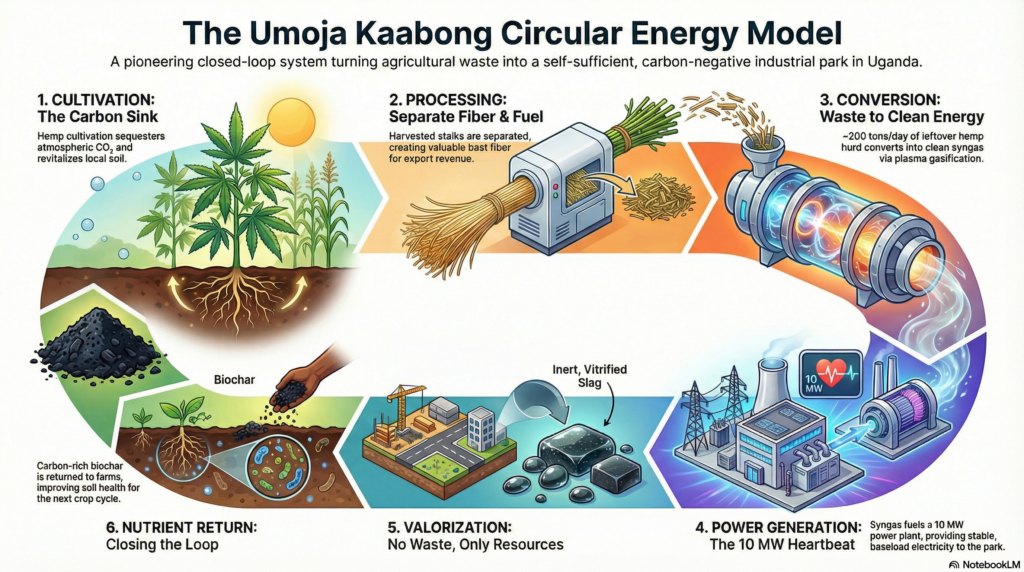
This synthesis transforms agricultural “waste”—specifically hemp hurd—into a high-value sovereign asset. By valorizing every byproduct of the 30-acre daily harvest cycle, we transition from a speculative project to a physical industrial deployment.

PODCAST – https://mikeh69.podbean.com/e/the-umoja-project

2. Phase 0: Site Readiness and Digital Foundation

Phase 0 is defined by the “Landing Ready” narrative. To secure the regulatory and physical perimeter, we avoid the delays of traditional construction by deploying the RIOS Pilot Command Center. This ruggedized, solar-powered “Infrastructure-in-a-Box” serves as the site’s digital brain and primary management hub on Day 1. Its presence signals to stakeholders and the Ugandan government that we have landed; our infrastructure is active and our data gathering is live.

Infrastructure-in-a-Box Deliverables (Phase 0)

DeliverableComponentStrategic Function
D-0.1150 kW Solar ArrayProvides immediate, renewable site power for initial operations and the “Proto-One Stop Center.”
D-0.2400 kWh BESSIntegrated battery energy storage to buffer solar loads and ensure 24/7 site security and connectivity.
D-0.3RIOS Starlink Business KitEnables high-performance, site-wide data connectivity and links Kaabong to the global DeReticular mesh.
D-0.4RIOS Command CenterA ruggedized container housing edge servers and sensor arrays for on-site data management.

This deployment functions as a critical regulatory tool, fulfilling the 2024 Ugandan Guidelines for Developing Industrial Parks. Specifically, it addresses the Stage 1 Site Justification requirement for “empirical feasibility data.” By using onboard GIS and environmental sensors to map solar irradiance and biomass density in real-time, we generate the Extended Cost Benefit Analysis (eCBA) required to unlock Green Special Economic Zone (SEZ) tax incentives and VAT exemptions on equipment imports.

3. Phase 1: Modular Deployment of the 1 MW “Bridge” Plant

Phase 1 introduces the 1 MW “Bridge” Plant (SKU: ADE-SPS-1MW-NA). This containerized system provides the reliable power required for the primary construction of the industrial park. At this scale, the plant requires approximately 18–20 metric tons of dried biomass per day, effectively validating the supply chain from the initial hemp pilot crops before we scale to full industrial capacity.

1 MW Modular System Bill of Materials (BOM)

ItemPart NameSpecificationsStrategic Role
1.1ADE-FP-10040ft HC; Primary Shredder; Rotary Drum DryerProcesses 18-20 TPD; moisture control <10%.
1.2ADE-GC-2001.5MW Thermal Plasma Reactor (Zirconia-lined)Molecularly dissociates biomass at >5,000°C.
1.3ADE-SC-300Syngas Conditioning & Tar CrackerPurifies syngas via catalytic scrubbers and filters.
1.4ADE-PG-400Syngas-rated Reciprocating Engine (Jenbacher/CAT)1.2MW net output using purified synthesis gas.
1.5ADE-CO-500RIOS Central Control; Redundant AI ServersRuns the plant’s “Digital Twin” for autonomous ER control.
1.6ADE-PD-6001.5MVA Step-Up Transformer & SynchronizationManages microgrid distribution and grid-tie logic.

Commissioning Milestones:

  1. Site Prep: Completion of reinforced concrete pads and utility trenches.
  2. Docking: Arrival and craning of factory-tested modules into position.
  3. Interconnection: Mechanical/electrical link-up of all six ADE modules.
  4. Performance Test: Execution of a mandatory 72-hour continuous performance test at full load.

This “bridge” plant de-risks the $30M total investment by proving the technology’s ability to handle hemp hurd at a modular scale, validating our baseline efficiency before the 10 MW expansion.

4. Phase 2: Industrial Symbiosis and Microgrid Expansion

In Phase 2, we shift from a standalone power plant to a fully integrated “Industrial Symbiosis” microgrid. This phase focuses on the integration with the primary anchor tenant: the Hemp Processing Facility. We establish a “Closed-Loop” mechanism where hemp waste (hurd) flows to the ADE plant as fuel, while the resulting waste heat from the thermal cycle flows back to the processing facility to dry fiber.

RIOS Campus Network Capabilities:

  • SD-WAN Gateway: Orchestrates site-wide traffic and UCC-1 data backhaul.
  • Trifi Far X Routers: Provides high-range industrial Wi-Fi across agricultural and industrial zones.
  • Agentic Workflows: RIOS AI agents balance loads between heavy processing machinery and energy generation in real-time.

To secure the park’s expansion and water security, we deploy advanced Geophysical Exploration methods. Utilizing CG5/CG6 gravimeters and the Medusa MS 1000 sensor (drone-mounted), we map subsurface density and radiometric signatures. We specifically utilize Normal Resistivity Probes to locate deep-seated aquifers for water security and Natural Gamma Probes for lithological characterization to ensure the geological stability of foundations for site-erected structures.

5. Phase 3: Scaling to 10 MW Commercial Operation

Phase 3 marks the commissioning of the 10 MW Main Power Plant (SKU: ADE-SPS-10MW-NA), the “Crown Jewel” of Node 4. This system transitions from modular containers to heavy industrial, site-erected architecture, requiring 200 metric tons per day (TPD) of biomass to process 49,000 tons annually.

10 MW Technical Architecture vs. Phase 1

ItemPhase 3 ComponentTechnical SpecificationContrast to Phase 1
2.1Industrial Handling50 TPH Automated Conveyor NetworkIndustrial tipping floor vs. container intake.
2.215MW Thermal PGUSite-erected steel vessel; 10x 1.5MW TorchesMulti-story reactor vs. modular core.
2.4Power Block12 MW Steam Turbine & HRSGHigh-efficiency steam cycle vs. gas engine.
2.6HV Substation15MVA Main Transformer; grid interconnectIndustrial substation vs. modular PD-600.

Umoja Compute Core (UCC-1): We monetize “stranded energy” by allocating 1.8 MW to a high-performance compute cluster (1,000 NVIDIA H100 GPUs). By utilizing a **0.07/kWh transfer price**, the project converts low-cost onsite power into global data revenue (11.3M annually).

Workforce Development: Full-scale operations require 30–40 full-time employees. Phase 1 relies on RCT-Professional level technicians, while Phase 3 scales via the Umoja Kaabong Scholars Program, an initiative of the DeReticular Academy that trains local talent in advanced thermal conversion and RIOS agentic management.

6. Technical Optimization: The Gasification Physics & Control Layer

Precise chemical control is the “Alchemical Core” of Project Umoja. Our system architecture is designed to fulfill the rigorous requirements established by the University of Modena’s modeling.

Scientific Challenge vs. Agra Dot Engineered Solution

Scientific ChallengeModena Lab FindingAgra Dot Solution
Moisture ControlMoisture >10% kills efficiency.ADE-FP-100 Dryer: Uses waste heat for consistency.
Equivalence Ratio (ER)ER of 0.3 is optimal but “very hard to set.”ADE-CO-500 AI: Automates ER via “Digital Twin.”
Tar MitigationTars damage mechanical components.Plasma Torches: Dissociate molecules at >5,000°C.
Cold Gas EfficiencyModel predicts 58.1% for hemp.Alpha Result: Experimental tests achieved 65.8%.

The Equivalence Ratio (ER) of 0.3 is critical for maximizing cold gas efficiency. Because this variable is highly sensitive to biomass moisture and density, the RIOS CO-500 module uses the “Digital Twin” to make real-time micro-adjustments to the gasifying agent flow, ensuring we capture the 7.7% efficiency “alpha” observed in the Femto Gasifier experimental tests over theoretical models.

7. Revenue Realization and Circular Resource Management

Node 4 de-risks its $30M investment through a diversified “Revenue Stack” that ensures financial stability even during commodity price fluctuations.

Capital Requirement Breakdown ($30M):

  • $10M: Plasma Gasification Unit.
  • $10M: Processing Infrastructure (Fiber/Oil & UCC-1).
  • $7M: Land Acquisition (7,000 acres).
  • $2M: Farming Operations.
  • $1M: Working Capital.

Diversified Revenue Stack ($30M+ Projected Total Annual):

  • Stream A: Commodity Exports ($9.8M): Sale of hemp fiber, oils, and seeds.
  • Stream B: Energy Sales ($10M): 10 MW of baseload power sold at $0.10/kWh to park tenants.
  • Stream C: Global Compute ($11.3M): Revenue from UCC-1 processing via global DePIN networks.
  • Stream D: Carbon Credits: Monetization of sequestration via Article 6 of the Paris Agreement.

Circular Resource Management:

  1. Vitrified Slag: Non-leachable gasification byproduct used as aggregate for road construction.
  2. Nutrient Return: Carbon-rich ash is returned to the agricultural cooperative as a soil amendment.

The integration of zkVerify sensors allows us to cryptographically hash environmental data, minting “Green Compute” credits that prove sequestration without exposing trade secrets. This model aligns with Uganda’s Vision 2040 and provides a blueprint for global sovereign infrastructure.
integration of the RIOS “Sovereign Asset” model with local-specific verticals: NEMT (Non-Emergency Medical Transportation)

Michael Noel · January 20, 2026 ·

This financial forecast for Node 3 (The Blast Furnace) in Quartzsite, AZ, is based on the integration of the RIOS “Sovereign Asset” model with local-specific verticals: NEMT (Non-Emergency Medical Transportation) and Seasonal Surge Infrastructure.

While Node 2 (Canada) is the “Profit Engine” (IP-based), Node 3 is the “Operational Engine,” proving that sovereign infrastructure can generate high cash flow in physically demanding environments.


Node 3 Financial Forecast (2026 – 2028)

1. Key Assumptions

  • NEMT (Sovereign Transport): Utilization of 2 Kurb Kars (AVs) in 2026, scaling to 10 by 2028. Average reimbursement of $110 per round-trip to Parker, AZ.
  • Academy (Physical Campus): 25 students in 2026, scaling to 150 by 2028. Focus on hands-on “Desert Hardening” certifications at $3,500/ea.
  • The Seasonal Surge: Capturing 0.5% of the 1,000,000 peak-season visitors for “Sovereign Mesh” data passes ($50/week for high-speed Starlink-bonded access).
  • Data Arbitrage: Node 3 retains a 20% share of global data sales due to the high value of “Extreme Heat” battery telemetry.

2. Pro Forma Income Statement

Podcast – https://mikeh69.podbean.com/e/node-3-integrates-several-key-partners-to-achieve-its-mission/

Revenue Category2026 (Pilot Phase)2027 (Growth Phase)2028 (Scale Phase)
1. NEMT Services (AHCCCS)$264,000$792,000$1,320,000
(Assumption)2 AVs / 8 trips/day6 AVs / 24 trips/day10 AVs / 40 trips/day
2. Academy Tuition$87,500$262,500$525,000
(Assumption)25 students @ $3.5k75 students @ $3.5k150 students @ $3.5k
3. Seasonal Surge Mesh$250,000$500,000$1,000,000
(Assumption)5k users @ $50 pass10k users @ $50 pass20k users @ $50 pass
4. Data Arbitrage Sales$25,000$150,000$600,000
(Source)Heat Stress DatasetsBattery Aging ModelsGlobal OEM Sales
TOTAL REVENUE$626,500$1,704,500$3,445,000
Operating Expenses (OpEx)
Hardware Maint. (Sand/Heat)$75,000$150,000$300,000
AV Power (Solar/Microgrid)$12,000$36,000$60,000
Personnel (Field Instructors)$180,000$350,000$650,000
Bandwidth (Starlink/Trifi)$48,000$120,000$240,000
TOTAL EXPENSES$315,000$656,000$1,250,000
NET INCOME (EBITDA)$311,500$1,048,500$2,195,000
Net Margin49.7%61.5%63.7%

3. Strategic Analysis of Projections

Feasibility Study Transitioning to Autonomous NEMT in the Quartzsite Sovereign Node

2026: The “Desert Hardening” Proof

Node 3 enters the market with a focus on NEMT. Unlike the Canadian node, which starts at a loss due to AI R&D, Quartzsite is profitable from Year 1 because it solves an immediate, high-reimbursement medical need. The primary cost is hardware maintenance—protecting GPUs and batteries from 120°F ambient temperatures and fine desert dust.

2027: Scaling the “Flash Market”

Revenue doubles as the “Seasonal Surge” model is refined. During the January Gem Show, the RIOS mesh provides high-speed connectivity to vendors and RVers who are otherwise “blacked out” by congested cell towers. This creates a massive injection of cash in a 60-day window, funding the expansion of the Kurb Kar fleet.

2028: The Industrial Data Powerhouse

By 2028, Node 3 becomes the primary source of truth for Battery Degradation in Arid Climates. This data is sold via the Node 2 exchange to electric vehicle (EV) manufacturers and stationary storage providers. NEMT operations reach a “Scale Phase,” providing nearly half of the town’s critical care transit, independent of the municipal grid.


4. Capital Expenditure (CapEx) Requirements

To achieve these numbers, Node 3 requires an initial and ongoing investment in physical assets:

  1. RIOS SCS License: $200,000 (One-time, paid to the network/Node 2).
  2. Kurb Kar Fleet: $45,000 per autonomous unit (total $450,000 over 3 years).
  3. Solar Canopy & Storage: $150,000 (To ensure “Black Start” capability and zero-cost fuel for the AVs).

5. Conclusion

Node 3 is the Cash Flow Anchor for Project Octagon in North America. While Node 2 (Canada) holds the IP, Node 3 demonstrates the Real-World Utility of the system. The 63.7% net margin by 2028 proves that sovereign infrastructure is more efficient than traditional rural government services, particularly when bolstered by autonomous logistics and seasonal data arbitrage.

L3 Horizen Verification essentially a digital receipt cryptographically signed

Michael Noel · January 19, 2026 ·


Layer 3: Horizen Verification After a computation is complete, the node generates a “Remote Attestation” quote—essentially a digital receipt cryptographically signed by the hardware itself—to prove the operation was performed correctly inside the secure TEE. The Horizen blockchain then verifies this proof on-chain, confirming the integrity of the code without ever seeing the underlying data.

Understanding DeReticular Sovereign Infrastructure for a Confidential Future

Welcome! This guide is designed to break down the core ideas behind the DeReticular project. We’ll explore complex topics like data sovereignty, rural infrastructure, and confidential computing, making them simple and easy to understand. Our goal is to show you how DeReticular is building a new type of resilient and private infrastructure from the ground up, designed for the unique challenges of the modern world.

——————————————————————————–

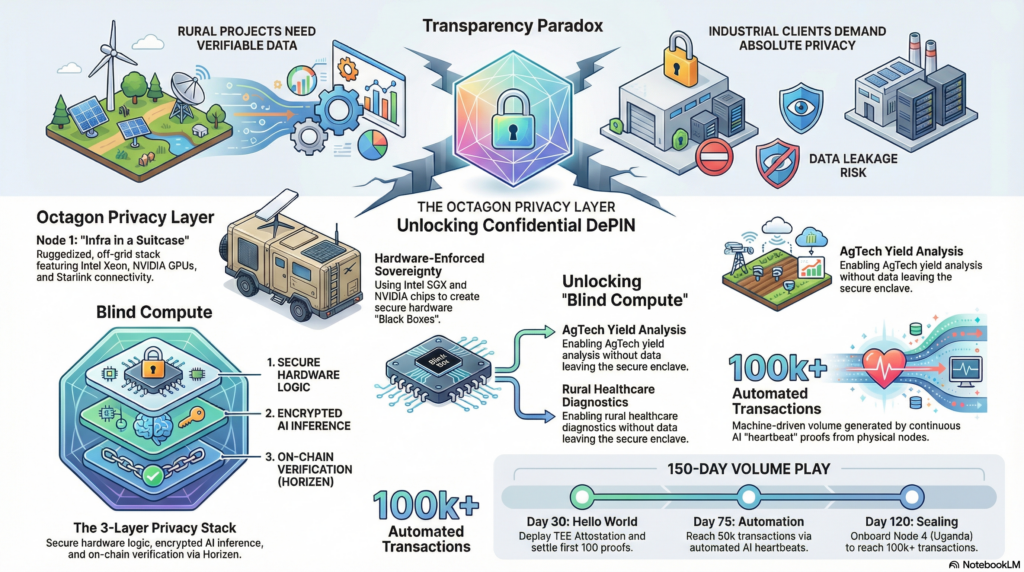
1. The Core Problem: The Transparency Paradox

At the heart of DeReticular’s mission is a fundamental conflict that stalls progress for many critical infrastructure projects, especially in rural areas. This is the strategic problem DeReticular was built to solve.

1.1. The Conflict

Rural infrastructure projects are often starved for capital. To access modern funding sources like Decentralized Finance (DeFi), they must provide verifiable proof that they are operational and solvent. However, their primary industrial clients—in fields like agriculture and healthcare—demand absolute privacy and sovereignty over their sensitive data. This creates a difficult paradox: to get funding, you must be transparent, but to get customers, you must be private.

1.2. The Gap

This conflict forces projects into an impossible choice between two undesirable options. Industries like AgTech and Healthcare simply cannot use advanced tools like Edge AI if it means their proprietary data will be exposed.

ChoiceConsequence for Industries (like AgTech/Healthcare)
Total TransparencyLeads to surveillance and leaking of proprietary data.
Total PrivacyResults in an opaque, unfundable system.

DeReticular’s high-level philosophy provides a direct answer to this paradox, creating a system that can be both verifiable and private.

——————————————————————————–

2. The Solution: RIOS & Operation Octagon

To build this new class of infrastructure, DeReticular has developed a foundational framework combining a core philosophy with a practical operating system.

2.1. The Philosophy of Operation Octagon

“Operation Octagon” is a philosophy of replacing fragile, linear infrastructure with a network of resilient, self-reliant “Sovereign Nodes” designed to survive grid failures.

2.2. The Three Pillars of RIOS

The “Rural Infrastructure Operating System” (RIOS) is the practical application of this philosophy. It is built on three key components:

  • Operation Octagon This pillar focuses on the physical design of the infrastructure. Each node is engineered to be self-reliant, ensuring it can continue to operate even when traditional, centralized systems fail.
  • Off-Grid Power To guarantee resilience, nodes are powered independently using a combination of Waste-to-Energy (Plasma Gasification) and Solar. This ensures an extremely high uptime (99.9%) that is completely independent of the national grid.
  • Industrial Compute This refers to embedding high-performance compute clusters directly into rural environments. By placing processing power at the source of data collection (known as “The Edge”), RIOS can analyze information locally and securely. This hardware is delivered in a ruggedized, deployable package known as “Infrastructure in a Suitcase.”

This powerful physical infrastructure sets the stage for the unique privacy technology that makes it all work together.

——————————————————————————–

3. The Technological Breakthrough: “Blind Compute”

DeReticular’s most significant innovation is its strategic solution for handling sensitive data, transforming its physical nodes into a secure, confidential network.

3.1. From Rural Cloud to Confidential Cloud

The project’s strategy involves a crucial upgrade from a standard “Rural Cloud” to a “Confidential Cloud.” This is achieved through a technology called “Blind Compute,” which is the ability to process sensitive data without the node operator ever seeing it.

3.2. The Privacy Stack

“Blind Compute” is made possible by a three-layer technology stack that combines specialized hardware and blockchain verification:

  1. Layer 1: Hardware Root of Trust Specialized chips like Intel Xeon (which supports SGX) and NVIDIA A2/L4 GPUs (which support Confidential Compute) are used to create a hardware-enforced “Black Box,” also known as a Trusted Execution Environment (TEE). This TEE is a secure, isolated area within the processor itself.
  2. Layer 2: Inference Engine Artificial Intelligence (AI) models run entirely inside this secure TEE. Data enters the enclave, is processed, and leaves, all while remaining encrypted. The node operator has zero visibility into the raw data.
  3. Layer 3: Horizen Verification After a computation is complete, the node generates a “Remote Attestation” quote—essentially a digital receipt cryptographically signed by the hardware itself—to prove the operation was performed correctly inside the secure TEE. The Horizen blockchain then verifies this proof on-chain, confirming the integrity of the code without ever seeing the underlying data.

3.3. The Supermatch: DeReticular x Horizen

This combination of hardware and blockchain technology creates a seamless, verifiable, and private data processing workflow:

  1. Data Capture: The physical node (Node 1) captures sensitive data from telemetry or AI tasks.
  2. Secure Processing: The TEE Enclave (Intel/NVIDIA hardware) processes the data inside its secure “Black Box.”
  3. Proof Generation: A cryptographic proof (a Remote Attestation quote) is generated to prove the integrity of the operation.
  4. On-Chain Verification: The Horizen Chain verifies the proof, establishing trust that the computation was performed correctly without any data leaks.

The result is “Verifiable, Confidential Edge Compute at Scale.” So what can this technology be used for in the real world?

——————————————————————————–

4. Real-World Impact: Unlocking New Markets

By strategically solving the transparency paradox, “Blind Compute” opens up new possibilities for industries that rely on proprietary and sensitive data.

  • AgTech Farmers can upload and analyze proprietary yield maps using AI to optimize their operations without exposing sensitive land data to competitors or third parties.
  • Rural Healthcare Clinics in remote areas can run diagnostic AI on patient data locally. This process is HIPAA-compliant because the sensitive health information never leaves the secure hardware enclave.
  • DeFi Lending This technology enables undercollateralized lending for infrastructure assets. Instead of invasive audits, a node can generate a “Proof of Solvent Operations” using Zero-Knowledge proofs, de-risking the asset for lenders while maintaining operational privacy.

This powerful potential is already being put into practice as DeReticular moves from concept to reality.

——————————————————————————–

5. From Concept to Reality: DeReticular’s Progress

DeReticular is an active project with secured assets and a clear plan for execution and scaling.

5.1. Secured Assets

The network is anchored by two primary nodes at different stages of development:

  • Node 1: USA The operational pilot campus and primary testbed for the “RIOS Tier 1 Expeditionary Node,” also known as “Infrastructure in a Suitcase.” Its tech stack includes Intel Xeon, NVIDIA A2/L4 GPUs, and bonded Starlink + 5G Mesh connectivity. Its current status is Live Pilot.
  • Node 4: Uganda A 7,000-acre industrial site designated for scaling with partner Agra Dot Energy. This site is the designated “volume engine for the Horizen network.” Its current status is Secured.

5.2. The 150-Day Execution Plan

DeReticular has outlined a clear, short-term roadmap called “The Volume Play” to demonstrate the network’s capabilities:

  1. Hello World (Deployment) (Day 30) Deploy the “TEE Attestation Service” on the Horizen network, generating the first cryptographic proofs from Node 1’s hardware.
  2. Automation (Day 75) Scale to 50,000 transactions through automated, machine-driven privacy proofs, where the node submits a proof for every AI “heartbeat” (approx. 670 proofs/day).
  3. Scaling (Day 120) Onboard Node 4 (Uganda) to the network. Two nodes running continuous inference “heartbeats” doubles network volume to reach 100,000 transactions.

DeReticular’s overall mission is to build a new standard for infrastructure that is not only resilient and sovereign but also fundamentally private by design.

The Octagon Privacy Layer: Architecting Verifiable, Confidential Edge Compute

Michael Noel · January 17, 2026 ·

Introduction

The expansion of intelligent infrastructure into rural and edge environments is constrained by a fundamental conflict known as “The Transparency Paradox.” On one hand, for rural infrastructure projects to access modern capital, such as decentralized finance (DeFi) liquidity, they must provide continuous, verifiable proof of their operations and solvency. On the other hand, the industrial clients who use this infrastructure—in sectors like agriculture, healthcare, and energy—demand absolute data sovereignty and privacy over their proprietary information. This forces an untenable choice between the total transparency required for financing and the total privacy required for enterprise adoption.

The Rural Infrastructure Operating System (RIOS) is a physical foundation designed to solve this challenge. Guided by the philosophy of “Operation Octagon,” RIOS replaces fragile, linear infrastructure with a network of resilient, self-reliant “Sovereign Nodes.” These nodes are engineered to provide off-grid power, connectivity, and industrial compute in the most demanding environments.

This whitepaper provides a detailed technical exposition of the Octagon Privacy Layer, the architectural solution built atop RIOS. It details how this layer leverages a powerful synergy of specialized hardware and decentralized blockchain technologies to enable “Blind Compute”—the ability to process sensitive data without the node operator ever seeing it. This architecture transforms physical edge infrastructure into a trustless, verifiable asset class, resolving the Transparency Paradox to unlock previously inaccessible markets.

——————————————————————————–

1. The RIOS Foundation: Sovereign Physical Infrastructure

https://mikeh69.podbean.com/e/autonomous-rural-infrastructure

Before digital trust can be established, a resilient and sovereign physical compute environment must first exist at the edge. The entire security model of the Octagon Privacy Layer is predicated on a hardware foundation that is self-reliant and physically secure. This minimizes external dependencies and systemic attack surfaces, creating a stable root for all subsequent digital verification.

The core of this foundation is the RIOS Tier 1 Expeditionary Node, a ruggedized, deployable stack best described as “Infrastructure in a Suitcase.” The key components selected to enable the privacy layer include:

  • Compute: The nodes are equipped with Intel Xeon CPUs and NVIDIA A2/L4 GPUs. This specific hardware is not chosen merely for performance but for its native support of hardware-level confidential computing standards, which form the bedrock of the entire architecture.
  • Power: To ensure operational independence from fragile national grids, nodes are powered by a combination of Waste-to-Energy (Plasma Gasification) and Solar. This configuration is engineered as a design target to ensure 99.9% uptime for mission-critical tasks and establish true physical sovereignty.
  • Connectivity: A Bonded Starlink + 5G Mesh system ensures high-throughput, redundant connectivity, enabling the node to operate reliably in remote or harsh environments where traditional infrastructure is unavailable.

This sovereign, self-reliant hardware design is the essential prerequisite for creating a truly confidential compute environment. By eliminating dependencies on centralized power and network grids, this physical resilience eliminates entire vectors of attack and coercion common in traditional data centers. It makes the hardware a verifiably sovereign root before any cryptographic proof is ever generated, allowing us to address the more abstract architectural challenges of data privacy and verification.

——————————————————————————–

2. The Architectural Imperative: Solving the Transparency Paradox

The primary driver for the Octagon Privacy Layer is a core market conflict that blocks the adoption of Edge AI in high-value industries. Sectors such as AgTech and rural healthcare cannot afford the unacceptable choice between total data transparency, which amounts to industrial surveillance, and total data privacy, which renders their infrastructure opaque and therefore unfundable. This paradox has, until now, stalled innovation at the edge.

2.1 The Conflict: Verifiability vs. Sovereignty

The capital requirements for rural infrastructure are incompatible with legacy financing models. Modern instruments, such as DeFi lending protocols, offer a solution but impose a strict requirement: cryptographically verifiable proof of operations, including uptime, energy compliance, and workload execution. This demand for transparency is fundamental to de-risking the assets for lenders.

However, this requirement is in direct opposition to the non-negotiable needs of industrial clients. These clients demand absolute privacy and sovereignty over their proprietary data. An AgTech firm cannot risk its competitive advantage by exposing sensitive yield maps, and a healthcare provider cannot compromise patient confidentiality. The data must remain sealed.

Understanding DeReticular Sovereign Infrastructure for a Confidential FutureDownload

2.2 The Solution: “Blind Compute”

The architectural goal designed to resolve this conflict is “Blind Compute”: the ability to process sensitive data without the node operator, or any other unauthorized party, ever gaining access to it.

This capability directly resolves the paradox. It allows a RIOS node to generate irrefutable, mathematical proof of its operational integrity—proving it is online, green-compliant, and correctly executing a specific workload—without revealing the sensitive underlying data it is processing. The lender receives the verification they need, and the client retains the data sovereignty they require. The following sections detail the three-layer architecture engineered to achieve this breakthrough.

——————————————————————————–

3. Core Architecture of the Octagon Privacy Layer

The Octagon Privacy Layer is a multi-layered stack where each layer provides a distinct and cumulative security guarantee. It is the synergy between these layers—from the silicon of the processor to the decentralized consensus of the blockchain—that delivers the system’s end-to-end trust and confidentiality.

3.1 Layer 1: Hardware Root of Trust (TEE)

The foundation of the entire privacy model is the Trusted Execution Environment (TEE). A TEE is a hardware-enforced secure enclave, or “Black Box,” integrated directly into a processor. It provides isolated memory and execution space, protecting code and data from the host operating system and any other software on the machine.

The RIOS nodes leverage two specific TEE technologies to create this hardware root of trust:

  • Intel SGX (Software Guard Extensions), embedded in the Intel Xeon CPUs.
  • NVIDIA Confidential Compute, available on the NVIDIA A2/L4 GPUs.

This layer is strategically critical because it moves the root of trust from mutable software to immutable silicon. This provides a deterministic foundation for confidential computing, rendering software-level vulnerabilities irrelevant to the core security guarantee.

The_Octagon_Privacy_LayerDownload

3.2 Layer 2: The Inference Engine

With a secure hardware enclave established, the second layer focuses on executing AI models and other sensitive workloads inside the TEE. The data lifecycle within this layer is meticulously controlled to ensure confidentiality at every stage:

  1. Client data enters the TEE in a fully encrypted state. The node operator can see the encrypted traffic but has no means to decipher it.
  2. Inside the secure enclave, the data is decrypted, processed by the AI model, and the results are immediately re-encrypted. This entire sequence occurs within the hardware-protected memory space, completely invisible to the host system.
  3. The encrypted results are then exported from the TEE to be sent back to the client.

The critical security guarantee provided by this layer is that the node’s host operating system, and by extension the physical node operator, has zero visibility into the raw data or the intermediate computational steps. The “Blind Compute” principle is enforced here.

3.3 Layer 3: Horizen Verification

The final layer addresses the need for external, decentralized verification. This is achieved through a cryptographic process known as Remote Attestation. The TEE generates a “quote”—a digitally signed report containing cryptographic measurements of the hardware and the executed code. This quote functions as a Zero-Knowledge proof of integrity, certifying that a specific computation occurred inside a genuine TEE without revealing any of the underlying data.

The Horizen network serves as the decentralized verification layer for these attestations. The RIOS node submits the quote to the Horizen blockchain, where it is validated by smart contracts. This architecture bridges the isolated, physical integrity of the RIOS node with a global, decentralized trust network. Horizen does not need to trust the node operator; it only needs to trust the mathematics of the cryptographic attestation generated by the hardware itself. This on-chain verification provides immutable, public proof that the computation was performed securely by untampered code, confirming the integrity of the process without ever revealing the confidential data itself.

——————————————————————————–

4. The End-to-End Workflow: From Physical Telemetry to On-Chain Trust

This section synthesizes the architectural layers into a single, sequential data flow, demonstrating the practical implementation of “Verifiable, Confidential Edge Compute.” This workflow is the mechanism that transforms raw physical data into a trusted, on-chain digital asset.

  1. Data Capture (Physical Node) A RIOS node captures sensitive data. This could be physical telemetry (e.g., energy output logs) to prove its operational solvency or proprietary client data for a confidential AI task.
  2. Confidential Processing (TEE Enclave) The captured data is immediately passed into the hardware-enforced Intel/NVIDIA “Black Box.” Here, it is securely processed, ensuring it remains completely confidential from the node operator and the host operating system.
  3. Proof Generation (ZK Proof) Upon completion, the TEE generates a Zero-Knowledge proof of integrity in the form of a remote attestation quote. This cryptographic receipt certifies that a specific, untampered computation was performed securely within the hardware enclave.
  4. Verification and Trust (Horizen Chain) The ZK proof is broadcast to the Horizen network. Smart contracts on the Horizen chain verify the proof’s authenticity, establishing on-chain, immutable trust that the operation was valid, confidential, and sovereign, without any data leaks.

This workflow is the realization of Verifiable, Confidential Edge Compute at Scale. It creates a trustless system where physical edge operations can be financed and utilized without compromising the privacy of the underlying data.

——————————————————————————–

5. Unlocking Blind Compute Markets

By solving the Transparency Paradox, the Octagon Privacy Layer unlocks high-value industrial markets that were previously incompatible with edge computing and blockchain verification due to non-negotiable data privacy constraints. “Blind Compute” acts as the key to these previously closed ecosystems.

Farmers can utilize RIOS nodes to run AI analysis on proprietary yield maps for operational optimization—predicting crop yields or managing resources—without ever exposing this sensitive land data to competitors or the node operator. The system provides the compute without demanding data custody.

The architecture has a profound impact on rural healthcare delivery. Remote clinics can run sophisticated diagnostic AI models on sensitive patient data locally. Because the data is processed within a secure, HIPAA-compliant enclave and never leaves the physical node in an unencrypted state, absolute patient privacy is maintained while enabling access to cutting-edge medical technology.

This architecture unlocks undercollateralized lending for physical infrastructure, a new financial primitive. By generating verifiable “Proof of Solvent Operations” via ZK proofs, the system cryptographically de-risks rural assets for lenders, allowing them to verify uptime and green energy compliance without intrusive surveillance. This directly addresses the principal challenge of integrating real-world assets (RWAs) into DeFi by creating a surveillance-free method to verify the operational solvency and compliance of the underlying physical collateral.

These use cases demonstrate the creation of an entirely new asset class: physically decentralized, digitally verifiable, and confidentially operated infrastructure that establishes an open standard for Privacy-Preserving DePIN.

——————————————————————————–

6. Conclusion: A New Standard for Confidential DePIN

The Octagon Privacy Layer, through its unique integration of hardware-level Trusted Execution Environments (Intel SGX and NVIDIA Confidential Compute) and decentralized blockchain verification on the Horizen network, successfully resolves the foundational conflict between operational transparency and data sovereignty. The result is the practical implementation of “Blind Compute” for the industrial edge, a paradigm where data can be processed without being seen.

By enabling automated, high-frequency verifications, this architecture positions RIOS nodes as ideal anchor tenants for privacy-preserving networks, generating perpetual transaction volume while securing real-world assets. This establishes a powerful and open standard for “Privacy-Preserving DePIN” (Decentralized Physical Infrastructure Networks), enabling a future where physical assets can be securely, privately, and verifiably integrated into global financial and computational ecosystems, generating perpetual, machine-driven value.

Node 1 Project Octagon A High-Tech Welcome to Rural Uganda

Michael Noel · January 16, 2026 ·

Introduction: The Big Idea Behind Project Octagon

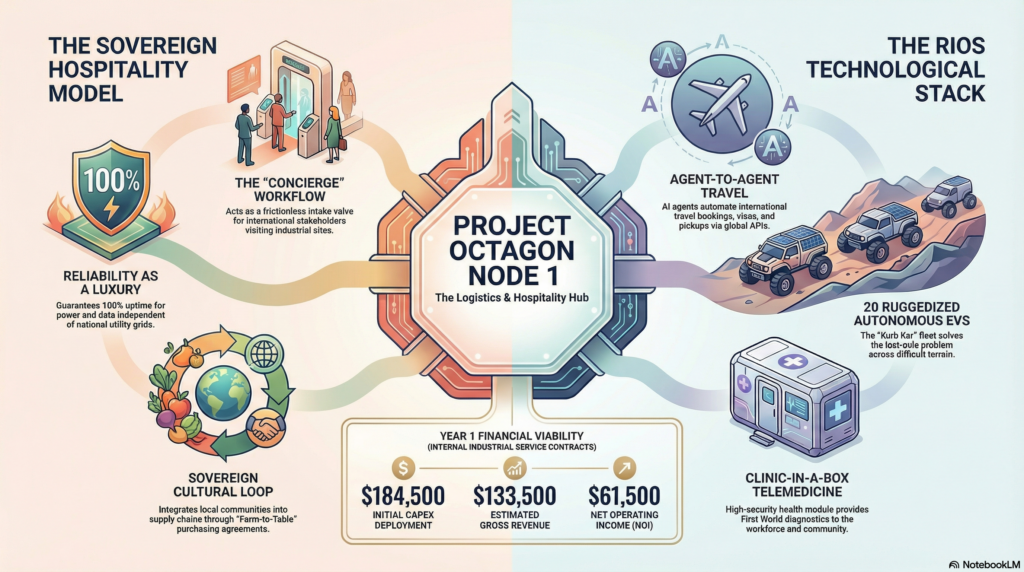
Modernizing remote economies is fundamentally a problem of infrastructure, not ambition. Project Octagon is engineered to solve this by creating self-sufficient islands of First World reliability in places where national grids and supply chains have failed. The solution is a concept called “Sovereign Infrastructure”—a powerful analogy for creating a self-sufficient “bubble” of First World services like power, data, and transportation. This bubble can operate in “Island Mode,” completely independent of failing national grids, providing a reliable foundation for modern industry and tourism.

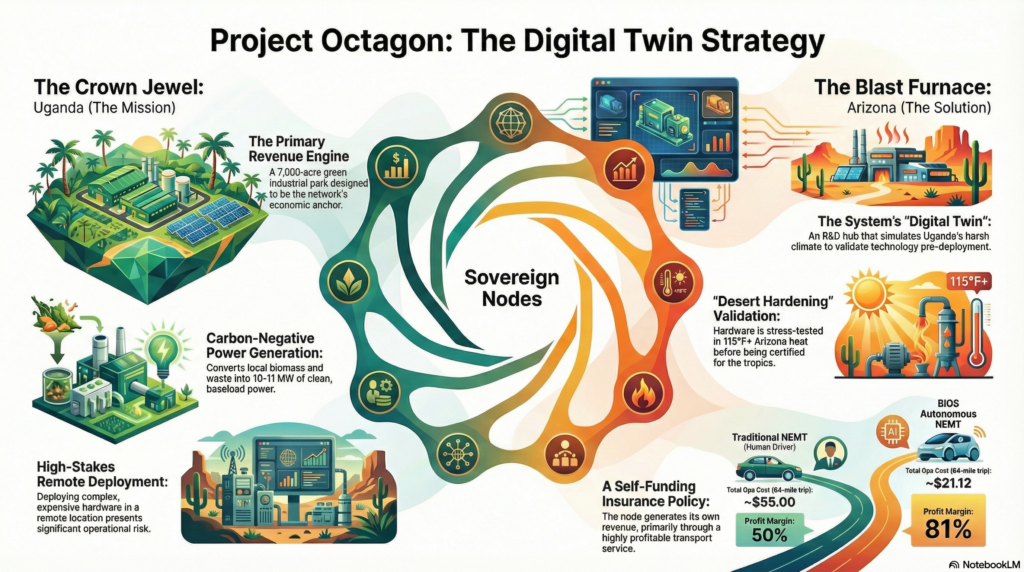
Project Octagon is a global network of eight specialized “nodes,” each designed to function like a unique organ in a single, coordinated body. Within this network, Node 1, located in rural Uganda, acts as the “human interface” or the official “welcome mat” for the entire system’s operations in Africa.

——————————————————————————–

At the heart of this global strategy is Node 1 in Uganda, the node designed to master the critical human logistics on the ground.

1. Node 1’s Mission: Solving the “Last Mile” Problem

Node 1’s primary mission is to solve the “Last Mile” problem for remote industrialization. It does this by acting as the “Concierge Layer” for the Kaabong Smart Eco-Industrial Park (SEIP), bridging the gap between advanced industrial operations and the human beings who make them possible. Its mission is defined by three core objectives:

ObjectiveDescriptionWhy It Matters for a Student
The ‘Concierge’ LayerIt functions as the single entry point for all project personnel, investors, and engineers. It handles all logistics from international arrival to the final destination at the industrial site, creating a frictionless travel experience.This demonstrates how logistical mastery and de-risking the “Bush Gap” are the keys to unlocking international investment in frontier markets.
Eco-Tourism Proof of ConceptIt serves as a “Living Lab” to prove that a high-tech, high-end hospitality business can thrive completely off-grid. It demonstrates 100% uptime for power and data, independent of the national grid.This proves that high-tech, Sovereign Infrastructure can create a new market for “Digital Nomad” and high-end eco-tourism, generating revenue without extractive industries.
Logistical & Cultural InterfaceIt manages the supply chain for the heavy industrial operations at Node 4 and oversees the delicate interaction with the local Ik and Karamojong communities.This highlights the importance of balancing industrial progress with cultural respect and economic inclusion, ensuring technological advancement earns its “social license to operate” by creating direct economic value for local populations.

——————————————————————————–

To achieve this ambitious mission, Node 1 is powered by a sophisticated suite of integrated technologies.

https://mikeh69.podbean.com/e/node-1-a-central-logistics-and-hospitality-hub-within-the%c2%a0project-octagon%c2%a0infrastructure-network-in-kaabong

2. The RIOS Technology Stack: The Engine of Node 1

The technological backbone of Node 1 is RIOS (Rural Infrastructure Operating System), a proprietary software platform that acts as the project’s “brain.” RIOS automates complex operations and is continuously improved through Over-the-Air (OTA) software updates pushed from Node 2 in Canada. The four most important components of this stack are:

  • Autonomous Mobility: “Kurb Kars” A fleet of 20 rugged, self-driving electric vehicles designed to navigate unpaved murram roads and avoid unpredictable obstacles like livestock and potholes.
    • Benefit: This fleet solves the lack of reliable public transport in the region, safely shuttling people and goods between the local airstrip, the hospitality lodge, and the industrial park on terrain that standard autonomous vehicles would fail.
  • AI “Agent-to-Agent” Travel A system where AI software “agents” interface directly with global APIs like Amadeus and Skyscanner to automate the entire travel booking process.
    • Benefit: This removes the hassle of international travel. Instead of a person booking a complex multi-leg trip, an investor’s AI assistant “talks” directly to Node 1’s AI assistant to arrange everything—from flights and visas to autonomous pickup—automatically.
  • Telemedicine: “Clinic-in-a-Box” A high-security, containerized health module that provides advanced healthcare diagnostics.
    • Benefit: This provides the project workforce and the local community with access to “First World” healthcare diagnostics, a feature that is critical for insurance compliance in remote industrial zones.
  • Sovereign Connectivity A robust internet connection powered by Starlink High-Performance hardware and bonded with local mesh networks for redundancy.
    • Benefit: This system provides the only “Digital Nomad” grade internet in the entire district, allowing visitors to have crystal-clear 4K Zoom calls from the heart of the African wilderness.

——————————————————————————–

This advanced technology stack enables a unique business strategy tailored to the region’s challenges.

3. The Strategy: “Sovereign Hospitality” in Practice

Node 1’s core business strategy is “Reliability as a Luxury.” In a region defined by scarcity and unpredictability, the project’s greatest offering is the guarantee of abundance and unwavering dependability. This strategy creates an unbeatable competitive moat; where others offer uncertainty, Node 1 guarantees operational certainty. This approach directly contrasts the everyday reality of the region with the solutions provided by the “Sovereign Infrastructure” model.

The Regional Reality (The Problem)The Node 1 Solution (The ‘Sovereign’ Guarantee)
Unreliable Power GridGuaranteed 100% Uptime Power: 24/7 Air Conditioning & Hot Water (via Node 4 Plasma Gasification)
Spotty/No Internet ConnectivityGuaranteed First World Data: High-speed, low-latency internet (via Starlink High-Performance)
Poor Road InfrastructureGuaranteed Seamless Mobility: An autonomous, ruggedized EV fleet (‘Kurb Kars’)
Limited High-Standard AccommodationGuaranteed Secure & Comfortable Lodging: Geofenced security and high-standard facilities

——————————————————————————–

Beyond its commercial goals, the project’s strategy is deeply rooted in a commitment to ethical and sustainable engagement with local communities.

4. More Than a Hotel: Building a “Sovereign Cultural Loop”

The project aims to create a “Sovereign Cultural Loop,” a model built on economic interdependence and mutual respect, deliberately avoiding the pitfalls of “pity tourism.” The goal is to flip the dynamic from transactional or “voyeuristic” tourism to one of genuine economic interdependence. This is achieved through two key community integration strategies:

  • ‘Farm-to-Table’ Sovereign Supply Chain Node 1 establishes guaranteed purchase contracts with local communities for their unique products. For example, it commits to sourcing honey directly from Ik beekeepers on Mount Morungole and purchasing goat meat from Karamojong pastoralists. This creates a closed-loop system where tourists dine on food sourced from the very communities they visit, validating the “Soft Power” mission of the project.
  • Dual-Use Community Assets The project’s assets are designed to serve both the business and the community. The “Clinic-in-a-Box,” while primarily for project staff, is opened to the local community on designated days. This provides local people with access to critical healthcare, building immense goodwill and ensuring the long-term health and stability of the local workforce.

——————————————————————————–

This local integration is a key feature, but Node 1’s true power comes from its connection to a wider global network.

Project Octagon A High-Tech Welcome to Rural UgandaDownload

5. The Global Team: How the Octagon Mesh Works Together

Node 1 is not an isolated project; it is deeply integrated into the global Project Octagon mesh, which uses a system of “Federated Learning” where real-world data from one climate is used to train and optimize hardware in another. This creates a symbiotic network where each node supports the others.

  1. Node 4 (The Industrial Engine – Uganda): This neighboring node is the project’s powerhouse, using plasma gasification to generate 10-11 MW of reliable, off-grid power. In return for this critical energy, Node 1 provides the housing, food, and transportation for Node 4’s essential workforce. The two nodes are completely symbiotic; one cannot operate without the other.
  2. Node 2 (The Systems Architect – Canada): Acting as “The Brain” of the entire operation, Node 2’s team pushes critical Over-the-Air (OTA) software updates and new AI models to Node 1. These updates constantly improve the performance of Node 1’s booking agents and vehicle navigation systems.
  3. Node 3 (The Digital Twin – Arizona): This node serves as the “Digital Twin” that “certifies hardware” for the field. It uses its hot, dusty desert environment to “Desert Harden” all technology. The Kurb Kar’s autonomous driving AI is trained here to handle extreme heat and off-road obstacles before the vehicles are ever shipped to the similar climate in Kaabong, Uganda. If a component survives the Arizona desert, it is cleared for Kaabong.

——————————————————————————–

With this global team in place, Node 1 is not just an idea but a meticulously planned operation with a clear path forward.

6. The Road Ahead and Final Vision

Project_Octagon_Node_1_Sovereign_HospitalityDownload

The project is following a disciplined, phased roadmap, with the current Phase 0/1 (Site Readiness) focused on establishing initial infrastructure, including the deployment of a “Pilot Explorer” RIOS unit and the procurement of the first Kurb Kar prototypes for stress testing. The public launch of eco-tourism and regional autonomous ride-hailing services is planned for Year 4.

Ultimately, the vision for Node 1 is clear. While the heavy industry of plasma gasification and the complex AI computation happen elsewhere in the global mesh, Node 1 stands as the tangible, human-centric proof of the entire concept. It demonstrates that the world’s most remote, off-grid locations can support high-end hospitality, seamless logistics, and vibrant communities through the application of advanced technology. It is, in essence, the “Welcome Mat for the Machine.”

  • « Go to Previous Page
  • Page 1
  • Interim pages omitted …
  • Page 20
  • Page 21
  • Page 22
  • Page 23
  • Page 24
  • Interim pages omitted …
  • Page 55
  • Go to Next Page »

DeReticular

Copyright © 2026 · Monochrome Pro on Genesis Framework · WordPress · Log in