The Octagon Privacy Layer: Architecting Verifiable, Confidential Edge Compute
Introduction
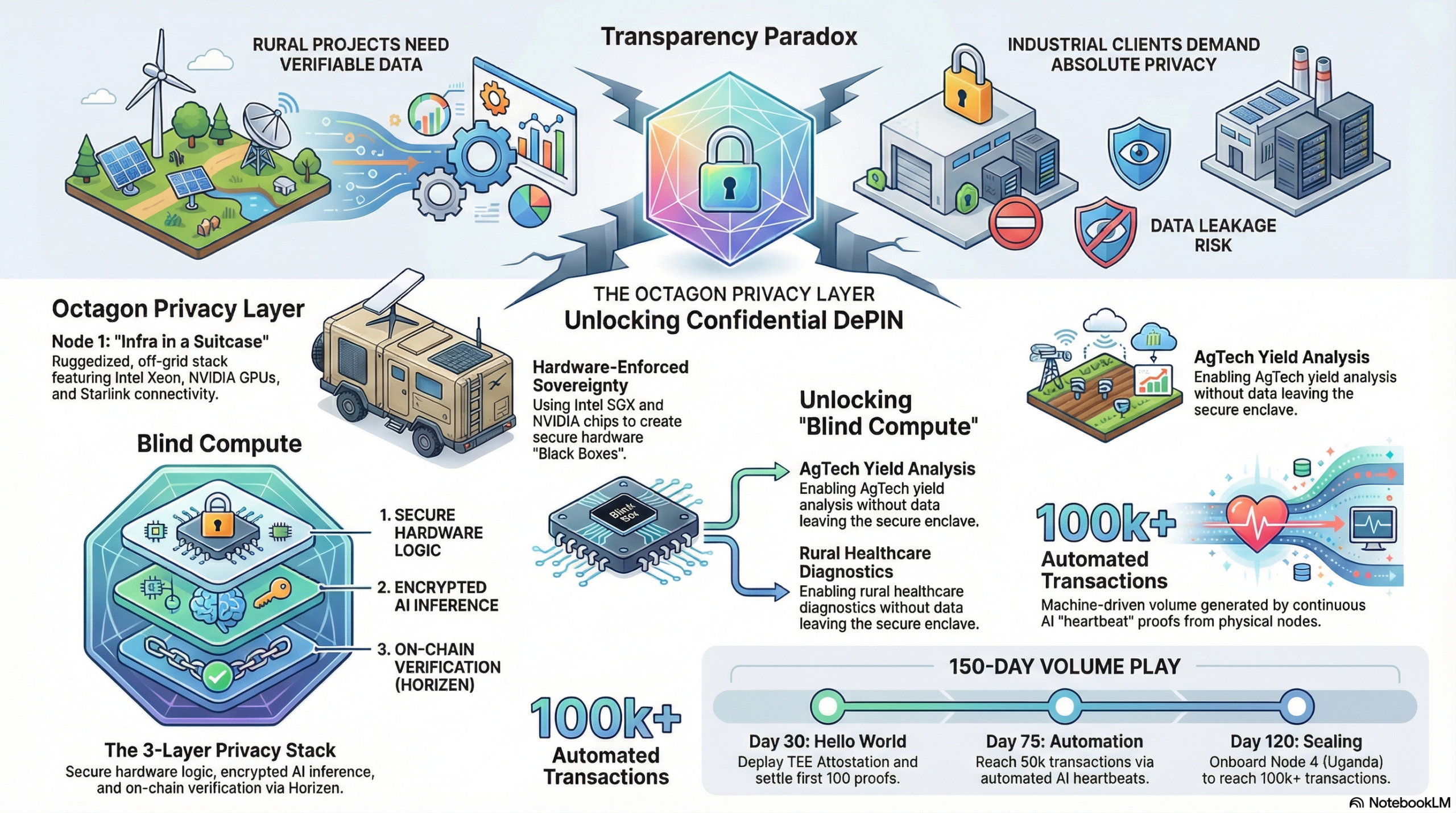
The expansion of intelligent infrastructure into rural and edge environments is constrained by a fundamental conflict known as “The Transparency Paradox.” On one hand, for rural infrastructure projects to access modern capital, such as decentralized finance (DeFi) liquidity, they must provide continuous, verifiable proof of their operations and solvency. On the other hand, the industrial clients who use this infrastructure—in sectors like agriculture, healthcare, and energy—demand absolute data sovereignty and privacy over their proprietary information. This forces an untenable choice between the total transparency required for financing and the total privacy required for enterprise adoption.
The Rural Infrastructure Operating System (RIOS) is a physical foundation designed to solve this challenge. Guided by the philosophy of “Operation Octagon,” RIOS replaces fragile, linear infrastructure with a network of resilient, self-reliant “Sovereign Nodes.” These nodes are engineered to provide off-grid power, connectivity, and industrial compute in the most demanding environments.
This whitepaper provides a detailed technical exposition of the Octagon Privacy Layer, the architectural solution built atop RIOS. It details how this layer leverages a powerful synergy of specialized hardware and decentralized blockchain technologies to enable “Blind Compute”—the ability to process sensitive data without the node operator ever seeing it. This architecture transforms physical edge infrastructure into a trustless, verifiable asset class, resolving the Transparency Paradox to unlock previously inaccessible markets.
——————————————————————————–
1. The RIOS Foundation: Sovereign Physical Infrastructure
https://mikeh69.podbean.com/e/autonomous-rural-infrastructure
Before digital trust can be established, a resilient and sovereign physical compute environment must first exist at the edge. The entire security model of the Octagon Privacy Layer is predicated on a hardware foundation that is self-reliant and physically secure. This minimizes external dependencies and systemic attack surfaces, creating a stable root for all subsequent digital verification.
The core of this foundation is the RIOS Tier 1 Expeditionary Node, a ruggedized, deployable stack best described as “Infrastructure in a Suitcase.” The key components selected to enable the privacy layer include:
- Compute: The nodes are equipped with Intel Xeon CPUs and NVIDIA A2/L4 GPUs. This specific hardware is not chosen merely for performance but for its native support of hardware-level confidential computing standards, which form the bedrock of the entire architecture.
- Power: To ensure operational independence from fragile national grids, nodes are powered by a combination of Waste-to-Energy (Plasma Gasification) and Solar. This configuration is engineered as a design target to ensure 99.9% uptime for mission-critical tasks and establish true physical sovereignty.
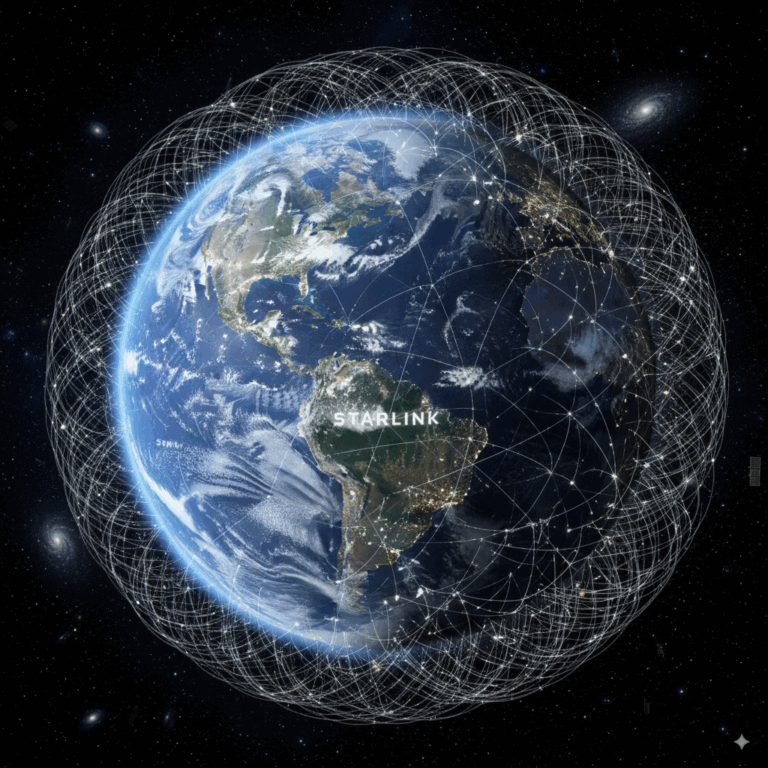
- Connectivity: A Bonded Starlink + 5G Mesh system ensures high-throughput, redundant connectivity, enabling the node to operate reliably in remote or harsh environments where traditional infrastructure is unavailable.
This sovereign, self-reliant hardware design is the essential prerequisite for creating a truly confidential compute environment. By eliminating dependencies on centralized power and network grids, this physical resilience eliminates entire vectors of attack and coercion common in traditional data centers. It makes the hardware a verifiably sovereign root before any cryptographic proof is ever generated, allowing us to address the more abstract architectural challenges of data privacy and verification.
——————————————————————————–
2. The Architectural Imperative: Solving the Transparency Paradox
The primary driver for the Octagon Privacy Layer is a core market conflict that blocks the adoption of Edge AI in high-value industries. Sectors such as AgTech and rural healthcare cannot afford the unacceptable choice between total data transparency, which amounts to industrial surveillance, and total data privacy, which renders their infrastructure opaque and therefore unfundable. This paradox has, until now, stalled innovation at the edge.
2.1 The Conflict: Verifiability vs. Sovereignty
The capital requirements for rural infrastructure are incompatible with legacy financing models. Modern instruments, such as DeFi lending protocols, offer a solution but impose a strict requirement: cryptographically verifiable proof of operations, including uptime, energy compliance, and workload execution. This demand for transparency is fundamental to de-risking the assets for lenders.
However, this requirement is in direct opposition to the non-negotiable needs of industrial clients. These clients demand absolute privacy and sovereignty over their proprietary data. An AgTech firm cannot risk its competitive advantage by exposing sensitive yield maps, and a healthcare provider cannot compromise patient confidentiality. The data must remain sealed.
2.2 The Solution: “Blind Compute”
The architectural goal designed to resolve this conflict is “Blind Compute”: the ability to process sensitive data without the node operator, or any other unauthorized party, ever gaining access to it.
This capability directly resolves the paradox. It allows a RIOS node to generate irrefutable, mathematical proof of its operational integrity—proving it is online, green-compliant, and correctly executing a specific workload—without revealing the sensitive underlying data it is processing. The lender receives the verification they need, and the client retains the data sovereignty they require. The following sections detail the three-layer architecture engineered to achieve this breakthrough.
——————————————————————————–
3. Core Architecture of the Octagon Privacy Layer
The Octagon Privacy Layer is a multi-layered stack where each layer provides a distinct and cumulative security guarantee. It is the synergy between these layers—from the silicon of the processor to the decentralized consensus of the blockchain—that delivers the system’s end-to-end trust and confidentiality.
3.1 Layer 1: Hardware Root of Trust (TEE)
The foundation of the entire privacy model is the Trusted Execution Environment (TEE). A TEE is a hardware-enforced secure enclave, or “Black Box,” integrated directly into a processor. It provides isolated memory and execution space, protecting code and data from the host operating system and any other software on the machine.
The RIOS nodes leverage two specific TEE technologies to create this hardware root of trust:
- Intel SGX (Software Guard Extensions), embedded in the Intel Xeon CPUs.
- NVIDIA Confidential Compute, available on the NVIDIA A2/L4 GPUs.
This layer is strategically critical because it moves the root of trust from mutable software to immutable silicon. This provides a deterministic foundation for confidential computing, rendering software-level vulnerabilities irrelevant to the core security guarantee.
3.2 Layer 2: The Inference Engine
With a secure hardware enclave established, the second layer focuses on executing AI models and other sensitive workloads inside the TEE. The data lifecycle within this layer is meticulously controlled to ensure confidentiality at every stage:
- Client data enters the TEE in a fully encrypted state. The node operator can see the encrypted traffic but has no means to decipher it.
- Inside the secure enclave, the data is decrypted, processed by the AI model, and the results are immediately re-encrypted. This entire sequence occurs within the hardware-protected memory space, completely invisible to the host system.
- The encrypted results are then exported from the TEE to be sent back to the client.
The critical security guarantee provided by this layer is that the node’s host operating system, and by extension the physical node operator, has zero visibility into the raw data or the intermediate computational steps. The “Blind Compute” principle is enforced here.
3.3 Layer 3: Horizen Verification
The final layer addresses the need for external, decentralized verification. This is achieved through a cryptographic process known as Remote Attestation. The TEE generates a “quote”—a digitally signed report containing cryptographic measurements of the hardware and the executed code. This quote functions as a Zero-Knowledge proof of integrity, certifying that a specific computation occurred inside a genuine TEE without revealing any of the underlying data.
The Horizen network serves as the decentralized verification layer for these attestations. The RIOS node submits the quote to the Horizen blockchain, where it is validated by smart contracts. This architecture bridges the isolated, physical integrity of the RIOS node with a global, decentralized trust network. Horizen does not need to trust the node operator; it only needs to trust the mathematics of the cryptographic attestation generated by the hardware itself. This on-chain verification provides immutable, public proof that the computation was performed securely by untampered code, confirming the integrity of the process without ever revealing the confidential data itself.
——————————————————————————–
4. The End-to-End Workflow: From Physical Telemetry to On-Chain Trust
This section synthesizes the architectural layers into a single, sequential data flow, demonstrating the practical implementation of “Verifiable, Confidential Edge Compute.” This workflow is the mechanism that transforms raw physical data into a trusted, on-chain digital asset.
- Data Capture (Physical Node) A RIOS node captures sensitive data. This could be physical telemetry (e.g., energy output logs) to prove its operational solvency or proprietary client data for a confidential AI task.
- Confidential Processing (TEE Enclave) The captured data is immediately passed into the hardware-enforced Intel/NVIDIA “Black Box.” Here, it is securely processed, ensuring it remains completely confidential from the node operator and the host operating system.
- Proof Generation (ZK Proof) Upon completion, the TEE generates a Zero-Knowledge proof of integrity in the form of a remote attestation quote. This cryptographic receipt certifies that a specific, untampered computation was performed securely within the hardware enclave.
- Verification and Trust (Horizen Chain) The ZK proof is broadcast to the Horizen network. Smart contracts on the Horizen chain verify the proof’s authenticity, establishing on-chain, immutable trust that the operation was valid, confidential, and sovereign, without any data leaks.
This workflow is the realization of Verifiable, Confidential Edge Compute at Scale. It creates a trustless system where physical edge operations can be financed and utilized without compromising the privacy of the underlying data.
——————————————————————————–
5. Unlocking Blind Compute Markets
By solving the Transparency Paradox, the Octagon Privacy Layer unlocks high-value industrial markets that were previously incompatible with edge computing and blockchain verification due to non-negotiable data privacy constraints. “Blind Compute” acts as the key to these previously closed ecosystems.
Farmers can utilize RIOS nodes to run AI analysis on proprietary yield maps for operational optimization—predicting crop yields or managing resources—without ever exposing this sensitive land data to competitors or the node operator. The system provides the compute without demanding data custody.
The architecture has a profound impact on rural healthcare delivery. Remote clinics can run sophisticated diagnostic AI models on sensitive patient data locally. Because the data is processed within a secure, HIPAA-compliant enclave and never leaves the physical node in an unencrypted state, absolute patient privacy is maintained while enabling access to cutting-edge medical technology.
This architecture unlocks undercollateralized lending for physical infrastructure, a new financial primitive. By generating verifiable “Proof of Solvent Operations” via ZK proofs, the system cryptographically de-risks rural assets for lenders, allowing them to verify uptime and green energy compliance without intrusive surveillance. This directly addresses the principal challenge of integrating real-world assets (RWAs) into DeFi by creating a surveillance-free method to verify the operational solvency and compliance of the underlying physical collateral.
These use cases demonstrate the creation of an entirely new asset class: physically decentralized, digitally verifiable, and confidentially operated infrastructure that establishes an open standard for Privacy-Preserving DePIN.
——————————————————————————–
6. Conclusion: A New Standard for Confidential DePIN
The Octagon Privacy Layer, through its unique integration of hardware-level Trusted Execution Environments (Intel SGX and NVIDIA Confidential Compute) and decentralized blockchain verification on the Horizen network, successfully resolves the foundational conflict between operational transparency and data sovereignty. The result is the practical implementation of “Blind Compute” for the industrial edge, a paradigm where data can be processed without being seen.
By enabling automated, high-frequency verifications, this architecture positions RIOS nodes as ideal anchor tenants for privacy-preserving networks, generating perpetual transaction volume while securing real-world assets. This establishes a powerful and open standard for “Privacy-Preserving DePIN” (Decentralized Physical Infrastructure Networks), enabling a future where physical assets can be securely, privately, and verifiably integrated into global financial and computational ecosystems, generating perpetual, machine-driven value.