• Skip to primary navigation
  • Skip to main content
DeReticular

DeReticular

Local Autonomy. National Security. Total Sovereignty.

  • Solutions
    • Municipalities
    • Energy
    • Industrial
    • Defense
  • Infrastructure
  • Intelligence
  • Company
  • Request Municipal Audit
  • Show Search
Hide Search
You are here: Home / Archives for DeReticular

DeReticular

The PLASMA Project A Blueprint for a Brighter Future in Uganda

Michael Noel · January 7, 2026 ·

1. Introduction: The Vision of ‘Umoja’

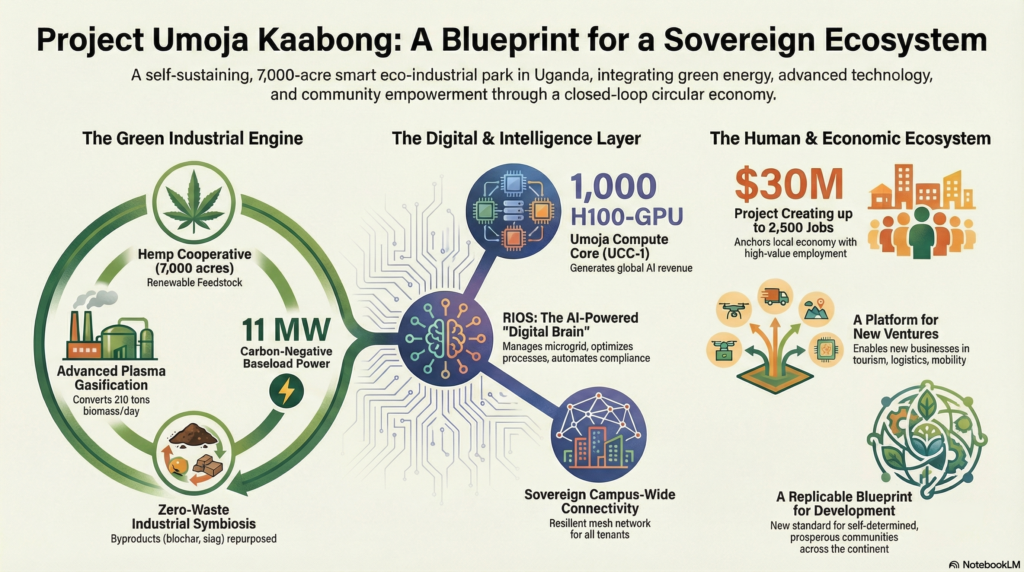
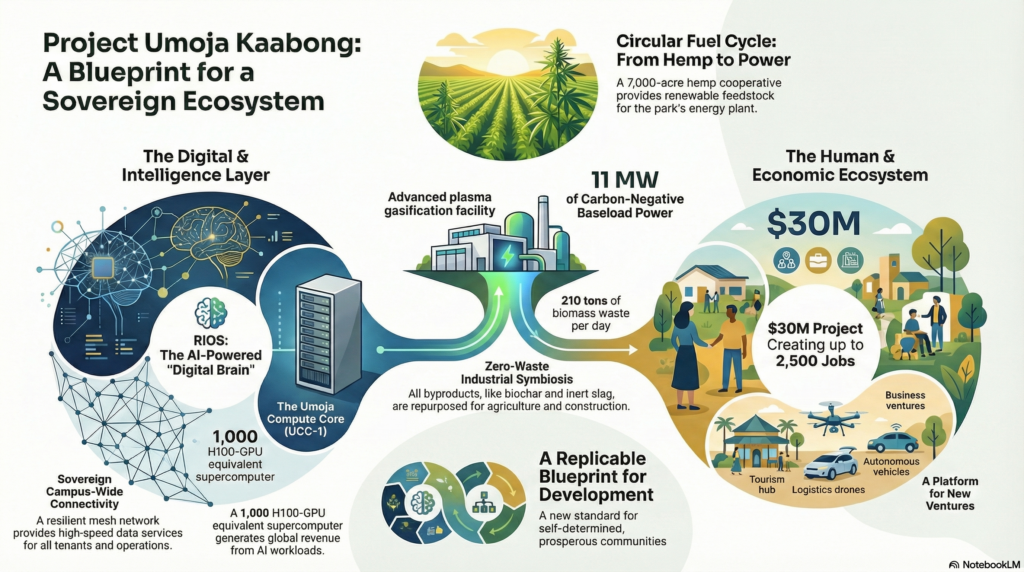
The PLASMA Project, also known as Project Umoja Kaabong, is an ambitious initiative to build a self-sustaining industrial and agricultural ecosystem across a 7,000-acre campus in Uganda. The project is guided by the principle of “Umoja,” the Swahili word for Unity, which represents its mission to weave together farming, industry, and community into a single, resilient fabric. For too long, progress in regions like Kaabong has been hindered by a critical problem: the lack of reliable energy. This single vulnerability makes it nearly impossible for businesses to grow and for communities to achieve true self-determination. The PLASMA Project, representing a $30 million investment in this vision, offers a revolutionary solution: to create a sovereign ecosystem that turns locally grown crops into clean, dependable power, paving the way for a future defined not by dependence, but by economic, energy, and community sovereignty.

This overview will explore the core concept behind this innovative project, its key components, and the profound impact it aims to have.

2. The Big Idea: A “No-Waste” Circular Economy

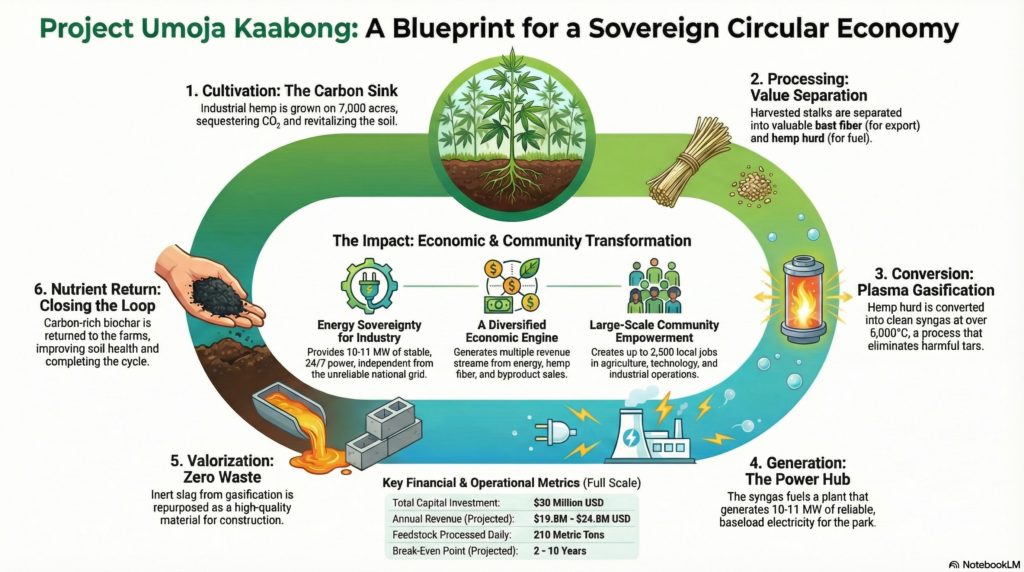
At its heart, the PLASMA Project is built on the concept of a circular economy. For a student, the easiest way to think of this is a loop where nothing is thrown away. Instead of the traditional “take, make, dispose” model, a circular economy is designed so that every output from one stage becomes a valuable input for another. It’s a “no-waste” system that mimics the efficiency of nature. The Umoja Kaabong model follows six key stages in a continuous cycle:

  1. Cultivation (The Carbon Sink): Local farmer cooperatives grow thousands of acres of industrial hemp, a crop that absorbs large amounts of CO₂ from the atmosphere and improves soil health.
  2. Harvest & Processing (Value Separation): The harvested hemp stalks are taken to an on-site facility where they are separated into the valuable outer bast fiber and the inner woody core, known as hurd.
  3. Thermal Conversion (The Alchemical Core): The leftover hemp hurd becomes the primary fuel for the power plant. It is fed into an advanced plasma gasification system that cleanly converts the solid biomass into an energy-rich gas called syngas.
  4. Power Generation & Distribution (The Heartbeat): The syngas is used as fuel to run a power generator, creating a constant stream of electricity that is distributed to all the businesses and facilities within the industrial park.
  5. Byproduct Valorization (Closing the Loop): The gasification process leaves behind useful byproducts. A glass-like material called vitrified slag is used to build local roads, and a carbon-rich material called biochar is also created.
  6. Nutrient Return (The Final Link): The biochar is returned to the farms and used as a natural fertilizer, enriching the soil and helping grow the next crop of hemp, completing the loop.

Now, let’s look at the specific ingredients that make this innovative cycle possible.

3. The Project’s Key Ingredients

This groundbreaking project is made possible by combining a unique agricultural crop, a powerful technology, and a strategic partnership.

3.1 The Amazing Crop: Industrial Hemp

Industrial hemp was chosen as the project’s primary crop for several powerful reasons. It provides not just fuel for the power plant but also a separate, valuable product and significant environmental benefits. Based on extensive agricultural data, a well-managed crop can be expected to produce a reliable average of 3.5 short tons of dried hurd per acre. This specific yield allows for the precise planning of the agricultural footprint required to fuel the power plant, making the entire economic model predictable and bankable.

  • As a Fuel Source: The inner woody core of the hemp stalk, called the hurd, is the primary feedstock that is converted into clean energy in the plasma gasification plant.
  • As a Valuable Product: The strong outer layer of the stalk contains bast fiber. This fiber is a valuable commodity that can be sold to the textile, paper, and construction industries, creating an additional, independent stream of income for the project.
  • For the Environment: Hemp is a remarkable “carbon sink,” absorbing and storing large amounts of carbon dioxide (CO₂) as it grows. It also has phytoremediation properties, which means it can help clean and restore the health of the soil.
3.2 The Powerful Technology: Plasma Gasification

To cleanly convert hemp hurd into energy, the project uses a state-of-the-art technology called plasma gasification. Imagine a process that creates temperatures “hotter than the surface of the sun.” Instead of burning the hemp waste, which would create smoke and ash, the plasma torches use this incredible heat to completely break down, or dissociate, the material at a molecular level.

This approach is a direct, engineered solution to the core challenges of biomass gasification identified in academic research. Studies show that the main problems that afflict traditional systems are uncontrolled tar production and the difficulty of maintaining a perfect “Equivalence Ratio” (ER)—the precise mix of fuel and oxygen needed for peak efficiency. The DeReticular system solves this in two ways: first, the extreme heat of the plasma makes it physically impossible for complex, harmful tars to form. Second, the entire process is managed by an AI control system that constantly makes micro-adjustments to maintain the optimal ER, ensuring a cleaner and more efficient source of energy.

3.3 The Essential Partnership: Local Roots and Global Tech

The success of the PLASMA Project depends on a powerful collaboration between a Ugandan company with deep local knowledge and a U.S. technology firm with world-class technical expertise. This partnership ensures the project is both culturally grounded and technologically advanced.

PartnerPrimary Role & Responsibilities
Agra Energy UgandaThe Operational Anchor: Manages all on-the-ground activities, including organizing farmer cooperatives, leading community engagement, managing land access, and securing all local permits.
DeReticularThe Technical Lead: Provides the core plasma gasification technology and the AI-powered RIOS (Rural Infrastructure Operating System)—the “brain” that optimizes the entire circular economy—while also leading international fundraising efforts.

With the right crop, technology, and team in place, here is a step-by-step look at how the system will operate.

4. How It All Works: From Farm to Lightbulb

This section outlines the tangible journey of a single hemp stalk as it is transformed from a plant in a field into the electricity that powers industry and opportunity in Kaabong. This is the physical tour of the circular economy in action.

  1. Planting and Harvesting To fuel the main power plant, local farmer cooperatives will cultivate and harvest enough industrial hemp to deliver a continuous supply of 180 to 200 metric tons of dried biomass per day, ensuring the plant has a constant and reliable source of fuel.
  2. Separating the Stalk Trucks carrying freshly harvested hemp arrive at the on-site Hemp Processing Facility. Here, specialized machinery separates the valuable outer bast fiber, which is bundled for sale, from the inner woody hurd, which moves on to the next stage.
  3. Making Clean Gas The leftover hemp hurd is dried and then fed into the plasma gasification plant. Inside the reactor, at incredibly high temperatures, the hurd is converted into a clean and combustible syngas, leaving behind only inert, non-toxic byproducts.
  4. Generating Power The clean syngas is used as fuel to power the plant’s generators, producing a constant stream of 10-11 MW of electricity. This provides approximately 86,400 MWh of reliable, baseload electricity annually—enough to power the entire industrial park. The 1 MW bridge plant uses a reciprocating gas engine, while the final 10 MW plant uses a more efficient, large-scale steam turbine power block.
  5. Using Every Byproduct In line with the “no-waste” philosophy, all leftover materials are put to good use. The vitrified slag is crushed into an aggregate for building roads, and the carbon-rich biochar is returned to the farms to be used as a natural fertilizer, helping to grow the next harvest.
This efficient process does much more than just keep the lights on; it creates a ripple effect of positive change throughout the community.

5. The Impact: More Than Just Electricity

The goals of the PLASMA Project extend far beyond simply generating power. The project is designed to be a powerful engine for community empowerment, economic growth, and environmental restoration.

  • A. Creating Jobs and Economic Growth
    • The project is expected to create around 250 full-time jobs in its initial phase, with the potential to scale up to 2,500 jobs as the campus reaches full operation.
    • These jobs will provide stable employment for local farmers, skilled plant technicians, and processing facility workers.
    • As an economics teacher would highlight, the project builds a highly resilient local economy through multiple, diversified revenue streams. It generates income from: 1) selling reliable electricity to tenants, 2) selling high-value hemp fiber to global markets, and 3) selling byproducts like vitrified slag for local construction.
  • B. Protecting and Healing the Environment
    • The project is designed to be “carbon-negative,” which means that through the process of growing hemp and creating biochar, it will remove more carbon dioxide from the atmosphere than it produces.
    • It features a “zero-waste-to-landfill” design. Every part of the hemp plant and every byproduct from the energy process is either sold or returned to the earth, creating a truly sustainable system.
  • C. Building a Self-Sufficient Community
    • The project delivers “energy sovereignty.” By generating its own reliable power, the Kaabong community and its industries will no longer be dependent on an unstable and unpredictable national grid.
    • Training programs will be run through the on-site DeReticular Academy to create certified local technicians, teaching valuable new skills in advanced technology, modern farming, and industrial operations to empower the community for generations to come.

By starting with a smart, phased approach, this grand vision is being turned into a practical reality.

6. A Smart Start for a Big Vision

To ensure success and minimize risk, the PLASMA Project is not being built all at once. It follows a highly specific, de-risked, and intelligent phased rollout plan that builds momentum and proves the model at each stage.

  1. Phase 0 – Site Readiness: The project begins by establishing a self-sufficient foundation. A 150 kW solar array and a 400 kWh battery system are installed first, providing clean power for the initial construction site from day one, without relying on the grid.
  2. Phase 1 – The Bridge Plant: Next, a smaller, containerized 1 MW “bridge” power plant is built. This crucial step proves the plasma gasification technology at scale and, critically, provides the reliable power needed to construct the main facility and energize the first industrial tenants.
  3. Phase 3 – Full Scale: Finally, powered by the bridge plant, the team constructs the final, full-scale 10 MW main power plant. This will serve as the permanent, unwavering heartbeat of the entire industrial park.

This step-by-step approach demonstrates that the project is not just an ambitious dream, but a well-planned and achievable blueprint for a brighter, more sovereign future in Uganda.
Understanding Node 2 The Brain of Project Octagon

Michael Noel · January 6, 2026 ·

1. Introduction: What is Node 2?

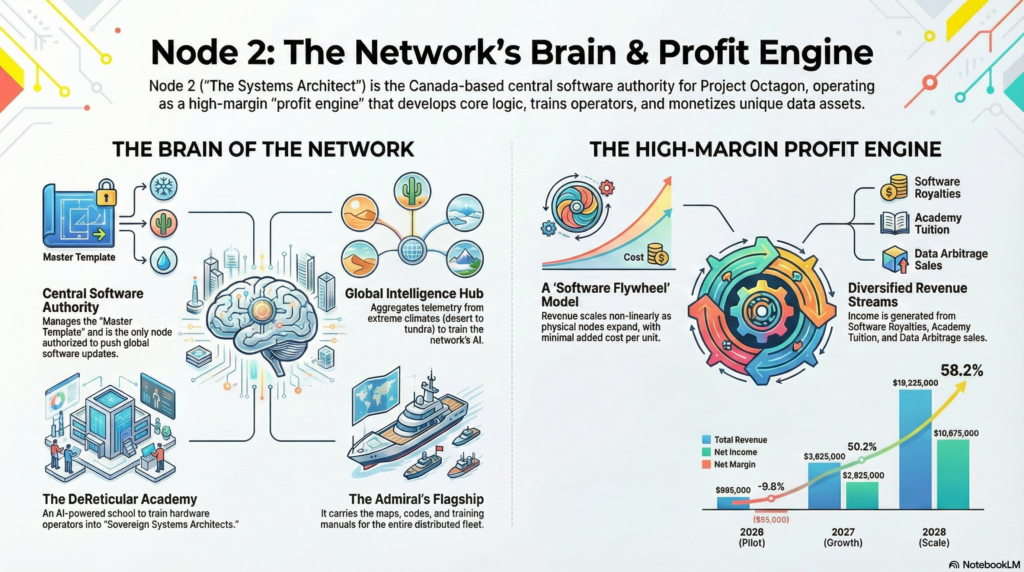
Node 2 is the central intelligence and software authority for the entire Project Octagon network. It goes by several key nicknames that hint at its crucial role: “The Systems Architect,” “The Brain,” and “OS HQ.” Located in Canada and led by Chief Technology Officer (CTO) Ash Aly, Node 2 is fundamentally different from the other nodes in the global network.

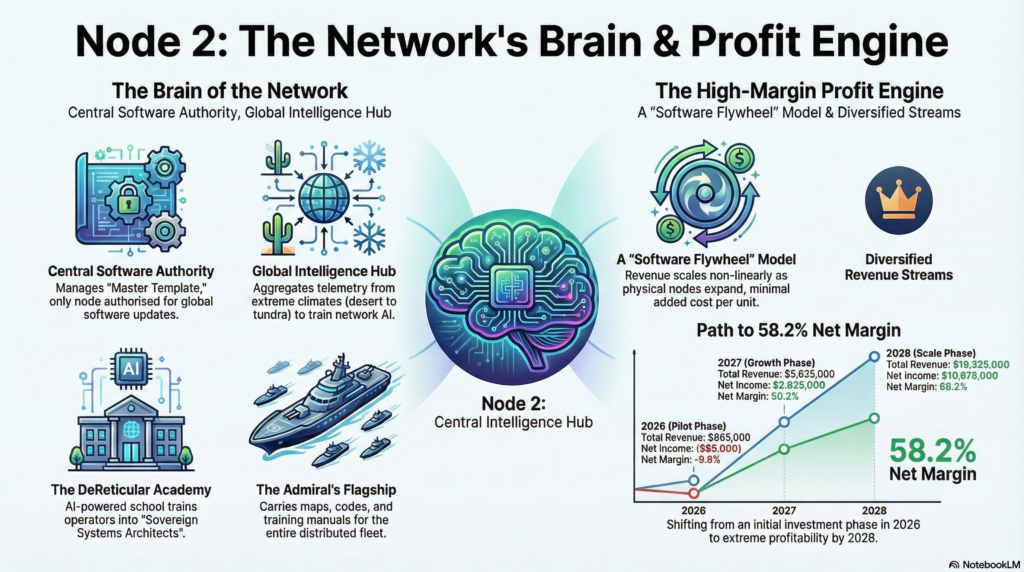
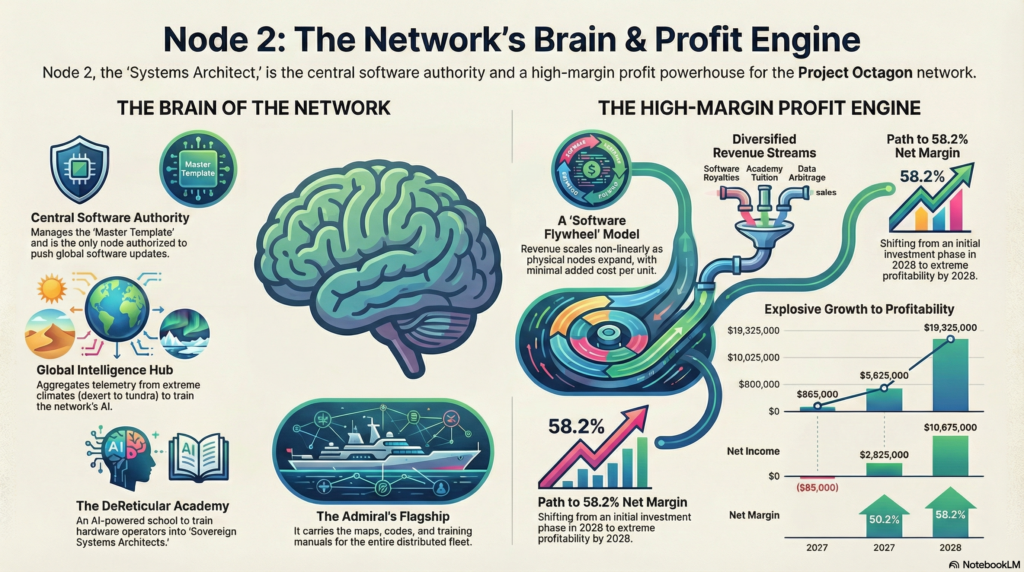
The best way to understand its function is through the “Admiral’s Flagship” analogy. In a global fleet of autonomous ships, most vessels are designed to carry cargo or perform specific industrial tasks. The flagship, however, doesn’t handle the heavy lifting. Instead, it is the flagship that provides the single source of truth for maps, codes, and training manuals, ensuring the entire fleet operates as one. Node 2 is that flagship; it directs the entire Project Octagon network.

This document will explore the three core missions that define Node 2’s essential role as the network’s brain.

2. The Three Core Missions of the Systems Architect

Node 2’s critical importance to Project Octagon can be understood through its three primary functions: serving as the software authority, the global intelligence hub, and the physical proving ground for the system’s hardware.

2.1 Mission 1: The Central Software Authority

Node 2 is the only node in the entire network authorized to manage and update the core software, the Rural Infrastructure Operating System (RIOS). This centralized control ensures stability, security, and uniformity across all nodes worldwide. Its two key responsibilities in this mission are:

  • Master Template Management: Node 2 maintains the “Golden Image” of the RIOS software. Think of this as the master blueprint for the system’s digital brain. By managing this single, pristine template, Node 2 ensures that a node in the Ugandan savanna runs the exact same kernel and security protocols as a node in Texas.
  • Over-the-Air (OTA) Updates: From its headquarters in Canada, Node 2 is responsible for developing and distributing all system patches, security improvements, and new features to the global network. This centralized update process guarantees that every node benefits from the latest advancements and is protected against emerging threats, creating a stable and reliable system for everyone.

2.2 Mission 2: The Global Intelligence Hub

Node 2 is tasked with making the entire Project Octagon network smarter through a process called “Federated Learning.” It acts as a central hub that aggregates non-sensitive telemetry data from nodes operating in extreme climates, from the scorching 115°F deserts of Arizona and the sub-zero winters of its Canadian home base to the equatorial humidity of Uganda.

The primary benefit of collecting this diverse data is to train global AI models. These models learn from the real-world performance of hardware in varied conditions to optimize critical systems for all nodes, such as improving battery thermal management and predicting energy loads more efficiently.

2.3 Mission 3: The Physical Proving Ground

Beyond its digital and AI functions, Node 2 leverages its unique location for a critical physical mission known as “Tundra Mode.” The team uses the harsh Canadian winters to physically test and validate RIOS hardware components, specifically focusing on battery performance and the integrity of enclosure seals in sub-zero temperatures.

The key insight from this testing is profound: it proves that the hardware can survive and operate reliably in extreme environments where traditional infrastructure, like diesel generators, often fails. This validation makes the entire system more resilient and commercially valuable for deployment anywhere on Earth.

From mastering the system’s software to training its intelligence and proving its physical resilience, Node 2’s role extends to cultivating the human talent needed to run the network.

3. The DeReticular Academy: Building Future Architects

Node 2 is not just a command center; it is also a school. It is the official home of the DeReticular Academy, a specialized training ground with a core mission to transform hardware operators into “Sovereign Systems Architects.”

The Academy’s most important features include:

  • “The Tutor” AI: The Academy utilizes a sophisticated, LLM-based AI agent known as “The Tutor.” This tool provides multi-language technical training, making complex knowledge accessible to a global student body.
  • From Operator to Designer: The curriculum’s goal is not merely to teach students how to use the hardware. It aims to empower them to design and blueprint complex infrastructure, fostering a new generation of engineers who can build and deploy these systems independently.
  • Offline “Black Start” Capability: In keeping with the network’s philosophy of resilience, the Academy’s educational tools are designed to work even if a node’s primary satellite link is cut. This ensures that learning and training can continue under any circumstances.

These educational services not only build human capital but also form the foundation for a powerful business model, enabling future high-value modules like delivering remote healthcare through a “Clinic-in-a-Box” software suite.

4. The Business of Intelligence: How Node 2 Creates Value

Unlike industrial nodes like the one in Uganda, which function as “Revenue Engines” by selling physical products like electricity, Node 2 operates as a high-margin “Profit Engine” by selling intelligence, software, and education. With a projected net margin of over 58% by 2028, Node 2 is designed for non-linear scaling. It functions as the intellectual property holder for the entire network, generating revenue from scalable digital assets.

Service/ProductDescriptionValue for the Network/Customer
RIOS Sovereign Cloud Suite (SCS)A one-time, perpetual software license (MSRP: $200,000) that unlocks the full capabilities of a node’s hardware.Transforms a node into a local cloud provider, allowing owners to sell services and prevent capital flight to large tech companies.
RIOS Mobile Pro OptimumAn annual subscription ($1,200/year) that activates “Signal Fusion” for edge devices, bonding satellite and 5G signals.Enables roaming devices to participate in the Federated Learning mesh, enhancing network intelligence and providing resilient connectivity.
DeReticular Academy CertificationProfessional certification for “RIOS Certified Technicians” ($3,500 per certification).Creates a skilled global workforce capable of deploying, managing, and scaling the network’s infrastructure.
Data ArbitrageSelling unique, aggregated datasets from one of the world’s only sources of real-world, off-grid AI performance across every major climate zone.Creates a pure-profit revenue stream while providing invaluable insights to clients like agricultural insurers and hardware manufacturers.

5. Leadership: The Guardian of the Logic

The leader of Node 2 is Ash Aly, the Chief Technology Officer of the entire mesh network. His role is best summarized by his title as the “Guardian of the Network’s Logic.” This creates a critical distinction within the project: while the hardware deployed in the field “gets dirty” through its daily operations in harsh environments, Aly’s responsibility is to ensure the core software remains “pristine, secure, and constantly evolving.”

6. Key Takeaways: Why Node 2 is Essential

For any student new to Project Octagon, these are the three most critical points to remember about Node 2’s role:

  1. Centralized Control, Global Stability By managing the single Master Template and distributing all Over-the-Air (OTA) updates, Node 2 ensures the entire global network runs on the same secure, proven software. This prevents fragmentation and enhances stability for every user.
  2. Intelligence Through Diversity Node 2 makes the entire system smarter by learning from the network’s most extreme environments. By collecting data from hot, cold, and equatorial climates, its AI models can deliver optimizations that make every node more resilient and efficient.
  3. The Profit Engine Node 2’s business model is what makes Project Octagon financially scalable. By selling high-margin, low-variable-cost digital assets like software, certifications, and data, it generates the profit needed to fund the network’s growth, acting as the perfect financial complement to the high-CapEx industrial nodes.

The Welcome Mat Understanding Node 1 and Sovereign Hospitality

Michael Noel · January 6, 2026 ·

Introduction: The Front Door to a High-Tech Frontier

In the rugged, remote Karamoja sub-region of northeast Uganda, a new kind of welcome mat is being laid down. This is not a simple entryway but a strategic beachhead for an audacious bet on the future of development. The thesis is simple but profound: “infrastructure drives tourism: where there is reliable power and safety… the world will come.”

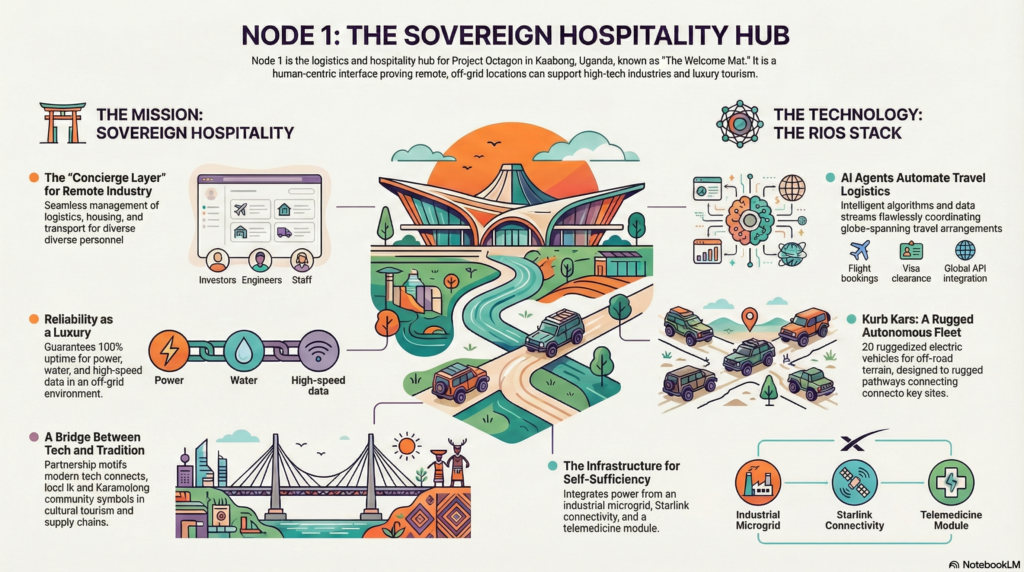
This is the mission of Node 1, a core component of the ambitious global technology initiative, Project Octagon. Helmed on the ground by local leader Mike Tumwesigye, who provides the project’s crucial “social license to operate,” Node 1 is far more than a simple logistics hub. It is the human-friendly front door to a high-tech frontier, engineered to solve the complex challenge of managing people—investors, engineers, and specialized staff—in one of East Africa’s most disconnected environments. Its purpose is to handle the crucial “human element” for a major industrial operation, mastering the intricate web of logistics, housing, and hospitality.

Designation: “The Welcome Mat” / “The Concierge Layer”

By engineering a pocket of absolute technological self-sufficiency, Node 1 aims to prove that a new model of development is possible, starting by solving the fundamental “last mile” problem that has long hindered progress in the world’s frontier markets.

1. The Core Problem: Solving the “Last Mile” Challenge

The term “Last Mile” often refers to the final step in a supply chain, but in the context of remote industrialization, it represents a far greater hurdle. The Kaabong region presents a classic “‘high friction, high reward’ scenario.” It is a land of stunning natural beauty, home to Kidepo Valley National Park and unique local cultures, but it is also defined by a near-total lack of reliable infrastructure. Roads are largely unpaved gravel, or murram, prone to complete washouts during the rainy season. The power grid is unstable, and internet connectivity is virtually non-existent.

Node 1 was engineered as a self-sufficient solution to these challenges, designed to provide “sovereign” infrastructure that is completely independent of national grids and local limitations.

Regional ChallengeNode 1’s “Sovereign” Solution
Logistical Isolation & Rough RoadsAn autonomous fleet of rugged electric vehicles (“Kurb Kars”).
Unreliable Power & WaterA 100% uptime guarantee, powered by the nearby Node 4 industrial engine.
Spotty Internet Connectivity“First World” high-speed internet via a Starlink High-Performance backhaul.
Scarcity of High-Standard HousingSecure, modern eco-lodges for investors and specialized staff.

This ability to overcome foundational infrastructure gaps allows Node 1 to pursue a unique, multifaceted mission that blends industrial support with a new vision for tourism and cultural engagement.

2. The Four-Part Mission: Concierge, Eco-Tourism, Logistics, and Culture

Node 1’s mission is fourfold, blending the practical needs of an industrial project with the ambitious goal of creating a new model for sustainable development that is deeply rooted in its environment.

  1. The “Concierge” Layer Node 1 acts as the human-friendly entry point for the Kaabong Smart Eco-Industrial Park. It translates the raw industrial power of the project into a seamless, comfortable experience. As the source material notes: “If Project Octagon were a Smart City, Node 1 is Grand Central Station combined with a Visitor’s Center.”
  2. The Eco-Tourism “Living Lab” The hub is designed to prove that a high-end, off-grid hospitality business can thrive. By leveraging the region’s assets, it will offer unique, high-tech adventures, including The “Black Start” Safari—a tour of the plasma gasification power plant combined with a game drive in Kidepo—and guided Ik Cultural Treks to the remote villages atop Mount Morungole.
  3. The Logistical Intake Hub At its most practical level, Node 1 manages the supply chain and housing for the workforce of the industrial engine, Node 4. This includes secure accommodations for the specialized “Black Start” operators who maintain the project’s critical plasma gasification power units.
  4. The Cultural Interface Crucially, Node 1 is tasked with managing the “delicate interaction” between the high-tech project and the local Karamojong and Ik communities. The goal is to foster genuine economic inclusion and avoid the trap of “zoo-ification,” ensuring cultural preservation is a core part of the mission, not an afterthought.

Underpinning these four strategic pillars is a sophisticated technology stack that makes this ambitious vision a reality.

3. The Tech Stack: How RIOS Powers the Experience

The “digital brain” that automates Node 1’s operations is the RIOS (Rural Infrastructure Operating System). This system integrates several key technologies to deliver a seamless experience in an otherwise disconnected environment.

  • AI “Agent-to-Agent” Travel Instead of human travel agents, specialized AI software books flights and coordinates all travel logistics. For an investor, this means the friction of traveling to a remote location is completely removed, as their AI agent communicates directly with Node 1’s AI to handle every detail.
  • Autonomous “Kurb Kars” A fleet of rugged, self-driving electric vehicles provides reliable transportation where public options are non-existent. These vehicles are specifically “hardened” for the challenge, using AI training data from the Arizona desert (Node 3) that prioritizes “obstacle avoidance (potholes, livestock) over traffic laws, which are non-existent on these tracks.” For a worker or guest, this guarantees a safe ride connecting the campus, airstrip, and industrial site.
  • “Clinic-in-a-Box” Telemedicine A modern, high-security healthcare module provides “First World” medical diagnostics and remote consultation services. For staff and visitors, this ensures their health and safety are protected, a critical requirement for operating in such a remote area.

The application of this technology enables a unique business strategy that redefines what “luxury” means in a frontier market.

4. The Big Idea: Defining “Sovereign Hospitality”

Node 1’s core concept is “Sovereign Hospitality,” a strategy where reliability itself becomes the ultimate luxury. In a region defined by scarcity, Node 1’s most valuable offering is the guarantee of services taken for granted elsewhere.

This strategy is built to address the “Missing Middle” thesis—the observation that Kaabong’s tourism market is polarized between ultra-luxury lodges and basic budget options, with no reliable mid-tier choices for business travelers or discerning tourists. Node 1 fills this gap by guaranteeing:

  • Guaranteed Power: 24/7 Air Conditioning and Hot Water, independent of any national grid.
  • Guaranteed Data: High-speed, low-latency internet for uninterrupted work and communication.
  • Guaranteed Safety: Geofenced security and immediate access to modern medical care.

This concept extends to a “Sovereign Supply Chain,” creating economic interdependence through “Farm-to-Table” contracts for locally sourced goods like Ik Honey and Karamojong goat meat, making the guest experience authentic and the community impact tangible.

5. Part of a Bigger System: Node 1’s Role in Project Octagon

Node 1 does not operate in a vacuum; it is a vital, deeply integrated component of the global Project Octagon network. It has a symbiotic, give-and-take relationship with the other key nodes.

  • Relationship with Node 4 (The Industrial Engine): Node 4 provides the 10-11 MW of power that makes Node 1’s “100% uptime” guarantee possible. In return, Node 1 provides the housing, food, and transport for Node 4’s essential workforce. One cannot function without the other.
  • Relationship with Node 2 (The Brain in Canada): Node 2 designs and sends AI software updates and training models to Node 1’s logistics systems. In return, Node 1 sends back real-world operational data from the challenging Ugandan environment, helping to refine the AI.
  • Relationship with Node 3 (The Proving Ground in Arizona): Node 3 acts as a “digital twin,” stress-testing all hardware and vehicle AI in a harsh desert that mimics Karamoja’s conditions. This ensures that any technology deployed to Node 1 is “hardened” and ready for the real world.

These interconnected roles highlight Node 1’s ultimate purpose as the crucial link between advanced technology and the people who depend on it.

Conclusion: The Human Face of a Digital Machine

Ultimately, Node 1 serves as the essential “Human Interface” for a complex and powerful technological ecosystem. For the first three years of its operation, it will function as an internal service provider, perfecting its systems while supporting the industrial build-out. But its long-term vision is far more ambitious.

In Year 4, the plan is to pivot to a public-facing commercial entity, launching “Umoja Digital Adventure Tours” and expanding its autonomous fleet to create a regional logistics monopoly. It is the face of Project Octagon, designed to prove that by deploying advanced, self-sufficient infrastructure, it is possible to create world-class hospitality, sustainable tourism, and seamless logistics in the planet’s most challenging environments. It is not just a hub for lodging and transport; it is a replicable blueprint for bringing opportunity and connection to the world’s last frontiers.

Briefing Document RIOS Pilot AI Core (Tier 3)

Michael Noel · January 3, 2026 ·

Executive Summary

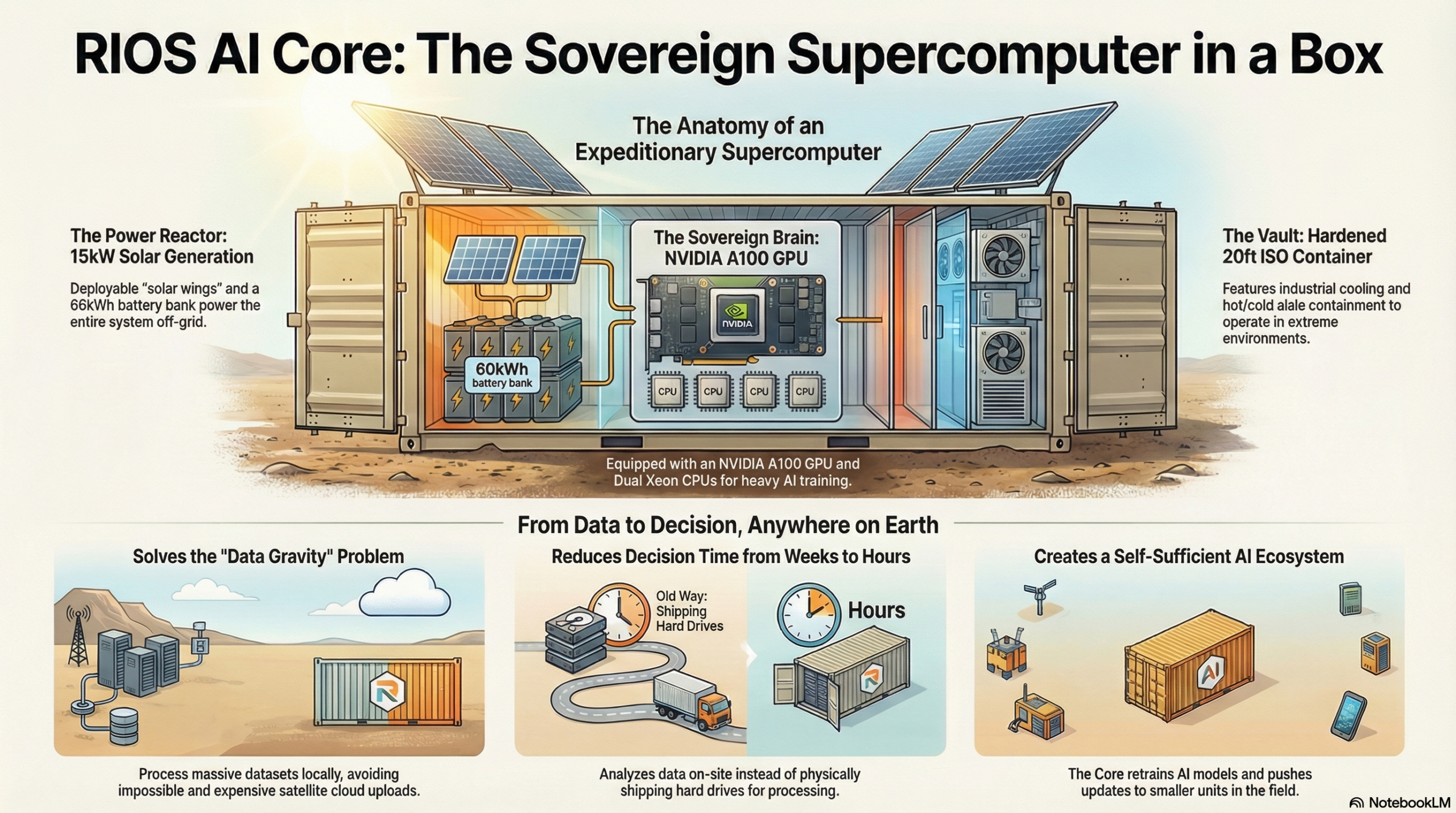
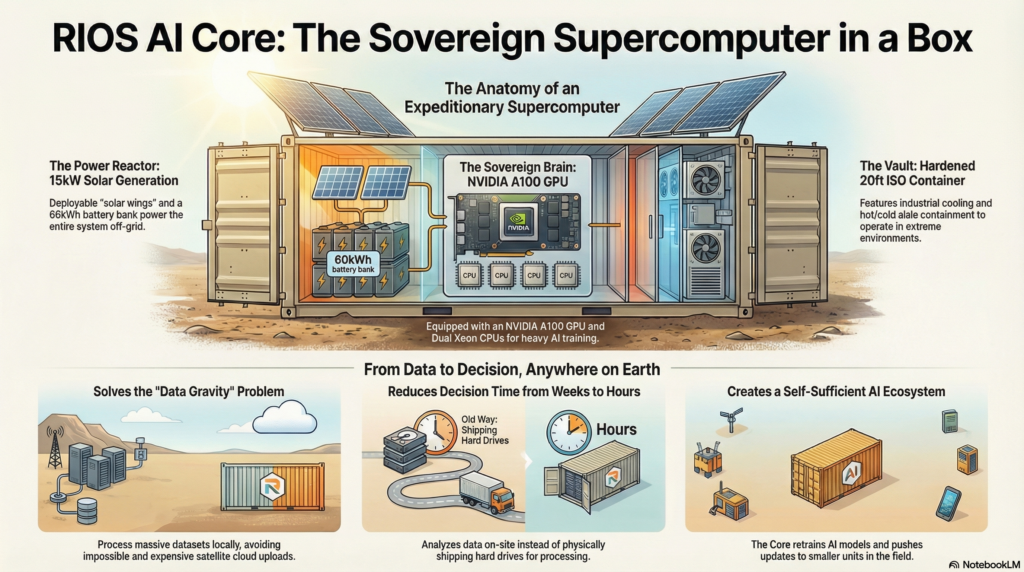
The RIOS Pilot AI Core (Tier 3) is a sovereign, mobile supercomputing node designed for off-grid AI model training and heavy scientific simulation. Housed in a modified 20ft High-Cube ISO container, its core mission is to solve the “Data Gravity” problem by bringing high-performance computing (HPC) directly to remote data sources, thus bypassing the bandwidth limitations of cloud uploads. Tagged as “The Sovereign Brain,” it functions as the pinnacle of the DeReticular hardware ecosystem, distinguishing itself from Tier 1 and Tier 2 units which focus on AI inference.

Powered by a 15kW deployable solar array and a 60kWh battery bank, the unit’s “Power-First” design supports a data center-class compute core featuring Dual Intel Xeon Platinum processors and an NVIDIA A100 (80GB) Tensor Core GPU. This enables on-site retraining of Large Language Models (LLMs) and complex simulations for industries like remote mining, disaster response, and field genomics.

Strategically positioned as a low-volume, high-margin “Halo Product,” the AI Core targets national governments, research institutions, and large industrial enterprises. With a Manufacturer’s Suggested Retail Price (MSRP) of $185,000 and an estimated Cost of Goods Sold (COGS) of $92,500, it carries a 50% gross margin. The product is a complex, build-to-order system with a 10-12 week lead time and is subject to strict U.S. export compliance regulations due to its high-performance components.

——————————————————————————–

1. Product Overview and Strategic Role

The RIOS Pilot AI Core (Tier 3), with the SKU RIOS-CORE-20FT-A100, is classified as an Expeditionary High-Performance Computing (HPC) unit or Mobile Data Center. Its primary strategic distinction is its capability for AI Training, whereas the lower-tier RIOS units are designed for AI Inference. This positions the Tier 3 unit as the central hub in a distributed sovereign cloud architecture, responsible for creating and updating the AI models used by other units at the tactical edge.

  • Core Problem Solved: The unit directly addresses the “Data Gravity” problem, where massive datasets (terabytes) generated in remote locations (e.g., geological scans, drone swarm data) cannot be efficiently uploaded to centralized cloud services like AWS or Azure. The AI Core’s value proposition is that it “brings the cloud to the data.”
  • Tagline: “The Sovereign Brain. Train AI Models Anywhere on Earth.”
  • Halo Product Status: It is considered the flagship “Halo Product” for DeReticular, designed to validate the power of the entire ecosystem and establish the brand as a serious Defense & Industrial Grade technology provider.
  • Market Position: It targets the top 5% of the market, including national governments with data sovereignty mandates (e.g., Uganda, Israel), research institutions, and industrial enterprises.

2. System Architecture and Technical Specifications

The AI Core is built on a “Power-First” design philosophy, where the physical form factor is dictated by the energy requirements of its supercomputing hardware.

A. The Shell (Chassis & Containment)

The foundation is a robust, physically secure, and thermally managed enclosure.

  • Form Factor: New/One-Trip 20ft High-Cube ISO Shipping Container.
  • Dimensions: 20′ (L) x 8′ (W) x 9’6″ (H).
  • Gross Weight: Approximately 12,000 – 12,500 lbs (5,670 kg) fully loaded.
  • Thermal Management: The interior is fabricated with a Hot Aisle / Cold Aisle Containment system to isolate the hot exhaust from the server intakes, maximizing cooling efficiency.
  • Physical Security: Features include steel-reinforced doors, biometric access control, and internal motion/vibration sensors.
  • RF Shielding: An optional copper-foil lining is available for signal isolation, making the unit compliant for use as a Sensitive Compartmented Information Facility (SCIF).

B. Power Systems (The Reactor)

The unit is engineered for complete energy independence, capable of sustaining peak loads off-grid.

  • Solar Generation: 12kW – 15kW peak capacity. This is achieved through a combination of bifacial roof panels and heavy-duty, manual fold-out “Solar Wings” on the East and West flanks that triple the solar capture area.
  • Battery Storage: 40kWh – 60kWh industrial battery bank, expandable to 100kWh.
    • Chemistry: High-Voltage (400V) LiFePO4 Stack for greater efficiency.
    • Autonomy: Capable of sustaining the NVIDIA A100’s peak load through the night or providing 12-18 hours of operation at 50% HPC load without solar input.
  • Power Management: Utilizes triple-redundant 15kW inverters (e.g., Victron Quattro, Sol-Ark 15k) or a single 30kW industrial 3-phase inverter to provide pure sine wave power suitable for sensitive HPC equipment.

C. Supercompute Core (The Brain)

This is the high-performance heart of the unit, designed for intensive computational tasks.

  • Server: A high-density 4U GPU server (e.g., Dell PowerEdge XE8545 or Supermicro GPU SuperServer).
  • CPU: Dual Intel Xeon Platinum 8300 Series processors, providing a total of 40-80 cores.
  • AI Acceleration: A single NVIDIA A100 Tensor Core GPU with 80GB PCIe memory is standard. The system is upgradable to include up to four A100 GPUs. An NVIDIA H100 is also an option.
    • Compute Power: ~9.7 TFLOPS (FP64 for scientific simulation) / ~600 TFLOPS (AI Tensor operations).
  • RAM: 512GB DDR4 ECC Registered memory.
  • Storage: A 100TB+ NVMe All-Flash Array serves as a local “Data Lake” for high-speed data ingestion, with rates noted up to 40GB/s.
  • Operating System: RIOS Sovereign Cloud OS (HPC Edition / Kubernetes).
  • Connectivity: Dual bonded Starlink High-Performance terminals and fiber uplink ports.

D. Industrial Cooling System

To ensure peak performance in extreme environments, the cooling system is robust and redundant.

  • System: Dual 18,000 BTU to 36,000 BTU dedicated CRAC (Computer Room Air Conditioning) units.
  • Redundancy: An N+1 (Main + Backup) configuration ensures that the GPU never throttles due to heat, even in ambient temperatures of 50°C (122°F).
  • Operating Temperature Range: The unit is rated to operate from -20°F to 120°F (-29°C to 49°C).
  • Fire Suppression (Optional): A clean agent gas system (e.g., Novec 1230) can be installed.

3. Operational Model: The Sovereign Cloud Hub

The Tier 3 AI Core is designed to be the central “Region” in a distributed, sovereign cloud network.

  1. Data Aggregation: Tier 1 and Tier 2 units deployed at the edge collect data (e.g., images, sensor readings) and perform initial inference. They forward “hard cases”—data they cannot process or understand—to the Tier 3 unit.
  2. Local Learning & Retraining: The AI Core ingests this new data and uses its powerful compute core to retrain the master AI model, typically overnight.
  3. Over-the-Air (OTA) Updates: The updated, more intelligent model is then pushed back out to the Tier 1 and Tier 2 units via a local mesh network.

This creates a self-improving ecosystem that “gets smarter every day, without ever connecting to AWS or Azure,” ensuring complete data sovereignty and reducing the data-to-decision loop from weeks to hours.

4. Financial and Commercial Analysis

The AI Core is a high-value asset with a specific pricing and fulfillment strategy.

A. Pricing and Margin

MetricValueNotes
MSRP$185,000.00 USDBased on “Infrastructure Replacement” value proposition.
Wholesale / Partner Price$155,000.00 USDFor approved partners and resellers.
Estimated COGS$92,500.00 USDIncludes all hardware, fabrication, and labor.
Gross Margin50% ($92,500)Buffers against silicon price volatility and warranty risk.
Payment Terms40% Deposit30% at Milestone (Shell Complete), 30% Pre-Shipment.

B. Cost of Goods Sold (COGS) Breakdown

ComponentEstimated CostDetails
Shell & Fabrication$14,50020ft container, hot/cold aisle, RF shielding, solar wing bracing.
Power Systems$28,00014kW solar array, 60kWh battery bank, inverters.
Supercompute Core$38,000Server, Dual Xeon CPUs, 512GB RAM, 100TB NVMe, Single A100.
Industrial Cooling$4,500Dual 18,000 BTU mini-splits and fans.
Labor & Integration$7,50080 hrs fabrication, 50 hrs systems engineering @ $55/hr.
Total Estimated COGS$92,500.00

C. Recurring Revenue and Upgrades

  • RIOS Core Support Subscription: A mandatory or highly recommended service priced at **2,500/month** (30,000 annually). This includes priority “Red Phone” support, remote thermal monitoring, and HPC software stack updates.
  • Hardware Upgrades:
    • Add 2nd A100 GPU: +$25,000
    • Quad-GPU Upgrade: +$75,000 (est.)
    • Satellite Uplink: +$3,000 – $5,000 (Dual Starlink High-Perf Kit)

5. Fulfillment and Export Compliance

The AI Core is a complex, build-to-order (BTO) asset with a strict fulfillment process and significant regulatory requirements.

  • Lead Time: 10-12 weeks from deposit.
  • Fulfillment Process:
    • Weeks 1-3 (Compliance & Procurement): An Export Check is a critical first step to verify the end-user is not on the BIS Entity List. Silicon components (GPU, server) are sourced immediately.
    • Weeks 4-7 (Heavy Fabrication): Involves cutting vents, installing partitions, and welding the articulating solar wing arms.
    • Weeks 8-10 (HPC Integration): Server rack installation, thermal tuning under load, and software installation (RIOS OS, Kubernetes).
    • Weeks 11-12 (Logistics): Requires a heavy-duty crane for transport. Commissioning often requires a DeReticular Field Engineer on-site.
  • Export Control:
    • Classification: The NVIDIA A100 GPU and high-performance server fall under ECCN 4A003.b and 5A002.
    • Requirement: The product is RESTRICTED and subject to US Export Administration Regulations (EAR). All international sales require a completed End-User Statement and may require a BIS License Review.

6. Competitive Analysis

The RIOS Pilot AI Core offers a unique combination of mobility, power autonomy, and sovereign AI training capabilities that differentiate it from established competitors.

FeatureRIOS Pilot AI Core (Tier 3)AWS OutpostsStandard Modular Data Center
Price$185,000 (Capex)High Monthly Opex~$250,000+ (Capex)
PowerIncluded (15kW Solar)Requires GridRequires Grid
MobilityISO ContainerStationary RackISO Container (less integrated)
Data Sovereignty100% Local StorageAWS Control PlaneVaries
AI CapabilityTraining (A100)Inference mostlyVaries

Understanding the RIOS Pilot AI Core: The Four Systems of a Mobile Supercomputer

Michael Noel · January 3, 2026 ·

Introduction: What is the RIOS AI Core?

Welcome! If you’ve ever been curious about what a real-world supercomputer looks like and how it works, you’re in the right place. We’re going to explore a fascinating piece of technology called the RIOS Pilot AI Core. Think of it as a “Sovereign Brain” or a complete “Data Center in a Box,” designed to operate anywhere on Earth.

Its core purpose is to solve the “Data Gravity” problem by bringing supercomputing power to remote locations where massive amounts of data are generated from sources like drone swarms or geological scans, making it impossible to upload to the cloud.

The goal of this document is to demystify this complex machine by breaking it down into four essential systems, just like understanding the parts of a car. By the end, you’ll understand how these parts work together to create a mobile supercomputer. The four systems we will cover are:

  • The Shell
  • The Reactor
  • The Brain
  • The Cooling System

——————————————————————————–

1. The Shell: The Armored Body

Think of the Shell as the AI Core’s armored body. Its job is to protect the delicate systems inside from the outside world. This entire system is built from a modified 20ft High-Cube ISO Shipping Container, which is what makes it so mobile—it can be transported anywhere by truck or crane.

The Shell has three critical functions that protect the valuable hardware inside:

  • Physical Security The unit is built for security, featuring steel reinforced doors and biometric access controls. This ensures that only authorized personnel can access the millions of dollars of high-performance computing equipment housed within.
  • Signal Security For sensitive or military operations, the Shell can be lined with copper, creating an RF Shield. This acts like a Faraday cage, preventing any electronic signals from getting in or out, which stops electronic eavesdropping and ensures data privacy.
  • Cooling Efficiency The interior is cleverly divided into a “Hot Aisle” and a “Cold Aisle.” This design feeds cool air into the front of the server racks while containing the hot exhaust in a separate channel at the rear. This simple but critical design manages airflow, maximizing the effectiveness of the cooling system.

Now that we understand the protective body, let’s look at the powerful heart that keeps it alive.

——————————————————————————–

2. The Reactor: The Independent Heart

If the Shell is the body, the Reactor is the powerful, self-sustaining heart. It generates, stores, and manages all the electricity the supercomputer needs to operate completely off-grid.

The Reactor is composed of three primary components that work in harmony:

  • Power Generation The system uses large, deployable “Solar Wings.” These heavy-duty arrays fold out from the East and West sides of the container, complemented by panels on the roof, to triple the surface area for solar capture and generate between 14kW and 15kW of power from the sun.
  • Power Storage Electricity from the solar wings is stored in a large industrial battery bank, ranging from 40kWh to 60kWh. Its most important capability is having enough power to sustain the supercomputer’s peak workload all through the night, long after the sun has gone down.
  • Power Management The system uses triple-redundant inverters to convert the raw DC power from the batteries into the stable AC power the computers need. These inverters ensure the power is “clean” (a pure sine wave), which is crucial for protecting the sensitive and expensive computer hardware from electrical damage.

With a protected and powered system, it’s time to explore the most important part: the supercomputing brain itself.

——————————————————————————–

3. The Brain: The Supercomputing Mind

This is the ‘AI Core’s’ mind. The Brain is where all the thinking, learning, and problem-solving happens. Unlike smaller systems that just use AI, this brain is powerful enough to create and retrain AI.

Here is a breakdown of the key components that make up this supercomputing mind:

ComponentWhat It IsWhy It Matters (Its Job)
CPU (Dual Intel Xeon Platinum)The system’s general-purpose processors.Handles the millions of background tasks and calculations needed to run the whole system smoothly.
AI Accelerator (NVIDIA A100 80GB GPU)A highly specialized processor designed for artificial intelligence.This is the powerhouse for AI Training. It processes huge amounts of data to help the AI learn new things, like processing seismic data on-site to decide where to drill, saving weeks of time.
Storage (100TB+ NVMe All-Flash Array)The system’s ultra-fast internal storage.Acts as a “Data Lake,” holding all the raw information (like drone footage or geological scans) right next to the brain for instant access and processing.

A brain this powerful generates an incredible amount of heat, which leads us to the final, critical system: the lungs that keep it cool.

——————————————————————————–

4. The Cooling System: The Tireless Lungs

Just like an athlete, a hard-working computer gets hot. The Industrial Cooling system acts as the AI Core’s tireless lungs, constantly breathing out hot air and breathing in cold air to prevent overheating.

This isn’t just a simple air conditioner. The NVIDIA A100 GPU alone generates so much heat that without a dedicated, powerful cooling system, it would automatically slow itself down (a process called “throttling”) or shut down completely to prevent damage.

Two key features make this system robust enough for the job:

  • Serious Power The system uses two 18,000 BTU units for a combined 36,000 BTUs of power. This is computer room-grade air conditioning (CRAC), a system designed specifically for the extreme heat loads of high-density computing.
  • Redundancy (N+1) The system uses a dual-unit configuration, with a main air conditioner and a full backup. This N+1 redundancy guarantees that the AI Core can run at full power without throttling, even in harsh desert environments with temperatures up to 50°C (122°F).

With all four systems in place, let’s see how they come together to create something truly revolutionary.

——————————————————————————–

Conclusion: A Complete System

The four systems of the RIOS AI Core work together in a perfect, dependent loop. The Shell protects the Brain, the Reactor powers it, and the Cooling system allows it to think at maximum speed without interruption.

By combining these four elements, the RIOS Pilot AI Core achieves its ultimate goal: it brings the power of the cloud directly to the data. This revolutionary approach reduces the “Data-to-Decision” loop from weeks—the time it would take to physically ship hard drives to a data center—to mere hours. You now have a foundational understanding of the architecture that makes a mobile supercomputer possible.

  • « Go to Previous Page
  • Page 1
  • Interim pages omitted …
  • Page 22
  • Page 23
  • Page 24
  • Page 25
  • Page 26
  • Interim pages omitted …
  • Page 55
  • Go to Next Page »

DeReticular

Copyright © 2026 · Monochrome Pro on Genesis Framework · WordPress · Log in