• Skip to primary navigation
  • Skip to main content
DeReticular

DeReticular

Local Autonomy. National Security. Total Sovereignty.

  • Solutions
    • Municipalities
    • Energy
    • Industrial
    • Defense
  • Infrastructure
  • Intelligence
  • Company
  • Request Municipal Audit
  • Show Search
Hide Search
You are here: Home / Archives for DeReticular

DeReticular

Unpacking RIOS Your Guide to Infrastructure in a Suitcase

Michael Noel · January 2, 2026 ·

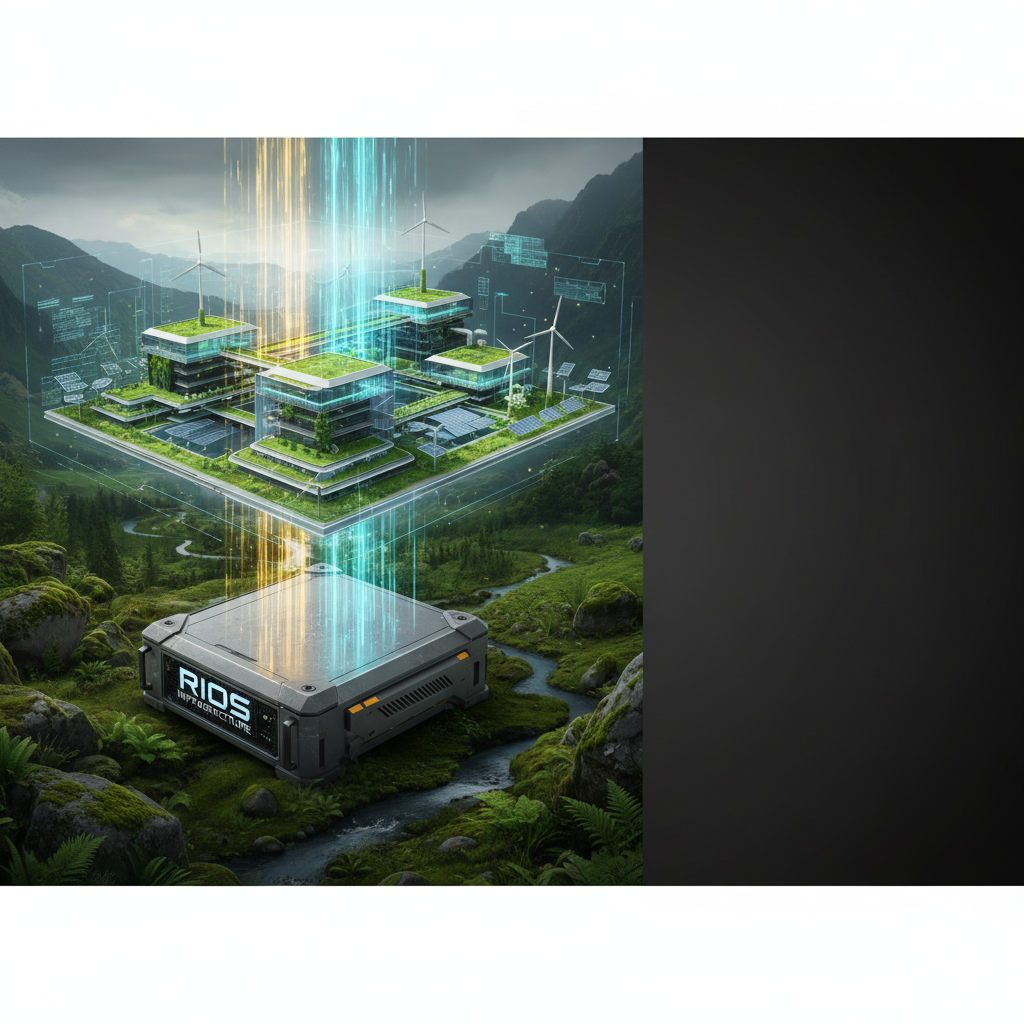
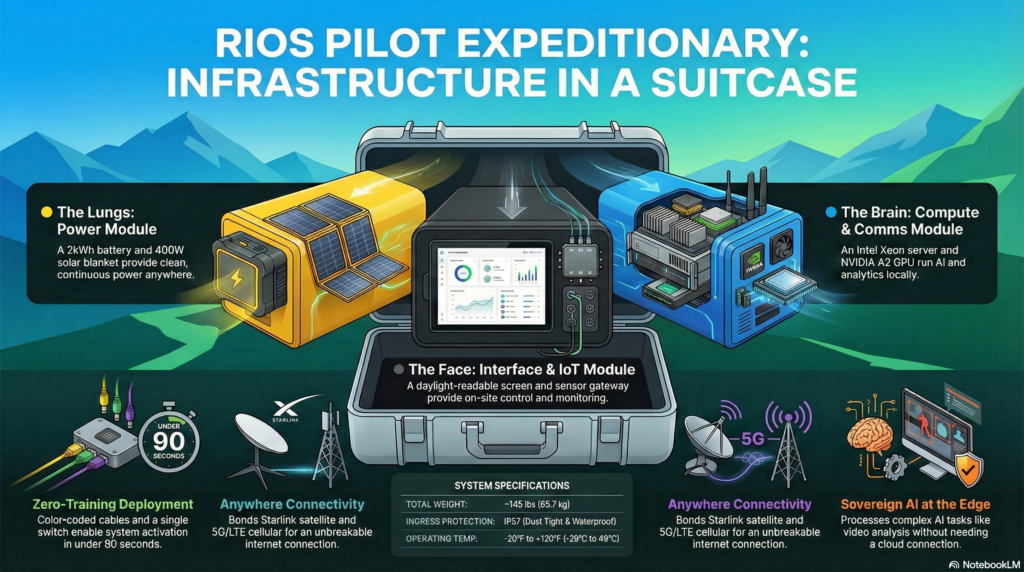
Welcome to the world of the RIOS Pilot Expeditionary. Imagine being able to drop a complete, modern command center anywhere on Earth—a remote disaster zone, a new construction site, or a scientific outpost—and have it running in minutes. That’s the core idea behind RIOS. Think of it as “Infrastructure in a Suitcase” or a “Civilization Seed”: a system designed to bring power, internet, and advanced computing to places that have none, all packed into three rugged boxes.
1. The “Mission Stack”: Building Blocks of a Modern Outpost

The RIOS system isn’t one single object but a modular “stack” of three color-coded cases that work together like a single organism. To make their functions intuitive, the system uses analogies for parts of the human body: the Lungs provide power, the Brain does the thinking, and the Face is how you interact with it. Crucially, the system is designed for a “Zero-Training” deployment, using color-coded cables and a single master switch to go from packed cases to a fully operational command center in under 90 seconds.

Case (Analogy)Core PurposeKey Components Inside
🟡 The Lungs (Power Module)Provides the lifeblood for the entire system—clean, continuous, and independent energy.<ul><li>400W Foldable “Blanket” Solar Array</li><li>2kWh LiFePO4 Battery</li></ul>
🔵 The Brain (Compute & Comms Module)Processes all data, runs the AI, and manages all communications with the outside world.<ul><li>Intel Xeon D-Series Server</li><li>NVIDIA A2 AI Card</li><li>Starlink & 5G/LTE Bonding Router</li></ul>
⚫ The Face (Interface & IoT Module)Provides the hands-on control center, allowing an operator to see system output and interact with the software.<ul><li>22″ Daylight Readable Screen</li><li>Weatherproof Keyboard & Trackball</li></ul>

This modular “Mission Stack” is not just for organization; it’s critical for resilience. In a remote location, if one component fails, the affected case can be swapped out individually without having to send the entire system back for repair, ensuring the mission continues.

Now that we understand the physical building blocks, let’s explore the powerful ideas that this hardware brings to life.

2. Core Concept #1: Energy Independence (Powering a Dream)

Energy Independence is the system’s ability to “live on its own” without needing to be plugged into a wall outlet or refueled like a diesel generator. It’s the foundation that makes everything else possible.

The core problem RIOS solves is operating in remote places where reliable power simply doesn’t exist, such as a hurricane-stricken town or a new agricultural site. The solution is the Yellow Case, which acts like a giant, intelligent power bank for the whole system.

This solution has two key parts:

  • Generation: The system comes with a 400W foldable “blanket” solar array. This is how the system “eats” sunlight to make its own electricity. It’s a clean, silent, and limitless source of energy as long as the sun is shining.
  • Storage: Inside the Yellow Case is a 2kWh LiFePO4 battery. This is how the system “saves” that solar energy to continue working through the night or on cloudy days, decoupling the sensitive electronics from unreliable power sources.

The main benefit for the user is simple but profound: you can run high-tech equipment anywhere the sun shines, completely off-grid and self-sufficiently.

With its own power source secured, RIOS can run its most important tool: its own brain for thinking on the spot.

3. Core Concept #2: Edge AI (A Brain in the Field)

Edge AI is a term that sounds complex, but the core idea is simple. “The edge” just means “right here, on location”—as opposed to sending your data to a distant cloud server for processing.

Think about how a service like Google Photos works. To identify faces or objects in your pictures, you must first upload them to Google’s powerful servers. This requires a strong and stable internet connection.

RIOS, with its powerful NVIDIA A2 GPU inside the Blue Case, does all the thinking locally. It’s like having the supercomputer with you instead of thousands of miles away. This “on-site” intelligence provides three massive advantages:

  1. Speed: You get answers instantly, without waiting for slow uploads or downloads. The system can process over 12 simultaneous streams of HD video for object detection in real-time.
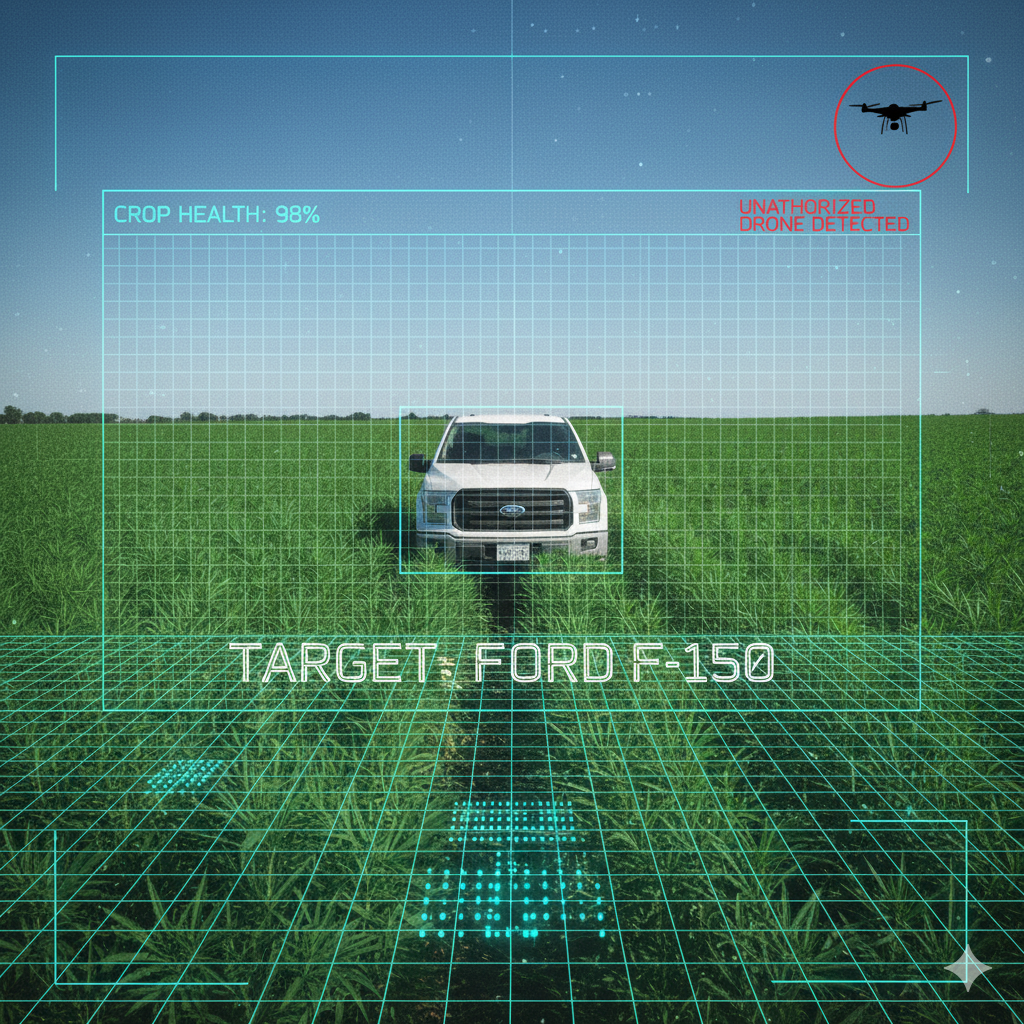
  2. Privacy: Sensitive data never has to leave the device. For example, you can monitor a construction site or mine perimeter using AI computer vision to detect intruders without needing a generator or guard shack, and the footage remains completely secure.
  3. Offline Capability: The system’s AI works even if the internet goes down. This is critical for tasks like analyzing drone maps for agriculture (Agro-Scouting) in a field with zero cell signal.

By combining its own power with its own intelligence, RIOS achieves the final goal: creating a completely self-reliant, private digital world.

4. Core Concept #3: Sovereign Infrastructure (Your Own Private Cloud)

Sovereign Infrastructure is about independence and self-governance. The word “sovereign” simply means that you are in control, not a third party.

This concept solves a major problem in the modern world: dependency. Most operations depend on big tech companies for cloud services and on unreliable local infrastructure for power and internet. RIOS provides a complete, private “stack” of infrastructure that the user owns and controls completely.

This “Before vs. After” table makes the difference clear:

FeatureTypical Setup (Dependent)RIOS Setup (Sovereign)
PowerRelies on the local grid (unstable, prone to outages) or diesel generators (noisy, requires refueling).Generates its own power from the sun.
InternetDepends on local cell towers or cable providers (unreliable, can be censored or congested).Creates its own link to the internet via Starlink satellite.
Local NetworkDepends on available routers and switches.Creates a secure Wi-Fi bubble, provides PoE+ ports for cameras, and broadcasts a long-range IoT mesh network.
ComputingSends data to a public cloud for analysis (high latency, privacy risks, requires constant connection).Processes all data locally using its onboard AI.

In short, “Sovereign Infrastructure” means you control your power, your internet connection, and your data, no matter where you are in the world.

Putting all these pieces together reveals why RIOS is more than just a box of electronics.

5. Conclusion: Why It Matters

By integrating Energy Independence, Edge AI, and Sovereign Infrastructure, RIOS delivers a new reality. It means a disaster response team in a hurricane-stricken town can establish a command post in minutes, using local AI to register victims and coordinate aid, all while the local power grid and cell towers are completely down. Its solar panels provide Energy Independence to run lifesaving equipment. Its local Edge AI analyzes drone footage to find survivors without needing an internet connection. Its Sovereign Infrastructure creates a communications hub for first responders when nothing else works.

It’s not just a box of tech; it’s the “Civilization Seed” that allows communities to begin rebuilding from day one. This is the power to build, create, analyze, and respond in places that were previously out of reach, unlocking a more connected and resilient future.
The RIOS Sovereign Cloud Turning Hardware into a Local Business

Michael Noel · January 1, 2026 ·

Introduction: Your Community’s Digital Bank

Think of a local bank. It plays a vital role by keeping money circulating within a community, helping local businesses and families thrive. In the same way, the RIOS Sovereign Cloud Suite helps a community keep its most valuable modern currency—its data—local. This document will explain how this special piece of software transforms a powerful computer into a new, revenue-generating business that strengthens a community from the inside out.

——————————————————————————–

1. The Problem: “Capital Flight” and the Cloud

Most communities today rely on massive, distant cloud providers like Amazon Web Services (AWS), Microsoft Azure, or Google Cloud Platform (GCP). While useful, this means that every dollar spent on hosting a local business’s website, storing school records, or running town software is sent hundreds or thousands of miles away. This process is called “capital flight”—it’s money that leaves the local economy, never to return.

The RIOS Sovereign Cloud Suite is a software solution designed to solve this exact problem. It creates a trusted, high-performance, and locally-owned cloud alternative, giving a community the power to redirect that capital flight back into its own economy. The key to this transformation is the software itself.

——————————————————————————–

2. What is the “Sovereign Cloud Suite”?

The Sovereign Cloud Suite is not a physical item, but a perpetual software license. It is a one-time purchase that is pre-installed on the RIOS-CC-1000 hardware, permanently unlocking its full potential to act as a community cloud. This is a fundamental difference from the subscription models of other cloud providers; it represents true ownership of the capability, not just renting it.

By activating this license, the community’s “digital bank” is open for business, gaining the tools to offer a complete set of enterprise-grade services—the financial products for the digital age.

Unlocked Capabilities for Your Community

ServiceWhat it Means for a Local Business
☁️ Infrastructure-as-a-Service (IaaS)This lets a local business host their website or software on a local server instead of renting one from far away.
</> Platform-as-a-Service (PaaS)This gives local developers a ready-to-use launchpad to build, manage, and scale new applications for the community.
🛡️ The Secure Data VaultThis is an ultra-secure digital fortress—the bank’s vault—for sensitive data from local clinics, law firms, or town agencies.
🔄 Backup & Disaster Recovery (DR)This acts as a digital insurance policy, automatically backing up critical data to prevent catastrophic loss.

This suite of powerful tools provides everything needed to compete with outside providers, but understanding what it does is only half the story. The next step is understanding how it becomes a business.

——————————————————————————–

3. The Business Model: A Breakdown of Cost and Revenue

This section breaks down how the one-time software investment is structured and how it empowers the owner to generate ongoing revenue.

A. The Initial Investment: Buying the License

The Manufacturer’s Suggested Retail Price (MSRP) for the perpetual license is $200,000. To justify this significant capital investment, we must first analyze its underlying cost structure and value proposition.

Demystifying the Cost (COGS)

The “Cost of Goods Sold” (COGS) represents what it costs to create and deliver the software license. For a digital product, this is primarily the amortized cost of the intellectual property (IP) development.

  • Core R&D Amortization – $85,000: This is the largest single cost, representing a fraction of the immense investment in software engineering required to build the custom platform.
  • Third-Party Software Licensing – $10,000: This covers licensing fees for any commercial software components embedded within the suite.
  • Fulfillment & Provisioning Labor – $500: This is the direct labor cost for an engineer to securely provision the license key for a specific deployment.
  • Physical Badge – $50: This covers the cost of the high-quality, metallic “RIOS Ready” badge affixed to the hardware.
  • Total Estimated COGS: $95,550

Explaining the Price (Value-Based Pricing)

The final price isn’t just based on cost; it’s based on the tremendous value the software unlocks for its owner. The price is justified by three key factors:

  1. It Enables a New Revenue Stream: This is the most important factor. The license is a business-in-a-box, giving the owner the direct ability to become a local cloud provider and generate income.
  2. It’s a One-Time Cost: Unlike competitors who charge expensive, recurring subscription fees every year, this is a permanent asset. It represents predictable, long-term cost and true ownership.
  3. It’s a Turnkey Solution: The software is a fully integrated, pre-installed platform. This saves the owner the immense cost and complexity of integrating disparate systems, but it is engineered to be managed by a certified professional to ensure enterprise-grade reliability and security.

B. Generating Revenue: Becoming a Local Cloud Provider

The Sovereign Cloud Suite unlocks the technical capability for the hardware owner to sell cloud services to local businesses, schools, and government agencies. To transform this capability into a revenue-generating business, the final step is to implement a billing and metering solution.

While the core platform is ready, a mechanism to automatically track customer usage (CPU, storage, bandwidth) and generate invoices is required to operationalize the business model. This allows the Campus owner to operate on a simple and transparent pay-as-you-go model.

RIOS is developing a fully integrated Cloud Billing & Metering Solution as a future module. In the interim, Campus owners can work with RIOS partners to integrate proven third-party billing platforms. This implementation is the critical step that allows the owner to begin collecting “digital deposits”—capturing the revenue that was previously leaving the community and putting it to work locally.

——————————————————————————–

4. The “Sovereign Advantage”: Why Local Matters

The benefits of this model extend beyond a single business owner to the entire community, creating a powerful competitive advantage over distant providers.

AdvantageDescription
Stop Capital FlightEvery dollar spent on the RIOS Sovereign Cloud stays within your community, strengthening the local economy.
Ultra-Low LatencyBy processing data locally, you dramatically reduce lag time. This provides a tangible performance advantage for real-time applications like telehealth or smart manufacturing.
Enhanced Security & ComplianceKnowing exactly where your data is physically located simplifies regulatory compliance and provides a level of security and control that is impossible with a global hyperscale provider.
Local Support & PartnershipYour cloud is supported by local, certified experts who are invested in your success, offering a level of partnership that a distant call center cannot match.

These advantages make the local cloud not just a viable alternative, but a powerful and often superior choice for local organizations.

——————————————————————————–

5. Conclusion: A Permanent Asset for Your Community

Ultimately, the RIOS Sovereign Cloud Suite represents a strategic decision to transform a sunk hardware cost into a productive, community-owned asset. It is the key that enables a local business to generate recurring revenue, stop capital flight, and provide a superior service to its neighbors. The perpetual license is the legal and technical mechanism that ensures this transformation is not merely a service being rented, but a sovereign capability that is permanently owned.

RIOS Sovereign Cloud Suite Strategic Briefing

Michael Noel · January 1, 2026 ·

Executive Summary

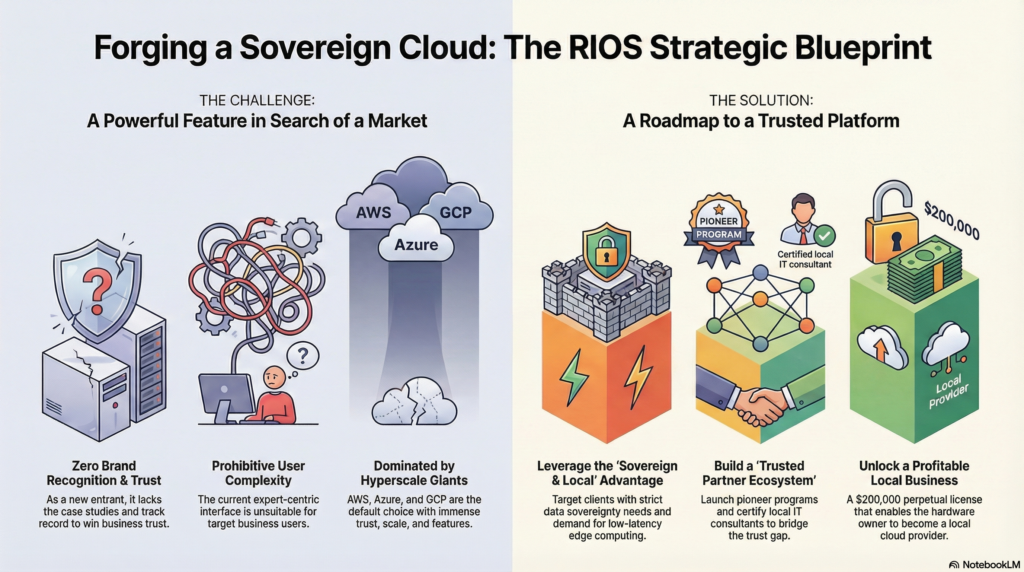
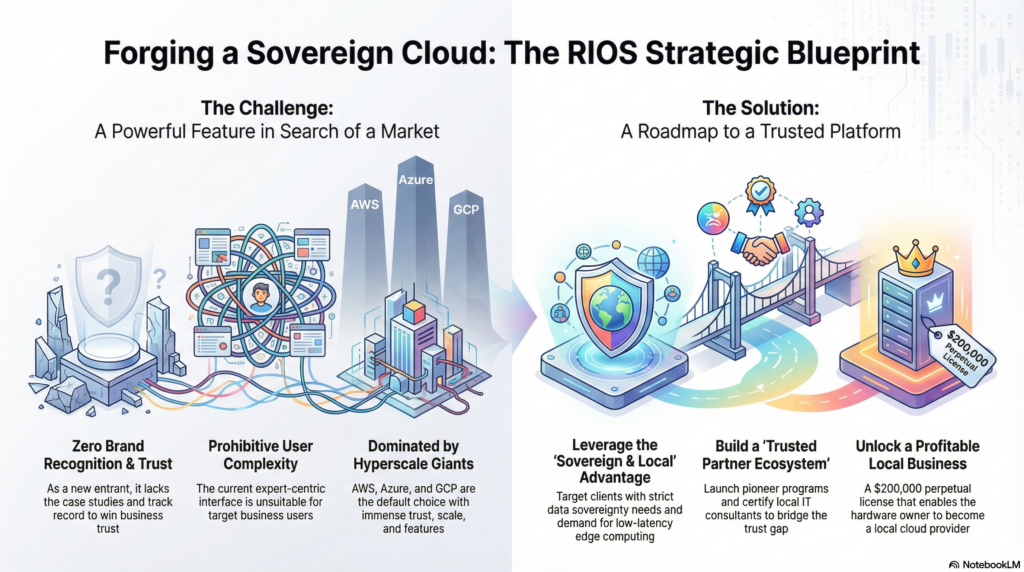
The RIOS Sovereign Cloud Suite is a perpetual software license (SKU: RIOS-SW-SCS-PERP) intrinsically tied to the RIOS-CC-1000 Core Compute Cluster. Its core function is to transform this hardware from a simple compute engine into a dual-mission, revenue-generating community asset, enabling the hardware owner to operate as a local cloud provider. Currently, the suite exists as a “Powerful Feature Set”—a technologically sound platform with IaaS, PaaS, and Secure Vault capabilities. However, its success hinges on transitioning to a “Trusted Cloud Platform” that is user-friendly, market-ready, and supported by a robust local ecosystem.

The primary gaps identified are not in the core technology but in User Experience, Market Trust, Feature Competitiveness, and the Partner Ecosystem. The strategic imperative is to leverage the suite’s unique strengths—its truly sovereign, local nature and perpetual license model—to capture a niche market focused on clients with data sovereignty and low-latency needs. This approach aims to build a defensible position against the existential threat posed by hyperscale providers (AWS, Azure, GCP) by competing on trust, local partnership, and community economic alignment rather than on features or price. With an estimated Cost of Goods Sold (COGS) of $95,550, a value-based Manufacturer’s Suggested Retail Price (MSRP) of $200,000 has been established, yielding a 52.2% gross margin and positioning the software as a core value proposition of the entire RIOS Campus Standard project.

——————————————————————————–

1. Product Definition and Value Proposition

Core Concept: A Declaration of Digital Independence

The RIOS Sovereign Cloud Suite is defined as a perpetual, pre-installed software license that unlocks the secondary mission of the RIOS-CC-1000 hardware: to serve as a community-owned cloud platform. It is framed as a tool to reclaim “digital territory” by reversing the cycle of capital flight and data export to distant hyperscale providers. The suite empowers local businesses, schools, and government agencies to host their data and applications locally, transforming the hardware into a revenue-generating asset for the community.

Unlocked Capabilities

The license activates a suite of integrated, enterprise-grade services managed through a single interface:

CapabilityDescription
Infrastructure-as-a-Service (IaaS)Your Virtual Data Center. Enables the provisioning and management of virtual machines directly on the RIOS-CC-1000. It is positioned as the ideal solution for local businesses to host websites, run accounting software, or migrate on-premise servers.
Platform-as-a-Service (PaaS)The Engine for Local Innovation. Provides a ready-to-use platform for developers to deploy, manage, and scale applications without managing the underlying infrastructure, fostering local tech development.
The Secure Data VaultYour Digital Fortress. An ultra-secure, compliant storage solution with end-to-end encryption, designed for sensitive data from sectors like healthcare (HIPAA), law, and municipal government, where physical data location is paramount.
Backup & Disaster Recovery (DR)Your Digital Insurance Policy. An integrated service for reliable, automated backups of local servers and workstations to the Secure Data Vault, ensuring rapid data recovery and operational continuity after a failure or cyberattack.

The Sovereign Advantage

The fundamental value proposition is built on four key advantages that differentiate it from global hyperscale providers:

  • Stop Capital Flight: IT spending remains within the local economy, contributing to the “Data Flywheel” that funds community infrastructure.
  • Ultra-Low Latency: Processing data locally provides a tangible performance advantage for real-time applications such as telehealth and smart manufacturing.
  • Enhanced Security & Compliance: The physical location of data is known and controlled, simplifying regulatory compliance (e.g., GDPR, data residency laws) and enhancing security.
  • Local Support & Partnership: The platform is supported by local RIOS Certified Technicians, offering a level of responsiveness and partnership that remote call centers cannot match.

——————————————————————————–

2. Market Positioning and Financials

Competitive Positioning

The RIOS Sovereign Cloud Suite is positioned as an enterprise-grade, private cloud operating system. It is not intended to compete directly with hyperscalers like AWS, Azure, and GCP on feature breadth or price. Instead, its primary competitors are established enterprise private cloud solutions from VMware (vSphere), Nutanix, and Red Hat (OpenShift). The key differentiator against these competitors is the perpetual license model, which offers true ownership and predictable long-term cost, in contrast to the recurring subscription fees that dominate the market.

Pricing Strategy

A value-based pricing model has been adopted, reflecting the immense value the suite unlocks for the RIOS Campus owner.

  • Value Propositions for Pricing:
    1. Enables a New Revenue Stream: Transforms the hardware into a business that can serve as a local cloud provider.
    2. Perpetual License Model: A one-time cost provides a powerful selling point of “true ownership.”
    3. Turnkey Solution: The pre-installed and integrated nature saves clients significant consulting and integration fees.
  • Target Gross Margin: 50-60% is targeted to cover significant ongoing R&D and support obligations. The calculation targets approximately 55%.

Financial Breakdown

The final retail price is a significant but justifiable component of the overall RIOS Campus Standard project cost.

Financial MetricValue (USD)Notes
Core R&D Amortization$85,000Represents a fraction of the IP development cost for the RIOS management layer, portal, and billing system.
Third-Party Software Licensing$10,000Potential costs for embedded commercial software components.
Fulfillment & Provisioning Labor$500Direct labor cost for license generation and provisioning.
Physical Badge Cost$50Cost of the premium “RIOS Ready” chassis badge.
Total Estimated COGS$95,550The total direct and amortized cost to deliver one license.
Calculation for Target Price$95,550 / (1 – 0.55)COGS / (1 – Target Margin %) ≈ $212,333
MSRP$200,000Manufacturer’s Suggested Retail Price.
Gross Profit per Unit$104,450MSRP – COGS
Gross Margin52.2%Gross Profit / MSRP

——————————————————————————–

3. GAP Analysis: Current State vs. Desired Future

The central objective is to evolve the RIOS Sovereign Cloud Suite from a “Powerful Feature Set” to a “Trusted Cloud Platform,” accelerating adoption and solidifying its market position. The analysis identifies critical gaps and recommends actions to bridge them.

Area/FunctionCurrent StateDesired Future StateIdentified Gaps & Recommended Actions
1. User Experience & OnboardingExpert-centric interface requiring an RCT-Expert to operate complex open-source tools (e.g., OpenStack).A business-friendly, self-service portal where a user with moderate technical skill can easily provision services.Gap: Prohibitive user complexity. <br> Action: Develop the “RIOS Cloud Command Portal,” a simplified, branded front-end that abstracts complexity with a clean UI/UX and wizard-based setups.
2. Market Trust & CredibilityAn unknown, unproven platform lacking brand recognition, case studies, or third-party security certifications (SOC 2, ISO 27001).A certified, trusted local provider with a portfolio of local success stories, testimonials, and industry-standard security certifications.Gap: Lack of market trust and social proof. <br> Action: Launch the “RIOS Cloud Pioneer Program” to incentivize early adopters and meticulously document their success. Simultaneously, begin the SOC 2 Type 1 certification process for third-party validation.
3. Feature Competitiveness & MarketplaceA core but limited feature set providing foundational primitives (IaaS, PaaS) but lacking a rich ecosystem of one-click applications.A curated “Local App Marketplace” within the portal for one-click deployment of pre-configured business applications (e.g., WordPress, Odoo ERP).Gap: Lack of a value-added software ecosystem. <br> Action: Develop and curate the Local App Marketplace by partnering with open-source communities to create a library of popular business applications, dramatically increasing the platform’s utility.
4. Local Partner & Support EcosystemSales, migration, and support are bottlenecked by a small number of highly skilled RCT-Experts.A thriving local partner network of certified “RIOS Cloud Partners” (IT consultants, MSPs) who actively sell and support the platform.Gap: Lack of a scalable sales and support channel. <br> Action: Create the “RIOS Cloud Partner” Certification, a specialized track within the DeReticular Academy to train local IT professionals to migrate businesses and build profitable MSP services on the platform.
5. Pricing & Billing ModelThe monetization model is undefined; the perpetual license is part of the hardware, but there is no mechanism for the Campus owner to bill end-users.A simple, transparent, pay-as-you-go billing system that automatically tracks resource usage and generates monthly invoices for end-users.Gap: No mechanism for the Campus owner to monetize the asset. <br> Action: Integrate a Cloud Billing & Metering Solution. Develop or license a multi-tenant billing platform, which is the final piece to transform the suite into a revenue-generating business.

——————————————————————————–

4. SWOT Analysis and Strategic Imperatives

This analysis focuses on the software license as a product to inform its roadmap, marketing, and risk mitigation strategies.

SWOT Matrix

Strengths (Internal, Positive)Weaknesses (Internal, Negative)
1. Truly Sovereign & Local: Unparalleled data control and compliance with data residency laws.1. Zero Brand Recognition & Trust: A massive barrier to entry as a new, unproven entrant.
2. Perpetual License Model: A powerful differentiator offering true ownership and predictable cost.2. Limited Feature Set: Cannot compete with the thousands of specialized services from hyperscalers.
3. Pre-installed & Turnkey: Eliminates the complexity, cost, and time of building a private cloud from scratch.3. Dependency on Specific Hardware: The addressable market is limited to owners of the RIOS-CC-1000.
4. Enables a Local Revenue Stream: A “business-in-a-box” for the Campus owner to stop capital flight.4. High Skill Requirement for Management: The underlying complex technologies require an RCT-Expert for effective maintenance.
Opportunities (External, Positive)Threats (External, Negative)
1. Data Sovereignty & Privacy Regulations: A massive global tailwind (e.g., GDPR) making local clouds a necessity.1. Dominance of Hyperscale Providers (AWS, Azure, GCP): The primary threat due to their brand trust, scale, and feature sets.
2. Demand for Low-Latency Edge Computing: Rise of IoT and real-time applications requires local processing power.2. Market Inertia & Perceived Risk: Enormous challenge in convincing businesses to migrate from trusted global platforms.
3. “Stop Capital Flight” & “Support Local” Narratives: Powerful economic and social marketing messages.3. Cybersecurity Threats: As a new platform, it’s a high-value target; a single breach could destroy its reputation permanently.
4. Growth of the Local MSP Ecosystem: A ready channel of IT consultants looking for new platforms to offer clients.4. Competition from Established Private Cloud Software: Established players like VMware and Nutanix have deep enterprise roots.

Strategic Recommendations

  • Attack (Strengths + Opportunities): Aggressively target clients with strict data sovereignty requirements, such as local healthcare clinics, law firms, and municipal governments. This leverages the core strength to capture the most immediate market opportunity.
  • Defend (Strengths + Threats): Differentiate from hyperscalers by doubling down on the “local” and “perpetual” narratives. Compete on trust, partnership, and economic alignment, not on price or features.
  • Develop (Weaknesses + Opportunities): Build a “RIOS Cloud Partner” program to overcome the trust deficit. By training and certifying local, trusted MSPs, their existing client relationships and credibility can bridge the trust gap.
  • Consolidate (Weaknesses + Threats): Prioritize security above all else. Invest heavily in foundational security certifications (e.g., SOC 2) to mitigate the threat of a reputation-destroying breach and directly address the weakness of low market trust.

——————————————————————————–

5. Product Fulfillment Details

The fulfillment of the Sovereign Cloud Suite license (RIOS-SW-SCS-PERP) includes a comprehensive set of digital, documentation, and physical deliverables.

Bill of Materials (BOM)

A. Digital Deliverables:

Item #QtyPart NameDescription
A-011Perpetual License KeyA unique, cryptographically signed key permanently tied to the RIOS-CC-1000’s hardware serial number.
A-021Pre-installed Software ImageThe complete, hardened, and pre-configured software stack flashed onto the cluster’s management nodes.
A-031Digital Certificate of AuthenticityA digitally signed PDF confirming the client’s perpetual license ownership and software authenticity.
A-041Access to the RIOS Software RepositorySecure credentials for accessing ongoing security patches and core software updates for the life of the hardware.

B. Documentation & Handover Package:

Item #QtyPart NameDescription
B-011Sovereign Cloud Suite Admin Guide (Digital)A comprehensive manual for the RIOS Certified Technician on platform architecture, management, and maintenance.
B-021Sovereign Cloud Suite User Guide (Digital)A simpler guide for end-users on how to use the “RIOS Cloud Command Portal.”

C. Physical Deliverables:

Item #QtyPart NameDescription
C-011“RIOS Ready” Chassis BadgeA premium, metallic badge affixed to the RIOS-CC-1000 rack, certifying it as a genuine, licensed Sovereign Cloud host.

The Sovereign Mandate A Blueprint for Local Economic and Infrastructural Resilience

Michael Noel · December 31, 2025 ·

banner image f
BizBuilderMike.com

1. The End of Centralization: Identifying the New Systemic Risks for Modern Communities

The modern global environment is defined by an increasing and often unpredictable fragility. The vast, centralized systems that once promised efficiency—sprawling power grids, continent-spanning supply chains, and monolithic data clouds—now represent critical single points of failure. For municipal governments, industrial developers, and local communities, this reliance on external systems poses a direct and growing threat to economic stability and self-determination. Understanding these new systemic risks is the first step toward building genuine resilience.

The primary vulnerabilities facing today’s communities can be distilled into three interconnected dependencies:

  • The Brittle Grid and Fragile Supply Chains The core philosophy of 20th-century infrastructure was the “Death of the Line”—a belief in linear, centralized utilities. This model is now dangerously outdated. In an era of escalating geopolitical instability, climate-driven disruptions, and volatile energy markets, relying on a distant power plant or a global supply chain is a strategic liability. A single disruption hundreds of miles away can paralyze a local economy, demonstrating that linear dependency is a blueprint for failure, not efficiency.
  • The “Digital Sharecropper” Economy For the last decade, the standard startup playbook has been a trap. Communities have outsourced their digital future to a handful of Big Tech cloud providers like Amazon Web Services (AWS) and Microsoft Azure. In doing so, they have become modern-day “digital sharecroppers,” trapped in a rent-seeking economy where they rent the very infrastructure that holds their most valuable asset: data. This arrangement creates profound economic and security risks as value is continuously extracted in the form of subscription fees, while critical data is stored on external servers, outside of local control and legal jurisdiction.
  • The Loss of Economic Self-Determination The cumulative effect of these energy and data dependencies is a fundamental loss of local economic sovereignty. When power, connectivity, and data processing are controlled by external entities, value—in the form of capital, intellectual property, and local talent—is siphoned out of the community rather than being recirculated within it. This economic leakage prevents the creation of a self-sustaining local ecosystem, leaving communities perpetually vulnerable to the decisions and failures of distant corporations and markets.

To counter these threats, communities must adopt a new strategic imperative: the pursuit of local sovereignty.

2. The Sovereignty Framework: Three Pillars of a Resilient Local Economy

Local sovereignty should not be mistaken for isolationism. It is a strategic capability that empowers a community to operate independently when necessary—a state referred to as “Island Mode”—while remaining connected to the global economy on its own terms. This framework for resilience is built upon three foundational pillars that work in concert to create a robust, self-sufficient, and prosperous local ecosystem.

Energy Independence

The first pillar is the ability to generate reliable, localized power. By leveraging advanced technologies like Agra Dot Energy’s Plasma Gasification, communities can convert local waste streams—from agricultural biomass to municipal refuse—into a consistent source of electricity and fuel. This model provides complete immunity to national grid blackouts and eliminates exposure to volatile global fuel prices, transforming a local liability (waste) into a strategic asset (power).

Data Sovereignty

As articulated in the strategic thesis, “The ‘Vault’ in the Cornfield,” the future of data security lies in localization. The second pillar involves “The Great Repatriation”—a deliberate migration of data from centralized hyperscaler clouds back to secure, locally owned and operated “Edge” nodes. By becoming the custodians of their own data, communities gain significant legal, security, and economic advantages. They control who accesses their information, ensure compliance with privacy regulations, and can monetize their data infrastructure directly.

Economic Self-Sufficiency

The final pillar integrates the first two into a self-funding economic engine known as the “Digital Flywheel.” This innovative model transforms traditional operational costs, such as power and compute, into revenue-generating assets. By using locally generated energy to power high-value compute services, a community creates a new, sustainable income stream. This revenue can then be used to pay for the initial infrastructure, fund public services, and stimulate further economic development, creating a virtuous cycle of local reinvestment.

This conceptual framework is enabled by a tangible and integrated technology platform designed to bring these pillars to life.

3. The RIOS Solution: An Operating System for the Sovereign Community

The Rural Infrastructure Operating System (RIOS) is the world’s first integrated platform engineered to implement the three pillars of sovereignty. It acts as the “Brain” of the ecosystem, orchestrating the physical hardware—power generation, connectivity, and compute—into a cohesive, intelligent, and profitable system. RIOS provides the blueprint and the control panel for building a modern, resilient local economy.

The core economic engine of the RIOS framework is the Digital Flywheel, a three-step process that creates a self-liquidating infrastructure asset:

  1. Generate Sovereign Power: The system integrates with power generation technologies like Agra Dot Energy’s plasma gasifiers. The RIOS Power Core 2X acts as the critical “translator” device, managing the energy handoff from the generator to the digital network.
  2. Convert Power to High-Value Compute: This verified power is then used to run the RIOS-CC-1000 Core Compute Cluster, a rack of high-performance servers that transforms raw electricity into high-value AI processing and data services.
  3. Monetize Compute as a Global Asset: The system automatically sells this “Green Compute” capability on the global market to clients needing to train AI models or process large datasets. This creates a direct revenue stream, with future tokenization of these Real World Assets (RWAs) set to enhance liquidity.

Underpinning the RIOS architecture is the “Velcro Principle,” a core design philosophy that creates value by tightly integrating disparate sectors. Instead of operating in silos, RIOS creates circular economies where the output of one system becomes the input for another. A prime example is the integration of heat and agriculture: Your AI servers produce massive heat. Don’t vent it—pipe it into a greenhouse to grow food year-round (The DAOSRUS / Agra model). This principle eliminates inefficiency, creates new economic opportunities, and strengthens the overall resilience of the community.

The RIOS software and economic model are delivered through a catalog of standardized, physical hardware packages.

4. The Sovereign Stack: Scalable Infrastructure for Immediate Deployment

The strategic pivot from bespoke, high-touch consultancy to a standardized product catalog is the solution to scaling this vision globally. The “Sovereign Stack” is a defined menu of solutions engineered to move beyond the bottleneck of custom engineering, making sovereign infrastructure accessible, predictable, and rapidly deployable. This product-based approach allows municipal and industrial developers to select the precise infrastructure needed to achieve their resilience goals.

The RIOS Campus infrastructure is available in four distinct tiers, designed for a range of use cases from emergency response to full-scale industrial development.

TierProduct NameTarget Use CaseDescription
Tier 1RIOS Pilot: ExpeditionaryDisaster Response, Scouting, Rapid Deployment“Infrastructure in a Suitcase.” A 3-case modular stack with Starlink bonding, Edge AI compute, and battery management. Ruggedized for travel.
Tier 2RIOS Pilot: StandardSmall Farms, Field Research StationsA 10ft shipping container micro-data center and field office, including basic solar and battery integration.
Tier 3RIOS Campus LiteRural Co-ops, Small VillagesThe entry-level village node. Includes an SD-WAN Gateway and mesh routers for robust community connectivity.
Tier 4RIOS Campus EnterpriseIndustrial Parks, “Digital Hamlets,” Smart CitiesThe full stack. Integrates the Agra Dot Energy SPS-1MW power system with massive AI compute clusters, capable of supporting a town of 500+ people.

The definitive proof-of-concept for the Tier 4 solution is detailed in the Kaabong Blueprint, released on August 31, 2025. This project outlines the development of a 7,000-acre hemp industrial park in the Karamoja sub-region of Uganda, fully powered by an Agra Dot Energy Plasma Gasification system. This deployment serves as a powerful demonstration that the RIOS Enterprise model can enable entire regions to leapfrog decades of traditional, centralized infrastructure development and achieve industrial sovereignty on an accelerated timeline.

At the other end of the spectrum, the system’s agility is showcased by the RIOS Pilot: Expeditionary (Tier 1). This $45,000 “Infrastructure in a Suitcase” fits critical communications, compute, and power management into three ruggedized cases. It is an essential tool for first responders, disaster relief agencies, and site scouting teams, proving that the Sovereign Stack is as modular and portable as it is powerful.

This productized approach provides the “what” of sovereignty; the implementation process provides the “how.”

5. Your Roadmap to Resilience: A Partnership for Implementation

Adopting this new model of infrastructure and economic development represents a significant strategic shift. It requires a new skill set and a new way of thinking about the relationship between energy, data, and local commerce. The RIOS ecosystem is designed not only to provide the technology but also to guide partners through this transition with structured support for planning and workforce development.

The path to adoption for a municipality or developer is clear and supported at every stage:

  • Strategic Blueprinting The critical first step is the Sovereign Strategy Session. This high-level engagement allows stakeholders to work directly with the system’s chief architects. In this session, a custom implementation plan is designed, tailored to the specific geography, resources, and economic goals of the community. This process ensures that the deployment of a RIOS campus is strategically sound and aligned with long-term objectives from day one.
  • Workforce Development Long-term resilience depends on local expertise. To solve the critical “Scalability Gap” and move beyond founder dependency, the DeReticular Academy was created. It is the ecosystem’s strategic solution for decentralizing knowledge, training a local workforce capable of operating and maintaining this advanced infrastructure. With certification tracks like the Sovereign Power Technician (SPT), RIOS Administrator, Node Operator (Level 1), and Sovereign Systems Architect (SSA), the Academy ensures that the expertise required to run a sovereign node is cultivated within the community itself, building lasting self-sufficiency and enabling global scale.

Embarking on the journey toward local sovereignty begins with a commitment to strategic planning and education. We invite you to begin this process by engaging with these foundational resources.

6. Conclusion: Architecting the Post-Centralized Future

In an increasingly unstable world, the pursuit of local sovereignty is no longer a luxury but a strategic necessity. The vulnerabilities of centralized power, data, and supply chains demand a new paradigm—one based on distributed, resilient, and self-determined local economies. The RIOS framework, delivered through the standardized Sovereign Stack, provides a proven, deployable, and economically viable blueprint for communities ready to reclaim their future. By transforming local liabilities into sovereign assets, this model empowers communities to achieve energy independence, data ownership, and lasting economic prosperity. The tools are available, the blueprint is defined, and the time is now to begin Building the New World, One Node at a Time.

DeReticular: A Team Building the Future, One Node at a Time

Michael Noel · December 31, 2025 ·

Introduction: What is a “Sovereign Node”?

DeReticular is an industrial company built on a single, powerful declaration: the old way of doing things is over. With a philosophy called “The Death of the Line,” it is actively rewiring the planet by making fragile, centralized infrastructure obsolete. Instead of relying on a single power line or a single road that can be easily broken, DeReticular designs and manufactures “Civilization in a Box”—circular, self-sufficient economies that thrive on their own.

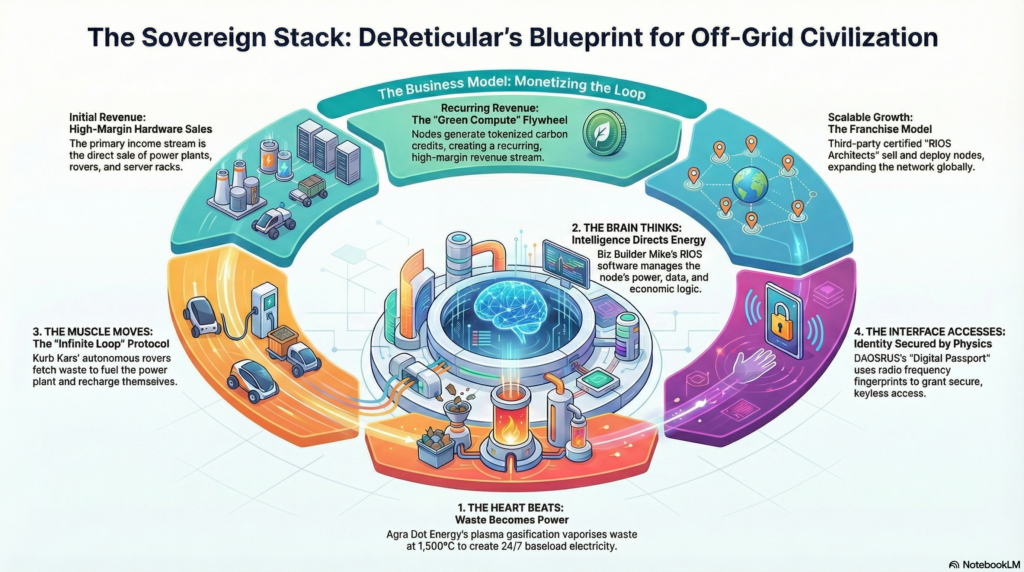
The company’s core product is the “Sovereign Node.” You can think of a Sovereign Node as a self-powered, self-sufficient “bubble” or “mini-city.” It’s designed to run completely on its own by turning local waste into power and using autonomous vehicles to do the work. This ability to operate independently is called “Island Mode.” While each node can stand alone, it is also connected to a global “Cognitive Mesh” of other nodes, sharing information and strengthening the entire system.

To achieve this ambitious goal, DeReticular isn’t just one company; it’s a team of four specialized divisions. Each division has a unique job, but they all work together in perfect sync, much like the different parts of a single, complex machine.

——————————————————————————–

1. The Four Pillars: Meet the DeReticular Team

1.1 Agra Dot Energy: The Heart of the Node

Agra Dot Energy is The Heart of the node, acting as a powerful engine that creates electricity from local resources.

What It DoesKey Technology It Uses
– Turns local waste into a constant supply of electricity, 24/7.<br>- Creates synthetic fuel, like diesel, from the gas produced during the process.<br>- Provides true “Baseload Power,” a constant 24/7 energy source that is not dependent on sun or wind.– Plasma Gasification: Uses super-hot ionized gas (over 1,500°C) to vaporize waste into its basic elements, creating a clean gas (Syngas) that generates electricity. The process is feedstock-agnostic, meaning it can use anything from hemp and tires to municipal solid waste and plastics.<br>- Micro-GTL Module: A special add-on that converts the Syngas from the plasma unit directly into liquid fuel.

With the system’s heart now beating steadily, that power must be translated into action by the node’s muscle.

1.2 Kurb Kars: The Muscle of the Node

Kurb Kars is The Muscle of the node, providing an autonomous fleet of vehicles that do the heavy lifting and logistics.

What It DoesKey Technology It Uses
– Autonomously moves physical goods—like food, medicine, or biomass for the power plant—around the node.<br>- Acts as a mobile security and defense network for the entire area.<br>-  – The Infinite Loop: The ability for a vehicle to automatically drive to an Agra power station and recharge itself without any human help.<br>- Radio Frequency Fingerprinting (RFF): A security system that uses the unique radio signal of a user’s device as an un-spoofable key, instead of a QR code or app.<br>- Distributed Listening Radio (DLR): A defense system where the fleet works together to detect threats like GPS jammers, turning a simple delivery service into a valuable security asset for the entire community.

While these vehicles provide the physical brawn, they are all controlled by a single, powerful software brain.

1.3 Biz Builder Mike: The Brain of the Node

Biz Builder Mike is The Brain of the node, providing the master software that manages and optimizes the entire system.

What It DoesKey Technology It Uses
– Manages all the energy and data flowing through the node to make sure nothing is wasted.<br>- Turns the node’s activities (like creating green energy) into digital assets that can be sold.<br>- Provides standardized, shelf-ready products, from the $45,000 “Infrastructure in a Suitcase” (RIOS Pilot: Expeditionary) to full industrial park deployments.– RIOS (Rural Infrastructure Operating System): The central operating system that connects all the hardware and makes decisions, similar to Windows or macOS for a computer.<br>- The “Digital Flywheel”: An economic engine built into RIOS. The system generates power, uses it for computing, creates a verifiable “Green Compute” credit, and sells it.<br>- zkVerify (The Carbon Oracle): A cryptographic tool that mathematically proves the node is creating carbon-negative energy, allowing it to mint valuable “Green Compute” credits.

This central brain controls the machines and the economy, but it needs a secure way to grant people permission to participate.

1.4 DAOSRUS: The Interface to the Node

DAOSRUS is The Interface of the node, managing who has access and giving the community a voice in its future.

What It DoesKey Technology It Uses
– Provides a secure and simple way for people to prove their identity and access things like Kurb Kars.<br>- Manages the “experience layer” of the ecosystem, including industrial tourism and community governance.– DAO (Decentralized Autonomous Organization): The company is structured like a club where members (called Sovereign Stewards) vote on important decisions, like where to build new nodes.<br>- The Digital Passport (RFF): Instead of a password or app, DAOSRUS uses Radio Frequency Fingerprinting to create a digital identity. It’s the “Master Key” for the entire ecosystem, built on the doctrine of “Physics over QR Codes” to be physically un-spoofable.

——————————————————————————–

2. How the Team Works Together: Building a Sovereign Node

  1. Start the Engine Agra Dot Energy (“The Heart”) kicks everything off. It takes a pile of local waste, like hemp from a nearby farm, and feeds it into its Plasma Gasification unit. This creates a steady, 24/7 stream of electricity for the entire node.
  2. The Brain Takes Over The RIOS software from Biz Builder Mike (“The Brain”) instantly sees this new power coming online. It acts as a traffic cop, deciding where the electricity is needed most. It might store some in batteries for later, use some to run high-powered computer servers, or send the rest to the vehicle charging stations.
  3. The Muscle Gets to Work A Kurb Kar “Mule” vehicle (“The Muscle”) receives an order from RIOS. It autonomously drives out to the fields to pick up another load of hemp biomass to feed the Agra power plant. When its battery gets low, it automatically follows the “Infinite Loop” protocol, driving itself back to a charging station powered by the very plant it helps supply.
  4. A Human Arrives A newly-certified Sovereign Power Technician (SPT) with permission to inspect the site arrives. As she approaches a Kurb Kar, the DAOSRUS “Digital Passport” system (“The Interface”) uses RFF technology to verify her identity from the unique radio signal of her device—no app or QR code needed. The vehicle’s door unlocks, granting her access.

The architecture is defined. The hardware is deployed. The network is listening. The Octagon is Live.

  • « Go to Previous Page
  • Page 1
  • Interim pages omitted …
  • Page 24
  • Page 25
  • Page 26
  • Page 27
  • Page 28
  • Interim pages omitted …
  • Page 55
  • Go to Next Page »

DeReticular

Copyright © 2026 · Monochrome Pro on Genesis Framework · WordPress · Log in