Unpacking RIOS Your Guide to Infrastructure in a Suitcase
Welcome to the world of the RIOS Pilot Expeditionary. Imagine being able to drop a complete, modern command center anywhere on Earth—a remote disaster zone, a new construction site, or a scientific outpost—and have it running in minutes. That’s the core idea behind RIOS. Think of it as “Infrastructure in a Suitcase” or a “Civilization Seed”: a system designed to bring power, internet, and advanced computing to places that have none, all packed into three rugged boxes.
1. The “Mission Stack”: Building Blocks of a Modern Outpost
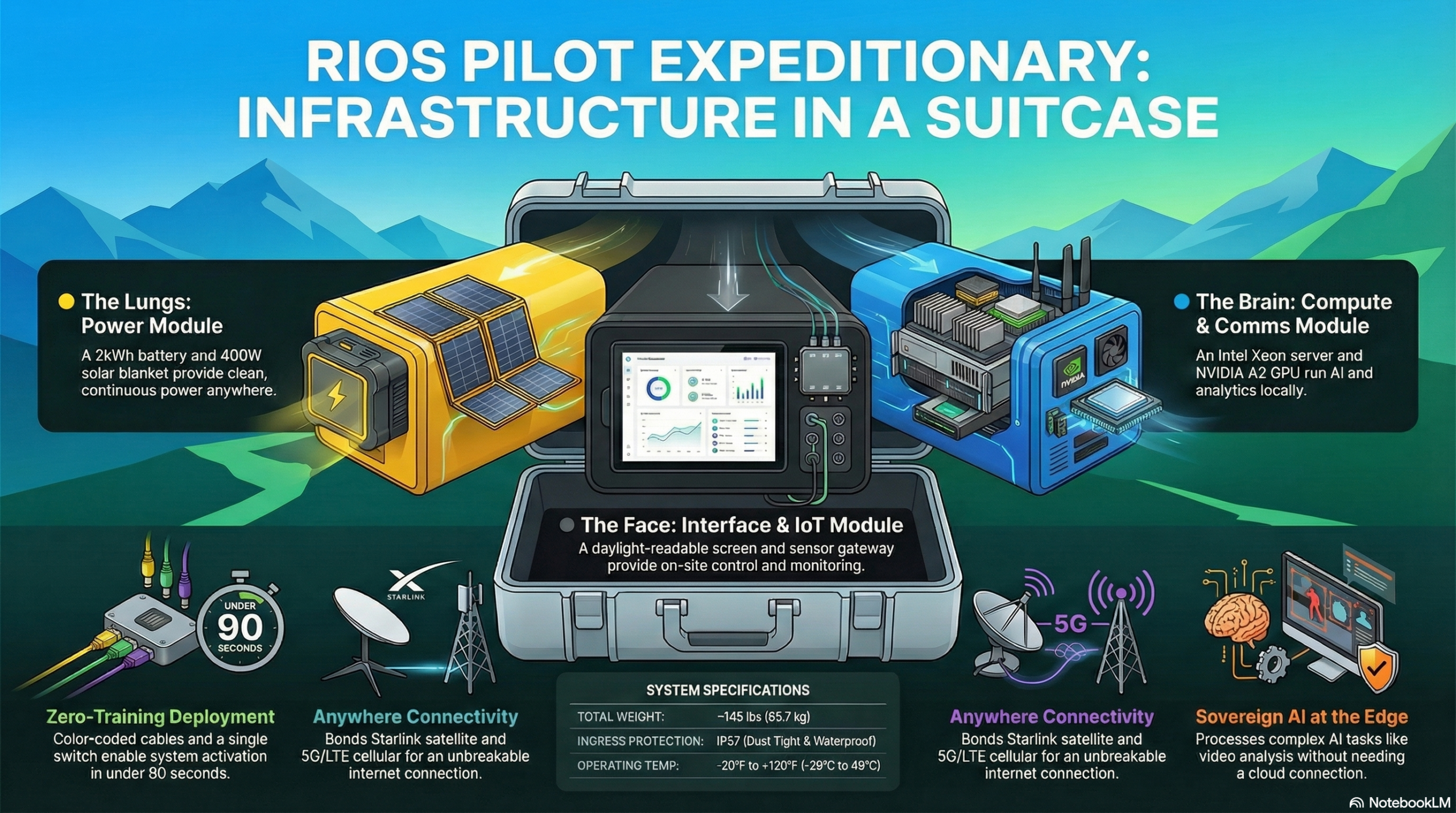
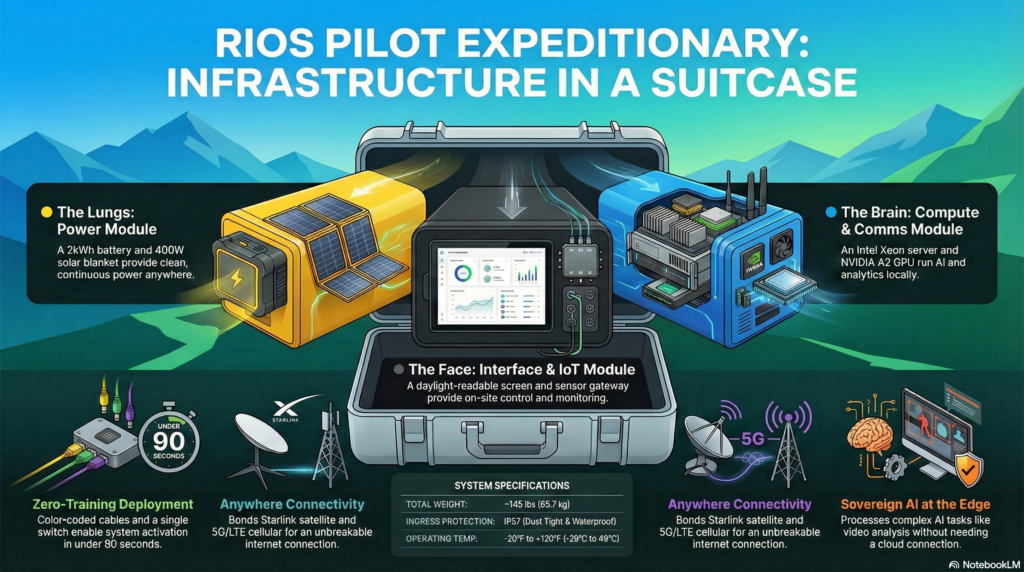
The RIOS system isn’t one single object but a modular “stack” of three color-coded cases that work together like a single organism. To make their functions intuitive, the system uses analogies for parts of the human body: the Lungs provide power, the Brain does the thinking, and the Face is how you interact with it. Crucially, the system is designed for a “Zero-Training” deployment, using color-coded cables and a single master switch to go from packed cases to a fully operational command center in under 90 seconds.
| Case (Analogy) | Core Purpose | Key Components Inside |
| 🟡 The Lungs (Power Module) | Provides the lifeblood for the entire system—clean, continuous, and independent energy. | <ul><li>400W Foldable “Blanket” Solar Array</li><li>2kWh LiFePO4 Battery</li></ul> |
| 🔵 The Brain (Compute & Comms Module) | Processes all data, runs the AI, and manages all communications with the outside world. | <ul><li>Intel Xeon D-Series Server</li><li>NVIDIA A2 AI Card</li><li>Starlink & 5G/LTE Bonding Router</li></ul> |
| ⚫ The Face (Interface & IoT Module) | Provides the hands-on control center, allowing an operator to see system output and interact with the software. | <ul><li>22″ Daylight Readable Screen</li><li>Weatherproof Keyboard & Trackball</li></ul> |
This modular “Mission Stack” is not just for organization; it’s critical for resilience. In a remote location, if one component fails, the affected case can be swapped out individually without having to send the entire system back for repair, ensuring the mission continues.
Now that we understand the physical building blocks, let’s explore the powerful ideas that this hardware brings to life.
2. Core Concept #1: Energy Independence (Powering a Dream)
Energy Independence is the system’s ability to “live on its own” without needing to be plugged into a wall outlet or refueled like a diesel generator. It’s the foundation that makes everything else possible.
The core problem RIOS solves is operating in remote places where reliable power simply doesn’t exist, such as a hurricane-stricken town or a new agricultural site. The solution is the Yellow Case, which acts like a giant, intelligent power bank for the whole system.
This solution has two key parts:
- Generation: The system comes with a 400W foldable “blanket” solar array. This is how the system “eats” sunlight to make its own electricity. It’s a clean, silent, and limitless source of energy as long as the sun is shining.
- Storage: Inside the Yellow Case is a 2kWh LiFePO4 battery. This is how the system “saves” that solar energy to continue working through the night or on cloudy days, decoupling the sensitive electronics from unreliable power sources.
The main benefit for the user is simple but profound: you can run high-tech equipment anywhere the sun shines, completely off-grid and self-sufficiently.
With its own power source secured, RIOS can run its most important tool: its own brain for thinking on the spot.
3. Core Concept #2: Edge AI (A Brain in the Field)
Edge AI is a term that sounds complex, but the core idea is simple. “The edge” just means “right here, on location”—as opposed to sending your data to a distant cloud server for processing.
Think about how a service like Google Photos works. To identify faces or objects in your pictures, you must first upload them to Google’s powerful servers. This requires a strong and stable internet connection.
RIOS, with its powerful NVIDIA A2 GPU inside the Blue Case, does all the thinking locally. It’s like having the supercomputer with you instead of thousands of miles away. This “on-site” intelligence provides three massive advantages:
- Speed: You get answers instantly, without waiting for slow uploads or downloads. The system can process over 12 simultaneous streams of HD video for object detection in real-time.
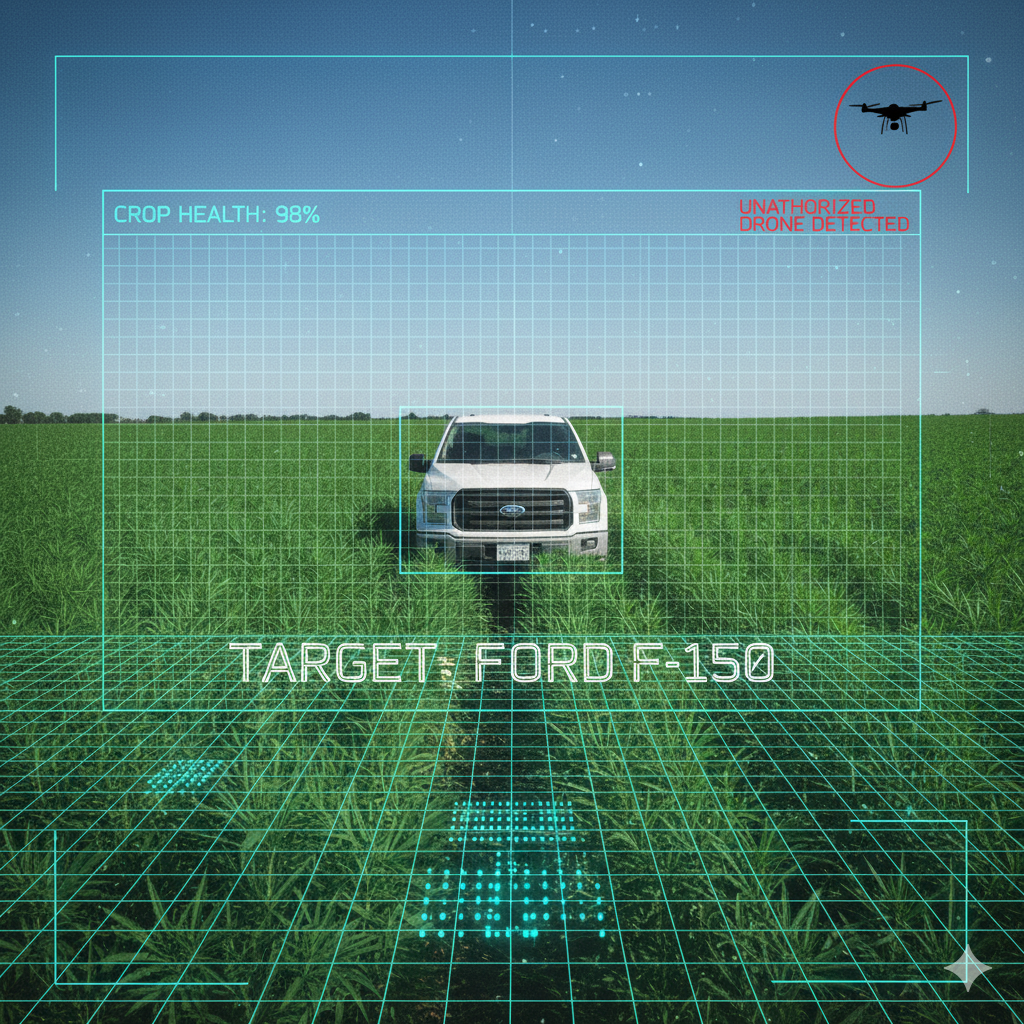
- Privacy: Sensitive data never has to leave the device. For example, you can monitor a construction site or mine perimeter using AI computer vision to detect intruders without needing a generator or guard shack, and the footage remains completely secure.
- Offline Capability: The system’s AI works even if the internet goes down. This is critical for tasks like analyzing drone maps for agriculture (Agro-Scouting) in a field with zero cell signal.
By combining its own power with its own intelligence, RIOS achieves the final goal: creating a completely self-reliant, private digital world.
4. Core Concept #3: Sovereign Infrastructure (Your Own Private Cloud)
Sovereign Infrastructure is about independence and self-governance. The word “sovereign” simply means that you are in control, not a third party.
This concept solves a major problem in the modern world: dependency. Most operations depend on big tech companies for cloud services and on unreliable local infrastructure for power and internet. RIOS provides a complete, private “stack” of infrastructure that the user owns and controls completely.
This “Before vs. After” table makes the difference clear:
| Feature | Typical Setup (Dependent) | RIOS Setup (Sovereign) |
| Power | Relies on the local grid (unstable, prone to outages) or diesel generators (noisy, requires refueling). | Generates its own power from the sun. |
| Internet | Depends on local cell towers or cable providers (unreliable, can be censored or congested). | Creates its own link to the internet via Starlink satellite. |
| Local Network | Depends on available routers and switches. | Creates a secure Wi-Fi bubble, provides PoE+ ports for cameras, and broadcasts a long-range IoT mesh network. |
| Computing | Sends data to a public cloud for analysis (high latency, privacy risks, requires constant connection). | Processes all data locally using its onboard AI. |
In short, “Sovereign Infrastructure” means you control your power, your internet connection, and your data, no matter where you are in the world.
Putting all these pieces together reveals why RIOS is more than just a box of electronics.
5. Conclusion: Why It Matters
By integrating Energy Independence, Edge AI, and Sovereign Infrastructure, RIOS delivers a new reality. It means a disaster response team in a hurricane-stricken town can establish a command post in minutes, using local AI to register victims and coordinate aid, all while the local power grid and cell towers are completely down. Its solar panels provide Energy Independence to run lifesaving equipment. Its local Edge AI analyzes drone footage to find survivors without needing an internet connection. Its Sovereign Infrastructure creates a communications hub for first responders when nothing else works.
It’s not just a box of tech; it’s the “Civilization Seed” that allows communities to begin rebuilding from day one. This is the power to build, create, analyze, and respond in places that were previously out of reach, unlocking a more connected and resilient future.