DeReticular: A Team Building the Future, One Node at a Time
Introduction: What is a “Sovereign Node”?
DeReticular is an industrial company built on a single, powerful declaration: the old way of doing things is over. With a philosophy called “The Death of the Line,” it is actively rewiring the planet by making fragile, centralized infrastructure obsolete. Instead of relying on a single power line or a single road that can be easily broken, DeReticular designs and manufactures “Civilization in a Box”—circular, self-sufficient economies that thrive on their own.
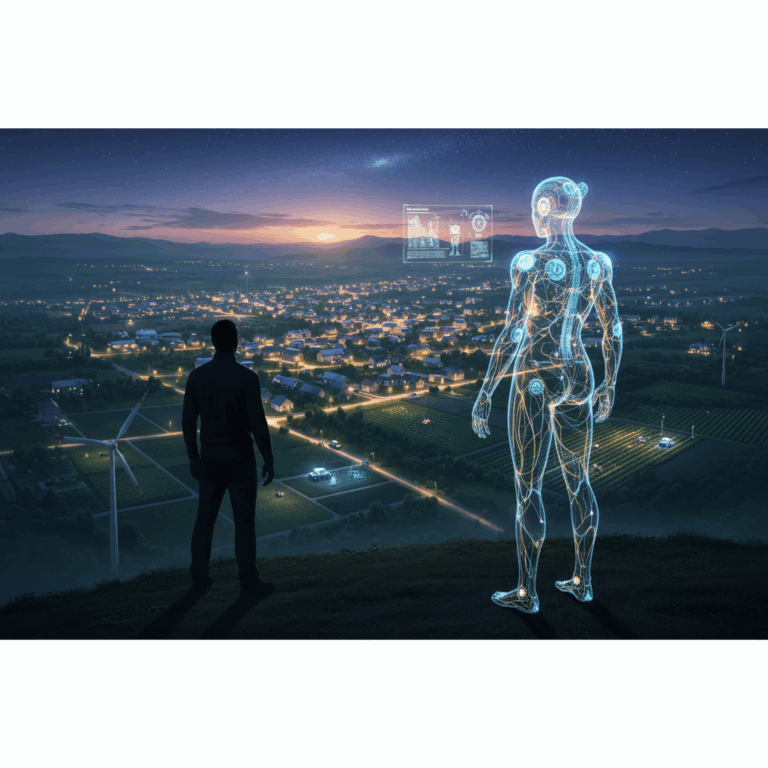
The company’s core product is the “Sovereign Node.” You can think of a Sovereign Node as a self-powered, self-sufficient “bubble” or “mini-city.” It’s designed to run completely on its own by turning local waste into power and using autonomous vehicles to do the work. This ability to operate independently is called “Island Mode.” While each node can stand alone, it is also connected to a global “Cognitive Mesh” of other nodes, sharing information and strengthening the entire system.
To achieve this ambitious goal, DeReticular isn’t just one company; it’s a team of four specialized divisions. Each division has a unique job, but they all work together in perfect sync, much like the different parts of a single, complex machine.
——————————————————————————–
1. The Four Pillars: Meet the DeReticular Team
1.1 Agra Dot Energy: The Heart of the Node
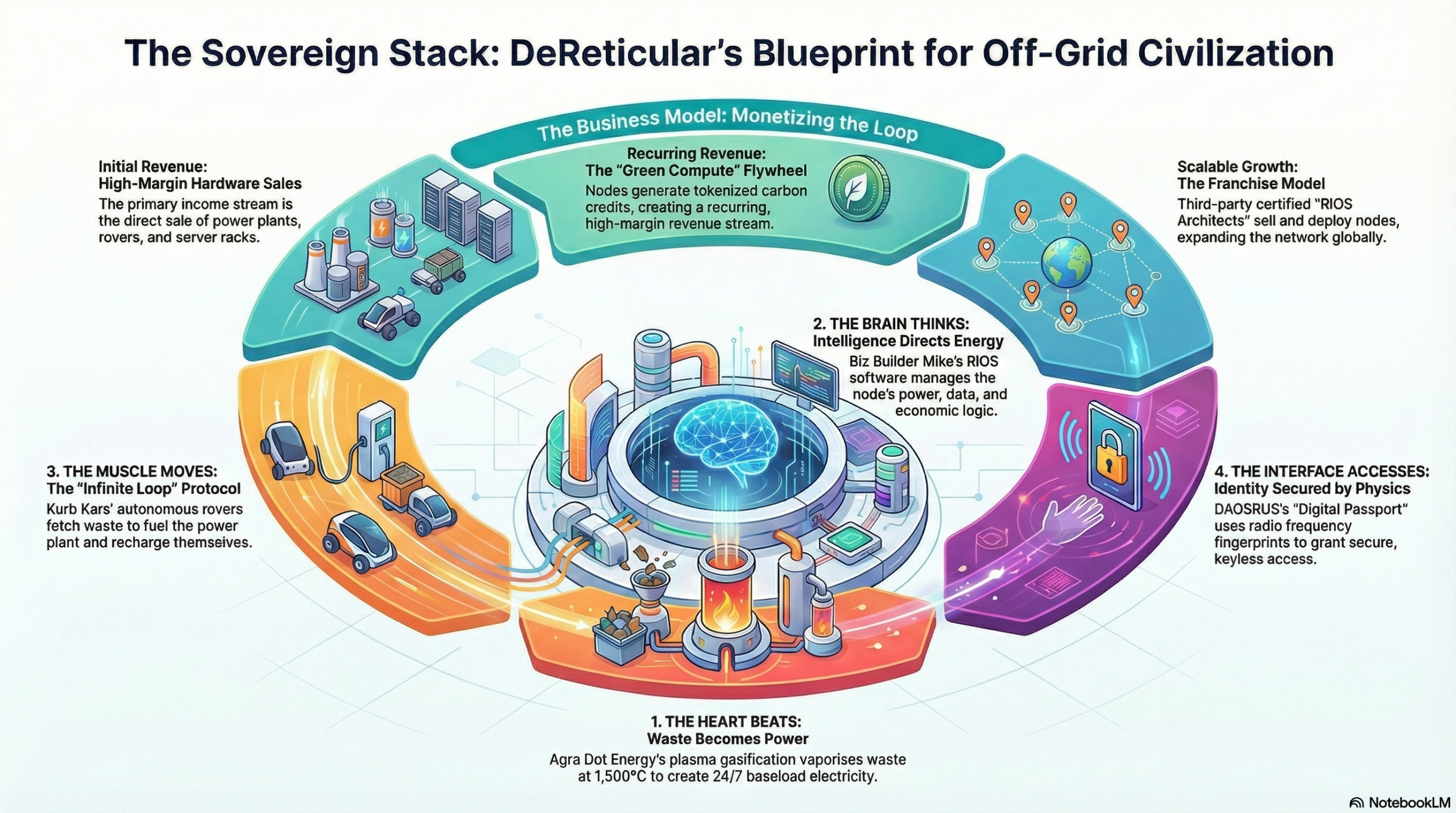
Agra Dot Energy is The Heart of the node, acting as a powerful engine that creates electricity from local resources.
| What It Does | Key Technology It Uses |
| – Turns local waste into a constant supply of electricity, 24/7.<br>- Creates synthetic fuel, like diesel, from the gas produced during the process.<br>- Provides true “Baseload Power,” a constant 24/7 energy source that is not dependent on sun or wind. | – Plasma Gasification: Uses super-hot ionized gas (over 1,500°C) to vaporize waste into its basic elements, creating a clean gas (Syngas) that generates electricity. The process is feedstock-agnostic, meaning it can use anything from hemp and tires to municipal solid waste and plastics.<br>- Micro-GTL Module: A special add-on that converts the Syngas from the plasma unit directly into liquid fuel. |
With the system’s heart now beating steadily, that power must be translated into action by the node’s muscle.
1.2 Kurb Kars: The Muscle of the Node
Kurb Kars is The Muscle of the node, providing an autonomous fleet of vehicles that do the heavy lifting and logistics.
| What It Does | Key Technology It Uses |
| – Autonomously moves physical goods—like food, medicine, or biomass for the power plant—around the node.<br>- Acts as a mobile security and defense network for the entire area.<br>- | – The Infinite Loop: The ability for a vehicle to automatically drive to an Agra power station and recharge itself without any human help.<br>- Radio Frequency Fingerprinting (RFF): A security system that uses the unique radio signal of a user’s device as an un-spoofable key, instead of a QR code or app.<br>- Distributed Listening Radio (DLR): A defense system where the fleet works together to detect threats like GPS jammers, turning a simple delivery service into a valuable security asset for the entire community. |
While these vehicles provide the physical brawn, they are all controlled by a single, powerful software brain.
1.3 Biz Builder Mike: The Brain of the Node
Biz Builder Mike is The Brain of the node, providing the master software that manages and optimizes the entire system.
| What It Does | Key Technology It Uses |
| – Manages all the energy and data flowing through the node to make sure nothing is wasted.<br>- Turns the node’s activities (like creating green energy) into digital assets that can be sold.<br>- Provides standardized, shelf-ready products, from the $45,000 “Infrastructure in a Suitcase” (RIOS Pilot: Expeditionary) to full industrial park deployments. | – RIOS (Rural Infrastructure Operating System): The central operating system that connects all the hardware and makes decisions, similar to Windows or macOS for a computer.<br>- The “Digital Flywheel”: An economic engine built into RIOS. The system generates power, uses it for computing, creates a verifiable “Green Compute” credit, and sells it.<br>- zkVerify (The Carbon Oracle): A cryptographic tool that mathematically proves the node is creating carbon-negative energy, allowing it to mint valuable “Green Compute” credits. |
This central brain controls the machines and the economy, but it needs a secure way to grant people permission to participate.
1.4 DAOSRUS: The Interface to the Node
DAOSRUS is The Interface of the node, managing who has access and giving the community a voice in its future.
| What It Does | Key Technology It Uses |
| – Provides a secure and simple way for people to prove their identity and access things like Kurb Kars.<br>- Manages the “experience layer” of the ecosystem, including industrial tourism and community governance. | – DAO (Decentralized Autonomous Organization): The company is structured like a club where members (called Sovereign Stewards) vote on important decisions, like where to build new nodes.<br>- The Digital Passport (RFF): Instead of a password or app, DAOSRUS uses Radio Frequency Fingerprinting to create a digital identity. It’s the “Master Key” for the entire ecosystem, built on the doctrine of “Physics over QR Codes” to be physically un-spoofable. |
——————————————————————————–
2. How the Team Works Together: Building a Sovereign Node
- Start the Engine Agra Dot Energy (“The Heart”) kicks everything off. It takes a pile of local waste, like hemp from a nearby farm, and feeds it into its Plasma Gasification unit. This creates a steady, 24/7 stream of electricity for the entire node.
- The Brain Takes Over The RIOS software from Biz Builder Mike (“The Brain”) instantly sees this new power coming online. It acts as a traffic cop, deciding where the electricity is needed most. It might store some in batteries for later, use some to run high-powered computer servers, or send the rest to the vehicle charging stations.
- The Muscle Gets to Work A Kurb Kar “Mule” vehicle (“The Muscle”) receives an order from RIOS. It autonomously drives out to the fields to pick up another load of hemp biomass to feed the Agra power plant. When its battery gets low, it automatically follows the “Infinite Loop” protocol, driving itself back to a charging station powered by the very plant it helps supply.
- A Human Arrives A newly-certified Sovereign Power Technician (SPT) with permission to inspect the site arrives. As she approaches a Kurb Kar, the DAOSRUS “Digital Passport” system (“The Interface”) uses RFF technology to verify her identity from the unique radio signal of her device—no app or QR code needed. The vehicle’s door unlocks, granting her access.
The architecture is defined. The hardware is deployed. The network is listening. The Octagon is Live.