The Sovereign Mandate A Blueprint for Local Economic and Infrastructural Resilience
1. The End of Centralization: Identifying the New Systemic Risks for Modern Communities
The modern global environment is defined by an increasing and often unpredictable fragility. The vast, centralized systems that once promised efficiency—sprawling power grids, continent-spanning supply chains, and monolithic data clouds—now represent critical single points of failure. For municipal governments, industrial developers, and local communities, this reliance on external systems poses a direct and growing threat to economic stability and self-determination. Understanding these new systemic risks is the first step toward building genuine resilience.
The primary vulnerabilities facing today’s communities can be distilled into three interconnected dependencies:
- The Brittle Grid and Fragile Supply Chains The core philosophy of 20th-century infrastructure was the “Death of the Line”—a belief in linear, centralized utilities. This model is now dangerously outdated. In an era of escalating geopolitical instability, climate-driven disruptions, and volatile energy markets, relying on a distant power plant or a global supply chain is a strategic liability. A single disruption hundreds of miles away can paralyze a local economy, demonstrating that linear dependency is a blueprint for failure, not efficiency.
- The “Digital Sharecropper” Economy For the last decade, the standard startup playbook has been a trap. Communities have outsourced their digital future to a handful of Big Tech cloud providers like Amazon Web Services (AWS) and Microsoft Azure. In doing so, they have become modern-day “digital sharecroppers,” trapped in a rent-seeking economy where they rent the very infrastructure that holds their most valuable asset: data. This arrangement creates profound economic and security risks as value is continuously extracted in the form of subscription fees, while critical data is stored on external servers, outside of local control and legal jurisdiction.
- The Loss of Economic Self-Determination The cumulative effect of these energy and data dependencies is a fundamental loss of local economic sovereignty. When power, connectivity, and data processing are controlled by external entities, value—in the form of capital, intellectual property, and local talent—is siphoned out of the community rather than being recirculated within it. This economic leakage prevents the creation of a self-sustaining local ecosystem, leaving communities perpetually vulnerable to the decisions and failures of distant corporations and markets.
To counter these threats, communities must adopt a new strategic imperative: the pursuit of local sovereignty.
2. The Sovereignty Framework: Three Pillars of a Resilient Local Economy
Local sovereignty should not be mistaken for isolationism. It is a strategic capability that empowers a community to operate independently when necessary—a state referred to as “Island Mode”—while remaining connected to the global economy on its own terms. This framework for resilience is built upon three foundational pillars that work in concert to create a robust, self-sufficient, and prosperous local ecosystem.
Energy Independence
The first pillar is the ability to generate reliable, localized power. By leveraging advanced technologies like Agra Dot Energy’s Plasma Gasification, communities can convert local waste streams—from agricultural biomass to municipal refuse—into a consistent source of electricity and fuel. This model provides complete immunity to national grid blackouts and eliminates exposure to volatile global fuel prices, transforming a local liability (waste) into a strategic asset (power).
Data Sovereignty
As articulated in the strategic thesis, “The ‘Vault’ in the Cornfield,” the future of data security lies in localization. The second pillar involves “The Great Repatriation”—a deliberate migration of data from centralized hyperscaler clouds back to secure, locally owned and operated “Edge” nodes. By becoming the custodians of their own data, communities gain significant legal, security, and economic advantages. They control who accesses their information, ensure compliance with privacy regulations, and can monetize their data infrastructure directly.
Economic Self-Sufficiency
The final pillar integrates the first two into a self-funding economic engine known as the “Digital Flywheel.” This innovative model transforms traditional operational costs, such as power and compute, into revenue-generating assets. By using locally generated energy to power high-value compute services, a community creates a new, sustainable income stream. This revenue can then be used to pay for the initial infrastructure, fund public services, and stimulate further economic development, creating a virtuous cycle of local reinvestment.
This conceptual framework is enabled by a tangible and integrated technology platform designed to bring these pillars to life.
3. The RIOS Solution: An Operating System for the Sovereign Community
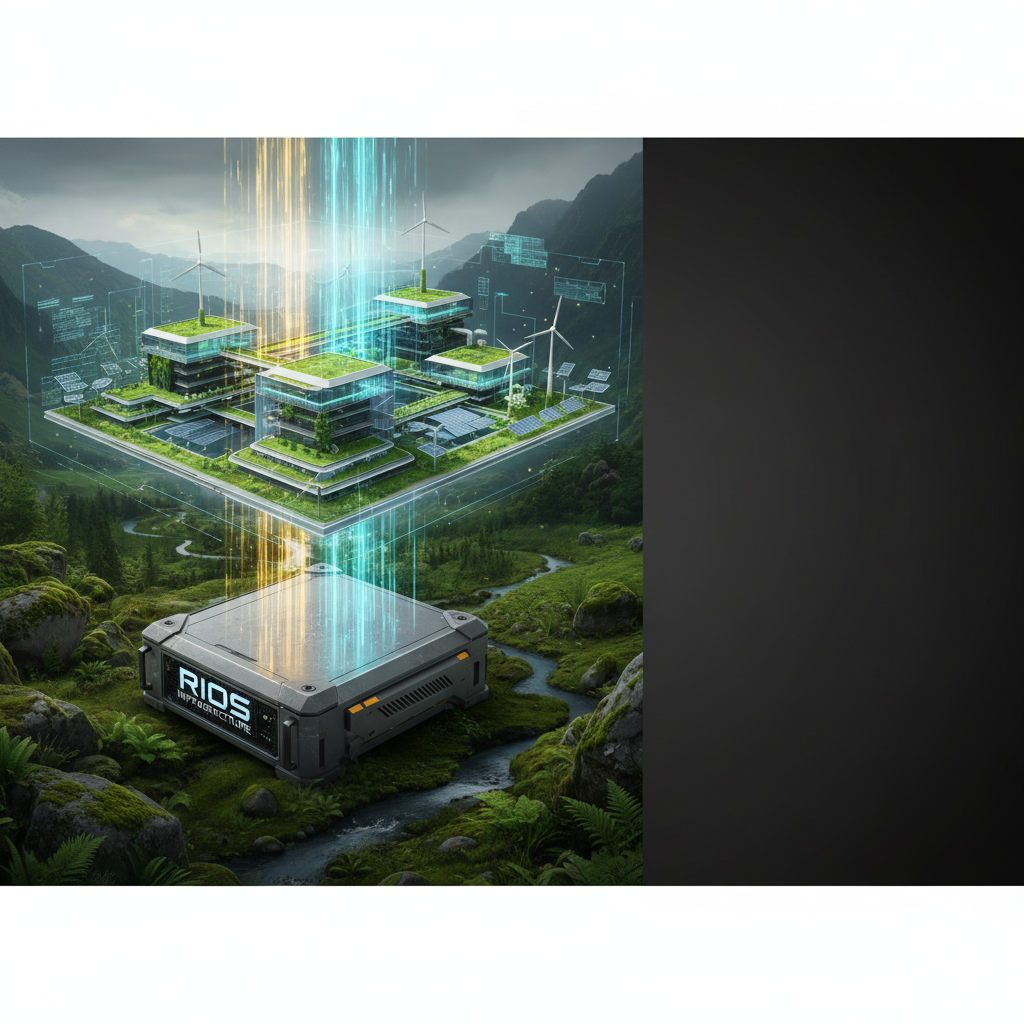
The Rural Infrastructure Operating System (RIOS) is the world’s first integrated platform engineered to implement the three pillars of sovereignty. It acts as the “Brain” of the ecosystem, orchestrating the physical hardware—power generation, connectivity, and compute—into a cohesive, intelligent, and profitable system. RIOS provides the blueprint and the control panel for building a modern, resilient local economy.
The core economic engine of the RIOS framework is the Digital Flywheel, a three-step process that creates a self-liquidating infrastructure asset:
- Generate Sovereign Power: The system integrates with power generation technologies like Agra Dot Energy’s plasma gasifiers. The RIOS Power Core 2X acts as the critical “translator” device, managing the energy handoff from the generator to the digital network.
- Convert Power to High-Value Compute: This verified power is then used to run the RIOS-CC-1000 Core Compute Cluster, a rack of high-performance servers that transforms raw electricity into high-value AI processing and data services.
- Monetize Compute as a Global Asset: The system automatically sells this “Green Compute” capability on the global market to clients needing to train AI models or process large datasets. This creates a direct revenue stream, with future tokenization of these Real World Assets (RWAs) set to enhance liquidity.
Underpinning the RIOS architecture is the “Velcro Principle,” a core design philosophy that creates value by tightly integrating disparate sectors. Instead of operating in silos, RIOS creates circular economies where the output of one system becomes the input for another. A prime example is the integration of heat and agriculture: Your AI servers produce massive heat. Don’t vent it—pipe it into a greenhouse to grow food year-round (The DAOSRUS / Agra model). This principle eliminates inefficiency, creates new economic opportunities, and strengthens the overall resilience of the community.
The RIOS software and economic model are delivered through a catalog of standardized, physical hardware packages.
4. The Sovereign Stack: Scalable Infrastructure for Immediate Deployment
The strategic pivot from bespoke, high-touch consultancy to a standardized product catalog is the solution to scaling this vision globally. The “Sovereign Stack” is a defined menu of solutions engineered to move beyond the bottleneck of custom engineering, making sovereign infrastructure accessible, predictable, and rapidly deployable. This product-based approach allows municipal and industrial developers to select the precise infrastructure needed to achieve their resilience goals.
The RIOS Campus infrastructure is available in four distinct tiers, designed for a range of use cases from emergency response to full-scale industrial development.
| Tier | Product Name | Target Use Case | Description |
| Tier 1 | RIOS Pilot: Expeditionary | Disaster Response, Scouting, Rapid Deployment | “Infrastructure in a Suitcase.” A 3-case modular stack with Starlink bonding, Edge AI compute, and battery management. Ruggedized for travel. |
| Tier 2 | RIOS Pilot: Standard | Small Farms, Field Research Stations | A 10ft shipping container micro-data center and field office, including basic solar and battery integration. |
| Tier 3 | RIOS Campus Lite | Rural Co-ops, Small Villages | The entry-level village node. Includes an SD-WAN Gateway and mesh routers for robust community connectivity. |
| Tier 4 | RIOS Campus Enterprise | Industrial Parks, “Digital Hamlets,” Smart Cities | The full stack. Integrates the Agra Dot Energy SPS-1MW power system with massive AI compute clusters, capable of supporting a town of 500+ people. |
The definitive proof-of-concept for the Tier 4 solution is detailed in the Kaabong Blueprint, released on August 31, 2025. This project outlines the development of a 7,000-acre hemp industrial park in the Karamoja sub-region of Uganda, fully powered by an Agra Dot Energy Plasma Gasification system. This deployment serves as a powerful demonstration that the RIOS Enterprise model can enable entire regions to leapfrog decades of traditional, centralized infrastructure development and achieve industrial sovereignty on an accelerated timeline.
At the other end of the spectrum, the system’s agility is showcased by the RIOS Pilot: Expeditionary (Tier 1). This $45,000 “Infrastructure in a Suitcase” fits critical communications, compute, and power management into three ruggedized cases. It is an essential tool for first responders, disaster relief agencies, and site scouting teams, proving that the Sovereign Stack is as modular and portable as it is powerful.
This productized approach provides the “what” of sovereignty; the implementation process provides the “how.”
5. Your Roadmap to Resilience: A Partnership for Implementation
Adopting this new model of infrastructure and economic development represents a significant strategic shift. It requires a new skill set and a new way of thinking about the relationship between energy, data, and local commerce. The RIOS ecosystem is designed not only to provide the technology but also to guide partners through this transition with structured support for planning and workforce development.
The path to adoption for a municipality or developer is clear and supported at every stage:
- Strategic Blueprinting The critical first step is the Sovereign Strategy Session. This high-level engagement allows stakeholders to work directly with the system’s chief architects. In this session, a custom implementation plan is designed, tailored to the specific geography, resources, and economic goals of the community. This process ensures that the deployment of a RIOS campus is strategically sound and aligned with long-term objectives from day one.
- Workforce Development Long-term resilience depends on local expertise. To solve the critical “Scalability Gap” and move beyond founder dependency, the DeReticular Academy was created. It is the ecosystem’s strategic solution for decentralizing knowledge, training a local workforce capable of operating and maintaining this advanced infrastructure. With certification tracks like the Sovereign Power Technician (SPT), RIOS Administrator, Node Operator (Level 1), and Sovereign Systems Architect (SSA), the Academy ensures that the expertise required to run a sovereign node is cultivated within the community itself, building lasting self-sufficiency and enabling global scale.
Embarking on the journey toward local sovereignty begins with a commitment to strategic planning and education. We invite you to begin this process by engaging with these foundational resources.
6. Conclusion: Architecting the Post-Centralized Future
In an increasingly unstable world, the pursuit of local sovereignty is no longer a luxury but a strategic necessity. The vulnerabilities of centralized power, data, and supply chains demand a new paradigm—one based on distributed, resilient, and self-determined local economies. The RIOS framework, delivered through the standardized Sovereign Stack, provides a proven, deployable, and economically viable blueprint for communities ready to reclaim their future. By transforming local liabilities into sovereign assets, this model empowers communities to achieve energy independence, data ownership, and lasting economic prosperity. The tools are available, the blueprint is defined, and the time is now to begin Building the New World, One Node at a Time.