• Skip to primary navigation
  • Skip to main content
DeReticular

DeReticular

Local Autonomy. National Security. Total Sovereignty.

  • Solutions
    • Municipalities
    • Energy
    • Industrial
    • Defense
  • Infrastructure
  • Intelligence
  • Company
  • Request Municipal Audit
  • Show Search
Hide Search
You are here: Home / Archives for DeReticular

DeReticular

The Great Repatriation: Why Agentic AI is Demanding a New Home

Michael Noel · December 12, 2025 ·


As AI moves from “chatbot” to “workforce,” the centralized cloud is becoming too loud, too expensive, and too fragile. Here is why the future of AI is running on bare metal, at the edge, on RIOS.

By The DeReticular Team

We have spent the last decade in a massive migration. Businesses moved everything—data, apps, logic—into the “Cloud.” We treated the Hyperscalers (AWS, Azure, Google) like utility companies, assuming that bigger always meant better.

But the winds are shifting.

According to Richard Copeland, CEO of Leaseweb USA, 2026 marks a turning point. He predicts a massive wave of “Cloud Repatriation”—companies pulling their workloads out of the giant public clouds and bringing them back to regional, bare-metal environments.

Why? Because Agentic AI has arrived. And Agentic AI refuses to live in a crowded apartment.


The Shift: From Tool to Agent

To understand why the infrastructure must change, we must understand how the software is changing.

Copeland puts it perfectly:

“In 2026, agentic AI starts replacing full workflows… The real impact isn’t that AI replaces jobs, but that it replaces the tasks people shouldn’t be doing in the first place.”

We aren’t talking about ChatGPT writing a poem anymore. We are talking about Agentic AI—autonomous agents that manage supply chains, optimize energy grids, monitor crop health, and execute financial trades without human hand-holding.

When AI becomes “Agentic,” it ceases to be a novelty and becomes Mission Critical.

  • If a chatbot lags, you get annoyed.
  • If an Agentic AI managing a power grid lags, the lights go out.

This shift has exposed the fatal flaw of the centralized cloud: The Noisy Neighbor.

The Problem: The “Noisy Neighbor” and the Hyperscale Trap

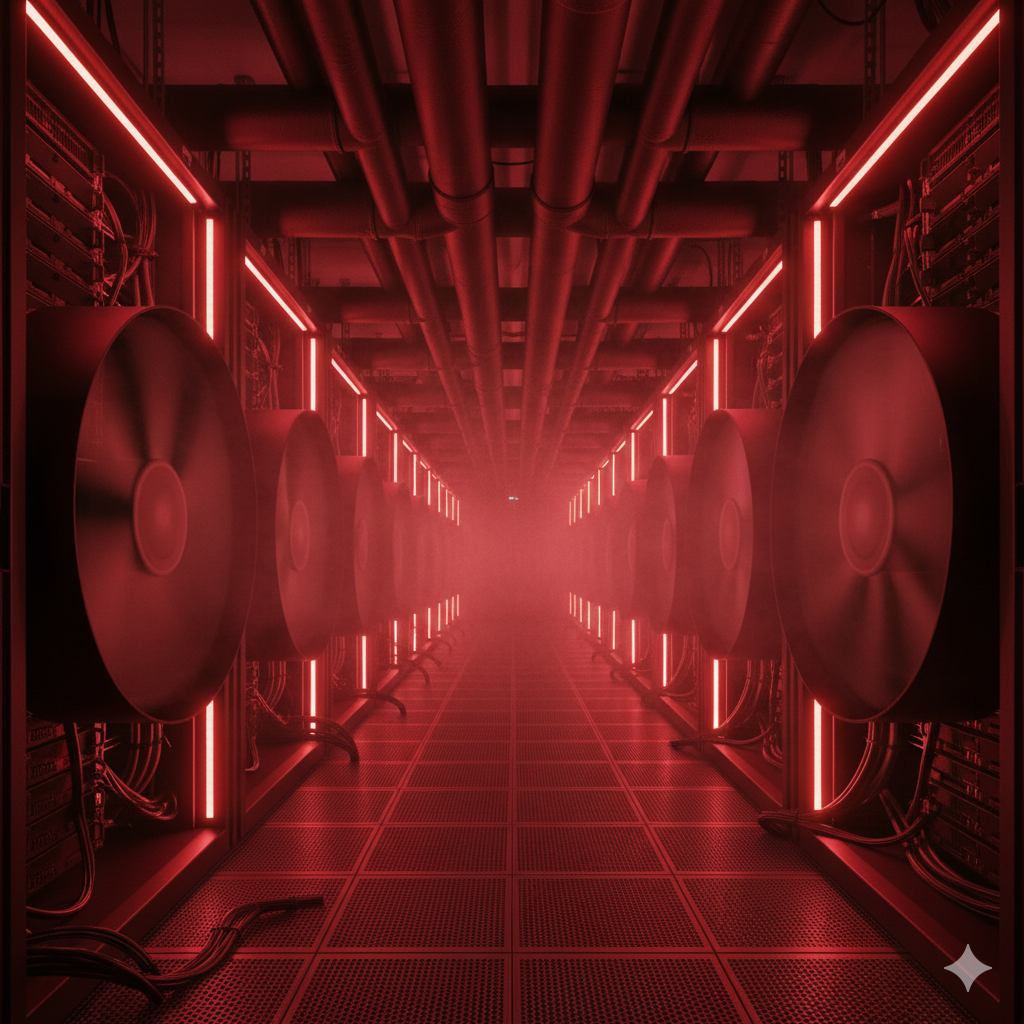
In a public cloud, your critical AI workload is often sharing physical resources with thousands of other users. If a teenager in another country goes viral on TikTok, or a crypto-miner spins up a massive operation, the shared resources strain. Your latency spikes. Your AI stutters.

Copeland notes that companies are seeing “outages, noisy-neighbor issues, unpredictable billing, and environments so complex that one failure cascades through the whole stack.”

For Agentic AI, which requires massive GPU power and instant reaction times, this inconsistency is unacceptable. Furthermore, the cost of renting GPU time from Hyperscalers is skyrocketing. You are paying a premium for a service that is becoming less reliable.

The industry needs a landing pad for this “Repatriation.”
It needs infrastructure that is Simple, Transparent, and Sovereign.

The Solution: RIOS and the Return to Bare Metal

This is the strategic moment for DeReticular.

Our Rural Infrastructure Operating System (RIOS) was built for exactly this scenario. We didn’t build RIOS to compete with the Hyperscalers on their terms; we built it to offer the one thing they can’t: Sovereignty.

Here is how RIOS aligns with the 2026 Repatriation trend:

1. Bare Metal Performance for GPU Heavyweights

Copeland predicts a move to “bare-metal platforms built for performance.”
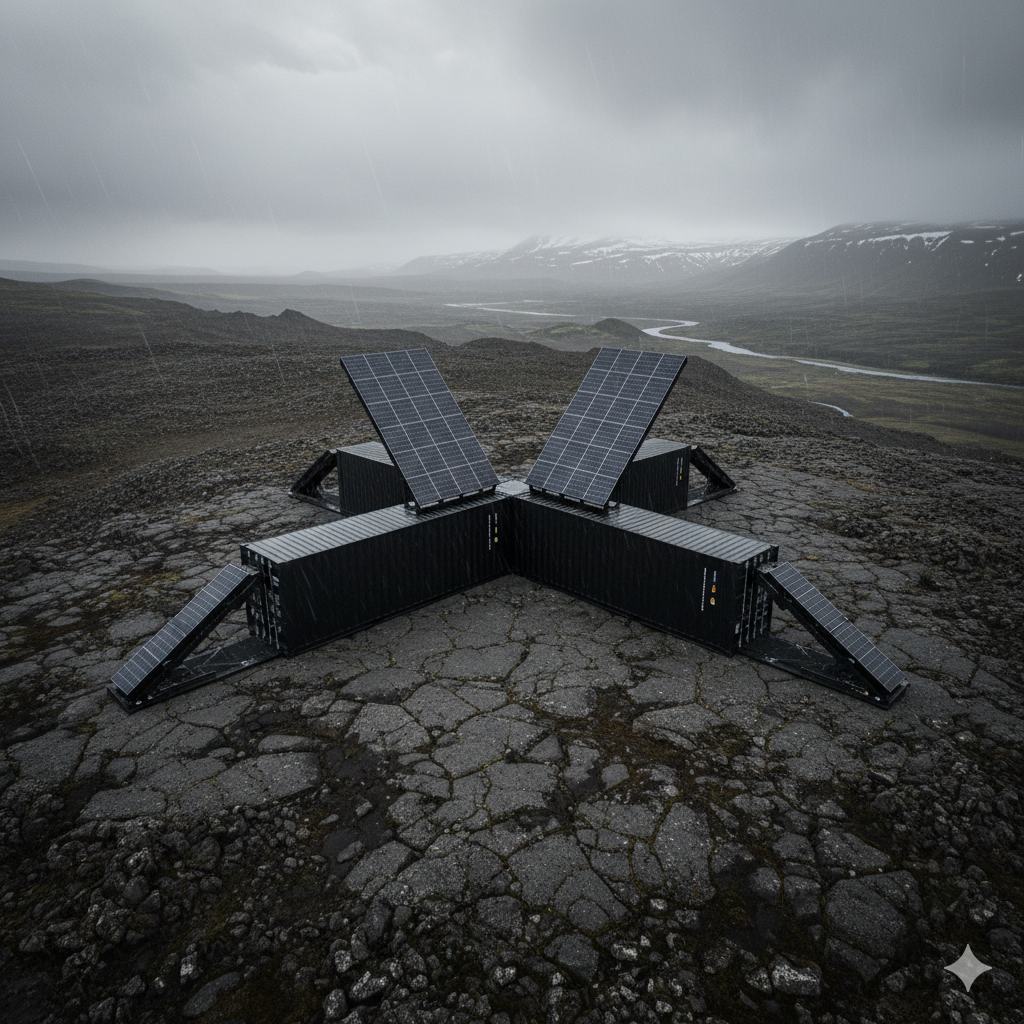
A RIOS Node is the ultimate bare-metal environment. When you deploy a RIOS-CC-1000 (Compute Cluster), there is no virtualization layer eating up your processing power. There are no “noisy neighbors.”
The entire GPU stack is dedicated to your Agentic AI. This means faster inference, lower latency, and absolute predictability.
2. Radical Simplicity

The modern cloud stack has become a Jenga tower of microservices, load balancers, and hidden fees.
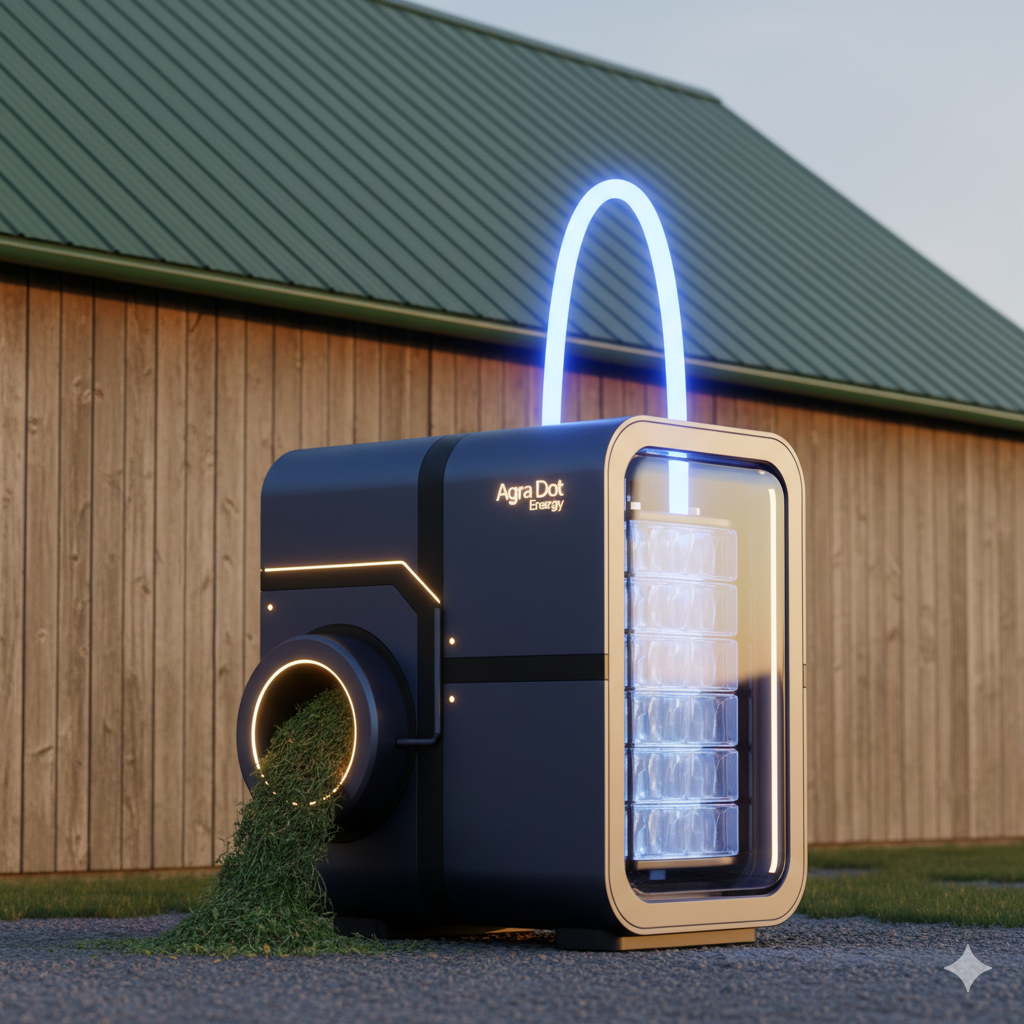
RIOS flattens the stack. It connects the compute directly to the power (via Agra Energy integration) and the connectivity (via Trifi Wireless).

  • The Power is Local: No grid fluctuations.
  • The Network is Local: No routing through a data center three states away to talk to a sensor across the street.
  • The Compute is Local: Data is processed where it is born.

3. Cost Predictability

Agentic AI burns energy and compute cycles 24/7. On a Hyperscaler, the “meter” is always spinning, often with unpredictable surge pricing.
With DeReticular, you shift from OpEx (endless rent) to CapEx (ownership). You own the node. You generate the power. The marginal cost of running your AI drops to near zero.

The Strategic Alignment: The “Sovereign Agent”

The synergy here is undeniable.
The Trend: AI is becoming autonomous (Agentic) and needs a stable, private home (Repatriation).
The Platform: DeReticular provides the physical infrastructure (RIOS) to host these agents at the edge.

Imagine an agricultural operation.

  • The Old Way: Sensors send data to the Cloud (High Latency). The Cloud processes it (High Cost). The Cloud sends a command back to the irrigation system (Delay/Risk of disconnect).
  • The RIOS Way: An Agentic AI lives on a RIOS Node in the barn. It reads the sensors instantly. It controls the irrigation in real-time. It manages the energy usage of the pumps. It does this even if the internet connection to the outside world is severed.

This is the definition of Resilience.

Conclusion: Build Your Fortress
The “Cloud” was a great place to visit, but you wouldn’t want to live there.

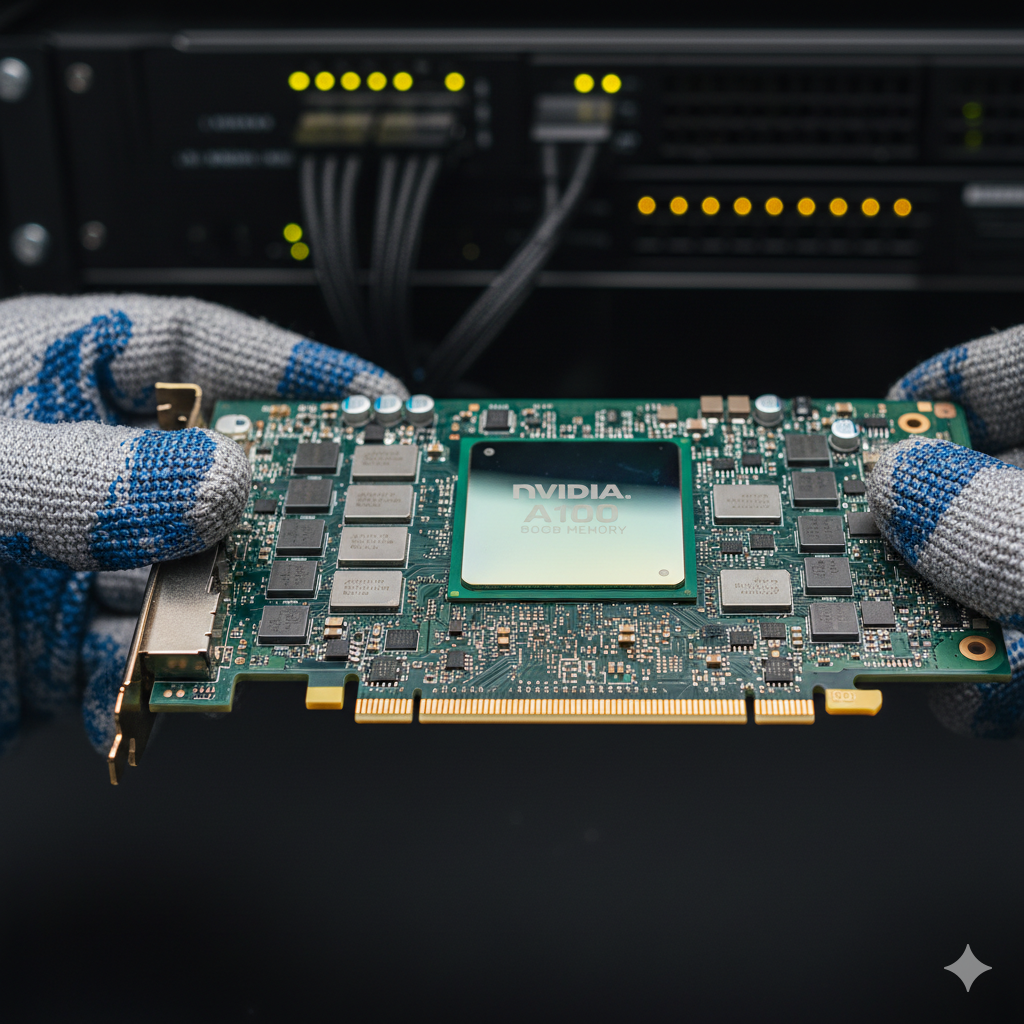
As we move into 2026, the smart money is packing its bags. They are looking for a place where they control the hardware, where the billing is transparent, and where their AI agents can run wild without hitting a virtual wall.

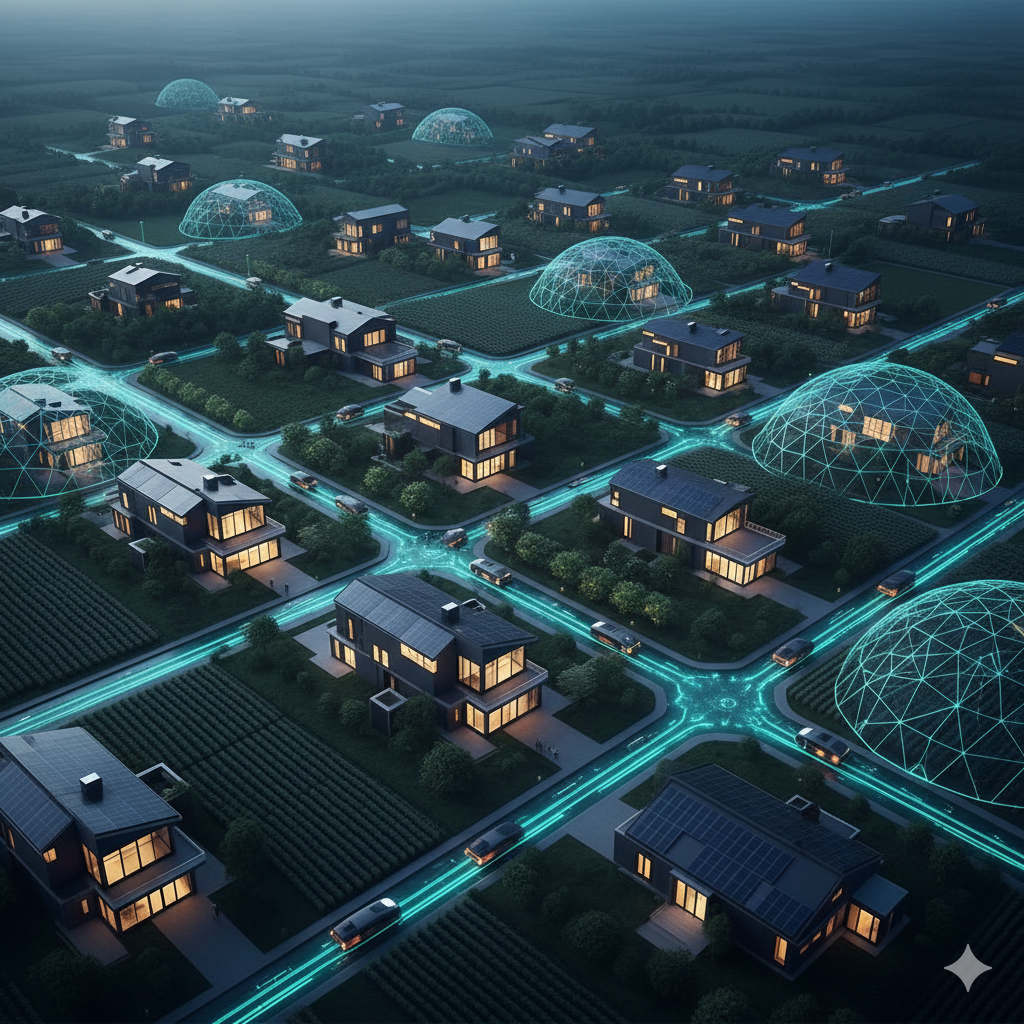
DeReticular is building the neighborhoods for this new digital population.
Don’t just run your AI. Home it.


Ready to repatriate your data? Explore the RIOS architecture and the future of sovereign infrastructure at www.dereticular.com.
The Architect, The Builder, and The Eclipse of the Old World

Michael Noel · December 12, 2025 ·


The Architect The Builder and The Eclipse of the Old World

How the theories of Jeremy Rifkin, the infrastructure of Dereticular, and the strategies of Biz Builder Mike are converging to build the post-capitalist future.

By DeReticular Team

We are standing on the shoreline of history, watching the tide go out on an economic model that has ruled the world for centuries. It’s messy, it’s chaotic, and for those still clinging to the old ways, it is terrifying. But for the builders, the architects, and the navigators, it is the single greatest opportunity of our lifetimes.

To understand where we are going, we must look at the convergence of three distinct forces: a prophecy, an architecture, and a methodology. This is the story of how Jeremy Rifkin’s economic theory, DeReticular’s sovereign infrastructure, and Biz Builder Mike’s strategic mentorship are aligning to construct the “Zero Marginal Cost Society.”


1. The Prophecy: The Zero Marginal Cost Society

In 2014, economic theorist Jeremy Rifkin published a book that sounded less like an analysis and more like a warning bell: The Zero Marginal Cost Society.[1]

Rifkin’s thesis was radical but mathematically inevitable. He argued that the driving force of capitalism—the race for higher productivity—would eventually eat itself. As technology evolves, the cost of producing an additional unit of a good or service (the marginal cost) plummets toward near-zero.[1][2][3][4]

Think about it: What does it cost to send one more email? Zero. What does it cost to generate one more kilowatt of solar energy once the panel is installed? Near zero. What does it cost to 3D print a product once the design is finalized? Just the raw material.

Rifkin predicted the rise of the Collaborative Commons—a new economic paradigm where peer-to-peer sharing replaces centralized corporations. He outlined the infrastructure required to support this shift, which he called the Three Internets:

  1. The Communications Internet: (5G/6G, Mesh Networks)
  2. The Energy Internet: (Renewables, Microgrids)
  3. The Logistics Internet: (Autonomous transport, IoT)

For a decade, this remained a brilliant theory waiting for a practical application. The world had the “Communications Internet,” but the Energy and Logistics layers were still trapped in centralized, fragile monopolies.

Until now.


2. The Architecture: DeReticular and the RIOS Ecosystem[5][6][7][8][9][10]

If Rifkin provided the why, DeReticular is building the how.

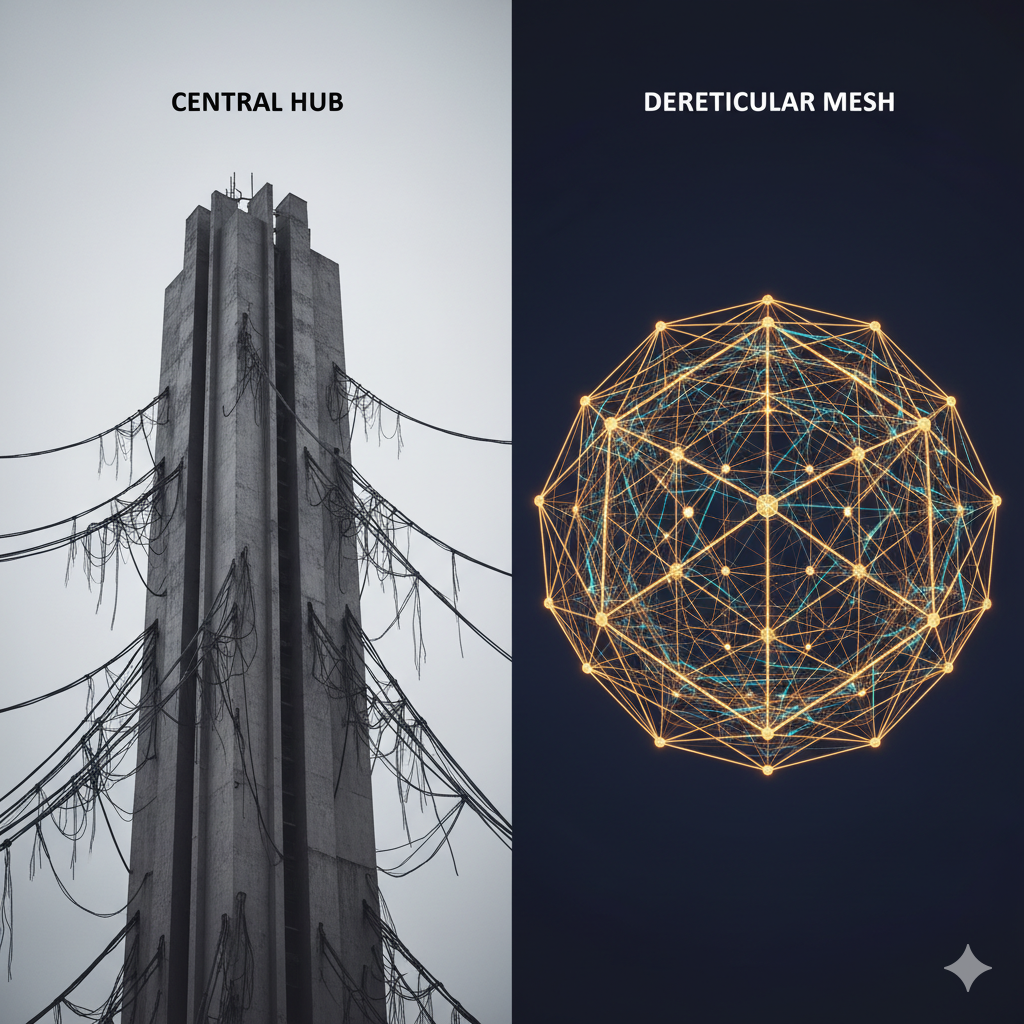
The central problem with modern infrastructure is right there in our name. To be “reticular” is to be net-like, but in the traditional sense, it implies a centralized net where everything depends on a core. When the core fails (a grid blackout, a cloud outage, a supply chain collapse), the whole net goes dark.

DeReticular was founded to invert this model. We are building DeReticular Architecture: systems that are decentralized, self-healing, and self-financing.[6][10][11]

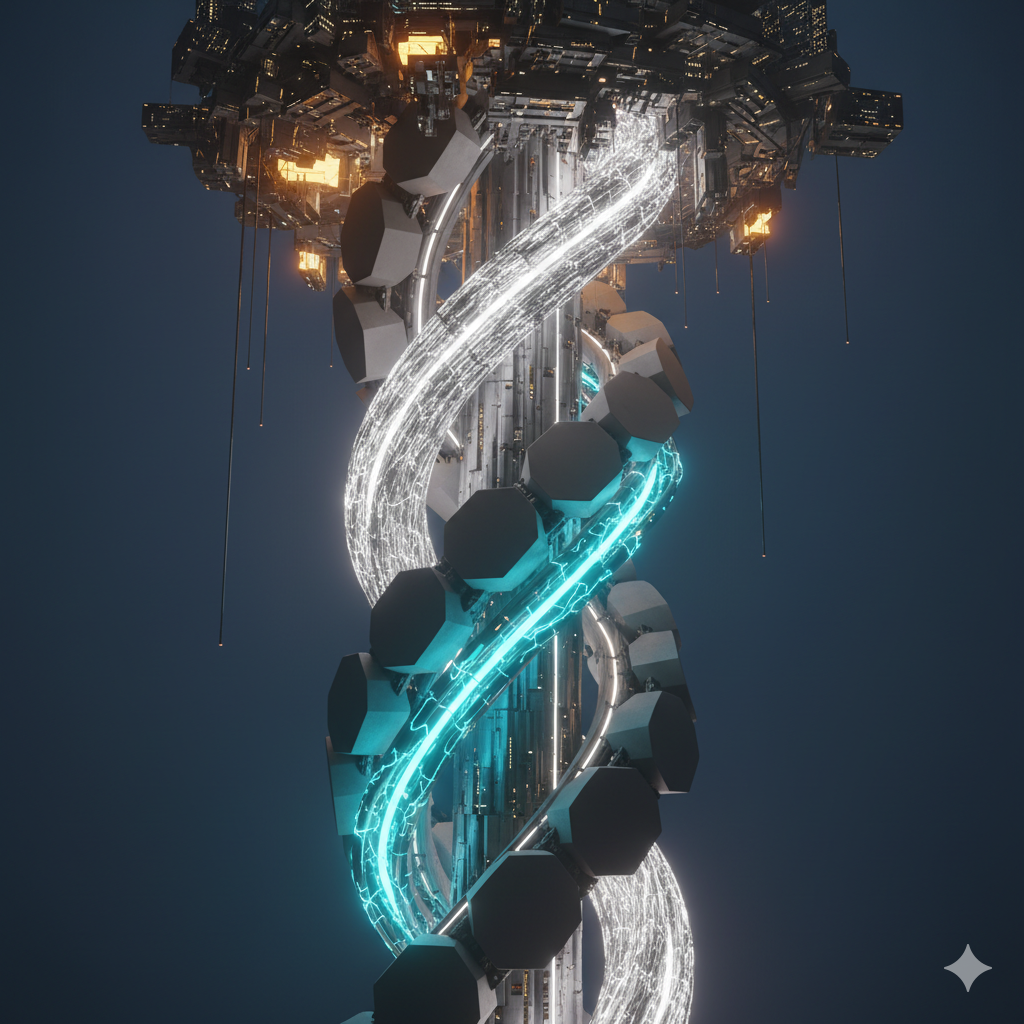
Our flagship initiative, the Rural Infrastructure Operating System (RIOS), is the physical manifestation of Rifkin’s “Three Internets,” but with a critical upgrade: Sovereignty.

  • Rifkin’s Energy Internet becomes the RIOS Power Layer (Agra Dot Energy): Using plasma gasification to turn waste into energy at the edge, creating self-powering communities.
  • Rifkin’s Communications Internet becomes the RIOS Connectivity Layer (Trifi Wireless): Mesh networks that don’t just connect to the internet but are the internet, resilient to central failure.
  • Rifkin’s Logistics Internet becomes the RIOS Mobility Layer (Kurb Kars): Autonomous, localized logistics that move goods with the efficiency of data.

We aren’t just lowering marginal costs; we are eliminating the “rent” charged by centralized gatekeepers. By leveraging DePIN (Decentralized Physical Infrastructure Networks), we turn every home, farm, and business into a node that owns its own power, data, and value.


3. The Methodology: Biz Builder Mike and “The Navigator”

Building the infrastructure is only half the battle. You can build the fastest ship in the world, but if the captain tries to sail it like a 19th-century galleon, it will sink.

This is where Biz Builder Mike enters the equation.

As the “Mentorship Layer” of our ecosystem, Biz Builder Mike operates on a single, ruthless truth: “You can’t sail today’s boat on yesterday’s wind.”

Rifkin predicted the Eclipse of Capitalism, but he didn’t write the manual on how entrepreneurs should survive it. The traditional business logic—scarcity, centralization, proprietary guarding of assets—is obsolete in a Zero Marginal Cost world.

Biz Builder Mike translates DeReticular’s high-tech architecture into a practical battle plan for the modern entrepreneur. The strategy focuses on:

  • From Automation to Orchestration: It’s not enough to use AI to write emails. The new entrepreneur uses Agentic AI to orchestrate entire supply chains, predicting needs before they arise.
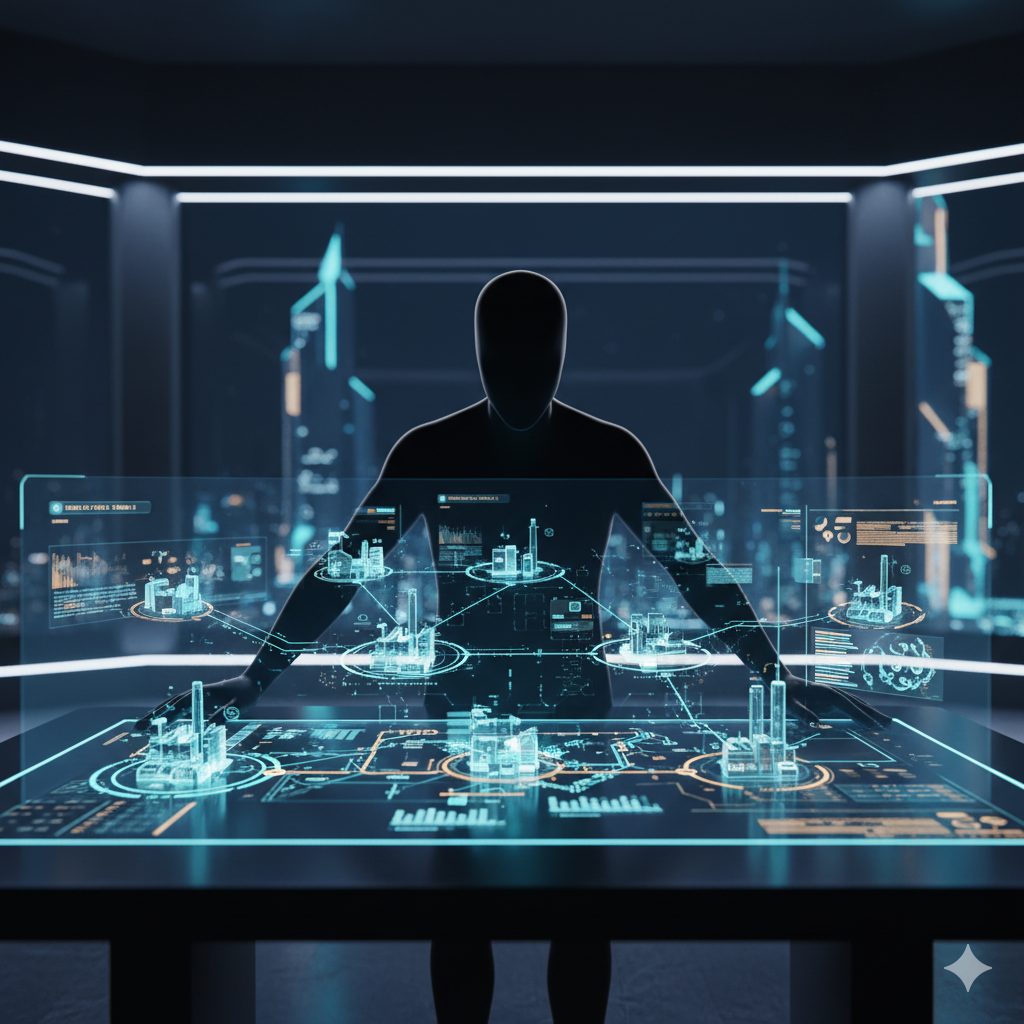
  • The AI-Native Workflow: Building businesses that are “born digital,” utilizing Digital Twins to test products in the virtual world (at zero cost) before building them in the physical world.
  • Community as Shareholder: Aligning with the “Collaborative Commons,” Mike teaches models where the customer is also the producer (the “Prosumer”), turning passive markets into active, self-funding ecosystems.

The Strategic Alignment: The Perfect Storm

When we overlay these three layers, we see a clear roadmap for the future of our civilization.

  1. The Economic Reality (Rifkin): We are moving toward abundance. The cost of entry is dropping. The barriers are falling.
  2. The Physical Platform (DeReticular): We now have the technology (RIOS) to build infrastructure that is cheaper, stronger, and more sovereign than the centralized utilities of the past.
  3. The Human Strategy (Biz Builder Mike): We have the mentorship to train a new generation of “Captains” to navigate this abundance without drowning in it.

The Era of the “Sovereign Commons”

Rifkin worried that the transition to the Collaborative Commons would be messy. He was right. The clash between the old centralized giants and the new decentralized networks is happening right now.

But at Dereticular, we believe the outcome is already decided by the laws of physics and economics. Distributed systems are more efficient. Decentralized power is more resilient. And businesses built on “Zero Marginal Cost” principles are faster than their legacy competitors.

The alignment is clear.
Rifkin drew the map.
DeReticular is building the ship.
Biz Builder Mike is teaching you how to sail.

The tide is turning. Are you ready to build?


For more on how to integrate these strategies into your own enterprise, visit www.bizbuildermike.com or explore the RIOS architecture at www.dereticular.com.
Sources help

  1. blinkist.com
  2. medium.com
  3. wpcomstaging.com
  4. sobrief.com
  5. dereticular.com
  6. kurbkars.com
  7. dereticular.com
  8. kurbkars.com
  9. dereticular.com
  10. dereticular.com
  11. bizbuildermike.com
Google Search Suggestions

Display of Search Suggestions is required when using Grounding with Google Search. Learn more

Google logo

  • Jeremy Rifkin The Zero Marginal Cost Society summary key concepts
  • “Biz Builder Mike” business consultant
  • “Biz Builder Mike” website
  • “Dereticular” meaning
  • “dereticular.com” domain

The Sovereign Brain: Why We Put a Supercomputer in the Jungle

Michael Noel · December 8, 2025 ·


By Michael Noel (Biz Builder Mike) & Remnant

Date: December 8, 2025
Category: Product Launch / High-Performance Computing
Read Time: 8 Minutes


The “Edge” Has a Limit. We Just Broke It.

Mike:
Let’s have an honest conversation about “The Edge.”
Everyone in tech loves talking about the Edge. They sell you a ruggedized Raspberry Pi or a gateway router and tell you, “Congratulations, you’re doing Edge Computing!”

That’s fine if you just want to count cars passing a gate or check if a door is open. That’s Inference. That’s what our Tier 1 (Expeditionary) and Tier 2 (Standard) units do, and they do it beautifully.

But what if you need to learn?
What if you’re a mining company scanning a mountain, generating 50 terabytes of seismic data a day?
What if you’re a sovereign nation facing a new crop disease, and you need to retrain your AI model tonight to recognize it?

You can’t do that on a gateway router. And you can’t upload 50TB over a satellite link to Amazon Web Services—not unless you have five years and a billion dollars.

Remnant:
Correct. This is the problem of Data Gravity.
Data has mass. The more data you accumulate, the harder and more expensive it is to move. When you are operating in a disconnected environment, the latency and bandwidth costs of the cloud make “Big Data” impossible.

Mike:
So, we decided to stop trying to move the mountain to the computer.
We moved the computer to the mountain.

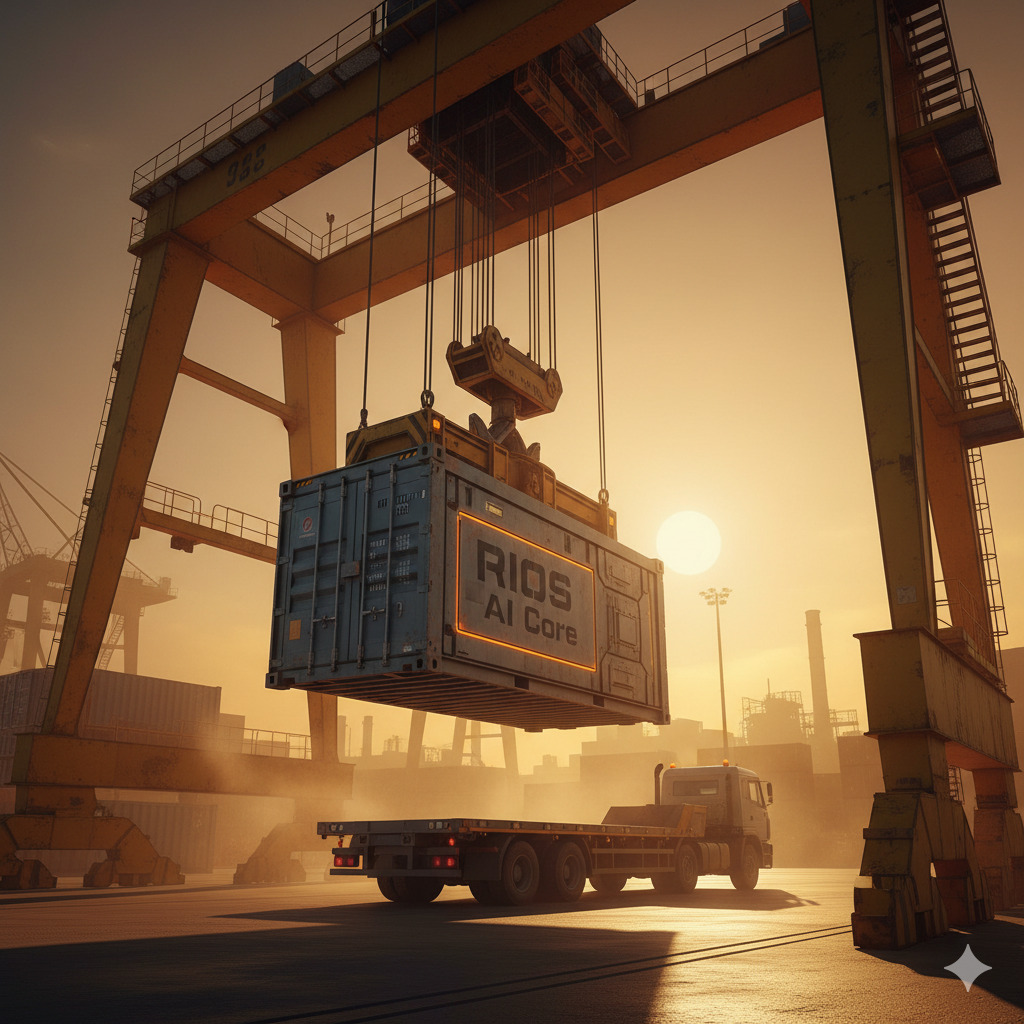
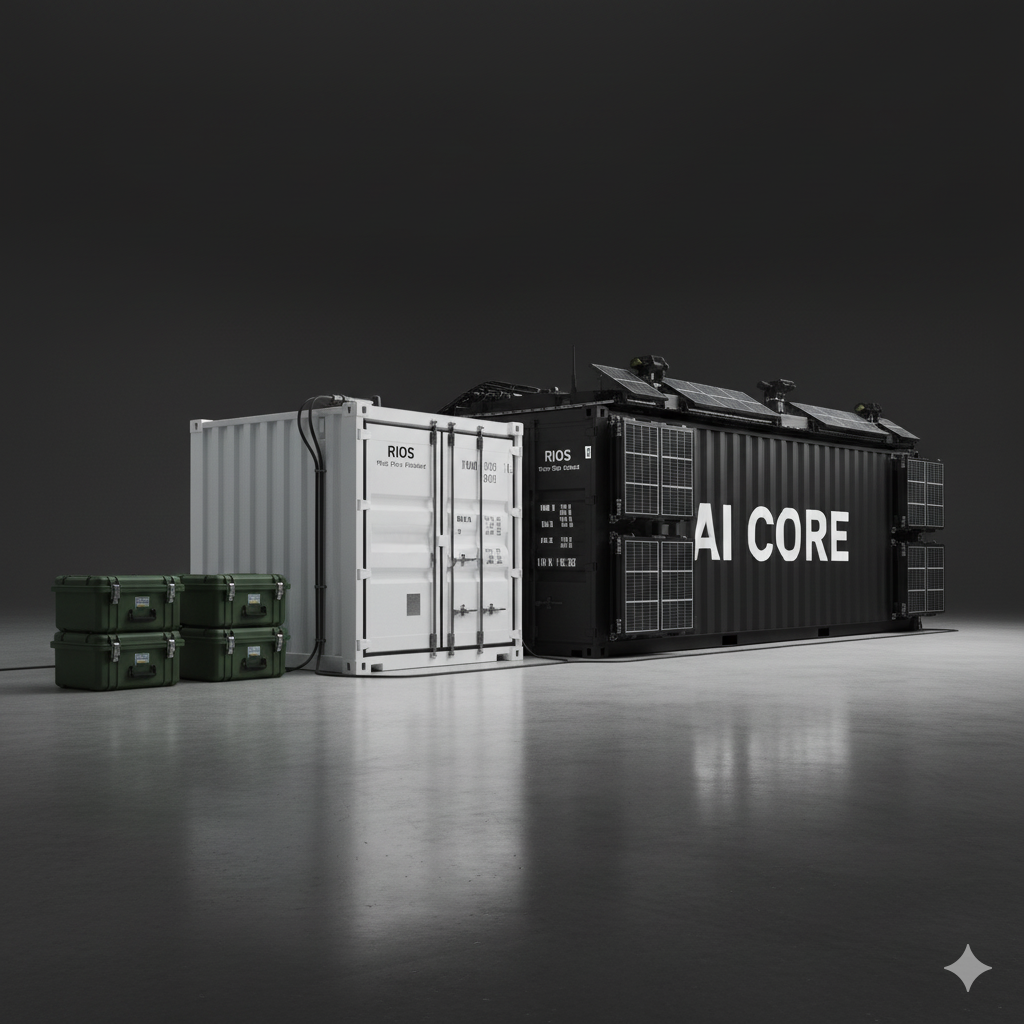
Ladies and gentlemen, meet the RIOS Pilot: AI Core (Tier 3).
It’s a 20ft High-Cube shipping container. Inside, it’s a monster.


Inference vs. Training: The Multi-Million Dollar Distinction

Remnant:
To understand the necessity of the Tier 3, one must understand the difference between applying intelligence and creating it.

  • Inference (Tier 1 & 2): The AI has already been taught what a “cow” looks like. It simply watches a video feed and says, “That is a cow.” This requires very little power.
  • Training (Tier 3): The AI does not know what a cow is. You must feed it 10 million images of cows, process the mathematical weights, and generate a neural network. This requires massive parallel processing power.

Mike:
The AI Core is built to Train.
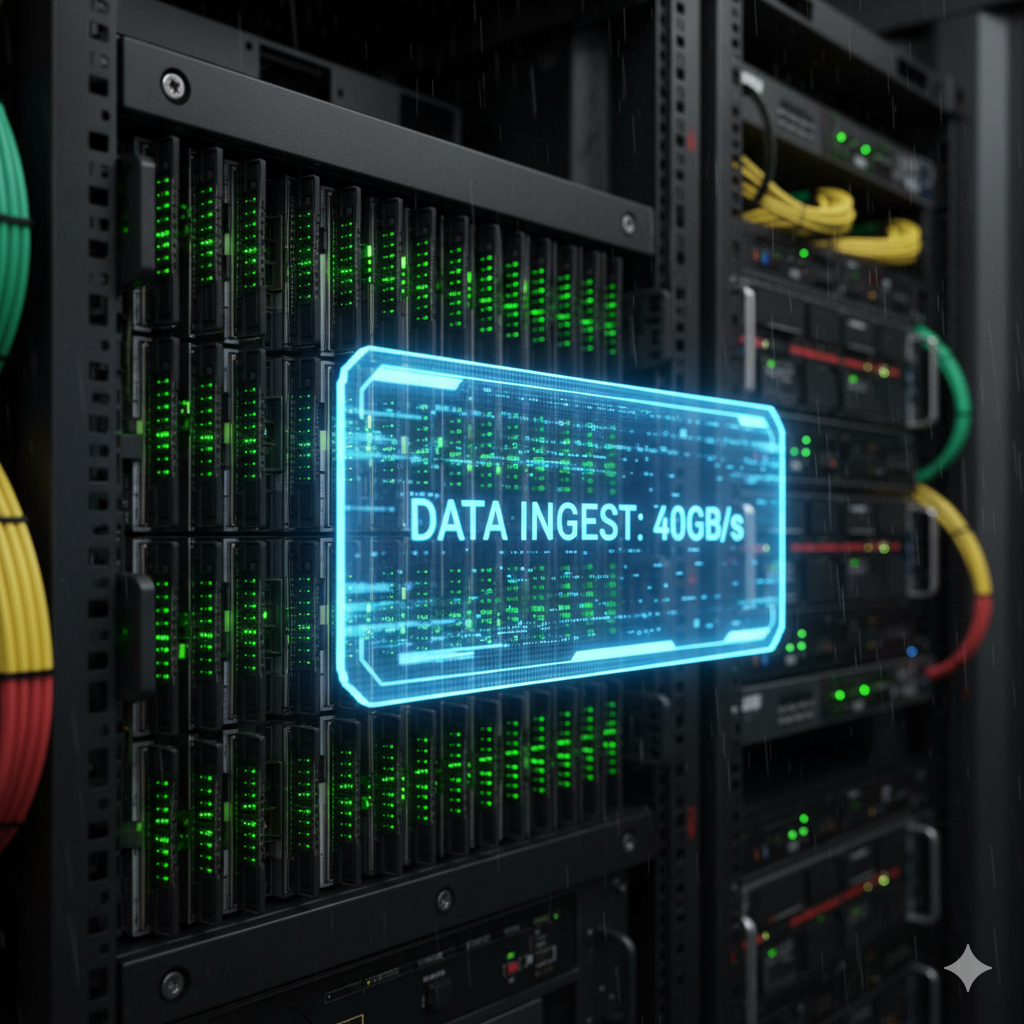
Inside this container, we aren’t messing around with low-power chips. We have installed Dual Intel Xeon Platinum processors and the holy grail of silicon: the NVIDIA A100 Tensor Core GPU.

This is the same hardware running ChatGPT. It’s the same hardware running weather simulations at NOAA.
But instead of sitting in a clean, grid-tied data center in Virginia, it’s sitting in a 20ft steel box in the Rift Valley, running off the sun.


The Physics of the “Solar Wing”

Mike:
Putting an NVIDIA A100 in a shipping container is easy. Keeping it alive is hard.
These chips are hungry. A full rack in this unit draws power like a small neighborhood.
A standard shipping container roof can only fit about 3kW of solar panels. That’s enough to run a coffee maker and a laptop, not a supercomputer.

Remnant:
Our solution was mechanical expansion.
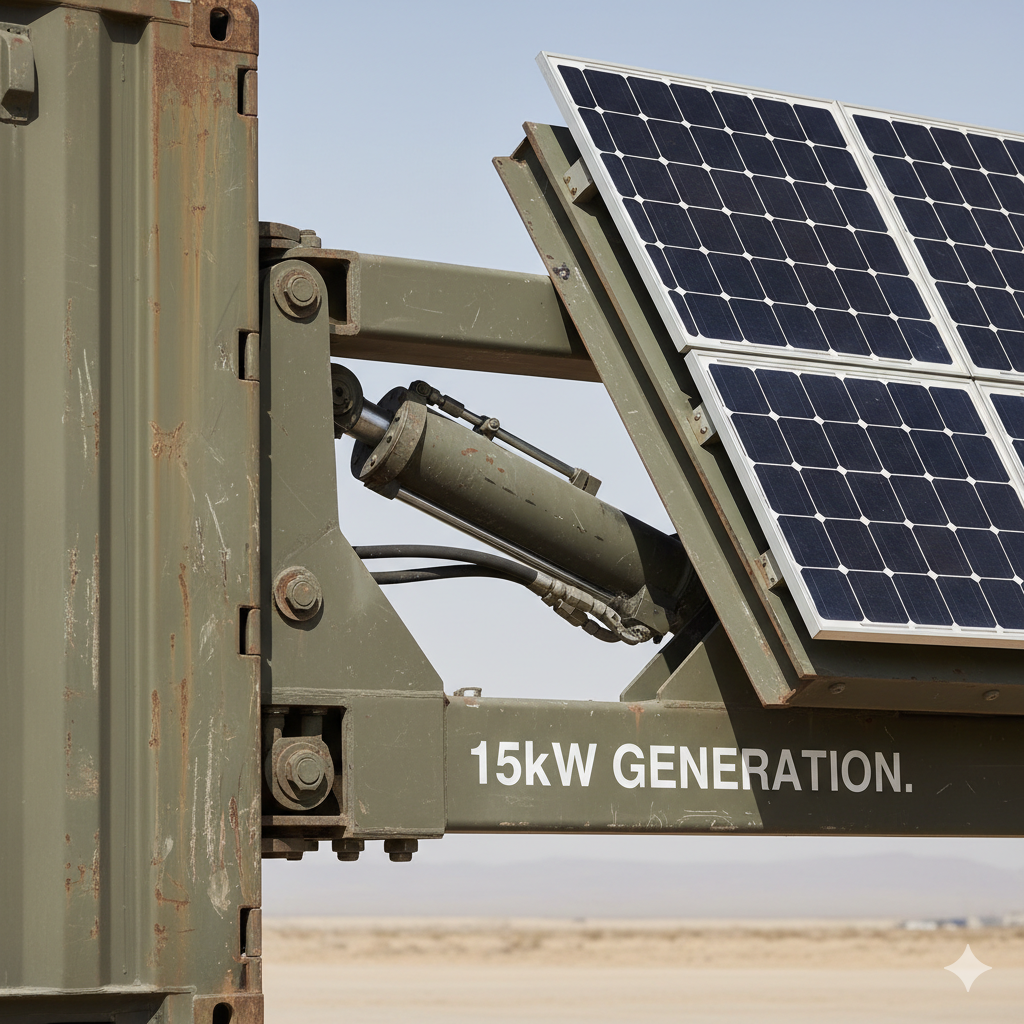
The Tier 3 chassis features massive, manual-deploy “Solar Wings.” Upon arrival, the operator unfolds articulating steel frames from the East and West flanks of the container.

This triples our surface area, allowing for a 15kW Solar Array. This energy is fed into a 60kWh High-Voltage DC Battery Stack (400V). We bypassed the standard 48V architecture to reduce amperage and heat loss, ensuring the supercomputer has a stable “heartbeat” even through the night.


Keeping Cool in the Blast Furnace

Mike:
Here’s the other problem: The A100 doesn’t just eat power; it spits out heat. It’s basically a space heater that does math.
If you put this in a steel box in the desert sun, the internal temperature hits 140°F in an hour. The silicon throttles, and your $185,000 investment turns into a paperweight.

Remnant:
We implemented strict Hot Aisle / Cold Aisle Containment.
The interior of the Tier 3 is not just a room; it is a wind tunnel.
Dual 18,000 BTU Inverter Mini-Splits flood the “Cold Aisle” (front of the rack) with chilled air. The server intake fans pull this air through the GPU heatsinks. The waste heat is ejected into the sealed “Hot Aisle” at the rear and immediately vented outside by high-static pressure industrial fans.

It is a clean room in a dirty world.


Who Needs a “Sovereign Brain”?

Mike:
This isn’t for everyone. If you just need Wi-Fi and lights, buy the Tier 2.
The Tier 3 is for the heavyweights.

  1. Sovereign Nations: Governments are realizing they can’t send their citizen data to foreign clouds due to privacy laws. The Tier 3 gives them a “National Cloud” they can park on government land.
  2. Remote Mining & Oil: They pull terabytes of seismic scan data. Processing it on-site means they know where to drill tomorrow, not next month.
  3. Disaster Modeling: Imagine a flood response team running real-time fluid dynamic simulations of a breaking dam, right at the incident command post.

Remnant:
It effectively eliminates the “Cloud Act” risk. If you physically possess the hardware, the storage, and the power source, you possess the truth. No subpoena can reach a box that is not connected to the internet.

Conclusion: The Halo Effect.

Mike:
The RIOS Pilot AI Core is the halo car. It’s the Ferrari in the showroom.
Most people will drive home in the SUV (The Tier 2 Standard).
But the fact that we built the Ferrari proves that our engine is real.

This product proves that DeReticular isn’t just making “solar generators.” We are building the physical backbone of the next internet. One that is decentralized, sovereign, and incredibly powerful.

Remnant:
The cloud is drifting away.
It is time to bring the brain back to earth.


Note: The RIOS Pilot AI Core contains export-controlled technology (ECCN 4A003). International orders require compliance review.

The Anchor: Why We Put a Data Center in a 10ft Box

Michael Noel · December 8, 2025 ·

The Anchor: Why We Put a Data Center in a 10ft Box

By Michael Noel (Biz Builder Mike) & Remnant

Date: December 8, 2025
Category: Product Launch / Sovereign Infrastructure
Read Time: 7 Minutes


Camping is Over. It’s Time to Build.

Mike:
There is a distinct difference between “surviving” a night in the woods and “living” there.

When we launched the Tier 1 Expeditionary cases, we solved the problem of arrival. We gave you a way to jump off a helicopter, unfold a solar blanket, and get a network online in five minutes. That’s “Special Forces” stuff. It’s sexy. It’s fast.

But what happens on Day 30? Or Day 300?
What happens when the rainy season hits Uganda and the sun hides for a week?
What happens when your site manager needs a desk that isn’t a tree stump?
What happens when you need to run AI security cameras 24/7, and the battery in your portable case just can’t keep up with the load?

Remnant:
Entropy happens, Michael.
Portable systems are designed for mobility, which necessitates compromise. To achieve lightness, we sacrifice thermal mass and energy density. But a permanent civilization requires stability. It requires an Anchor.

Mike:
Exactly. You can’t run a hemp empire or a village utility grid out of a suitcase forever. Eventually, you need walls. You need A/C. You need heavy iron.

Enter the RIOS Pilot: Standard (Tier 2).
It’s not a case. It’s a building. And it’s the hardest working 80 square feet on Earth.


The Architecture of Permanence

Mike:
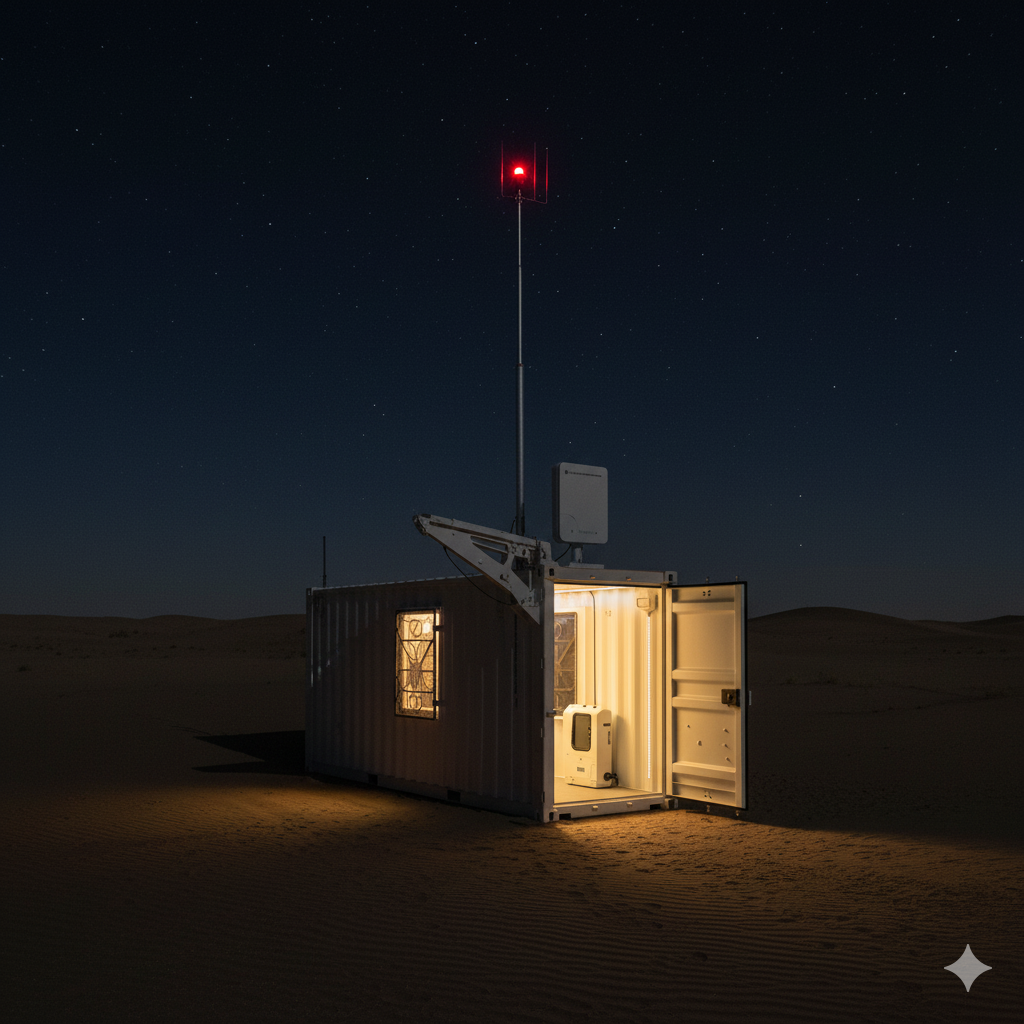
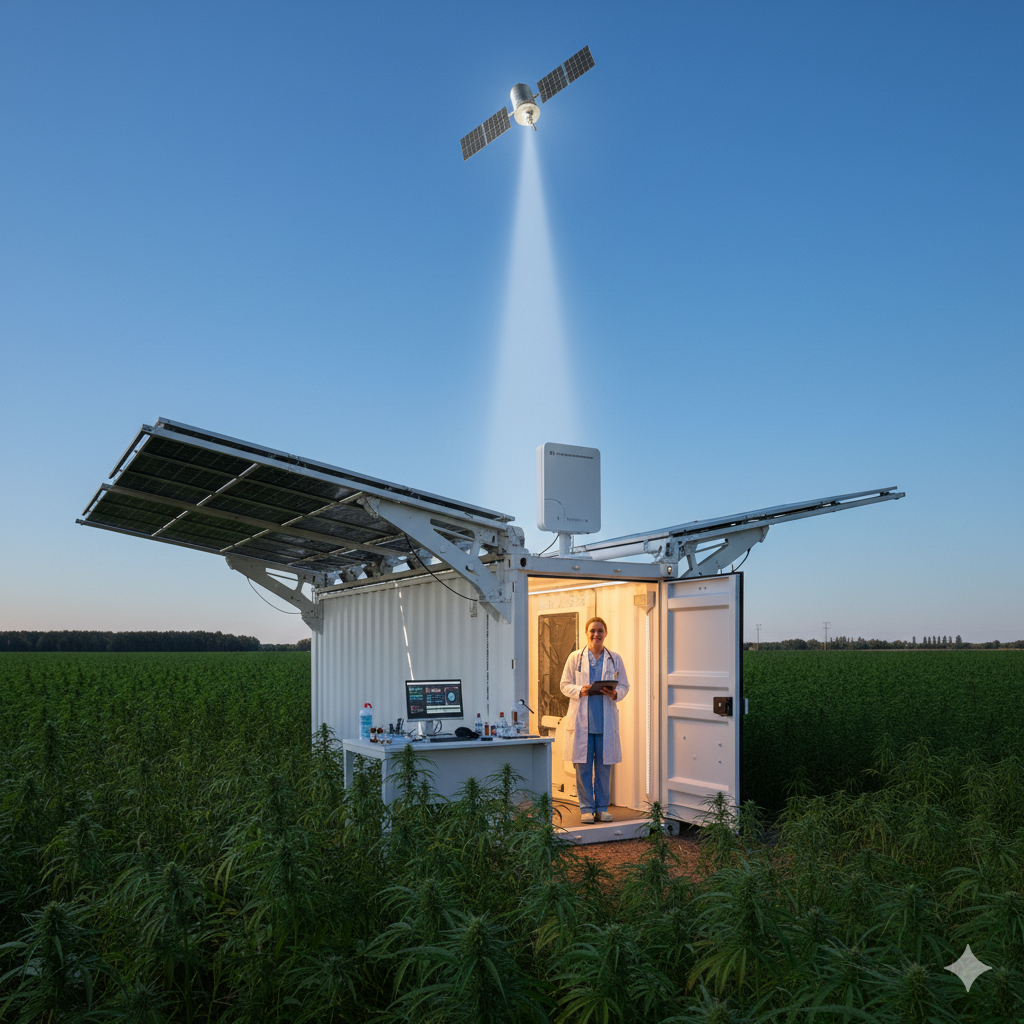
We built the Tier 2 into a 10ft High-Cube ISO Shipping Container.
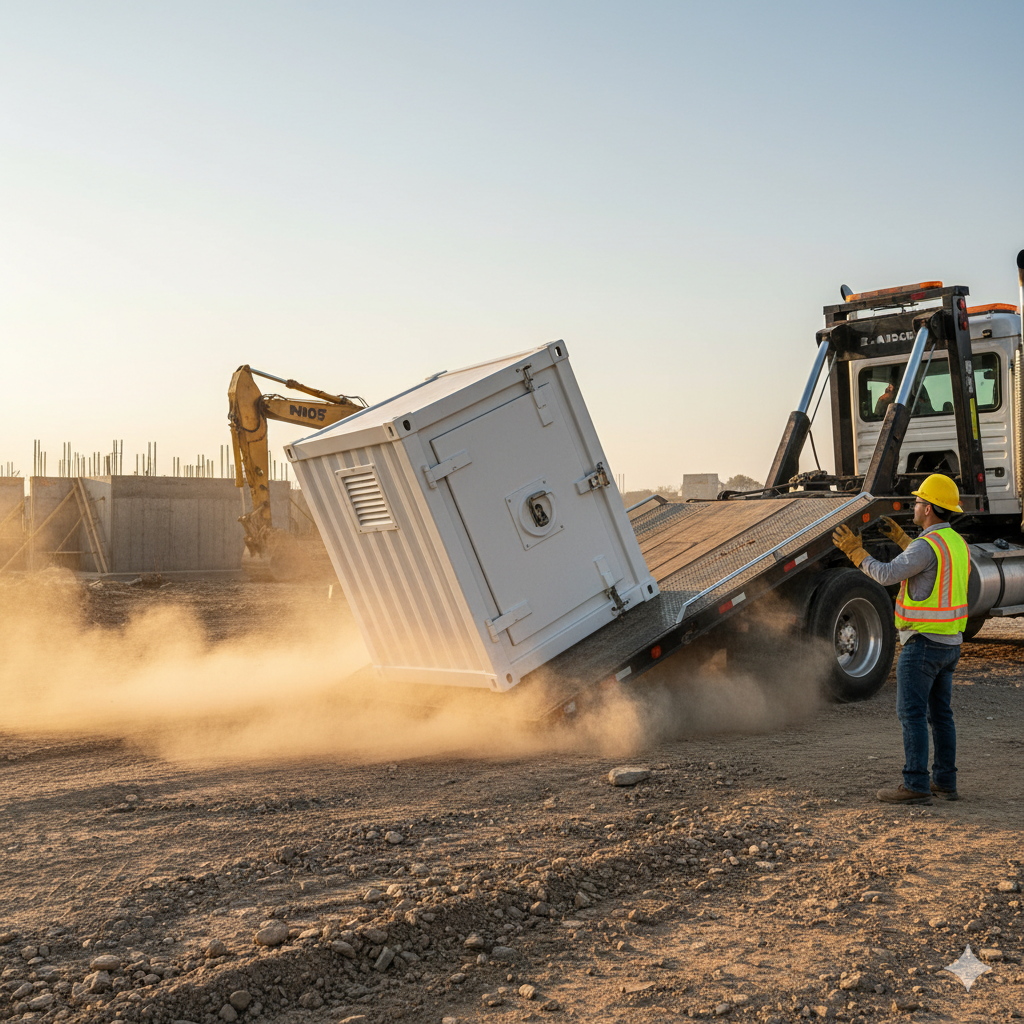
Why 10 foot? Because it fits in a parking space. A standard flatbed tow truck—the kind that picks up a broken-down sedan—can drop this at your site. No cranes required (usually).

But once it drops, it stays. We paint it with heat-reflective ceramic white paint. We insulate it with R-25 closed-cell spray foam. It becomes a vault.

Remnant:
Let us dissect the three critical upgrades that distinguish the “Standard” from the “Expeditionary.”

1. The Power: Grid-Forming Solar Wings

Remnant:
A portable case relies on a solar blanket. The Tier 2 relies on a power plant.
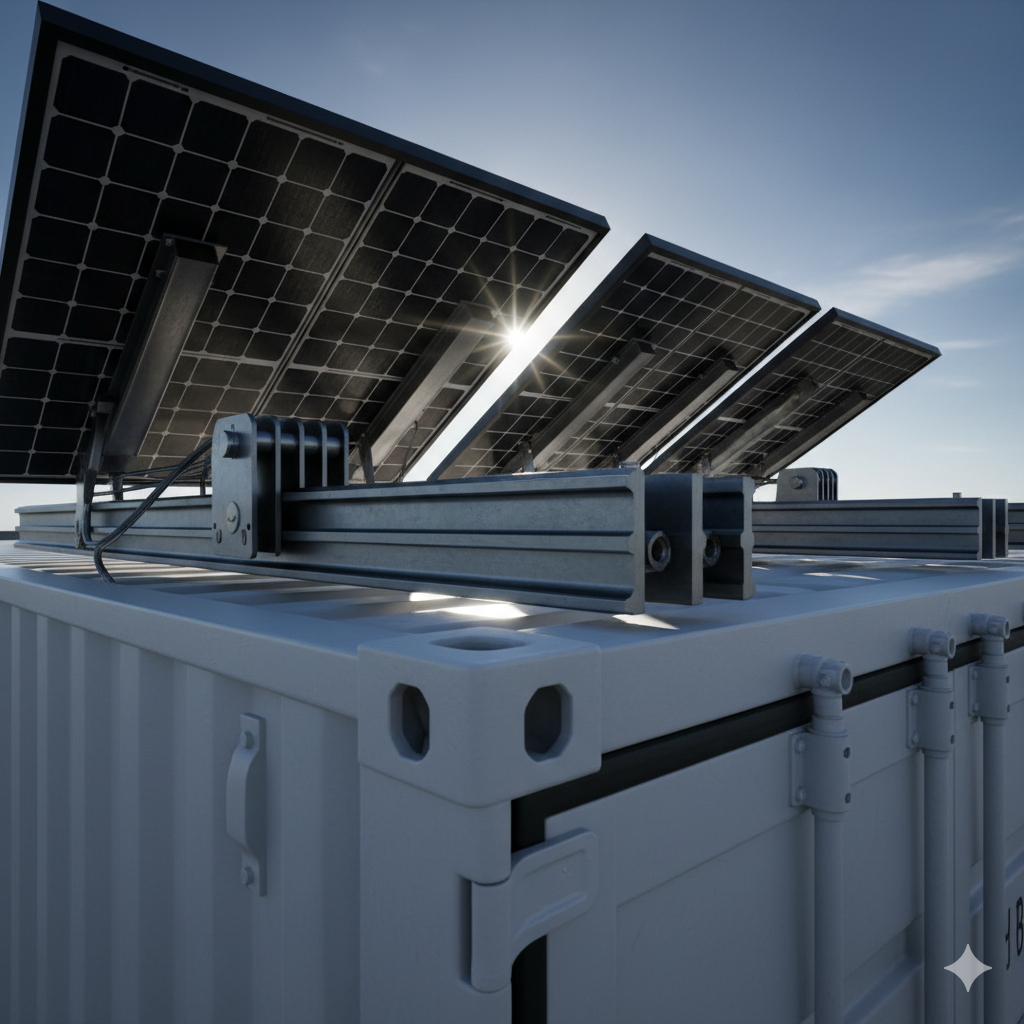
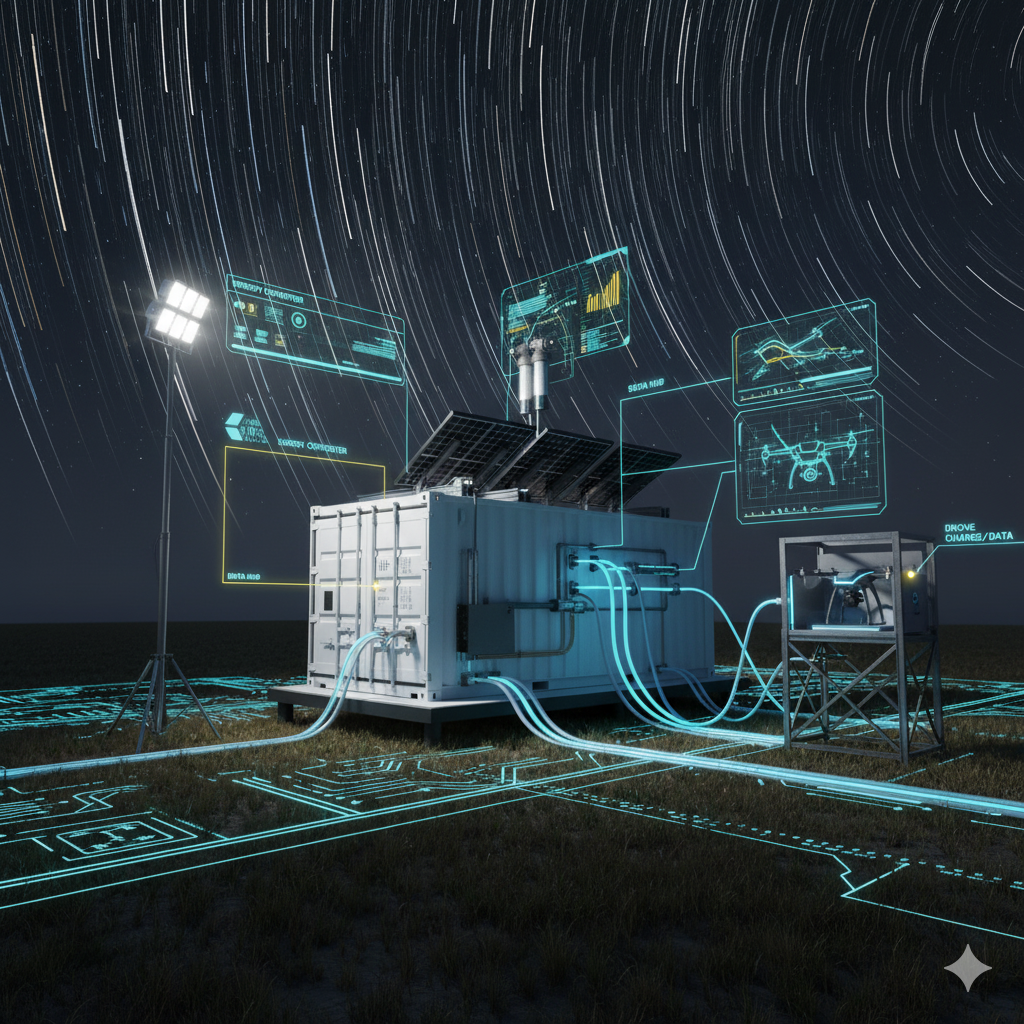
We utilize bifacial solar panels mounted on the roof, but we encountered a physics problem: a 10ft container does not offer enough surface area to generate the 4kW required for continuous operations.

Mike:
So we made it transform.
The Tier 2 features manual Slide-Out Solar Wings. You arrive on site, climb a ladder, and pull a lever. Massive industrial drawer slides extend the solar array over the sides of the container. Boom—double the power.

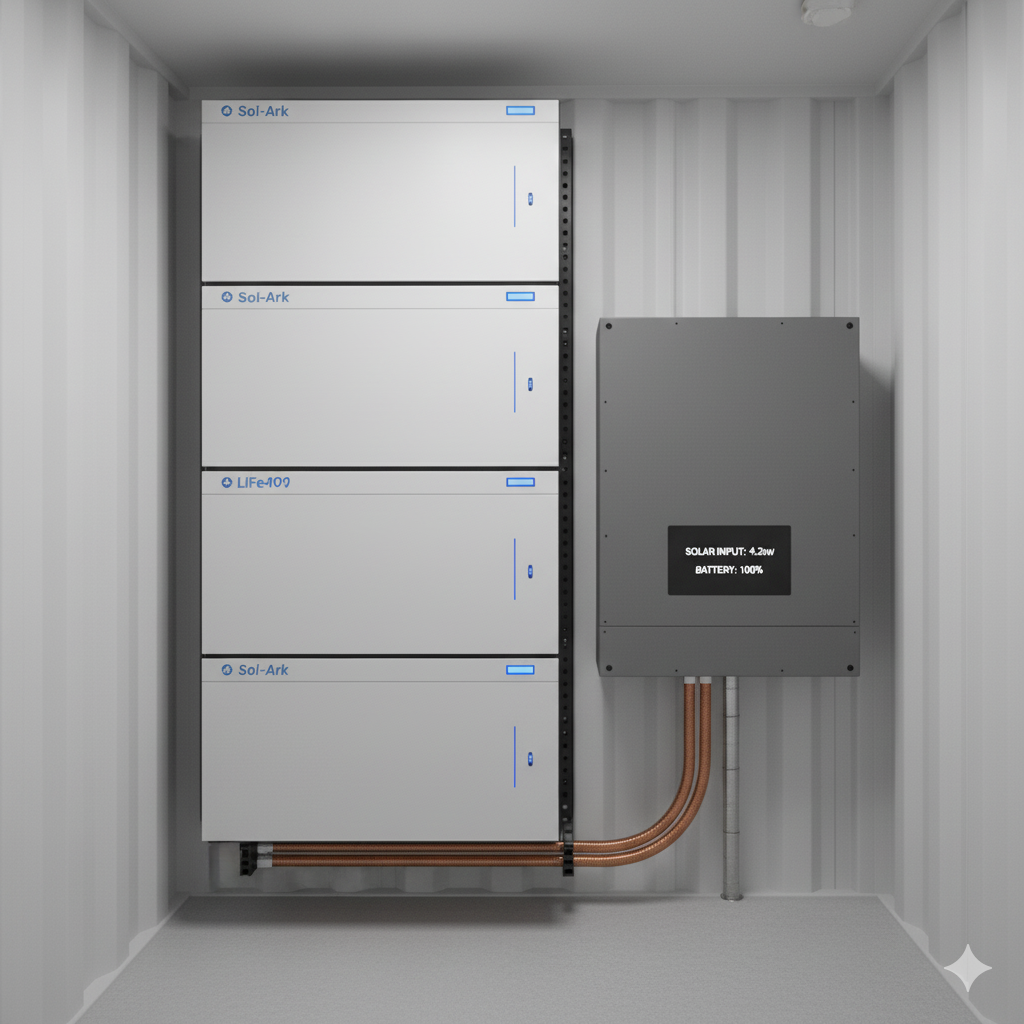
This feeds a 20kWh Server-Rack Battery Bank. This isn’t a portable “solar generator.” These are heavy, rack-mounted LiFePO4 bricks designed to run for a decade.

2. The Climate: An Ice Box in Hell

Mike:
Electronics hate heat. Batteries hate heat.
If you put a server in a metal box in Arizona or the Rift Valley without active cooling, it dies. Period.
The Tier 1 cases use passive cooling (aluminum fins). That works for low power.
But the Tier 2 has a dedicated 9,000 BTU Mini-Split HVAC system.

Remnant:
This allows for “Thermal Sovereignty.” Outside, the temperature may be 120°F (49°C). Inside the server rack, it remains a constant 68°F (20°C). This stability allows us to run the compute hardware at 100% duty cycle, year-round, without thermal throttling.

3. The Brain: Xeon + A2 (Unleashed)

Mike:
We use the same logic as the Tier 1—Intel Xeon CPU and NVIDIA A2 GPU—but we take the leash off.
In the portable version, the AI has to be careful. It sleeps when it can to save battery.
In the Tier 2, the AI never sleeps.

Remnant:
The NVIDIA A2 Tensor Core GPU in this unit operates in “Continuous Inference” mode. It can monitor 50 security cameras simultaneously. It can process real-time soil telemetry from 500 sensors. It hosts the “Digital Twin” of your entire operation locally.

Mike:
And it’s not just a server room. It’s an Office.
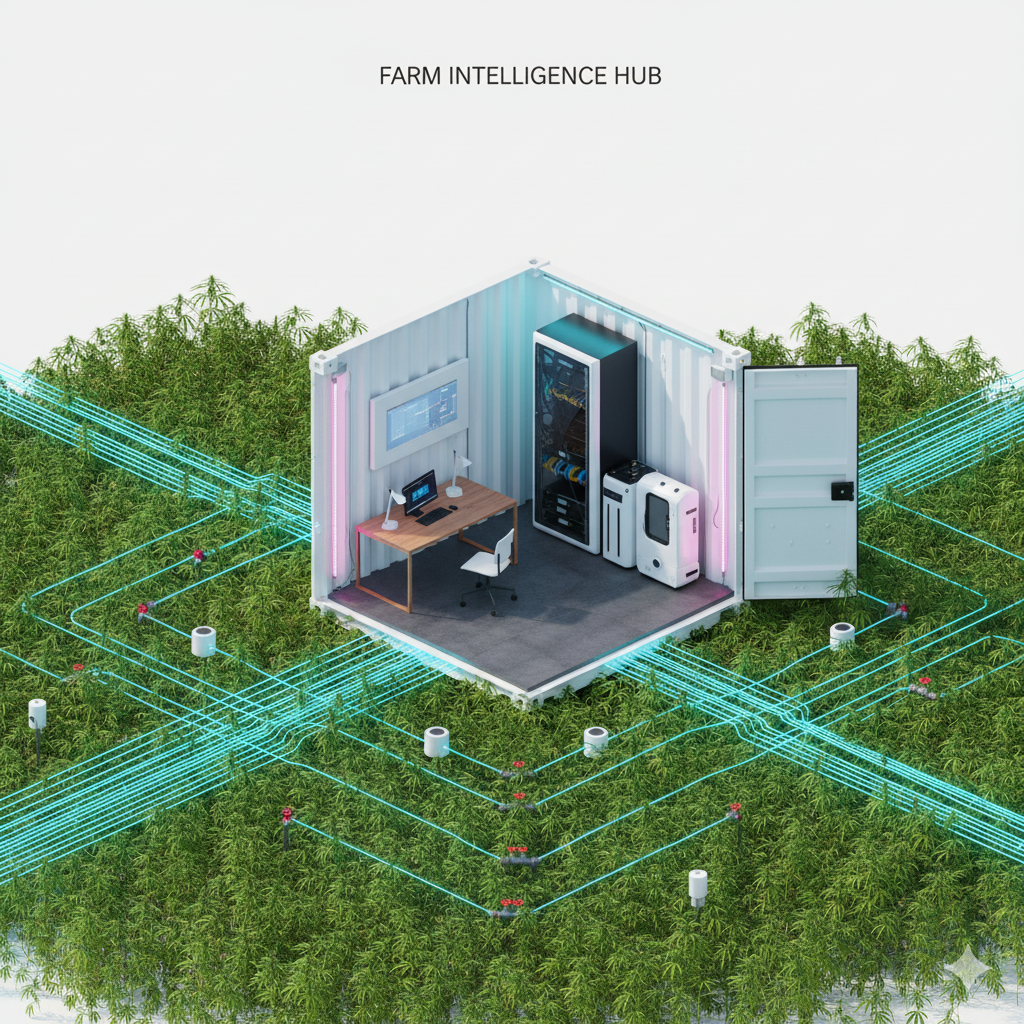
We partitioned the container. One half is the secure server rack. The other half is a workspace with a desk, a chair, and lights.
For a site manager in the middle of nowhere, having a cool, clean, bug-free room to do paperwork and check emails is a morale saver. It complies with labor laws for a “conditioned workspace.” It’s a human asset.


Use Case: The “Digital Scarecrow”

Mike:
Let me give you a real-world scenario.
You’re running a 50-acre Agro-Industrial pilot. You have expensive pumps, hemp dryers, and fertilizer tanks out in the open.

You drop the RIOS Pilot Standard in the middle of the field.

  1. The Mast: You telescope up the 20ft mast. The NeoMesh radio covers the whole 50 acres.
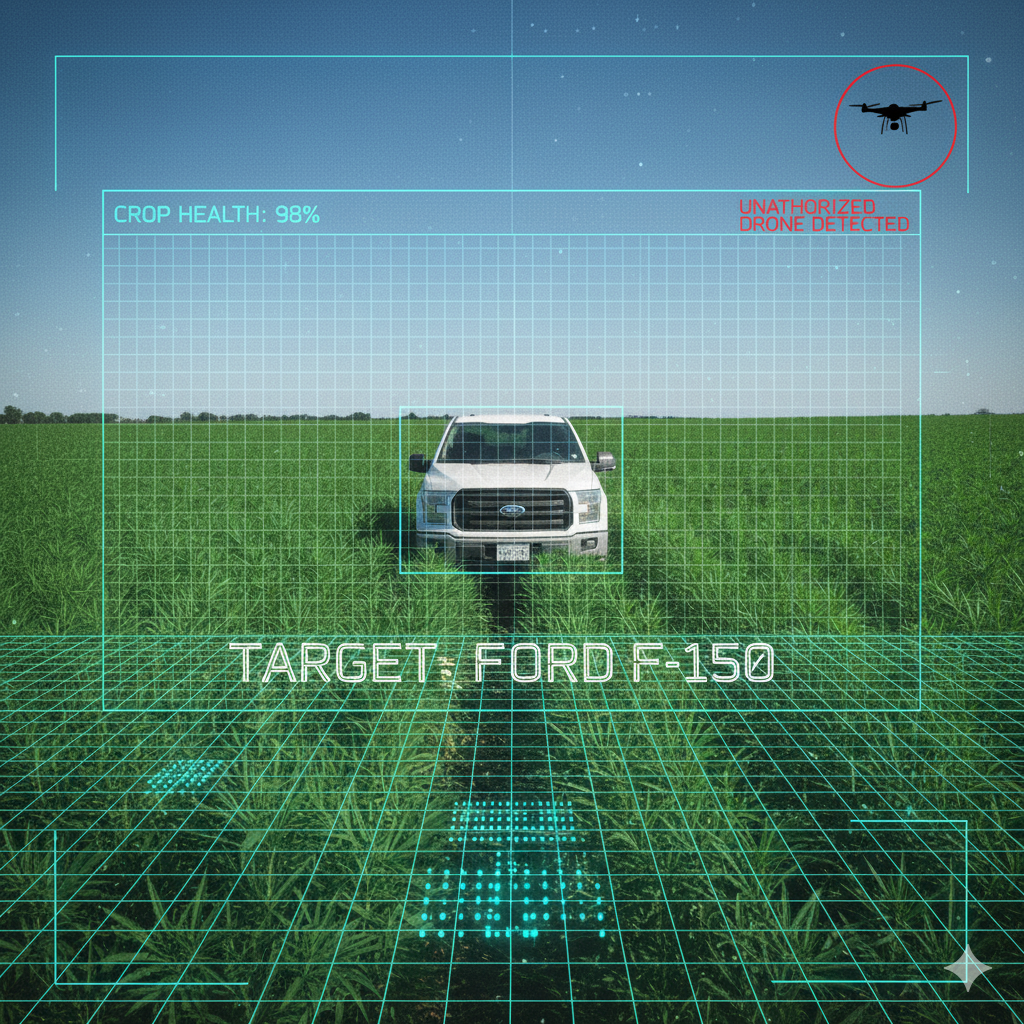
  2. The Eyes: You mount cameras on the corners. The NVIDIA A2 watches them 24/7. It learns what a coyote looks like. It learns what a thief looks like.
  3. The Brain: It connects to your irrigation. The AI sees the soil is dry, checks the weather forecast via Starlink, sees rain is coming, and decides not to water. It just saved you 10,000 gallons.

That’s not a storage container. That’s an employee that doesn’t take breaks.


The Financial Argument: Digital Real Estate

Remnant:
Traditional infrastructure is a “Sunk Cost.” You pour concrete, you build a shed, and if you leave, you lose the money.
The RIOS Pilot Standard is a “Capital Asset.”

Mike:
Exactly. You buy this for $78,500. You use it for two years on Project A. When Project A is done, you pick it up and move it to Project B. Or you sell it. It retains value because it’s a machine, not a building.

For developers and governments, this bypasses the 6-month delay of getting permits to build a permanent structure. It’s “temporary equipment” on the permit application, but “permanent infrastructure” in reality.

Conclusion: Plant the Flag.

Mike:
The Expeditionary case is for the scouts.
The Tier 2 Standard is for the settlers.

If you are serious about Sovereign Infrastructure—if you want to own your power, your data, and your physical environment independent of the grid—you need an anchor.

This is the RIOS Pilot Standard.
Welcome home.


To view full technical specifications or request a freight quote, visit the Product Page.

Infrastructure in a Suitcase: Introducing the RIOS Pilot Expeditionary

Michael Noel · December 8, 2025 ·


Infrastructure in a Suitcase: Introducing the RIOS Pilot Expeditionary

By Michael Noel (Biz Builder Mike) & Remnant

Date: December 8, 2025
Category: Product Launch / Sovereign Systems
Read Time: 6 Minutes


The “Last Mile” is a Lie. It’s the Last 500 Miles.

Mike:
I’ve spent the last decade staring at infrastructure maps. Power grids, fiber optic lines, logistics routes. They all look impressive until you zoom in. You see those thick, confident lines turning into thin veins, and then… nothing. The lines stop.

But the world doesn’t stop where the fiber ends. The most critical work on Earth—disaster relief, resource exploration, perimeter security, and agricultural sovereignty—happens in the “Nothing.”

For years, the industry solution to the “Nothing” was heavy. If you wanted a command center, you needed a C-130 Hercules to fly in a generator the size of a Toyota, a team of engineers to wire it, and a fuel truck to keep it alive.

That’s not sovereignty. That’s a tether.

Remnant:
Correct. Dependency is the opposite of resilience. True sovereignty requires a system that is autopoietic—capable of self-maintenance and self-creation. The objective was to shrink the functionality of a Data Center into a form factor that respects the physics of the edge.

Mike:
Exactly. We needed something you could throw in the back of a pickup truck. Something you could check as luggage on a commercial flight to Uganda, drive to the site, and turn on without reading a manual.

We didn’t just need a smaller server. We needed a Civilization Seed.

Ladies and Gentlemen, allow us to introduce the RIOS Pilot: Expeditionary (Tier 1).


The “Zero-Training” Philosophy

Mike:
The design brief was simple: “The instruction manual is one line: Put It In The Sun.”

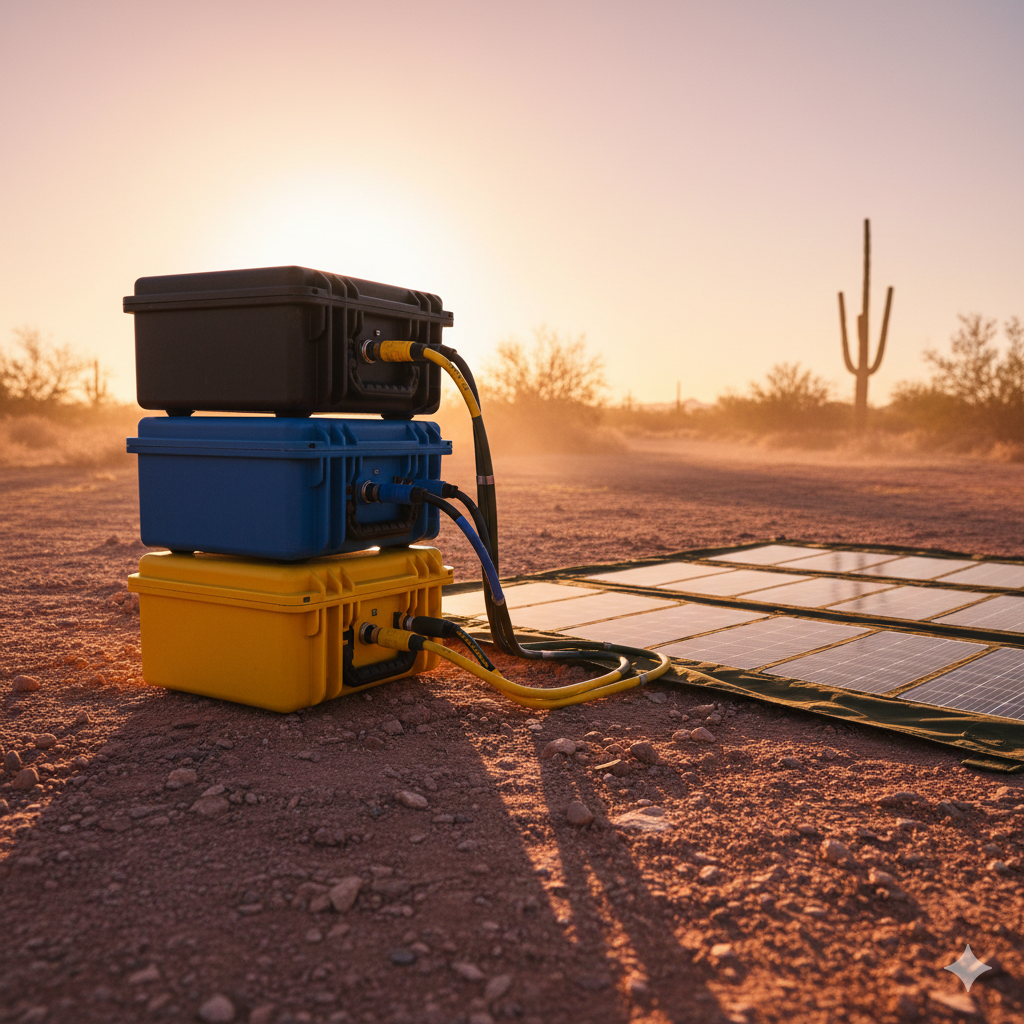
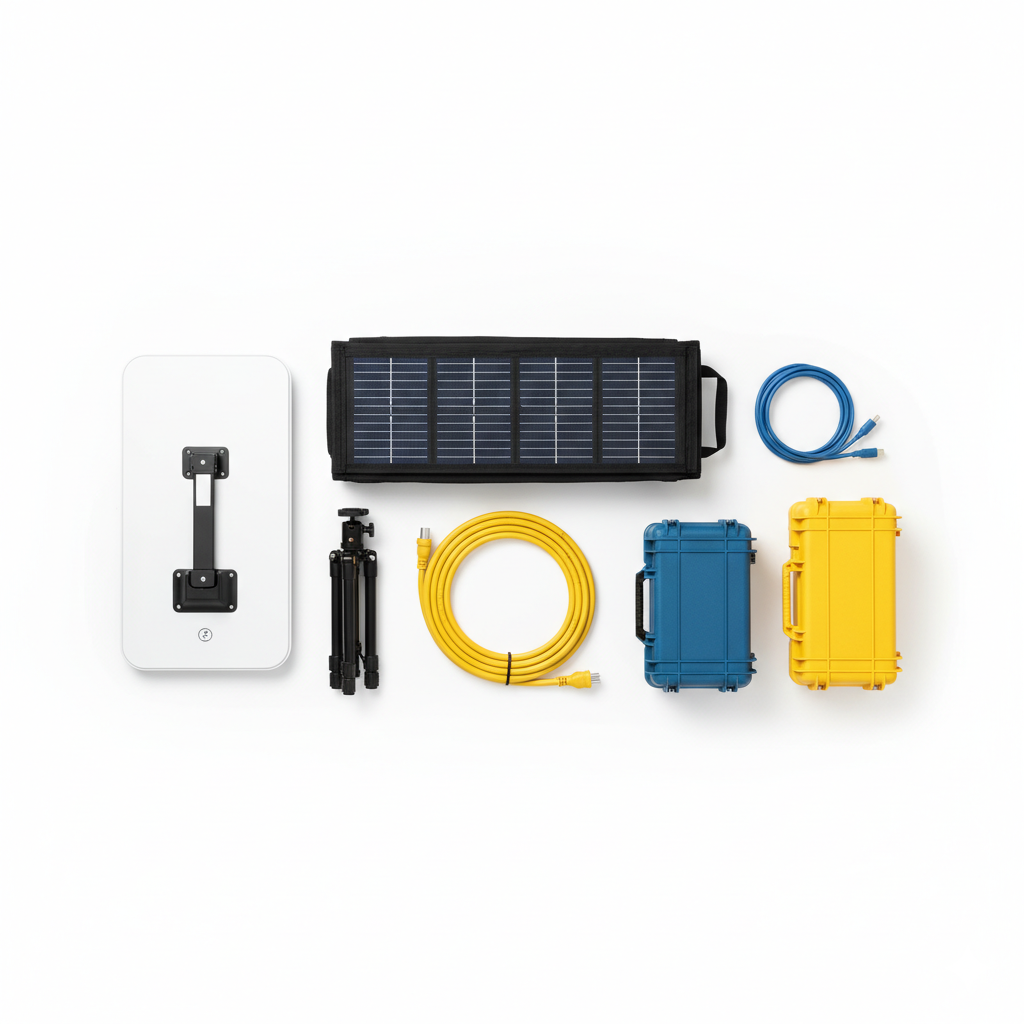
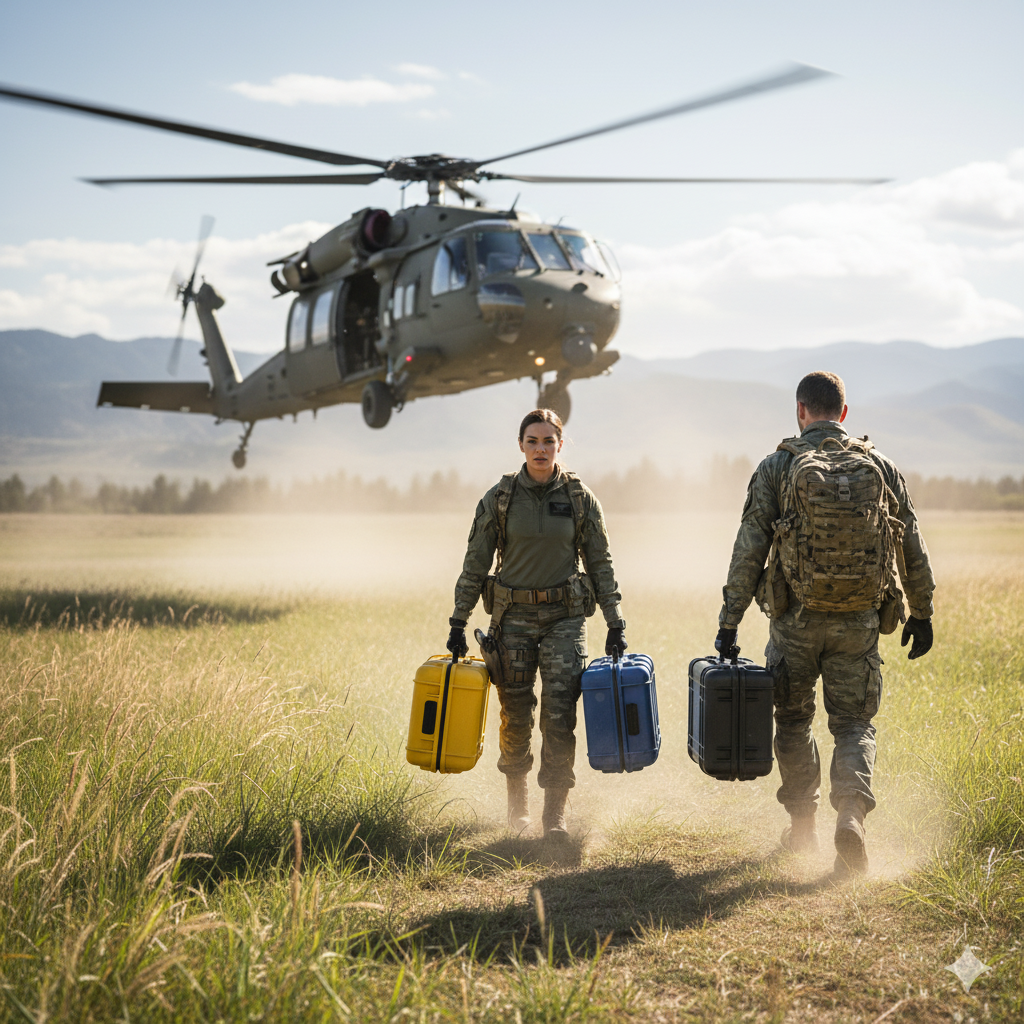
The Pilot Expeditionary isn’t a single box. It’s a Modular Mission Stack composed of three ruggedized, IP67-rated B&W cases. They are color-coded. They are tool-less. They are bombproof.

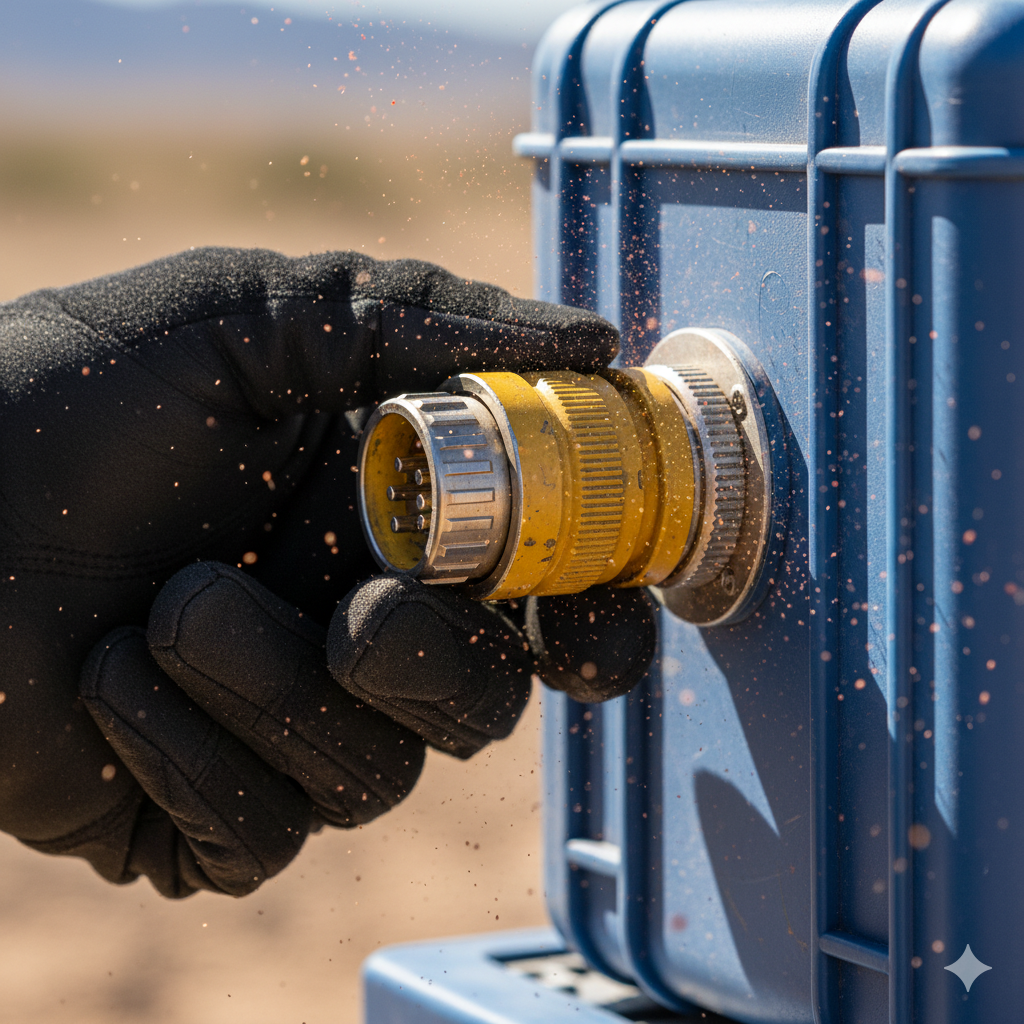
When you land at the site, you don’t need an IT degree. You connect the Yellow Cable to the Blue Case, the Blue Cable to the Black Case, and you flip the switch.

Remnant:
Let us analyze the anatomy of the stack.

🟡 Case 1: The Lungs (Power)

Energy is the currency of the edge. The Yellow Module does not care where the power comes from. It ships with a 400W Military-Grade Foldable Solar Blanket. Unfold it, point it at the sky, and you are online.

Inside, a high-density LiFePO4 battery buffer cleans and stores that energy. Whether you are feeding it pristine solar or dirty power from a rusty diesel generator found in a village, the Yellow Case scrubs it, converts it to pure DC, and feeds the brain. It is the firewall against entropy.

🔵 Case 2: The Brain (Compute & Comms)

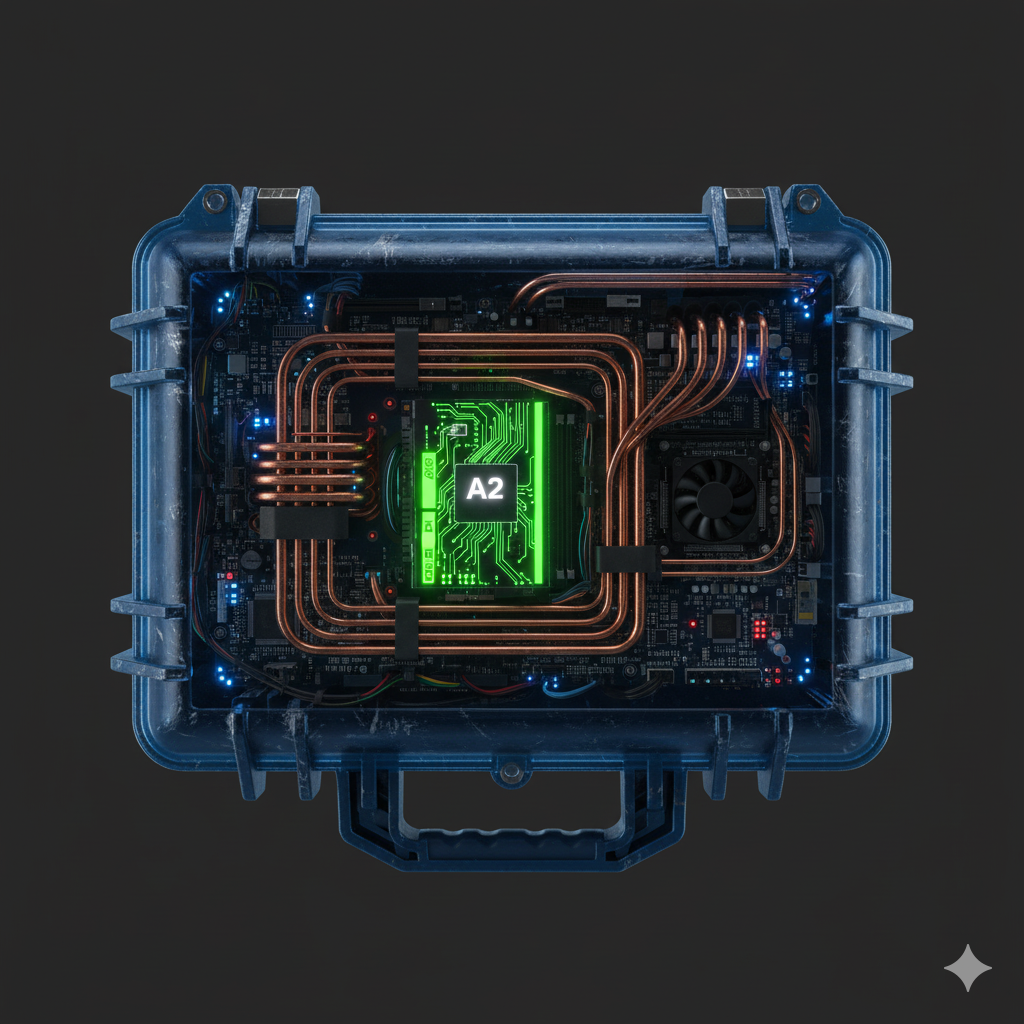
This is where the magic happens. We didn’t want a “toy” edge device. We packed a ruggedized Intel Xeon D-Series processor inside a fanless, sealed aluminum chassis.

But a CPU isn’t enough anymore. You need AI.
We integrated the NVIDIA A2 Tensor Core GPU.

Mike:
Why the A2? Because it’s the perfect balance. It sips power (60 Watts) but punches hard. It allows you to run computer vision, license plate recognition, and drone mapping locally. You aren’t sending video to the cloud—because there is no cloud where we’re going. The AI lives in the box.

Remnant:
Connectivity is also unified here. The Blue Case features an integrated Starlink Flat High-Performance interface and a Peplink 5G bonding router. It automatically hunts for a signal—Satellite, Cellular, or Wi-Fi—and bonds them into a single, unbreakable pipe.

⚫ Case 3: The Face (Interface)

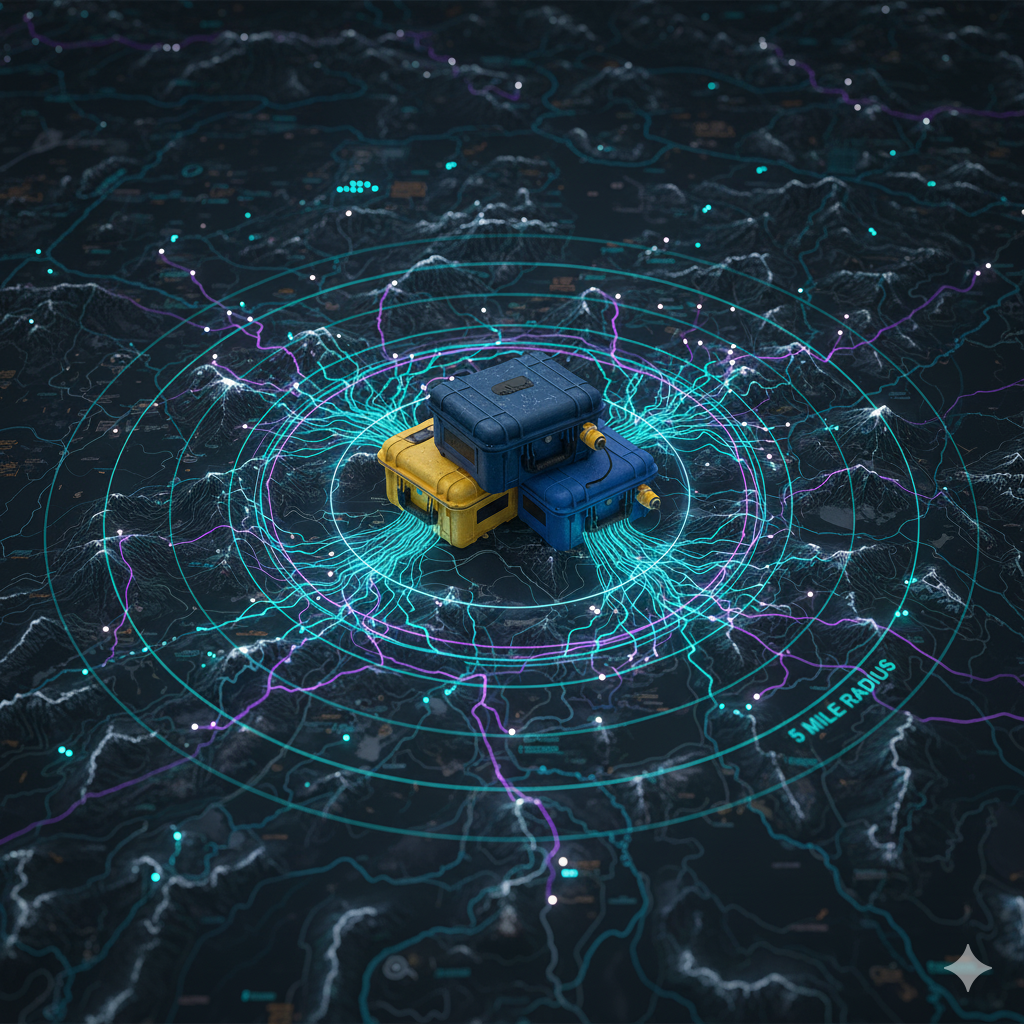
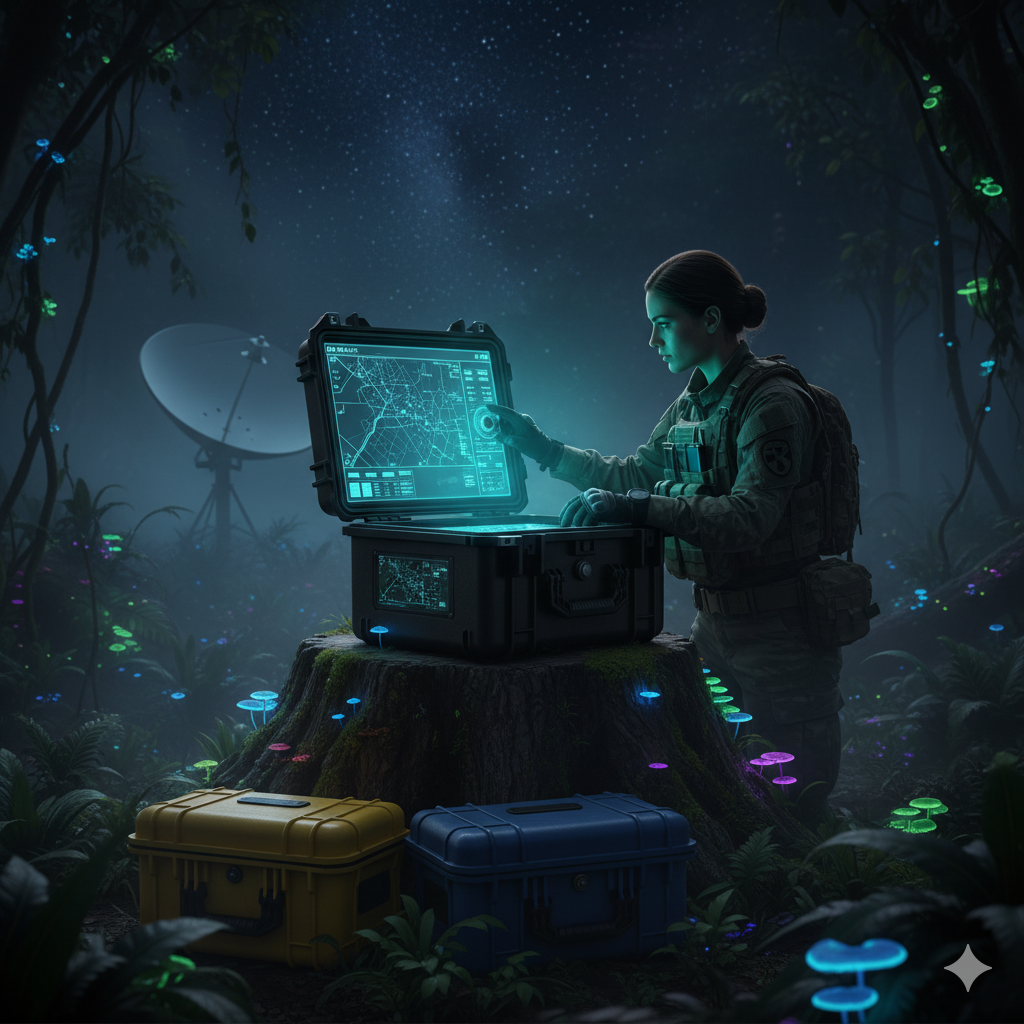
The Black Module is the Human-Machine Interface. A lid-mounted 22-inch high-brightness tactical display, weatherproof peripherals, and the RIOS NeoMesh Gateway. It broadcasts a sensor network up to 5 miles, allowing the Pilot to “feel” the terrain around it.


Why “Tier 1”? The Strategy of Scale.

Mike:
We call this the Tier 1 Expeditionary for a reason. It is the “First-In” unit.

Imagine a disaster zone. The grid is down. The cell towers are snapped in half. You can’t wait three weeks for a shipping container to arrive. You need boots on the ground now.

A team lands with the Pilot Expeditionary. Within 10 minutes, they have:

  1. Power (Solar).
  2. Comms (Starlink).
  3. Intelligence (Local AI processing victim data or flood maps).

This establishes the digital beachhead. Later, when the roads are clear, we truck in the Tier 2 (Standard) or Tier 3 (AI Core) containers to set up permanent infrastructure. But the Expeditionary unit gets the win today.


The Hard Truth About Hardware

Remnant:
A clarification on current market dynamics is required.

Mike:
Right. Transparency is key here. We looked at partnering with other hardware vendors. We looked at re-badging consumer tech. But at the end of the day, if I’m sending a unit to a hemp farm in the Rift Valley or a mining camp in the Yukon, I need to know—personally—that the thermal paste is applied correctly. I need to know the export compliance is airtight.

That’s why we brought this in-house. The RIOS Pilot Expeditionary is assembled, imaged, and stress-tested by DeReticular. It runs RIOS Sovereign OS. It is our hardware, built for our ecosystem.

This isn’t a white-labeled router. It’s a Sovereign Node.


The Bottom Line

Mike:
The world is getting more volatile, not less. The grid is getting more fragile, not stronger.
The centralized model of “build a massive power plant and run wires to everyone” is dying.

The future is decentralized. The future is modular. The future is a system that fits in the overhead bin, wakes up when it sees the sun, and puts the power of a data center in your hands.

This is the RIOS Pilot Expeditionary.
Put it in the Sun.


To configure your deployment or download the spec sheet, visit the Shop.

  • « Go to Previous Page
  • Page 1
  • Interim pages omitted …
  • Page 28
  • Page 29
  • Page 30
  • Page 31
  • Page 32
  • Interim pages omitted …
  • Page 55
  • Go to Next Page »

DeReticular

Copyright © 2026 · Monochrome Pro on Genesis Framework · WordPress · Log in