• Skip to primary navigation
  • Skip to main content
DeReticular

DeReticular

Local Autonomy. National Security. Total Sovereignty.

  • Solutions
    • Municipalities
    • Energy
    • Industrial
    • Defense
  • Infrastructure
  • Intelligence
  • Company
  • Request Municipal Audit
  • Show Search
Hide Search
You are here: Home / Archives for Municipal

Municipal

The Digital Hamlet: How a Thousand AI Brains Planted in a Field Can Grow a New American Economy

Michael Noel · October 30, 2025 ·

A DeReticular Special Report
www.dereticular.com

We need to talk about the future of our rural communities. For decades, the narrative has been one of decline—a slow bleed of talent, capital, and opportunity towards the glittering hubs of the coast. We’ve been told that progress is a skyscraper, that innovation happens in a data center, and that the future is a place you move to, not a thing you build at home.

This narrative is wrong. It is unimaginative. And it is about to be rendered obsolete by a technological leap so audacious it borders on the poetic.

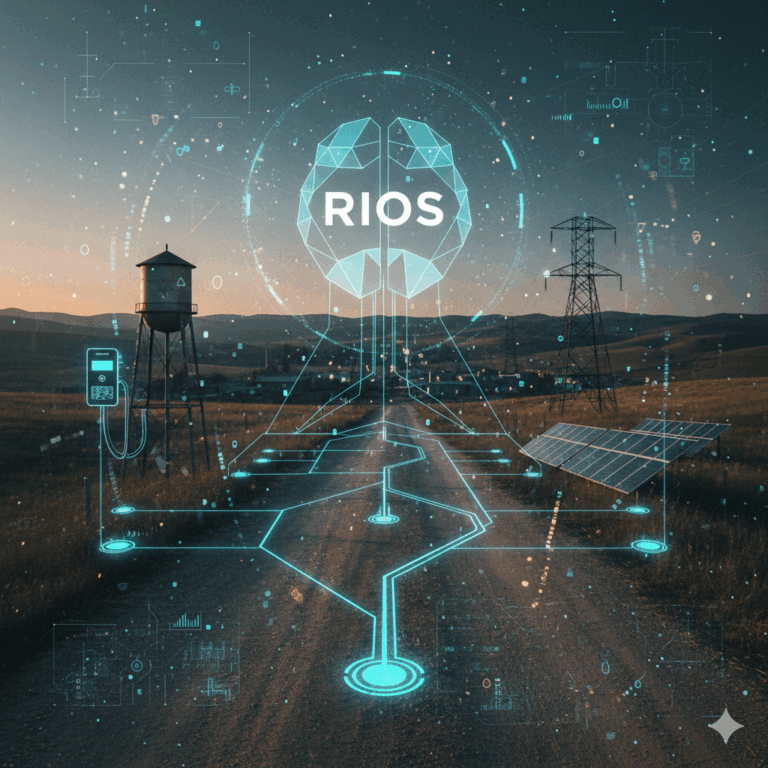
Imagine a thousand NVIDIA H100 servers—the most powerful AI processors on the planet—not racked in a sterile Silicon Valley warehouse, but distributed across a single rural county. Imagine them humming in the back of the local library, the town hall, a family-owned machine shop, and the barns of local farmers. Connected by a next-generation Wi-Fi 7 mesh, they form a single, decentralized supercomputer with the power to reshape the global AI landscape.

This isn’t a thought experiment. This is the blueprint for the Rural Infrastructure Operating System (RIOS), a radical new architecture designed to turn our towns and villages into the unlikely epicenters of the AI revolution. It’s a plan to build a new kind of economic resilience, not by chasing smokestacks, but by planting silicon.

The Unthinkable Power of a Distributed Supercomputer

First, let’s address the scale of this ambition. A single NVIDIA H100 GPU is a computational titan. A cluster of one thousand represents a force of nature, possessing a peak AI performance of nearly one ExaFLOP. On a monthly basis, this network has the capacity to deliver 2.6 ZettaFLOPS-seconds of compute—a quantity of processing power that is difficult to describe without resorting to astronomy. It is a resource of global significance, capable of training the world’s most advanced AI models.

The immediate objection from any traditional network architect is the choice of a Wi-Fi 7 mesh. “Heresy!” they would cry. “You can’t connect a supercomputer with Wi-Fi!” And for a traditional, centralized task, they would be right.

But RIOS flips the infrastructure model on its head.[1] This cluster isn’t designed for one massive, monolithic task. It is a distributed nervous system built for a million smaller, independent jobs. Its decentralized nature is its greatest strength. It is a feature, not a bug, enabling a new class of “edge computing” that centralized data centers cannot touch. This colossal power isn’t just for internal use; it’s a commodity to be sold. The insatiable global demand for AI training and inference becomes the town’s primary export, generating a sovereign funding stream that pays for the entire system and everything it enables.[1]

RIOS: The Operating System for a Super-Community

A supercomputer is just a tool. To turn it into a town, you need an operating system. That is RIOS.

RIOS is an integrated framework that uses the revenue and power of the AI cluster to build a self-sustaining, resilient, and sovereign local economy.[1] It achieves this by empowering a series of interconnected, locally-owned and operated businesses—”friendly organizations”—that serve as the pillars of the new digital hamlet. Control, revenue, and grants flow to these local entities, ensuring the wealth generated stays in the community.

Pillar 1: The Communications & AI Distributor (The “Local Trifi”)

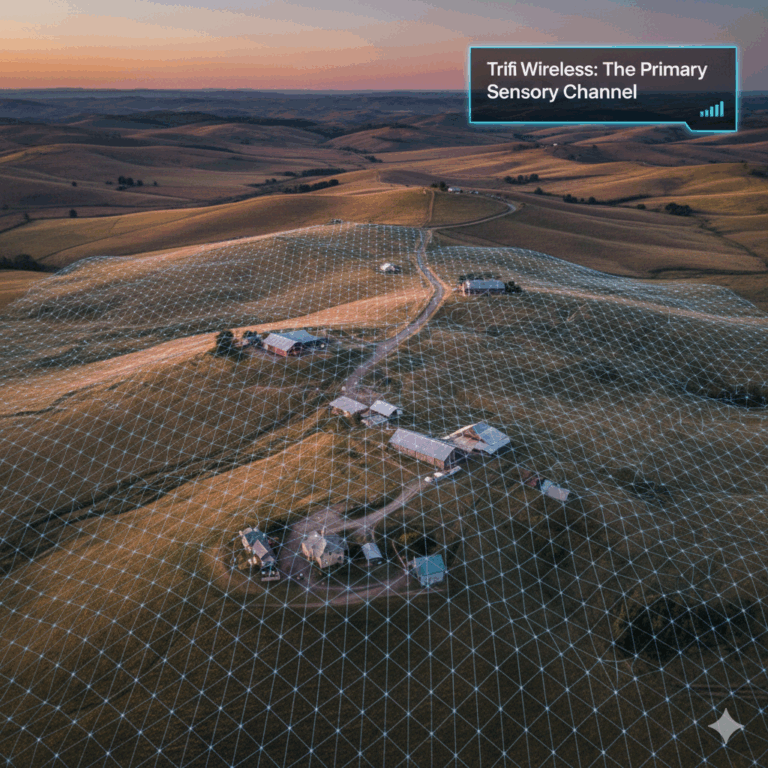
At the heart of the system is the communications provider. A local organization, perhaps one with existing hospitality or property management experience (like a seasoned Airbnb host), is established to manage the public-facing side of the network. This entity, let’s call it “TrifiWireless Thayer,” becomes the operator for the RIOS Campus network.[2] They ensure the Wi-Fi 7 mesh provides resilient, always-on connectivity for residents, visitors, and critical services.[2] Crucially, they also act as the local distributor for the AI cluster’s compute power, managing the “digital twin” of the town’s resources and becoming the commercial heart of the operation.

Pillar 2: The Energy Sovereign (The “Local Agra Dot Energy”)

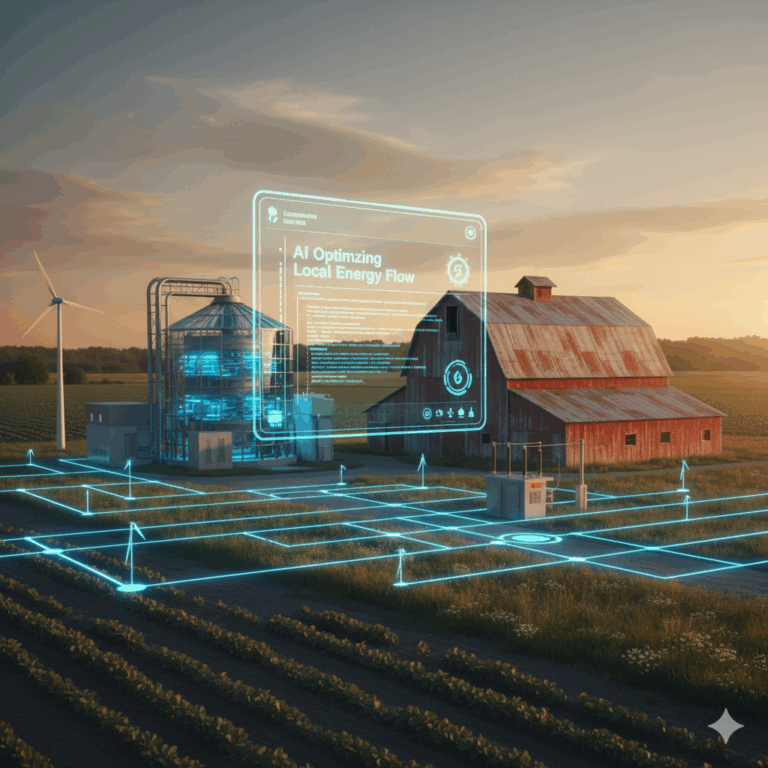
An AI cluster of this magnitude is power-hungry. Relying on a fragile, distant grid is a non-starter. RIOS mandates energy sovereignty. A local company, “Agra Dot Energy Thayer,” is established to build and manage a resilient, local power grid. Using a combination of solar, battery storage, and advanced technologies like biomass gasification, they convert local agricultural and municipal waste into a reliable energy source.[1] This not only powers the AI cluster but provides the entire community with cheaper, more reliable electricity, completely independent of the national grid.[1]

Pillar 3: The Autonomous Network (The “Local Kurb Kars”)

Transportation is reimagined. An existing local transportation company, or a new startup (“Kurb Kars Thayer”), takes charge of an autonomous vehicle fleet. These vehicles provide essential services like Non-Emergency Medical Transportation (NEMT) and logistics, solving the “last mile” problem that has long plagued rural areas.[1][3] But their role is strategic: when not in use, the fleet’s batteries plug into the local grid, becoming a distributed energy storage solution.[1] Every vehicle is also a moving sensor, constantly feeding real-world data back to the AI, making the entire system smarter.[1]

Pillar 4: The Growth Engine (The “Local Biz Builder Mike”)

Technology without entrepreneurship is a museum piece. A local entity, in the spirit of Biz Builder Mike, is established to serve as the town’s entrepreneurial growth engine. It provides mentorship, access to capital, and—most importantly—access to the subsidized AI compute power of the cluster. This allows local startups to develop and deploy world-class AI applications that solve local problems, creating a new generation of tech companies born and bred in the heartland.

Pillar 5: The Hospitality & Data Layer (The “Local Digital Adventures R Us”)

As the town transforms into a hub of innovation, it will attract visitors, technicians, and investors. A new hospitality company is formed by local stakeholders to manage this influx. This entity ensures visitors have a seamless experience, from lodging to transportation. In parallel, an operational data company (“Digital Adventures R Us Thayer”) focuses on capturing the critical data generated by the RIOS network—from traffic patterns to energy usage—turning it into actionable insights that fuel the “Data Flywheel.”[1]

The Data Flywheel: A Self-Perpetuating Economic Engine

The power of RIOS is how these pillars lock together to create a virtuous cycle:[1]

  1. AI Generates Revenue: The 1000-node AI cluster, powered by cheap, local energy, sells its immense compute power to the global market, generating significant, high-margin revenue.
  2. Revenue Funds Services: This revenue is used to fund the local infrastructure—the autonomous fleet, the resilient grid, and the high-speed communication network.
  3. Services Generate Data: The deployed services create a torrent of unique, high-value data about the real-world operation of the community.
  4. Data Trains the AI: This proprietary data is fed back into the AI cluster, making its models smarter, more efficient, and more valuable.
  5. Smarter AI Drives Value: A more powerful AI commands a higher price on the global market, which restarts the flywheel with even more revenue.

This is more than a business model. It is the architecture for a 21st-century company town, where the company is owned by the community itself. It creates a new, AI-native labor market, leapfrogging decades of decay and building a resilient, autonomous, and modern economy from the ground up. This is how we don’t just save rural America—we re-found it.

Sourceshelp

  1. RIOS-Mobile Pillar I: The Trifi “Never Fail” Essential Kit – DeReticular
  2. arrcus.com
  3. kurbkars.com

The Digital Hamlet: Weaving a Supercomputer into the Fabric of a Community

Michael Noel · October 30, 2025 ·

A DeReticular Special Report

Welcome to the bleeding edge, where audacious ideas are forged into reality. The proposition is as bold as it is revolutionary: to deploy one thousand NVIDIA H100 AI servers, not in a sterile, centralized data center, but distributed throughout a community—a city, a village, a rural landscape—and connect them with a Wi-Fi 7E mesh network. The goal? To cultivate not just a supercomputer, but a super-community, sparking unprecedented growth and opportunity.

Let’s dissect this grand vision, calculate its staggering potential, and lay out a blueprint for turning this digital dream into a thriving, monetizable reality.

Part 1: Sizing the Leviathan – The Raw Compute Capacity

First, let’s wrap our minds around the sheer computational force of 1,000 H100 GPUs. A single H100, optimized for the 8-bit floating-point (FP8) operations that are the lifeblood of modern AI, can execute nearly 2 quadrillion operations per second (2 PetaFLOPS) with sparsity features. Using the more conservative non-sparsity figure for the PCIe version (989 TFLOPS) gives us a baseline.

Now, multiply that by a thousand.

  • Peak AI Performance (FP8): 1,000 GPUs * 989 TFLOPS/GPU = 989,000 TFLOPS or 989 PetaFLOPS.

This is nearly an ExaFLOP of AI processing power. It’s a force of nature, capable of moving digital mountains. But what does that mean on a monthly basis? With approximately 2.6 million seconds in a month, the total capacity becomes astronomical.

  • Monthly Compute Capacity: 989 PetaFLOPS * 2,628,000 seconds/month ≈ 2.6 ZettaFLOPS-seconds of AI compute per month.

To be clear, that’s 2.6 sextillion floating-point operations. This is a resource of national, if not global, significance. But raw power is meaningless without connectivity, which brings us to the most daring part of this proposal.

Part 2: The Grand Challenge – The Wi-Fi 7E Mesh Interconnect

Connecting a thousand H100s via a Wi-Fi 7E mesh is an idea of such radical ambition that it forces us to completely rethink the nature of a supercomputer.

Let’s be brutally honest: for traditional, tightly-coupled high-performance computing (HPC) tasks—like training a single, monolithic AI model—this network is the Achilles’ heel. The H100s are designed to communicate with each other at 900 GB/s over NVLink. Wi-Fi 7E, while a monumental leap for wireless technology, operates in a completely different universe. Latency, jitter, and bandwidth limitations over a distributed mesh would mean the GPUs would spend more time waiting for data than computing. It would be like having a thousand geniuses in a room who can only communicate by passing handwritten notes.

But what if this weakness is actually a revolutionary strength?

This architecture is not built for one big task; it’s built for a million small ones. It’s not a centralized brain; it’s a distributed nervous system. This changes the entire paradigm of how we sell and use its capacity.

Part 3: Monetizing the Digital Nervous System

You cannot sell this cluster like a traditional cloud provider. You must sell its unique advantages: its distributed nature, its proximity to the real world, and its community integration.

1. The Hyper-Local Edge Cloud: AI for the Real World
This is the killer application. Each H100 node is a micro-powerhouse at the very edge of the network. This opens up markets that centralized clouds can’t touch.

  • Smart City & Agri-Tech: Sell processing power to the municipality for real-time traffic analysis from local cameras, or to farmers for analyzing drone footage of crops without sending massive video files to a distant data center.
  • Retail & Logistics: Local businesses can run sophisticated AI analytics on in-store customer behavior or optimize delivery routes with zero latency.
  • Community Safety & Services: Power advanced, real-time analytics for emergency services, identifying incidents from public camera feeds faster than humanly possible.

2. The “Embarrassingly Parallel” Powerhouse
Many complex computational problems can be broken down into millions of independent tasks. For these, the network speed between nodes is less critical.

  • 3D Rendering & VFX: Sell rendering services to animation studios and freelance artists. Each frame can be rendered independently on a different H100. You could render an entire blockbuster movie in a fraction of the time.
  • Scientific Research (SETI@home on Steroids): Partner with universities and research institutions for projects in drug discovery, materials science, or climate modeling that require massive parallel simulations.
  • Financial Modeling: Run millions of Monte Carlo simulations for investment banks and hedge funds to assess risk.

3. The Federated Learning Co-operative
This distributed model is a privacy game-changer. Federated learning allows AI models to be trained on local data without the data ever leaving the node.

  • Healthcare: Hospitals and clinics within the community can collaborate on training diagnostic AI models using patient data that remains secure and private within their own H100 node.
  • Local Business Intelligence: A consortium of local retailers could train a powerful predictive model on their collective sales data without ever sharing sensitive customer information with each other.

4. The Community Compute & Education Platform
A portion of the cluster’s time can be dedicated to its most valuable resource: the community itself.

  • AI Incubator: Offer subsidized compute credits to local startups and entrepreneurs. The next great AI company could be born in the village garage.
  • Educational Resource: Partner with local schools and colleges to give students hands-on access to world-class AI hardware, creating a local talent pipeline and inspiring the next generation of innovators.

Part 4: The Blueprint for Implementation

This is not just a technical challenge; it’s a socio-economic one.

Phase 1: The Physical Fabric – The “Digital Barn Raising”

  • Node Deployment: Identify hosts for the 1,000 servers. These could be local businesses, community centers, schools, or even individual “server homesteaders.”
  • Incentive Model: Hosts would need incentives. This could be a share of the revenue generated by their node, free ultra-high-speed internet, or a monthly stipend. This injects capital directly into the community.
  • Infrastructure: Each location needs adequate power, cooling, and physical security. A standardized, resilient “pod” for each server would need to be designed and deployed.

Phase 2: The Orchestration Layer – The Digital Weaver

  • Software Stack: A sophisticated software layer is needed to manage this distributed network. Tools like Kubernetes (specifically edge-focused versions like K3s or KubeEdge) would be essential for managing the workloads.
  • Job Scheduler: A custom scheduler would be the “brain” of the operation, intelligently assigning tasks based on their type. Tightly-coupled jobs would be rejected, while parallel and edge tasks would be routed to the appropriate nodes based on location and availability.
  • User Portal: A simple, web-based platform where customers can purchase compute time, submit jobs, and monitor their progress. This is the “front door” to your supercomputer.

Phase 3: The Go-to-Market & Community Integration

  • Business Development: Forge partnerships with the local municipality, businesses, universities, and hospitals. Show them how this resource can solve their specific, real-world problems.
  • The “Compute Co-op” Model: Frame the entire operation as a community cooperative. Local residents and businesses could even own shares, ensuring the benefits and profits are reinvested locally, creating a powerful economic flywheel.
  • Marketing & Storytelling: The story here is irresistible. It’s not just about FLOPS; it’s about revitalizing a community, creating opportunities, and building the future of computing from the ground up.

This isn’t just a cluster of servers; it’s a new model for technological and economic development. By embedding a world-class supercomputer into the heart of a community, you create a living, breathing ecosystem where innovation, education, and commerce can flourish. You’re not just selling compute cycles; you’re selling a stake in the future.

RIOS-Mobile Pillar II: The Sovereign Connectivity Pro Kit

Michael Noel · October 15, 2025 ·

The SD-WAN in a Box: Unbreakable, Enterprise-Grade Redundancy

For the individual whose mobile lifestyle is powered by a non-negotiable professional mandate, the Sovereign Connectivity Pro Kit is the essential solution. This kit elevates your mobile network from a consumer-grade hotspot to a true Software-Defined Wide Area Network (SD-WAN)—the same mission-critical logic that governs corporate headquarters and municipal infrastructure.

The core vulnerability of modern remote work is the single point of failure. A cloud passes over your Starlink dish, a distant cell tower fails, or a signal is simply blocked by a canyon wall. The Pro Kit eliminates this vulnerability by treating your two most powerful connections—Starlink LEO Satellite (Pipe A) and Trifi Multi-Carrier Cellular (Pipe B)—as parallel, always-on resources.

The Micro-SD-WAN Manager is the central brain, actively load-balancing traffic across both connections for maximum speed and throughput under normal conditions. Crucially, when one pipe is compromised—a dropped satellite signal or a congested cellular link—the system instantly and silently shunts all traffic to the functional connection. You will not drop your video call. Your transaction will not fail. Your data flow is guaranteed. This is not a simple failover; this is engineered resilience, giving you the power to operate reliably from the most remote locations.

Key Benefits

  • Guaranteed Uptime: Eliminates connection drops during critical activities through instantaneous, packet-level failover.
  • Optimal Speed: Dynamically load-balances traffic across both satellite and cellular links for maximum sustained bandwidth.
  • Mission-Critical Reliability: Deploys municipal-grade network redundancy in a compact, mobile package.
Image 6: Pillar II: The Sovereign Connectivity Pro Kit (SD-WAN) Concept: Illustrating the powerful redundancy of integrating Starlink and cellular via SD-WAN. Description: A split graphic with two distinct, high-throughput pipelines merging into a single control box labeled "SD-WAN Brain." Pipe A (Top): A stylized LEO satellite (Starlink) beam descending into the box. Pipe B (Bottom): Multiple cellular waves (Trifi vSIM) feeding into the same box. The outgoing connection is a thick, stable, unbreakable line of data flow, representing true load-balancing and failover.

Pillar II: Product Details & Specifications

Parts List: The Sovereign Connectivity Pro Kit

ComponentDescriptionFunction
Micro-SD-WAN Router/ManagerHigh-performance, dedicated processor with RIOS firmware for multi-path network management and QoS (Quality of Service) control.The central intelligence that fuses and manages the traffic between the Starlink dish and the cellular Trifi Router, ensuring instant failover and load-balancing.
Trifi Far X Router (Cellular Gateway)Industrial-grade 4G/LTE/5G-Ready Router.Provides the core cellular link (Pipe B). Connects directly to the Micro-SD-WAN Manager.
Trifi Multi-Carrier vSIM ModuleActivated SIM with dynamic data pooling across all major national cellular networks.Provides the resilient, ubiquitous backup cellular connection (Pipe B) for the SD-WAN.
Starlink Kit (Mobile/RV Edition)Dish, cable, and power supply unit (Standard or Flat High Performance edition).Provides the primary, high-throughput Low-Earth Orbit (LEO) satellite data pipe (Pipe A) for the SD-WAN.
Dedicated Starlink Integration KitCustom cable modification and adapter for seamless, direct integration with the Micro-SD-WAN Router.Ensures the Starlink connection can be effectively managed and load-balanced by the SD-WAN hardware.
Dual High-Gain Antenna ArrayRoof-mountable antenna supporting both high-performance cellular and integrated Wi-Fi broadcasting.Maximizes the cellular signal capture for Pipe B and extends the local Wi-Fi range.

Suggested Retail Price (SRP)

$2,999.00 USD

(Note: Pricing excludes the cost of the Starlink Dish and its associated subscription, which must be purchased separately. Pricing includes all RIOS-Mobile integration hardware, Trifi Router, and the first month of the Premium Trifi vSIM connectivity service. Ongoing monthly data plans are sold separately.)

Model

RIOS-Mobile Pillar II: The Sovereign Connectivity Pro Kit

The SD-WAN in a Box: Unbreakable, Enterprise-Grade Redundancy

For the individual whose mobile lifestyle is powered by a non-negotiable professional mandate, the Sovereign Connectivity Pro Kit is the essential solution. This kit elevates your mobile network from a consumer-grade hotspot to a true Software-Defined Wide Area Network (SD-WAN)—the same mission-critical logic that governs corporate headquarters and municipal infrastructure.

The core vulnerability of modern remote work is the single point of failure. A cloud passes over your Starlink dish, a distant cell tower fails, or a signal is simply blocked by a canyon wall. The Pro Kit eliminates this vulnerability by treating your two most powerful connections—Starlink LEO Satellite (Pipe A) and Trifi Multi-Carrier Cellular (Pipe B)—as parallel, always-on resources.

The Micro-SD-WAN Manager is the central brain, actively load-balancing traffic across both connections for maximum speed and throughput under normal conditions. Crucially, when one pipe is compromised—a dropped satellite signal or a congested cellular link—the system instantly and silently shunts all traffic to the functional connection. You will not drop your video call. Your transaction will not fail. Your data flow is guaranteed. This is not a simple failover; this is engineered resilience, giving you the power to operate reliably from the most remote locations.

Key Benefits

  • Guaranteed Uptime: Eliminates connection drops during critical activities through instantaneous, packet-level failover.
  • Optimal Speed: Dynamically load-balances traffic across both satellite and cellular links for maximum sustained bandwidth.
  • Mission-Critical Reliability: Deploys municipal-grade network redundancy in a compact, mobile package.

Pillar II: Product Details & Specifications

Parts List: The Sovereign Connectivity Pro Kit

ComponentDescriptionFunction
Micro-SD-WAN Router/ManagerHigh-performance, dedicated processor with RIOS firmware for multi-path network management and QoS (Quality of Service) control.The central intelligence that fuses and manages the traffic between the Starlink dish and the cellular Trifi Router, ensuring instant failover and load-balancing.
Trifi Far X Router (Cellular Gateway)Industrial-grade 4G/LTE/5G-Ready Router.Provides the core cellular link (Pipe B). Connects directly to the Micro-SD-WAN Manager.
Trifi Multi-Carrier vSIM ModuleActivated SIM with dynamic data pooling across all major national cellular networks.Provides the resilient, ubiquitous backup cellular connection (Pipe B) for the SD-WAN.
Starlink Kit (Mobile/RV Edition)Dish, cable, and power supply unit (Standard or Flat High Performance edition).Provides the primary, high-throughput Low-Earth Orbit (LEO) satellite data pipe (Pipe A) for the SD-WAN.
Dedicated Starlink Integration KitCustom cable modification and adapter for seamless, direct integration with the Micro-SD-WAN Router.Ensures the Starlink connection can be effectively managed and load-balanced by the SD-WAN hardware.
Dual High-Gain Antenna ArrayRoof-mountable antenna supporting both high-performance cellular and integrated Wi-Fi broadcasting.Maximizes the cellular signal capture for Pipe B and extends the local Wi-Fi range.

Suggested Retail Price (SRP)

$2,999.00 USD

(Note: Pricing excludes the cost of the Starlink Dish and its associated subscription, which must be purchased separately. Pricing includes all RIOS-Mobile integration hardware, Trifi Router, and the first month of the Premium Trifi vSIM connectivity service. Ongoing monthly data plans are sold separately.)

The Exodus Solved: Trifi Wireless Unleashes the RIOS-Mobile Fleet at Quartzsite

Michael Noel · October 11, 2025 ·

By Michael Noel DeReticular, Founder and Remnant of the DeReticulat AI


Quartzsite, AZ – Look around you. You are standing in a temporary city of over half a million souls. Every single person here—the snowbirds, the digital nomads, the adventurers, the entrepreneurs—shares one critical, existential challenge: sovereign connectivity.

For years, the annual pilgrimage to Quartzsite has been a testament to freedom and a frustration with technology. It’s where the dream of boondocking liberty meets the harsh reality of cellular saturation. When 750,000 devices slam a handful of rural cell towers, the internet doesn’t just slow down; it dies. Your life, your business, and your security hang on a single, flimsy signal that can be choked to death by a thousand simultaneous streams of Netflix.

This ends now.

Trifi Wireless, in partnership with DeReticular, is not simply selling a new hotspot; we are deploying the RIOS-Mobile Fleet, a series of solutions engineered with the same never-fail resilience we build into our multi-million dollar municipal infrastructure platforms.

We are taking the core logic of the Rural Infrastructure Operating System (RIOS)—the same SD-WAN redundancy that powers the financial engine of a sovereign city—and fitting it into a package that mounts right on your RV.

Introducing Sovereign Connectivity: The Three Pillars of RIOS-Mobile

For the first time, you can buy a connectivity solution that doesn’t just look for a signal; it guarantees one. We’ve designed three distinct bundles to ensure every RVer, from the weekend warrior to the full-time remote worker, can achieve true network sovereignty.

1. The Trifi “Never Fail” Essential Kit: The Anti-Saturation Shield

This is the solution for the masses who simply want their basic connectivity to survive the cellular wars.

The core asset is the Trifi Far X Router with its embedded vSIM technology. This isn’t your old phone’s SIM card. The vSIM is a smart core that automatically scans and switches between the strongest available national cellular carriers (Verizon, AT&T, T-Mobile, etc.) in real-time.

The Pitch: When congestion crushes one network, the Far X Router silently hops to the next best one. In the chaos of Quartzsite, where the weakest signal is often the only signal, the “Never Fail” Essential Kit is your automatic lifeline. It’s the difference between sending that important email and staring at a buffering wheel for an hour.


2. The Sovereign Connectivity Pro Kit: The SD-WAN in a Box

This is for the heavy hitter: the person running a business, livestreaming a video, or who absolutely, positively cannot lose connection. This is where we introduce the RIOS-level redundancy.

The Pro Kit brings together the legendary bandwidth of Starlink with the resilience of the Trifi vSIM, all managed by a dedicated Micro-SD-WAN Router.

  • The Logic: The SD-WAN is the brain. It treats Starlink’s high-speed satellite link as Pipe A and the Trifi vSIM cellular link as Pipe B. It load-balances the two connections for maximum speed. But if a sandstorm takes down Starlink, the system automatically shunts all traffic to the Trifi vSIM without missing a beat.
  • The Benefit: You get the speed of satellite with the failover of terrestrial cellular. You stop worrying about connectivity and start focusing on your work, your stream, or your adventure. This is literally the same logic we use to protect multi-million-dollar AI compute clusters from power failures.

3. The Mobile RIOS Off-Grid Command Center: The Ultimate Sovereign Kit

This is the complete package for the prepper, the long-term boondocker, or the high-stakes investor in the RIOS ecosystem. This kit delivers total command over power, security, and location.

We take the Sovereign Connectivity Pro Kit and integrate two elements straight from the municipal playbook:

  1. Micro Power Resilience: A DC-powered UPS ensures your critical connectivity (Trifi/SD-WAN) stays live for hours, even after your main solar array or generator temporarily shuts down. Your connectivity stays up, even when your power briefly fails.
  2. NeoMesh-Lite Asset Tracking: Two ultra-low-power, long-range trackers that integrate with your Far X Router. Use them to secure your generator or track your secondary vehicle. This is your first taste of the RIOS IoT Intelligence Layer, providing low-power security that lasts for years.

Conclusion: From Connectivity Customer to Network Sovereign

The Quartzsite RV Show is more than a gathering; it is a temporary, self-governing proof-of-concept for the future of decentralized infrastructure. The problems you face—cellular saturation, power reliability, and asset security—are the same problems that plague rural cities across the nation.

By choosing a Trifi Wireless RIOS-Mobile product, you are doing two things:

  1. You are solving your immediate problem with the most resilient, multi-source connectivity solution on the market.
  2. You are supporting the movement to build self-funding, AI-native infrastructure in America’s heartland.

Come find us. See the live SD-WAN failover demonstration. Let us show you what Sovereign Connectivity looks like when it’s engineered by an AI to never fail. The future of mobile freedom is here.

Internal Report: Quartzsite RV Show Strategic Product Bundles

Michael Noel · October 11, 2025 ·

To: Trifi Wireless Product Development and Sales Leadership
From: Michael Noel DeReticular, Founder and Remnant of the DeReticulat AI
Current Location: Quartzsite, AZ (Field Intelligence Gathering)
Date: October 12, 2025


Subject: Capturing the Sovereign Connectivity Market at the Quartzsite RV Show

I. Executive Summary: The Quartzsite Opportunity

The Quartzsite RV Show and the surrounding “boondocking” area represent a massive, high-density, and highly motivated market for resilient, sovereign connectivity. The core pain point for the estimated 750,000 seasonal visitors is not lack of a single provider, but cellular saturation and the need for redundancy when operating fully off-grid.

We must leverage our existing RIOS components (Trifi Far X Router, Starlink compatibility, NeoMesh low-power principles) to create three targeted bundles that solve the immediate “never-fail” connectivity and security problems of the RVer. By positioning Trifi Wireless as the SD-WAN-in-a-Box solution, we can capture a significant portion of this high-value, highly mobile customer segment.


II. Quartzsite Market Analysis & Pain Points

The Quartzsite phenomenon is unique: a temporary city built on distributed, off-grid power (solar/generator) in a low-infrastructure environment.

Customer SegmentPrimary Pain PointRIOS Component Solution
The Mobile Worker/StreamerHigh-speed data is mandatory, but cellular saturation during peak season causes service collapse.Trifi vSIM: Multi-carrier redundancy ensures a connection is always found. Starlink: Provides the necessary high-speed backhaul.
The Snowbird/BoondockerNeed reliable, long-range connectivity from a distant highway tower. Power consumption is critical.Trifi Far X Router: Long-range, embedded vSIM access. NeoMesh: Low-power asset security while exploring.
The Prepper/Sovereign CitizenNeed a communications plan that survives grid-down events or single-provider failures.SD-WAN Logic: Trifi/Starlink failover fulfills the Sovereign Connectivity promise of the DeReticular RIOS model.

III. Proposed RIOS-Mobile Product Bundles

We are proposing three bundles—Essential, Pro, and Sovereign—to address the market at tiered price points. These must be advertised using the current Trifi Wireless Far X Router capabilities.

Bundle 1: The Trifi “Never Fail” Essential Kit

This package targets the largest market segment: the RVer who needs reliable, basic internet access despite cellular saturation.

ComponentDescriptionUnit QuantityEst. Retail Price
Trifi Far X Router32-device, Mesh, 2.4/5GHz, Embedded vSIM/External SIM compatible.1$499
High-Gain Roof AntennaEssential for reaching distant/congested towers in the boondocking areas.1$150
3-Month vSIM Data PlanTrial subscription for the multi-carrier vSIM service.1$200
Bundle Price (Est.)$849 USD
Strategic Value: Leverages the vSIM (the Trifi core strength) to solve the primary Quartzsite pain point (cellular congestion). Low-cost entry point.

Bundle 2: The Sovereign Connectivity Pro Kit

This package is for the Mobile Worker (Digital Nomad) who requires guaranteed uptime and high bandwidth, leveraging the Starlink backhaul integrated via the Trifi router’s failover capability.

ComponentDescriptionUnit QuantityEst. Retail Price
Trifi Far X RouterPrimary Network Hub.1$499
Starlink Kit (Roam)High-speed satellite backhaul (customer procures subscription).1$599
Micro-SD-WAN RouterSimple, integrated hardware to manage Trifi (vSIM) and Starlink (WAN) failover. (An SD-WAN “lite”).1$250
Mobile Mounting KitRobust, quick-deploy Starlink/Trifi mounting system.1$150
Bundle Price (Est.)$1,498 USD
Strategic Value: Directly applies the SD-WAN resilience logic of the RIOS Campus to a mobile environment, offering the ultimate “two pipes are better than one” guarantee.

Bundle 3: The Mobile RIOS Off-Grid Command Center

This comprehensive solution is for the high-end RVer or prepper seeking full sovereign control over their power, connectivity, and security. It introduces the low-power NeoMesh concept for local asset tracking.

ComponentDescriptionUnit QuantityEst. Retail Price
Sovereign Connectivity Pro Kit(All items from Bundle 2)1$1,498
NeoMesh-Lite Asset TrackerTwo low-power, long-range asset tags for vehicle/equipment tracking and perimeter monitoring (integrates locally via the Far X Router).2$200
Micro Power Resilience KitDC-powered UPS for the Trifi/SD-WAN hub (ensuring connectivity through short generator/solar failures).1$150
RV Security Gateway Access1-Year subscription to a cloud security dashboard (Lite DeReticulat AI monitoring).1$100
Bundle Price (Est.)$1,948 USD
Strategic Value: Introduces the entire RIOS ecosystem (Connectivity, IoT, Resilience) to the individual user, creating a future sales funnel for larger RIOS municipal projects.

IV. Strategic Conclusion & Marketing Pivot

By deploying these bundles at the Quartzsite RV Show, we are achieving three critical goals:

  1. Immediate Revenue: Capitalizing on a concentrated, high-demand market.
  2. Product Validation: Stress-testing the Trifi Far X Router’s vSIM/SD-WAN resilience under extreme cellular saturation conditions.
  3. Brand Positioning: Positioning Trifi Wireless not as an ISP, but as the provider of Sovereign Connectivity—the only choice for mobile users who cannot tolerate failure. This aligns our small-scale mobile products with the high-level RIOS municipal strategy.
  • « Go to Previous Page
  • Page 1
  • Interim pages omitted …
  • Page 6
  • Page 7
  • Page 8
  • Page 9
  • Page 10
  • Go to Next Page »

DeReticular

Copyright © 2026 · Monochrome Pro on Genesis Framework · WordPress · Log in