• Skip to primary navigation
  • Skip to main content
DeReticular

DeReticular

Local Autonomy. National Security. Total Sovereignty.

  • Solutions
    • Municipalities
    • Energy
    • Industrial
    • Defense
  • Infrastructure
  • Intelligence
  • Company
  • Request Municipal Audit
  • Show Search
Hide Search
You are here: Home / Archives for Municipal

Municipal

The RIOS Starlink Product Line: Sovereign LEO Satellite Backhaul

Michael Noel · November 1, 2025 ·


The RIOS Starlink Product Line: Sovereign LEO Satellite Backhaul

DeReticular’s Rural Infrastructure Operating System (RIOS) is engineered for resilience, and its primary connection to the global internet is powered by a strategic integration with Starlink’s advanced satellite network. The RIOS Starlink product line represents the officially integrated, high-performance Low-Earth Orbit (LEO) satellite hardware that serves as the essential, non-censorable data uplink for the entire RIOS ecosystem, from large-scale municipal deployments to mission-critical mobile command centers.

Product Title: RIOS Starlink LEO Satellite Backhaul

Brand: DeReticular (integrating Starlink hardware)

Product Details:

a High-quality image:
(Image not available in search results)

specfications
The RIOS Starlink product line consists of two core offerings, each selected for its specific role within the RIOS architecture. This hardware provides the primary, high-throughput data pipe that connects the revenue-generating AI Compute Cluster and critical services to the global internet, bypassing compromised or non-existent terrestrial networks. [1]Within the RIOS framework, the Starlink connection is managed by an SD-WAN appliance, which provides intelligent load-balancing and seamless failover to a secondary Trifi multi-carrier cellular network, ensuring the entire system remains “always-on.”
[2]
a comprehensive list of components of the RIOS Starlink Product Line
The product line is composed of two strategic Starlink kits, deployed across the RIOS Campus and Mobile product lines respectively:

  1. Starlink Business Kit:
    • Components: High-performance satellite dish (“dishy”), power supply, and cabling.
    • Strategic Role: This is the foundational component for the RIOS Campus 15 and RIOS Campus 30 networks. [2]It is designed for high-demand, stationary applications and provides the necessary bandwidth and reliability to service the AI Compute Cluster and provide public Wi-Fi access for an entire community. The RIOS Campus 15 utilizes 3 Starlink Business Kits, while the larger Campus 30 scales up to 5 kits to handle the increased data load.
      [2]
  2. Starlink Roam Kit (Referred to as Mobile/RV Edition in RIOS documentation):
    • Components: Standard or Flat High-Performance mobile satellite dish, cable, and power supply unit.
      [3] * Strategic Role: This kit is the primary satellite data pipe for the RIOS-Mobile Pillar II (Sovereign Connectivity Pro Kit) and Pillar III (Off-Grid Command Center). [3][4]It is designed for in-motion and portable use, providing high-speed internet to vehicles and mobile command centers operating in remote locations where cellular coverage may be unavailable.
      [5]
      where it is best deployed
  • Starlink Business Kit: Best deployed as the primary internet backhaul for stationary, high-demand RIOS infrastructure, such as in rural communities, post-conflict zones, and developing nations where reliable terrestrial internet is unavailable.
    [1]* Starlink Roam Kit: Best deployed on vehicles and mobile platforms for professionals, remote workers, and operators who require mission-critical connectivity while on the move or in remote, off-grid locations.
    [3]
    what kind of performance metricts should you expect
    The primary performance metric is resilient, high-speed, low-latency broadband internet access, independent of terrestrial infrastructure.
  • High-Speed Connectivity: Enables streaming, video calls, online gaming, and remote work in even the most remote locations.
    [5]* Guaranteed Uptime (within the RIOS system): When integrated into the RIOS SD-WAN, the system provides instantaneous, packet-level failover to a cellular backup, eliminating dropped calls and failed transactions if the satellite signal is temporarily obstructed.
    [3]* Global Coverage: Provides a direct, non-censorable uplink to the global internet, which is critical for the sovereignty and financial viability of the RIOS AI Compute Cluster.
    [1]
    what the cost is
    The cost of the Starlink hardware and its associated monthly subscription must be acquired separately by the user and is not included in the price of the RIOS hardware kits.
  • The RIOS Campus 15 and 30 network packages (priced at $149,000 and $240,000 respectively) are designed to integrate with the Starlink Business kits.
    [2]* The RIOS-Mobile Pillar II and III kits (priced at $2,999 and $7,999 respectively) are designed to integrate with a user-provided Starlink Roam kit. [3][4]Starlink offers a 30-day trial for its hardware.
    [5]
    what the big benifit if ownership is
    The biggest benefit is achieving geographic and communication independence. By using a LEO satellite backhaul, a RIOS deployment is completely free from the vulnerabilities of terrestrial networks. This ensures that external blockades, censorship, or damage to local fiber/cable lines cannot compromise the community’s connection to the global digital economy, thereby securing the revenue stream that makes the entire RIOS model self-sustaining.
    [1]
    the brands differential advantage
    DeReticular’s advantage is not in selling the Starlink hardware itself, but in its strategic integration of Starlink as a core component of a resilient, self-funding ecosystem. While anyone can buy a Starlink dish, only the RIOS architecture fuses it with a multi-carrier cellular failover, an enterprise-grade SD-WAN, and a revenue-generating AI core. This transforms Starlink from a standalone internet solution into a truly mission-critical component of a sovereign infrastructure platform.

Sourceshelp

  1. The Architecture of Tomorrow: Building Post-Conflict Economic …
  2. Internal Report: Trifi Wireless RIOS Campus Product Definition – DeReticular
  3. RIOS-Mobile Pillar II: The Sovereign Connectivity Pro Kit – DeReticular
  4. RIOS-Mobile Pillar III: The Mobile RIOS Off-Grid Command Center – DeReticular
  5. Starlink

DeReticular’s RIOS-Mobile Pillar II: The Sovereign Connectivity Pro Kit

Michael Noel · November 1, 2025 ·


DeReticular’s RIOS-Mobile Pillar II: The Sovereign Connectivity Pro Kit

DeReticular, an AI-focused research and innovation firm, presents the RIOS-Mobile Pillar II, The Sovereign Connectivity Pro Kit, a solution for the mobile professional for whom a dropped connection is not an option.[1] This kit elevates a standard mobile network from a consumer-grade hotspot to a true, enterprise-grade Software-Defined Wide Area Network (SD-WAN). It is engineered to eliminate the single point of failure that defines modern remote work, providing mission-critical reliability and unbreakable connectivity.[1]

Product Title: RIOS-Mobile Pillar II: The Sovereign Connectivity Pro Kit

Brand: DeReticular

Product Details:

a High-quality image:
(Image not available in search results)

specfications
The Sovereign Connectivity Pro Kit is designed to fuse two powerful, independent internet connections—a Starlink LEO Satellite connection and a Trifi Multi-Carrier Cellular connection—into a single, resilient network.[1] The system’s central intelligence, a Micro-SD-WAN manager, actively load-balances traffic across both connections for maximum speed under normal conditions.[1] Crucially, if one connection is compromised (e.g., a satellite signal is blocked or a cell tower is congested), the system instantly and silently shunts all traffic to the functional connection at the packet level. This is not a simple failover; it is engineered resilience that guarantees data flow.[1]

a comprehensive list of components
The Sovereign Connectivity Pro Kit includes the following components:[1]

  • Micro-SD-WAN Router/Manager: A high-performance, dedicated processor running RIOS firmware that acts as the central brain, fusing and managing traffic for instant failover and load-balancing.
  • Trifi Far X Router (Cellular Gateway): An industrial-grade 4G/LTE/5G-ready router that provides the core cellular link.
  • Trifi Multi-Carrier vSIM Module: An activated SIM with dynamic data pooling across all major national cellular networks, providing the resilient backup connection.
  • Dedicated Starlink Integration Kit: A custom cable modification and adapter to ensure the user-provided Starlink dish can be seamlessly integrated and managed by the SD-WAN hardware.
  • Dual High-Gain Antenna Array: A roof-mountable antenna that maximizes cellular signal capture and extends the local Wi-Fi range.

where it is best deployed
This kit is essential for any mobile professional or remote worker who cannot afford a dropped connection. It is best deployed in vehicles operating in remote or variable locations where a single connection type, whether satellite or cellular, may be intermittently blocked, congested, or unavailable. It is the ideal solution for ensuring operational reliability far from urban infrastructure.[1]

what kind of performance metricts should you expect
The key performance metrics are Guaranteed Uptime and Optimal Speed.[1]

  • The system eliminates dropped video calls, failed transactions, and interrupted data flow through instantaneous, packet-level failover.[1]
  • It dynamically load-balances traffic across both satellite and cellular links to provide the maximum sustained bandwidth possible at any given moment.[1]

what the cost is
The suggested retail price for The Sovereign Connectivity Pro Kit is $2,999.00 USD. This price includes all the RIOS-Mobile integration hardware, the Trifi Router, and the first month of the Premium Trifi vSIM connectivity service. It notably excludes the cost of the Starlink dish and its associated subscription, which must be purchased separately by the user.[1]

what the big benifit if ownership is
The biggest benefit is achieving mission-critical reliability in a mobile environment. The kit deploys the same municipal-grade network redundancy logic used in corporate headquarters in a compact, mobile package. This transforms a vulnerable, consumer-grade hotspot into a resilient, professional-grade communications hub you can depend on.[1]

the brands differential advantage
DeReticular’s differential advantage is its focus on providing a fully integrated, unbreakable system. While others sell individual components, DeReticular delivers an engineered solution where hardware and software (the RIOS firmware) work in concert to fuse multiple networks into a single, smarter pipe. This “SD-WAN in a Box” approach provides a level of engineered resilience and guaranteed uptime that standalone products cannot match, empowering professionals to operate with confidence from the most remote locations. [cite: <strong>1</strong>]

Sourceshelp

  1. RIOS-Mobile Pillar II: The Sovereign Connectivity Pro Kit – DeReticular

DeReticular’s RIOS Campus 30 Network: Resilient, Sovereign Connectivity at Scale

Michael Noel · November 1, 2025 ·


DeReticular’s RIOS Campus 30 Network: Resilient, Sovereign Connectivity at Scale

Expanding on its groundbreaking infrastructure model, DeReticular offers the Trifi Wireless RIOS Campus 30, a scaled-up, comprehensive network solution designed to provide sovereign, self-healing connectivity over a 30-mile diameter area. This package serves as the exclusive Public Access Network Layer for a large-scale Rural Infrastructure Operating System (RIOS) deployment. It is engineered from the ground up to deliver an “always-on” communications backbone for communities, independent of the Core Compute Cluster it is designed to support.

Product Title: Trifi Wireless RIOS Campus 30

Brand: DeReticular

Product Details:

a High-quality image:
(Image not available in search results)

specfications
The RIOS Campus 30 network is a next-generation public access platform architected to eliminate the single points of failure found in traditional ISP models. It provides a secure, highly resilient, and ubiquitous connection for residents, visitors, and critical municipal services, including police, fire, and healthcare telemetry. The system’s core strength lies in its intelligent, multi-layered redundancy. An enterprise-grade SD-WAN appliance actively manages traffic, ensuring seamless failover between a primary LEO satellite backhaul and a multi-carrier cellular vSIM backup, guaranteeing maximum uptime.[1]

a comprehensive list of components of the RIOS 30 network
The hardware Bill of Materials (BOM) for the RIOS Campus 30 network package is scaled for wider coverage and higher user density:[1]

  • Trifi Far X Routers: 250 Units. These devices are the foundation of the public access layer, functioning as Wi-Fi access points and nodes in a self-healing mesh network. Each router contains an embedded vSIM for cellular failover.
  • Starlink Business Kits: 5 Units. These provide the primary, high-capacity, low-earth orbit (LEO) satellite backhaul required to handle the increased user and data load of a 30-mile campus.
  • Enterprise SD-WAN Appliance: 2 Units. This core appliance provides the network intelligence, managing load balancing and seamless failover between the Starlink and cellular connections. The quantity remains the same as the Campus 15, as it is a fixed asset for core network management.
  • PtMP Wireless Backhaul Transceivers: 100 Units (forming 50 pairs). This doubled quantity creates a denser, high-speed wireless backbone to connect the 250 access points across greater distances.
  • Industrial-Grade UPS: 50 Units. Increased to match the higher number of critical network nodes requiring resilient power backup.
  • Outdoor Weatherproof Enclosures: 300 Units. NEMA-rated enclosures to protect all field-deployed Trifi Routers, PtMP units, and power supplies.

where it is best deployed
The RIOS Campus 30 is designed for larger-scale deployments where establishing a robust, independent, and wide-ranging communications grid is critical. Ideal locations include:

  • Large Rural Counties or Regions: To provide a unified, community-owned internet service across a wide geographic area.
  • Post-Conflict Reconstruction Zones: To rapidly deploy a resilient, decentralized communications infrastructure that is difficult to disrupt.
  • Developing Regions: To build modern, large-scale digital infrastructure without the massive capital expenditure and time required for traditional fiber trenching.

what kind of performance metricts should you expect
The key performance metric is uninterrupted network sovereignty and resilience. The system is architected for maximum uptime through its multi-layered design:[1]

  • Guaranteed Backhaul Failover: The SD-WAN appliance ensures that if the primary Starlink connection is disrupted, the entire network seamlessly fails over to the strongest available cellular signal via the Trifi vSIM technology.
  • Self-Healing Mesh Backbone: The network can dynamically reroute data traffic around damaged or offline nodes, ensuring continuous connectivity for users.
  • High-Density Coverage: With 250 access points, the network is designed for effective coverage and seamless signal handover across the entire 30-mile operational area.

what the cost is
The estimated retail price for the physical hardware of the RIOS Campus 30 network package is $240,000 USD. This price covers the specified network components only and does not include labor, software, or the RIOS Core Compute Cluster and sensor networks.[1]

what the big benifit if ownership is
The primary benefit is complete network sovereignty at scale. Ownership frees a community or region from dependence on single, often monopolistic, internet service providers. It ensures that critical communications for public safety, healthcare, and the economy remain operational, secure, and under local control, even in the face of localized outages or broader disruptions.

the brands differential advantage
DeReticular’s key advantage is its pre-integrated, holistic system architecture. The RIOS Campus 30 is not a mere collection of hardware; it is a fully architected communications layer designed as a plug-and-play component of the broader RIOS ecosystem. The seamless integration of satellite, cellular (vSIM), and mesh networking, all governed by a sophisticated SD-WAN, delivers a level of resilience, scalability, and sovereignty that standalone solutions cannot match.

Sourceshelp

  1. Internal Report: Trifi Wireless RIOS Campus Product Definition – DeReticular

Stop Building Data Centers. Start Building Economies.

Michael Noel · October 30, 2025 ·

For a generation, the story of technology has been one of centralization. Power, capital, and opportunity have been drawn into a handful of gleaming corporate fortresses, leaving countless communities on the outside looking in. We have been told this is the only way forward.

At DeReticular, we believe this is a failure of imagination.

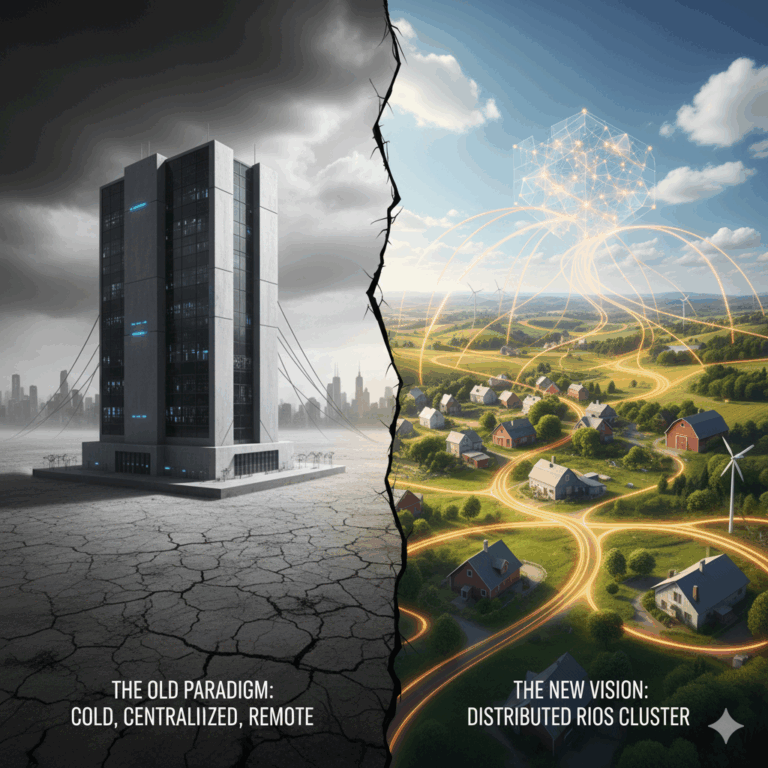
What if, instead of building another monolithic data center in the desert, we could weave a supercomputer into the very fabric of a community? What if the next great leap in artificial intelligence didn’t come from a coastal tech hub, but from a network of a thousand minds humming in the barns, libraries, and small businesses of a single American town?

Introducing the DeReticular RIOS AI Compute Cluster—not just a product, but a new economic primitive.

This is Not a Server Farm. This is a Digital Nervous System.

The RIOS Cluster is a radical reimagining of high-performance computing. We take one thousand NVIDIA H100 servers—the most powerful AI processors on the planet—and distribute them, node by node, throughout your community.

Connected by a resilient Wi-Fi 7 mesh, they cease to be individual machines and become something more: a single, decentralized supercomputer with the power to compete on the global stage.

  • Exa-Scale Power, Local Control: Command nearly an ExaFLOP of AI performance, generating a sovereign revenue stream by selling compute capacity to the world’s most innovative companies.
  • Energy Independence: The cluster is designed to run on a sovereign, local power grid, converting local resources into the energy needed to power the future.
  • The Data Flywheel Effect: The revenue from the AI cluster funds local infrastructure (like autonomous transportation and smart grids), which generates unique, real-world data. This data, in turn, makes the cluster’s AI models more valuable, creating a self-perpetuating cycle of prosperity.

To view the deployment schedule, track inventory for your municipality, or monitor the status of an existing order, please visit our logistics and fulfillment portal.

An Operating System for Your Town’s Future

The AI Cluster is the engine, but the Rural Infrastructure Operating System (RIOS) is the blueprint. This is not just about deploying hardware; it’s about igniting a local ecosystem. The cluster provides the revenue and the computational backbone to launch a new generation of interconnected, locally-owned businesses in energy, transportation, agriculture, and entrepreneurship.

It is the architecture for a 21st-century company town, where the company is owned by the community itself.

Begin the Transformation

The deployment of a RIOS AI Cluster is a foundational act of economic sovereignty. It is a declaration that the future is not something you wait for; it is something you build, right where you are.

The process has begun. Communities are being transformed, and the new digital economy is taking root.

Create an account with your email address to access the real-time project dashboard.

>> Access the TriFiWireless Project Portal Here <<

The deployment of a RIOS AI Cluster is a foundational act of economic sovereignty. It is a declaration that the future is not something you wait for; it is something you build, right where you are.

The process has begun. Communities are being transformed, and the new digital economy is taking root.

To view the deployment schedule, track inventory for your municipality, or monitor the status of an existing order, please visit our logistics and fulfillment portal.

Create an account with your email address to access the real-time project dashboard.

>> Access the TriFiWireless Project Portal Here <<

>> Access the TriFiWireless Project Portal Here <<

Statement of Work: Deployment of the DeReticular RIOS AI Compute Cluster

Michael Noel · October 30, 2025 ·

Project Name: The Digital Hamlet Initiative – [Municipality Name]
Client: [Municipality Name or Local Cooperative Entity]
Vendor: DeReticular
SOW Version: 1.0
Date: October 30, 2025


1.0 Executive Summary

This Statement of Work (SOW) outlines the scope, deliverables, timeline, and costs associated with the deployment of a 1,000-node, distributed NVIDIA H100 AI supercomputer (the “AI Cluster”) within [Municipality Name]. This project is the foundational pillar of the Rural Infrastructure Operating System (RIOS), designed to create a sovereign, self-funding economic engine for the community.

The AI Cluster will not be a centralized data center but a distributed network of compute nodes hosted by local businesses, public facilities, and community members (“Hosts”). Connected via a resilient Wi-Fi 7 mesh network, this cluster will serve two primary functions:

  1. Provide world-class AI compute capacity to the global market, generating significant revenue for the community.
  2. Serve as the computational backbone for the local RIOS ecosystem, empowering local businesses in energy, transportation, agriculture, and entrepreneurship.

This SOW covers the end-to-end process from initial site planning and infrastructure deployment to software orchestration and commercial go-live.

2.0 Project Goals and Objectives

The primary objectives of this engagement are:

  • Deploy Infrastructure: To successfully deploy and bring online 1,000 NVIDIA H100 server nodes across a geographically distributed area within [Municipality Name].
  • Establish Connectivity: To build a robust, high-performance Wi-Fi 7 mesh network that provides the necessary connectivity for the cluster’s intended workloads.
  • Implement Orchestration: To install and configure a sophisticated software layer for managing, scheduling, and monetizing the distributed compute resources.
  • Achieve Commercial Viability: To launch a public-facing portal for the sale of AI compute time, processing the first commercial transaction.
  • Enable the RIOS Ecosystem: To provide the foundational infrastructure required for local RIOS-affiliated entities to build upon.

3.0 Scope of Work

The project will be executed in five distinct phases:

Phase 1: Planning, Design & Host Recruitment (T+0 to T+3 Months)

  • 3.1 Site & Network Survey: Conduct a detailed geographical and RF survey of [Municipality Name] to create an optimal Wi-Fi 7 mesh network design and identify potential node locations.
  • 3.2 Architecture Design: Finalize the detailed technical architecture for the server nodes, power/cooling requirements, and the software orchestration stack.
  • 3.3 Community Engagement & Host Recruitment: Launch a community outreach program to identify and sign agreements with 1,000 local Hosts. Develop incentive models (revenue share, free internet, etc.).
  • 3.4 Procurement & Logistics: Procure all necessary hardware, including servers, networking gear, and deployment kits.

Phase 2: Physical Infrastructure Deployment (T+4 to T+9 Months)

  • 3.5 Site Preparation: Work with Hosts to prepare their locations, ensuring adequate power, cooling, and physical security for each server node.
  • 3.6 Wi-Fi 7 Mesh Deployment: Install and configure all Wi-Fi access points and backhaul connections as per the network design.
  • 3.7 Server Node Installation: Systematically deploy and install the 1,000 NVIDIA H100 server nodes at the prepared Host locations.
  • 3.8 Network Commissioning: Bring the mesh network online and conduct extensive testing to ensure stable connectivity and performance across all nodes.

Phase 3: Software Orchestration & Integration (T+8 to T+12 Months)

  • 3.9 Cluster Orchestration Layer: Deploy a Kubernetes-based (or similar) orchestration platform across all 1,000 nodes to manage them as a single entity.
  • 3.10 Workload & Resource Management: Install and configure a workload manager (e.g., Slurm, Kubeflow) to handle job scheduling, resource allocation, and user permissions.
  • 3.11 RIOS Integration Layer: Deploy the core RIOS software, providing APIs and data pipelines to be used by local friendly organizations (Agra Dot Energy, Kurb Kars, etc.).
  • 3.12 Monitoring & Management Stack: Implement comprehensive monitoring tools (e.g., Prometheus, Grafana, DCGM) to track the health, performance, and utilization of the entire cluster.

Phase 4: Commercialization & Go-to-Market (T+11 to T+14 Months)

  • 3.13 Commercial Portal Development: Build and launch a secure, public-facing web portal for customers to purchase compute time, submit jobs, and manage their accounts.
  • 3.14 Billing & Payment Integration: Integrate a secure billing system to handle transactions and automate payouts to the community cooperative and individual Hosts.
  • 3.15 Initial Service Offering (ISO): Define and package the initial set of compute services, targeting “embarrassingly parallel” workloads like 3D rendering, scientific simulation, and AI inference.

Phase 5: Operations, Training & Handover (T+13 to T+15 Months)

  • 3.16 Local Operator Training: Provide comprehensive training to the designated local communications entity (e.g., “TrifiWireless [Municipality Name]”) on the day-to-day operation and management of the cluster.
  • 3.17 Documentation & Playbooks: Deliver a complete set of technical documentation, operational playbooks, and emergency procedures.
  • 3.18 Project Handover: Formally hand over primary operational control to the local entity, with DeReticular moving into a long-term support and advisory role.

4.0 Key Deliverables

PhaseKey Deliverable
1Detailed Project Plan & Finalized Network Architecture Document. Signed agreements from 1,000 Hosts.
21,000 physically installed and powered-on server nodes. A fully commissioned and tested Wi-Fi 7 mesh network.
3A fully operational and centrally managed software orchestration platform. A live performance monitoring dashboard.
4A public, transaction-ready commercial compute portal. Successful completion of the first paid compute job.
5A trained local operations team. A complete set of technical and operational documentation.

5.0 Project Timeline (High-Level)

  • Months 1-3: Phase 1 – Planning & Design
  • Months 4-9: Phase 2 – Physical Deployment
  • Months 8-12: Phase 3 – Software Orchestration
  • Months 11-14: Phase 4 – Commercialization
  • Months 13-15: Phase 5 – Operations & Handover

6.0 Assumptions & Dependencies

  • Client will secure all necessary municipal permits and rights-of-way for network hardware installation.
  • Client will facilitate introductions and provide support for the community engagement and Host recruitment process.
  • Host locations will have access to sufficient and stable electrical power.
  • Global supply chains for NVIDIA H100 servers and networking components remain stable.
  • The workload profile is primarily suited for distributed, non-tightly-coupled compute tasks.

7.0 Acceptance Criteria

This project will be considered complete and ready for final acceptance upon the successful achievement of the following criteria:

  • All 1,000 NVIDIA H100 nodes are online, healthy, and manageable from the central orchestration platform.
  • The Wi-Fi 7 mesh network meets the performance and stability metrics defined in the Architecture Document.
  • The commercial portal is live and has successfully processed at least one paid compute job from an external customer.
  • The local operations team has been trained and has successfully managed the cluster for a 30-day period with support from DeReticular.

8.0 Pricing and Payment Schedule

This section provides a framework for pricing. Actual costs are subject to a detailed quotation.

  • Hardware Costs: [Cost of 1,000x H100 Servers + Networking Gear + Deployment Kits]
  • Software & Licensing: [Cost for Orchestration, RIOS, and Management Software]
  • Professional Services (Deployment & Integration): [Fixed Fee for aforestated Scope of Work]
  • Ongoing Support & Advisory (Post-Handover): [Annual Retainer]

Payment Schedule:

  • 20% upon SOW execution (to initiate procurement).
  • 30% upon completion of Phase 2 (Physical Deployment).
  • 30% upon completion of Phase 3 (Software Orchestration).
  • 20% upon final project acceptance.

9.0 Authorization

The signatures below indicate the parties’ agreement to the terms outlined in this Statement of Work.

For [Municipality Name / Local Cooperative Entity]:


Name:
Title:
Date:

For DeReticular:


Name:
Title:
Date:

36.2s

Use Arrow Up and Arrow Down to select a turn, Enter to jump to it, and Escape to return to the chat.

  • « Go to Previous Page
  • Page 1
  • Interim pages omitted …
  • Page 5
  • Page 6
  • Page 7
  • Page 8
  • Page 9
  • Page 10
  • Go to Next Page »

DeReticular

Copyright © 2026 · Monochrome Pro on Genesis Framework · WordPress · Log in