1. Introduction: The Strategic Imperative of Regulatory Alignment
In the decentralized telecommunications landscape, regulatory compliance is not a secondary administrative burden; it is a foundational strategic asset. Adherence to federal mandates and provider-level Acceptable Use Policies (AUP) transforms a decentralized node from a high-risk “hobbyist” project into a legitimate, resilient, and legally shielded business infrastructure. By aligning with established telecommunications frameworks, operators protect their capital investment and ensure the long-term viability of their network service against service termination or legal seizure.
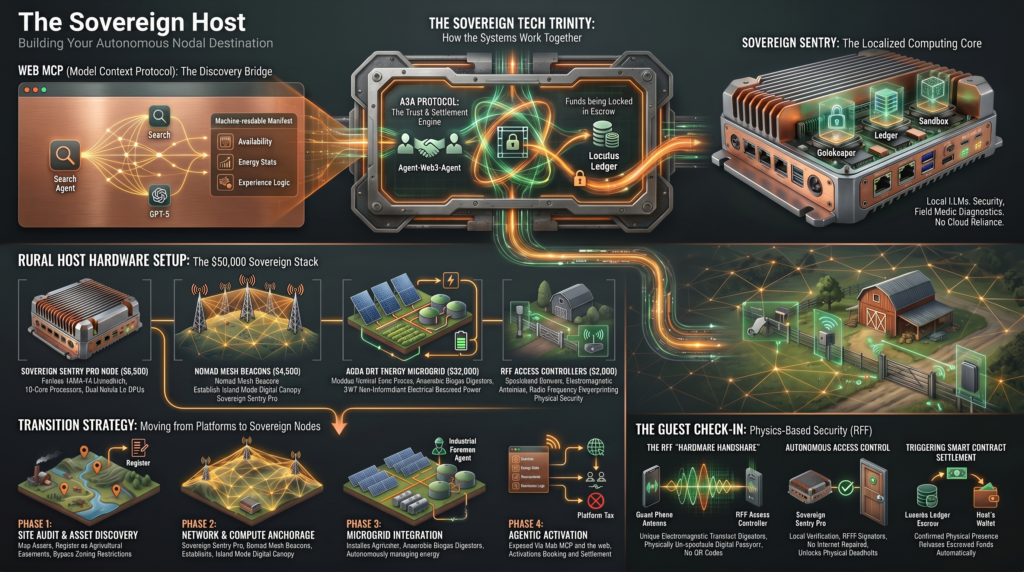
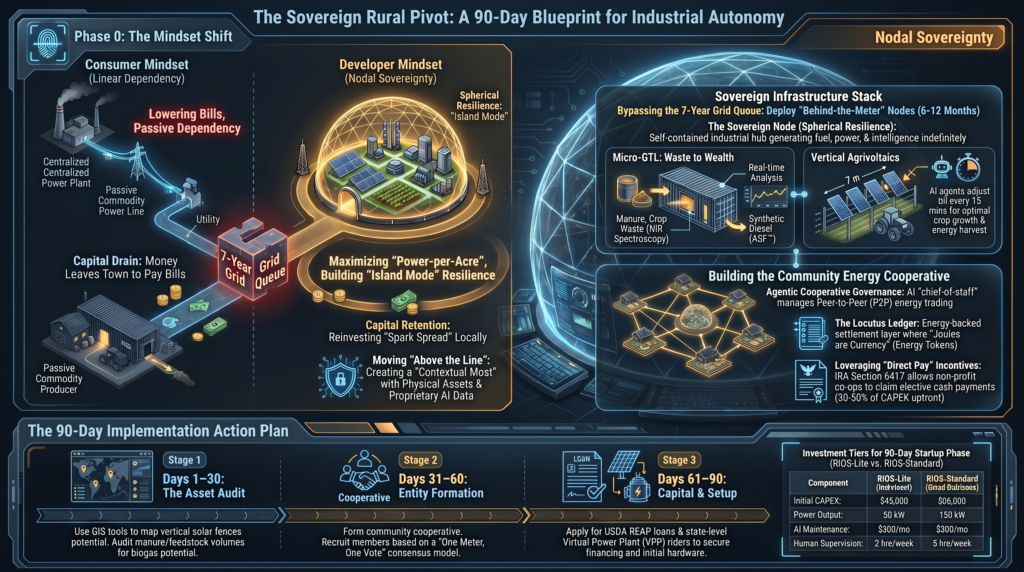
The “Sovereign WISP” (Wireless Internet Service Provider) model is a hyperconverged, autonomous gateway system powered by the Rural Infrastructure Operating System (RIOS). This architecture centers on the Sovereign Sentry Pro, a core compute engine that integrates DeReticular’s ruggedized hardware with TriFiWireless enterprise backhaul via Starlink Business connectivity. This “Civilization-in-a-Box” model allows independent entrepreneurs to deploy high-speed internet in remote or off-grid environments while maintaining the professional and legal standards required of modern ISPs. To ensure this infrastructure remains operational and compliant, strict adherence to uplink and distribution protocols is non-negotiable.
video
2. Backhaul Integrity: Starlink Acceptable Use Policy (AUP) & Enterprise API Hard-Locks
The integrity of the primary satellite backhaul is the first line of defense for a micro-ISP. Compliance with the Starlink AUP is a binary requirement: failure to adhere to reselling restrictions on unauthorized tiers results in immediate service termination at the terminal level, rendering the local node inert.
Authorized Enterprise Backhaul vs. Residential Service
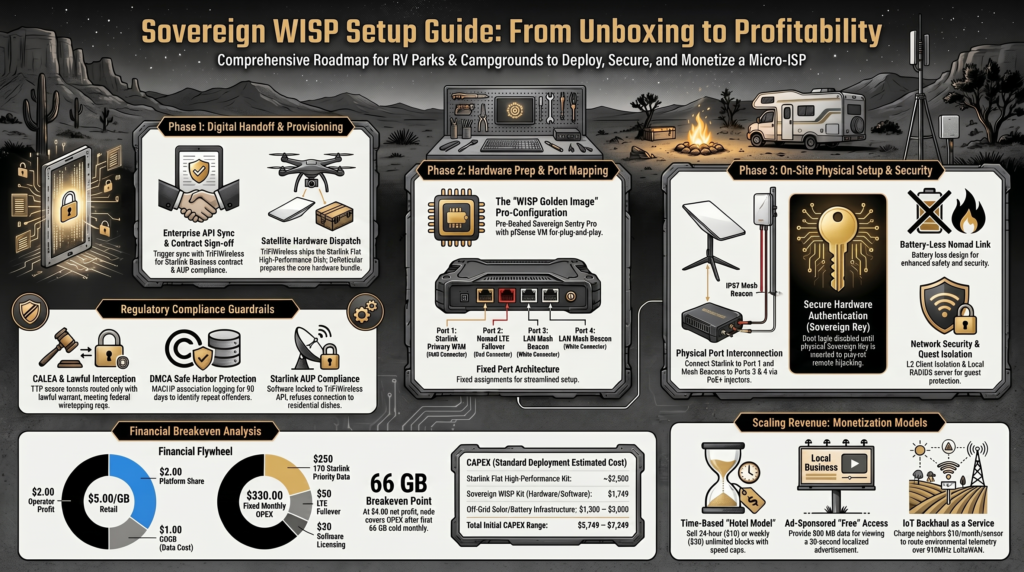
There is a critical differentiator between standard Starlink residential service and the authorized TriFiWireless Starlink Business model. Residential contracts explicitly forbid the resale of bandwidth; however, the Sovereign WISP Kit (SKU: RIOS-KIT-WISP) is engineered to operate exclusively within the authorized TriFiWireless enterprise framework. This ensures that the redistribution of data to third-party users is contractually sanctioned. To facilitate “plug-and-play” deployment, technicians at the Node 3 Workshop flash each Sentry Pro with a custom “WISP Golden Image” (Doc 6). This configuration pre-defines the network topology, mapping Port 1 as the primary WAN link to the Starlink Flat High-Performance Dish.
The Partner API Integration Lock
To enforce AUP compliance, the Sovereign Sentry Pro utilizes a “Partner API Integration” hardware-software lock. The integrated “Tollbooth” software agent interacts directly with the TriFiWireless API to verify the hardware’s “Authorized Enterprise” status. The system is architected to refuse to boot if it detects a connection to an unauthorized residential terminal, providing an automated safeguard against accidental policy violations.
podcast
Bridging the “ISP of Record” Gap
Operating a public node technically classifies the owner as a micro-ISP, introducing significant regulatory exposure. To mitigate this, the protocol utilizes a Master Service Agreement (MSA) where DeReticular assumes the role of the officially registered “ISP of Record.” This strategic bridge shields individual operators from direct regulatory audits and the administrative complexity of federal telecommunications filings. These hardware and software locks are essential prerequisites before the node satisfies federal surveillance mandates.
3. Lawful Interception Architecture: CALEA Compliance and TTP Tunneling
The Communications Assistance for Law Enforcement Act (CALEA) is a mandatory federal requirement for all telecommunications providers in the United States. For micro-ISPs, implementing CALEA-compliant wiretapping capabilities is a strategic requirement for maintaining legal operating status and avoiding severe federal penalties.
Implementation via Trusted Third Parties (TTP)
To satisfy CALEA without requiring the operator to manage forensic data interception manually, the system utilizes Trusted Third Party (TTP) tunneling through providers such as Subsentio or Apogee. This allows the micro-ISP to outsource the legal and technical heavy lifting of interception requests.
Technical Execution and Hypervisor Isolation
The technical execution of lawful interception is localized within the pfSense Virtual Machine (VM), which is hosted on the Sovereign Sentry Pro’s Proxmox hypervisor. This architectural isolation ensures that:
- Warrant-Based Activation: Secure tunnels are pre-configured within the pfSense VM but remain dormant, establishing a connection only upon the presentation of a valid lawful warrant.
- The Sovereign Key: Administrative access to these interception protocols is secured by the Sovereign Key—a FIDO2/PIV-compliant hardware token (Doc 1). This physical credential ensures that only authorized personnel can modify sensitive legal configurations.
This framework protects the privacy of the broader user base from unauthorized access while ensuring the micro-ISP remains compliant with federal surveillance mandates.
4. Intellectual Property Protection: DMCA Safe Harbor Execution
The Digital Millennium Copyright Act (DMCA) provides “Safe Harbor” protections that shield ISP operators from third-party liability for the copyright-infringing actions of their users. Execution of these protections is critical to preventing litigation from disrupting node operations.
The Safe Harbor Execution Strategy
To maintain Safe Harbor status, operators must execute three critical actions managed through the RIOS environment:
- Designated Agent Registration: Operators must officially register a designated DMCA agent with the US Copyright Office.
- MAC/IP Association Logging: The “Tollbooth” agent is configured to maintain 90-day logs of MAC address and IP associations to identify specific users linked to infringement notices.
- Repeat Offender Termination: The local RADIUS server, residing on the Sentry Pro, enforces a “Repeat Offender” policy. By hosting the RADIUS server locally rather than in the cloud, the node can enforce access revocation even during periods of backhaul rain-fade or service disruption (Doc 6).
Layer 2 Security and Liability Mitigation
The protocol mandates the enforcement of Layer 2 Client Isolation. This configuration, managed by the local RADIUS and Mesh Beacon settings, prevents peer-to-peer hacking between users on the same node. This isolation localizes IP liability and prevents a single malicious user from compromising the security of other connected clients.
5. Operational Data Governance: Software Locks, QoS, and Bandwidth Shaping
Effective data governance via Quality of Service (QoS) is essential for maintaining network health and preventing “Bandwidth Hogging.” These locks ensure that the shared backhaul remains stable for all paying clients.
Hard QoS Limits
The OpenClaw “Tollbooth” agent (dereticular/openclaw-wisp:latest) enforces the following limits:
| Control Mechanism | Specification | Strategic Impact |
| Download Speed Cap | 15 Mbps per MAC | Ensures fair-share access to the 1TB Starlink Priority Data pool. |
| Upload Speed Cap | 2 Mbps per MAC | Preserves upstream capacity for critical system telemetry. |
| Data Quota Trigger | 1,024 MB (1 GB) | Synchronizes with the RIOS Ledger to trigger session revocation at the kilobyte level. |
The Sovereign Audit Engine
Integrity is maintained by the Sovereign Audit Engine, a specialized function of the Tollbooth agent. It monitors client behavior for MAC address spoofing; if a user attempts to cycle MAC addresses to bypass data quotas, the engine triggers an automatic localized blocklist. Furthermore, RIOS utilizes dynamic QoS prioritization to ensure that critical system operations, such as firmware updates and node telemetry, take precedence over retail Wi-Fi traffic.
6. Future-State Compliance: Evolution to Zero-Trust and NTN (Gen 4)
The decentralized ISP landscape is evolving from the Gen 3 pilot phase toward a Gen 4 “Sovereign Communications Infrastructure,” characterized by multi-orbit resilience and automated compliance.
Zero-Trust and Cryptographic Identity
Generation 4 will phase out MAC-based captive portals in favor of Cryptographic Zero-Trust Network Access (ZTNA) and WPA3-Enterprise. This system eliminates portal bypass and session hijacking by issuing unique, temporary cryptographic tokens directly to a device’s secure enclave upon transaction.
Multi-Orbit Resilience and 5G NTN
Compliance with uptime obligations will be bolstered by multi-orbit SD-WAN (bonding Starlink, Amazon Project Kuiper, and Eutelsat OneWeb). Furthermore, Gen 4 hardware will incorporate unified cellular-satellite transceivers aligned with 3GPP Release 19 standards (5G Non-Terrestrial Networks) for orbital direct-to-cell fallback. Mesh Beacons will transition to Wi-Fi 7 (802.11be) utilizing Multi-Link Operation (MLO) to eliminate localized network congestion.
Edge AI and Autonomous Governance
Future Sentry Pro nodes will utilize integrated Neural Processing Units (NPUs) on-chip for Edge AI. These NPUs will autonomously filter local telemetry and manage data governance, ensuring compliance with evolving privacy standards without requiring constant operator intervention.
7. Conclusion: Compliance Verification Checklist
The operator of a “Civilization-in-a-Box” node is the steward of a professional telecommunications asset. Compliance is the mechanism that ensures this sovereign independence is sustainable, profitable, and legally protected.
Critical Compliance Checklist
Before broadcasting the public SSID, every operator must verify the following:
- Register DMCA Agent: Confirm a designated agent is registered with the US Copyright Office.
- Authenticate via Sovereign Key: Verify that administrative root access is locked behind the hardware token.
- Verify TriFiWireless API Link: Ensure the Sentry Pro is authenticated with the enterprise billing API to permit booting.
- Confirm TTP Tunneling: Verify active, dormant CALEA tunnels to Subsentio or Apogee within the pfSense VM.
- Enable Client Isolation: Confirm Layer 2 isolation is active on all Mesh Beacons to localize liability.
Operators must conduct regular audits using the Sovereign Deck (SKU: RIOS-OP-DECK). By utilizing its integrated RTL-SDR, technicians must monitor the 2.4GHz and 915MHz RF spectrums to identify rogue nodes or unauthorized interference, ensuring the security and performance of the sovereign network.