Technical Deployment Specification: Sovereign Node Infrastructure
1. Physical Hardware Layer: The Sovereign Sentry Pro and Network Anchorage
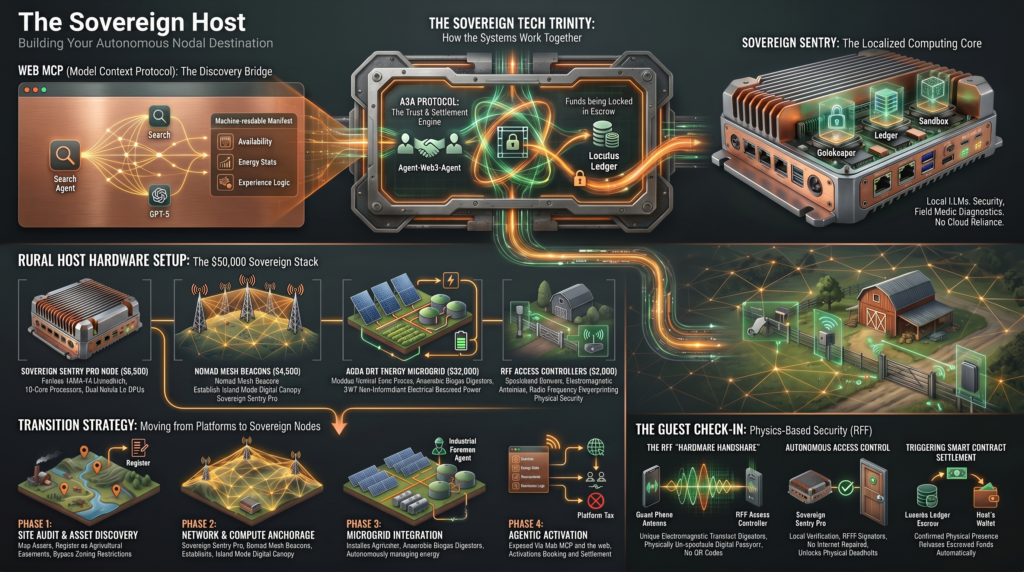
Establishing “Spherical Resilience” in rural environments demands a fundamental shift from fragile, linear infrastructure to high-performance, fanless edge computing. Standard deployment requires the establishment of a localized hardware anchor that functions independently of centralized cloud providers. This architecture ensures operational continuity during macro-network volatility and utility blackouts. The Sovereign Sentry Pro serves as the primary physical node, providing the compute density and connectivity required for “Island Mode” autonomy.
Sovereign Sentry Pro Hardware Specifications
The Sovereign Sentry Pro is an industrial-grade hyperconverged infrastructure (HCI) node. It is engineered for extreme environments using an anodized aluminum monoblock with deep thermal heat sink fins, eliminating active cooling dependencies. To ensure long-term viability, the chassis must utilize hot-swappable MXM GPU and PCIe carrier backplanes, enabling modular hardware upgrades in under 15 minutes.
| Component | Specification |
| Form Factor | Fanless, NEMA 4X weather-sealed, anodized aluminum monoblock |
| Processing Core | AMD EPYC Embedded Processor (16 Cores, 32 Threads) |
| AI Acceleration | 2x Nvidia L4 GPUs (48GB combined GDDR6 VRAM) |
| System Storage | 4TB Enterprise U.3 NVMe SSD (RAID-1 Mirror Configuration) |
| Backplane | Hot-swappable MXM and PCIe carrier backplane architecture |
| Connectivity | 10GbE SFP+ optical ports; integrated Starlink Business array podcastinterface |
podcast
Nomad Mesh-Point Routers (RIOS-EXT-01)
To eliminate field “dead zones,” the deployment shall utilize Nomad Mesh-Point Routers. These units project a private intranet canopy to support the Rural Infrastructure Operating System (RIOS).
- Installation Standards: Units must be sited at high-elevation points with a minimum 30-foot vertical clearance to ensure 360° line-of-sight coverage over a 1.5-mile radius.
- Protocol Allocation:
- Tri-band Wi-Fi 6E: Reserved for high-bandwidth tasks, specifically Augmented Reality (AR) spatial data delivery.
- 915MHz LoRaWAN: Dedicated to long-range, low-power telemetry and sensor network communication.
video
Mobile Edge Integration: Nomad Link and Fleet Kits
The “Vehicle-as-a-Relay” architecture shall be implemented using Nomad Link and Fleet Kits. Ruggedized transceivers mounted on moving machinery—interfaced via OBD-II and CAN Bus—cache IoT telemetry and sensor data in off-grid pockets. Upon entering the range of the core Sovereign Sentry cluster, the system initiates an automated high-speed data synchronization, bridging physical terrain gaps.
The physical layer provides the necessary compute environment for the virtualization and software layers that animate the node’s local intelligence.
——————————————————————————–
2. Local Logic Layer: Hyperconverged Infrastructure and OpenClaw AI Agents
Maintaining data sovereignty requires a mandatory air-gapped automation strategy. By hosting logic locally within the RIOS environment, the Sovereign Node ensures that operational data and personal privacy remain on-site, mitigating the risks of platform extraction and centralized cloud dependency.
Virtualization via Proxmox VE
The Sentry Pro shall utilize the Proxmox VE hypervisor (Kernel 6.x) to manage three mandatory, isolated virtual environments:
- The Gatekeeper: Runs pfSense/OPNsense for deep packet inspection, firewall security, and automated WAN failover.
- The Ledger: Hosts the Locutus/Freenet daemon to validate smart contracts and manage encrypted data shards.
- The Sandbox: Reserved for local, air-gapped Large Language Models (LLMs) and OpenClaw automation services.
OpenClaw AI Agent Suite
Autonomous operations are driven by the OpenClaw framework. Each agent must be configured according to the following technical standards:
- The DevOps Sovereign (OpenClaw Deep Admin): Shall run Llama-3-8B-Instruct (quantized to 4-bit, Q4_K_M GGUF format). It is responsible for auditing network performance, parsing system logs, and self-healing crashed services offline.
- The Field Medic: Shall run Mistral-7B-Instruct, fine-tuned on industrial equipment manuals. It monitors hardware parameters (e.g., digester temperatures, solar curves) and provides step-by-step troubleshooting via mesh headsets.
- The Industrial Foreman: A specialized model with integrated CAN Bus translation capabilities. It automates on-site systems, including agrivoltaic sun-tracking and mechanical machinery control.
Local Democratic Consensus
Governance for local cooperatives is managed by the Sovereign Elector agent. Utilizing TPM 2.0 cryptographic verification, it ensures that voting and consensus processes remain secure and tamper-proof. All results are logged directly to the Locutus Ledger, providing a transparent, local record of governance independent of external authorities.
This internal logic provides the foundation for secure, external communication and transaction protocols.
——————————————————————————–
3. Trust and Settlement Layer: A3A and Web MCP Protocol Integration
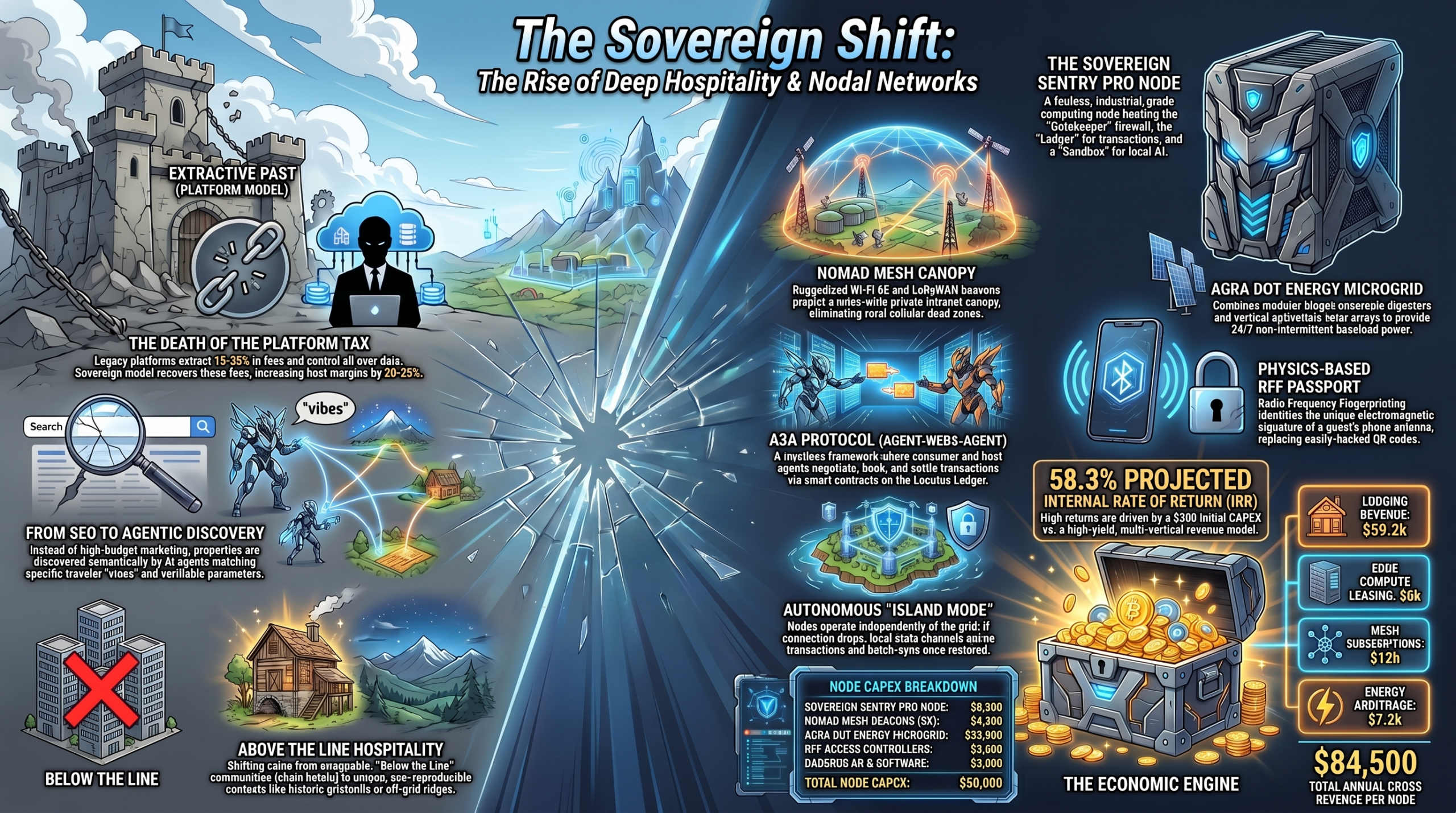
Deployment must facilitate a shift from platform-mediated search to “Agentic Discovery.” By utilizing the Model Context Protocol (MCP), rural entrepreneurs eliminate the 15–30% “Platform Tax” imposed by centralized aggregators.
Communication Stack: A2A and MCP
The node must support two distinct communication interfaces for autonomous commerce:
- Model Context Protocol (MCP): Standardizes the connection between agents and local tools (e.g., live inventory, sensor feeds, and weather APIs).
- Agent-to-Agent (A2A) Protocol: Enables the local Property Agent to negotiate with consumer agents using JSON-RPC 2.0. Every agent must expose an “Agent Card” (agent.json) detailing its endpoints and capabilities.
The A3A (Agent-Web3-Agent) Protocol Execution Flow
Direct settlement is managed via the A3A protocol, integrating the x402 protocol and ERC-7715 session keys for gasless, sub-cent USDC settlements:
- Discovery: Consumer agents query the “Agent-Readable Manifest” published in JSON-LD markup.
- Direct Negotiation: Agents exchange terms via A2A protocols.
- Smart Contract Escrow: Upon agreement, funds are locked in a smart contract on the Locutus Ledger.
- Verifiable Release: Funds are released to the host’s wallet only after physical check-in is verified by the guest’s Radio Frequency Fingerprint (RFF).
The Agent-Readable Manifest
To be discoverable by agents like Gemini Spark, the manifest must include the following structured data:
#acoustic-silence-90dB(Real-time quiet scores)#off-grid-biogas-reliable(Energy verification)#history-1840s-mill(Contextual asset tagging)#starlink-integratedand#EV-charging-available(Operational readiness)
Digital settlement frameworks are anchored by physical access and identity verification systems.
——————————————————————————–
4. Experience and Identity Layer: DAOSRUS RFF and Immersive Spatial Systems
Security is defined by “Physics over QR Codes.” By utilizing the unique physical properties of hardware, the system establishes un-spoofable security and high-value experiences immune to digital cloning.
Radio Frequency Fingerprinting (RFF)
The DAOSRUS Digital Passport utilizes Radio Frequency Fingerprinting (RFF). The system analyzes the unique electromagnetic transient signature of a user’s mobile device antenna during the connection handshake. This physical-layer verification allows the Sentry node to control physical locks and equipment access without internet connectivity or external metadata transmission.
Immersive Spatial Systems
The Nomad Mesh canopy enables the delivery of high-bandwidth experiences with zero external bandwidth consumption:
- AR Trail Maps: Rich spatial data served directly from the local Sentry Pro.
- Historical Excursions: 3D reconstructions of sites (e.g., 19th-century timber flumes) overlayed on the physical landscape via local edge-hosted assets.
Experience Logic and Valuation
“Experience Logic” allows rural assets to move “Above the Line” by providing verifiable parameters. Authenticated “quiet scores” and energy reliability metrics allow historical assets to compete semantically with centralized luxury brands by meeting precise guest intent.
The guest experience is supported by a resilient, on-site power generation layer.
——————————————————————————–
5. Base Generation Layer: Agra Dot Energy Microgrid Configuration
Strategic “Island Mode” resilience depends on non-intermittent, on-site baseload power. Sovereign Nodes must function as independent micro-utilities to bypass grid fragility.
Microgrid Technical Specifications and Regulatory Compliance
The Agra Dot Energy system integrates modular anaerobic biogas digesters and vertical agrivoltaic arrays.
- Vertical Agrivoltaic Arrays: Shall utilize vertical bifacial N-type solar panels.
- Agricultural Spacing: Panels must be installed at 7-meter row intervals to accommodate standard agricultural machinery.
- Regulatory Strategy: To bypass utility zoning restrictions, all nodes must maintain a Land Equivalent Ratio (LER) above 1.2. This ensures the property remains classified under Agricultural Easement protections.
- Automation: The Industrial Foreman agent manages 15-minute panel tilt adjustments to balance solar harvesting with crop light requirements.
Spark Spread Optimization
The Sentry node monitors real-time energy output to optimize the “Spark Spread.” Using the Locutus Ledger, the system automates fuel arbitrage—converting methane to fuel or exporting surplus power to neighboring nodes—ensuring the infrastructure is self-financing.
——————————————————————————–
6. Resiliency Protocols: ‘Island Mode’ and Automated Offline Failover
Automated failover is mandatory to protect rural operations from macro-network volatility and utility blackouts. The Sovereign Node is engineered for continuous operation during network partitions.
Offline Intranet Mode Logic Flow
graph TD
    A[Network Connectivity Status] -->|Disconnected| B[Activate Offline Intranet Mode]
    B --> C[Nomad Mesh Canopy: Active for local AR/Comm]
    C --> D[Locutus State Channels: Activate for transaction queuing]
    D --> E[RFF Access Control: Local physical verification remains operational]
    E --> F[Connectivity Restored]
    F --> G[Batch-Sync Protocol: Local queue synchronizes with global chain]
Automatic Synchronization and Fault Isolation
- Batch-Sync Protocol: Upon restoration of satellite backhaul, the Sentry Pro automatically settles the local offline transaction queue with the global ledger.
- Mechanical Fault Isolation: In the event of hardware failure (e.g., tracker motor fault), the Field Medic and Industrial Foreman agents isolate the component, switch to manual analog override, and transmit encrypted diagnostic alerts over the local mesh network.
The deployment of the Sovereign Node Infrastructure creates a high-yield, resilient alternative to centralized models, integrating physical security, energy independence, and autonomous commerce into a single, sovereign destination.