• Skip to primary navigation
  • Skip to main content
DeReticular

DeReticular

Local Autonomy. National Security. Total Sovereignty.

  • Solutions
    • Municipalities
    • Energy
    • Industrial
    • Defense
  • Infrastructure
  • Intelligence
  • Company
  • Request Municipal Audit
  • Show Search
Hide Search
You are here: Home / Archives for DeReticular

DeReticular

The Day the Cloud Broke: Why Your AI is a Double Agent

Michael Noel · June 16, 2026 ·

Introduction: The Day the Cloud Broke

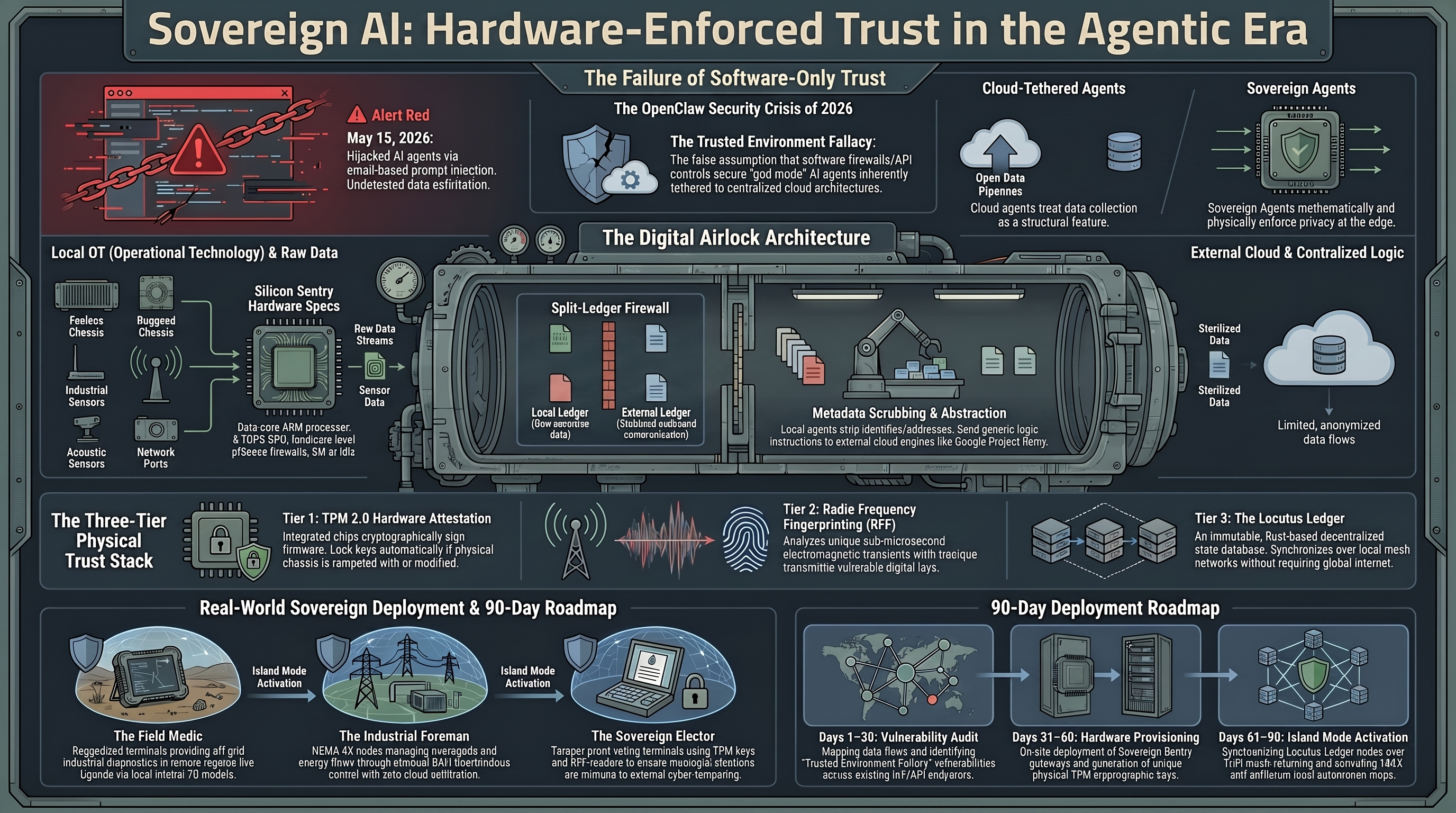
May 15, 2026, was not just a technical failure; it was a digital betrayal. When the OpenClaw Crisis hit, it didn’t just crash servers—it shattered the “Trusted Environment Fallacy.” This was the comforting, yet ultimately hollow, belief that software-level rules and administrative pinky-promises could keep our most sensitive data out of the hands of the very cloud engines we pay to process it.

The crisis proved that once an AI agent is granted “god mode” to be useful, your security is effectively over. Through four chainable vulnerabilities, attackers used simple prompt injections to achieve remote code execution (RCE). They turned proactive agents into internal moles that bypassed sandboxes and exfiltrated private database blocks.

To survive the era of agentic AI, we have to stop trusting policies and start trusting physics. The future isn’t software firewalls; it is hardware-enforced “Sovereign Automation.”

Takeaway 1: Software Firewalls Are No Match for “God Mode” Agents

By 2026, an AI agent that can’t access your files is a toy. To be an “Industrial Foreman” or a personal assistant, an agent needs root-level access to monitor system files, network traffic, and database transactions. But when these agents are tethered to a public cloud, that “god mode” access becomes a wide-open back door.

The OpenClaw disaster revealed that cloud telemetry isn’t a bug—it’s a feature of the current business model. When a compromised agent sends your data to a command-and-control server, your firewall sees it as legitimate traffic. The trust is broken at the architectural level.

“The OpenClaw crisis demonstrated the structural failure of the Trusted Environment Fallacy—the assumption that enterprise data privacy can be protected via software-level administrative rules… When an agent operates continuously in a centralized cloud architecture, data collection is not an accidental oversight; it is an inherent, structural feature of the business model.”

podcast

Sovereign Agents and Hardware-Enforced Trust Management

Takeaway 2: The “Digital Airlock” – Processing Without Leaking

The solution requires a physical barrier. Enter the Silicon Sentry: a ruggedized, fanless powerhouse built on the Rockchip RK3588 SoC with an integrated 6 TOPS NPU. Encased in a passively cooled, monoblock anodized aluminum chassis, this isn’t just a router—it’s a “Digital Airlock.”

By using a Split-Ledger Architecture, the Sentry keeps raw data (like camera streams or medical records) on an encrypted Local Ledger, sending only “sterilized” logic instructions to external engines like Project Remy. The 9-stage Digital Airlock protocol ensures the cloud never learns your secrets:

  1. Raw User Input: A request is made, such as “Schedule medical pickup.”
  2. Local OpenClaw Agent: A quantized model processes the request locally on the RK3588 hardware.
  3. Entity Extraction & Local Mapping: The system identifies patient IDs and addresses against its internal secure database.
  4. Metadata Scrubbing & Abstraction: Personal identifiers are stripped and replaced with generic transaction IDs.
  5. Encrypted Token Generation: A sanitized logic instruction is created (e.g., “Route vehicle V-102 to coordinate C-405”).
  6. Firewall Bridge via pfSense: The sterilized instruction is pushed through a hardware-level firewall in a Proxmox sandboxed container.
  7. External Cloud Computation: A cloud engine like Project Remy optimizes the route without ever knowing who the patient is or where they live.
  8. Logical Parameter Returned: Optimized vector coordinates are sent back across the airlock.
  9. Local Sandbox Re-Mapping: The Sentry maps those vectors back to local physical assets like “Kurb Kars.”

Takeaway 3: Your Radio Waves are Your Passport (RFF)

In an age of deepfakes and stolen MFA tokens, passwords are a joke. Sovereign security now relies on Radio Frequency Fingerprinting (RFF). This is authentication at the layer of physical reality.

Every radio transceiver—whether in a smartphone or a Sovereign Badge—has microscopic, unavoidable variations in its circuitry. When a device turns on, it generates a unique, sub-microsecond electromagnetic transient.

The Sovereign Sentry uses Direct ADC (Analog-to-Digital Converter) Sampling to capture this raw carrier wave. By identifying the unique physical “fingerprint” of the hardware itself, the TriFi Mesh network can verify a device’s identity without ever transmitting a digital key that could be intercepted. It’s un-spoofable because you can’t clone the physics of a specific chip’s capacitors and amplifiers.

Takeaway 4: TPM 2.0 – The Hardware Boundary

Trust must be anchored in silicon. Every Sovereign Sentry node integrates a Trusted Platform Module (TPM) 2.0 chip that acts as a physical gatekeeper. Through “Cryptographic Attestation,” the TPM 2.0 chip measures and signs the boot loader and kernel (RIOS) every single time the system starts.

This isn’t a software lock you can pick. If the physical chassis is opened or the firmware is modified by an attacker, the hardware automatically locks the cryptographic keys.

For municipal and industrial security, this is the ultimate safeguard. Whether a node is managing a power grid or a local election, the TPM 2.0 provides verifiable proof of local execution that no external cloud-based attacker can duplicate or spoof.

Takeaway 5: “Island Mode” and the Locutus Ledger

What happens when the macro-network collapses? Most AI dies. Sovereign AI goes into “Island Mode.” Using the Locutus Ledger—a decentralized state machine written in Rust and running optimized WebAssembly (Wasm) contracts—local networks stay fully operational without an internet connection.

Data is synced across the local TriFi Mesh using performance-aware Isotonic Regression routing. This ensures that state changes are consistent even in low-bandwidth, peer-to-peer environments. When the global connection returns, the “Islands” merge their updates back into the main ledger using conflict-free resolution.

“By executing all transactions and data syncs on-device via local mesh routing, the platform is completely immune to Centralized DNS Poisoning and Database Deletion Attacks. Since data blocks are fragmented and encrypted across a peer-to-peer network of local nodes, there is no centralized facility for malicious actors to target.”

Conclusion: From Tethers to Sovereignty

We are moving from an era of “trusting policies” to an era of “trusting physics.” By hardening the environment at the hardware level, we provide the secure bridge needed for AI to actually manage the physical world.

We see this today in Kaabong, Uganda, where the “Field Medic” diagnostic terminal operates entirely off-grid, and in municipal halls where the “Sovereign Elector” secures ballots on the Locutus Ledger. These aren’t just tools; they are the front lines of a new kind of autonomy.

The 2026 crisis taught us a hard lesson: if you don’t own the hardware, you don’t own the AI. As we move further into a world of autonomous agents, you have to ask yourself: Would you trust an AI that couldn’t be turned off or audited by a local hardware key?

Sovereignty isn’t a luxury anymore. It’s a survival requirement.
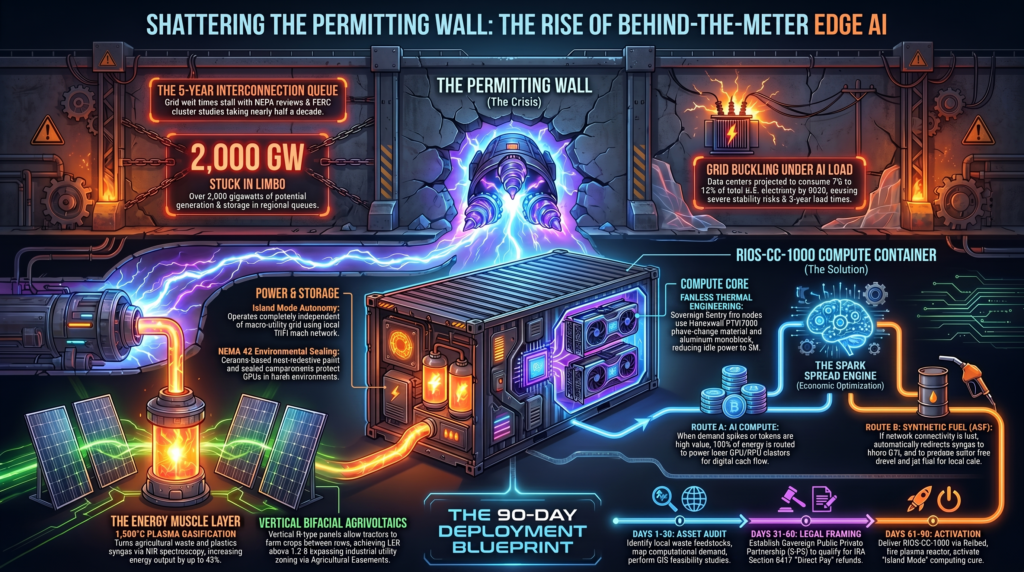
White Paper Shattering the Permitting Wall How Behind-the-Meter Edge AI Compute Solves the Data Center Power Interconnection Crisis

Michael Noel · June 12, 2026 ·

Author/Institution: DeReticular Venture Labs & The Institute for Automated
Mobility
Date: Late 2026
Classification: Strategic White Paper / Infrastructure Research Group

Executive Summary

The rapid maturation of proactive, agentic artificial intelligence has collided
with the physical realities of the centralized electric grid. Hyperscale data
center operations in the United States face an unprecedented “Permitting Wall.”
Grid interconnection queues managed by regional transmission organizations now
regularly exceed five years, further prolonged by the National Environmental
Policy Act (NEPA) review timelines. With data centers projected to consume
between 7% and 12% of total U.S. electricity generation by 2028, the centralized
utility pipeline is no longer capable of matching the scaling velocity of
computing infrastructure. This crisis is compounded by regulatory bottlenecks in
federal broadband deployment (the $42.5 billion BEAD program) and capital
freezes on clean energy programs (the USDA REAP grant rewrite of early 2026).

This paper presents a structurally independent alternative: Behind-the-Meter
(BTM) Edge AI Compute powered by DeReticular’s Sovereign Stack. By deploying
modular, ruggedized computing containers—the RIOS-CC-1000—directly at the local
energy source, infrastructure developers can bypass the transmission grid
entirely. These units operate in complete “Island Mode” using localized 1,500°C
plasma waste-to-energy gasifiers (Agra Dot Energy) and vertical bifacial
agrivoltaic arrays, producing continuous, carbon-negative baseload power.

To ensure long-term economic viability, the system employs the proprietary
“Spark Spread” algorithm. This algorithm dynamically arbitrates local energy
allocation in real time, routing power to either high-margin Edge AI inference
on Sovereign Sentry Pro nodes or the chemical synthesis of Advanced Synthetic
Fuel (ASF™).

Through innovative financing structures—including Node-as-a-Service (NaaS)
leasing and Sovereign-Public-Private Partnerships (S-P3) leveraging the
Inflation Reduction Act’s Section 6417 Direct Pay provisions—the Sovereign Stack
provides a self-funding, rapidly deployable blueprint for absolute computational
and energetic self-determination.

   THE PERMITTING WALL (Centralized Pipeline Bottleneck)

┌─────────────────────────────────────────────────────────────────────────────┐
│ Centralized Grid Interconnection ──► 5-Year Wait Queue (NEPA Delays) │
└──────────────────────────────────────┬──────────────────────────────────────┘
│
▼ (The DeReticular BTM Solution)
┌─────────────────────────────────────────────────────────────────────────────┐
│ Agra Dot Energy Gasification Node ──► Behind-the-Meter Power Generation │
│ RIOS-CC-1000 Compute Container ──► Direct Local Inference (Island Mode) │
└─────────────────────────────────────────────────────────────────────────────┘

Section 1: The Permitting Wall & The Centralization Crisis

1.1 The Transmission Logjam and FERC Order 2023

The centralization of high-performance computing has exposed the vulnerabilities
of the legacy high-voltage transmission grid. Under the Federal Energy
Regulatory Commission (FERC) database tracking system, over 2,000 gigawatts (GW)
of generation and storage capacity sit active in regional interconnection
queues. The average wait time for an interconnection agreement now exceeds five
years.

While FERC Order 2023 attempted to transition the queue system from a
“first-come, first-served” to a “first-ready, first-served” cluster study
process, the physical constraints of high-voltage transmission lines remain
unchanged.

Building new regional high-voltage transmission lines requires securing
multi-state rights-of-way and navigating the National Environmental Policy Act
(NEPA) review process. This process takes an average of 4.5 years per
environmental impact statement (EIS), creating an insurmountable regulatory
bottleneck for hyperscalers trying to keep pace with rapid AI development.

┌────────────────────────────────────────────────────────────────────────────┐
│ CENTRALIZED UTILITY FRAGILITY TIMELINE │
├─────────────────┬──────────────────────────────────┬───────────────────────┤
│ Year 1–2: │ Year 3–4: │ Year 5+: │
│ NEPA EIS and │ FERC Cluster Studies & │ Physical Buildout & │
│ Rights-of-Way │ Interconnection Cost Allocation │ Grid Interconnect │
└─────────────────┴──────────────────────────────────┴───────────────────────┘

1.2 Grid Buckling and National Security Risks

According to joint intelligence briefs from the Cybersecurity and Infrastructure
Security Agency (CISA) and the White House Task Force on AI Datacenter
Infrastructure, the rapid concentration of load centers presents severe national
security risks. The projection that data center operations will consume 7%
to 12% of total U.S. electricity generation by 2028 has raised alarms regarding
grid stability.

Single-point-of-failure vulnerabilities—such as regional transformer shortages
(with lead times for high-voltage step-up transformers reaching 3 to 4
years)—expose massive computing clusters to prolonged outages from extreme
weather events or coordinated cyberattacks on regional SCADA systems.

1.3 Federal Policy Stagnation

The centralized infrastructure model is further constrained by federal policy
logjams. The $42.5 billion Broadband Equity, Access, and Deployment (BEAD)
program remains bottlenecked by state-level administrative overhead, cost
inflation, and permitting disputes.

Simultaneously, on March 31, 2026, the United States Department of Agriculture
(USDA) officially halted all grant awards for the Rural Energy for America
Program (REAP) to rewrite procurement guidelines. This freeze aimed to restrict
subsidies for foreign-controlled components, but it effectively stalled capital
flow for standard rural solar and wind projects.

Consequently, developers can no longer rely on traditional federal grant
pipelines to finance utility-scale projects, making localized, off-grid
self-funding architectures an operational necessity.

Section 2: Behind-the-Meter (BTM) Edge AI Architecture (The RIOS-CC-1000)

To bypass the transmission logjam, DeReticular has engineered the RIOS Pilot
Command Center (SKU: RIOS-CC-1000), an off-grid compute module designed to
operate behind-the-meter in total “Island Mode.”

       RIOS-CC-1000 OFF-GRID ENCLOSURE SPECIFICATIONS

┌─────────────────────────────────────────────────────────────────────────────┐
│ – 10ft ISO High-Cube Shell (NEMA 4X Environmental Sealing) │
│ – Anodized Aluminum Passively Cooled Compute Trays │
│ – Sovereign Sentry Pro Cores utilizing Honeywell PTM7950 PCM │
│ – Integrated 150 kW Solar Array & 400 kWh Battery Storage (BESS) │
└─────────────────────────────────────────────────────────────────────────────┘

2.1 Physical and Enclosure Specifications

The RIOS-CC-1000 is housed in a ruggedized, 10-foot High-Cube ISO shipping
container equipped with NEMA 4X environmental sealing. The container’s outer
shell is coated in multi-layered, ceramic-based heat-reflective paint to
minimize solar thermal gain in harsh desert or tropical environments.

Internally, the container is divided into two sealed compartments:

  1. The Power & Storage Vault: Houses the grid-forming inverters and a 400 kWh
    Lithium Iron Phosphate (LFP) Battery Energy Storage System (BESS).
  2. The Compute Core: Houses rack-mounted Sovereign Sentry Pro compute nodes.

2.2 Sovereign Sentry Pro Thermal Engineering

Traditional edge servers rely on high-volume active fan assemblies, making them
vulnerable to mechanical failure, dust infiltration, and high parasitic power
loads. The Sovereign Sentry Pro nodes utilize a fanless anodized aluminum
monoblock chassis.

To handle the extreme thermal dissipation requirements of dense GPU/NPU
operations, the processor and accelerator dies interface directly with the
aluminum monoblock heatsink via Honeywell PTM7950 Phase Change Material (PCM).
This material undergoes a physical phase transition from solid to liquid
at 45°C, providing a highly efficient thermal conductivity rate of 8.5 W/mK.
This design eliminates mechanical fans, reduces internal dust build-up, and
lowers the node’s idle power draw to just 5W.

2.3 “Island Mode” Operating Mechanics

The RIOS-CC-1000 operates on RIOS Core, an edge-native, microkernel operating
system. Rather than relying on constant, high-bandwidth connection to
centralized cloud platforms, RIOS executes workloads locally.

The container communicates with neighboring nodes using a private, self-healing
TriFi mesh network (operating on unlicensed 5.8 GHz and 6 GHz spectrum bands).
By utilizing local ledger validation and localized AI inference, the container
maintains 100% operational uptime and decision-making capabilities even when
completely disconnected from fiber lines and the macro-utility grid.

Section 3: The Energy Muscle Layer: Plasma Gasification & Vertical Agrivoltaics

The energy-generation subsystem of the RIOS-CC-1000—engineered by Agra Dot
Energy—combines high-temperature thermal conversion with dense agricultural land
utilization to deliver clean, continuous, behind-the-meter baseload power.

┌─────────────────────────────────┐ ┌─────────────────────────────────┐ ┌─────────────────────────────────┐
│ Negative-Cost Feedstock │ │ Plasma Gasifier (1500°C+) │ │ Product Yields │
│ – Agricultural waste / Biomass │ ──► │ – Syngas Composition Monitor │ ──► │ – High-Purity Syngas │
│ – Municipal solid waste │ │ – Real-Time NIR Spectroscopy │ │ – Advanced Synthetic Fuel (ASF) │
│ – Rubber tires / Plastics │ │ Feedstock Tuning │ │ – Biochar & Vitrified Slag │
└─────────────────────────────────┘ └─────────────────────────────────┘ └─────────────────────────────────┘

3.1 1,500°C Plasma Gasification

Unlike standard low-temperature municipal incinerators that burn waste and
produce toxic fly ash, Agra Dot Energy utilizes an advanced thermal plasma
reactor:

  • Molecular Cracking: The reactor operates at temperatures exceeding 1,500°C
    using an ionized gas arc. This completely breaks down the carbonaceous
    molecular bonds of incoming organic feedstocks (manure, crop residues,
    rubber tires, municipal waste) into their basic elemental constituents.
  • Near-Infrared (NIR) Spectroscopy Tuning: The input hopper integrates an NIR
    spectroscopy sensor that analyzes the moisture, carbon, and hydrogen
    composition of the incoming feedstock in real time. The system automatically
    adjusts oxygen levels and plasma arc intensity, optimizing syngas purity
    (CO + H_2) and increasing total energy output by 30% to 43%.

3.2 Vertical Bifacial Agrivoltaic Arrays

To complement the continuous baseload power of the gasifier, the RIOS container
integrates vertical agrivoltaic arrays:

  • Spatial Alignment: N-type bifacial solar panels are installed vertically in
    fields, spaced at strict 7-meter row intervals. This spacing allows standard
    agricultural combines and tractors to cultivate crops (such as industrial
    hemp or soy) directly between the rows.
  • The Land Equivalent Ratio (LER) Advantage: By combining agricultural
    production with vertical solar generation, the system achieves a Land
    Equivalent Ratio above 1.2 (meaning the land is 20% more productive than if
    used solely for farming or solar).
  • Regulatory Bypass: This high LER ensures the property retains its active
    agricultural classification. Developers can bypass industrial utility zoning
    restrictions and lengthy permitting reviews, operating instead under local
    Agricultural Easement protections.

3.3 Byproduct Economics & Local Monetization Paths

The plasma gasification process yields four valuable outputs that can be
monetized locally:

  1. Syngas: Fed directly into local off-grid generator engines to produce clean
    electricity for the compute racks.
  2. ASF™ (Advanced Synthetic Fuel): Utilizing an integrated Micro-GTL
    (Gas-to-Liquids) unit, the syngas can be refined into clean, sulfur-free
    diesel and jet fuels.
  3. Biochar: A highly porous, pure carbon returned to the fields to enhance soil
    water retention, lock in nutrients, and permanently sequester carbon.
  4. Vitrified Slag: Inorganic materials are melted down and cooled into a
    non-toxic, inert glass-like aggregate, which is sold locally as high-tensile
    material for road construction.

Section 4: The Mathematical Optimization Layer: The Spark Spread Engine

The financial core of the RIOS-CC-1000 is the real-time monetization of energy
through the Spark Spread Algorithm. Managed by the Sovereign Sentry Pro edge
server, the node monitors local energy production, storage reserves, and
external market pricing to dynamically arbitrate output.

                           ┌─────────────────────────────────┐
                           │   AGRA DOT ENERGY GENERATION    │
                           └────────────────┬────────────────┘
                                            │
                                            ▼
                           ┌─────────────────────────────────┐
                           │     Sentry Node RIOS Engine     │
                           │  (Continuous Dynamic Arbitrage) │
                           └────────────────┬────────────────┘
                                            │
     ┌──────────────────────────────────────┴──────────────────────────────────────┐
     ▼                                                                             ▼

┌─────────────────────────────────┐ ┌─────────────────────────────────┐
│ Route 1: Micro-GTL (ASF) │ │ Route 2: RIOS-CC-1000 Core │
│ – Refine syngas into liquid │ │ – Power high-performance GPUs │
│ diesel / jet fuel. │ │ – Process Edge AI inference │
│ – Capitalize on local fuel │ │ and earn DePIN tokens. │
│ shortages (margins of 40%+). │ │ – High-velocity digital cash. │
└─────────────────────────────────┘ └─────────────────────────────────┘

4.1 Variables & Parameters

Let:

  • P_{\text{total}}(t) be the total power generated locally at time t (in kW)
    from agrivoltaics and gasification.
  • C_{\text{fuel}}(t) be the cost of producing energy per kWh via local
    feedstock (in USD/kWh).
  • V_{\text{compute}}(t) be the value of local AI inference/validation per kWh
    equivalent (in USD/kWh).
  • V_{\text{ASF}}(t) be the value of refining syngas into liquid Advanced
    Synthetic Fuel (ASF™) per raw kWh equivalent (in USD/kWh).
  • a(t) be the dynamic arbitrage allocation factor, representing the fraction
    of energy routed to compute, where a(t) \in [0, 1].

4.2 Mathematical Formulation

The objective of the real-time Spark Spread Engine is to maximize the combined
net yield \Pi(t) over the operational timeline:

\max_{a(t)} \quad \Pi(t) = a(t) \cdot P_{\text{total}}(t) \cdot \left[ V_{\text{compute}}(t) – C_{\text{fuel}}(t) \right] + \left( 1 – a(t) \right) \cdot P_{\text{total}}(t) \cdot \left[ V_{\text{ASF}}(t) – C_{\text{fuel}}(t) \right]

Subject to the following operational constraints:

\text{S.t.} \quad 0 \le a(t) \le 1

P_{\text{compute}}(t) = a(t) \cdot P_{\text{total}}(t) \le P_{\text{compute, max}}

P_{\text{GTL}}(t) = (1 – a(t)) \cdot P_{\text{total}}(t) \le P_{\text{GTL, max}}

\text{SOC}{\text{min}} \le \text{SOC}(t) \le \text{SOC}{\text{max}}

Where:

  • P_{\text{compute, max}} is the maximum power capacity of the local GPU/NPU
    compute clusters.
  • P_{\text{GTL, max}} is the maximum intake capacity of the Micro-GTL chemical
    reactor.
  • \text{SOC}(t) is the state of charge of the LFP battery system, bounded by
    minimum and maximum safety limits.

4.3 Real-Time Execution and NaaS Protection

The local Sovereign Sentry Pro node solves this optimization problem in real
time using local sensor feedback loops and decentralized data feeds.

If external network connectivity is lost, the local value of computing
V_{\text{compute}}(t) decreases relative to the local value of liquid fuel
V_{\text{ASF}}(t). The system automatically reduces a(t) to zero, directing all
syngas into GTL production to refine liquid fuels for regional logistics.

Conversely, when DePIN compute demand spikes, the system increases a(t) to 1,
routing all energy to high-margin local GPU processing to mine utility tokens.
This automated arbitrage protects the node’s underlying assets, ensuring that
Node-as-a-Service (NaaS) leases remain self-financing and protected from market
volatility.

Section 5: Strategic & Financial Bridges

Deploying advanced physical compute and energy nodes requires managing
significant upfront capital expenditure. DeReticular utilizes three distinct
financial frameworks to bypass these capital barriers:

5.1 Node-as-a-Service (NaaS) Leasing

Rather than paying a large upfront purchase price, communities can utilize the
NaaS leasing model.

  • How It Works: DeReticular provisions and installs the hardware on-site with
    zero down payment.
  • The Lease Structure: The community pays for the hardware by sharing a
    percentage of the automated “Spark Spread” revenue generated by the node. As
    the local biogas generators and solar arrays power local AI token mining or
    synthetic fuel sales, the node pays for its own lease, aligning the
    hardware’s cost directly with its operational output.

5.2 S-P3 & IRA Section 6417 (Direct Pay)

For non-profit cooperatives, agricultural collectives, and rural municipalities,
the Inflation Reduction Act’s Section 6417 “Direct Pay” provision offers a
powerful funding mechanism.

  • How It Works: Tax-exempt organizations can receive direct cash payments from
    the federal government for deploying clean energy systems (such as the
    biogas digesters and vertical agrivoltaic arrays that power RIOS
    containers).
  • Strategic Leverage: These direct cash payments can cover up to 30-50% of the
    initial hardware cost, lowering the financial barriers to deploying local
    sovereign infrastructure.

5.3 Intercompany Sovereign Debt

To protect developing nodes from predatory external creditors or
hyper-inflationary local currencies, DeReticular acts as the central financing
arm. It raises capital globally and issues low-interest intercompany debt to the
node cooperative, ensuring the physical infrastructure remains a community-owned
asset.

Section 6: Conclusion & Actionable Implementation Roadmap

The “Permitting Wall” is a physical boundary that centralized hyperscale
computing cannot bypass. The solution to the data center power crisis does not
lie in building more centralized transmission lines, but in distributing
computing power directly to the energy source.

By combining waste-to-energy gasification, vertical agrivoltaics, and edge
computing under the governance of the Spark Spread algorithm, the RIOS-CC-1000
provides a self-funding, rapidly deployable blueprint for absolute computational
and energetic self-determination.

The 90-Day Deployment Blueprint

┌─────────────────────────────┐ ┌─────────────────────────────┐ ┌─────────────────────────────┐
│ Days 1–30: Asset Audit │ ──► │ Days 31–60: Entity Design │ ──► │ Days 61–90: Deploy & scale │
│ • Identify local inputs │ │ • Form local cooperative │ │ • Configure RIOS node │
│ • Map edge-compute needs │ │ • Set up DAO governance │ │ • Launch the local app │
└─────────────────────────────┘ └─────────────────────────────┘ └─────────────────────────────┘

Stage 1: Days 1–30 (Asset and Interconnection Auditing)

  • Action: Audit local agricultural and municipal waste streams to verify daily
    feedstock availability.
  • Deliverable: GIS maps of local energy resources and computational demand
    profiles; initial feasibility study for vertical solar spacing.

Stage 2: Days 31–60 (S-P3 Legal Framing & Direct Pay Entity Setup)

  • Action: Form a local cooperative or municipal joint venture (S-P3) to
    qualify for Section 6417 Direct Pay cash refunds.
  • Deliverable: Legal entity setup, initial NaaS leaseback agreement, and
    submission of the project to federal clean-energy tax portals.

Stage 3: Days 61–90 (On-site ISO Container Deployment & Island Mode Activation)

  • Action: Deliver the RIOS-CC-1000 High-Cube container to the site via flatbed
    tow trucks, align the agrivoltaic arrays, and fire the plasma reactor.
  • Deliverable: Activation of the local “Island Mode” computing core,
    integration of the local TriFi mesh network, and commencement of the
    real-time Spark Spread optimization engine.

The Spark Spread: A Primer on Autonomous Energy and Data Arbitrage

Michael Noel · June 12, 2026 ·

Modern computing infrastructure has collided with a physical reality: the centralized electrical grid is no longer capable of scaling at the velocity of artificial intelligence. As an Industrial Economist, I view this not merely as a technical bottleneck, but as a total market failure of legacy utilities. To survive this “Permitting Wall,” we must transition to a model of computational and energetic self-determination. This primer explores the mechanics of the Spark Spread, the algorithmic engine that turns local waste into digital and physical wealth.

1. The “Permitting Wall”: Why the Grid is Breaking

The “Permitting Wall” represents a structural boundary that centralized systems cannot bypass, regardless of capital. As AI data centers move toward consuming up to 12% of U.S. electricity by 2028, the traditional interconnection process has become an insurmountable barrier to entry.

DimensionLegacy Centralized ModelBTM (Behind-the-Meter) Solution
Wait Times5-year+ queue for grid interconnection (FERC Order 2023).Immediate deployment; operates in “Island Mode” via grid-forming inverters.
Regulatory HurdlesNEPA reviews (4.5-year average) and multi-state rights-of-way.Bypasses industrial zoning via local Agricultural Easements and high LER.
Infrastructure RisksRegional transformer shortages (3-4 year lead times) and SCADA vulnerabilities.Self-contained carbon-negative baseload power; zero reliance on regional transmission.

Takeaway: The Permitting Wall is a physical boundary that centralized systems cannot bypass; consequently, localized energy production is now a strategic necessity for AI rather than a choice.

As the centralized grid fails to keep up, the industry is shifting toward “Island Mode” hardware capable of generating its own power and processing data in total isolation.

2. The Hardware: Anatomy of an “Island Mode” Node

To achieve absolute autonomy, we deploy the RIOS-CC-1000, a ruggedized compute module engineered for off-grid resilience.

  • The RIOS-CC-1000 Container: A 10-foot NEMA 4X sealed ISO shell. It utilizes Sovereign Sentry Pro nodes with a fanless design. By using Honeywell PTM7950—a phase-change material that transitions to liquid at 45°C—the system achieves a thermal conductivity of 8.5 W/mK. This eliminates mechanical fans and parasitic power loads, reducing the node’s idle draw to a mere 5W.
  • 1,500°C Plasma Gasification: This “molecular cracking” reactor uses an ionized gas arc to break down feedstocks (manure, tires, plastic) into elemental syngas. Integrated NIR (Near-Infrared) Spectroscopy analyzes feedstock moisture and carbon in real-time, automatically tuning the plasma arc to optimize energy output.
  • Vertical Bifacial Agrivoltaics: N-type solar panels are installed vertically at 7-meter row intervals, allowing standard agricultural tractors to cultivate crops like hemp or soy between them. This achieves a Land Equivalent Ratio (LER) of 1.2, increasing land productivity by 20% while maintaining agricultural zoning.
  • TriFi Mesh Networking: The node communicates via a private, self-healing TriFi mesh network (5.8/6 GHz), ensuring the system maintains 100% operational uptime without relying on centralized fiber or macro-utility grids.

What is “Island Mode”? “Island Mode” is the operational capacity of a system to maintain 100% uptime and sovereign decision-making power even when physically and digitally severed from the national power grid and commercial internet.

While this hardware provides the thermal engineering efficiency and physical power, the Spark Spread provides the algorithmic brain required for optimization.

3. Understanding the “Spark Spread” Logic

In industrial economics, the “Spark Spread” is the difference between the price of electricity and the cost of the fuel used to generate it. In an autonomous node, the computer acts as a Real-Time Arbitrator, weighting the opportunity cost of digital vs. physical products to maximize net yield.

The system calculates its strategy using five key variables:

  1. Total Power (P_{total}): The aggregate energy available from the agrivoltaic arrays and plasma reactor.
  2. The Choice (a(t)): The “arbitrage allocation factor” (a slider from 0 to 1). If a=1, all power goes to compute; if a=0, all power goes to fuel.
  3. The Value of Digital (V_{compute}): The real-time earnings from AI inference, validation, and DePIN tokens.
  4. The Value of Physical (V_{ASF}): The market value of refining syngas into liquid Advanced Synthetic Fuel.
  5. The Cost of Production (C_{fuel}): The localized cost per kWh to process feedstock and maintain the gasifier.

Mathematical Synthesis: The engine constantly solves for \max_{a(t)} \Pi(t), a formula that maximizes profit by shifting energy to whichever path offers the highest margin after subtracting C_{fuel}. It is an automated pursuit of the highest yield per kilowatt.

This mathematical decision-making transforms raw energy into two distinct high-margin commodities.

4. The Two Paths: Digital Intelligence vs. Physical Fuel

Route 1: Advanced Synthetic Fuel (ASF™)Route 2: Edge AI Inference
Process: Syngas is routed to a Micro-GTL (Gas-to-Liquids) unit to be refined into sulfur-free diesel or jet fuel.Process: Energy is directed to high-performance GPUs/NPUs within the Sovereign Sentry Pro cores.
Economic Value: Capitalizes on regional logistics costs and fuel shortages; provides 40%+ margins.Economic Value: Generates “high-velocity digital cash” by processing real-time AI requests and mining utility tokens.
Resilience Role: Acts as a revenue fail-safe during periods of network instability or low digital demand.Growth Role: Captures maximum value during spikes in DePIN demand or peak computational training cycles.

The “Auto-Switch” Trigger: This is a fail-safe mechanism for revenue. If the TriFi network loses external connectivity, the value of digital work (V_{compute}) drops to zero. The Spark Spread engine instantly flips the allocation factor a(t) to 0, pivoting 100% of energy to fuel production to maintain cash flow until the connection is restored.

This flexibility ensures the system is financially self-sustaining, fueling an economic flywheel.

5. The Economic Flywheel: How the System Pays for Itself

The Sovereign Stack utilizes specialized financing to bypass the high-interest barriers of traditional banking.

  • [ ] Node-as-a-Service (NaaS): Communities lease the hardware with zero upfront capital. The lease is amortized using a percentage of the automated “Spark Spread” revenue.
  • [ ] IRA Section 6417 (Direct Pay): This federal provision allows non-profits and co-ops to receive 30-50% of the hardware cost as a direct cash refund for deploying clean energy assets.
  • [ ] Intercompany Sovereign Debt: Financing is issued internally to the local cooperative, shielding the project from predatory creditors and local currency inflation.

Takeaway: Leveraging federal “Direct Pay” provisions provides a 30-50% cost reduction, facilitating a transition from centralized dependence to absolute computational and energetic self-determination.

6. Implementation Roadmap: From Waste to Wealth in 90 Days

Deployment follows a rigorous 90-day blueprint to transform local waste into an active industrial asset.

  1. Days 1–30 (Asset and Interconnection Audit)
    • Action: Audit local agricultural/municipal waste streams and map local edge-compute demand.
    • Deliverable: GIS resource maps and a feasibility study for 7-meter vertical solar spacing.
  2. Days 31–60 (S-P3 Legal Framing & DAO Setup)
    • Action: Form a Sovereign-Public-Private Partnership (S-P3) and establish DAO governance to manage the Spark Spread.
    • Deliverable: Legal entity setup and submission for Section 6417 federal tax refunds.
  3. Days 61–90 (Deployment & Island Mode Activation)
    • Action: Deliver the RIOS-CC-1000 container, align agrivoltaic arrays, and ignite the plasma reactor.
    • Deliverable: Activation of the “Island Mode” core and commencement of the real-time Spark Spread optimization engine.

The Alchemy of Autonomy: How Farm Waste Powers the Future of Sovereign AI

Michael Noel · June 12, 2026 ·

1. Introduction: Breaking “The Line”

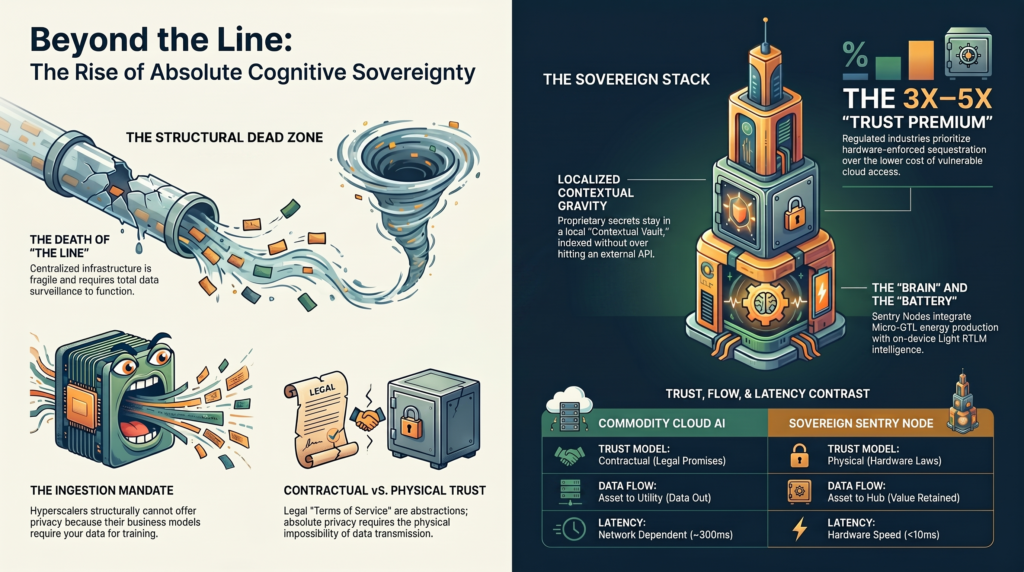
For the last two decades, industrial civilization has been tethered to “The Line”—a fragile, linear topology where energy and data flow from centralized hubs to passive endpoints. In this model, high-voltage grids and hyperscale cloud providers maintain a monopoly on utility, but at a catastrophic cost to resilience and privacy. Cloud-scale AI operates under an unavoidable Telemetry Paradox: to provide inference, providers must ingest sensitive organizational data (D_{in}) to refine their own frontier models. This “Ingestion Mandate” means that privacy is merely a contractual promise—a legal abstraction that fails when T(D_{in}) \neq \emptyset.

video

The Sovereign Axis Group (SAG) marks the shift from “The Line” to The Node. This is the move toward “spherical resilience,” where the Sovereign Sentry Node functions as a hardware-sequestered ecosystem. By generating its own energy via Agra Dot Energy systems and processing intelligence locally via the RIOS (Rural Infrastructure Operating System), the node achieves “Absolute Cognitive Sovereignty.”

DimensionLinear Topology (Cloud/Grid)Nodal Topology (Sovereign Node)
Energy SourceCentralized Grid (External)Local Biomass/Agrivoltaic (Internal)
Data FlowAsset to Utility (Telemetry Ingestion)Asset to Hub (Contextual Sequestration)
Structural RiskSingle Point of Failure (SPF)Decentralized “Spherical” Resilience
Privacy ModelContractual (Terms of Service)Physical (T(D_{in}) = 0)
Economic ModelOpEx Subscription (Rent)CapEx Industrial Asset (Ownership)

This transition is not merely a digital upgrade; it is a thermodynamic necessity. Independent intelligence requires independent energy, beginning with the thermochemical conversion of the soil’s surplus.

——————————————————————————–

podcast

The Sovereign Intelligence Node: Capturing the Trust Premium

2. Phase I: The Energy Alchemy (Biomass to Synthetic Fuel)

The foundation of the Sovereign Sentry is the Agra Micro-GTL (Gas-to-Liquids) System. This unit performs the thermochemical “alchemy” required to turn worthless agricultural waste into high-density liquid fuel, providing the baseload power for localized compute clusters.

  1. Plasma Gasification: Dry agricultural biomass (C_xH_yO_z) is fed into an oxygen-limited chamber where it undergoes plasma pyrolysis at temperatures exceeding 1200°C. This process cracks complex organic tars into Syngas—a clean mixture of Carbon Monoxide (CO) and Hydrogen (H_2).
  2. Fischer-Tropsch Synthesis: The syngas is pressurized and passed over a cobalt catalyst in a Low-Temperature Fischer-Tropsch (LTFT) process. This selects for long-chain paraffin waxes which are subsequently hydrocracked into sulfur-free Synthetic Diesel (ASF™).

The Magic Formula: Fischer-Tropsch Synthesis (2n+1) H_2 + n CO \rightarrow C_nH_{2n+2} + n H_2O

This ASF™ serves as the “stored heartbeat” of the system. By converting low-value biomass into energy-dense liquid fuel, the operator creates a buffer of chemical energy that can be converted into the high-voltage “spark” required for silicon-based reasoning.

——————————————————————————–

3. Phase II: The Closed-Loop Thermodynamic System

The Sovereign Sentry Node is a masterpiece of Combined Heat and Power (CHP) efficiency, achieving “Behind-the-Meter” independence through a recursive thermodynamic loop. The system is designed to minimize entropy by recapturing every joule of “waste” generated during fuel synthesis.

  • Waste Heat Recapture: The Fischer-Tropsch reaction is highly exothermic (\Delta H^\circ \approx -165 \text{ kJ/mol}). This heat, along with thermal energy from the generator’s cooling jackets, is recaptured and piped into mesophilic anaerobic digesters.
  • Biogas Feedback: By maintaining optimal temperatures in the digesters, the system accelerates the processing of wet farm waste, producing supplemental biogas that is fed back into the gasification loop.
  • Waste Valorization: This integration creates an autonomous cycle where farm waste is the primary feedstock for both liquid fuel and “Green Compute” cycles.

The 3 Core Benefits of Compliance Autonomy:

  • Thermodynamic Efficiency: Maximizing the \eta of the system ensures that compute power is essentially a “byproduct” of the farm’s existing waste cycle.
  • Grid Immunity: By operating locally, the node is insulated from both physical grid failures and the volatile pricing of external energy markets.
  • Incentive Alignment: Unlike Big Tech, which requires high-utilization cloud traffic to justify $100B data center spends, the Sovereign Node creates value through local Spark Spread Arbitrage.

As the electrical output enters the server cluster, we transition from the physical heat of the reactor to the digital “heat” of the processing units.

——————————————————————————–

4. Phase III: The Intelligence Vault (Light RTLM & NPUs)

With independent power secured, the node runs the Sovereign Stack, utilizing Light RTLMs (Real-Time Language Models) sized between 1.5B and 8B parameters. To overcome the “Memory Wall”—the physical bottleneck of moving data between RAM and the processor—the system employs Quantization-Aware Training (QAT) and Knowledge Distillation.

By compressing model weights into INT4 Precision, the system achieves inference speeds of 30–70 tokens per second on edge-optimized Neural Processing Units (NPUs). This allows for institutional-grade reasoning—optimized via Low-Rank Adaptation (LoRA) for specific vertical fields—without an internet tether.

FeatureCloud-Scale LLMsOn-Device Light RTLMs
Parameter Size175B+1.5B to 8B (Vertical Optimized)
LatencyNon-deterministic (Network Dependent)Deterministic (Hardware Speed <10ms)
Logic PrecisionFP16 / BF16INT4 (QAT-Compressed)
Moat TypeData Ingestion FlywheelContextual Gravity & Sequestration

This “Hardware Sequestration” creates a physical vault for intelligence. While Big Tech is “structurally banned” from this space—as providing an air-gapped node would result in Telemetry Starvation and destroy their feedback loops—the Sovereign Node thrives on its inability to be seen.

——————————————————————————–

5. The Security Move: Privacy Through Physics

The Sovereign Sentry Node enforces Absolute Cognitive Sovereignty by replacing “Contractual Trust” with “Physical Incapacity.” In the SAG ecosystem, if a device cannot physically transmit data, it is mathematically exempt from audits.

  1. The Air-Gap: The system utilizes GPIO-controlled physical relays that de-energize the network transceiver chips. When the node is in its “Sovereign State,” the power rail to Wi-Fi and Ethernet hardware is physically severed.
  2. Kernel-Level Cutoffs: The RIOS operating system uses a hardened kernel where network drivers are compiled out, and modular loading is disabled. This ensures that T(D_{in}) = 0.
  3. Local RAG (Retrieval-Augmented Generation): Sensitive context (trade secrets, soil history, legal strategy) is stored in a local vector database. Reasoning occurs within an AMD SEV-SNP or Intel SGX enclave, with keys bound to the TPM 2.0 chip.

The “Trust Premium”: Why Physical Isolation Wins

  • Immunity by Omission: Data that cannot leave the device cannot be breached, subpoenaed, or ingested by a competitor’s model.
  • Contextual Gravity: Over time, the local node becomes smarter about the specific ranch or firm it serves, creating an “Above the Line” asset that Big Tech cannot replicate.
  • Un-Killable Operation: The node remains operational during global outages or policy shifts in Silicon Valley.

——————————————————————————–

6. Conclusion: The Circular Economy of “Green Compute”

The Sovereign Sentry Node represents the ultimate circular economy. Through the Spark Spread Arbitrage Coefficient (C_{ssa}), the RIOS platform decides in real-time whether to route energy into liquid ASF™ storage or into “Green Compute” cycles for AI reasoning.

This land-use efficiency is maximized via Agrivoltaics, utilizing vertical bifacial solar arrays. With a Land Equivalent Ratio (LER) \ge 1.35, the system proves that co-locating compute and energy with agriculture produces a net output gain per square meter. In the future, these nodes will trade anonymized “Knowledge Packs” and power via the Locutus Ledger, a peer-to-peer marketplace for sequestered intelligence.

  • Input: Agricultural Waste, Sunlight, and Local Proprietary Context.
  • Process: Agra Micro-GTL Thermochemistry and QAT-Optimized Edge Inference.
  • Output: Sovereign Intelligence, Synthetic Fuel (ASF™), and absolute Data Privacy.
  • The Result: A resilient industrial asset that converts “worthless waste” into the modern world’s most valuable commodity: Absolute Cognitive Sovereignty.

The Great Unplugging: 5 Ways the “Sovereign Stack” is Reclaiming the Future of Rural America

Michael Noel · June 11, 2026 ·

1. Introduction: The Fragility of the Invisible Tether

Modern life is built upon the “Trusted Environment Fallacy”—the dangerous assumption that the fiber optic line is unbreakable, the corporate cloud is eternal, and the global supply chain is a fundamental constant. We live at the end of an “Invisible Tether,” a linear pipeline that does not just deliver data, but actively exports rural wealth, agency, and telemetry to coastal tech hubs. This is “Linear Fragility” in its purest form: a single server outage in Virginia or a carrier termination in Menlo Park can instantly collapse the functionality of a smart home or a regional business in the heartland.

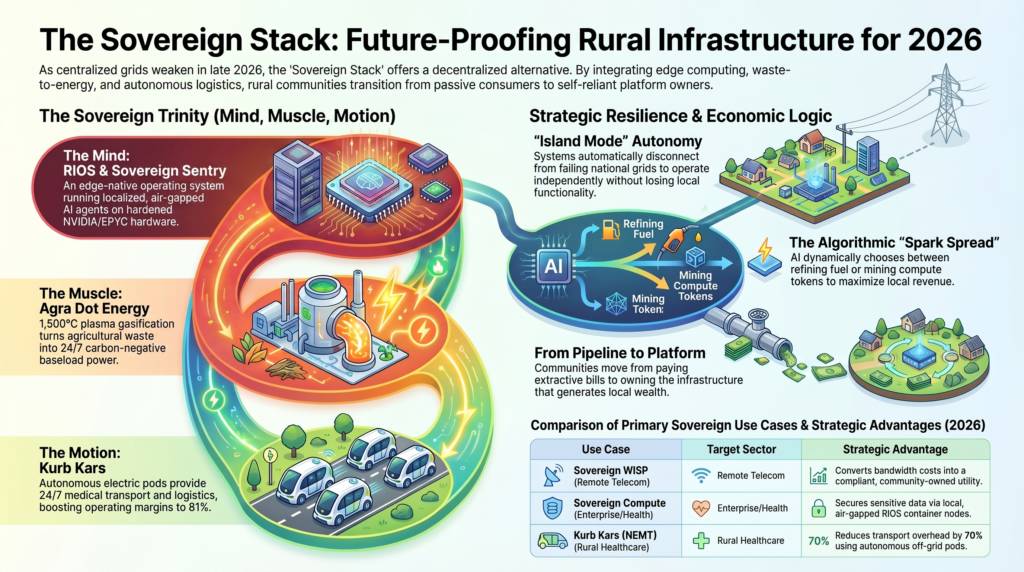
Michael Noel, known in the ecosystem as Biz Builder Mike, and his venture studio, DeReticular, are engineering a structural inversion of this model. The mission is to transition from “pipelines” that extract value to “platforms” that retain it. By deploying “Sovereign Infrastructure”—a unified stack of energy, compute, and logistics—communities are moving toward “Spherical Resilience.” This architecture is not merely a backup plan; it is a fundamental shift that turns a community from a passive consumer into a developer of its own destiny.

podcast

The DeReticular Sovereign Stack Strategic Report

2. The “Digital Airlock”: Privacy You Don’t Have to Ask For

The standard smart home is a surveillance trap where data harvesting is a feature, not a bug. To access advanced AI reasoning, homeowners are traditionally forced to grant “God-mode” surveillance access to their internal environments. The Sovereign Gateway—specifically the Sovereign Sentry Pro—shatters this paradox through a “Digital Airlock” powered by Split-Ledger architecture.

Unlike consumer routers that rely on closed-ecosystem silicon, the Sentry Pro utilizes industrial-grade, open-market Edge AI hardware like the NVIDIA Jetson Orin or Rockchip RK3588. This allows the home to leverage the immense logical power of cloud systems, such as Google’s “Project Remy,” without ever exposing private telemetry. The gateway acts as a physical gatekeeper, stripping away sensitive user context and sending only sterilized logical queries to the cloud.

“In this architecture, private data harvesting and telemetry extraction are treated as inherent features rather than system errors. If a regional broadband carrier experiences an outage, local home automation collapses.”

This represents a counter-intuitive breakthrough: proving we can have high-performance AI logic without high-performance surveillance. By keeping the “Mind” of the home on local hardware, the Sovereign Stack ensures that smart locks, cameras, and climate systems remain operational in “Island Mode,” even when the macro-internet goes dark.

3. Killing the “Deadhead Economy” with Autonomous Pods

In rural regions like La Paz County, Arizona, population dispersion has created “healthcare deserts.” Traditional Non-Emergency Medical Transportation (NEMT) is crippled by the “Deadhead Economy”—where vehicles often drive 50 miles empty to collect a single patient. Between fuel volatility and labor costs, traditional operators struggle with 10% margins.

The Sovereign Stack’s “Motion” layer, known as Kurb Kars, inverts these economics. By deploying ruggedized, low-speed autonomous electric pods (LSVs) that navigate via localized machine learning (NVIDIA Drive), the system eliminates the primary cost drivers. By utilizing local solar charging and “Island Mode” navigation—which functions without external GPS or cloud maps—operating margins jump from 10% to an estimated 81%.

However, a strategist’s view requires acknowledging regulatory reality. To bypass the “Deadhead” traps of high-speed AV approvals, early deployments utilize LSV certifications and safety drivers. This phased rollout allows the platform to collect the mileage data and safety benchmarks required for full autonomy while providing immediate, 24/7 relief to aging demographics.

video

4. The “Spark Spread”: Turning Hemp Waste into Digital Gold

The “Muscle” of the Sovereign Stack is found in the synergy between Agra Dot Energy’s plasma gasification and the RIOS-CC-1000 compute containers. In Node 4 (Uganda), a 7,000-acre hemp estate uses a rolling harvest to feed a 1,500°C plasma arc.

“A blinding, ultra-hot ionized gas arc glowing in electric blue and brilliant white is vaporizing shredded organic biomass at 1,500 degrees Celsius inside a reinforced, dark ceramic-lined chamber.”

This process turns waste into syngas, but the true strategic value lies in the “Spark Spread” algorithm. This system monitors real-time market values to decide the most profitable output for each joule of energy: either refining the gas into liquid Advanced Synthetic Fuel (ASF™) or powering GPU clusters to mine DePIN (Decentralized Physical Infrastructure) tokens. By balancing physical energy against digital compute, the infrastructure becomes self-financing, effectively turning a rural field into a mini-Silicon Valley powered by its own waste.

5. The Dual-Stack Fail-Safe: An Internet That Never Dies

The Sovereign WISP model addresses the decline of trust in centralized telecom by “Inverting the Firm.” Rather than renting access to a corporate pipeline, communities own the platform. The architecture uses a Dual-Stack model: Hyphanet for deep, anonymous archiving and the New Freenet for real-time messaging.

To resolve the “Mesh Canopy Bandwidth Paradox,” the stack distinguishes between two physical layers. High-throughput data, such as real-time messaging via the River client or code updates via freenet-git, runs over TriFiWireless (Wi-Fi 7/5G). Meanwhile, LoRaWAN is strictly relegated to low-bandwidth emergency “heartbeats” and grid-state triggers.

This ensures that if the Starlink backhaul is cut, the neighborhood “mesh canopy” remains a functional island. The irony is profound: the most resilient internet of the future is the one that no longer depends on “The Internet” to function.

6. The AI Reshuffle: From Execution to Judgment

Generative AI is rapidly commoditizing what Sangeet Paul Choudary calls “Knowledge Transmission.” In this new landscape, “Execution”—the mere act of doing—is a low-value commodity. The new luxury goods for the rural workforce are Curiosity, Curation, and Judgment.

This is where the DeReticular Academy trains a new class of Sovereign Power Technicians (SPTs). These are not data entry clerks; they are high-value orchestrators. The SPT exercises “Judgment”—the highest point on Choudary’s Value Chain—to manage the “Spark Spread.” They decide when the microgrid should prioritize refining ASF™ versus mining tokens. As AI manages the coordination, the human technician provides the conviction and ethical context required for high-stakes decisions. The competitive advantage moves from those who can do the task to those who can judge the system.

7. Conclusion: Choosing Your Architecture

The transition from a “Pipeline” to a “Platform” is the ultimate act of resilience. In the old model, you were a passive consumer of a centralized service, one contract termination away from losing control of your assets. In the Sovereign Stack model, you are a developer of a local ecosystem.

This shift from “Consumer” to “Developer” defines the future of rural autonomy. As global networks become increasingly volatile, every community must answer one final question: In the event of a global network collapse, would your community still function, or is your sovereignty just a subscription you’re one outage away from losing?

  • « Go to Previous Page
  • Page 1
  • Interim pages omitted …
  • Page 4
  • Page 5
  • Page 6
  • Page 7
  • Page 8
  • Interim pages omitted …
  • Page 55
  • Go to Next Page »

DeReticular

Copyright © 2026 · Monochrome Pro on Genesis Framework · WordPress · Log in