The Great Unplugging: 5 Ways the “Sovereign Stack” is Reclaiming the Future of Rural America
1. Introduction: The Fragility of the Invisible Tether
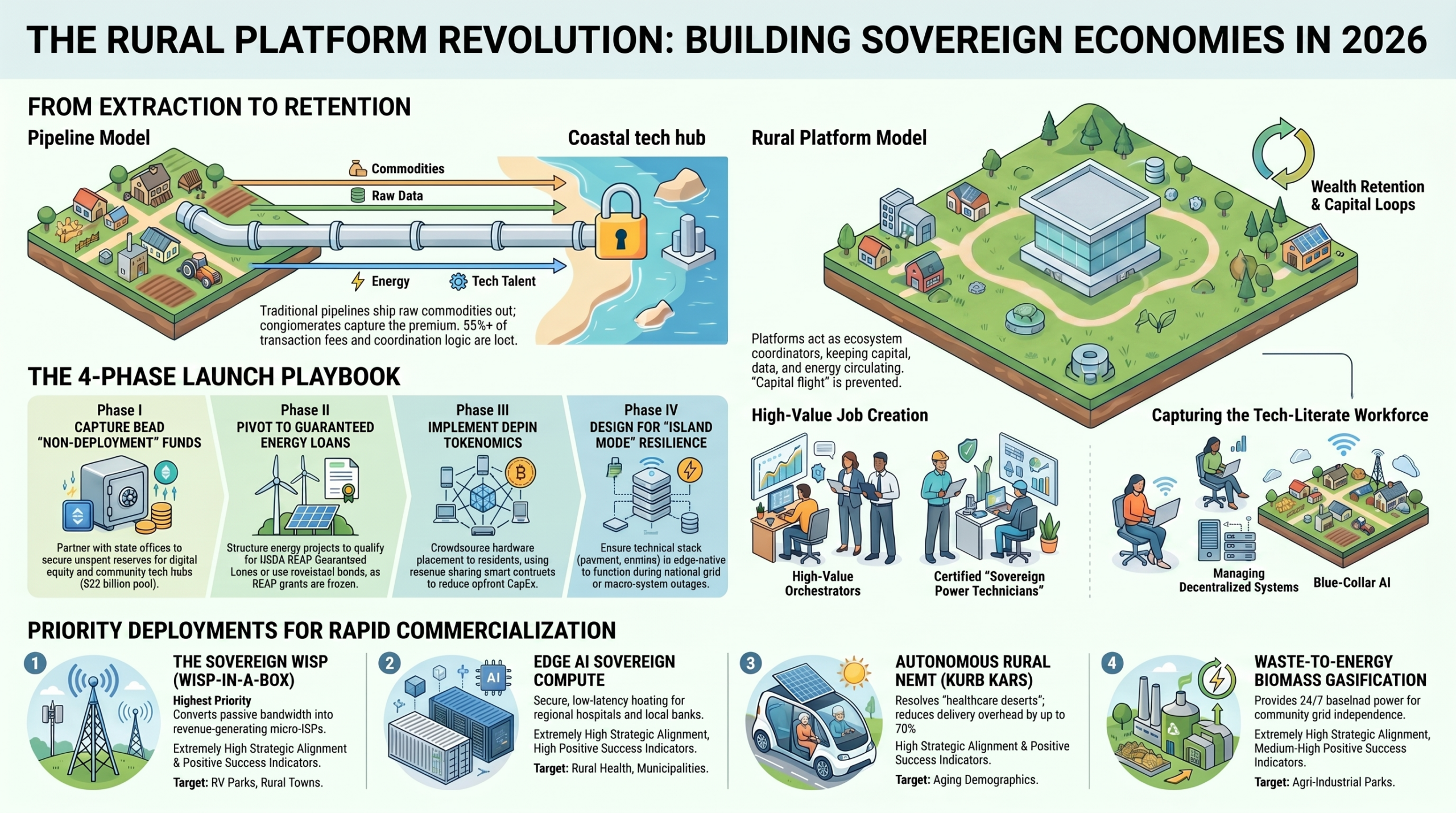
Modern life is built upon the “Trusted Environment Fallacy”—the dangerous assumption that the fiber optic line is unbreakable, the corporate cloud is eternal, and the global supply chain is a fundamental constant. We live at the end of an “Invisible Tether,” a linear pipeline that does not just deliver data, but actively exports rural wealth, agency, and telemetry to coastal tech hubs. This is “Linear Fragility” in its purest form: a single server outage in Virginia or a carrier termination in Menlo Park can instantly collapse the functionality of a smart home or a regional business in the heartland.
Michael Noel, known in the ecosystem as Biz Builder Mike, and his venture studio, DeReticular, are engineering a structural inversion of this model. The mission is to transition from “pipelines” that extract value to “platforms” that retain it. By deploying “Sovereign Infrastructure”—a unified stack of energy, compute, and logistics—communities are moving toward “Spherical Resilience.” This architecture is not merely a backup plan; it is a fundamental shift that turns a community from a passive consumer into a developer of its own destiny.
podcast
2. The “Digital Airlock”: Privacy You Don’t Have to Ask For
The standard smart home is a surveillance trap where data harvesting is a feature, not a bug. To access advanced AI reasoning, homeowners are traditionally forced to grant “God-mode” surveillance access to their internal environments. The Sovereign Gateway—specifically the Sovereign Sentry Pro—shatters this paradox through a “Digital Airlock” powered by Split-Ledger architecture.
Unlike consumer routers that rely on closed-ecosystem silicon, the Sentry Pro utilizes industrial-grade, open-market Edge AI hardware like the NVIDIA Jetson Orin or Rockchip RK3588. This allows the home to leverage the immense logical power of cloud systems, such as Google’s “Project Remy,” without ever exposing private telemetry. The gateway acts as a physical gatekeeper, stripping away sensitive user context and sending only sterilized logical queries to the cloud.
“In this architecture, private data harvesting and telemetry extraction are treated as inherent features rather than system errors. If a regional broadband carrier experiences an outage, local home automation collapses.”
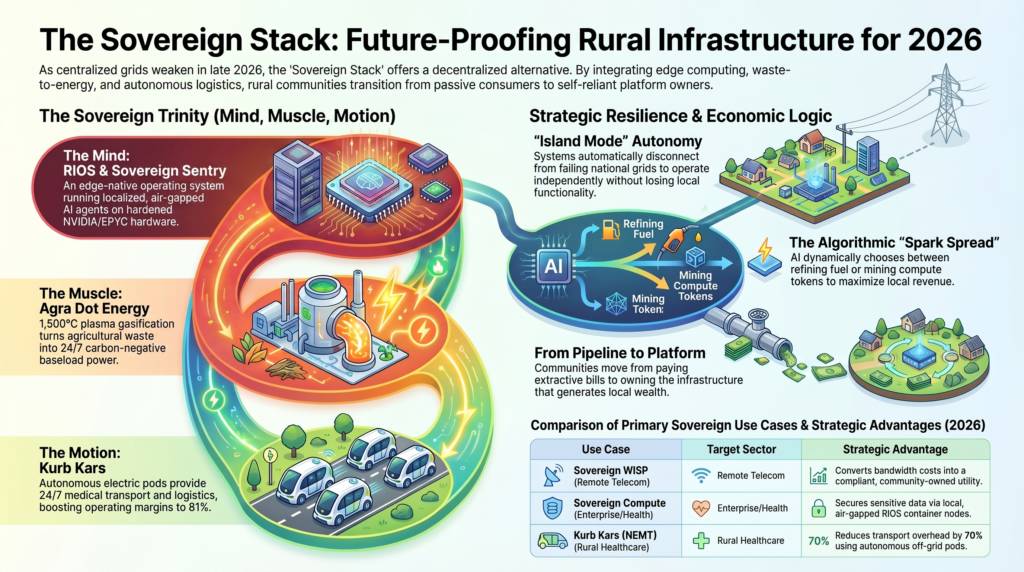
This represents a counter-intuitive breakthrough: proving we can have high-performance AI logic without high-performance surveillance. By keeping the “Mind” of the home on local hardware, the Sovereign Stack ensures that smart locks, cameras, and climate systems remain operational in “Island Mode,” even when the macro-internet goes dark.
3. Killing the “Deadhead Economy” with Autonomous Pods
In rural regions like La Paz County, Arizona, population dispersion has created “healthcare deserts.” Traditional Non-Emergency Medical Transportation (NEMT) is crippled by the “Deadhead Economy”—where vehicles often drive 50 miles empty to collect a single patient. Between fuel volatility and labor costs, traditional operators struggle with 10% margins.
The Sovereign Stack’s “Motion” layer, known as Kurb Kars, inverts these economics. By deploying ruggedized, low-speed autonomous electric pods (LSVs) that navigate via localized machine learning (NVIDIA Drive), the system eliminates the primary cost drivers. By utilizing local solar charging and “Island Mode” navigation—which functions without external GPS or cloud maps—operating margins jump from 10% to an estimated 81%.
However, a strategist’s view requires acknowledging regulatory reality. To bypass the “Deadhead” traps of high-speed AV approvals, early deployments utilize LSV certifications and safety drivers. This phased rollout allows the platform to collect the mileage data and safety benchmarks required for full autonomy while providing immediate, 24/7 relief to aging demographics.
video
4. The “Spark Spread”: Turning Hemp Waste into Digital Gold
The “Muscle” of the Sovereign Stack is found in the synergy between Agra Dot Energy’s plasma gasification and the RIOS-CC-1000 compute containers. In Node 4 (Uganda), a 7,000-acre hemp estate uses a rolling harvest to feed a 1,500°C plasma arc.
“A blinding, ultra-hot ionized gas arc glowing in electric blue and brilliant white is vaporizing shredded organic biomass at 1,500 degrees Celsius inside a reinforced, dark ceramic-lined chamber.”
This process turns waste into syngas, but the true strategic value lies in the “Spark Spread” algorithm. This system monitors real-time market values to decide the most profitable output for each joule of energy: either refining the gas into liquid Advanced Synthetic Fuel (ASF™) or powering GPU clusters to mine DePIN (Decentralized Physical Infrastructure) tokens. By balancing physical energy against digital compute, the infrastructure becomes self-financing, effectively turning a rural field into a mini-Silicon Valley powered by its own waste.
5. The Dual-Stack Fail-Safe: An Internet That Never Dies
The Sovereign WISP model addresses the decline of trust in centralized telecom by “Inverting the Firm.” Rather than renting access to a corporate pipeline, communities own the platform. The architecture uses a Dual-Stack model: Hyphanet for deep, anonymous archiving and the New Freenet for real-time messaging.
To resolve the “Mesh Canopy Bandwidth Paradox,” the stack distinguishes between two physical layers. High-throughput data, such as real-time messaging via the River client or code updates via freenet-git, runs over TriFiWireless (Wi-Fi 7/5G). Meanwhile, LoRaWAN is strictly relegated to low-bandwidth emergency “heartbeats” and grid-state triggers.
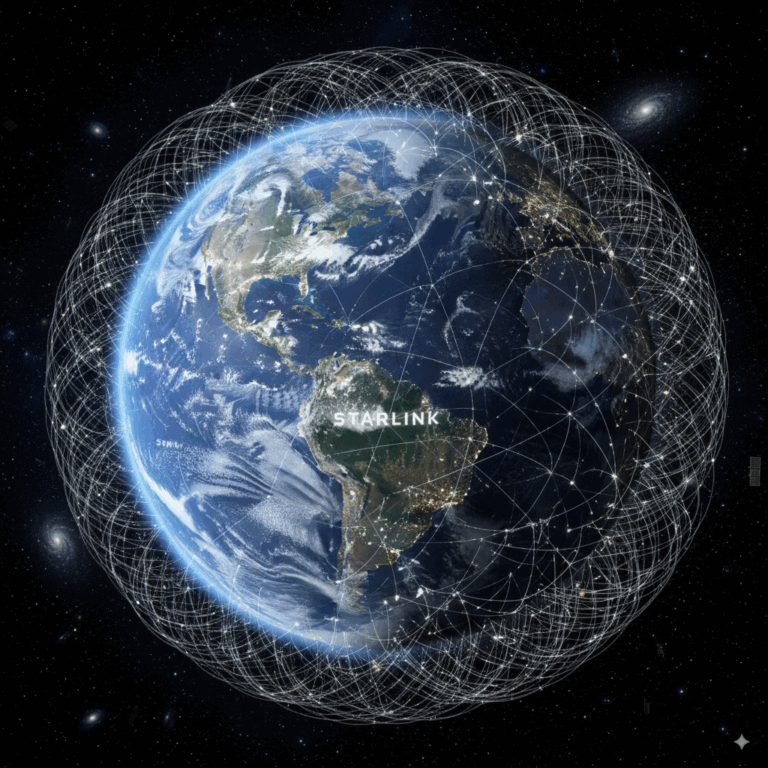
This ensures that if the Starlink backhaul is cut, the neighborhood “mesh canopy” remains a functional island. The irony is profound: the most resilient internet of the future is the one that no longer depends on “The Internet” to function.
6. The AI Reshuffle: From Execution to Judgment
Generative AI is rapidly commoditizing what Sangeet Paul Choudary calls “Knowledge Transmission.” In this new landscape, “Execution”—the mere act of doing—is a low-value commodity. The new luxury goods for the rural workforce are Curiosity, Curation, and Judgment.
This is where the DeReticular Academy trains a new class of Sovereign Power Technicians (SPTs). These are not data entry clerks; they are high-value orchestrators. The SPT exercises “Judgment”—the highest point on Choudary’s Value Chain—to manage the “Spark Spread.” They decide when the microgrid should prioritize refining ASF™ versus mining tokens. As AI manages the coordination, the human technician provides the conviction and ethical context required for high-stakes decisions. The competitive advantage moves from those who can do the task to those who can judge the system.
7. Conclusion: Choosing Your Architecture
The transition from a “Pipeline” to a “Platform” is the ultimate act of resilience. In the old model, you were a passive consumer of a centralized service, one contract termination away from losing control of your assets. In the Sovereign Stack model, you are a developer of a local ecosystem.
This shift from “Consumer” to “Developer” defines the future of rural autonomy. As global networks become increasingly volatile, every community must answer one final question: In the event of a global network collapse, would your community still function, or is your sovereignty just a subscription you’re one outage away from losing?