The Spark Spread: A Primer on Autonomous Energy and Data Arbitrage
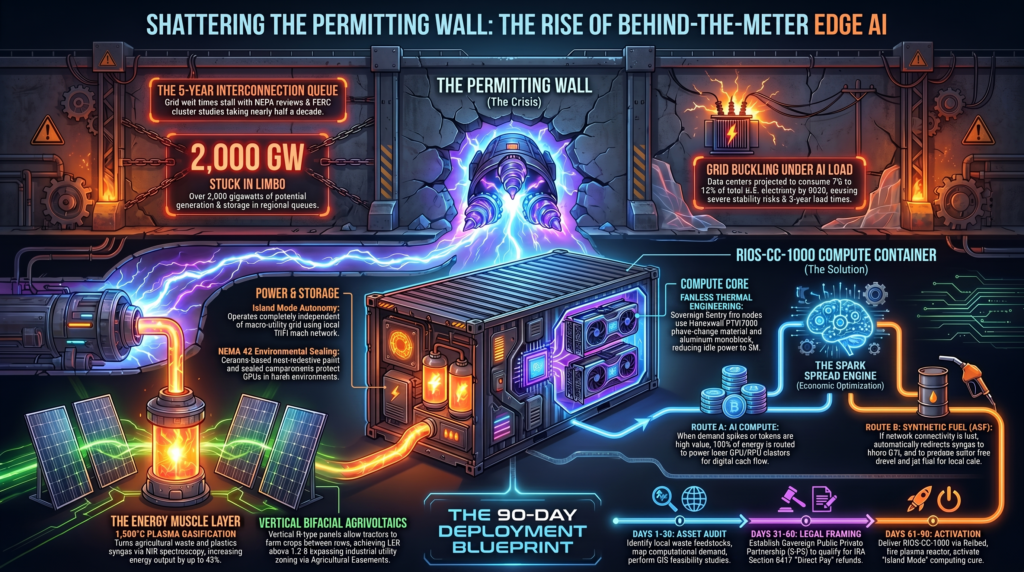
Modern computing infrastructure has collided with a physical reality: the centralized electrical grid is no longer capable of scaling at the velocity of artificial intelligence. As an Industrial Economist, I view this not merely as a technical bottleneck, but as a total market failure of legacy utilities. To survive this “Permitting Wall,” we must transition to a model of computational and energetic self-determination. This primer explores the mechanics of the Spark Spread, the algorithmic engine that turns local waste into digital and physical wealth.
1. The “Permitting Wall”: Why the Grid is Breaking
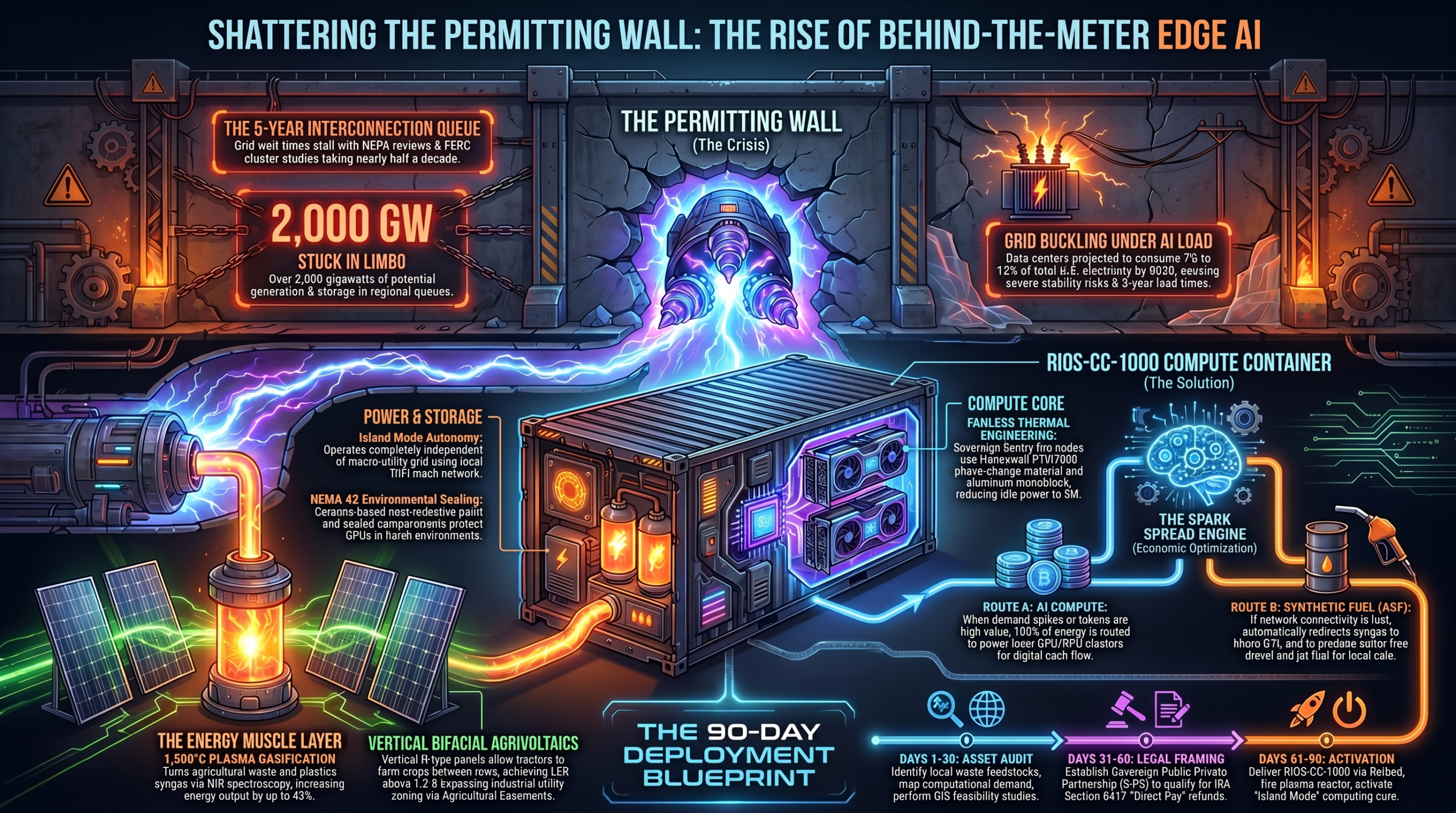
The “Permitting Wall” represents a structural boundary that centralized systems cannot bypass, regardless of capital. As AI data centers move toward consuming up to 12% of U.S. electricity by 2028, the traditional interconnection process has become an insurmountable barrier to entry.
| Dimension | Legacy Centralized Model | BTM (Behind-the-Meter) Solution |
| Wait Times | 5-year+ queue for grid interconnection (FERC Order 2023). | Immediate deployment; operates in “Island Mode” via grid-forming inverters. |
| Regulatory Hurdles | NEPA reviews (4.5-year average) and multi-state rights-of-way. | Bypasses industrial zoning via local Agricultural Easements and high LER. |
| Infrastructure Risks | Regional transformer shortages (3-4 year lead times) and SCADA vulnerabilities. | Self-contained carbon-negative baseload power; zero reliance on regional transmission. |
Takeaway: The Permitting Wall is a physical boundary that centralized systems cannot bypass; consequently, localized energy production is now a strategic necessity for AI rather than a choice.
As the centralized grid fails to keep up, the industry is shifting toward “Island Mode” hardware capable of generating its own power and processing data in total isolation.
2. The Hardware: Anatomy of an “Island Mode” Node
To achieve absolute autonomy, we deploy the RIOS-CC-1000, a ruggedized compute module engineered for off-grid resilience.
- The RIOS-CC-1000 Container: A 10-foot NEMA 4X sealed ISO shell. It utilizes Sovereign Sentry Pro nodes with a fanless design. By using Honeywell PTM7950—a phase-change material that transitions to liquid at 45°C—the system achieves a thermal conductivity of 8.5 W/mK. This eliminates mechanical fans and parasitic power loads, reducing the node’s idle draw to a mere 5W.
- 1,500°C Plasma Gasification: This “molecular cracking” reactor uses an ionized gas arc to break down feedstocks (manure, tires, plastic) into elemental syngas. Integrated NIR (Near-Infrared) Spectroscopy analyzes feedstock moisture and carbon in real-time, automatically tuning the plasma arc to optimize energy output.
- Vertical Bifacial Agrivoltaics: N-type solar panels are installed vertically at 7-meter row intervals, allowing standard agricultural tractors to cultivate crops like hemp or soy between them. This achieves a Land Equivalent Ratio (LER) of 1.2, increasing land productivity by 20% while maintaining agricultural zoning.
- TriFi Mesh Networking: The node communicates via a private, self-healing TriFi mesh network (5.8/6 GHz), ensuring the system maintains 100% operational uptime without relying on centralized fiber or macro-utility grids.
What is “Island Mode”? “Island Mode” is the operational capacity of a system to maintain 100% uptime and sovereign decision-making power even when physically and digitally severed from the national power grid and commercial internet.
While this hardware provides the thermal engineering efficiency and physical power, the Spark Spread provides the algorithmic brain required for optimization.
3. Understanding the “Spark Spread” Logic
In industrial economics, the “Spark Spread” is the difference between the price of electricity and the cost of the fuel used to generate it. In an autonomous node, the computer acts as a Real-Time Arbitrator, weighting the opportunity cost of digital vs. physical products to maximize net yield.
The system calculates its strategy using five key variables:
- Total Power (P_{total}): The aggregate energy available from the agrivoltaic arrays and plasma reactor.
- The Choice (a(t)): The “arbitrage allocation factor” (a slider from 0 to 1). If a=1, all power goes to compute; if a=0, all power goes to fuel.
- The Value of Digital (V_{compute}): The real-time earnings from AI inference, validation, and DePIN tokens.
- The Value of Physical (V_{ASF}): The market value of refining syngas into liquid Advanced Synthetic Fuel.
- The Cost of Production (C_{fuel}): The localized cost per kWh to process feedstock and maintain the gasifier.
Mathematical Synthesis: The engine constantly solves for \max_{a(t)} \Pi(t), a formula that maximizes profit by shifting energy to whichever path offers the highest margin after subtracting C_{fuel}. It is an automated pursuit of the highest yield per kilowatt.
This mathematical decision-making transforms raw energy into two distinct high-margin commodities.
4. The Two Paths: Digital Intelligence vs. Physical Fuel
| Route 1: Advanced Synthetic Fuel (ASF™) | Route 2: Edge AI Inference |
| Process: Syngas is routed to a Micro-GTL (Gas-to-Liquids) unit to be refined into sulfur-free diesel or jet fuel. | Process: Energy is directed to high-performance GPUs/NPUs within the Sovereign Sentry Pro cores. |
| Economic Value: Capitalizes on regional logistics costs and fuel shortages; provides 40%+ margins. | Economic Value: Generates “high-velocity digital cash” by processing real-time AI requests and mining utility tokens. |
| Resilience Role: Acts as a revenue fail-safe during periods of network instability or low digital demand. | Growth Role: Captures maximum value during spikes in DePIN demand or peak computational training cycles. |
The “Auto-Switch” Trigger: This is a fail-safe mechanism for revenue. If the TriFi network loses external connectivity, the value of digital work (V_{compute}) drops to zero. The Spark Spread engine instantly flips the allocation factor a(t) to 0, pivoting 100% of energy to fuel production to maintain cash flow until the connection is restored.
This flexibility ensures the system is financially self-sustaining, fueling an economic flywheel.
5. The Economic Flywheel: How the System Pays for Itself
The Sovereign Stack utilizes specialized financing to bypass the high-interest barriers of traditional banking.
- [ ] Node-as-a-Service (NaaS): Communities lease the hardware with zero upfront capital. The lease is amortized using a percentage of the automated “Spark Spread” revenue.
- [ ] IRA Section 6417 (Direct Pay): This federal provision allows non-profits and co-ops to receive 30-50% of the hardware cost as a direct cash refund for deploying clean energy assets.
- [ ] Intercompany Sovereign Debt: Financing is issued internally to the local cooperative, shielding the project from predatory creditors and local currency inflation.
Takeaway: Leveraging federal “Direct Pay” provisions provides a 30-50% cost reduction, facilitating a transition from centralized dependence to absolute computational and energetic self-determination.
6. Implementation Roadmap: From Waste to Wealth in 90 Days
Deployment follows a rigorous 90-day blueprint to transform local waste into an active industrial asset.
- Days 1–30 (Asset and Interconnection Audit)
- Action: Audit local agricultural/municipal waste streams and map local edge-compute demand.
- Deliverable: GIS resource maps and a feasibility study for 7-meter vertical solar spacing.
- Days 31–60 (S-P3 Legal Framing & DAO Setup)
- Action: Form a Sovereign-Public-Private Partnership (S-P3) and establish DAO governance to manage the Spark Spread.
- Deliverable: Legal entity setup and submission for Section 6417 federal tax refunds.
- Days 61–90 (Deployment & Island Mode Activation)
- Action: Deliver the RIOS-CC-1000 container, align agrivoltaic arrays, and ignite the plasma reactor.
- Deliverable: Activation of the “Island Mode” core and commencement of the real-time Spark Spread optimization engine.