Beyond the Grid: How 7,000 Acres of Robots and Plasma are Building Africa’s First Sovereign Industrial Oasis

Industrializing a remote frontier like the Karamoja sub-region of Northern Uganda has long been a graveyard for conventional development models. Plagued by grid instability, extreme logistical latencies, and “linear fragility,” the region has remained on the periphery of the global economy. However, a new architecture for industrial resilience is emerging in Kaabong: a “closed-loop” industrial park—Node 4—designed to operate as a self-sustaining island of automation and energy.
The Kaabong Smart Eco-Industrial Park (SEIP) represents a radical departure from centralized infrastructure. Capitalized at $30 million, this 7,000-acre estate is not merely a farm; it is a vertically integrated platform where agricultural biomass serves as the foundational feedstock for renewable electricity, high-margin bioprocessing, and global edge computing. By integrating advanced robotics with plasma gasification and blockchain-verified finance, Node 4 provides a provocative blueprint for “Spherical Resilience”—the ability for industrial nodes to survive and thrive even if national grids or global internet tethers fail.
As we move toward a future of decentralized “Sovereign Stacks,” Node 4 stands as the first terrestrial validation center for an economy that operates entirely in “Island Mode.” Here is how this autonomous estate is rewriting the rules of economic sovereignty.
1. The 100-Day Infinite Loop: Why 40 Acres a Day Changes Everything
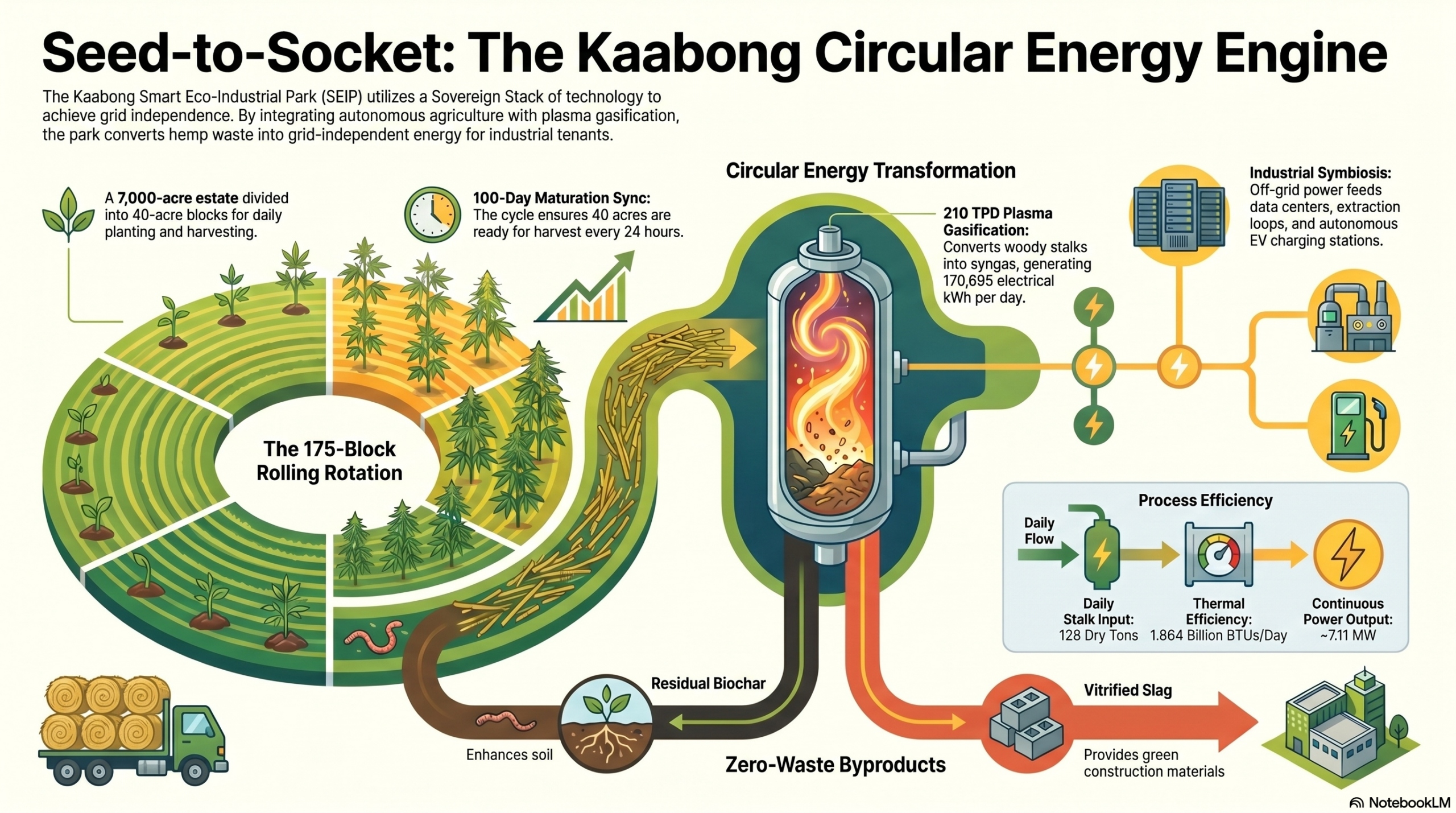
Traditional agriculture is defined by seasonal volatility—massive spikes in labor demand during harvest followed by months of idle equipment. Node 4 eliminates this bottleneck through a Continuous Rolling Rotation Model. The 7,000-acre estate is divided into 175 operational blocks of 40 acres each. Because industrial hemp matures in approximately 100 days under equatorial conditions, the system is designed to plant 40 acres and harvest 40 acres every single day of the active season.
By the time the autonomous planting fleet finishes seeding Block 100, the harvesting fleet begins cutting Block 1 on its exact 100-day maturation date. This ensures a steady, unceasing supply of raw material for the on-site processing facilities, maximizing equipment utilization and preventing the “batch-processing” lag that kills agricultural ROI.
“This ensures a continuous daily supply of feedstock to feed the on-site plasma gasification unit and leaf biomass for the extraction loop, maximizing equipment utilization and preventing bottlenecking.” — Industrial Operations & Yield Report
Deck
https://academy.dereticular.com/wp-content/uploads/2026/06/The_Kaabong_Perpetual_Engine.pdf
2. From Swarms to Sentry AI: The Autonomous Workforce
Autonomy at Node 4 is not merely about labor replacement; it is about Input Precision and 24/7 operational capability. The estate utilizes a decentralized swarm of specialized robots to manage the unique challenges of industrial hemp, which is notoriously difficult to process due to its high-tensile fiber.
- The Planting Swarm: Two 120 HP Sabanto-retrofitted electric/diesel hybrid tractors pull 20-foot pneumatic air seeders. Guided by GPS-RTK towers with sub-centimeter accuracy, they complete the daily 40-acre block in under two hours, reducing seed overlap waste by 8%.
- The Custom Harvester: A Class 7 rotary combine, equipped with a 30-foot draper header, is modified with an “under-scythe” cutter. While the top header collects foliage, the secondary bar cuts the stalks at four inches above the soil, laying them flat for retting.
- The Kaabong Kars: A fleet of 20 rugged, autonomous electric UTVs handles field-to-facility hauling, transporting fresh material to processing loops using the Node 6 autonomy stack.
- The Grain Weevils: Inside the drying silos, these auger-propelled robots are safety-critical. They maneuver across the grain to level the pile and break up crust layers, preventing the biological fermentation that causes moisture-driven spontaneous combustion.
- Sovereign Sentry AI: Edge-based computer vision manages a “15-meter safety envelope” around all machinery, allowing robots to operate among livestock and personnel without human oversight.
3. Plasma Gasification: Generating 7 Megawatts of “Island” Power
At the heart of the facility’s energy sovereignty is a 210 Tons Per Day (TPD) plasma gasifier. Operating independently of the national utility grid, this system converts woody agricultural waste into synthesis gas (syngas) and a vitrified slag used in construction.
Under an “Energy-Focused Max” configuration (Scenario A), 128 dry tons of hemp stalks are fed into the gasifier daily. With a heating value of 6,500 BTU/lb and a 35% thermal-to-electrical efficiency, this generates approximately 170,000 kWh per day—a 7.11 MW continuous power output. This baseload power is sold to the on-site UCC-1 compute cluster at a fixed, low-cost energy tariff of $0.07/kWh, ensuring an 83% EBITDA margin for global AI training workloads.
“The 210 TPD Plasma Gasification Unit is the ‘engine’ of the ecosystem… providing 101% of the gasifier’s wet-basis intake capacity from a 40-acre-per-day harvest.” — Business Plan: Kaabong Agro-Energy
4. The Lotion Pipeline: Scaling Beauty to 3 Million Bottles Daily
The economic density of Node 4 is achieved through “Agile Reconfiguration.” When the park shifts to a “Balanced Dual-Purpose” model (Scenario C), it prioritizes high-margin bioprocessing. In this mode, the daily 40-acre harvest yields 100 wet tons of foliage.
This biomass is fed into a continuous-flow chilled ethanol extraction loop, yielding approximately 750 gallons of crude cannabinoid oil every 24 hours. Given a formulation of 500 mg of active extract per 2 oz bottle, this single estate can produce 3.15 million bottles of topical lotion every day. By converting a raw crop into a pharmaceutical-grade consumer product on-site, the park captures the entire value chain before a single truck leaves the gate.
5. The “Sovereign Bank”: Bypassing Wall Street with Math
A major friction for remote projects is the “Oracle Problem”—the difficulty in proving to a lender thousands of miles away that a harvest actually occurred. Node 4 solves this by becoming a “Sovereign Bank” using Digital Twin Dynamic NFTs and Zero-Knowledge Proofs (ZKPs).
The RIOS Pilot Command Center captures real-time telemetry from flow meters, scale sensors, and energy logs. This data is cryptographically hashed into a digital twin classified under UCC Article 12 as a Controllable Electronic Record (CER). This legal status, combined with CFTC Letter No. 25-39, allows institutional clearers to accept these tokenized real-world assets as eligible margin collateral in derivatives markets. Global lenders take “cryptographic control” of the harvest or energy, bypassing traditional banking latencies and releasing credit in seconds via compliant stablecoins.
6. The Vanguard Pivot: From Industrial Engine to “Sovereign Oasis”
In March 2026, the project underwent a strategic shift known as the Vanguard Pivot. While the heavy industrial blueprints for 7.11 MW power and 3.1 million bottles remain legally preserved and ready for activation, logistical latencies led to the re-scoping of Node 4 as a “Sovereign Oasis.”
Today, the site serves as a high-value validation center for “Spherical Resilience.” It functions as an off-grid hospitality and eco-tourism retreat where network stakeholders experience 99.9% uptime independent of the national grid. It is a live showcase for the “Sovereign Stack”—a modular, air-gapped system of AI agents (like the Sovereign Sentry) and mesh networking that can survive even if the global internet goes dark.
7. A Provocative Glimpse of the Future
The lessons learned in the Karamoja highlands are already being exported beyond Earth. The terrestrial testing of these autonomous systems and power-balancing algorithms has paved the way for Sovereign Space Systems, a pipeline adapting the “Sovereign Stack” for the Lunar Adaptation Pipeline. The same robots managing hemp silos in Uganda are providing the data necessary for off-world agricultural economies.
As centralized cities and national grids face increasing strain, Node 4 suggests a different path forward. The future of human infrastructure may not lie in bigger, more connected centers, but in these autonomous, self-sustaining “islands of resilience.” If a 7,000-acre estate in one of the most remote corners of Africa can operate as its own energy utility, digital cloud, and bank, the question is no longer if we can live off-grid—but how fast the rest of the world will adopt the Sovereign Stack.