
• Skip to primary navigation
  • Skip to main content
DeReticular

DeReticular

Local Autonomy. National Security. Total Sovereignty.

  • Solutions
    • Municipalities
    • Energy
    • Industrial
    • Defense
  • Infrastructure
  • Intelligence
  • Company
  • Request Municipal Audit
  • Show Search
Hide Search
You are here: Home / Archives for Michael Noel

Michael Noel

Regulatory Compliance Protocol: Operational Standards for Sovereign Micro-ISPs

Michael Noel · June 9, 2026 ·

1. Introduction: The Strategic Imperative of Regulatory Alignment

In the decentralized telecommunications landscape, regulatory compliance is not a secondary administrative burden; it is a foundational strategic asset. Adherence to federal mandates and provider-level Acceptable Use Policies (AUP) transforms a decentralized node from a high-risk “hobbyist” project into a legitimate, resilient, and legally shielded business infrastructure. By aligning with established telecommunications frameworks, operators protect their capital investment and ensure the long-term viability of their network service against service termination or legal seizure.

The “Sovereign WISP” (Wireless Internet Service Provider) model is a hyperconverged, autonomous gateway system powered by the Rural Infrastructure Operating System (RIOS). This architecture centers on the Sovereign Sentry Pro, a core compute engine that integrates DeReticular’s ruggedized hardware with TriFiWireless enterprise backhaul via Starlink Business connectivity. This “Civilization-in-a-Box” model allows independent entrepreneurs to deploy high-speed internet in remote or off-grid environments while maintaining the professional and legal standards required of modern ISPs. To ensure this infrastructure remains operational and compliant, strict adherence to uplink and distribution protocols is non-negotiable.

video

2. Backhaul Integrity: Starlink Acceptable Use Policy (AUP) & Enterprise API Hard-Locks

The integrity of the primary satellite backhaul is the first line of defense for a micro-ISP. Compliance with the Starlink AUP is a binary requirement: failure to adhere to reselling restrictions on unauthorized tiers results in immediate service termination at the terminal level, rendering the local node inert.

Authorized Enterprise Backhaul vs. Residential Service

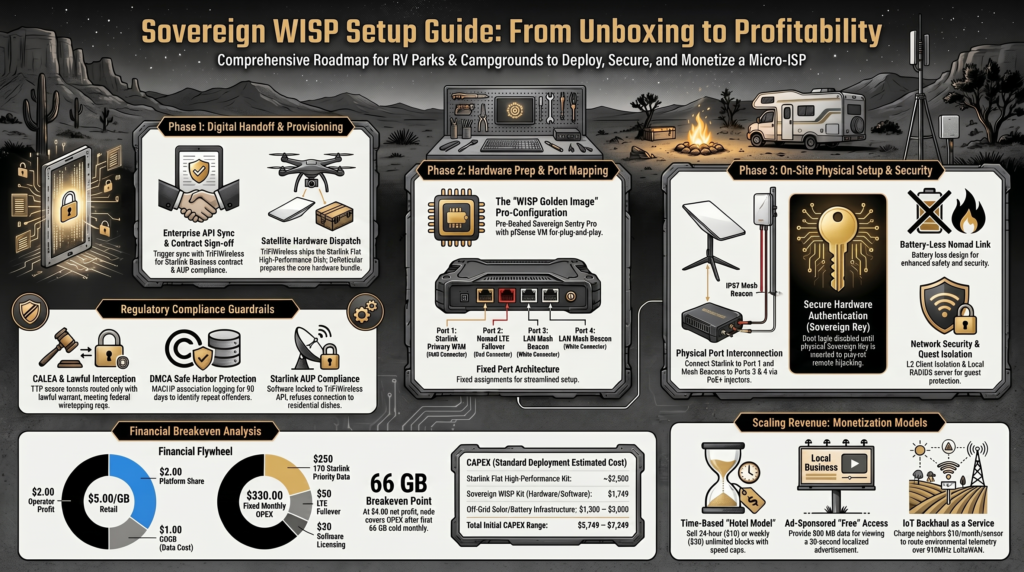
There is a critical differentiator between standard Starlink residential service and the authorized TriFiWireless Starlink Business model. Residential contracts explicitly forbid the resale of bandwidth; however, the Sovereign WISP Kit (SKU: RIOS-KIT-WISP) is engineered to operate exclusively within the authorized TriFiWireless enterprise framework. This ensures that the redistribution of data to third-party users is contractually sanctioned. To facilitate “plug-and-play” deployment, technicians at the Node 3 Workshop flash each Sentry Pro with a custom “WISP Golden Image” (Doc 6). This configuration pre-defines the network topology, mapping Port 1 as the primary WAN link to the Starlink Flat High-Performance Dish.

The Partner API Integration Lock

To enforce AUP compliance, the Sovereign Sentry Pro utilizes a “Partner API Integration” hardware-software lock. The integrated “Tollbooth” software agent interacts directly with the TriFiWireless API to verify the hardware’s “Authorized Enterprise” status. The system is architected to refuse to boot if it detects a connection to an unauthorized residential terminal, providing an automated safeguard against accidental policy violations.

podcast

DeReticular Hardware and Software Product Catalog

Bridging the “ISP of Record” Gap

Operating a public node technically classifies the owner as a micro-ISP, introducing significant regulatory exposure. To mitigate this, the protocol utilizes a Master Service Agreement (MSA) where DeReticular assumes the role of the officially registered “ISP of Record.” This strategic bridge shields individual operators from direct regulatory audits and the administrative complexity of federal telecommunications filings. These hardware and software locks are essential prerequisites before the node satisfies federal surveillance mandates.

3. Lawful Interception Architecture: CALEA Compliance and TTP Tunneling

The Communications Assistance for Law Enforcement Act (CALEA) is a mandatory federal requirement for all telecommunications providers in the United States. For micro-ISPs, implementing CALEA-compliant wiretapping capabilities is a strategic requirement for maintaining legal operating status and avoiding severe federal penalties.

Implementation via Trusted Third Parties (TTP)

To satisfy CALEA without requiring the operator to manage forensic data interception manually, the system utilizes Trusted Third Party (TTP) tunneling through providers such as Subsentio or Apogee. This allows the micro-ISP to outsource the legal and technical heavy lifting of interception requests.

Technical Execution and Hypervisor Isolation

The technical execution of lawful interception is localized within the pfSense Virtual Machine (VM), which is hosted on the Sovereign Sentry Pro’s Proxmox hypervisor. This architectural isolation ensures that:

  • Warrant-Based Activation: Secure tunnels are pre-configured within the pfSense VM but remain dormant, establishing a connection only upon the presentation of a valid lawful warrant.
  • The Sovereign Key: Administrative access to these interception protocols is secured by the Sovereign Key—a FIDO2/PIV-compliant hardware token (Doc 1). This physical credential ensures that only authorized personnel can modify sensitive legal configurations.

This framework protects the privacy of the broader user base from unauthorized access while ensuring the micro-ISP remains compliant with federal surveillance mandates.

4. Intellectual Property Protection: DMCA Safe Harbor Execution

The Digital Millennium Copyright Act (DMCA) provides “Safe Harbor” protections that shield ISP operators from third-party liability for the copyright-infringing actions of their users. Execution of these protections is critical to preventing litigation from disrupting node operations.

The Safe Harbor Execution Strategy

To maintain Safe Harbor status, operators must execute three critical actions managed through the RIOS environment:

  1. Designated Agent Registration: Operators must officially register a designated DMCA agent with the US Copyright Office.
  2. MAC/IP Association Logging: The “Tollbooth” agent is configured to maintain 90-day logs of MAC address and IP associations to identify specific users linked to infringement notices.
  3. Repeat Offender Termination: The local RADIUS server, residing on the Sentry Pro, enforces a “Repeat Offender” policy. By hosting the RADIUS server locally rather than in the cloud, the node can enforce access revocation even during periods of backhaul rain-fade or service disruption (Doc 6).

Layer 2 Security and Liability Mitigation

The protocol mandates the enforcement of Layer 2 Client Isolation. This configuration, managed by the local RADIUS and Mesh Beacon settings, prevents peer-to-peer hacking between users on the same node. This isolation localizes IP liability and prevents a single malicious user from compromising the security of other connected clients.

5. Operational Data Governance: Software Locks, QoS, and Bandwidth Shaping

Effective data governance via Quality of Service (QoS) is essential for maintaining network health and preventing “Bandwidth Hogging.” These locks ensure that the shared backhaul remains stable for all paying clients.

Hard QoS Limits

The OpenClaw “Tollbooth” agent (dereticular/openclaw-wisp:latest) enforces the following limits:

Control MechanismSpecificationStrategic Impact
Download Speed Cap15 Mbps per MACEnsures fair-share access to the 1TB Starlink Priority Data pool.
Upload Speed Cap2 Mbps per MACPreserves upstream capacity for critical system telemetry.
Data Quota Trigger1,024 MB (1 GB)Synchronizes with the RIOS Ledger to trigger session revocation at the kilobyte level.

The Sovereign Audit Engine

Integrity is maintained by the Sovereign Audit Engine, a specialized function of the Tollbooth agent. It monitors client behavior for MAC address spoofing; if a user attempts to cycle MAC addresses to bypass data quotas, the engine triggers an automatic localized blocklist. Furthermore, RIOS utilizes dynamic QoS prioritization to ensure that critical system operations, such as firmware updates and node telemetry, take precedence over retail Wi-Fi traffic.

6. Future-State Compliance: Evolution to Zero-Trust and NTN (Gen 4)

The decentralized ISP landscape is evolving from the Gen 3 pilot phase toward a Gen 4 “Sovereign Communications Infrastructure,” characterized by multi-orbit resilience and automated compliance.

Zero-Trust and Cryptographic Identity

Generation 4 will phase out MAC-based captive portals in favor of Cryptographic Zero-Trust Network Access (ZTNA) and WPA3-Enterprise. This system eliminates portal bypass and session hijacking by issuing unique, temporary cryptographic tokens directly to a device’s secure enclave upon transaction.

Multi-Orbit Resilience and 5G NTN

Compliance with uptime obligations will be bolstered by multi-orbit SD-WAN (bonding Starlink, Amazon Project Kuiper, and Eutelsat OneWeb). Furthermore, Gen 4 hardware will incorporate unified cellular-satellite transceivers aligned with 3GPP Release 19 standards (5G Non-Terrestrial Networks) for orbital direct-to-cell fallback. Mesh Beacons will transition to Wi-Fi 7 (802.11be) utilizing Multi-Link Operation (MLO) to eliminate localized network congestion.

Edge AI and Autonomous Governance

Future Sentry Pro nodes will utilize integrated Neural Processing Units (NPUs) on-chip for Edge AI. These NPUs will autonomously filter local telemetry and manage data governance, ensuring compliance with evolving privacy standards without requiring constant operator intervention.

7. Conclusion: Compliance Verification Checklist

The operator of a “Civilization-in-a-Box” node is the steward of a professional telecommunications asset. Compliance is the mechanism that ensures this sovereign independence is sustainable, profitable, and legally protected.

Critical Compliance Checklist

Before broadcasting the public SSID, every operator must verify the following:

  1. Register DMCA Agent: Confirm a designated agent is registered with the US Copyright Office.
  2. Authenticate via Sovereign Key: Verify that administrative root access is locked behind the hardware token.
  3. Verify TriFiWireless API Link: Ensure the Sentry Pro is authenticated with the enterprise billing API to permit booting.
  4. Confirm TTP Tunneling: Verify active, dormant CALEA tunnels to Subsentio or Apogee within the pfSense VM.
  5. Enable Client Isolation: Confirm Layer 2 isolation is active on all Mesh Beacons to localize liability.

Operators must conduct regular audits using the Sovereign Deck (SKU: RIOS-OP-DECK). By utilizing its integrated RTL-SDR, technicians must monitor the 2.4GHz and 915MHz RF spectrums to identify rogue nodes or unauthorized interference, ensuring the security and performance of the sovereign network.
Technical Deployment Specification: Sovereign Node Infrastructure

Michael Noel · June 9, 2026 ·

1. Physical Hardware Layer: The Sovereign Sentry Pro and Network Anchorage

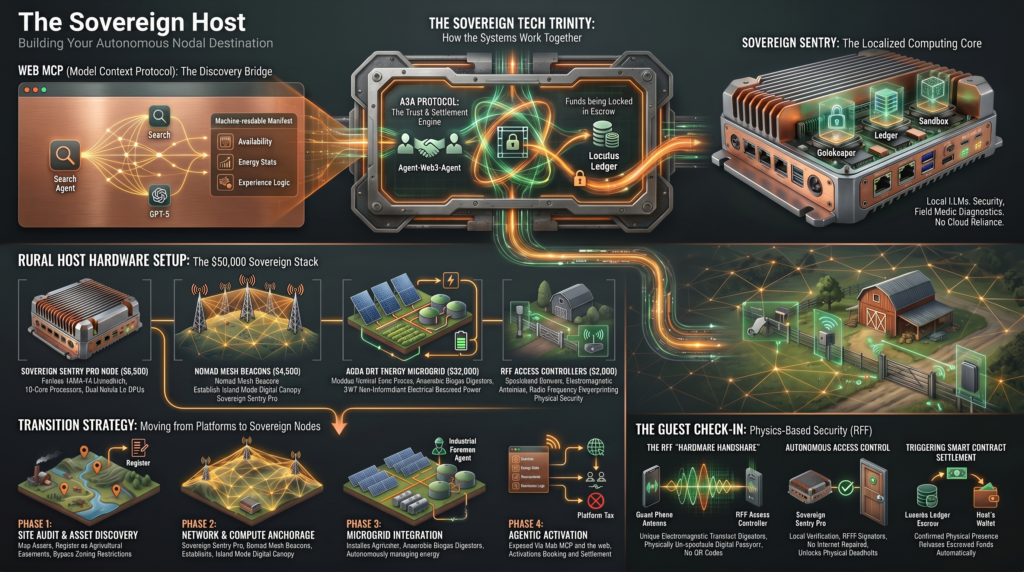
Establishing “Spherical Resilience” in rural environments demands a fundamental shift from fragile, linear infrastructure to high-performance, fanless edge computing. Standard deployment requires the establishment of a localized hardware anchor that functions independently of centralized cloud providers. This architecture ensures operational continuity during macro-network volatility and utility blackouts. The Sovereign Sentry Pro serves as the primary physical node, providing the compute density and connectivity required for “Island Mode” autonomy.

Sovereign Sentry Pro Hardware Specifications

The Sovereign Sentry Pro is an industrial-grade hyperconverged infrastructure (HCI) node. It is engineered for extreme environments using an anodized aluminum monoblock with deep thermal heat sink fins, eliminating active cooling dependencies. To ensure long-term viability, the chassis must utilize hot-swappable MXM GPU and PCIe carrier backplanes, enabling modular hardware upgrades in under 15 minutes.

ComponentSpecification
Form FactorFanless, NEMA 4X weather-sealed, anodized aluminum monoblock
Processing CoreAMD EPYC Embedded Processor (16 Cores, 32 Threads)
AI Acceleration2x Nvidia L4 GPUs (48GB combined GDDR6 VRAM)
System Storage4TB Enterprise U.3 NVMe SSD (RAID-1 Mirror Configuration)
BackplaneHot-swappable MXM and PCIe carrier backplane architecture
Connectivity10GbE SFP+ optical ports; integrated Starlink Business array
podcastinterface

podcast

The Sovereign Host: Agentic Orchestration and Deep Hospitality

Nomad Mesh-Point Routers (RIOS-EXT-01)

To eliminate field “dead zones,” the deployment shall utilize Nomad Mesh-Point Routers. These units project a private intranet canopy to support the Rural Infrastructure Operating System (RIOS).

  • Installation Standards: Units must be sited at high-elevation points with a minimum 30-foot vertical clearance to ensure 360° line-of-sight coverage over a 1.5-mile radius.
  • Protocol Allocation:
    • Tri-band Wi-Fi 6E: Reserved for high-bandwidth tasks, specifically Augmented Reality (AR) spatial data delivery.
    • 915MHz LoRaWAN: Dedicated to long-range, low-power telemetry and sensor network communication.

video

Mobile Edge Integration: Nomad Link and Fleet Kits

The “Vehicle-as-a-Relay” architecture shall be implemented using Nomad Link and Fleet Kits. Ruggedized transceivers mounted on moving machinery—interfaced via OBD-II and CAN Bus—cache IoT telemetry and sensor data in off-grid pockets. Upon entering the range of the core Sovereign Sentry cluster, the system initiates an automated high-speed data synchronization, bridging physical terrain gaps.

The physical layer provides the necessary compute environment for the virtualization and software layers that animate the node’s local intelligence.

——————————————————————————–

2. Local Logic Layer: Hyperconverged Infrastructure and OpenClaw AI Agents

Maintaining data sovereignty requires a mandatory air-gapped automation strategy. By hosting logic locally within the RIOS environment, the Sovereign Node ensures that operational data and personal privacy remain on-site, mitigating the risks of platform extraction and centralized cloud dependency.

Virtualization via Proxmox VE

The Sentry Pro shall utilize the Proxmox VE hypervisor (Kernel 6.x) to manage three mandatory, isolated virtual environments:

  1. The Gatekeeper: Runs pfSense/OPNsense for deep packet inspection, firewall security, and automated WAN failover.
  2. The Ledger: Hosts the Locutus/Freenet daemon to validate smart contracts and manage encrypted data shards.
  3. The Sandbox: Reserved for local, air-gapped Large Language Models (LLMs) and OpenClaw automation services.

OpenClaw AI Agent Suite

Autonomous operations are driven by the OpenClaw framework. Each agent must be configured according to the following technical standards:

  • The DevOps Sovereign (OpenClaw Deep Admin): Shall run Llama-3-8B-Instruct (quantized to 4-bit, Q4_K_M GGUF format). It is responsible for auditing network performance, parsing system logs, and self-healing crashed services offline.
  • The Field Medic: Shall run Mistral-7B-Instruct, fine-tuned on industrial equipment manuals. It monitors hardware parameters (e.g., digester temperatures, solar curves) and provides step-by-step troubleshooting via mesh headsets.
  • The Industrial Foreman: A specialized model with integrated CAN Bus translation capabilities. It automates on-site systems, including agrivoltaic sun-tracking and mechanical machinery control.

Local Democratic Consensus

Governance for local cooperatives is managed by the Sovereign Elector agent. Utilizing TPM 2.0 cryptographic verification, it ensures that voting and consensus processes remain secure and tamper-proof. All results are logged directly to the Locutus Ledger, providing a transparent, local record of governance independent of external authorities.

This internal logic provides the foundation for secure, external communication and transaction protocols.

——————————————————————————–

3. Trust and Settlement Layer: A3A and Web MCP Protocol Integration

Deployment must facilitate a shift from platform-mediated search to “Agentic Discovery.” By utilizing the Model Context Protocol (MCP), rural entrepreneurs eliminate the 15–30% “Platform Tax” imposed by centralized aggregators.

Communication Stack: A2A and MCP

The node must support two distinct communication interfaces for autonomous commerce:

  • Model Context Protocol (MCP): Standardizes the connection between agents and local tools (e.g., live inventory, sensor feeds, and weather APIs).
  • Agent-to-Agent (A2A) Protocol: Enables the local Property Agent to negotiate with consumer agents using JSON-RPC 2.0. Every agent must expose an “Agent Card” (agent.json) detailing its endpoints and capabilities.

The A3A (Agent-Web3-Agent) Protocol Execution Flow

Direct settlement is managed via the A3A protocol, integrating the x402 protocol and ERC-7715 session keys for gasless, sub-cent USDC settlements:

  1. Discovery: Consumer agents query the “Agent-Readable Manifest” published in JSON-LD markup.
  2. Direct Negotiation: Agents exchange terms via A2A protocols.
  3. Smart Contract Escrow: Upon agreement, funds are locked in a smart contract on the Locutus Ledger.
  4. Verifiable Release: Funds are released to the host’s wallet only after physical check-in is verified by the guest’s Radio Frequency Fingerprint (RFF).

The Agent-Readable Manifest

To be discoverable by agents like Gemini Spark, the manifest must include the following structured data:

  • #acoustic-silence-90dB (Real-time quiet scores)
  • #off-grid-biogas-reliable (Energy verification)
  • #history-1840s-mill (Contextual asset tagging)
  • #starlink-integrated and #EV-charging-available (Operational readiness)

Digital settlement frameworks are anchored by physical access and identity verification systems.

——————————————————————————–

4. Experience and Identity Layer: DAOSRUS RFF and Immersive Spatial Systems

Security is defined by “Physics over QR Codes.” By utilizing the unique physical properties of hardware, the system establishes un-spoofable security and high-value experiences immune to digital cloning.

Radio Frequency Fingerprinting (RFF)

The DAOSRUS Digital Passport utilizes Radio Frequency Fingerprinting (RFF). The system analyzes the unique electromagnetic transient signature of a user’s mobile device antenna during the connection handshake. This physical-layer verification allows the Sentry node to control physical locks and equipment access without internet connectivity or external metadata transmission.

Immersive Spatial Systems

The Nomad Mesh canopy enables the delivery of high-bandwidth experiences with zero external bandwidth consumption:

  • AR Trail Maps: Rich spatial data served directly from the local Sentry Pro.
  • Historical Excursions: 3D reconstructions of sites (e.g., 19th-century timber flumes) overlayed on the physical landscape via local edge-hosted assets.

Experience Logic and Valuation

“Experience Logic” allows rural assets to move “Above the Line” by providing verifiable parameters. Authenticated “quiet scores” and energy reliability metrics allow historical assets to compete semantically with centralized luxury brands by meeting precise guest intent.

The guest experience is supported by a resilient, on-site power generation layer.

——————————————————————————–

5. Base Generation Layer: Agra Dot Energy Microgrid Configuration

Strategic “Island Mode” resilience depends on non-intermittent, on-site baseload power. Sovereign Nodes must function as independent micro-utilities to bypass grid fragility.

Microgrid Technical Specifications and Regulatory Compliance

The Agra Dot Energy system integrates modular anaerobic biogas digesters and vertical agrivoltaic arrays.

  • Vertical Agrivoltaic Arrays: Shall utilize vertical bifacial N-type solar panels.
  • Agricultural Spacing: Panels must be installed at 7-meter row intervals to accommodate standard agricultural machinery.
  • Regulatory Strategy: To bypass utility zoning restrictions, all nodes must maintain a Land Equivalent Ratio (LER) above 1.2. This ensures the property remains classified under Agricultural Easement protections.
  • Automation: The Industrial Foreman agent manages 15-minute panel tilt adjustments to balance solar harvesting with crop light requirements.

Spark Spread Optimization

The Sentry node monitors real-time energy output to optimize the “Spark Spread.” Using the Locutus Ledger, the system automates fuel arbitrage—converting methane to fuel or exporting surplus power to neighboring nodes—ensuring the infrastructure is self-financing.

——————————————————————————–

6. Resiliency Protocols: ‘Island Mode’ and Automated Offline Failover

Automated failover is mandatory to protect rural operations from macro-network volatility and utility blackouts. The Sovereign Node is engineered for continuous operation during network partitions.

Offline Intranet Mode Logic Flow

graph TD
    A[Network Connectivity Status] -->|Disconnected| B[Activate Offline Intranet Mode]
    B --> C[Nomad Mesh Canopy: Active for local AR/Comm]
    C --> D[Locutus State Channels: Activate for transaction queuing]
    D --> E[RFF Access Control: Local physical verification remains operational]
    E --> F[Connectivity Restored]
    F --> G[Batch-Sync Protocol: Local queue synchronizes with global chain]

Automatic Synchronization and Fault Isolation

  • Batch-Sync Protocol: Upon restoration of satellite backhaul, the Sentry Pro automatically settles the local offline transaction queue with the global ledger.
  • Mechanical Fault Isolation: In the event of hardware failure (e.g., tracker motor fault), the Field Medic and Industrial Foreman agents isolate the component, switch to manual analog override, and transmit encrypted diagnostic alerts over the local mesh network.

The deployment of the Sovereign Node Infrastructure creates a high-yield, resilient alternative to centralized models, integrating physical security, energy independence, and autonomous commerce into a single, sovereign destination.

Comprehensive Briefing: The Transition to Sovereign Rural Infrastructure

Michael Noel · June 8, 2026 ·

Executive Summary

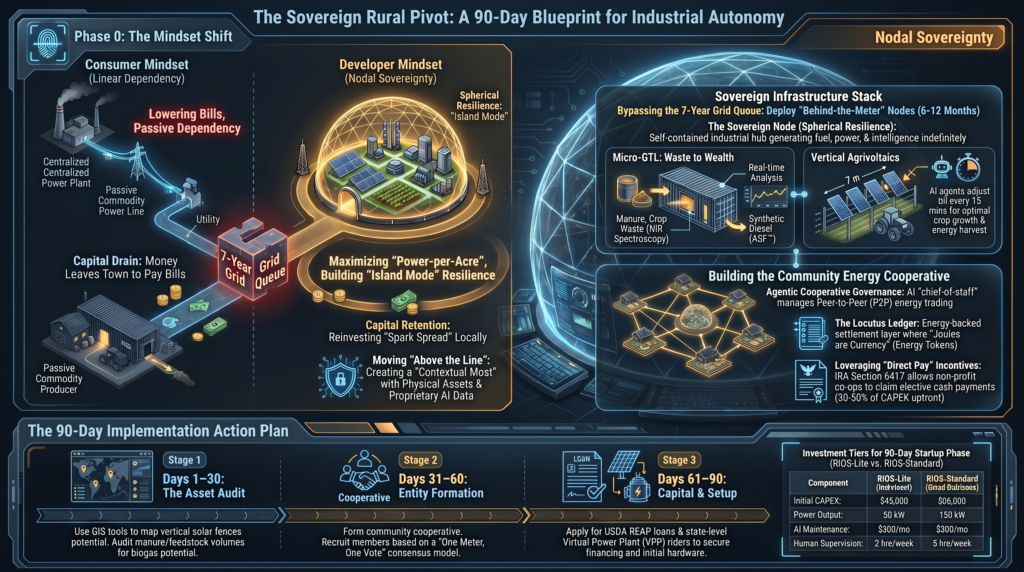
Modern industrial civilization is currently defined by “The Line”—centralized, linear, and fragile corridors of power, data, and logistics. This system is increasingly prone to “operational sclerosis” and catastrophic failure. DeReticular and its division, Agra Dot Energy, are engineering a structural inversion of this model, transitioning rural America from the “tail end” of the grid to a decentralized “Above the Line” power center.

The core of this transition is the Sovereign Node, a self-contained industrial hub capable of generating its own power, fuel, and intelligence in “Island Mode.” By leveraging AI-managed biogas, vertical agrivoltaics, and air-gapped edge computing, rural entrepreneurs can bypass 4–7 year grid interconnection queues and transform negative-cost waste into high-margin assets. This strategy shifts the rural participant from a “Consumer Mindset” (paying utility bills) to a “Developer Mindset” (building sovereign infrastructure).

Critical Takeaways:

  • Grid Bypass: Nodes operate “Behind-the-Meter,” allowing for deployment in 6–24 months compared to the multi-year wait for centralized utility approval.
  • Economic Arbitrage: Capturing the “Spark Spread”—the difference between low-cost on-site production (0.04/kWh) and retail grid prices (0.12+/kWh).
  • Technological Sovereignty: Using RIOS (Rural Infrastructure Operating System) and air-gapped AI agents to ensure operational continuity without dependency on hyperscale cloud providers.
  • Financial Innovation: Utilizing Node-as-a-Service (NaaS) and IRA “Direct Pay” incentives to overcome high initial CAPEX barriers.

——————————————————————————–

video

1. Core Philosophy: The “Death of the Line”

The current centralized energy and data model is viewed as a liability. DeReticular’s mission is to replace these fragile systems with “Spherical Resilience.”

  • Linear Dependency: A state where operations fail if the external network (power lines, fiber, or cloud) is interrupted.
  • Spherical Resilience: The ability of a node to function as a self-contained orb of production.
  • “Above the Line” Positioning: As raw AI becomes a commodity, value moves into “context-deep” industries. By integrating hardware with proprietary rural data, these nodes create a “contextual moat” that centralized organizations cannot penetrate.

——————————————————————————–

2. The Sovereign Energy Stack: Agra Dot Energy

The energy infrastructure, branded as “The Heart,” focuses on converting underutilized or negative-cost feedstocks into reliable baseload power and synthetic fuels.

Micro-GTL (Gas-to-Liquids) Units

  • Function: Modular reactors roughly the size of a shipping container that use plasma gasification (exceeding 1,500°C) to process biomass, manure, and plastics.
  • Outputs:
    • Syngas: Burned for 24/7 baseload electricity.
    • ASF™ (Agra Synthetic Fuel): Local diesel and jet fuel for independent mobility.
  • Key Technology: NIR Spectroscopy sensors analyze feedstock in real-time to optimize methane yield, typically boosting output by 30–43%.

Vertical Agrivoltaics (“Dual-Harvest”)

  • Design: Bifacial solar panels installed in vertical “fences” with 7-meter spacing to allow standard agricultural machinery (tractors/combines) to pass through.
  • AI Management: Dynamic tracking adjusts panel angles every 15 minutes to balance energy harvesting with the light requirements of crops (wheat, soy, corn).
  • Efficiency: Bifacial panels capture ground-reflective light, performing approximately 15% better than fixed systems during winter months.

——————————————————————————–

podcats

Sovereign Infrastructure and the Rural Power Hub Revolution

3. Sovereign Automation: The Digital Infrastructure

Sovereign Automation provides the “Digital Flywheel” required to manage complex hardware without constant human presence or internet connectivity.

RIOS (Rural Infrastructure Operating System)

RIOS is an air-gapped kernel that governs the logic of the node. It manages the “Spark Spread,” deciding whether to direct energy toward power generation, fuel synthesis, or edge compute hosting based on market rates.

The Agentic Suite (70/30 Rule)

AI agents handle 70% of routine preparatory and maintenance tasks, leaving only 30% for critical human judgment.

  • Field Foreman: Manages machinery diagnostics and maintenance; specifically designed to bypass OEM software “repair locks” (Right to Repair strategy).
  • Vault Warden: Uses rotating LiDAR for 360-degree perimeter security and 2mm precision asset monitoring.
  • Field Medic: An air-gapped diagnostic engine for local community healthcare, ensuring patient records stay local and secure.
  • Sovereign Elector: A verifiable, air-gapped voting system for local governance.

Edge Computing

  • RIOS-CC-1000 Server Clusters: Liquid-cooled hardware racks submerged in dielectric fluid, optimized for heavy AI inferencing.
  • Nomad Link: A Wi-Fi 6E/LoRaWAN mesh canopy that creates a private intranet extending for miles, securing the property against cloud outages.

——————————————————————————–

4. Economic Framework and Revenue Vectors

The transition to a sovereign node creates multiple high-margin revenue streams that traditional farming cannot match.

Primary Revenue Streams

VectorDescription
Spark SpreadArbitraging low-cost local power against high retail utility rates.
Green ComputeRenting out local rack space for secure, sensitive AI data processing.
Synthetic FuelLocalized sales of ASF™ Diesel for agricultural and community use.
Carbon CreditsAutomated blockchain logging of every green kilowatt and carbon avoidance event.

The Locutus Ledger

An energy-backed settlement layer that allows for Peer-to-Peer (P2P) trading of “Energy Tokens.” This creates a local currency backed by physical joules, keeping capital within the rural community rather than allowing it to flee to centralized utilities.

——————————————————————————–

white paper

White Paper: Hardware-Sequestered Edge Compute Nodes Powered by Closed-Loop Thermochemical and Agrivoltaic Microgrids

5. Strategic Gap Analysis: Transitioning to Sovereignty

The move from a “Consumer Mindset” to a “Developer Mindset” faces several structural hurdles that require targeted bridge strategies.

Current State (Linear)Target State (Sovereign)Bridge Strategy
Grid RelianceBaseload AutonomyModular GTL and Agrivoltaic deployment.
Capital FlightLocal Capital RetentionP2P Settlement via Locutus Ledger.
Cloud DependencyAir-Gapped LogicRIOS-managed local compute (Sovereign Sentry).
OEM Software LocksSovereign ForemanAI-driven “Right to Repair” diagnostic overrides.

The Financial Bridge

The high initial CAPEX (45k–250k+) is addressed through:

  • Node-as-a-Service (NaaS): Equipment is leased in exchange for a percentage of the “Spark Spread” revenue.
  • IRA Direct Pay (Section 6417): Non-profit co-ops and municipalities can claim cash payments from the IRS for up to 30–50% of the project cost upfront.

——————————————————————————–

6. Implementation and Scalability

DeReticular targets 50% Year-over-Year (YoY) growth in node deployment.

90-Day Action Plan for Entrepreneurs

  1. Days 1–30 (Asset Audit): Use GIS tools to map feedstock volume (manure/waste) and agrivoltaic potential.
  2. Days 31–60 (Entity Formation): Form a community cooperative and recruit members.
  3. Days 61–90 (Capital & Setup): Secure USDA REAP loans or NaaS financing and begin modular installation.

10-Year Financial Projections (Select Highlights)

  • Year 1: 100 Nodes, $12M Gross Revenue.
  • Year 5: 507 Nodes, $73.5M Gross Revenue (Cumulative ROI: 140%).
  • Year 10: 3,848 Nodes, $711.8M Gross Revenue (Cumulative ROI: 700%).

Conclusion

The DeReticular and Agra Dot Energy ecosystem represents a significant structural inversion of rural economics. By shifting from the “tail end” of the line to a sovereign node, rural stakeholders transform their land into high-density intelligence and energy refineries. This “Node vs. Line” strategy provides a resilient alternative to failing centralized systems, positioning rural America as the strategic high-ground of the 2026 economy.

Beyond the Grid: How 7,000 Acres of Robots and Plasma are Building Africa’s First Sovereign Industrial Oasis

Michael Noel · June 1, 2026 ·

Industrializing a remote frontier like the Karamoja sub-region of Northern Uganda has long been a graveyard for conventional development models. Plagued by grid instability, extreme logistical latencies, and “linear fragility,” the region has remained on the periphery of the global economy. However, a new architecture for industrial resilience is emerging in Kaabong: a “closed-loop” industrial park—Node 4—designed to operate as a self-sustaining island of automation and energy.

The Kaabong Smart Eco-Industrial Park (SEIP) represents a radical departure from centralized infrastructure. Capitalized at $30 million, this 7,000-acre estate is not merely a farm; it is a vertically integrated platform where agricultural biomass serves as the foundational feedstock for renewable electricity, high-margin bioprocessing, and global edge computing. By integrating advanced robotics with plasma gasification and blockchain-verified finance, Node 4 provides a provocative blueprint for “Spherical Resilience”—the ability for industrial nodes to survive and thrive even if national grids or global internet tethers fail.

As we move toward a future of decentralized “Sovereign Stacks,” Node 4 stands as the first terrestrial validation center for an economy that operates entirely in “Island Mode.” Here is how this autonomous estate is rewriting the rules of economic sovereignty.

1. The 100-Day Infinite Loop: Why 40 Acres a Day Changes Everything

Traditional agriculture is defined by seasonal volatility—massive spikes in labor demand during harvest followed by months of idle equipment. Node 4 eliminates this bottleneck through a Continuous Rolling Rotation Model. The 7,000-acre estate is divided into 175 operational blocks of 40 acres each. Because industrial hemp matures in approximately 100 days under equatorial conditions, the system is designed to plant 40 acres and harvest 40 acres every single day of the active season.

By the time the autonomous planting fleet finishes seeding Block 100, the harvesting fleet begins cutting Block 1 on its exact 100-day maturation date. This ensures a steady, unceasing supply of raw material for the on-site processing facilities, maximizing equipment utilization and preventing the “batch-processing” lag that kills agricultural ROI.

“This ensures a continuous daily supply of feedstock to feed the on-site plasma gasification unit and leaf biomass for the extraction loop, maximizing equipment utilization and preventing bottlenecking.” — Industrial Operations & Yield Report

Deck

https://academy.dereticular.com/wp-content/uploads/2026/06/The_Kaabong_Perpetual_Engine.pdf

2. From Swarms to Sentry AI: The Autonomous Workforce

Autonomy at Node 4 is not merely about labor replacement; it is about Input Precision and 24/7 operational capability. The estate utilizes a decentralized swarm of specialized robots to manage the unique challenges of industrial hemp, which is notoriously difficult to process due to its high-tensile fiber.

  • The Planting Swarm: Two 120 HP Sabanto-retrofitted electric/diesel hybrid tractors pull 20-foot pneumatic air seeders. Guided by GPS-RTK towers with sub-centimeter accuracy, they complete the daily 40-acre block in under two hours, reducing seed overlap waste by 8%.
  • The Custom Harvester: A Class 7 rotary combine, equipped with a 30-foot draper header, is modified with an “under-scythe” cutter. While the top header collects foliage, the secondary bar cuts the stalks at four inches above the soil, laying them flat for retting.
  • The Kaabong Kars: A fleet of 20 rugged, autonomous electric UTVs handles field-to-facility hauling, transporting fresh material to processing loops using the Node 6 autonomy stack.
  • The Grain Weevils: Inside the drying silos, these auger-propelled robots are safety-critical. They maneuver across the grain to level the pile and break up crust layers, preventing the biological fermentation that causes moisture-driven spontaneous combustion.
  • Sovereign Sentry AI: Edge-based computer vision manages a “15-meter safety envelope” around all machinery, allowing robots to operate among livestock and personnel without human oversight.
Project Umoja Kaabong Joint Venture and Capital Structuring Report

3. Plasma Gasification: Generating 7 Megawatts of “Island” Power

At the heart of the facility’s energy sovereignty is a 210 Tons Per Day (TPD) plasma gasifier. Operating independently of the national utility grid, this system converts woody agricultural waste into synthesis gas (syngas) and a vitrified slag used in construction.

Under an “Energy-Focused Max” configuration (Scenario A), 128 dry tons of hemp stalks are fed into the gasifier daily. With a heating value of 6,500 BTU/lb and a 35% thermal-to-electrical efficiency, this generates approximately 170,000 kWh per day—a 7.11 MW continuous power output. This baseload power is sold to the on-site UCC-1 compute cluster at a fixed, low-cost energy tariff of $0.07/kWh, ensuring an 83% EBITDA margin for global AI training workloads.

“The 210 TPD Plasma Gasification Unit is the ‘engine’ of the ecosystem… providing 101% of the gasifier’s wet-basis intake capacity from a 40-acre-per-day harvest.” — Business Plan: Kaabong Agro-Energy

4. The Lotion Pipeline: Scaling Beauty to 3 Million Bottles Daily

The economic density of Node 4 is achieved through “Agile Reconfiguration.” When the park shifts to a “Balanced Dual-Purpose” model (Scenario C), it prioritizes high-margin bioprocessing. In this mode, the daily 40-acre harvest yields 100 wet tons of foliage.

This biomass is fed into a continuous-flow chilled ethanol extraction loop, yielding approximately 750 gallons of crude cannabinoid oil every 24 hours. Given a formulation of 500 mg of active extract per 2 oz bottle, this single estate can produce 3.15 million bottles of topical lotion every day. By converting a raw crop into a pharmaceutical-grade consumer product on-site, the park captures the entire value chain before a single truck leaves the gate.

5. The “Sovereign Bank”: Bypassing Wall Street with Math

A major friction for remote projects is the “Oracle Problem”—the difficulty in proving to a lender thousands of miles away that a harvest actually occurred. Node 4 solves this by becoming a “Sovereign Bank” using Digital Twin Dynamic NFTs and Zero-Knowledge Proofs (ZKPs).

The RIOS Pilot Command Center captures real-time telemetry from flow meters, scale sensors, and energy logs. This data is cryptographically hashed into a digital twin classified under UCC Article 12 as a Controllable Electronic Record (CER). This legal status, combined with CFTC Letter No. 25-39, allows institutional clearers to accept these tokenized real-world assets as eligible margin collateral in derivatives markets. Global lenders take “cryptographic control” of the harvest or energy, bypassing traditional banking latencies and releasing credit in seconds via compliant stablecoins.

6. The Vanguard Pivot: From Industrial Engine to “Sovereign Oasis”

In March 2026, the project underwent a strategic shift known as the Vanguard Pivot. While the heavy industrial blueprints for 7.11 MW power and 3.1 million bottles remain legally preserved and ready for activation, logistical latencies led to the re-scoping of Node 4 as a “Sovereign Oasis.”

Today, the site serves as a high-value validation center for “Spherical Resilience.” It functions as an off-grid hospitality and eco-tourism retreat where network stakeholders experience 99.9% uptime independent of the national grid. It is a live showcase for the “Sovereign Stack”—a modular, air-gapped system of AI agents (like the Sovereign Sentry) and mesh networking that can survive even if the global internet goes dark.

7. A Provocative Glimpse of the Future

The lessons learned in the Karamoja highlands are already being exported beyond Earth. The terrestrial testing of these autonomous systems and power-balancing algorithms has paved the way for Sovereign Space Systems, a pipeline adapting the “Sovereign Stack” for the Lunar Adaptation Pipeline. The same robots managing hemp silos in Uganda are providing the data necessary for off-world agricultural economies.

As centralized cities and national grids face increasing strain, Node 4 suggests a different path forward. The future of human infrastructure may not lie in bigger, more connected centers, but in these autonomous, self-sustaining “islands of resilience.” If a 7,000-acre estate in one of the most remote corners of Africa can operate as its own energy utility, digital cloud, and bank, the question is no longer if we can live off-grid—but how fast the rest of the world will adopt the Sovereign Stack.

Architecting the Sovereign Stack: A Guide to Resilient IoT Connectivity

Michael Noel · May 28, 2026 ·

As a Solutions Architect, I’ve watched the industry move through cycles of extreme centralization. For years, the “Cloud-First” mantra dominated, but we are now entering the era of the Sovereign Stack. This shift is driven by a hard reality: legacy infrastructure is fragile, and the move from centralized clouds to the Sovereign Edge—often referred to as “Island Mode”—is no longer optional for critical systems.

——————————————————————————–

NextG Funding Pathways

1. The Evolution of Connection: From Centralized Clouds to Sovereign Stacks

The decommissioning of 2G and 3G networks is a technical imperative. These legacy networks were built on a centralized paradigm that relied on trust in the carrier core, but they are plagued by three fundamental cryptographic and physical vulnerabilities that modern standards must resolve:

  • Unidirectional Authentication: 2G/3G networks authenticate the device, but the device cannot verify the network. This allows attackers to deploy IMSI Catchers (Stingrays) to intercept unencrypted traffic.
  • Weak Encryption: Legacy ciphers like A5/1 are trivial to crack with modern commercial hardware, exposing sensitive data in real-time.
  • Lack of Integrity Protection: Older protocols do not secure the data itself, leaving telemetry open to manipulation before it reaches the end user.

For the modern architect, transitioning to modern 3GPP standards isn’t just about higher throughput; it’s about Sovereign Resilience. By implementing Mutual Authentication and SUPI-to-SUCI encryption, we can build infrastructure that remains secure and functional even when external internet backhaul is severed.

Successfully navigating this transition requires choosing the right tool from the modern 3GPP hierarchy, as each protocol offers a different balance of power, range, and bandwidth.

——————————————————————————–

2. The 3GPP Connectivity Hierarchy: Choosing Your Tool

Selecting the physical wireless link is an exercise in constraint management. We categorize these protocols based on their specific utility within the Sovereign Stack.

Comparative Protocol Analysis

Technical MetricNB-IoT (Narrowband IoT)LTE-M (enhanced MTC)5G RedCap (Release 17)5G eRedCap (Release 18)
Bandwidth180 kHz1.4 MHzUp to 20 MHz (FR1)5 MHz (FR1 only)
Max Downlink Rate~120 kbps~1 MbpsUp to 150 MbpsUp to 10 Mbps
Max Uplink Rate~160 kbps~1 MbpsUp to 50 MbpsUp to 10 Mbps
Latency1.6s to 10s50 ms to 100 ms10 ms to 50 ms20 ms to 100 ms
Voice (VoLTE/NR)NoYesYesYes
Relative CostLow (~3–5)Mid-Low (~7–12)Moderate (~15–25)Mid-Low (~$10)

In the field, there is no “best” protocol—only the right one for your operational constraints. A subterranean sensor doesn’t need the 150 Mbps downlink of 5G RedCap, just as a tele-operated drone cannot survive the 10-second latency of NB-IoT.

Understanding these high-level metrics is only the first step; to truly design for resilience, we must understand the underlying physics of how these signals propagate through hostile environments.

——————————————————————————–

3. The Physics of Range: Penetration vs. Performance

In wireless design, the “range” is governed by the Maximum Coupling Loss (MCL)—the maximum signal loss a system can tolerate while maintaining a link.

The Narrowband Advantage

NB-IoT achieves an exceptional 164 dB MCL, significantly outperforming LTE-M (155.7 dB) or 5G RedCap (143 dB). This is achieved through the physics of Power Spectral Density (PSD). The relationship is expressed as:

PSD \propto \frac{P}{B}

(Where P is transmit power and B is channel bandwidth)

By concentrating all available transmit power into an ultra-narrow 180 kHz pipe, the signal gains the “density” required to punch through concrete walls, soil, and subterranean vaults. Think of it as the difference between a garden hose and a pressure washer; the narrow stream carries the force necessary to reach locations that wider signals simply cannot penetrate.

The 5G “Structural Penalty”

While 5G RedCap is significantly faster, it carries a 3–4 dB structural coverage penalty. Standard 5G devices utilize four receive (RX) antennas for spatial diversity. To reduce cost and footprint, RedCap scales this down to one or two antennas. This makes the device less “sensitive” at the cell edge, potentially leading to dropped connections in environments where an NB-IoT sensor would remain rock-solid.

Understanding these physical constraints allows us to evaluate how these protocols perform in diverse, real-world operational environments like the open field or the dense city.

——————————————————————————–

4. Protocol in Practice I: Precision Agriculture (Sovereign Harvest)

In a “Sovereign Harvest” deployment, the farm acts as its own private telecom operator. This architecture utilizes a tiered approach: Wi-Fi 6E mesh points create a high-speed intranet canopy over the fields, while LoRaWAN towers provide long-range, low-power coverage for simple sensors.

The “Tractor-as-a-Relay” Concept

A major challenge in rural deployments is the “dead zone”—valleys or dense foliage where towers can’t reach. The Nomad Series fleet kits solve this by turning heavy machinery into mobile data hubs.

  • Seamless Mobility: Because LTE-M supports Full Seamless Handovers, a tractor can maintain a real-time telemetry link while moving between towers. NB-IoT, by contrast, is limited to Re-selection, meaning it must drop and re-establish its connection if it moves too far.
  • The Relay Mechanism: When a vehicle enters a dead zone, the Nomad kit caches sensor telemetry locally. Once the vehicle returns to the Wi-Fi mesh canopy, it automatically relays that data to the central server.
  • Sovereign Control: Critically, these Nomad kits interface directly with the CAN Bus and ISOBUS ports of heavy machinery. This enables Right-to-Repair by allowing farmers to clear error codes and manage diagnostics locally, bypassing proprietary manufacturer software locks.

This move toward local infrastructure ensures the harvest continues even if the global internet fails. This same need for resilience extends to the complex, high-density environments of our modern cities.

——————————————————————————–

5. Protocol in Practice II: Smart Cities and Disaster Resilience

In the “City-in-a-Box” model, municipalities use a City Infrastructure Nexus to manage critical services like healthcare and water management locally.

Network Slicing and the Carrier-Tethered Trap

A defining feature of 5G Standalone (5G SA) architectures is Network Slicing. This allows a city to partition a single physical network into virtual lanes:

  1. High-Priority Slice: Low-latency, guaranteed bandwidth for emergency services.
  2. Low-Priority Slice: Best-effort lanes for non-critical utility meters.

However, architects must be wary of the “Carrier-Tethered Trap.” Standard NB-IoT is structurally designed to operate on centralized carrier networks. If the carrier’s cloud goes down, the NB-IoT devices fail. To achieve true “Island Mode” survivability, cities are increasingly deploying private 5G gNodeB units using open-source stacks like Open5GS. This allows the city to maintain a fully private, air-gapped Sovereign Stack that functions during a total internet blackout.

As we master these current protocols, we are already seeing the next frontier where wireless signals do more than just carry data.

——————————————————————————–

6. The Future Frontier: 6G and Spatial Sensing

The transition to 6G introduces Integrated Sensing and Communication (ISAC). In this paradigm, wireless signals act as a radar-like sensor network, enabling high-precision spatial awareness without cameras.

This is achieved through CSI (Channel State Information) Matrix Extraction, where the distortion of signals bouncing off objects is analyzed in four steps:

  1. Extraction: Capturing the raw CSI matrix (H_i) from the signal preamble.
  2. Sanitization: Using software algorithms (like Principal Component Analysis) to clean hardware noise.
  3. Geometrical Modeling: Applying ray-tracing models to solve for multipath components: V = \sum_{n=1}^{N} \|V_n\| e^{-j\phi_n}
  4. Edge Inference: Using deep learning models to recognize patterns, such as a person falling or a change in respiration.

This “magical” insight turns the wireless signal itself into a sensor, allowing a room to “sense” inhabitants without compromising privacy through video. This reinforces the need for Sovereign infrastructure: as our networks become our eyes and ears, we must ensure they remain under our local control.

——————————————————————————–

7. Summary Comparison: The Learner’s Cheat Sheet

Protocol NamePrimary “Superpower”The “Cost of Admission”Real-World Example
NB-IoTDeep Penetration: Punches through walls and soil via high PSD.Extremely slow; limited mobility (re-selection).Subterranean Water Meter
LTE-MVoice & Mobility: Supports full seamless handovers.Higher power consumption than NB-IoT.Autonomous Tractor Telemetry
5G RedCapSpeed & Slicing: High data rates with priority lanes.Expensive; 3–4 dB structural coverage penalty.Municipal Emergency Grid
LoRaWANUltra-Long Range: Miles of coverage with minimal power.Minimal data throughput; no high-speed video.Field Soil Moisture Sensors

Power, Range, and Bandwidth exist in a zero-sum game. In the reality of a Link Budget, you cannot maximize all three. To gain Range, you must sacrifice Bandwidth. To gain Bandwidth, you must sacrifice Power (battery life). A master architect is someone who knows exactly which one the project can afford to surrender.

  • « Go to Previous Page
  • Page 1
  • Interim pages omitted …
  • Page 6
  • Page 7
  • Page 8
  • Page 9
  • Page 10
  • Interim pages omitted …
  • Page 55
  • Go to Next Page »

DeReticular

Copyright © 2026 · Monochrome Pro on Genesis Framework · WordPress · Log in