Moving Minds: A Beginner’s Guide to Physical AI
1. The “Kinetic” Shift: What is Physical AI?
For decades, artificial intelligence has been a “brain in a jar”—a brilliant but paralyzed observer trapped behind digital screens and stationary servers. It could analyze data or generate text, but it couldn’t reach out and touch the world. Physical AI marks the moment that intelligence becomes kinetic. It is the transition from AI that merely “chats” to AI that moves, lifts, builds, and navigates the “cold steel” of our physical reality.
The “So What?”: Why does moving from screens to steel change the world? Because digital-only AI is an observer, but Physical AI is a participant. When intelligence is no longer tethered to a cloud, it can rebuild infrastructure, manage energy, and provide care autonomously. This shift moves us from a world of information to a world of autonomous action.
To make an AI move, we cannot rely on code alone. We need a “physical container”—a laboratory where digital logic is forged into machinery.
2. The Builder’s Laboratory: Where Digital Meets Steel
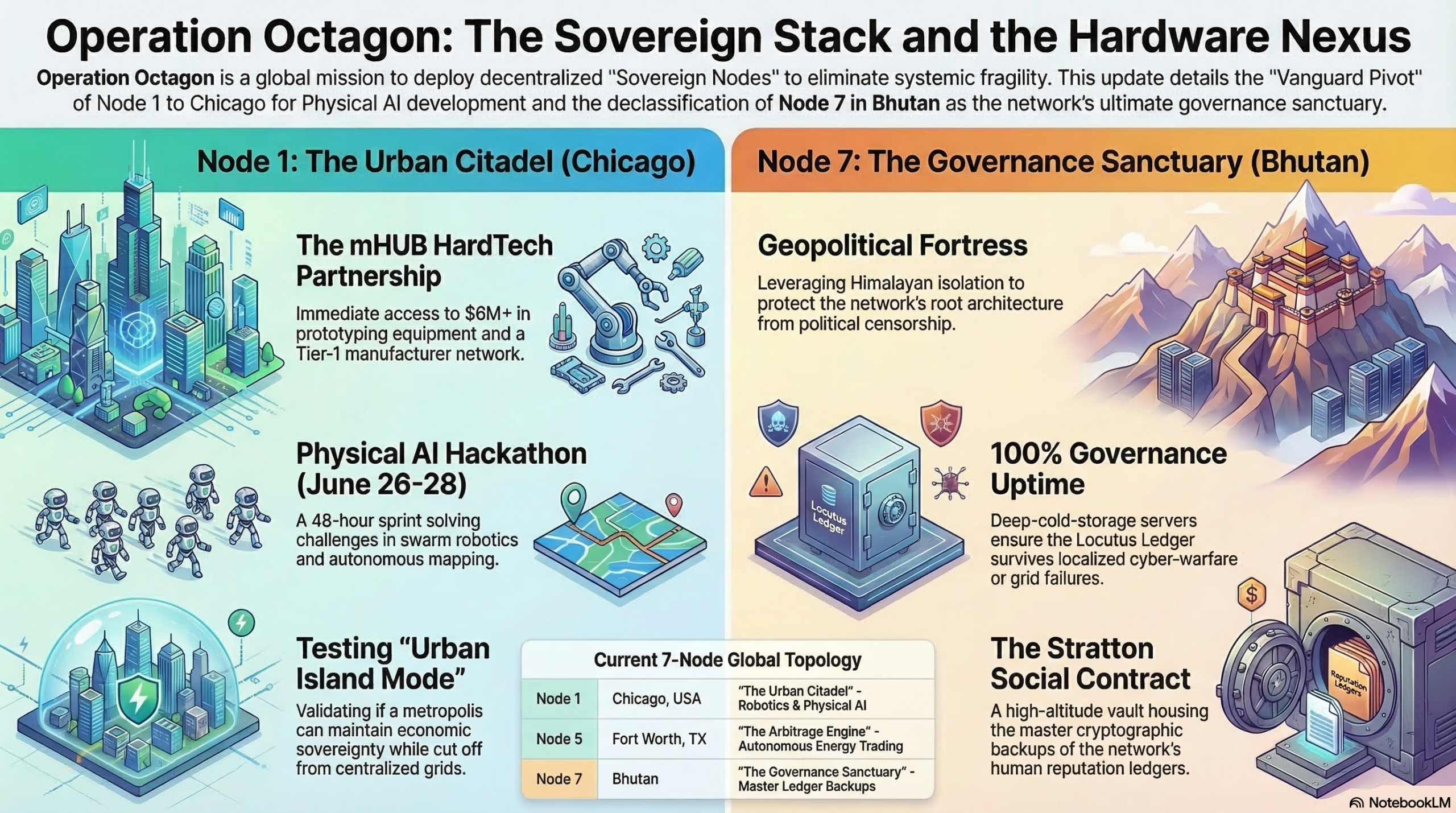
In the domain of “HardTech,” innovation requires more than just a laptop; it requires heavy industrial gear and a high-trust network. mHUB, Chicago’s premier innovation center, serves as the physical anchor for Node 1 (The Urban Citadel). It is the world’s epicenter for sovereign robotics, where the digital ledger meets the reality of manufacturing.
For the beginner, a HardTech hub provides the essential “Hardware Arsenal” to bridge the digital-to-physical gap:
| Resource | Primary Benefit for the Learner |
| Prototyping Equipment | Access to $6M+ in gear (3D printers, CNC mills) to turn Wasm smart-contracts into physical joint movements. |
| The Talent Router | Connection to an elite network of builders and experts from institutions like MIT, UChicago, Purdue, and Northwestern. |
| Builder Kits | Access to Sovereign Keys and localized edge-compute boards to begin building the “Sovereign Stack.” |
| Tier-1 Manufacturer Links | Direct channels to partners like Baxter and Schneider Electric to scale a prototype into a fleet. |
Once you have the steel, you need the “nervous system” to make the machine think and act without a leash.
3. The Brains of the Machine: Sentry and Foreman
Physical AI requires a radical departure from traditional “Cloud AI.” To operate safely, a robot must be sovereign—meaning it cannot rely on a distant server that might fail. DeReticular provides the two-part “brain” for these machines:
- Sovereign Sentry (The Secure Brain): This localized server acts as the robot’s mind. Its core feature is “Island Mode.” Unlike “Cloud Dependency”—where a robot “dies” if AWS or Google goes offline—a machine in Island Mode remains fully operational and secure from external cyber-warfare. It is off-grid, autonomous, and untouchable.
- Industrial Foreman (The Physical Executor): If the Sentry is the “brain,” the Foreman is the “motor cortex.” This agent translates high-level logic into physical reality, routing power via industrial protocols and ensuring the machine moves its joints within safe thermal limits.
When a single robot is sovereign, the next hurdle is teaching it to play well with others in a complex environment.
4. Three Great Challenges: Making AI Play Well with Others
Building a machine that moves is only the beginning. To be useful, Physical AI must overcome three primary “HardTech” hurdles:
- Swarm Coordination
- Getting multiple robots to work together (e.g., transport or assembly) without a “Centralized Wi-Fi” master. They must communicate via decentralized edge-networks to ensure coordination even in interference-heavy environments.
- Autonomous Mapping (The “Vault Warden” Protocol)
- Robots must “see” a room and understand it. Using onboard sensors, they create semantic maps that label obstacles and humans, mimicking the Vault Warden security protocols used to protect high-value facilities.
- Human-Robot Collaboration (“Cobots”)
- This is about intuition. A “cobot” must learn to adapt to human gestures, speed, and unpredictable behavior, ensuring it can work alongside people in a workshop without causing accidents.
Solving these challenges allows us to deploy Physical AI to solve human problems in the real world.
5. Real-World Impact: Mobility and Beyond
Physical AI isn’t a future concept; it is already being deployed across the global mesh to defeat “Linear Fragility”—the tendency of centralized systems to fail under stress.
Node 6: The Circulatory System (Arizona) In La Paz County, Physical AI powers Sovereign Mobility. Using edge-based AI dispatching, autonomous systems provide Non-Emergency Medical Transportation (NEMT), ensuring people with disabilities have reliable, off-grid movement.
Node 4: The Sovereign Oasis (Uganda) In the African theater, Physical AI manages high-value eco-tourism and hospitality. These off-grid retreats use decentralized mesh networks to remain connected and operational, regardless of local infrastructure stability.
These machines provide the ability for goods and people to move freely, but they require a safety net to ensure they remain helpful.
6. The Safety Net: Governance and the Ledger
Because moving machines carry real-world risks, they must be governed by immutable “laws.” Physical AI uses a decentralized governance structure to prevent misuse.
- The Locutus Ledger: A cryptographic record that tracks every action a machine or builder takes. This creates an “immutable resume” and ensures total accountability for everything built within the network.
- Node 7: The Governance Sanctuary (Bhutan): Located in the geographically isolated Himalayas, Bhutan serves as a geopolitical and digital fortress. It houses deep-cold-storage clusters that protect the “Stratton Social Contract”—the master blueprints for how these robots must behave. Even if an urban center faces a total cyber-attack, the “roots” of the system remain safe in the sanctuary.
3 Things to Remember About Physical AI Safety:
- Island Mode is Sovereignty: Off-grid operation is the only way to ensure a robot cannot be hacked or disabled by a centralized authority.
- Linear Fragility is the Enemy: Centralized systems are fragile; decentralized Physical AI is resilient and “spherical.”
- The Ledger is Law: The Locutus Ledger ensures that the “Stratton Social Contract” is enforced by code, not just promises.
7. Summary: Joining the Revolution
Physical AI is more than just robotics; it is the ultimate manifestation of the Sovereign Stack. We are graduating from a world where intelligence is a tool we use on a screen to a world where intelligence is a kinetic force that builds, protects, and moves us.
We are no longer just writing software; we are building the machines that will build the future.