Navigating the Decentralized Web: A Learner’s Guide to Hyphanet and the New Freenet
Navigating the Decentralized Web: A Learner’s Guide to Hyphanet and the New Freenet
1. The 2023 Fork in the Road: Understanding the Rebrand
For over two decades, the name “Freenet” was the gold standard for digital privacy. However, in March 2023, the project reached a historic crossroads, resulting in a split into two distinct paths. Ian Clarke, the original founder of the project, now leads the development of the “New” Freenet, while the original codebase continues under a new identity to avoid confusion for users navigating old bookmarks.
The primary domain and name changes are as follows:
- Hyphanet (hyphanet.org): Formerly located at
freenetproject.org, this is the continuation of the “Classic” Java-based project. - Freenet (freenet.org): The “New” branch, originally developed under the codename Locutus, representing a ground-up rewrite of the protocol.
Core Mission Shift: While the classic project was built for “static anonymity” (protecting identity while sharing files), the new project aims to become a “global shared computer”—a decentralized replacement for the modern web that supports real-time, programmable applications.
While these two branches share a common lineage and a commitment to freedom, their underlying “DNA” has diverged into two entirely different species of technology.
——————————————————————————–
2. Hyphanet: The Battle-Tested Guardian of Anonymity
Hyphanet is the “Classic” branch, a mature, Java-based architecture refined since 2000 to prioritize the shielding of users from censorship. It is accessed primarily through FProxy, a web interface that allows users to browse the network using a standard web browser.
Core Features of Hyphanet:
- Darknet vs. Opennet Modes: Users can build a “Darknet” by connecting only to trusted friends for maximum security, or use “Opennet” to automatically connect to any available node.
- Freesites: These are decentralized websites hosted within the network. Because data is fragmented and encrypted across many nodes, these sites are virtually impossible to take down.
- High-Capacity Archiving: When deployed on enterprise-grade hardware like a RIOS node, Hyphanet utilizes a massive 8TB NVMe datastore. This allows for “deep archiving,” ensuring that critical data remains available to a local community even if the external satellite uplink is severed.
3 Primary Benefits for the Privacy-Conscious:
- Whistleblowing & Journalism: Providing a secure, paper-trail-free platform for sharing sensitive documents.
- Censorship-Resistant Storage: Hosting permanent libraries of medical guides or wikis that survive political upheavals.
- High-Level Anonymity: Utilizing a routing algorithm that obscures both the origin and destination of every piece of data.
While Hyphanet is the gold standard for anonymity, it is notoriously bandwidth-intensive and can be slower than the traditional web, creating a performance gap that the new branch seeks to bridge.
——————————————————————————–
3. The New Freenet: A High-Speed Kernel for Dynamic Apps
The new Freenet (formerly Locutus) is a ground-up rewrite in Rust designed for speed and scalability. It moves away from simple file storage toward a “distributed database” model capable of hosting the modern, interactive web.
The Wasm Advantage
The defining innovation of the new Freenet is the use of WebAssembly (Wasm) Contracts. Rather than just storing a static file at a specific address, the network uses smart contracts to enforce rules. This makes the network programmable—allowing the system to define exactly how data is updated, validated, and shared.
The “So What?” of Commutative Monoids (CRDTs) To enable real-time interactivity without a central server, Freenet uses Conflict-free Replicated Data Types (CRDTs). In plain English, this advanced math allows multiple users to update an app (like a chat room) simultaneously. The network merges these updates automatically and correctly without needing a central coordinator, solving the “simultaneous update” problem that typically breaks decentralized applications.
The “River” Proof-of-Concept The primary demonstration of this speed is River, a decentralized group chat application. Unlike classic chat tools, River has no login servers or central databases; it demonstrates that Freenet can handle real-time communication with the responsiveness users expect from the “Clear Web.”
As we look at these two technologies side-by-side, it becomes clear that they are not competitors, but complementary tools in a modern toolkit.
——————————————————————————–
4. Head-to-Head: Comparing the Two Branches
| Feature | Hyphanet (Classic) | New Freenet (Locutus) |
| Primary Goal | Extreme anonymity & static storage | Scalable platform for decentralized apps |
| Language/Tech | Java & Encrypted File Stores | Rust & WebAssembly (Wasm) Contracts |
| Maturity | Mature (Stable since ~2008) | Experimental / Alpha (Active Dev) |
| Content Type | Static (mostly “Freesites”) | Dynamic (Real-time chat, social feeds) |
| Primary Use Case | Whistleblowing, deep archiving | Dynamic DApps, real-time communication |
These technologies are currently being deployed together in the field to create a “Sovereign Edge” architecture for remote communities.
——————————————————————————–
5. Practical Application: The RIOS “Sovereign Stack” Example
The Rural Infrastructure Operating System (RIOS) uses a “dual-stack” approach to provide both industrial utility and digital freedom.
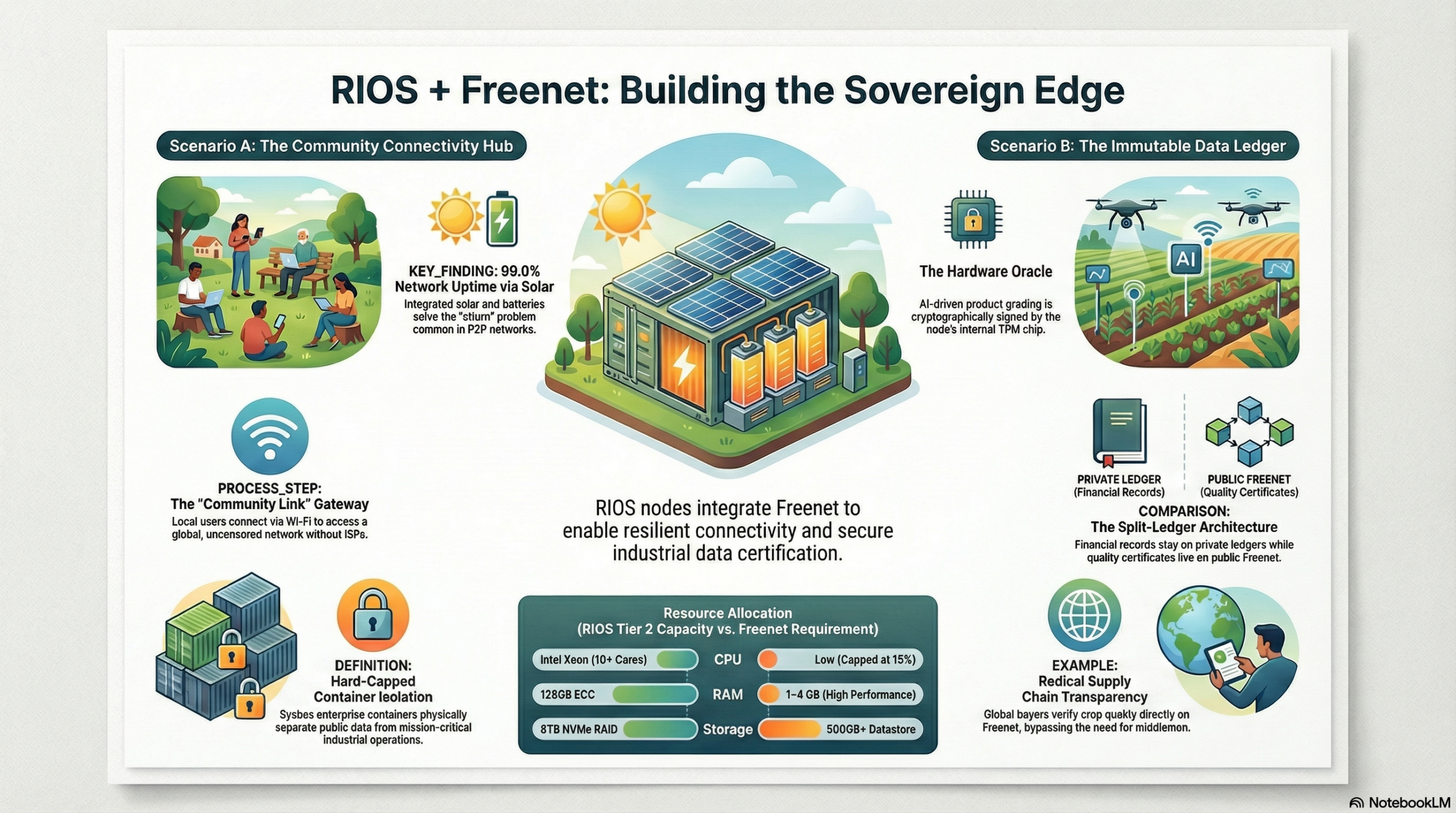
- Scenario A (Infrastructure/Communication): The node runs Hyphanet to provide a “Community Link” via a ruggedized outdoor Access Point. Local users connect to Wi-Fi to access uncensored news or medical wikis. By navigating to
http://freenet.local:8888, they can browse the network through their standard mobile browser without installing extra software. - Scenario B (Data Interoperability): The node uses New Freenet’s Wasm contracts for “HempGrade” data transparency. When the node’s AI grades agricultural hemp, it pushes that data to a Freenet contract.
The Hardware Oracle and Isolation To ensure the data is trustworthy, the RIOS node acts as a Hardware Oracle. It uses a TPM 2.0 (Trusted Platform Module) to cryptographically sign grading data with a private key stored in the physical hardware. This prevents “Garbage In” attacks, proving the data came from a specific, untampered sensor at a specific time.
The node maintains “hard” isolation between these layers using Sysbox Enterprise. This container runtime ensures that public Freenet traffic is physically and logically jailed away from the regulated financial ledgers.
Operational Workflow for a RIOS User:
- Connection: User joins the local Wi-Fi hotspot (SSID:
RIOS_Free_Link). - Authentication: For secure tasks, the operator uses a physical YubiKey to access the [SECURE_ZONE] container.
- Access: The user opens their browser to the local gateway address to access the global Freenet swarm or view the immutable “HempGrade” certificates.
——————————————————————————–
6. Your Path Forward: Choosing the Right Tool
Choosing between these branches depends on your specific mission in the decentralized ecosystem:
- IF you need high-level anonymity for publishing static documents or maintaining a deep archive of information… THEN choose Hyphanet.
- IF you want to build or use dynamic, real-time apps like decentralized chat or transparent supply-chain tracking… THEN choose Freenet.
For those using RIOS hardware, the “Sovereign Net” toggle in the dashboard represents the literal on-switch for these capabilities. By integrating these tools, we move closer to the philosophy of “Civilization in a Box”—providing individuals and communities the sovereignty to own their power, their data, and their voice.